Genre: Occult Horror

All Ace Black Movie Blog reviews are here.
Reviews of Classic and Current Movies


In Montana, disgraced former Air Force General Lawrence Dell (Burt Lancaster) breaks out of prison along with convicts Powell, Garvas, and Hoxey (Paul Winfield, Burt Young, and William Smith). They infiltrate and take control of an Intercontinental Ballistic Missile launch site. With his finger on the button that could launch nine nuclear warheads towards the Soviet Union, Dell connects with his former commander General Martin MacKenzie (Richard Widmark) and demands to talk to US President David Stevens (Charles Durning).
Dell wants Stevens to publicly release top secret documents revealing the futility of the Vietnam War. MacKenzie crafts a plan for a military assault on the silo base to end the takeover, while Stevens weighs his options with a group of advisors.
Twilight's Last Gleaming enjoys an impressive-looking set at the silo base, and the opening facility penetration is decent when swallowed with a liberal dose of just-go-with-it. But while a rogue General could have plenty of reasons to initiate global destruction, releasing the minutes of a White House meeting about a past conflict must be close to the bottom of the list. Walter Wager's novel may have worked on paper, but the script by Ronald M. Cohen and Edward Huebsch rarely extracts tension out of the doofus premise, and director Robert Aldrich makes matters worse by extending the exercise to a wholly unnecessary 146 minutes.
Minutiae replaces substance and the pace slows to a crawl. Several sequences consist of Dell and his crew in the launch room waiting for President Stevens and his advisors to make a decision, with MacKenzie playing the role of joker in the pack. Aldrich attempts an artificial injection of energy with overuse of split screens, and twice resorts to prolonged handle-this-gizmo-with-care-or-it-will-explode scenes.Burt Lancaster and Richard Widmark are always watchable and come close to rescuing a few moments. An unlikely choice for President, Charles Durning appears suspicious of his own abilities to convince. He is surrounded by veterans like Melvyn Douglas and Joseph Cotten spouting their lines with earnest plasticity.
The final act throws logic to the wind, the previously cold and calculating Dell succumbing to a bout of idiocy but only after Stevens opts for a ludicrous plan to end the showdown. The plot suddenly veers towards unearned notions of grand self-sacrifice, further hastening Twilight's Last Gleaming's descent into darkness.
All Ace Black Movie Blog reviews are here.
In 1867, outlaw James "Stretch" Dawson (Gregory Peck) leads his gang into a town where they quietly rob the local bank without hurting anyone. The gang members include the cool and detached Dude (Richard Widmark), the ambitious but highly strung Lengthy (John Russell), the noisy Walrus (Charles Kemper), and the young Bull Run (Robert Arthur). Chased by a posse, they escape into a hostile desert.
Suffering dehydration and exhaustion, the gang arrives at the abandoned town of Yellow Sky. The only inhabitants are a young woman named Mike (Anne Baxter) and her Grandpa (James Barton), a prospector. Mike triggers sexual tension among the gang members, while Lengthy and Dude take turns challenging Stretch's leadership. When Dude learns that Grandpa has a stash of gold, Stretch negotiates a share agreement, but greed causes gang rivalries to explode into violence.
Directed by William A. Wellman, written by Lamar Trotti, and inspired by Shakespeare's The Tempest, Yellow Sky enjoys unconventional twists. The absence of a natural protagonist is pleasantly disorienting. Stretch Dawson is an outlaw, and has to work hard to reveal the gradations of good separating him from the other gang members. The settings and terrain are also more mythical than traditional westerns, the narrative seeking mental and physical isolation as triggers for organizational breakdown. The desert crossing sequence is a brutal odyssey across unforgiving land, and at the end of it the ghost town of Yellow Sky is the antithesis of salvation.
A watering hole at the town's edge emerges as the one initially unifying source of life, until a woman, gold, and greed combine to bust up the gang. Mike's male name metaphorically signals she is unaware of her impact on men. Quickly a target of their lust, she also wields power beyond the rifle to influence outcomes.Some of the film's other elements are less refined. The large group of Apaches who ride into town are an unwieldy plot contrivance in the evolution of trust between Stretch and Grandpa. Wellman excels when the pacing is deliberate, but struggles when emotions run high, the scuffling and shootout scenes lacking polish. And the search for gold takes a detour into an unlikely and clumsy mine excavation.
But the aesthetics are always engaging and convey a slightly surreal trapped-in-a-nightmare mood, the black and white cinematography (courtesy of Joseph MacDonald) making excellent use of sparsity to surround Stretch and his men with ramshackle nothingness. And the narrative strengthens with the sturdy character arc navigated by Stretch, Trotti providing him with a background, a reason to reform, and an opportunity to stand by his word and seek redemption. In Yellow Sky, the pathway from money to wealth passes through an arid test of self-reckoning.
All Ace Black Movie Blog reviews are here.
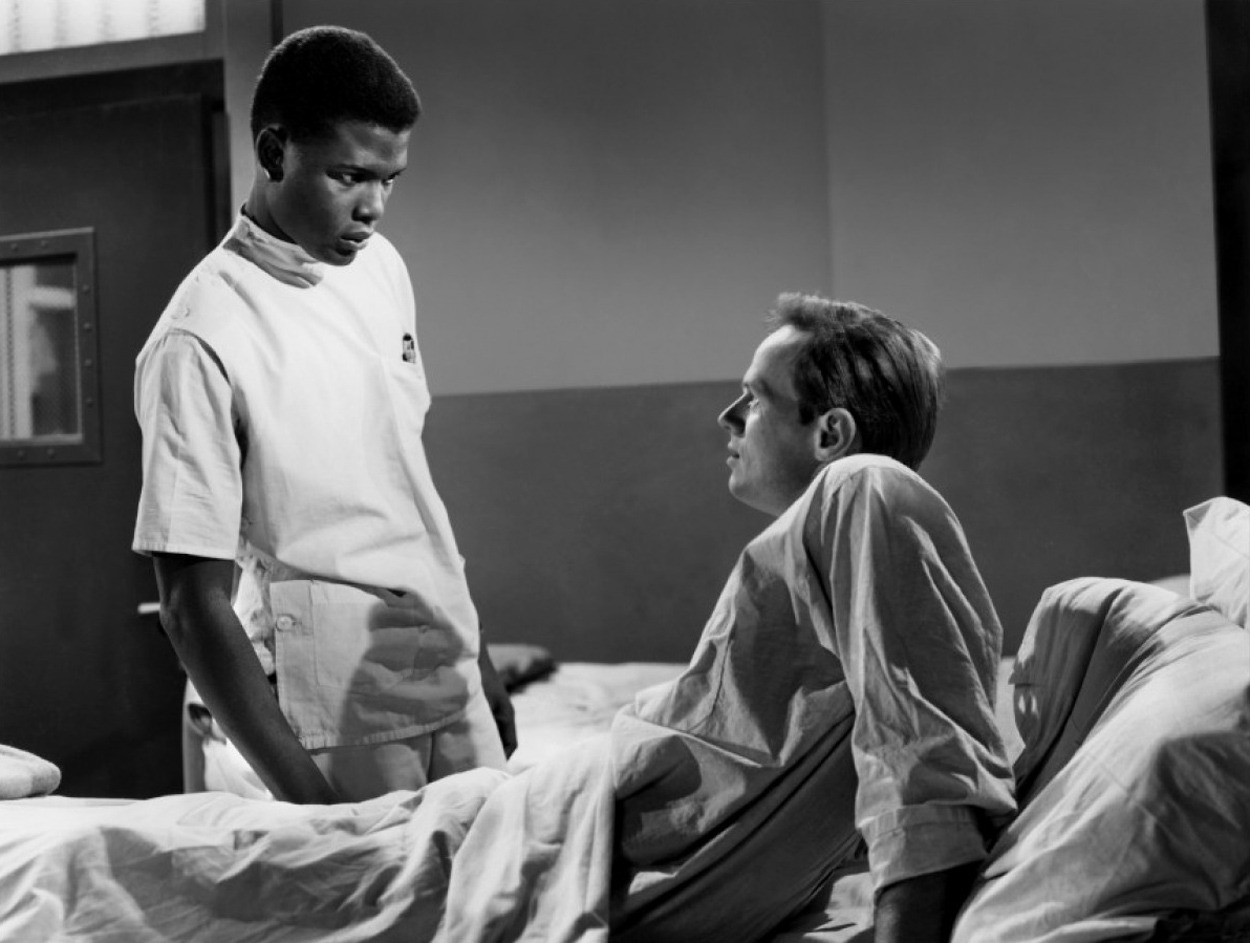
Dr. Luther Brooks (Sidney Poitier) is the first black doctor at a respectable hospital. His mentor Dr. Dan Wharton (Stephen McNally) assigns Luther to the prison ward, where the racist criminal Ray Biddle (Richard Widmark) and his brother Johnny are admitted with gunshot wounds.
Johnny dies while Luther is trying to save his life, but Ray insists his brother was murdered by the doctor and refuses to authorize an autopsy that would prove the cause of death. Luther and Wharton turn to Johnny's ex-wife Edie (Linda Darnell) for help, but she is manipulated by Ray, who wants to spark racial riots between adjacent white and black neighbourhoods.
Sidney Poitier's first major screen role is a powerful, sometimes painful, commentary on poisonous white supremacy. Ray Biddle is a despicable character who makes no attempt to hide his blind hatred of blacks, and in the hands of director Joseph L. Mankiewicz, No Way Out becomes a searing examination of what Dr. Brooks is forced to endure. Despite the robust support of his mentor Dr. Wharton, Luther is surrounded by eyes loaded with suspicion, doubt, or outright contempt.
While always impactful, No Way Out suffers from some needless meandering. The script (by Mankiewicz and Lesse Samuels) goes searching for a larger story about inter-neighbourhood strife in an attempt to expand from the personal to the collective. Scenes of goons from adjacent communities prodded into street battles are impressively staged, but stray away from the compelling central characters and individual conflicts.Better are the representations of Dr. Brooks' home life, and the emphasis on his family's normality. In portraying a black family striving towards the common American dream, Mankiewicz succeeds in isolating Ray Biddle as the outlier somehow expressing contempt for the nation's most admired traits.
Caught in the middle is the character of Edie Johnson, representing internal turmoil between a tainted past and a potentially better future. She intuitively knows she must distance herself from the toxicity of former brother-in-law (and illicit lover) Ray, but is still susceptible to his fake charms and false narratives. Poitier, Richard Widmark, and Linda Darnell add plenty of streetwise grit in the three central roles, investing in deeply uncomfortable and emotionally draining scenes.
Ray and Johnny Biddle have a third brother, the deaf and mute George. He is observant, conniving, and an eager enabler of prejudice, virulent bigotry thriving in the shadow of silence.
All Ace Black Movie Blog reviews are here.
In New York City, detectives Daniel Madigan (Richard Widmark) and Rocco Bonaro (Harry Guardino) are humiliated when fugitive Barney Benesch (Steve Ihnay) slips from their grasp and steals their guns during what should have been a routine arrest. They set out to make amends, contacting Benesch's known associates to track him down.
Meanwhile Police Commissioner Anthony Russell (Henry Fonda) has other problems: he receives proof his long time friend and deputy Chief Inspector Charles Kane (James Whitmore) is on the take, while the distinguished Dr. Taylor (Raymond St. Jacques) is accusing the police department of harassing his Black son.
Madigan is finding it increasingly difficult to manage the expectations of his wife Julia (Inger Stevens), who resents his frequent absences and low salary. Russell is single, but is having an affair with the married Tricia (Susan Clark). Through bookie Castiglione (Michael Dunn) and then part-time pimp Hughie (Don Stroud), Madigan and Bonaro close in on Benesch, but he is determined to evade arrest.
An adaptation of Richard Dougherty's book The Commissioner with a script by Howard Rodman and Abraham Polonsky, Madigan deserves credit for attempting to round the two principal characters into people who have private lives and frustrations beyond solving the crime at hand. And the concurrent stories add a dose of realism, a Commissioner like Russell not afforded the luxury of solving one problem at a time.While the change in title from book to film suggests an increased focus on top-billed Richard Widmark's detective, director Don Siegel still tilts the screen time more towards Henry Fonda's commissioner. In this case, this is not necessarily a good thing, Fonda appearing dour and vaguely disinterested throughout. His multiple worries surrounding the evidence against Inspector Kane, Dr. Taylor's allegations of brutality and racism, and his illicit relationship with Tricia spread the movie too thin. Madigan threatens to drop to the level of a television pilot where future episodes will pick up the many loose threads (a short-lived network series did follow).
Siegel does better foreshadowing 1970s urban grittiness and loose-cannon detectives. Madigan deglamourizes New York City into yellows and browns, the action playing out in back alleys, narrow hallways and nondescript motel rooms. And with Widmark relishing his character's joy at operating just slightly over the line, the film starts and ends with short and sharp bangs, taut encounters with the dangerous Benesch making up for some of the flab in the middle. The police officers may have romantic partners to appease and cocktail parties to attend, but nothing replaces the thrill of the chase.
All Ace Black Movie Blog reviews are here.
Despite a stellar cast, stunning scenery and a potentially intriguing premise, Garden Of Evil stumbles into a narrative morass and withers into insignificance.