Showing posts with label Candice Bergen. Show all posts

Wednesday, 1 July 2026

Movie Review: The Adventurers (1970)


Genre: Epic Drama  
Director: Lewis Gilbert  
Starring: Bekim Fehmiu, Ernest Borgnine, Candice Bergen, Fernando Rey, Alan Badel, Olivia de Havilland, Rossano Brazzi, Leigh Taylor-Young, Charles Aznavour  
Running Time: 177 minutes  

Synopsis: It's 1945 in (fictional) Corteguay, South America. With a violent revolution underway, ten-year-old Dax witnesses rape and slaughter. His nobleman father Jaime Xenos (Fernando Rey) is loyal to revolutionary leader Rojo (Alan Badel), who seizes power but quickly turns to corruption. Jaime is appointed ambassador to Italy, where Dax (Bekim Fehmiu) grows up as a driven young man. With Corteguay again in the grips of revolution, Jaime and Dax return to the country but are manipulated and victimized. Dax retreats to Europe with nothing and starts life over again as a gigolo, intent on achieving wealth to settle scores.

What Works Well: Packed full of incident, characters, and action, this epic and engrossing adaptation of the Harold Robbins novel (inspired by the life of Dominican diplomat and playboy Porfirio Rubirosa) leaves almost nothing out from the book. The scope and scale resemble a David Lean project, but without the polish. Director Lewis Gilbert excels in grand scenes of combat and ceremonial set-pieces featuring armies of extras, and does not flinch from the intense violence and sexual exploits that underpin Dax's emotional detachment. The powerful context nails the futility of caring about a troubled country in a constant state of upheaval, idealism devoured by corruption while the populace endures persistent misery.

What Does Not Work As Well: The editing can be messy, and while the script contains the occasional sparkle, the acting lacks subtlety and most of the the dialogue is obvious. At almost three hours in length, the middle act does drag.

Key Quote: 
President Rojo: A man must use what weapons he has to defend his country, Dax.
Dax: Treachery?
President Rojo: Treachery is a weapon.


All Ace Black Movie Blog reviews are here.

Saturday, 9 April 2022

Movie Review: Let Them All Talk (2020)

A dramedy about friendship, Let Them All Talk is a pleasantly scattered literary sailing.

Alice Hughes (Meryl Streep) is a New York-based prize-winner author. Afraid of flying but invited to receive a prestigious award in London, she decides to cross the Atlantic on the Queen Mary 2. Alice invites her nephew Tyler (Lucas Hedges) to join the trip, along with her two best friends from college days: Susan (Dianne Wiest) now advocates for prisoners' rights, while Roberta (Candice Bergen) is divorced, has a lowly retail job, and is seeking a rich husband. Alice's new agent Karen (Gemma Chan) also makes the trip, desperate to uncover information about her secretive client's latest manuscript.

During the crossing Tyler and Karen start hanging out, while decades of tension surface between Alice and Roberta, who believes she was the subject of her friend's most celebrated book. Susan tries to play peacemaker, Roberta is on the prowl for a rich man, Alice privately works on her new book, and the whole group is intrigued when they spot world-famous crime novel author Kelvin Kranz (Daniel Algrant) among the passengers.

A streamlined production directed by Steven Soderbergh and (loosely) written by Deborah Eisenberg, Let Them All Talk is an honest title. With plenty of improvisation spicing up awkward connections, this is a series of short and bright conversations between interesting characters as a luxury liner powers across the ocean. The spectacular cast is afforded almost free reign to steer scenes, and they deliver natural interactions with enough discipline to maintain coherence, landing short of profound but well above frivolous.

The number of passengers on this particular sailing is suspiciously low (the background is often empty), but the setup is an otherwise snug trip filled with the threat of revelations. Soderbergh served as his own cinematographer and editor, and keeps the scenes sharp. Conversations end without a moment of fat, building a convincing sense of eavesdropping on mid-life luggage with more to the story than these characters will ever be comfortable sharing. The budding but awkward romance between Tyler and Karen mixes well with Alice's haughtiness and layers of passive-aggressiveness harboured by Roberta, but the side-quest involving crime author Kranz is an only partially successful catalyst.

Through the simple premise the film perhaps over-reaches for some lofty themes. Alice is enamored with an obscure Welsh writer, and expresses her admiration with lyrical discourse about the ties that bind across time and generations. Her exploration of the human condition is worthwhile, but also sets her well apart and underlines the disconnect with her friends.

The final act finds bittersweet twists, as Let Them All Talk happily charts a choppy course, the untidy resolutions mimicking life's unscripted surprises.


All Ace Black Movie Blog reviews are here.

Saturday, 29 August 2020

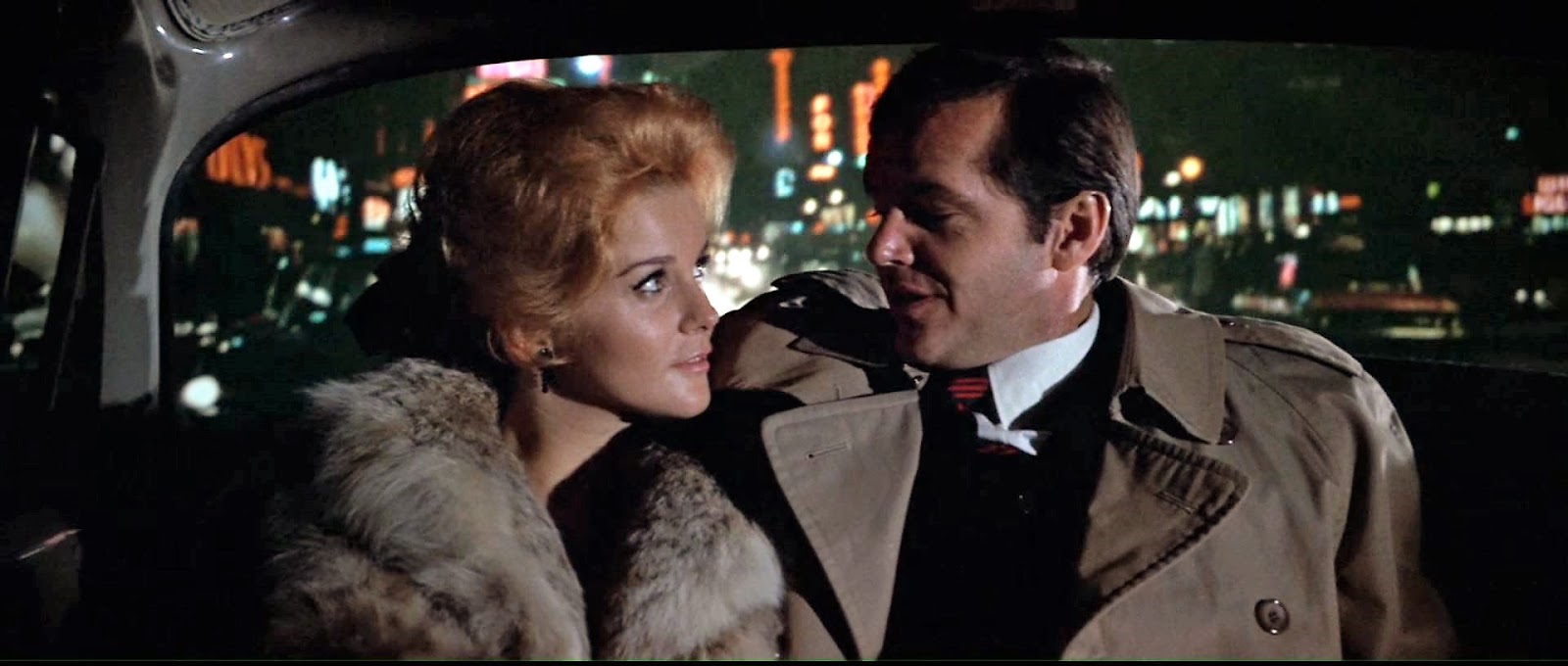
Movie Review: Carnal Knowledge (1971)

A drama about the various sexual adventures of two friends over many years, Carnal Knowledge plugs into the post-free love 1960s era to explore the consequent opportunities and disillusionments. 

Jonathan (Jack Nicholson) and Sandy (singer Arthur Garfunkel) are best friends entering college, and obsessed with women and sex. Jonathan is selfish, judges women by their looks, seeks the thrill of the chase and has no desire to settle down. Sandy is more sensitive and interested in finding and falling in love with a soul mate. After a tentative start Sandy makes progress with fellow college student Susan (Candice Bergen), but Jonathan swoops in and starts to also date Susan on the side.

Years later the men are professionals and Sandy is married to Susan, although the passion has seeped out of the relationship. Jonathan is very much single and for his next conquest pursues part-time actress Bobbie (Ann-Margret), who has the dream shapely figure he has always coveted. Fuelled by sex their relationship peaks early and starts a slow descent, Bobbie craving the long-term commitment that Jonathan is not interested in. Meanwhile Sandy moves on from Susan, and starts a relationship with Cindy (Cynthia O'Neal).

Fairly shocking for its era due to a singular obsession with frank discussions about sexual desires, Carnal Knowledge helped usher in brazen and turbulent on-screen depictions of sex and lust among adults. Written by cartoonist and author Jules Feiffer and directed by Mike Nichols, the film features plenty of profanity, scenes of frollicking and lovemaking, and some risque nudity, as the evolving male perspective on sexual relationships gets a rigorous test.

As far as content and plot, Carnal Knowledge has a one-track mind and gets bogged down in prolonged talky scenes more suitable for the stage. The focus on Jonathan and Sandy is tight, the women in their orbit often unceremoniously dumped as the men move on. In a few scenes the emotions run high and tempers boil over, Nicholson and Ann-Margret engaging in an exhausting shout fest as their union circles the drain.

Nichols enlivens the dialogue with innovative camera work, the background and foreground often equally important, the talking sometimes occurring off-screen and the passive but interested listeners given prominence.

Carnal Knowledge continued Jack Nicholson's rise to prominence as one of the most exciting and edgy talents in Hollywood. Brash and fully aware of his narcissism, Nicholson portrays Jonathan as an emotional risk methodically shunning opportunities for his own happiness. In one his rare movie outings Garfunkel is not bad, but definitely overshadowed. 

With plenty of bravura oscillating from the highs of sexual fulfillment to the lows of depression, Ann-Margret matches Nicholson is one of her best career performances. Carol Kane and Rita Moreno arrive late with telling contributions, Moreno leaving a searing impression as the only remaining destination once burnout edges out titillation.

Sexual adventurism veering far away from monogamy carries a buzz, but at a cost. Carnal Knowledge meanders to the place where selfishness folds in on itself, what was once easy pleasure now in need of sordid mind tricks and expert but passionless help.


All Ace Black Movie Blog reviews are here.

Saturday, 16 May 2020

Movie Review: The Domino Principle (1977)


A conspiracy thriller, The Domino Principle (also known as The Domino Killings) takes forever to get to the point only to realize it does not have one.

Decorated Vietnam War veteran Roy Tucker (Gene Hackman) is serving a long prison sentence at San Quentin for murdering the former husband of his wife Ellie (Candice Bergen). He passes the time enduring the tall tales of his talkative cellmate Spiventa (Mickey Rooney). Tagge (Richard Widmark) and Ross (Eddie Albert) represent mysterious interests and start visiting Tucker in prison, delving into his background with a promise of an early release in exchange for unspecified assignments.

Eventually Tucker and Spiventa gain their freedom in a staged escape. Transported to Costa Rica, Tucker is provided with a fake identity and bank account and reunited with Ellie at a lavish villa. He also meets retired General Reser (Eli Wallach), another of Tagge's associates. Relocated to Long Beach, Tucker balks at the designated assassination assignment, endangering Ellie's life.

Director and producer Stanley Kramer, known for his cerebral socially conscious dramas from decades past, steps way outside his comfort zone and predictably stumbles. The Domino Principle clambers onto the post-Watergate, post-Vietnam pile of films tapping into government mistrust, but the adaptation of Adam Kennedy's book is a vacuous exercise in hinting at something that never happens.

The premise of dark hands manipulating everyone and everything is used as an excuse to explain nothing, and instead the film settles down first as a prolonged prison interview and then a travelogue hopping from San Francisco to Costa Rica then Long Beach. The cinematography by Fred J. Koenekamp and Ernest Laszlo is often spectacular and always bright and colourful, but cannot hide the absence of actual content.

Tagge, Ross and General Reser represent a heavy-hitting trio of mystery men (and talented actors) who never reveal anything beyond shuffling Tucker from one location to another. The assassination assignment is inferred, neither the victim nor the cause ever discussed. And Tucker's insubordination at every turn, attempting with decreasing success to wrangle free from the men now controlling his life, becomes the tired focus of the film.

All of which is a waste of a stellar cast. Gene Hackman, Richard Widmark and Eli Wallach all deserved better, and even Eddie Albert and Mickey Rooney deliver better-than-usual work here, all of it unfortunately misdirected. The biggest victim is Candice Bergen, miscast and struggling mightily in deglamorized role.

The Domino Principle bungles both the set-up and the knock-down.


All Ace Black Blog Movie Reviews are here.


Sunday, 16 December 2018

Movie Review: The Wind And the Lion (1975)


A historical adventure, The Wind And The Lion is inspired by real events but never threatens to inspire.

It's 1904 in Tangier, North Africa. Berber raiders under the command of charismatic leader Raisuli (Sean Connery) invade the city, kill a few people and kidnap American Eden Pedecaris (Candice Bergen) and her two children, triggering an international incident. Tangier is a hot bed of intrigue as the European powers of the day vie for influence over inept local rulers. Raisuli's objective is to expose the Sultan as a corrupt puppet and trigger a widescale rebellion.

In the United States, President Theodore Roosevelt (Brian Keith) is running for re-election and with the help of his Secretary of State John Hay (John Huston) goes looking for an issue to galvanize the electorate. He talks tough against Raisuli, and sends in battleships and troops to sort out the situation. In the meantime Raisuli ensures no harm comes to Eden, who starts to grow fond of her captor.

Written and directed by John Milius, The Wind And The Lion strives for epic depth but is a mostly shallow and clumsy effort. The film is inspired by real events but swaps Mr. Ion Perdicaris with Mrs. Eden Pedecaris and adds plenty of artistic license and dollops of imaginative action and violence. The whiff of budget and talent limitations is evidenced in an underpowered cast, unimaginative script, and creaky staging.

Milius does conjure up some impressive desert scenery, and makes good use of sunsets and silhouettes to create the occasional visual highlight. But the modest eye candy is the extent of enjoyment to be found.

Sean Connery insists on a thick Scottish brogue, undermining with finality any inkling his character can be taken seriously. Candice Bergen fares worse, in a plastic performance so devoid of passion and emotion it is doubtful she ever read the script to realize the two kids running around are supposed to be her children.

Between them, Connery and Bergen register zero chemistry, and Milius' amateurish and repetitive prose does not help. Even the ready made platform to meaningfully explore the Stockholm syndrome is ignored.

The scenes with President Roosevelt and his entourage back in the United States talking about bears as representations of the spirit of the United States start as distractions until it becomes clear Milius really wants to tell the barely-there story of the President and the Berber leader, two men who never met. The climax creates villains out of Spaghetti western cast-offs, sweaty and faceless soldiers belonging to other countries, with no explanation as to what all the shooting is about.

The Wind And The Lion is an awkward kitten, stumbling in the breeze.


All Ace Black Blog Movie Reviews are here.

Monday, 17 September 2018

Movie Review: The Women (2008)


A social drama with a comedy sprinkling, The Women adapts the classic play to tackle 21st century issues.

The film is set in New York and Connecticut. Although she gave up on a fashion design career to look after her family, dedicated mother and philanthropist Mary Haines (Meg Ryan) believes she has the perfect comfortable well-to-do life. But her best friend Sylvie (Annette Bening), a high-powered magazine editor, learns from Saks manicurist Tanya (Debi Mazar) that perfume sales girl Crystal Allen (Eva Mendes) is having an affair with Mary's husband Stephen.

Sylvie and Mary's other friends Edie (Debra Messing) and Alex (Jada Pinkett Smith) are torn whether to tell Mary; she finds out anyway, straight from Tanya. Mary's mother Catherine (Candice Bergen) encourages her to wait before confronting Stephen. Meanwhile, Sylvie is struggling to improve the fortunes of her fashion magazine, and finds her ideas out of touch with popular opinion. Mary eventually confronts Stephen and starts to re-examine her life, unintentionally heaping pressure on her teenaged daughter Molly (India Ennenga).

The play was written in 1936 and the classic film adaptation arrived in 1939. Here Diane English writes, directs and co-produces an update to the story of women navigating the choppy waters of family, relationships, careers, friendships, sacrifice and personal expectations. Once again the film consists exclusively of women in every role, including all the children and extras (and more than likely, all the pet dogs are also female).

The film delves into all the expected topics. Mary is forced to assess her own priorities, and whether she allowed her various roles to subsume who she is as a person. Crystal represents a case study in women who appeal to vulnerable men's most base instincts. Sylvie had one failed marriage and is now happily single and focused on her career, but has to reckon with her values diverging from what is popular, placing all she worked for at risk, including her friendship with Mary.

More superficially, the pregnant Edie is a baby factory, and Alex is a lesbian, the only one among the friends blissfully going through life unconcerned by men. Young Molly is struggling with body image issues and the fallout from her mother's disintegrating marriage.

Not that The Women offers any profound new thoughts, nor is it expected to. This is a polished, glossy and sometimes humorous representation of relatively wealthy and comfortable women, with all the depth of a monthly advertising-dominated magazine. For all the concerns and tensions at hand, self-empowered resolutions will be found for all, and English still finds time for the requisite fashion show montage and a baby delivery scene in a double-headed climax.

The cast members share the screen time, Ryan and Bening most prominent but never being asked to stretch. Heavyweight star power appears in the form of Carrie Fisher and Bette Midler providing single-scene support, while Cloris Leachman as Mary's housekeeper contributes resigned comic relief.

The Women freshens up the challenges, but does not stray too far from cushy and safe film territory.


All Ace Black Blog Movie Reviews are here.


Friday, 24 August 2018

Movie Review: Book Club (2018)


A romantic comedy about the pursuit of relationships in the later years, Book Club features a stellar cast and bravely explores an often ignored topic, but quickly runs out of plot.

Four women friends in their senior years have been part of the same book club for 30 years. Vivian (Jane Fonda) is a successful hotel owner, Diane (Diane Keaton) is still getting over the loss of her husband, Sharon (Candice Bergen) is a divorced federal judge, and Carol (Mary Steenburgen) is happily married to the recently-retired Bruce (Craig T. Nelson), although their sex life is dormant..

Vivian's selected book for the group to read next is the erotic Fifty Shades of Grey. Initially reluctant and scandalized, the other ladies get into the spirit and all agree to pursue romance and reawaken their sex drives. Vivian rekindles a relationship with old flame Arthur (Don Johnson). Diane meets and starts dating the suave Mitchell (Andy Garcia), although her daughters are overprotective. Sharon experiments with online dating, and meets George (Richard Dreyfuss) among others. Carol tries to get Bruce interested in having sex again, with limited success.

Directed and co-written by Bill Holderman, Book Club carries a clever premise: unlock the libido of older women with some trashy fiction and watch them roar back to sexual activity. But despite a cast featuring multiple winners of multiple big and small screen awards, Book Club never builds on its intriguing concept. After affirming that women are allowed to enjoy a sex drive on the other side of 65ish, the film quickly settles down to unveil four essentially unrelated mini rom-coms, none containing much that is new.

Vivian is successful, independent and afraid to surrender to the mysteries of falling in love and the charms of couplehood. Diane is being treated like a child by her own daughters (Alicia Silverstone and Katie Aselton), who are hampering her attempts at finding new love. Sharon needs to learn to let go of the husband who divorced her while suffering through a series of mildly comic dates. Carol has to find a way to rev-up her husband. Each storyline gets about 20 minutes of screen time, which already feels long given the overly familiar notes.

Fonda, Keaton, Bergen and Steenburgen roll back the calendar about 40 years and reclaim the screen with confidence. While they generally just recreate their most famous screen personas, their star appeal and enduring talent ensure that Book Club is at least always watchable, if only rarely enjoyable. Don Johnson and Andy Garcia are the two most prominent men, their roles restricted to exuding idyllic mature masculine confidence and whispering bland aspirations of true love.

Book Club looks for new rom-com frontiers, but stumbles on the same old limp clichés.


All Ace Black Blog Movie Reviews are here.


Saturday, 16 December 2017

Movie Review: Home Again (2017)


A lightweight drama, Home Again offers a slice of life triggered by a weird premise with nowhere to go.

Recently separated 40-year old Alice Kinney (Reese Witherspoon) relocates her life and two young daughters from New York back to Los Angeles, and settles in at the estate of her late father, celebrated independent filmmaker John Kinney. Up-and-coming young filmmakers and friends Harry (Pico Alexander), George (Jon Rudnitsky), and Teddy (Nat Wolff) are in town to negotiate a feature-length film deal after the breakout success of their short. Harry is the director, George the writer and Teddy (George's brother) is an actor, and all three are in their twenties.

The trio meet Alice while partying at a club, and thanks to Alice's mom Lillian (Candice Bergen) they end up staying at the Kinney guesthouse. Alice and Harry are drawn to each other and start an unlikely relationship despite the age difference. The three guys also make friends with Alice's daughters, writer George helping older daughter Isabel break out of her shell. Things appear to be going smoothly until Alice and Harry hit a big bump in their relationship, and Alice's husband Austen (Michael Sheen), a record producer, shows up and tries to reclaim her love.

Directed and written by Hallie Meyers-Shyer (daughter of  Nancy Meyers and Charles Shyer), Home Again exists solely as a star vehicle of sorts for Reese Witherspoon. The concept of a mother entering middle age enjoying the attention of three hunky and remarkably well behaved young men appears to have been hatched over afternoon cocktails, and that's as far as the plot goes. Once Harry, George and Teddy move in with Alice and her daughters, the film is caught in the open somewhere between the fields of bland and the plains of predictable.

At least Meyers-Sheyer does not sell out to cheap laughs, nor does she veer towards melodrama. But a whole lot of vanilla nothingness is also not a good place to land. It proves difficult to create any sort of compelling viewing out of a situation where Alice secures free childcare, free sex and free handymen services. The romance elements are more of a fling, the intrusion of husband Austen as the mood disruptor is almost painfully awful and ends with an atrociously juvenile punch-up. At least the sub-plot about Harry and his friends navigating the Hollywood sharks who find a way to ruin every good idea offers some welcome wit and sarcasm.

Witherspoon saves as many scenes as she can and is never less than watchable. The two young actresses who play her daughters, Lola Flanery and Eden Grace Redfield, are cute and capable. Candice Bergen gets a couple of good moments but is generally wasted. The three actors who portray the young filmmakers have no opportunity to rise above the status of props.

Home Again seeks familiar comforts only to stumble into stale surroundings.


All Ace Black Blog Movie Reviews are here.


Monday, 30 May 2016

Movie Review: Miss Congeniality (2000)


An engaging comedy about an undercover investigation at a beauty pageant, Miss Congeniality offers a reasonably fresh premise and a committed Sandra Bullock performance.

A tough tomboy as a child, Gracie Hart (Bullock) is now a dedicated FBI agent with no life outside her career and no social skills. After disobeying orders and botching a bust of Russian gangsters, Gracie gets into trouble with her supervisor Harry McDonald (Ernie Hudson). Meanwhile her colleague Agent Eric Matthews (Benjamin Bratt) is assigned to head a task force trying to prevent a domestic terrorist known only as The Citizen from carrying out a new attack.

Intelligence points to an upcoming Miss United States pageant in San Antonio as the likely target of the Citizen's next attack. Eric recruits Gracie to go undercover as Miss New Jersey to try and disrupt the plot and unmask the perpetrator. Pageant director Kathy Morningside (Candice Bergen) and her show host Stan Fields (William Shatner) are none-too-pleased that the plain-looking Gracie is being forced upon their competition. Kathy appoints Victor Melling (Michael Caine), a consultant to pageant aspirants, to scrub Gracie into some sort of competitive shape. Gracie struggles to adopt a new glamorous persona while trying to piece together clues to uncover and stop the threat.

Directed by Donald Petrie and produced by Bullock, Miss Congeniality is a compact comedy that mostly works thanks to better-than-usual array of characters and some wry social commentary. The stream of laughs is steady, and a lot of the humour is self-deprecatingly delivered at the expense of Bullock's fish-out-of-water character. And with the likes of Caine, Bergen, and Shatner in key supporting roles, there is plenty of talent to carry the weight of the film.

The Pygmalion-like relationship between mentor Victor Melling and pupil Gracie Hart allows the film to explore a substantive side-quest with many laugh opportunities. Gracie never cared to be anything other than a cop, and Victor faces the challenge of his life unearthing an alluring woman out of the red-meat-eating, beer-swilling, gun-toting FBI agent.

The film also nudges Gracie towards better understanding a world that she never cared for, and through friendships she develops with the other contestants, she starts to gain a modicum of appreciation if not respect for women who care about their appearance and their personality, and are not just single-mindedly focused on careers.

The film includes shallow romance elements, with Eric gradually finding the courage to express some feelings towards Gracie, and he is helped along by her stunning physical evolution from grungy one-of-the-guys to pageant beauty.

Miss Congeniality may not be a stellar performer but she does earn a solid place on the podium.


All Ace Black Blog Movie Reviews are here.


Friday, 19 June 2015

Movie Review: Bride Wars (2009)


A brain dead comedy about best friends who become worst enemies and competing brides-to-be, Bride Wars is a monumental embarrassment.

In New York City, Liv (Kate Hudson) and Emma (Anne Hathaway) have been friends since childhood. As young girls they witnessed the perfect June wedding at the Plaza Hotel, and so they grew up with the common dream of getting married at the Plaza in June. Now Liv is a high-powered, highly-paid lawyer, and Emma is a humble school teacher, but despite their personality differences they remain best friends.

Their boyfriends propose around the same time, but a mix-up at the office of wedding planner Marion St. Claire (Candice Bergen) means that both their weddings are booked at the same day on the same hour. Liv and Emma both refuse to give up the date and then turn against each other, working hard to sabotage the competing wedding as their big day approaches.

The kind of film that gives chick flicks a really bad name, Bride Wars is a miserable excuse for entertainment. Directed by Gary Winick, this is an unfunny, unintelligent film, catering to women's most base instincts. From the fantasy dream of the perfect wedding to the cattiness of destroying a life-long friendship over trivialities, Bride Wars offers nothing but a bad, witless exercise in vacuous, self-obsessed behaviour.

And very little of it is funny. There is maybe one laugh in the still too long 89 minutes of running time, as the film quickly disintegrates into two women one-upping each other with stupid pranks. Liv sabotages Emma's pre-wedding sun-tan skin tone into traffic-cone orange. Emma sabotages Liv's pre-wedding hair colour into a blonde-and-blue disaster. Emma gate-crashes Liv's bacherolette party. Liv spreads a rumour that Emma is pregnant. Winick delivers all the antics with the subtlety of a rusted mechanical bull.

The extent of character development stops at the icy Liv learning to be more vulnerable and the meek Emma learning to be more assertive. Anne Hathaway deals with the thin material as best as she can, and often she single-handedly tries to pull the film out of the gutter, to no avail. Kate Hudson's level of comfort is unfortunately much more aligned with the mindless fare on offer. Candice Bergen not only suffers the indignity of having to appear in the film, but offers up useless narration just to make matters worse. The men who stand around and do next to nothing as the brides wage war include Chris Pratt, Bryan Greenberg and Steve Howey.

Crude and dull, Bride Wars is a lot of noise on an unnecessary front.


All Ace Black Blog Movie Reviews are here.


Monday, 2 March 2015

Movie Review: The Sand Pebbles (1966)


A near-miss epic, The Sand Pebbles is a three-hour drama set in a restless China, with a focus on the unexpected schisms created by stirring geopolitical forces.

It's 1926, the age of gunboat diplomacy in China, with foreign powers keeping military watch to exert power and enforce treaties. Against a backdrop of warring militias, local uprisings, and growing local resentment over foreign presence, US Navy engineer Jake Holman (Steve McQueen) is reassigned to the USS San Pablo, a small gunboat patrolling the Yangtze River. En route to his new assignment, he meets Jameson (Larry Gates), a fiery missionary opposed to foreign meddling in China, as well as idealistic school teacher Shirley Eckert (Candice Bergen).

Holman is a loner with a patchy record, more comfortable running his engine than interacting with people, and he immediately clashes with Captain Collins (Richard Crenna). Collins is happy to have Chinese labourers (known as coolies) look after all menial tasks on the San Pablo as a way to appease the locals, a system that Holman finds wholly unprofessional. The crew includes the thoughtful Frenchy (Richard Attenborough), who becomes one of Holman's few friends, and the brutish Stawski (Simon Oakland).

With local tensions rising and anti-foreigner sentiment reaching a boiling point, Holman trains Po-Han (Mako) to be his new engine room assistant, while Frenchy falls in love with local girl Maily (Marayat Andriane). But trouble is stalking the San Pablo, and soon the gunboat is sucked into the vortex of Chinese nationalism seeking to confront foreign military symbols.

An adaptation of the Richard McKenna book directed by Robert Wise, The Sand Pebbles tackles weighty subject matter with a serious, downbeat tone. The film is more about a sense of time and place rather than action and adventure. Wise invests in setting the scene, establishing context, introducing key characters, and only gradually winds the film towards a rousing climax. The pace is measured, the dialogue sparse, and the rural scenery often quite beautiful. Filmed in Taiwan and Hong Kong over an exhausting seven month production schedule, the settings are exotic, alternating between the busy river, bustling shoreline communities, the grimy bar/whorehouse that caters to the navy men, and the compound that serves as a base for Jameson and Shirley.

Amidst the thoughtful reflections on the unwelcome role of foreign powers in China, the one-sided treaties being protected by gunboats, and the fragmented local population trying to coalesce around a cause, The Sand Pebbles does get distracted by languid treatments of a couple of sub-plots. For questionable reasons Holman contrives to arrange a bare-knuckled boxing bout between Po-Han and Stawski, and the ordeal consumes a large chunk of screen time. Similarly the romance between Frenchy and Maily is filled with slow moving heartache, and appears to be based on not much other than sombre infatuation.

Steve McQueen received his only Best Actor Academy Award nomination for his role as Jake Holman. In many ways it's the prototypical McQueen character, tough, confident, independent and resourceful. But as a long-serving Navy machinist, Holman also has well developed survival skills, and is circumspect and willing to occasionally swallow his pride, waiting for the right moment to act. Crenna, Attenborough and Bergen provide able support, but given its length the film is rather thin when it comes to enduring and memorable secondary characters.

The Sand Pebbles ends on a high, and the final hour provides a handsome pay-off. China begins to shake off its malaise, and an era starts to draw to a close. A giant awakens, shrugs off the dust, and the San Pablo finds itself isolated, surrounded and trapped, the crew forced to endure a long wait before breaking a blockade and pursuing a cause. Collins finds a way for his spirited gunboat to turn potential mutiny into a grab for glory, while Holman finally gets to be part of a team. It's a stand in the face of a nation rising, perhaps heroic and perhaps foolish, and a fine way for a small gunboat to register a footnote in history.


All Ace Black Movie Blog reviews are here.

Tuesday, 7 October 2014

Movie Review: Bite The Bullet (1975)


A western with epic ambitions to capture the drama of a 700 mile endurance race, Bite The Bullet fails on almost all fronts. While the cinematography is admirable, the plot, characters and conflicts are routine, boring and superficial.

It's 1906, and a disparate group of cowboys gather to compete in an endurance race sponsored by a newspaper, with $2,000 in prize money and plenty of side bets to spice up the pot. Rough Riders and long-time friends Sam (Gene Hackman) and Luke (James Coburn) both enter the race, although for different reasons: while Luke has bet big that he will win the race, Sam is a humanitarian who loves animals, and wants to try and help competitors stay out of trouble and ensure that horses are not abused.

Other entrants with ambitions to win include an elderly man looking for a final shot at glory (Ben Johnson), a Mexican with a toothache (Mario Arteaga), an English gentleman (Ian Bannen), the young punk Carbo (Jan-Michael Vincent), and Miss Jones (Candice Bergen), the only woman in the race. The wealthy and conniving Parker (Dabney Coleman) owns a prize horse considered the favourite, and Parker intimates that he will stop at nothing to make sure that his horse comes in first. Once the race get going, the riders face challenges from the unforgiving terrain, bandits, and each other.

While the race, inspired by a real event, provides what could have been an intriguing backdrop, the script by director Richard Brooks is far too underdeveloped to build genuine drama. Despite the presence of a stellar cast, the characters are provided with insufficient depth to become compelling people worth caring about. Some of the key central competitors, such as Luke and the Mexican, remain astoundingly vacant at the end of the 131 minutes. In contrast, the young Carbo undergoes a jarring attitudinal transformation that defies all credibility, from a cocky young gun full of bravado to a meek and respectful kid.

The film appears to have suffered a gruesome fate in the editing room, and the botched cutting may have contributed to rampant character truncation. A central premise of the film is the front-runner status of Parker's horse; the cowboy entrusted with delivering victory on this thoroughbred is not even identified as a character, and the pair conveniently but inexplicably disappear at the film's climax. The one genuinely good moment involves Ben Johnson as the unnamed Mister, recognizing that he cannot anymore compete in a young man's world and summarizing his cowboy drifter life in an affecting soliloquy.

Otherwise, Bite The Bullet provides endless scenes of horses and riders racing across the terrain, sometimes on their own, sometimes in pairs, and sometimes in artistic slow motion. The cinematography by Harry Stradling Jr. makes excellent use of the varied landscape, and conveys a sense of lonely isolation as horse and rider streak across the wide western expanse. But nice imagery of panting horses is not nearly enough to sustain a long film. Bite The Bullet stumbles, falls and bites the dust.


All Ace Black Blog Movie Reviews are here.