Cisco Pike (to Jesse): It ain't your goddamned body they're after, man, it's your soul!

All Ace Black Movie Blog reviews are here.

Reviews of Classic and Current Movies


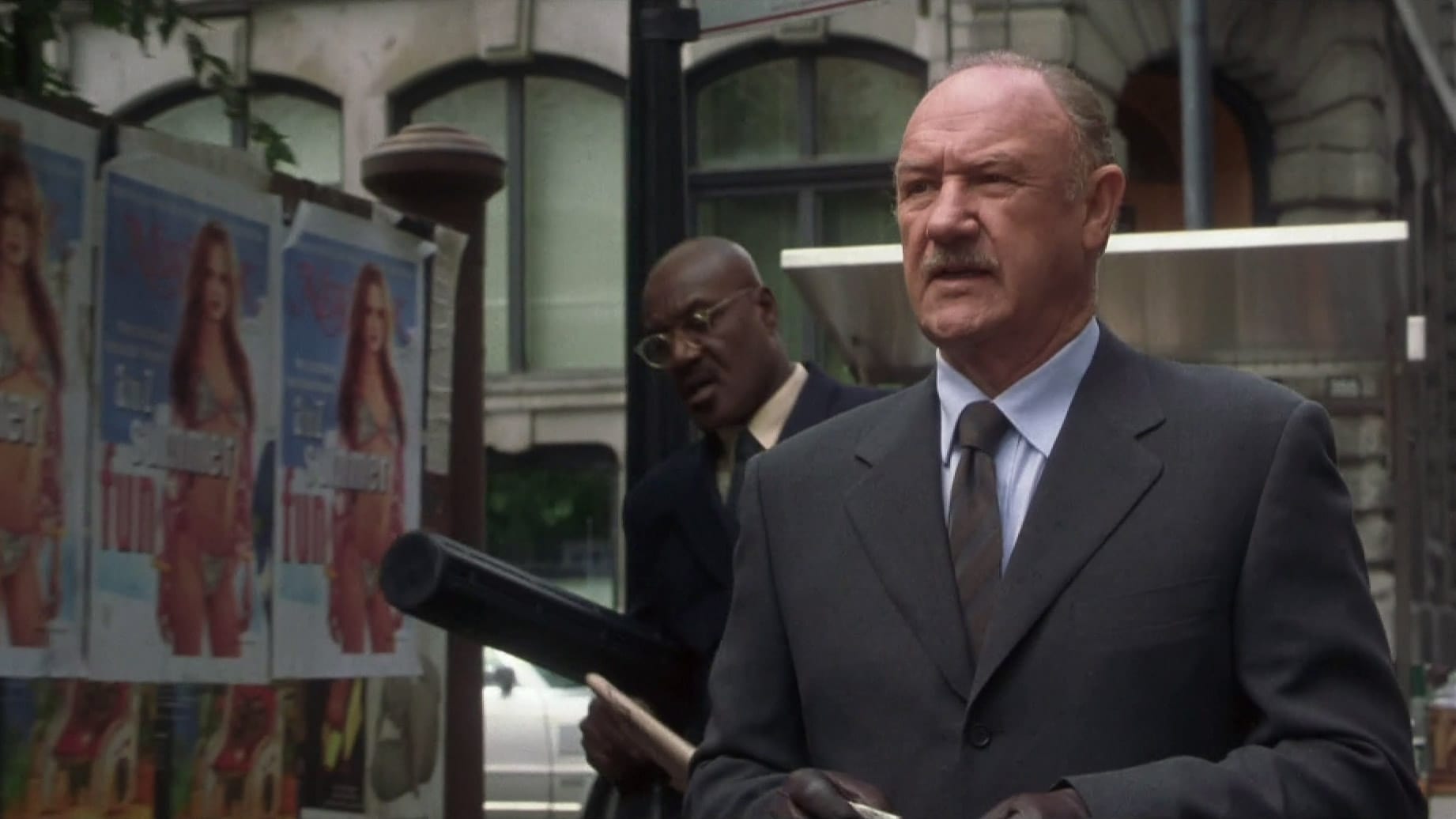
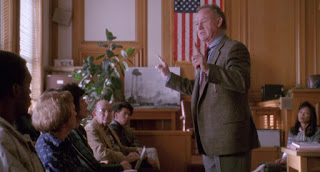
While robbing the lavish Washington DC mansion of billionaire power broker Walter Sullivan (E.G. Marshall), aging professional thief Luther Whitney (Clint Eastwood) secretly witnesses a rough sex session between US President Alan Richmond (Gene Hackman) and Sullivan's much younger wife Christy (Melora Hardin). When the roughness boils over into violence and Christy threatens Richmond with a letter opener, Secret Service agents Burton (Scott Glenn) and Collin (Dennis Haysbert) shoot and kill her. The President's Chief of Staff Gloria Russell (Judy Davis) orchestrates the cover-up.
Detective Seth Frank (Ed Harris) leads the investigation into Christy's death. Luther has a fraught relationship with his daughter Kate (Laura Linney), and is content to leave town before Frank catches up with him. But when Richmond nauseatingly pretends to grieve Sullivan's loss on national television, Luther decides to stick around and expose the President's hypocrisy.
An adaptation of a David Baldacci novel with a screenplay by William Goldman, Absolute Power boasts a strong cast and a glitzy coat of polish. Director and star Clint Eastwood allows the charismatic central character of Luther Whitney to anchor the action, and the aging, laid-back career thief occupies the eye of the storm with veteran ease. Gene Hackman is a welcome foil, but his role as the smarmy President Richmond is almost too easy.The plot is preposterous and requires a quick surrender to park-your-brain impulses. The peak arrives early: Luther hiding in a secret chamber and watching through a one-way mirror as the President's secret sex liaison starts badly then just gets worse. Eastwood's reaction shots are terrific, and the resulting mess of overlapping crimes is a great jumping-off point for a convoluted cover-up.
Thanks to the talent involved and high production values, the follow-through is never less than engaging, but also riddled with dead-ends and logic gaps. Richard Jenkins appears as a hit-man then disappears just as mysteriously; the two secret service agents pursue their own agendas leading to nowhere; and Judy Davis' Chief of Staff starts strong then dwindles to irrelevance. Meanwhile, Eastwood unnecessarily prolongs most scenes, then loses rhythmic control in the final 15 minutes. The film ends in a jumbled rush of barely coherent events and actions inconsistent with the careful build-up.
Elsewhere, the father-daughter dynamics between Luther and Kate are decent, Eastwood finding ways to tease out Luther's essence while avoiding most cliches. The stuttering would-be romance between detective Frank and Kate is less impressive and never grinds out of the awkward gear. Absolute Power does not fulfill all its promises, but still provides passable potency.
All Ace Black Movie Blog reviews are here.
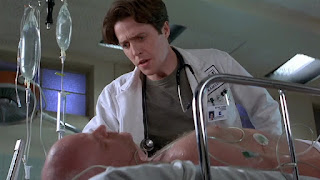
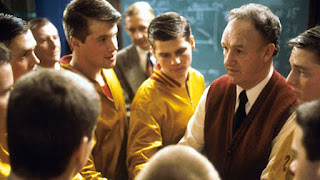
It's 1951, and middle-aged Norman Dale (Gene Hackman) arrives in the backwater of Hickory, Indiana, to coach the local high school basketball team. Due to a chequered history, this is Dale's final chance at redemption. He immediately clashes with fellow teacher Myra (Barbara Hershey), and his more serious coaching methods disillusion a vocal and passionate group of parents.
The school's star basketball player Jimmy Chitwood has decided not to play this year for personal reasons, and without him the team struggles with a string of bad results. Shooter Flatch (Dennis Hopper) is the perpetually drunk father of one of the players but also an astute student of the game, and Dale recruits him as an assistant coach. Unsatisfied with progress, the parents try to force Dale out as pressure mounts for the new coach to deliver better results.
Loosely inspired by the 1954 exploits of Indiana's Milan High School, Hoosiers encourages old fashioned stand-up-and-cheer exuberance. The hokiness is earned, though, as the Angelo Pizzo script puts coach Dale through the wringer on multiple fronts before the bounces start to go his way. Director David Anspaugh deploys rural charm in good doses, finds poignant locker room moments, and excels at staging coherent on-court action for the many in-game snippets.
Just as the team's journey to overcome adversity and achieve success is positively celebratory, the film's many weaknesses are also plain to see. Apart from Dale, Myra, and Shooter, the other characters are poorly defined, perhaps due to budget constraints limiting the available supporting acting talent. Star player Jimmy gets four short lines of dialogue and is denied the opportunity to explain his rationale for first leaving then rejoining the team. The turnaround in the team's fortunes coincides with Jimmy's return, but Anspaugh skips over explaining whether the coach's methods or one overpowered player triggered the winning streak. A few other side characters, including Myra's mother, are introduced with promise then simply discarded.The 18 years of age difference between Hackman and Hershey is obvious and grating, and what could have been a stellar friendship between coach Dale and teacher Myra is sacrificed for an awful romantic moment.
But Hoosiers also offers plenty of honest passion, and it's impossible not to admire and cheer the trajectory of the plucky small town team forging a winning spirit, battling larger and better funded schools, and riding momentum all the way to the state tournament. Hackman does his part injecting sideline spikiness, navigating around his initial disdain of small town attitudes, seeking allies where he can find them, and arguing every call until he inevitably gets tossed. His reclamation project to uncover the man hiding beneath Shooter's drunkenness is a satisfying supplementary plot.
The corn is plentiful and sometimes uncultivated, but Hoosiers sinks the basket when it matters most.
All Ace Black Movie Blog reviews are here.
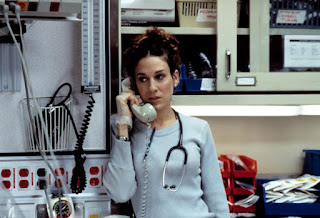
In San Francisco, Jed Ward (Gene Hackman) is a celebrated lawyer at a small firm, known for representing victims of accidents caused by corporate negligence. His daughter Maggie (Mary Elizabeth Mastrantonio) is also a lawyer, but the opposite of her father. She is on a partner track at a soulless law firm defending large corporate interests. Maggie is also in a romantic relationship with her boss Michael Grazier (Colin Friels).
Maggie and Jed are barely on speaking terms. She blames him for emotionally abandoning the family and enjoying numerous affairs. Her mother Estelle (Joanna Merlin) suffered in silence, and the marriage survived. Now Jed and Maggie find themselves on opposite sides of the same case. He is representing burn victims claiming a defective design caused cars to explode on impact. She is defending the auto manufacturer. Estelle pleads with Maggie to turn down the case, but both father and daughter relish the opportunity to match wits in the court room.
Combining a David vs. Goliath court case with an inter-family feud guarantees drama at every turn, and director Michael Apted delivers as expected. Class Action is a proficient effort, corporate maleficence and cross-generational squabbling providing twin robust storylines to pursue. The production values are high, the visuals slick but controlled, and Mary Elizabeth Mastrantonio, without ever looking quite comfortable, does enough to avoid being mismatched by the dependable Gene Hackman.But the script by Carolyn Shelby, Christopher Ames, and Samantha Shad is trying to tell two substantive stories in 105 minutes, and so predictably defaults to short cuts. On the home front, Jed's womanizing and his wife Etelle's decision to stand by her man are flash fried, leaving Maggie to simmer in rage as a perpetually angry daughter. In the courtroom, the testimony fast forwards only to the most essential witnesses, in a highlights package format devoid of build-up. And with all the event crowding in the middle, the car crash victims are marginalized and reduced to almost disrespectful sketch representations.
The two narratives merge in Jed and Maggie's face off as representatives for the plaintiffs and defendants respectively. Class Action fleetingly pretends to walk the neutral line, before overlapping nefarious cover ups at the auto company and Maggie's law firm comprehensively tilt the balance towards Jed's cause. Here coincidences become far-fetched contrivances and a series of less than professional actions shine a bad light on several lawyers.
The talented supporting cast helps navigate the rough patches, and includes Laurence Fishburne as one of Jed's associates, Donald Moffat as the senior partner at Maggie's firm, and Matt Clark as the presiding judge.
In taking on perhaps too much drama, Class Action doesn't lose any arguments, but neither does it fully convince.
All Ace Black Movie Blog reviews are here.

In New York City, emergency room doctor Guy Lathan (Hugh Grant) is unable to save patient Claude Minkins, a homeless man who dies in agony for inexplicable reasons. Guy's suspicions are aroused when he receives a phoney autopsy report then Minkins' body disappears. His boss Dr. Jeffrey Manko (Paul Guilfoyle) urges him to move on, but Guy delves into the archives and finds disturbing similar cases of homeless men's files being mishandled.
Guy is framed for a drug offence and his promising career appears to be over. But with help from nurse Jodie Trammel (Sarah Jessica Parker) he continues investigating, and uncovers the secret Triphase medical facility run by the distinguished Dr. Lawrence Myrick (Gene Hackman). Protected by corrupt FBI agent Frank Hare (David Morse) and police detective Bob Burke (Bill Nunn), Myrick is conducting unauthorized spinal nerve regeneration research using homeless men as unwilling test subjects. As Guy gets closer to the truth, his life is endangered.
Carrying strong echoes from 1978's Coma, Extreme Measures explores impetus for unsanctioned science. Here Dr. Myrick's motivation is not profit, but rather a genuine desire to reverse paralysis caused by spinal injury. Pursuing groundbreaking techniques and funded by the family and friends of spinal injury patients but running out of time due to his age, Myrick argues his homeless test subjects are worthwhile sacrificial heroes finally adding societal value.In the hands of director Michael Apted and screenwriter Tony Gilroy (adapting a Michael Palmer book), this intellectual challenge is turned into a sleek thriller. Events move quickly but stay in focus, Guy adopting a determined and principled stance to uncover what really caused the horrible demise of his patient, albeit a patient he only knew for a few minutes. From there the mystery is revealed in layers, culminating in a good climax where action and words play an equal role.
The middle third is a weak spot, as Guy searches for another escapee from Myrick's institution within a homeless encampment located in tunnels deep below the subway system. The film points a flashlight at a sanitized version of human misery then meekly backs away, the episode registering as unnecessary padding for the longish 118 minutes of running time.
Star power easily rides out the rough spots. Extreme Measures is more about Hugh Grant than Gene Hackman, and it's good to see Grant tackling something other than a routine rom-com. He still brings his quip-ready persona to the role of Dr. Lathan, but is also serious when he needs to be. Hackman has just the few scenes, and makes the most of them with considerable gravitational pull. A pre-stardom Sarah Jessica Parker suggests untapped coy dramatic talents.
Despite less than perfect treatment, Extreme Measures finds most of the right doses.
All Ace Black Movie Blog reviews are here.
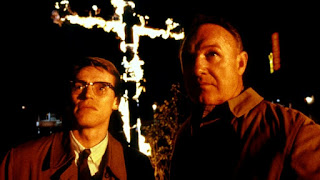
In 1964, three civil rights activists (two whites and one black) advocating for black voter registration are shot and killed in Jessup County, Mississippi. Initially only aware that the men are missing, the FBI send agent-in-charge Alan Ward (Willem Dafoe) and veteran agent Rupert Anderson (Gene Hackman) to investigate. Ward is urbane, young and idealistic; the grizzled Anderson is originally from the south, and the two men disagree about almost everything.
Ward and Anderson immediately clash with Sheriff Ray Stuckey (Gailard Sartain) and his Deputy Sheriff Clinton Pell (Brad Dourif), who are both racists and friendly with local Ku Klux Klan leader Clayton Townley (Stephen Tobolowsky) and his chief goon Frank Bailey (Michael Rooker). Ward calls for support from more FBI agents, creating a media storm, infuriating Mayor Tilman (R. Lee Ermey), and increasing arson and violence against blacks in the community. With the locals stonewalling the investigation, Anderson attempts to get close to Pell's wife (Frances McDormand), who may hold key information about the missing men.
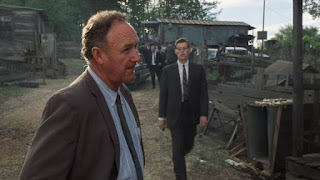
A deep dive into a boiling cauldron, Mississippi Burning explores the naked face of racism, not only alive and well but also in control of civic institutions. Loosely based on the murders of activists James Chaney, Andrew Goodman, and Michael Schwerner, director Alan Parker and writer Chris Gerolmo craft a gorgeous-looking and soulful drama, an ironically beautiful portrait of nefariousness.The elegant cinematography by Peter Biziou majestically captures a rustic setting of dusty roads, rural backwoods, dilapidating structures, and remote swamps stuck in time. Against this backdrop the excellent cast shines, Gene Hackman a particular joy as a seen-it-all agent deploying charismatic old-school methods to shake up the inhabitants of a gutter. Frances McDormand also stands out in a fragile role as the one local who may represent a path to enlightenment.
Beyond the rampant racism, the film finds enormous power from a tension-is-everywhere ethos. The locals resent the intrusion of the suited FBI agents. Ward and Anderson are at each other's throats, sometime literally. Secrets reside in the walls at Deputy Pell's household. Black community members are intimidated into silence. Churches and homes are firebombed, as the endless investigation causes tempers to boil over. And with Anderson's prodding, fissures eventually develop among the Klan members.
The film is not without faults. The narrative focusses only on white characters (as both heroes and bad guys), with the black community respectfully represented but confined to the background without a single prominent role. The three victims are also short-changed, and in fact barely named. And the final third, while still inspired by real events, leans towards gung-ho investigative tactics as a pressure relief valve to wrap up proceedings.
But Mississippi Burning glows brightly where it matters most, exposing the inhumane consequences of emboldened rot nurtured by poverty and ignorance.
All Ace Black Movie Blog reviews are here.
A tense drama set within Nicaragua's civil war, Under Fire captures the bracing chaos faced by journalists trying to make sense of a revolution in progress.
After covering the civil war in Chad, photojournalist Russell Price (Nick Nolte), and reporters Claire (Joanna Cassidy) and Alex (Gene Hackman) relocate to Nicaragua, where a leftist revolution is threatening to overthrow the US-backed regime of President Anastasio Somoza (RenĂ© EnrĂquez). Alex then returns to the US to accept a job as anchor, breaking off a strained relationship with Claire and allowing her to pursue a passionate romance with Russell.The Nicaraguan rebels, inspired by reclusive leader Rafael, are quickly advancing through the countryside and capturing key towns. Russell meets well-connected French businessman/spy Jazy (Jean-Louis Trintignant), as well as mercenary Oates (Ed Harris). American public relations expert Hub Kittle (Richard Masur) tries to burnish the President's reputation, despite Somoza's infatuation with Miss Panama (Jenny Gago) while the country burns. When rumours of Rafael's death threaten the rebels' progress, Russell and Claire are forced to make decisions that could alter the war's trajectory.
Filmed in Mexico, Under Fire recreates a country convulsing under the pressure of a Cold War fueled revolution. The script by Clayton Frohman and Ron Shelton lends sympathy to the rebels at the expense of the Somoza dictatorship, but is also under no illusions. Frenchman Jazy, at the point of losing everything, is blunt in his assessment of the country's prospects, under any regime.
Meanwhile director Roger Spottiswoode brilliantly evokes the horrific sights and smells of a furious conflict consuming the country. Under Fire captures the disorienting reality of deserted streets littered with destroyed equipment and abandoned dead bodies, civilians sheltering from the horror, the warring factions barely in control of opposite sides of small towns, the combatants themselves unsure where the front lines are. In one scene Russell and Claire, desperate to find a path to safety, encounter two rebels stationed at a street corner who just shrug in disinterested ignorance when asked whether the revolutionaries control that neighbourhood.As the death count rises, Russell and Claire witness increasing atrocities. Their objectivity erodes and they enter the danger zone where the appeal of taking sides rises. With his cameras and photographs emerging as potent weapons, Russell's exhausted psyche is put to the test, seemingly in a position to wield power but also unaware of his status as a pawn. Alex's unexpected return to Nicaragua threatens to elevate all of Russell's risks into disasters, but just like the endless neighbourhood mazes, more twists await.
At a running length of 128 minutes, Spottiswoode allows the drama to breathe with adequate time and space afforded for both character development and taut on-the-street action. Nolte, Cassidy and Hackman are provided enough context to round their characters into believable war correspondents, although the romantic entanglements are predictably clunky. Ed Harris as the mercenary Oates has a small but chilling role, the misery of nations providing gainful employment for men happy to kill for a living.
Unblinking, harrowing and riveting, Under Fire radiates with the intensity of infernal combat and impossible dilemmas.
All Ace Black Blog Movie Reviews are here.