Showing posts with label John Wayne. Show all posts

Sunday, 1 March 2026

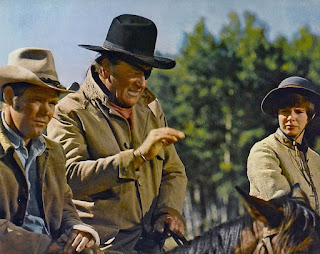
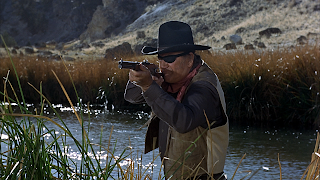
Movie Review: The Undefeated (1969)


Genre: Western  
Director: Andrew V. McLaglen  
Starring: John Wayne, Rock Hudson, Ben Johnson, Jan-Michael Vincent  
Running Time: 118 minutes  

Synopsis: After the end of the Civil War, Union Colonel John Henry Thomas (John Wayne) resigns from the military and leads his men on a round-up of 3,000 wild horses, intending to sell them to the army. Meanwhile, Confederate Colonel James Langdon (Rock Hudson) embarks on a journey to relocate his family and surviving soldiers to Mexico. Thomas is offered a better price to sell his horses in Mexico, and crosses paths with Langdon. The two former enemies have to cooperate to confront bandits and the murky alliances of an unfolding Mexican revolution.

What Works Well: This is a sturdy if unspectacular Western focusing on post-Civil War reconciliation, John Wayne and Rock Hudson representing the two sides of the conflict and developing a quick but still spiky rapport. The concept is extended to an inter-racial romance featuring Thomas' adopted Cherokee son and Langdon's daughter. Andrew V. McLaglen fills the screen with impressive shots of thousands of horses galloping to Hugo Montenegro's grandiose music score, and the final act surprisingly avoids genre cliches. 

What Does Not Work As Well: At 62-year-old, John Wayne mostly stands to the side and contributes quips and reaction shots. The bad guys are non-descript bandits and imported French troops, robbing the narrative of meaningful antagonists. The middle act is a low energy waiting game with not much plot advancement, and in the context of late 1960s westerns from Peckinpah and Leone, this one is almost quaint.

Key Quote:
James Langdon's sister-in-law Ann: You went out there to talk, why did you have to shoot the man?
John Henry Thomas: Conversation kinda dried up, ma'am.


All Ace Black Movie Blog reviews are here.

Saturday, 19 July 2025

Movie Review: Hondo (1953)


Genre: Western  
Director: John Farrow (and John Ford, uncredited)
Starring: John Wayne, Geraldine Page  
Running Time: 84 minutes  

Synopsis: With tensions rising in Apache territory, US Cavalry dispatcher Hondo Lane (John Wayne) stumbles upon the isolated ranch of Angie Lowe (Geraldine Page). She is living with her young son Johnny and unsure about the fate of her husband. Hondo helps her with errands in return for a horse, and an attraction grows between them before he rides off. Apache leader Vittorio grows fond of Johnny and allows Angie to stay on her land, but only if she finds a father figure for the boy. Hondo tangles with Angie's no-good husband, before returning to her ranch with war about to break out.

What Works Well: Cultural tensions reside within the character of Hondo Lane, a half-Apache raised by the tribe and now straddling the uneasy line between representing the cavalry and acknowledging the government's record of breaking treaties. Unable to trade in lies, Lane's moral code is both a point of pride and source of trouble on a frontier beset with contradictions. The small and personal story focused on the complex dynamics between Lane, Angie, and young Johnny is rich enough to probe the essentials of family within turbulence. 

What Does Not Work As Well: The Apache portrayal oscillates wildly between honourable and ridiculous, and the dark skin make-up does not help. The circle-the-wagons battle scenes (directed by an uncredited John Ford) retreat towards unfortunate simplifications, discarding opportunities uncovered by the good set-up work. The short running time (the movie is based on a Louis L'Amour short story) sacrifices all secondary character definitions, but still features an intermission to accommodate unfulfilled 3D ambitions, also apparent in some gimmicky throw-stuff-at-the-screen sequences.

Key Quote:
Hondo: A man oughta do what he thinks is best.


All Ace Black Movie Blog reviews are here.

Saturday, 12 July 2025

Movie Review: The Horse Soldiers (1959)


Genre: Western  
Director: John Ford  
Starring: John Wayne, William Holden, Constance Towers  
Running Time: 120 minutes  

Synopsis: During the Civil War, Union Colonel John Marlowe (John Wayne) is tasked with leading a brigade deep into Confederate enemy territory to destroy a key rail supply hub. Regimental surgeon Major Henry Kendall (William Holden) is attached to Marlowe's unit, and the two men immediately clash. Once in Confederate territory, Marlowe tangles with plantation owner Miss Hannah Hunter (Constance Towers), who exaggerates her hospitality in order to aid the enemy. She becomes Marlowe's prisoner, further complicating the mission.

What Works Well: This expansive western tackles multiple thorny wartime themes, often with unexpected sensitivity. The conflict between hurting and healing is exemplified by Wayne's gruff soldier and Holden's dedicated medicine man, but Wayne also gets to reveal plenty of pain when his troops are excelling at mayhem. Constance Towers matches the two men in a complex role transitioning from overbearing hostess to spy and then love interest. Elsewhere examples of heart, chivalry, and in-the-moment decision-making animate the accommodating plot (based on real events) of a dangerous mission deep in enemy territory.

What Does Not Work As Well: The narrative suffers from episodic choppiness, exposing the lack of a unifying theme beyond the obvious chaotic brutality of war. The conflict between Marlowe and Kendall is too obvious, and the soldiers' collective inability to control Hannah at critical moments is just a tired plot device.

Key Quote:
Hannah (offering a plate of chicken while revealing ample cleavage): Do you prefer the leg... or the breast?
Marlowe: I've had quite enough of both, thank you.


All Ace Black Movie Blog reviews are here.

Saturday, 1 April 2023

Movie Review: Rio Lobo (1970)


Genre: Western  
Director: Howard Hawks  
Starring: John Wayne, Jorge Rivero, Jack Elam, Jennifer O'Neill  
Running Time: 114 minutes  


Synopsis: After the end of the Civil War, former foes Cord McNally (John Wayne) and Pierre "Frenchy" Cordona (Jorge Rivero) become allies. Cord embarks on a personal mission to identify traitors responsible for the death of a close friend. His quest reunites him with Frenchy, and they team up to help the widow Shasta Delaney (Jennifer O'Neill) in her mission to seek revenge on the evil men dominating the town of Rio Lobo.

What Works Well: The opening train holdup scene is patient and contains more than one original nugget. Cinematographer William H. Clothier captures some elegant vistas, and John Wayne contributes reliably robust presence.

What Does Not Work As Well: The final movie directed by Howard Hawks is a disappointing and dispirited effort, going through the motions of retreading elements from the much better Rio Bravo and El Dorado. Here the plot meanders with notable clumsiness, never achieving focus nor a sense of place. The aimless drift is confirmed by an unimaginative but still cluttered supporting cast and barely defined villains. The anachronistic Jennifer O'Neill is particularly exposed in an underwritten role.

Conclusion: A tired horse munching on stale oats.


All Ace Black Movie Blog reviews are here.

Saturday, 23 July 2022

Movie Review: The Sons Of Katie Elder (1965)

A robust western, The Sons Of Katie Elder features a rich set of characters and a straightforward but still engaging plot centred on a quest for truth and justice. 

When their mother Katie dies, the four Elder brothers reconvene in their hometown of Clearwater, Texas. John (John Wayne) is a notorious gunslinger, Tom (Dean Martin) is a gambler, and Matt (Earl Holliman) is a struggling businessman. The youngest Bud (Michael Anderson Jr.) is attending college and the only brother who can still make something useful out of his life.

John learns that gunsmith Morgan Hastings (James Gregory) and his son Dave (Dennis Hopper) now own the Elder's family ranch. Morgan claims he won the property fair and square in a card game with the Elders' father, who was shot in the back that very night. Morgan is worried enough about his safety to hire gunslinger Curley (George Kennedy) for protection. Sheriff Billy Wilson and his upright deputy Ben Latta are eager to keep a lid on any violence, but emotions start to run high.

While the basic righting-old-wrongs plot of The Sons Of Katie Elder is familiar, director Henry Hathaway enriches the drama with relevant themes. Prominent threads include defending an imperfect family's honour, individuals striving for a better future, brothers getting reacquainted, and an awakening sense of guilt about having let down their mom. The film is stocked with lawmen and bad guys, and conflicts within each group add spice. The aesthetics are dusty bright, and Elmer Bernstein's music is suitably magnificent.

The plot's strongest foundation is a never-seen character. Katie is already dead when the brothers gather, but she is nevertheless a strong presence, often represented by her empty rocking chair. Various aquaintencances, including winsome neighbour Mary Gordon (Martha Hyer), take time to describe Katie's essence to her sons. An image of a determined, kind, crafty, proud, and resourceful woman emerges. She was also obviously disappointed by her three eldest sons, but anyway talked them up. Katie pinned her fading hopes on Bud, but now that she is gone he most wants to emulate gunslinger John.

A generous running length of two hours is prolonged by an unnecessary and truncated horse-drive sub-quest, and Hathaway takes his time building the central conflict with the Hastings. John is initially careful to knock back provocations and avoid unnecessary violence, eager to just establish facts and allow the law to solve the mystery of his father's death. It's only when Hastings reveals his truly evil colours that the film shifts into open hostilities, and the final act features two well-staged shoot-outs.

Forced to confront their shortcomings, The Sons Of Katie Elder finally seek to make their mom proud, in a demonstration of better late than never.


All Ace Black Movie Blog reviews are here.

Monday, 7 March 2022

Movie Review: True Grit (1969)

A character-driven western, True Grit thrives on an unlikely bond between a grizzled veteran and a headstrong young woman.

In 1880, dairy farmer and family man Frank Ross is on a trading trip to Fort Smith when he is killed by the coward Tom Chaney, who then escapes into the wilderness. Frank's spirited daughter Mattie (Kim Darby) seeks the services of the aging and hard-drinking Marshal Rooster Cogburn (John Wayne) to bring Chaney to justice. The Marshal has a well-earned reputation for uncompromising violence, often killing fugitives instead of arresting them.

Cogburn accepts the assignment after learning Chaney is riding with wanted outlaw Ned Pepper (Robert Duvall). Texas Ranger La Boeuf (Glen Campbell) is also hunting Chaney for another crime and partners with Cogburn, while Mattie stubbornly insists on joining the manhunt. The trio set off to track down the criminals, but capturing them will not be easy.

While the basic plot of True Grit consists of a standard quest for revenge, the Marguerite Roberts script, adapting the book by Charles Portis, is more interested in people than events. The larger-than-life, shoot-first-and-ask-questions-later Marshal Rooster Cogburn is confronted by the whip-smart and unyielding Mattie, and the film is more about their connection than any fugitive hunt. Mattie repeatedly references Cogburn's true grit but displays plenty more herself, and their combined tenacity grows to formidable strength.

Director Henry Hathaway crafts the story's cadence, and dedicates about half the running time to building the foundation with character introductions. The investment is slow but also worthwhile, rounding out Mattie with an uncanny ability to negotiate every issue until she gets her way, and a propensity to display an extreme state of perpetual readiness. Meanwhile Cogburn is crusty to the point of drowning all the killings with copious amounts of alcohol, his version of one-eyed law enforcement reduced to chasing after the best available bounties. He never quite admits it, but Mattie's dogged pursuit of justice reawakens his sense of purpose. Notably, their connection evolves to the point of genuine trust and caring but also remains true to both their characters by avoiding sentimentality.

The third point in this triangle is La Boeuf, and he is less defined and suffers in comparison. His Texan ways are a target for Cogburn's steady stream of insults, and La Boeuf does not help himself with a virulently obtuse reaction to Mattie's commitment. Despite his alcohol-addled mind, Cogburn recognizes the efficacy of accommodating Mattie on the manhunt while La Boeuf is still busy spanking her with a weed.

With so much hanging on the characters, the two key actors deliver. John Wayne dominates the screen with suitably boorish presence, leveraging his persona towards setting rather than abiding by the rules of the west. It takes a special skill to avoid being steamrolled by Wayne in this form, and Kim Darby successfully emerges with an equally memorable performance. Her Mattie could have easily been irritating or overbearing; instead she is a role model of no-nonsense self confidence.

Once the chase gets going, it's a straightforward affair. Cogburn traps a couple of Pepper's associates, and soon the hunters and hunted are face to face. Give or take a snake pit and a hostage taking, the resolution is routine. The chase and shoot scenes are familiar, but True Grit resides in the people.


All Ace Black Movie Blog reviews are here.

Sunday, 7 March 2021

Movie Review: Stagecoach (1939)

A western adventure, drama and romance, Stagecoach presents a compelling cross-section of American society in a rough and tumble story about nine travellers embarking on a dangerous trip.

With reports of Apache warrior Geronimo stalking the Arizona Territory, a stagecoach carrying mail and passengers prepares to travel from Tonto to Lordsburg. Buck (Andy Devine) is the driver, and Marshal Curley (George Bancroft) elects to ride shotgun, intending to catch up with fugitive Ringo Kid (John Wayne). The passengers include saloon girl Dallas (Claire Trevor) and perpetually drunk Doc Boone (Thomas Mitchell), who are both being driven out of town by the prim ladies of the Law and Order League. 

Also on the coach are the pregnant Lucy Mallory (Louise Platt), intending to reunite with her Army husband; professional gambler Hatfield (John Carradine), who joins the trip out of a sense of duty to protect Lucy; and whiskey salesman Peacock (Donald Meek). Not long into the journey the stagecoach picks up pompous but corrupt banker Gatewood (Berton Churchill), and then Ringo himself, with Curley semi-arresting the fugitive but allowing him to reach Lordsburg to right a family wrong. The travellers will learn plenty about each other and encounter many hazards before the journey ends.

The western that elevated the genre back to big-budget respectability and catapulted John Wayne into stardom, Stagecoach is a character-rich, incident-packed adventure. Directed by John Ford and written by Dudley Nichols, the film patiently introduces nine distinct characters representing the diversity of western society. They are then thrown together in a journey of survival and discovery, the breathtaking but rugged vistas of Monument Valley providing a perfect backdrop to peel away superficialities and expose the human essence within.

In a compact 96 minutes with never a dull moment, Ford explores themes of goodness obscured by rough edges; immorality hiding in rich clothes; divisions caused by thoughtless classism; defence of family honour; and heroism trumping fatalism to rise to the occasion, but only when necessary. Along the way love blossoms, sacrifices are made, perceptions are shattered and losses incurred.

Remarkably the outright action is limited to one prolonged sequence, Geronimo and his braves finally making their move and launching a sustained attack. The resulting chase is standard-setting western action film making at its finest, complete with audacious stunt work by Yakima Canutt and just-in-time arrival of the cavalry.

The unfortunately archaic portrayal of the Apaches as nothing but blood-thirsty savages is of its cinematic times, and a few dramatic moments are truncated to the edge of bewilderment. But the memorable highlights predominate: Ringo's introduction, standing tall in the way of the stagecoach; Ringo offering Dallas a seat at the table; Doc Boone sobering up when medical duty calls; and Dallas pushing past Lucy's haughtiness to prove the value of sisterhood. All are unforgettable vignettes, demonstrating the genre's potential to trigger provocative debates.

The ensemble cast members contribute to the film's legacy by investing in their characters, carving out individuals with notable efficiency and then rounding them into the men and women who defined an imperfect society. Wayne's Ringo emerges as the most charismatic and sympathetic character, while Thomas Mitchell as the whiskey-loving doctor and John Carradine's elegant southern gentleman gambler lend strong support.

Thundering down the trail with elegant intent, Stagecoach is a momentous ride.


All Ace Black Movie Blog reviews are here.

Sunday, 20 September 2020

Movie Review: Without Reservations (1946)

A romantic comedy, Without Reservations invests in a complicated premise but then abandons it in favour of an underdeveloped jealousy ploy.

Author Christopher "Kit" Madden (Claudette Colbert) is the talk of the nation, as her inspiring novel Here Is Tomorrow, a call for post-war nation building, sits for 16 weeks at the top of the bestseller charts. Hollywood producer Henry Baldwin (Thurston Hall) has optioned the book and is eagerly awaiting Kit's arrival in Los Angeles. Just before she boards the train Kit is disappointed to learn Cary Grant has passed on the role of the book's hero Mark Winston. 

But she soon spots Marine Captain "Rusty" Thomas (John Wayne) and his traveling buddy Lieutenant "Dink" Watson (Don DeFore), and decides Rusty would be perfect for the role. On the train ride Kit befriends Rusty and Dink but hides her identity, eager to find out if Rusty shares her passion for large-scale societal and governmental reforms. Although disappointed to find him more down to earth, Kit starts to fall in love with Rusty, but winning his heart will not be easy.

An adaptation of the book Thanks, God! I'll Take It From Here by Jane Allen and Mae Livingston, Without Reservations is directed by Mervyn LeRoy from an Andrew Solt script. The film combines a long and rather tedious road trip with romance and comedy. The original noble intention delves into the post-war national psyche and occupies plenty of screen time, Madden's book seemingly a forward-looking manifesto (disguised as a romance) for overhauling everything from childhood education to land development patterns. 

Discussions of the book are surprisingly the best parts of the movie's first two acts, because Solt and LeRoy are unable to do much else within the confines of the moving train. The humour is choppy, and the supporting characters are dominated by the exceptionally irritating Connie (Anne Triola), appropriately nicknamed Beetle. After switching from one train to another and then into a car, the story meanders along with Kit, Rusty and Dink into a quite bland adventure, the would-be lovers irritating each other before the romance even blossoms.

A long stop at a ranch occupied by the Mexican Ortega immigrant family gives the alluring Dona Drake as Dolores Ortega every opportunity to throw herself at Rusty and inflame Kit's jealousy. Once Kit finally arrives in Los Angeles she returns the favour in a final act running on fumes, the film stumbling into a dry exchange of letters. The story stalls into the gossip columns, the lovers not even sharing the screen together, the movie-casting project and the social commentary entirely discarded.

Claudette Colbert and John Wayne are game but share little chemistry, and the supporting cast is thin, although Cary Grant pops us as himself in an uncredited cameo. Without Reservations spends a long time on the train, but gets comprehensively sidetracked.


All Ace Black Blog Movie Reviews are here.

Saturday, 4 July 2020

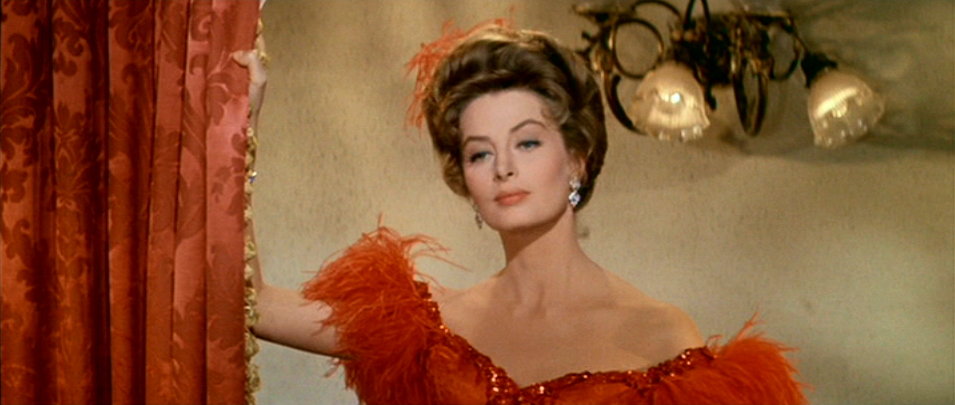
Movie Review: North To Alaska (1960)


A comedy western, North To Alaska throws a spiky romance into a rough-and-tumble gold rush.

The setting is the rambunctious town of Nome, Alaska during the 1900 gold rush. Logger-turned-prospector Sam McCord (John Wayne), his friend George Pratt (Stewart Granger) and George's younger brother Billy (Fabian) strike gold, while the conniving Frankie Canon (Ernie Kovacs) is slithering around town looking to get rich without working for it. Sam, who harbours strict anti-marriage opinions, heads to Seattle by boat to purchase mining equipment and escort George's fiancee Jenny back to Alaska.

Sam: Ahh, women! I never met one yet that was half as reliable as a horse!

In Seattle Sam finds Jenny, but she is already married and has forgotten about George. At a swanky nightclub Sam spots French hostess Michelle "Angel" Bonet (Capucine) and invites her to Alaska as a replacement wife for George. She starts to fall in love with Sam, and once in Alaska, Billy also gets infatuated with the sophisticated French beauty. Meanwhile Frankie has a history with Angel, while the region descends into lawlessness with competing cross-claims triggering violence.

Featuring no shortage of comic mass brawls, a few perfunctory shoot-outs (but no casualties) and plenty of trudging through the muddy streets of a recreated Nome, North To Alaska does not take itself too seriously. This is a western light, John Wayne happy to poke fun at his persona as his character Sam McCord is pulled, pushed and shoved into admitting he can, indeed, fall in love with a woman.

Sam: George, a wonderful thing about Alaska is that matrimony hasn't hit up here yet. Let's keep it a free country!

And Angel, a classy prostitute in all but name, is sure able to send Nome into a tizzy. George, Billy and Frankie take turns trying to win her attention, but she decides early Sam is the only man for her and alternates strategic seduction with patience to help his heart yield.

About five different writers had a hand in developing the script, and filming started with no clear direction where the story was going. Director Henry Hathaway could have trimmed the 2 hours of running time, and the disjointed scattershot approach to ideas is apparent. Many scenes meander aimlessly and take forever to get nowhere, with minor characters checking in, leaving no impression, and quietly checking out. 

The subplot about cross-claims erupting into violence is haphazardly tossed into the pot, mainly to justify one messy shootout and another comic highlight involving Wayne in a runaway cart. A loggers picnic in Seattle is a long and tiresome distraction, but even worse is an endless sequence between young Billy and Angel, as the 17 year old tries to act older and falls flat on his face (literally and figuratively).

Michelle: Are you going to leave me here alone?
Sam: Make yourself at home. Billy's here.
Michelle: Who's Billy?
Sam: George's little kid brother.
Michelle: How little?
Sam: Seventeen. But he's man enough to take care of you!
Michelle: That's what I'm afraid of!

The cast buys into the sense of fun and hams it up appropriately, Capucine emerging with plenty of credit as a self-confident and playful woman in a hostile environment. Ernie Kovacs is another stand-out as the oily Frankie, and the film would have benefited from giving him more screen time.

North To Alaska eventually gets to its destination, covered in mud but with a smile on its face.


All Ace Black Blog Movie Reviews are here.
 

Monday, 22 June 2020

Movie Review: The Comancheros (1961)


A rowdy but relatively routine Western with a streak of understated humour, The Comancheros is competently traditional.

It's 1843 in New Orleans. Professional gambler Paul Regret (Stuart Whitman) wins a pistols-at-dawn duel, but because his victim was the son of a judge Paul is deemed a fugitive wanted for murder. While gambling on a Texas-bound riverboat he meets and falls in love with the mysterious and independent-minded Pilar Graile (Ina Balin). Texas Ranger Jake Cutter (John Wayne) interrupts the romance, catching up with Paul and arresting him.

A grudging respect develops between Paul, who repeatedly escapes, and Jake, who repeatedly recaptures him. Meanwhile the Rangers become aware of outlaws calling themselves Comancheros running an illegal large-scale operation to smuggle stolen rifles to the Comanche native tribe. Jake pretends to be a gun trader to connect with middleman Tully Crow (Lee Marvin), then with Paul's help attempts to uncover the secret location of the gang's well-guarded headquarters.

An adaptation of a 1952 novel by Paul I. Wellman, The Comancheros is the last movie directed by veteran Michael Curtiz. In an uncredited assist, Wayne took over the director's chair when Curtiz fell ill. The resulting film is a middling effort, with the two intersecting narrative arcs maintaining decent interest through the efficient 107 minutes. Paul Regret's determination to escape his grim fate merges with the search for the rifle-smuggling bandits, and eventually Pilar emerges as a critical nexus in both quests.

In addition to beautiful scenery and rugged landscapes filmed in Utah and Arizona, the best moments are derived from the thorny friendship between Paul and Jake. The gentleman gambler and the grizzled Ranger come from two different worlds, Regret representing the urbanizing east and Jake a product of the frontier. From tolerating each other to developing a mutual dependence, their barbed bond keeps The Comancheros grounded amidst all the otherwise stock elements.

And most of the rest of the movie is pretty basic. The Comanches are archaically depicted as savages without any context or voice. Background snippets that could have rounded out Jake's character are tantalizingly introduced then summarily abandoned. And the titular outlaws, represented by a wheelchair-bound leader (Nehemiah Persoff), threaten to become intriguing but are reduced to a kill-hungry encampment.

John Wayne is in relaxed form and Stuart Whitman provides a spry counterpoint. Lee Marvin enjoys a relatively brief but impactful and animated role as a forcefully drunk, semi-scalped dangerous scoundrel. Michael Ansara is suitably intimidating as the most brutal of the bad guys, and the cast also features a who's who of veterans in small roles, including Jack Elam, Bruce Cabot, Edgar Buchanan and Henry Daniell

Hints of potential collide with limited ambition, and The Comancheros settles down somewhere between almost forgettable and vaguely memorable.


All Ace Black Blog Movie Reviews are here.
 

Sunday, 22 September 2019

Movie Review: The Alamo (1960)


A cinematic recounting of the famous battle, The Alamo is a well-staged but bloated western. Historical events are used as a faint foundation for mainly fictional heroics.

It's 1836 in a Texas conceivably controlled by Mexico, with the army of General Santa Anna sweeping through the countryside to consolidate his rule. Ramshackle pro-independent Texas forces are militarily disorganized but united in opposition to Santa Anna. General Sam Houston (Richard Boone) is the leader of the fledgling Texas Army and to gain precious time to recruit and train troops, he appoints Colonel Travis (Laurence Harvey) to make a stand at the abandoned Alamo mission compound.

Travis has only a few dozen men under his command, and a strained relationship with fellow Colonel Jim Bowie (Richard Widmark), an adventurer who commands his own small contingent. The two men can barely stand each other but join forces to cobble together a defensive plan. They are eventually joined by former Tennessee congressman and legendary maverick Colonel Davy Crockett (John Wayne), who adds his band of two dozen men into the ranks. Altogether about 200 men prepare to defend the Alamo against an army of more than 1,800.

A passion project for director and producer John Wayne, The Alamo is a grand western with elaborate sets, thousands of extras, mythological themes of heroism, nation building and sacrifice, and rousing battle scenes, including the climactic final assault. The film certainly does not lack ambition, but features enough misplaced bombast to also aggravate.

The film extends to close to three hours, and the fat surfaces in errant emphasis. The James Edward Grant script barely provides any context to the Texas Revolution. Instead an entire pre-siege sub-plot featuring a fledgling relationship between Crockett and Mexican widow Maria de Lopez (Linda Cristal) and her unwanted suitor drops in seemingly from another movie, and is then unceremoniously scrubbed out of the narrative. Hit-and-run raids by the mission defenders to sabotage a Mexican cannon and then steal heads of cattle are fictional enhancements and serve as juvenile distractions to introduce action and prolong the adventure.

Wayne injects a few soap-box soliloquies about freedom and his love of republics, and these land in the gap between rousing and cringe-inducing. Better are the inter-character dynamics, and here Wayne does invest welcome time is defining and building upon the tension between Travis and Bowie. Travis is a top-down by-the-book authoritarian, Bowie is an instinctive freewheeling and adventurous leader. They cannot reconcile their contradictory styles but both are effective, and the best moments of the film are drawn from the evolution of the barbed dynamic between them.

The cast is large, although not many secondary characters are provided an opportunity to shine. Heartthrob singer Frankie Avalon appears as a young soldier to attract the teenage demographic to the theatres. Chill Wills as a Tennessean known as Beekeeper, Ken Curtis as the loyal Captain Dickinson and Joan O'Brien as his resolute wife Sue get a few perfunctory scenes.

The Alamo ends with the Mexican army deploying overwhelming force in a final push to dislodge the dogged defenders. The combat is suitably spirited, bustling, daring and a bit bloody, another case where the western legend is perhaps more important than the more mundane facts.


All Ace Black Blog Movie Reviews are here.

Sunday, 15 September 2019

Movie Review: McQ (1974)


A crime action movie, McQ attempts to contribute to the genre's increasing grittiness but achieves only modest success.

In Seattle, two beat cops are shot dead by police detective Stan Boyle, who is then himself gunned down by a mysterious assailant. Stan's long term partner Detective Lon "McQ" McHugh (John Wayne) chases away a thief breaking into his green Pontiac Firebird, then returns fire and kills a hitman. McQ connects with Stan's wife Lois (Diana Muldaur) and starts to investigate the murders, convinced that local drug lord Santiago (Al Lettieri) must be behind the killings.

McQ resigns from the police force when he runs afoul of Captain Kosterman (Eddie Albert), although detective Toms (Clu Gulager) tries to mediate. McQ partners with private investigator "Pinky" Farrell (David Huddleston) and shakes down informants Rosey (Roger E. Mosley) and Myra (Colleen Dewhurst) for information. He learns Santiago has assembled a small army of henchmen to steal a shipment of seized drugs from under the noses of the police, but not everything is at it seems.

With Bullitt (1968), Dirty Harry and The French Connection (both 1971) redefining what a star-driven police action film looks and sounds like, director John Sturges and John Wayne trade in horses for cars and attempt to join the fun. With a brass-heavy Elmer Bernstein music score, impressive weaponry, and no shortage of roaring American muscle cars chasing each other across Seattle, McQ is not a bad effort, but it lacks verve and originality.

After a solid opening featuring multiple murders and an intriguing set-up, the film settles down to long stretches of mundane, television-level tedium, the flabby script by Lawrence Roman lacking a cutting edge and unable to capitalize on the early momentum. Sturges does not contribute any notable directorial touches, and at 67 years old, Wayne is well past convincing as a police detective.

The title character is also too faithful to Wayne's stand-up persona to be effective in the new reality of cops pushing boundaries and encountering walls of conspiracy. Sure McQ throws a few illegal punches and slams his badge on the table in disgust, but there is never any question which side of the line he is on, where he stands in the conflict between good and bad, and therefore which side will prevail.

But not all is lost. The story of police corruption and double-cross is actually decent, and in the final third the film finally latches on to its purpose as the action kicks out of second gear towards an acceptable if ultimately safe climax. In sharper hands and with more of the plot holes filled, McQ could have been elevated beyond merely average.


All Ace Black Blog Movie Reviews are here.


Sunday, 23 June 2019

Movie Review: The Man Who Shot Liberty Valance (1962)


A western about the frontier's evolution towards civility, The Man Who Shot Liberty Valance  thoughtfully reflects on the people and events that shaped an emerging nation.

Respected Senator Ransom Stoddard (James Stewart) and his wife Hallie (Vera Miles) make an unexpected visit to the town of Shinbone. The Senator reveals to the gathering journalists he is in town to attend the funeral of a man called Tom Doniphon and proceeds to recount their history together.

Decades earlier Ransom arrives in Shinbone as an idealistic young lawyer, and is quickly introduced to the ways of the wild west by vicious outlaw Liberty Valance (Lee Marvin), who robs Ransom and violently beats him up. The lawyer is rescued by rancher Tom Doniphon (John Wayne), the only man with the courage and gun skills to stand up to Liberty.

Tom's presumed bride-to-be Hallie runs the local eatery and helps Ransom recuperate while he teaches her to read and write, and an attraction develops between them. The rugged Tom pragmatically believes in the the ways of the gun, but Ransom wants to use education and the law to help bring outlaws to justice. With tensions in the territories rising, Ransom, Tom and Liberty are drawn into a raucous political conflict over statehood.

A western rich in narrative threads, The Man Who Shot Liberty Valance offers a quest for a new form of justice, a tense friendship, a romantic triangle, and the messy birth of political process as an alternative to individual score settling. John Ford directs with a intimate focus on characters and personal events rather than large-scale action, and the film uses individual stories to evoke a mood of inevitable change.

The overarching theme is creeping progress, for better or for worse. Happy to help out in the kitchen and serve at tables, Ransom Stoddard idealistically stands for education (for all), due process, and judgment in a courtroom rather than through the barrel of a gun. And yet he is forced to pick up a weapon and (haplessly) practice his shooting skills in a town still deciding whether to join the future.

Although John Wayne is first billed on the screen and his Tom Doniphon is the hinge around which the film rotates, James Stewart's Ransom Stoddard is the main character and the change agent pushing back against the west's more primitive tendencies to help create a more rational society. Together with Lee Marvin as an excellent title villain, the three men create a strong central triangle representing the past, present and future.

The capable supporting cast also includes Andy Devine as the cowardly and less than useless Marshal Appleyard, Edmond O'Brien as the newspaper editor Peabody, Woody Strode as Tom's loyal ranch hand Pompey, and Lee Van Cleef as one of Liberty's thugs.

Ford's tendencies towards rowdy excess emerge on a few occasions. The film meanders to over two hours, and some of the democracy-in-the-making crowd scenes, first in Shinbone and later at the Capitol City, go on for longer than needed with plenty of Capraesque speechifying.

And yet The Man Who Shot Liberty Valance finds its way to a most ironic and yet fully suitable denouement. The honest man of peace and order is a worthy political representative for the town that adopted him, even if his achievements are obscured by history's mythology.

Newspaper editor to Senator Stoddard: This is the West, sir. When the legend becomes fact, print the legend.


All Ace Black Movie Blog reviews are here.

Sunday, 21 January 2018

Movie Review: Tall In The Saddle (1944)


A robust western, Tall In The Saddle rises marginally above the routine thanks to numerous plot points and a rich cast of characters.

A mysterious stranger known only as Rocklin (John Wayne) arrives in the dusty town of Santa Inez only to discover that Red Cardell, the ranch owner who offered him employment, has just been killed. Rocklin finds himself unwelcome, with the elderly and caustic Miss Elizabeth Martin (Elisabeth Risdon), who stands to take control of the Cardell ranch, particularly unfriendly. But Martin's niece Clara (Audrey Long) makes a connection with Rocklin and appears to need help.

Other townsfolk have their plans disrupted by Rocklin's presence. Judge Robert Carvey (Ward Bond) is at the centre of land transactions, Harolday (Don Douglas) owns the ranch adjacent to Cardell, and Harolday's strong-willed step-daughter Arly (Ella Raines) and her brother Clint (Russell Wade) have their own agendas. Rocklin has to sort out a myriad of conflicts to uncover what is going on and his own place in the turmoil.

Directed by Edwin L. Marin, Tall In The Saddle features an assured John Wayne in a quintessential western about the tall no-nonsense stranger wading into a heap of trouble. The film delivers all that the genre demands, and a bit more thanks to a busy number of characters and disputes waiting to be unveiled.

After a slowish start to introduce all the characters, the small community of Santa Inez certainly proves to be a fidgety place. Rocklin finds himself embroiled in the unsolved murder of his would-be employer, on-going cattle rustling, allegations of fixed poker games, a multi-faceted land-grab plot, and the unwelcome release of a convicted man. Two women immediately compete for his attention, Clara the damsel in distress and Arly the tough-as-nails cowgirl.

By the time the credits roll after a somewhat rushed ending, most but not all the scattered plot points are tidied up with satisfactory rough and tumble frontier energy.

Lean, tall and handsome, Wayne is a confident presence, and Marin provides him with an elegant sequence to establish dominance. Rocklin quietly takes leave of a poker table argument, goes up to his room, comes back down with his gun belt, and resolves the issue through aura alone. Ward Bond contributes his typical dependable support, while Ella Raines and Audrey Long provide the necessary eyelid flutters. George "Gabby" Hayes is given the usual amount of gratuitous screen time as the talkative wagon driver.

Thanks to star power and overactive mischief, Tall In The Saddle transcends its workmanlike ethos.


All Ace Black Blog Movie Reviews are here.


Saturday, 20 January 2018

Movie Review: Brannigan (1975)


A police action film, Brannigan borrows heavily from the trends of the day and offers plenty of over-familiar London scenery but nothing remotely original.

Tough veteran Chicago cop Lieutenant James Brannigan (John Wayne) is dispatched to England to extradite his number one nemesis and criminal mastermind Ben Larkin (John Vernon) back to the US. In London Brannigan connects with Scotland Yard's Detective Sergeant Jennifer Thatcher (Judy Geeson) and stuffy but hands-on Commander Sir Charles Swann (Richard Attenborough).

To their surprise, Larkin is kidnapped and held for ransom before Brannigan can get his hands on him. Larkin's slick lawyer Mel Fields (Mel Ferrer) connects with Swann as he arranges for the ransom money to be handed to the kidnappers. But what appears to be a straightforward swap turns complicated, especially with hired hit man Gorman (Daniel Pilon) out to eliminate Brannigan.

Having turned down Dirty Harry, John Wayne scrambled to catch up with the burgeoning tough urban cop genre. After 1974's McQ, Brannigan arrives to scrounge not only from Harry, but also Coogan's Bluff (cop-out-of-his-cultural-waters). A British production directed by Douglas Hickox, Brannigan appears more interested in portraying itself as a 111 minute tourist commercial for London. Every other scene features a well-known landmark, with all the action contrived to take place near or around Big Ben, the houses of parliament, Piccadilly Circus and the Tower Bridge.

As for the plot, the decent set-up of a criminal being subjected to a crime which may or may not be a ruse gives way to an extremely flabby mid-section, mainly designed to allow Wayne to tour the City in circles, and a bumbled ending that hurriedly wraps things up with barely an explanation. The Anglo-American cultural clash consists of Brannigan unintentionally insulting Thatcher with his bluntness, Swann and Brannigan exchanging a few barbs, and the Brits pretending to be bamboozled by a few American euphemisms.

Wayne lumbers through the film unconvincingly, neither sharp nor agile. Attenborough as Swann alternates between haughty and clever in an uneven performance, while Geeson is given nothing to do except drive Wayne around town. Brannigan's low point is a prolonged and wholly unnecessary Western-style bar bawl in an English pub played for pure comic effect. He might want to pretend to be a Chicago cop, but try as he might, Wayne cannot get away from the wild west.


All Ace Black Blog Movie Reviews are here.


Sunday, 14 January 2018

Movie Review: She Wore A Yellow Ribbon (1949)


A salute to rank-and-file cavalrymen, She Wore A Yellow Ribbon lovingly portrays the machinations of cavalry tactics but forgets to include an engaging plot.

It's 1876, and after Custer's defeat at Little Bighorn the small and remote Fort Starke cavalry post near the Arizona-Utah border is on high alert. Captain Nathan Brittles (John Wayne) is less than a week away from retirement, and his long time friend, the hard drinking and somewhat dim Sergeant Quincannon (Victor McLaglen) is also close to leaving the military. Brittles and Quincannon are assigned a final mission to scope out the movement of emboldened Indian tribes in the area.

The mission is made much more complicated when the commanding officer Major Allshard (George O'Brien) also demands that his wife Abby (Mildred Natwick) and niece Olivia Dandridge (Joanne Dru) be escorted to a safer location. Brittles' men include Lieutenant Cohill (John Agar) and Lieutenant Pennell (Harry Carey Jr.), who are vying for Olivia's attention, as well as the more focused Sergeant Tyree (Ben Johnson). Navigating the tough terrain and avoiding confrontations with the marauding Indians will prove to be difficult.

Directed by John Ford and featuring gorgeous Monument Valley backdrops, She Wore A Yellow Ribbon is stunning to look at but also tedious to watch. Despite a concise running length of just over 100 minutes, the film is primarily occupied with portraying the soldiers' life on the frontier. Once the tenor of barking orders, trumpet calls and horses marching in formation this way and then that way is established, precious little else engages the mind. Ford's predilection for dim humour drawn from men of Irish descent drinking their way to foolishness does not help.

A couple of plot points are attempted on the long treks across the desert. In the first the soldiers need to navigate around invigorated Indian tribes, and the screenplay steers well clear of discussing any of the politics. She Wore A Yellow Ribbon is old-fashioned in portraying the Indians as a violent threat to be either avoided or confronted head-on, no explanation necessary.

The second and even weaker sub-plot involves a poorly defined romantic triangle featuring Olivia, Cohill, and Pennell. This is romance as imagined by a ten year old, with an impossibly beautiful woman whose presence on the frontier is barely explained causing young men to compete for her attention, and they proceed to behave with all the subtlety of young bucks locking horns.

What remains amidst the impressive and colourful scenery is a notable John Wayne performance. The actor was 42 but playing an older man nearing retirement, and Wayne carries the burden of a lifetime invested on the dusty edge of civilization on his broad shoulders. Wayne as Brittles is just a bit more resigned and circumspect compared to his more common screen presence, and the sense of commitment to duty tinged with fatigue permeates the film.

Beautiful but flawed, She Wore A Yellow Ribbon feasts the eye and starves the mind.


All Ace Black Blog Movie Reviews are here.


Saturday, 13 January 2018

Movie Review: Operation Pacific (1951)


A World War Two submarine action film with a touch of romance, Operation Pacific ticks all the boxes but does not shine in any of them.

In World War Two, the American submarine Thunderfish is tasked with tracking down and sinking Japanese enemy vessels in the Pacific Ocean. Captain "Pop" Perry (Ward Bond) and his Executive Officer "Duke" Gifford (John Wayne) are friends and smoothly command the sub. After rescuing civilians from a Japanese held island, Thunderfish returns to Pearl Harbor where Duke hopes to win back the love of his ex-wife Lieutenant Navy Nurse Mary Stuart (Patricia Neal). However, she is now in a romantic relationship with Pop's younger brother Lieutenant Bob Perry (Philip Carey).

Back at sea Thunderfish tangles with more enemy ships, but is hampered by faulty torpedoes. Pop and Duke have to lead their men into a difficult encounter with a heavily armed Japanese freighter, and the outcome further complicates the tense relationship between Duke and Bob. But the Thunderfish's biggest challenge still lies ahead.

Written and directed by George Waggner, Operation Pacific is inspired by true incidents that occurred in the Pacific theatre during World War Two. The film is committed to an investment in a close-to-realistic portrayal of submarine warfare operations, and the scenes at sea carry the requisite edge as men in confined surroundings dispatch death in the form of torpedoes and in return anticipate the juddering thuds of depth charges. The subplot about malfunctioning torpedoes introduces an unusual but welcome dose of engineering pragmatism in a war movie.

But in terms of characters and narrative engagement, the film sails in firmly bland territory. The Duke character is fully subsumed by John Wayne to the extent of sharing the actors' nickname. And Wayne treats the submarine as his horse as he rides tall in command, fearless in every decision and never harboring any doubt that he will win the war and win the girl.

The absence of depth exposes the film to the silliness of a romantic triangle where Mary Stuart clearly shares no affection with Bob and whether consciously or not is using him to win back Duke. Wayne and Patricia Neal do click as an on-screen couple (despite apparent off-screen apathy), but Duke's damn-the-torpedoes approach strips the film of subtlety both at sea and on land.

Waggner does alternate between action and romance at regular intervals and avoids lingering for too long in any one place. The film clocks in at under two hours, and Waggner finds a good ending in a large scale naval battle with plenty of opportunities for heroism and sacrifice. The love and war stories finally merge on the high seas, Wayne presented an efficient opportunity to dominate both arenas. And wet or dry, it's pointless to expect anything other than a comprehensive Duke triumph.


All Ace Black Blog Movie Reviews are here.


Tuesday, 21 November 2017

Movie Review: Reap The Wild Wind (1942)


A colourful maritime epic, Reap The Wild Wind has a bit of everything but not much of anything.

It's the 1840s, and Key West, Florida is a key marine gateway to the United States. Vessels frequently wreck in the rough seas, and salvage operators rush to rescue sailors and retrieve cargo. Rough and ready Loxie Claiborne (Paulette Goddard) runs a legitimate salvage company, while her rivals King Cutler (Raymond Massey) and his brother Dan (Robert Preston) are more interested in causing wrecks for profits. As a further complication, Dan is secretly in love with Loxie's cousin Drusilla (Susan Hayward).

The Cutlers' chicanery causes the ship captained by Jack Stuart (John Wayne) to wreck. Loxie rescues Jack and they fall in love. He dreams of captaining the Southern Cross, a modern steam boat owned by shipping tycoon Commodore Devereaux. Loxie travels to Charleston and flirts with Steven Tolliver (Ray Milland), Stuart's rival and Deveroux's influential second-in-command, to try and secure the Southern Cross command for Stuart. Instead, Tolliver falls in love with Loxie. Tolliver travels to Key West to investigate the Cutlers, heating up the love triangle but also forcing Tolliver and Stuart to cooperate to try and stop the escalating series of shipwrecks.

Produced and directed by Cecil B. DeMille, Reap The Wild Wind is a bright, boisterous, and busy adventure. The story hops between the bustling port of Key West and the much more refined and civilized Charleston, with frequent sailings out to sea to experience the world of cargo ships in rough waters and the salvage crews who either provide assistance or prey on misfortune. The production values are high, the screen pops with colour, the costumes are lavish, hordes of extras populate every corner of the screen, and the sets and special effects are state of the art for the era.

With no shortage of characters and events, the film breezes through the two hours of running time, and DeMille somehow contrives to end his epic with a dangerous underwater dive featuring a massive angry squid, but only after the film takes a substantive detour into courtroom drama territory.

The romantic triangle and underhanded business alliances crackle away as DeMille alternates between affairs of the heart and cut-throat underhanded double-crosses. It's all happening all the time, not a surprise given that Reap The Wild Wind is based on a newspaper serialization. The film benefits from the brisk fun factor, and also suffers from the consequent lack of depth and any sense of lasting substance.

Loxie is in the middle of everything, an irrepressible independent woman well ahead of her time in a man's world, and Goddard injects the necessary energy to allow Loxie to drive the film ever forward. The men are more troublesome and less worthy, rendering the romance moments more irritating than engaging. Ray Milland as Tolliver is foppish, bland and abusive, and worst of all attached to silly dog ventriloquist tricks. John Wayne as Stuart is sturdy but maybe none too bright, and the fistfights between the two men erupt all too predictably.

Reap The Wild Wind is undoubtedly entertaining, and just as definitely sailing in shallow waters.


All Ace Black Movie Blog reviews are here.