Showing posts with label Karl Malden. Show all posts

Wednesday, 9 July 2025

Movie Review: Meteor (1979)


Genre: Disaster Thriller  
Director: Ronald Neame  
Starring: Sean Connery, Natalie Wood, Karl Malden, Henry Fonda, Brian Keith, Martin Landau, Trevor Howard  
Running Time: 107 minutes  

Synopsis: A huge meteor is discovered hurtling towards Earth, with seven days to impact. Head of NASA Harry Sherwood (Karl Malden) recalls retired scientist Dr. Paul Bradley (Sean Connery) to duty, and the US President (Henry Fonda) places Bradley in control of Hercules, a satellite-based nuclear missile system that can target the meteor. Bradley works with his Soviet counterpart Dubov (Brian Keith) to overcome Cold War tensions and add the Soviet Union's equivalent space missiles to the attack on the meteor. Bradley also tests a romance with Dubov's interpreter Tatiana Donskaya (Natalie Wood), while advance fragments of the meteor start to strike Earth.

What Works Well: The special effects (particularly the close-ups of the space-based missile systems) are sometime adequate, and the combined presence of Sean Connery, Karl Malden, Brian Keith, Natalie Wood, and (briefly) Henry Fonda elevates the material. The imperative for the US and the USSR to pause the Cold War and join forces to save Earth is a good subtext.

What Does Not Work As Well: The repetitive scenes of a rock trundling through space are accompanied by a laughable music soundtrack that alternates between bewildering faux triumphalism and befuddling synth horror. Martin Landau as the obstructionist military commander marches into over-the-top territory, and when the special effects are bad, they are really bad: the avalanche in the Alps and the milkshake sewage in New York are particular lowlights. Sean Connery's clumsy attempts to woo Natalie Wood in the midst of an annihilation event are just cringey.

Key Quote:
Bradley (sarcastically trying to impress Tatiana about life in the United States): You'd like it here, you know. We've got everything. Power cuts, strikes, unemployment, race riots, and a terrific crime rate.


All Ace Black Movie Blog reviews are here.

Friday, 30 September 2022

Movie Review: The Cincinnati Kid (1965)

A poker drama, The Cincinnati Kid mixes high-stakes card action with less impressive romantic entanglements and some muddled era representations.

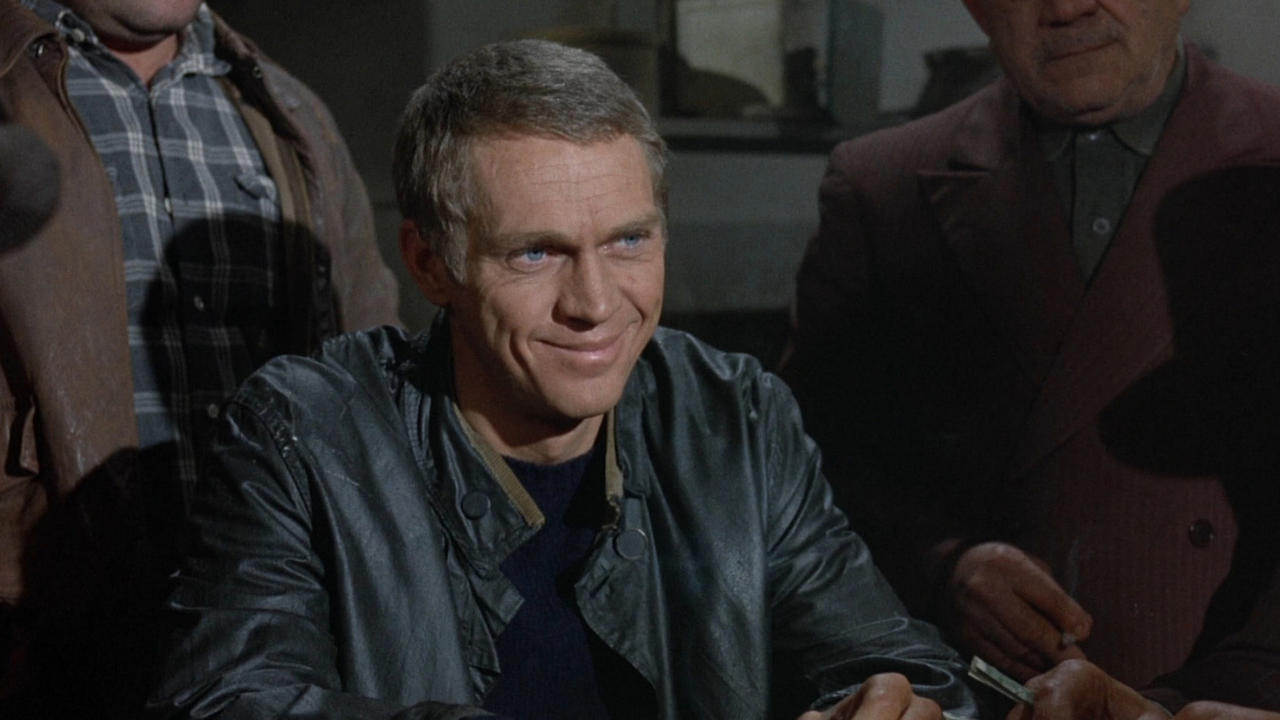
In New Orleans of the 1930s, Eric "the Cincinnati Kid" Stoner (Steve McQueen) is the hottest up-and-coming poker player. His mentor and friend is the aging Shooter (Karl Malden), who is married to the much younger Melba (Ann-Margret). The Kid's girlfriend Christian (Tuesday Weld) is growing disgruntled that she does not get much of his attention.

The revered Lancey "The Man" Howard (Edward G. Robinson) arrives in town with a well-earned reputation as the best poker player alive and promptly defeats wealthy businessman Slade (Rip Torn). Next up is a much anticipated showdown between Lancey and the Kid, with Shooter and Lady Fingers (Joan Blondell) recruited as dealers. The Kid has to contend with Christian's sour attitude and Melba's unconstrained lust, while Shooter comes under pressure to influence the game's outcome.

With The Hustler swinging open the door to grim smoke-filled backroom duels, The Cincinnati Kid arrives with a similar formula of the hot young talent (McQueen) challenging the veteran reigning champion (Robinson). Writers Ring Lardner Jr. and Terry Southern adapt the Richard Jessup novel with verve, and Norman Jewison directs with a sweaty immediacy to wring maximum tension out of men sitting around the table, encouraging McQueen and Robinson to naturally match actors with characters.

And when Jewison stays close to the poker table, the energy level buzzes. The audience is trusted to know the five card stud rules or quickly catch up, and regardless, the strategy propelled by bluffing, gamesmanship, and penetrating personality traits registers through facial expressions and body language. The showdown between Lancey and the Kid extends for several days and occupies the entire third act, and despite breaks for sleeping and eating, the pressure only builds towards the legendary final pair of hands.

The scenes without cards being dealt are comparatively limp. The Kid and Melba attend an entirely superfluous cockfight, the romance between The Kid and Christian stutters into painfully strained territory, and all three of Steve McQueen, Tuesday Weld, and Ann-Margret are dressed and styled according to 1960s fashions, despite the 1930s setting. Nothing substantive is revealed about The Kid's earlier days, and no explanation provided for the odd pairing of the vivacious Melba with boring has-been Shooter.

The dream cast makes up for plenty of deficiencies. While McQueen is adequate playing his usual nervy-cool persona, veterans Robinson and Malden provide superb senior heft, Rip Torn is suitably oily, and Joan Blondell breezes in as a dealer riding a flamboyant past. Ann-Margret (openly zesty) and Weld (quietly smoldering) embody classic opposites, while Jack Weston and Cab Calloway make up the numbers around the table with restless colour.

Although some of the cards have questionable value, The Cincinnati Kid deals from a crisp deck.


All Ace Black Movie Blog reviews are here.

Saturday, 22 January 2022

Movie Review: Billion Dollar Brain (1967)

The third film in a series adapting author Len Deighton's Harry Palmer spy adventures to the screen, Billion Dollar Brain steers towards buffoonish satire and crashes into a miserable failure.

In London, Palmer (Michael Caine) has left MI5 and is working as a private investigator. He refuses overtures by his former boss Colonel Ross (Guy Doleman) to return to the service, instead accepting a computer-issued assignment to deliver a package to Helsinki. There he meets Anya (Françoise Dorléac) and her partner Leo Newbigen (Karl Malden), who are involved in a plot financed by Texas megalomaniac General Midwinter (Ed Begley) to fight communism with the help of computer analytics.

Deploying strong arm tactics, Ross does succeed in convincing Palmer to rejoin MI5. Palmer makes his way to Latvia's capital Riga and gets reacquainted with his jovial Soviet foe Colonel Stok (Oskar Homolka). Palmer uncovers Midwinter's plan to force the Soviets out of Latvia, and realizes Leo has his own agenda to make a lot of money on the side. 

Combining controversial director Ken Russell with a spy milieu in frigid surroundings was always going to be a risk, and sure enough, it just does not work. Producer Harry Saltzman ends up with a mess on his hands, Billion Dollar Brain falling into a wide gap between muddled espionage, failed satire, and low-brow humour.

The opening act quickly loses balance, Palmer poking his business into a murky plot, allowing himself to be led by the nose first by Anya, then Leo, and finally Ross. The action goes completely off the rails with the introduction of nut case General Midwinter, Ed Begley not just chewing the scenery but also vomiting on it with no hint of control. By this point Oskar Homolka's Colonel Stok is undressing in Palmer's hotel room and exiting through the balcony in search of cheap laughs. The plot finally consumes itself in the idiocy of Midwinter leading an army - assembled out of nowhere and packed into tanker trucks - in an absurd attempt to liberate Latvia.

As Stok, Leo, and Midwinter form of a trio of lunatics commanding the asylum, Palmer is mostly an observer and doofus victim primarily concerned with seducing Anya. Russell wastes scenic Nordic and Eastern European surroundings with his uncoordinated antics, and the main point of interest defaults to glossy scenes of large computer rooms representing the era's state of the science. But even the imbecilic title premise of a computer issuing orders and plotting wars is undermined by the ease with which Leo reprograms the machine to suit his purpose. As it turns out, a billion dollars does not buy much of a brain.


All Ace Black Movie Blog reviews are here.

Sunday, 12 September 2021

Movie Review: Nevada Smith (1966)

An epic western, Nevada Smith is a grand tale of revenge and coming-of-age.

In the 1890s, outlaws Fitch (Karl Malden), Coe (Martin Landau), and Bowdre (Arthur Kennedy) murder the parents of Max Sand (Steve McQueen), a half-breed young man. Despite no education and no experience in killing, Max vows revenge and sets off to find the killers. He receives gun training from traveling gunsmith Jonas Cord (Brian Keith), then Kiowa woman Neesa (Janet Margolin) helps him identify Coe, a professional gambler and expert knifeman.

Max then locates Bowdre incarcerated in Louisiana, and stages a robbery to join him in a brutal prison located deep in the swamp lands. Max befriends Bowdre and plots an escape, using local woman Pilar (Suzanne Pleshette) to provide them with a boat. Max's final challenge is to find Fitch, now the leader of a large outlaw gang. He adopts the name Nevada Smith to mask his growing reputation and gain Fitch's trust.

Directed by Henry Hathaway and written by John Michael Hayes, Nevada Smith is inspired by a character in Harold Robbins' 1961 book The Carpetbaggers. This is a richly textured western with a story of personal growth unfolding over multiple chapters. Visually beautiful, the engrossing story of revenge fuelled by blind fury easily sustains 131 minutes of screen time.

Steve McQueen at 35 years old does struggle to convey a young Max Sand in the early scenes, and often appears more goofy than naive. As the narrative progresses, Hathaway could have helped by sharpening the definition of the passing years. Regardless, McQueen improves towards the latter segments, and his cool persona is fully meshed with his character for the final confrontation with Fitch.

Along the way, the Louisiana prison sequence is almost a film within a film and introduces a unique setting to the western milieu. Max's long detour to a brutal prison camp and the dangerous surrounding swamps carries a singular and memorable intensity.

At the metaphysical level, Max starts out as an empty vessel knowing only his family then pure evil and hatred. His arc introduces him to a good man in Jonas Cord, two good women from each side of his heritage in Neesa and Pilar, the meaning of a nurturing community with the Kiowa tribe, and finally God, through an encounter with Father Zaccardi (Raf Vallone). By the time Max is ready to close the chapter of his parents' death, he is mature, educated and much wiser to the world and his potential within it.

Karl Malden, Martin Landau, Arthur Kennedy, Brian Keith and Vallone offer robust support without stealing any scenes. Suzanne Pleshette does leave a haunting impression, her Pilar a prisoner without a crime sacrificing everything for a man while still oblivious to his potential for exploitativeness. Nevada Smith searches for a violent brand justice, but stumbles upon the compassion and humanity required for a different future.


All Ace Black Movie Blog reviews are here.

Monday, 15 June 2020

Movie Review: Kiss Of Death (1947)


A character profile focusing on the dilemma of an informer, Kiss Of Death is an intense crime drama heightened by an unforgettable Richard Widmark performance. 

It's Christmas time in New York City. Ex-convict Nick Bianco (Victor Mature) joins three hoodlums to rob a jewelry story at the Empire State Building, but he is the only one caught. Assistant District Attorney Louis D'Angelo (Brian Donlevy) offers leniency in return for the names of the other gang members, but Nick refuses to squeal and is sentenced to a long stint behind bars.

Three years later, Nick learns his wife has committed suicide, and his two daughters are in an orphanage. His ex-neighbour Nettie (Coleen Gray) visits him in prison and reveals that Rizzo, one of Nick's former associates, may have mistreated his wife before her death. Nick now strikes a deal with D'Angelo, naming names to earn visits with his daughters. Soon Nick is released on parole and settles down with Nettie, but D'Angelo wants his help to nab the dangerous Tommy Udo (Widmark), a psychotic killer.

In one of the more memorable big screen debuts, Richard Widmark announces his arrival with an incendiary performance. When he is on screen as the cackling, unhinged Udo, nothing else matters. He commands his scenes with a murderous edge of barely contained psychosis, creating one of the screen's most noteworthy villains.

When Widmark is not dominating, the screenplay by Ben Hecht and Charles Lederer is primarily interested in Nick's soul searching as he struggles to decide whether the criminal code of silence is worth the impact on his family. Despite a robust and heartfelt Victor Mature central performance, the narrative is sometimes bogged down wondering if Nick can be a good man at heart. 

But director Henry Hathaway also punctuates Kiss Of Death with short and sharp moments of extreme violence, including allowing Udo to earn his place in cinematic infamy in a scene involving a wheelchair and a staircase.

Some elements proved too troublesome for the censors and audiences of the day, leaving Nick's story somewhat muddled. His wife's death, and the role of the criminal Rizzo, were truncated to the edge of incomprehension. The romance between Nick and Nettie proceeds at jarring speed, and the climactic showdown is too far fetched, even for the standards of hardboiled men.

But Hathaway also produces some moments of noir-infused brilliance to compensate for the rough spots. In a couple of sequences, time slows down to a crawl to build unbearable tension. The endlessly long elevator descent from the opening scene of the crime to the lobby of the Empire State Building allows Nick plenty of time to reflect on his life's downward trajectory. And later, Udo's emergence from behind a curtain at an Italian restaurant is prolonged to an epic noir moment.

On either side of the prison walls, Kiss Of Death offers only dark paths to redemption.


All Ace Black Movie Blog reviews are here.


Saturday, 11 February 2017

Movie Review: Where The Sidewalk Ends (1950)


A film noir focusing on a flawed detective, Where The Sidewalk Ends hits many of the right dark notes but falls just short of perfect sharpness.

In New York City, police detective Mark Dixon (Dana Andrews) is warned about his violent methods. Too quick with his fists, Dixon's hatred of hoodlums stems from wanting to distance himself from the memory of his father, an infamous thief. Dixon and his partner Klein (Bert Freed) investigate the murder of Texas businessman Morrison, stabbed to death by abusive low life Ken Paine at an illegal gambling joint run by notorious criminal Tommy Scalise (Gary Merrill).

Dixon tracks down Paine and accidentally kills him with a punch. In a cold panic, Dixon decides to cover up his role in Paine's death, and works to implicate Scalise for the murders of both Morrison and Paine. In the meantime Dixon also starts to fall in love with Paine's estranged wife Morgan (Gene Tierney). But when Morgan's father Jiggs (Tom Tully) becomes the chief suspect in Paine's murder, Dixon finds his troubles multiplying.

Where The Sidewalk Ends reunites director Otto Preminger with stars Dana Andrews and Gene Tierney, the talent trio responsible for 1944's Laura. And with a script by Ben Hecht, Where The Sidewalk Ends gets many things right. The black and white photography is rich with bright light sources cutting through imposing shadows, heavy coats, glistening streets, neon signs and an abundance of hooligans. Mark Dixon as the central protagonist is a deeply damaged man, fighting internal demons with a career rumbling in reverse gear. And the plot is filled with just enough complexity and coincidence to highlight the ironies of life without slipping into irrational territory.

The film's texture is enhanced by several nice touches. Mobster Scalise is smooth as silk, Gary Merrill perfecting a condescending smarm and augmenting it with constant sniffing of an unknown substance to keep his airways clean and his brain in overdrive. Dixon's partner Klein is also hard headed but has it under control, and gets a moment to shine with his wife when Dixon comes calling for financial help. And an assortment of secondary characters including a taxi driver, a dotty neighbour, a caustic diner waitress, an ex-convict on parole and numerous hissing musclemen add animation at every turn. Karl Malden shows up as the newly minted Lieutenant at Dixon's precinct.

While Dana Andrews does well and has plenty to bite into as the emotionally distressed Dixon, the character of Morgan is less successful. Gene Tierney is generally unable to do much with the underwritten role of a too-good woman with poor judgement in men. And while Hecht's writing is sturdy, it lacks a cutting edge in dialogue exchanges that sound appropriately belligerent but lack in wit.

Where The Sidewalk Ends is a worthwhile place to visit, one detective finally running out of fist room in the confrontation with the ghost of his father's legacy.


All Ace Black Blog Movie Reviews are here.


Thursday, 17 October 2013

Movie Review: On The Waterfront (1954)


A masterpiece delving into union corruption and the power of the individual, On The Waterfront is a potent drama with a peerless Marlon Brando performance and an outstanding supporting cast.

Union boss Johnny Friendly (Lee J. Cobb) rules his waterfront district by intimidation, lining his pockets by running rackets and relying on the working men adhering to the "D and D" (deaf and dumb) code of conduct. Terry Malloy (Brando) hovers on the outer edge of Friendly's circle of corruption, and unwittingly finds himself used to lure informant Joey Doyle to his death. Joey's sister Edie (Eva Marie Saint) demands that the perpetrators be identified and brought to justice, and she shames Father Barry (Karl Malden) into action: he tries to encourage the men into testifying, but Friendly's goons are quick to beat-up anyone who breaks the code of silence.

Terry makes advances towards Edie, and gradually they become close, although she does not know Terry had a role Joey's death. As more men are violently silenced, Terry is influenced by Edie and Father Barry, and starts to consider testifying against Friendly. But his brother Charley (Rod Steiger) is one of Friendly's closest associates, and turning against the union boss and his henchmen will carry a high personal cost.

On The Waterfront carries the ominous tones of director Elia Kazan's own struggles. In 1952 he testified before the House Committee on Un-American Activities, naming names and identifying communist sympathizers from years past. In the movie, Terry Malloy is caught between doing what he is being told is the right thing to do, and loyalty to his "group", the organization of Johnny Friendly. Testifying against Friendly means betraying his friends and family, but remaining silent means letting down Edie and Father Barry, and allowing a rotten situation to get worse.

Alternating between an emerging unlikely love and the power of the fist down at the docks, On The Waterfront is full of energy. Friendly and his goons run a tight ship, controlling who gets to work and who does not, who gets the cushy job and who gets to toil, all determined according to favours afforded and gained. The men chafe under a regime imposed by violence and facilitated by their own acquiescence.

The Budd Schulberg script allows plenty of time for the romance between Edie and Terry to develop, and the measured pace contributes to the air of authenticity. Edie initially appears too good and too smart for Terry, and time is needed for her to find the charm and humanity within the self-described "bum". Once they start to care for each other, Edie offers a moral compass and a road to salvation, and Terry starts to understand that he may have something to gain by standing up for what is right. The film's beating heart is found in Terry's transformational journey from dim witted hanger-on to an inspirational leader of men.

Brando is surrounded by the triangle of Cobb (loyalty), Steiger (family) and Malden (conscience), and the four actors create an electric dynamic. Brando is brutally brilliant as a man suddenly being pulled in three different directions at once, the bum-like tendencies of a boxer who long-since sold-out now overburdened by unfamiliar responsibilities and demands.

Terry Malloy, speaking with his brother Charley: You don't understand. I coulda had class. I coulda been a contender. I coulda been somebody, instead of a bum, which is what I am.

Cobb is all fiery rule-by-fear, while once awakened, Malden is a tentative force for pure good. It is left to Steiger to provide the most textured supporting performance, Charley smart enough to see the writing on the wall, but hoping his brother would fully enter Friendly's fold before he can be convinced to testify. As much as Terry has a dilemma, Charley has a real problem, since he is all-in with Friendly and subject to potentially humiliating punishment should his brother talk.

All four men were nominated for Academy Awards, with Brando receiving his first statue at the fourth attempt. Eva Marie Saint, in her film debut at age 30, also won the Academy Award as Best Supporting Actress. Her turn as Edie is tenacious in the pursuit of justice and enlightened enough to explore a relationship with Terry.

Filled with heart, sweat, agony, blood and triumph, On The Waterfront rocks the docks.


All Ace Black Blog Movie Reviews are here.


Wednesday, 19 June 2013

The Movies Of Karl Malden


All movies starring Karl Malden and reviewed on the Ace Black Movie Blog are linked below:

Kiss Of Death (1947)


The Gunfighter (1950)


Nevada Smith (1966)


All Ace Black Movie Blog reviews are here.
The Movie Star Index is here.

Movie Review: Patton (1970)


A larger than life biopic for a larger than life war hero, Patton combines man and war to provide grand entertainment. George C. Scott's inspired performance embodies both Patton's self-serving bombast and his career-limiting failings.

It’s 1943, and the initial American foray into the North African theatre of World War Two is not going well: Rommel’s tanks inflict a heavy defeat on the Allies at Kasserine Pass. In response, General George S. Patton (Scott) is placed in charge of the American II Corps. Confident, aggressive, and a loud mouth, Patton appoints General Omar Bradley (Karl Malden) as his second-in-command and adopts an all-attack, all-the-time mentality while instilling discipline and improving morale. Before long, Patton masterminds an impressive victory over Rommel at the Battle of El Guettar.

Patton believes in reincarnation and destiny, and is convinced he has lived previous lives and participated in key battles throughout history. It is now his destiny to play a leading role in the Allied victory. After success in North Africa, the next objective is the invasion of Sicily, and Patton places great emphasis on personal glory, turning the invasion into a personal race with British Field Marshal Bernard Montgomery (Michael Bates) to reach the key port city of Messina. But Patton finally allows his passion to get the better of him: he accuses one of his soldiers of cowardice, and strikes him. The incident stalls Patton’s quest for glory, and he is forced to wait in the wings while Bradley is promoted into a key role as the Normandy invasion looms.

A war movie filled with the thunder of conflict and the agony and ecstasy of the humans who wage war, Patton is an enduring cinematic achievement. Through the eyes of General Patton, humanity's deranged but passionate love of carnage is expressed. Patton was born to lead men into war: ironically, the battlefield of death is the one place he feels most alive. The movie makes no apologies and no excuses. Men like Patton turned back evil and won the war, and this is his story.

Driven by a palpable sense of historic purpose, Patton is portrayed as a man bulldozing his way to the certainty of victory. Scott’s performance is a seminal achievement, dominating the screen with personality, and filling the General's boots with a take-no-prisoners, accept-no-nonsense attitude. But the self-aware tragic hero within Patton also emerges: an inability to control his mouth or his temper, a propensity to place personal objectives ahead of strategic needs, and an almost obsessive focus on immediate tactics as opposed to the big picture. 

The contrast with the more restrained Bradley, portrayed with resolve by Karl Malden, is a study in divergent leadership styles. Bradley is more cerebral and careful, creating fewer waves, and demonstrating more empathy. Patton has no time for the desktop generals and their political masters, and in an organization as complex as the US Army, it is no surprise that Bradley is more effective at climbing the ladder.

Written by Francis Ford Coppola and Edmund H. North, everything about Patton is large. The running length is close to three hours, the opening scene speech in front of a gigantic flag is audacious, the assembled armies of men, tanks, and trucks are huge, the battle scenes are impressively grand, and the personality battles are absorbing. Director Franklin J. Schaffner finds engaging settings and interesting camera angles for almost every shot, and Jerry Goldsmith provides a rousing yet poignant soundtrack. Patton is an artistic epic of legendary men eternally defined by a monumental conflict.


All Ace Black Movie Blog reviews are here.

Saturday, 10 November 2012

Movie Review: Birdman Of Alcatraz (1962)


The fictionalized story of Robert Stroud, a murderer who turned into a bird expert while serving a life sentence behind bars, Birdman Of Alcatraz is about the triumph of a restless but captive spirit. Burt Lancaster delivers a defining performance helping to celebrate the emergence of humanity in the face of grim austerity.

An uncompromising brute, Stroud (Lancaster) has killed a man in his home state of Alaska and is destined to spend a life in prison. His only relationship is with his mother Elizabeth (Thelma Ritter), a woman both dedicated to her son and obsessed with him. Eventually transferred to Leavenworth, Stroud quickly runs afoul of the strict rules of warden Harvey Shoemaker (Karl Malden). He kills a guard and is sentenced to death.

Elizabeth intervenes on behalf of her son and the sentence is commuted to a life of solitary confinement. While on a break in the prison yard, Stroud picks up an ailing sparrow and nurses the bird to health. One bird leads to many, and Stroud takes an interest in bird health and experiments with medications to treat their diseases. Through scientific publications his stature in the bird community grows, and he eventually meets and marries bird lover Stella Johnson (Betty Field). But Stroud's troubles continue as he is transferred to Alcatraz prison and an unwelcome reunion with Shoemaker.

A character study and a story of fledgling redemption, much of Birdman Of Alcatraz takes place in confined cells with tiny barred windows providing the only source of light. Director John Frankenheimer and his cinematographer Burnett Guffey use the black and white photography to highlight the bleakness of Stroud's life and the harshness of eternal incarceration. Within the overwhelming darkness no one is satisfied: not the guards, not the warden, and of course, not the prisoners. The captors are as depressed as their captives, and on the island of Alcatraz, even the guards' families are stranded on the same rock as the country's most hardened criminals.

Although Stroud gradually softens with age, he remains unromantacized and possessive of his jagged edges, angry and largely antisocial, a survivor achieving scientific recognition almost despite himself. Guy Trosper's screenplay offers some background exposition by hinting at a troubled childhood supervised by a frightfully domineering mother.

The fictional Shoemaker represents a formidable foe and the wall of authority that Stroud's life repeatedly crashes against. The warden carries all the morality and attachment to rules and regulations despised by Stroud, and the two men occupy different worlds cramped into the same miserable space.

Lancaster dominates the role physically and emotionally in a performance filled with passion and power, Malden countering with the circumspect arrogance of the person holding all the cards. Despite a running length of more than 140 minutes, there are surprisingly few other supporting characters surrounding Stroud's life. Ritter is icily determined as his mother, and she makes it easy to imagine the kind of upbringing that shaped his life. Betty Field as Stella offers a counterpoint positive influence. Telly Savalas as a fellow inmate at Leavenworth and Edmond O'Brien as the author Tom Gaddis, who wrote the book that popularized Stroud's story, round out the cast.

The men may be in literal or proverbial cells, but sometimes all it takes is a small helpless creature to unlock positive potential in the crustiest of hearts.


All Ace Black Blog Movie Reviews are here.

Friday, 2 November 2012

Movie Review: Baby Doll (1956)


A bizarre yet delectable descent into a world of twisted and simmering sexual tension, Baby Doll became one of the most controversial films of its day, and still packs a wallop. The story of the young virgin wife, lustfully frustrated older husband, and the dark stranger who explodes into their life starts out strange and swirls in ever tighter loops of dangerous depravity.

Archie Lee Meighan (Karl Malden) is a down-on-his-luck cotton gin owner, living in a large but unkempt mansion deep in the south. He has been married for four year to the much younger Baby Doll (Carroll Baker), but the marriage will only be consummated tomorrow, when Baby Doll turns 20. Archie Lee's sexual frustration has reduced him to peeping on his young wife through holes in the wall, as she sucks her thumb while sleeping in a crib, wearing short nightgowns.

With his furniture repossessed and facing financial ruin, Archie Lee attempts to destroy the competition by burning the cotton gin belonging to Silva Vacarro (Eli Wallach), a suave Sicilian business man. Silva is quickly onto Archie, and takes his time pretending to befriend him while in reality seeking to seduce Baby Doll on the way to destroying everything that Archie cares for.

Based on Tennessee Williams' play 27 Wagons Full Of Cotton, and adapted for the screen by Williams apparently with help from director Elia Kazan, Baby Doll is a momentous slow burn under the searing southern sky. Banned from theatres upon release but nevertheless celebrated for its artistic achievement, the film marked the start of mainstream Hollywood's irreversible march towards liberation from strict moral codes.

The three main characters compete for levels of smouldering sexual deviancy rarely seen on the screen. Archie is too old for Baby Doll, probably does not deserve her, and has succumbed to deviant behaviour targeting his own wife. Resorting to arson is unlikely to endear him to anyone, and instead of solving his problems the crime simply hastens his final humiliation. Karl Malden plays Archie full of worry, sweat and pent-up frustration, a man almost tasting the coming satisfaction of a night with Baby Doll, but unaware how far he really is from domestic happiness.

Carroll Baker, in her second major role after Giant, drapes the screen with an irresistible allure. Baby Doll is uneducated but far from dumb, a girl transitioning to adulthood and waking up to her world, but not liking what she sees. Instinctively repulsed by Archie she is immediately attracted to Silva, and the long scene between them generates intense eroticism packaged into eerily twisted behaviour. Baker emits a ferociously destabilizing combination of childlike innocence and sultry sexuality, a woman unleashing her powers before she even begins to understand them.

Eli Wallach makes his film debut and immediately establishes the persona of a shady man oily enough to manipulate others while working towards his own agenda. Silva easily outmanoeuvres Archie and seduces Baby Doll before finding and demonstrating some genuine warmth towards her and reconsidering his end game. The cosmopolitan to Archie's red-neck, and thoughtful while Archie is boorish, when Archie allows the red mist to rush him into the heat of a clumsy act of arson, Silva serves his revenge cold.

Throughout Baby Doll Kazan frequently keeps his principals in close-up, filling the screen with three people heading in different directions, colliding for a few hours as destinies intertwine before they are spun out into unexpected orbits, with nothing necessarily resolved but everything certainly changed.


All Ace Black Blog Movie Reviews are here.


Saturday, 20 October 2012

Movie Review: A Streetcar Named Desire (1951)


Class warfare, love, lust, longing, prostitution, mental illness and rape: A Streetcar Named Desire crams a bucketful of drama into an incendiary two hours of fascinating entertainment.

Blanche DuBois (Vivien Leigh) travels to New Orleans to visit her sister Stella (Kim Hunter), who is married to Stanley Kowalski (Marlon Brando). Blanche and Stella are from rich southern heritage, but Stanley is a rough and tumble Polish immigrant, and the Kowalskis live in a cramped, cluttered  apartment in a noisy part of town. Nevertheless, Stella and Stanley make room for Blanche, who puts on airs of superiority and haughtiness that immediately set her on a collision course with the no-nonsense Stanley.

It does not take the brutish but sharp Stanley long to unmask Blanche's faults and insecurities, despite her pretend snobbishness. She is a desperate almost-alcoholic, a woman on the run from her history, her misery and maybe more. Meanwhile, Blanche starts a relationship with the lonely Harold (Karl Malden), one of Stanley's co-workers and poker buddies. Harold is initially easy prey for Blanche's charms, and his infatuation threatens the friendship with Stanley. But it is the marriage between Stanley and Stella that is most at risk, and Blanche's prolonged stay in New Orleans starts to shake the foundation of their love.

Tennessee Williams and Oscar Saul adapted Williams' play for the screen, and Elia Kazan directs with an eye to creating an ever-simmering pot of red sauce punctuated by shocking outbursts from Brando as Stanley Kowalski. His performance is intensity in a pressurized bottle.

Whether expressing his anguished love for Stella or exploding in the face of Blanche, Stanley is raw manhood made all the more fascinating by the speed and certainty with which he climbs down from his paroxysms. Stanley "clearing" his side of the dinner table and then asking if he should help clear the rest is shocking cinematic excellence. In only his second film appearance, Brando was nominated for the Best Actor Academy Award, but lost to Humphrey Bogart's Charlie Allnut in The African Queen.

Vivien Leigh is equally brilliant as the sadly pathetic Blanche, a woman able to fool a few of people part of the time. With fading looks, lost landholdings, dead former lovers and other hidden unsavoury scraps dominating her fate, Leigh finds the desperation in a woman clutching at any remaining thin streams of light that could illuminate a better future, and finding in Harold one last possible path to salvation.

Blanche's theatrical act of supremacy is diametrically opposite to Stanley's pride in his animalistic instincts, and throwing the two together in a small apartment is no different than lighting a short fuse on a stick of dynamite.

Cinematographer Harry Stradling creates dark and claustrophobic settings all around Blanche as the world closes in on her and her options narrow. Whatever space she has left is often invaded by Stanley's brooding presence, ready to puncture her despairing self-delusion.

A Streetcar Names Desire ends with shattered illusions and lives left in tatters, the Kowalski apartment witness to a scene of unforgettable emotional wreckage. Not all desires can be satisfied, and even when they are, the outcome can often be unexpectedly devastating.


All Ace Black Blog Movie Reviews are here.


Wednesday, 16 May 2012

Movie Review: Gypsy (1962)


A musical biography, Gypsy is all about Rose Hovick, the mother of celebrated stripper Gypsy Rose Lee, rather than the story of Gypsy herself. A tad self-indulgent, the film nevertheless hits many high notes.

It's the 1920s, and Rose (Rosalind Russell) is the prototypical stage mother, desperate for her young blonde daughter June to achieve success on the vaudeville circuit. Older daughter Louise is less talented and apparently not suitable for life as a star. Rose was never herself successful, but teams up with minor show business promoter Herbie Sommers (Karl Malden) and stops at nothing to place June in the middle of a tacky show that achieves modest success, with Louise very much on the sidelines.

June grows into a teenager but Rose, terrified of ever growing old, still treats her like a child. June reacts by suddenly getting married and fleeing her domineering mother. Rose is left with no choice but to turn all her attention to Louise (Natalie Wood). An unexpected detour into a cheap burlesque theatre in Kansas exposes Louise to the art of stripping: to her mother's horror, Louise stumbles upon something she is good at. She adopts the stage name of Gypsy Rose Lee and her career as an exotic dancer takes off.

Gypsy is 143 minutes long, and it's highly questionable whether there is enough story to fill two and half hours of screen time. Director Mervyn LeRoy, adapting the book based on the stage play inspired by a book, instead packs the movie with songs, most of them sung by Russell, and too many of them the same: the theme of never giving up, battling the odds, striving for success, and wanting it all is repeated in various guises. Once Rose's resolute persona is set, her songs, although generally short in duration, become predictable and teeter on tiresome.

But Rose is a such a powerful personality that the film gets away with it. The role model for any mother wanting to trample all over her children's lives to fill the void in her own, Rose is overbearing and relentless. She dupes her own father, drags her children across the country, insists on treating the teen-aged June like a baby, reacts to losing June by setting up Louise as a straight swap regardless of the gap in talent, leaves Herbie hanging for years without committing to him, and is finally resentful rather than happy when Louise achieves success. Rose's destructive blind ambition is such that any mother watching Gypsy would instantly feel better about herself.

Natalie Wood has relatively little to do but does it well. It is only in the final quarter of the film that the persona of Gypsy Rose Lee emerges from the wreckage of Louise's psyche, and Wood as Gypsy immediately brightens the movie. Finally a star in her own right and not because of her mother's incessant pushing, Gypsy shines on stage and quickly graduates from tacky to glamorous locales. That after all the years of struggle Rose sees nothing in Gypsy's success except her own left-behind agony is confirmation of her abject self-obsession.

As Herbie, Karl Malden has the thankless role of being drawn to Rose's thorny personality and holding out for the day when she will see in him more than just another stage enabler. Herbie is patient and resilient, and Rose takes full advantage.

LeRoy manages to sufficiently break Gypsy out of its stage confines, although it remains very much an artificial set-bound production. The glossy production design overpowers the attempts at recreating the grim reality of struggle on the second rate vaudeville tour scene.

Gypsy is a grand celebration of a larger than life mother, with destiny delivering a distorted realization of a dream. Yes, one of her daughters achieves stardom, but Rose never anticipated neither the art form nor the emptiness that remains when the success of others fails to conceal the failure of her own life.


All Ace Black Blog Movie Reviews are here.