Showing posts with label Telly Savalas. Show all posts

Thursday, 20 January 2022

Movie Review: MacKenna's Gold (1969)

A western treasure hunt adventure, MacKenna's Gold harbours ambitions of grandeur but is just plain awful.

In Arizona of 1874, Marshal Sam MacKenna (Gregory Peck) stumbles upon a map locating a canyon full of gold. Local legends have long spoken about such a location, with Apache spirits protecting the treasure from any intruders. Sam burns the map, but is soon captured by his old foe the bandit Colorado (Omar Sharif) who believes Sam must remember the map's details.

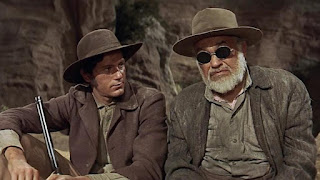
Colorado's gang also holds Inga Bergemann (Camilla Sparv) as a hostage to dissuade a chasing cavalry group from attacking. Sergeant Tibbs (Telly Savalas) is a cavalry member with his own ambitions to find the gold. A group of men from the nearby town of Hadleyburg join Colorado's treasure hunt, including Old Adams (Edward G. Robinson), who claims to have once seen the treasure before being blinded by vengeful Apaches. MacKenna does not believe the gold even exists, but has to keep himself alive long enough to escape and rescue Inga. 
Clocking in at an interminable 128 minutes, with horrifying legends of an original three hour cut, MacKenna's Gold is plagued by plastic motivations, bad casting, superfluous folksy narration, and an almost laughably inept script courtesy of producer Carl Foreman. Director J. Lee Thompson does capture majestic scenery and dazzling rock formations in Arizona and Utah, but the visual beauty is quickly trampled by atrocious pacing and unimaginative dynamics.

Within a charisma-free set of characters, the usually reliable Gregory Peck is simply disinterested, while Omar Sharif tries and miserably fails to channel Tuco. Both are not helped by remarkably juvenile dialogue in which characters threaten to kill each other in every scene.

The lowlights arrive early and frequently. The so-bad-it's-really-bad opening song Old Turkey Buzzard, incredibly composed by Quincy Jones with lyrics by Foreman, sets the stage, and the turkey reference soon proves entirely appropriate. An entire sub-cast of veteran actors, including Robinson, Eli Wallach, Lee J. Cobb, Anthony Quayle, Raymond Massey, and Burgess Meredith, is introduced with the theatrical inelegance of a stiff board meeting, before being summarily massacred in the next scene.

Director Thompson and his team of editors clumsily paste the stars into the action scenes with fuzzy and mismatched rear-projection. As part of a limp lust triangle, an entirely silent Julie Newmar as Apache woman Hesh-Ke, a member of Colorado's gang, spends the entire movie trying to kill Camilla Sparv's Inga. One of these women ends up falling to their death off an enormous cliff, but no one seems to remotely care. 

The ending features a rock formation shadow that grows longer as the sun rises, then three characters inexplicably scale an impossible-to-climb vertical cliff; two of them fight on a ledge half-way up; then all three clamber back down. The grand finale of destruction mixes a few impressive shots of collapsing rocks with plenty of atrocious miniature effects unworthy of a film school project.

It's easy to imagine MacKenna's Gold impressing ten year old boys. Everyone else starts to wonder whether Old Adams' poke-your-eyes-out fate is really all that bad.


All Ace Black Movie Blog reviews are here.

Saturday, 21 August 2021

Movie Review: Capricorn One (1977)

A conspiracy thriller about a faked Mars landing, Capricorn One is exceptionally silly and wildly entertaining.

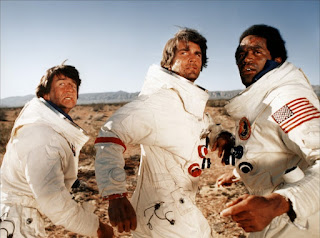
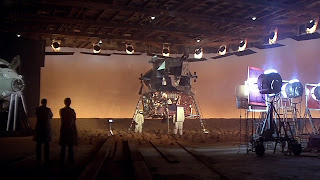
NASA is about to launch the first crewed mission to Mars. But minutes before blast-off, astronauts Brubaker (James Brolin), Willis (Sam Waterston) and Walker (O.J. Simpson) are removed from the spacecraft and hustled to a secret base in the desert, where a warehouse has been converted to a television studio with a Mars-like set. The launch proceeds without the crew, using voice recordings from earlier simulations. 

NASA's Dr. James Kelloway (Hal Holbrook) pressures the three astronauts into participating in fake studio broadcasts, pretending to be on Mars. He explains the original mission had to be scrubbed and converted to a crew-less flight due to faulty life-sustaining equipment, but admitting failure would have meant loss of funding. Brubaker, Willis and Walker reluctantly go along with the ruse, but Brubaker is uneasy about lying to his wife Kay (Brenda Vaccaro) and their young kids.

Meanwhile journalists Robert Caulfield (Elliot Gould) and Judy Drinkwater (Karen Black) are covering the mission. Caulfield receives a tip something is wrong, and starts to investigate.

Combining post-Watergate cynicism about government corruption with wild-ass conspiracy theories about faked moon landings, Capricorn One ambitiously aims for the sweet spot where unfettered collusion thrives. Writer and director Peter Hyams conjures a plot straight from a conspiracy theorists' convention floor, and with B-movie charm but a decent cast and budget, delivers a ridiculously engrossing two hours.

The details subversively reveal the lunacy of conspiracy theories, but may still be too subtle for ardent believers in the cause of nonsense. The Capricorn One conspiracy elements do not attempt to pass rudimentary scrutiny, the script requiring a roomful of the smartest scientists on the planet to not notice they are communicating with recorded messages. Over at the secret warehouse studio, the televised fakery resorts to slow-motion to simulate the lack of gravity. And between the warehouse technicians and the launchpad extraction team, Kelloway is relying on a lot of people to play along.

The group of conspirators becomes larger in the second half, when Brubaker, Willis and Walker make a run for it, split up and are stranded in the desert, hunted down by evil-looking but still cute twin helicopters. Capricorn One re-invents itself as a survival-in-the-desert adventure drama, until Elliot Gould's reporter Caulfield finally connects the dots and intervenes. 

Late in the day and in yet another sly twist, Hyams inserts Telly Savalas as acerbic crop duster Albain. His thorny dialogue exchanges with Caulfield are jagged diamonds, and the climactic chase between the two helicopters and the crop-duster biplane is executed with playful panache.

Capricorn One stays on earth, but is still a rollicking ride.


All Ace Black Movie Blog reviews are here.

Monday, 18 May 2020

Movie Review: Escape To Athena (1979)


A World War Two comedy thriller, Escape To Athena is lazy, hazy, and tonally uncoordinated.

It's 1944, and on an occupied Greek island Germany's Major Otto Hecht (Roger Moore) oversees an archeological dig. The forced labour is provided by assorted Allied prisoners of war including Professor Blake (David Niven), Sergeant Judson (Richard Roundtree), and Rotelli (Sonny Bono). Hecht is content sitting out the war and keeping some treasure for himself; Blake obliges by recycling the found artefacts to keep the dig going.

In a nearby village SS commander Major Volkmann (Anthony Valentine) is ruthlessly suppressing the population, while Zeno (Telly Savalas) is leading the local Greek resistance using the whorehouse run by Eleana (Claudia Cardinale) as his HQ. The arrival of talent show performers Charlie Dane (Elliott Gould) and Dottie Del Mar (Stefanie Powers) as new POWs at Hecht's camp adds a new dynamic. Charlie has his eyes on ancient treasure hidden at a local monastery, while Zeno is anticipating an allied invasion and has his orders to move against the occupying Germans.

Emitting the strong stench of a group vacation for underemployed Hollywood stars, Escape To Athena develops ugly blisters in the Greek sun. The Lew Grade production directed by George P. Cosmatos attempts to recreate the classic vibe of movies like The Guns Of Navarone but falls embarrassingly flat. While the setting, uniforms and vehicles hold promise, Cosmatos is never able to assemble them into anything other than settings, uniforms and vehicles waiting in vain for a breath of inspiration. Lame humour rubs against context-free action and plenty of explosions, but all momentum is lost in a stupefyingly bland opening hour.

As the parade of stars galavant across the screen, none are properly introduced or provided with anything resembling a backstory, creating an  emotional void that devours the film. And so the actors default to importing luggage from other projects. Roger Moore continues with the worst of his Bond womanizing mannerisms; Elliot Gould believes he is recreating MASH; Richard Roundtree has no idea what he is doing and gets maybe 10 words of dialogue; and Sonny Bono reads his lines off the nearest tree. Telly Savalas was not told this was a semi-comedy and plays the Greek resistance leader absolutely straight, adding to the tonal confusion.

The second half is marginally better and features three action set-pieces, slapped together but still decent: the mish mash of Allies first attack the German troops in the village; then destroy a submarine refueling depot; and finally assault a monastery high up in the mountains. And still Cosmatos' grip on the material is ghastly. At one point a group of unidentified underwater divers surface to join a battle, just because. Then for no apparent reason a massive intimidating rocket is rolled-out mid-battle complete with mirror-helmeted starship troopers in attendance. The rocket plays no meaningful role in the movie.

Of course the stuntmen do all the work, and all the explosions do not obscure Escape To Athena as a collection of random scenes cobbled together in the futile hope that the editors can create sense out of nonsense.


All Ace Black Blog Movie Reviews are here.


Wednesday, 14 June 2017

Movie Review: The Greatest Story Ever Told (1965)


A slow-moving version of Jesus' life story as described in the Gospel, The Greatest Story Ever Told lacks cinematic heart and soul. The film best resembles a well-intentioned but creatively challenged Catholic high school play on a big budget.

Jesus is born in a Bethlehem barn, in the presence of three elderly men who traveled a long distance guided by a bright star. The Roman client king Herod the Great (Claude Rains), fearing a prophecy about the birth of a great leader, orders the killing of all infants in Bethlehem, but Jesus is smuggled to safety. More than thirty years later John the Baptist (Charlton Heston) is proclaiming the imminent arrival of God's messenger, calling on all to repent and baptizing them in the Jordan river.

Jesus (Max von Sydow) appears and is baptized by John, before heading to the hills and meeting the Dark Hermit (Donald Pleasence), a personification of Satan. Jesus then returns to civilization and starts preaching his teachings of love, tolerance and humility, gaining followers including James, Matthew, and Judas (David McCallum). King Herod Antipas (Jose Ferrer) starts to hear of Jesus, his followers and his healing miracles, as does the prefect of Judaea Pontius Pilate (Telly Savalas). With Jesus' followers multiplying and his reputation spreading, King Herod and Pontius Pilate conspire to arrest him.

A grand, costly film produced and directed by George Stevens, The Greatest Story Ever Told arrived late in the cycle of Hollywood's historical epics, and helped bring to an end the popularity of the genre. For all its good intentions, the film is stiff, overly reverential, and awkwardly staged. At close to three and a half hours (there are also longer and shorter versions), it is also protracted and tiresome, with a snoozy Alfred Newman music score.

Adding to the sense of stagey aloofness, the film was shot with the single camera Cinerama process. The already slow pacing suffers from the resultant stiff character placement and interactions, with very few close-ups and characters seemingly never facing each other even when exchanging dialogue. Many scenes feature static postcard-style arrangements, and most of the film suffers from Every Spoken Word Is Important And Shall Be Recorded In A Future Film syndrome.

The film runs through most of the highlights of Jesus' life, although surprisingly his walk on water and feeding the multitudes occur off-camera. The raising of Lazarus is a highlight, but Stevens focuses on reactions rather than the event itself.

Continuing the trend previously seen in The Longest Day and How The West Was Won, Stevens employed pretty much every star name in Hollywood. A familiar face appears in almost every role, including Van Heflin, Dorothy McGuire, Martin Landau, Roddy McDowall, Michael Ansara, Carroll Baker, Angela Lansbury, Robert Loggia, Shelley Winters, Sal Mineo and Sidney Poitier. Most of the stars get one scene, and some have literally a few seconds of screen time. And it only takes about two seconds for John Wayne's cowboy drawl to ruin the film's emotional highlight.

Faring better are Max von Sydow and Charlton Heston in the two most prominent roles. von Sydow was cast because he was a relative unknown, and brings a quiet dignity to the proceedings, doing his best in difficult circumstances. Heston knows a cheesy epic when he sees one, and tears into the role of John The Baptist with venom.

The Greatest Story Ever Told is useful as a straightforward history lesson on a familiar topic, but is much less engaging as a movie.


All Ace Black Movie Blog reviews are here.

Saturday, 24 September 2016

Movie Review: The Young Savages (1961)


A tight crime and courtroom drama, The Young Savages energetically probes the culture of youth-gone-bad on the streets of Harlem.

In Harlem, three members of the Italian American street gang the Thunderbirds stab to death Roberto Escalante, a blind member of the rival Puerto Rican Horsemen gang. The three culprits are soon apprehended: Arthur Reardon is the combustible leader, Anthony "Batman" Aposto is a dimwit, and Danny diPace is still a juvenile at fifteen, escaping a broken home. Daniel Cole (Edward Andrews) is the ambitious District Attorney about to launch a campaign to become Governor. He agrees with assistant DA Hank Bell (Burt Lancaster) to charge the three boys with first degree murder and seek the death penalty.

With help from Detective Gunderson (Telly Savalas), Bell starts to put together the case. He is originally from the same Harlem neighbourhood, and in his younger days used to date Mary diPace (Shelley Winters), Danny's mother. Bell's wife Karin (Dina Merrill) holds liberal views espousing tolerance and understanding of the social conditions driving youth to violence. As Bell delves into the details of the murder and the backgrounds of the victim and the assailants, he finds more than meets the eye. But with the Puerto Rican community baying for revenge and Cole seeking the good publicity of a quick conviction, there is little room for compassion.

Directed by John Frankenheimer, The Young Savages is a gritty film, intent on seeking all sides a complex societal issue. A dramatic companion piece to West Side Story, Frankenheimer delivers a thoughtful, well-rounded exposition of the hidden factors that drive youth into trouble on the streets. What starts as a straightforward brutal murder of a helpless kid in broad daylight turns into much more, with complex and varied motivation and no easy answers.

The film draws energy from the menace of alleys dominated by wild kids engaged in their own civil war. The black and white cinematography, courtesy of Lionel Lindon, is a perfect fit for a rough Harlem dominated by dog-eat-dog sensibilities, petty turf wars and sneering youth finding a better fit among peers than at home. Bell is proud to have escaped this ghetto and believes anyone who also tries should succeed. It is ironically left to his well-bred wife Karin to prod him into seeing that not all kids will have the same opportunities, and some will be left behind to fend for themselves with knives as the primary survival tool.

The climax in the courtroom veers more towards social commentary to the detriment of pragmatic legal reality. Bell seeks to punish guilt but only in the right doses while accounting for evil intent, peer pressure and abject lack of intellect. He also tries to find space for the sensibilities of his wife, his boss and the victims' families. It is all a bit too much for one case to absorb and one attorney to deliver, and his improvisation away from a senior lawyer's discipline undermines credibility.

Burt Lancaster delivers a typically sturdy performance, ably assisted by small but precise roles from Dina Merrill and Shelley Winters. Merrill is cool and collected, almost icy, as Bell's life partner in the new world he created for himself. Winters is ruffled and frantic as the woman left behind: Bell could have been Danny's father, a scenario that Mary holds onto as her greatest achievement and he looks back on as his greatest escape. Such are the margins of life between savagery and civilization.


All Ace Black Blog Movie Reviews are here.

Saturday, 6 August 2016

Movie Review: Cape Fear (1962)


A psychological family-in-distress thriller, Cape Fear builds momentum through the sheer menace of what may happen. Robert Mitchum's domineering performance as criminal Max Cady towers over the film.

Sam Bowden (Gregory Peck) is a respected lawyer in a small town, where he lives with his wife Peggy (Polly Bergen) and young daughter Nancy (Lori Martin). Sam is suddenly confronted by Max Cady (Mitchum), a criminal released after serving eight years in prison for sexual assault. Sam's testimony was instrumental in convicting Max, and now the felon seems intent on extracting revenge.

Except that Max does nothing to break the law, satisfying himself with simply intimidating Sam, Peggy and Nancy with his sheer presence. Feeling threatened, Sam turns to his friend police chief Mark Dutton (Martin Balsam) and then private detective Charlie Sievers (Telly Savalas) to try and find a reason to either run Max out of town or arrest him. But Max is one step ahead, and he hires lawyer Dave Grafton (Jack Kruschen) to defend his rights. With Sam growing more concerned for the welfare of his family, he decides to stash Peggy and Nancy at a remote Cape Fear houseboat, but all will not go according to plan.

Directed by J. Lee Thompson, Cape Fear is a tight, exquisitely paced film, with a superb Bernard Herrmann score adding to the building sense of dread. The eternal conflict between good and bad is crystallized into the threat posed by one man against a wholesome family, and the James R. Webb script quickly etches out uncomfortable truths: the law can only go so far, and resisting evil intentions can easily drive good men like Sam Bowden into previously unthinkable actions.

The film draws its power from Max Cady's stubbornly patient ability to actually do nothing except hover around Sam and his family, breaking no laws. Max instead takes out his demented sexual aggression on call girl Diane Taylor (Barrie Chase), and does so with such ferocity that he chases her out of town rather than turn her into a witness. Instead it is Sam who starts harbouring thoughts of criminality to put an end to the perceived threat, and suddenly the potential victim turns into a budding aggressor, moving both men closer together into a grey zone of emotional turmoil.

To adhere to the sensibilities of the era Cape Fear avoid mentioning rape and paedophilia, but leaves no room for doubt. Cady is a danger to women, particularly young Nancy. Sam's rising levels of paranoia stem not out of a sense of personal danger, but his heightened awareness that he is helpless to protect his wife and daughter. Cady finds opportunities to ogle Nancy in a racy outfit at the bowling alley and then in a bathing suit; by merely walking on the sidewalk he induces a terrorizing ordeal for the young girl in the bowels of her school. Rarely has a film created such horror out of mere potentiality.

Robert Mitchum delivers one of his career best performances, fully occupying the twisted and intimidating personality of Max Cady. Thompson knows exactly what to do with Mitchum: he just let's him be, such that scenes of Cady sitting and walking near enough to the Bowdens create impeccable tension, the ever present Panama hat a symbol of a laidback approach to violence.

With a memorable psychopath leaving an indelible impression on an idyllic small town landscape, Cape Fear is a magnificently ominous thriller.


All Ace Black Blog Movie Reviews are here.

Friday, 16 May 2014

Movie Review: Violent City (1970)


A revenge thriller set in the murky world of professional assassins, Violent City is a competent Charles Bronson vehicle, combining sharp action with a dark plot and fatalistic outlook.

Assassin-for-hire Jeff Heston (Bronson) is vacationing in the Virgin Islands with glamorous girlfriend Vanessa (Jill Ireland). They are suddenly pursued by assassins in a prolonged car chase, which ends with Heston shot and left for dead by Coogan, a former business partner. To add insult to Jeff's open wounds, Vanessa flees the scene with Coogan.

Jeff recovers and endures a stint in a grimy prison after being framed for murder. Once released, he sets out to seek revenge on Coogan, an amateur racing driver, but Heston is then blackmailed by New Orleans crime boss Al Weber (Telly Savalas), and Vanessa surprisingly pops up again as Weber's wife. Weber wants Jeff to work for him, but Jeff has other ideas, and the city is about to become a lot more violent with the control of a criminal empire at stake.

Directed by Spaghetti Western veteran Sergio Sollima and with a soundtrack by Ennio Morricone, Violent City (also known as The Family) is a European production which mixes Hollywood-style action with the higher continental tolerance for cerebral reflection. Call it a Spaghetti Urban, and the results are mixed. There is an occasional whiff of an econo-thriller trying hard to be bigger than the budget and talent involved, but the overall package delivers most of the required hard edged entertainment.

With Steve McQueen having set the standard for modern car chases two years earlier in Bullitt (1968), Bronson gets his own Mustang to play with, and damn if the opening supercharged chase sequence doesn't hold its own in the all-time tire squealing stakes. Gunning down the twisty narrow streets of a Caribbean island at ridiculous speeds, Bronson leads his pursuers on a breathless race that climaxes with a dazzling climb up a long, steep set of stairs.

The other action scenes are all quite good. Jeff carefully hunting down Coogan on the race track is a well-crafted exercise in patience and imperfection, while the climax featuring an outdoor elevator brings the Spaghetti Western love of drama in death to the fore.

With Bronson effectively delivering his typical stone-faced persona, Jill Ireland supports her husband with plenty of sexy sass, Vanessa emerging as a much more complex character than the initial playmate-on-a-yacht scenes suggest. As the film progresses Sollima mixes in film noir elements, Jeff gradually realizing that the forces aligned against him are much larger than he thought, and that his heart is parked in the wrong place. Vanessa's ever-shifting allegiances and Weber's attempt to recruit Heston evoke the spirit of Out Of The Past (1947). Telly Savalas adds smarmy polish as Weber.

In the traditions of the morally ambiguous Spaghetti Westerns, there are no heroes or well-meaning characters in Violent City. The objectives are all about seizing power, gaining control and eliminating your enemies, and in a city this violent, every well-executed revenge killing is just a prelude to the next death.


All Ace Black Movie Blog reviews are here.
Saturday, 7 December 2013

Movie Review: On Her Majesty's Secret Service (1969)


An intriguing outing for James Bond, On Her Majesty's Secret Service is the first 007 adventure without Sean Connery, unknown actor and model George Lazenby stepping into the role. The film also features the agent's eternal love story, a heartfelt romance enlivened by Diana Rigg as Countess Tracy di Vicenzo.

In Europe, James Bond (Lazenby) saves a mysterious woman, later revealed to be Teresa (or Tracy) di Vicenzo (Rigg), from intentional drowning on a secluded beach. He meets her again at a casino, where he covers her reckless bet. Bond seeks out Tracy's father Marc-Ange Draco (Gabriele Ferzetti), the head of a crime syndicate attempting to transition into a semi-respected industrialist. Bond resists Draco's suggestion to marry his daughter, but does request help to identify the whereabouts of master criminal Ernst Stavro Blofeld.

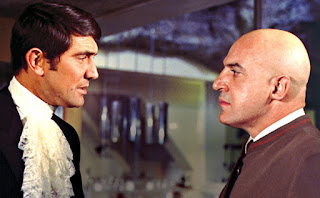
Bond learns Blofeld (Telly Savalas) has assumed the name Comte de Bleuchamp, and taken up refuge high in the Swiss Alps, apparently operating a scientific research centre to cure food allergies. Bond assumes the identity of genealogist Sir Hilary Bray and travels to the research centre ostensibly to confirm Blofeld's claim to the Compte title. He finds Blofeld protected by gunmen and the ruthless Irma Bunt (Ilse Steppat), and plotting to blackmail the world by threatening to destroy all agriculture using a bevy of beauties. After a breathless ski chase Tracy helps Bond escape, and he has to find a way to foil Blofeld while his romance with Tracy deepens.

With limited locations and a strong focus on romance, On Her Majesty's Secret Service aims for depth rather than breadth. Peter Hunt steps into directing duties after many editing assignments, and insists on staying close to Ian Fleming's original novel. The result is faithful to Fleming's vision of a conflicted, often overwhelmed, and sometimes unsure agent. Making the most of a running length extending to 140 minutes, Hunt invests the necessary time to conceive a character-driven story within a still raucous spy adventure.

Some troublesome narrative gaps do creep in. Tracy's initial excursion into the ocean, and the goons who intervene once Bond saves her, remain a puzzling mystery. Later, Bond has an opportunity to finish-off a tree-bound Blofeld, but inexplicably ignores it. But most of the other plot pieces tidily contribute to an in-depth mission. On this adventure Bond is gadget-free, and lacks support from MI6, almost walking away from his job before pursuing Blofeld on vacation time. He is frequently on the back foot, loses several battles, and requires a second try to instigate an escape. Tracy comes to the rescue as Blofeld's forces almost overwhelm Bond at the Swiss village, and still Blofeld gets the better of a chase thanks to an avalanche.

With Bond at a notable disadvantage, On Her Majesty's Secret Service most closely resembles From Russia With Love, and the insertion of George Lazenby into the role becomes strangely suitable. Lazenby often looks worried, an emotion rarely associated with Connery, but here nailing the reality of an agent cut loose from his agency and realizing his foe holds all the cards. Lazenby's overall performance is inconsistent, his stance often stooped and uncomfortable. But in face to face scenes with M, Blofeld, Draco and Tracy, Lazenby's willingness to demonstrate feelings elevates Bond to a real person rather than a superhero.

Diana Rigg finds the appeal in Tracy as a troubled, seductive and resourceful partner for Bond, a woman transitioning from rebellion against her father's dark empire to creating a positive place for herself in the world. Bond was only ever going to fall in love with a woman fighting her own set of demons and taking it out on the world, and Rigg finds the right balance between demanding independence and craving to be treasured.

The action centrepiece is the long ski pursuit down the mountains, Bond attempting to flee but unable to shake his pursuers. That Blofeld himself leads his men increases the intimacy of the conflict. This is not a villain confined to his extravagant command centre, and Telly Savalas transforms Blofeld into a take-charge-when-needed leader, personalizing the long-running duel with Bond.

Finding adventure within vulnerability, On Her Majesty's Secret Service is an invigorating ski run.


All Ace Black Movie Blog reviews are here.
Saturday, 10 November 2012

Movie Review: Birdman Of Alcatraz (1962)


The fictionalized story of Robert Stroud, a murderer who turned into a bird expert while serving a life sentence behind bars, Birdman Of Alcatraz is about the triumph of a restless but captive spirit. Burt Lancaster delivers a defining performance helping to celebrate the emergence of humanity in the face of grim austerity.

An uncompromising brute, Stroud (Lancaster) has killed a man in his home state of Alaska and is destined to spend a life in prison. His only relationship is with his mother Elizabeth (Thelma Ritter), a woman both dedicated to her son and obsessed with him. Eventually transferred to Leavenworth, Stroud quickly runs afoul of the strict rules of warden Harvey Shoemaker (Karl Malden). He kills a guard and is sentenced to death.

Elizabeth intervenes on behalf of her son and the sentence is commuted to a life of solitary confinement. While on a break in the prison yard, Stroud picks up an ailing sparrow and nurses the bird to health. One bird leads to many, and Stroud takes an interest in bird health and experiments with medications to treat their diseases. Through scientific publications his stature in the bird community grows, and he eventually meets and marries bird lover Stella Johnson (Betty Field). But Stroud's troubles continue as he is transferred to Alcatraz prison and an unwelcome reunion with Shoemaker.

A character study and a story of fledgling redemption, much of Birdman Of Alcatraz takes place in confined cells with tiny barred windows providing the only source of light. Director John Frankenheimer and his cinematographer Burnett Guffey use the black and white photography to highlight the bleakness of Stroud's life and the harshness of eternal incarceration. Within the overwhelming darkness no one is satisfied: not the guards, not the warden, and of course, not the prisoners. The captors are as depressed as their captives, and on the island of Alcatraz, even the guards' families are stranded on the same rock as the country's most hardened criminals.

Although Stroud gradually softens with age, he remains unromantacized and possessive of his jagged edges, angry and largely antisocial, a survivor achieving scientific recognition almost despite himself. Guy Trosper's screenplay offers some background exposition by hinting at a troubled childhood supervised by a frightfully domineering mother.

The fictional Shoemaker represents a formidable foe and the wall of authority that Stroud's life repeatedly crashes against. The warden carries all the morality and attachment to rules and regulations despised by Stroud, and the two men occupy different worlds cramped into the same miserable space.

Lancaster dominates the role physically and emotionally in a performance filled with passion and power, Malden countering with the circumspect arrogance of the person holding all the cards. Despite a running length of more than 140 minutes, there are surprisingly few other supporting characters surrounding Stroud's life. Ritter is icily determined as his mother, and she makes it easy to imagine the kind of upbringing that shaped his life. Betty Field as Stella offers a counterpoint positive influence. Telly Savalas as a fellow inmate at Leavenworth and Edmond O'Brien as the author Tom Gaddis, who wrote the book that popularized Stroud's story, round out the cast.

The men may be in literal or proverbial cells, but sometimes all it takes is a small helpless creature to unlock positive potential in the crustiest of hearts.


All Ace Black Blog Movie Reviews are here.

Sunday, 28 March 2010

Movie Review: Kelly's Heroes (1970)


Back in 1970, this must have seemed like a good idea: infuse modern anti-war cultural elements into a World War II movie to appeal to the hippie and flower-child audience of the day.

Hence Donald Sutherland as Oddball (indeed) is a laid-back, seemingly perpetually stoned tank commander. The rag-tag soldiers under his command are doing all they can to sit-out the war, living in a tent compound that can only be described as a hippie commune. In future Hollywood war films, characters like Sutherland and his anti-authoritarian crew make regular appearances in movies about the Korean and Vietnam conflicts. In the World War II setting of Kelly's Heroes, they are jarringly out of place. The main song of the movie, "Burning Bridges", is also straight out of the late 1960's and totally irrelevant to the World War II era.

Thankfully, Kelly's Heroes also offers Clint Eastwood as Private Kelly. Eastwood brings his typical restrained but tough persona to the war arena as the demoted Sergeant who, in the days after D-Day, stumbles onto the location of 14,000 bars of Nazi gold stored in the small town of Clermont, 30 miles behind enemy lines in France. He hatches a plan for a small force of disenchanted US soldiers to strike out on their own, defy orders, breakthrough the German lines and steal the gold from the bank where it is held. His reluctant companion is Big Joe, a Master Sergeant effectively brought to life by Telly Savalas.

As rumours of the gold spread, Kelly's small force unwittingly mushrooms into a full-fledged breakthrough of the German lines through which a large chunk of the allied army starts streaming in. What starts as a theft is transformed into a race to the bank before the American army unit arrives to liberate the town.

Kelly's Heroes is not trying to be serious, and it is does contain several memorable action sequences and some impressive explosions. Director Brian G. Hutton keeps the action moving and allows his stars time to stamp their personalities on proceedings. The final battle between Kelly's unit and the small armoured German force tasked with defending the bank is also well choreographed, with a nice blend of action and humour, and Hutton finds time to weave in a clever salute to Eastwood's Spaghetti Western roots.

Eastwood and Savalas are capably supported by a colourful cast that includes Don Rickles as a supply sergeant, and Carroll O'Connor as the General who spots the opportunity to exploit the gap created by Kelly's expedition.

Kelly's Heroes would have a made quite a solid comic-oriented war movie; the artificial imposition of a 1960's ethos unfortunately both undermines and unhinges the film. Oddball is not just the name of Sutherland's character -- it's an apt description of the movie itself.


All Ace Black Movie Blog reviews are here.

Friday, 26 March 2010

Movie Review: The Dirty Dozen (1967)


A World War II action movie, The Dirty Dozen boasts a star-studded cast thrust into a suicide mission as a ticket to freedom from incarceration.

Major John Reisman (Lee Marvin) is an anti-authoritarian US Army commander based in England in the days leading up to the D-Day Normandy invasion. He is tasked with a high-risk behind-enemy-lines-mission: train a unit composed of 12 hardened convicts to attack and destroy a chateau in France popular as a retreat for high-ranking German army officers.

From the ranks of criminals facing the death penalty or long-term sentences for violent crimes, Reisman's recruits include Wladislaw (Charles Bronson), Maggott (Telly Savalas), Franko (John Cassavetes), Pinkley (Donald Sutherland), and Jefferson (Jim Brown). They are all promised freedom in the unlikely event they survive the mission. Arduous training follows, Reisman finding his hands full with men more likely to turn on each other and on him before they ever get deployed. And despite detailed planning, the attack on the chateau will encounter unforeseen challenges.

Neatly divided into forming then storming segments, The Dirty Dozen is jovial, violent, and unafraid to take casualties. Director Robert Aldrich keeps the action moving with a straightforward and generally unobtrusive style, alternating scenes of the convicts clashing with Reisman during training with examples of their progression into a fighting unit. The training culminates in a lengthy war-game sequence where the dozen prove their resourcefulness and combat readiness.

The premise of criminals as heroes creates a natural edge. The men are intrinsically unstable, and in some cases unhinged. Instilling military discipline to pull off a dangerous mission is a mission onto itself, and the anything-can-happen tension stems both from enemy response and the men's propensity for ill-conceived improvisation.

Lee Marvin delivers a steely-eyed performance as the renegade Major appropriately given control of an insane assignment. He manages to maintain a strong hold on the core of the film, despite the many other familiar faces and loud explosions swirling all around him. Although John Cassavetes and Charles Bronson are given the most prominent roles among the convicts, Donald Sutherland, as the most intellectually challenged of the group, and Telly Savalas, as a racist woman-hating religious nut, are the most memorable. The rich cast also includes Ernest Borgnine, Robert Ryan, and George Kennedy.

The final 45 minutes of the relatively long 140 minutes of running time depict the actual raid itself, and of course nothing goes as planned. The tension, excitement, and action are continuous, and both sides suffer high casualties. Here Aldrich merges crime with war, and challenges the definition of success: German wives and girlfriends, trapped and cowering in a shelter, are not spared the ravages of battle. In return, many of the dozen will find coveted freedom in the form of dirty death.


All Ace Black Movie Blog reviews are here.