Showing posts with label Karen Black. Show all posts

Saturday, 8 February 2025

Movie Review: Cisco Pike (1971)


Genre: Drama  
Director: Bill L. Norton  
Running Time: 95 minutes  

Synopsis: In Los Angeles, former musician Cisco Pike (Kris Kristofferson) is trying to leave drug dealing behind him to rebuild his music career, with the support of his girlfriend Sue (Karen Black). But corrupt cop Holland (Gene Hackman) pressures Cisco into selling $10,000 worth of weed in less than three days. Cisco has to tap into his underworld network to move the product, leaving Sue disappointed as he interacts with dealers, users, musicians, and assorted hangers-on.

What Works Well: In his directorial debut, Bill L. Norton delves into the seedy Venice Beach area and finds desperate characters chasing unlikely dreams. In this deglamorized and downbeat quest to seek a better future, a has-been like Cisco looks for someone - anyone - to listen to his latest music tape, a crooked cop builds a massive stash of marijuana as an auxiliary income source, and Cisco's pathetic ex-bandmate Jesse (a tragic Harry Dean Stanton) confronts the horrors of aging. Kristofferson (in a solid movie debut) provides a few excellent soundtrack songs.

What Does Not Work As Well: Most of the film consists of Cisco desperately crisscrossing town looking for buyers, as energy runs low, padding creeps in (particularly in episodes featuring actresses Viva and Joy Bang), and the premise runs out of ideas. Gene Hackman's antagonist disappears for long stretches, robbing the drama of a counterpoint.

Key Quote:
Cisco Pike (to Jesse): It ain't your goddamned body they're after, man, it's your soul!


All Ace Black Movie Blog reviews are here.

Saturday, 21 August 2021

Movie Review: Capricorn One (1977)

A conspiracy thriller about a faked Mars landing, Capricorn One is exceptionally silly and wildly entertaining.

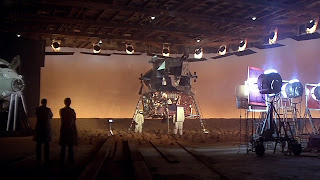
NASA is about to launch the first crewed mission to Mars. But minutes before blast-off, astronauts Brubaker (James Brolin), Willis (Sam Waterston) and Walker (O.J. Simpson) are removed from the spacecraft and hustled to a secret base in the desert, where a warehouse has been converted to a television studio with a Mars-like set. The launch proceeds without the crew, using voice recordings from earlier simulations. 

NASA's Dr. James Kelloway (Hal Holbrook) pressures the three astronauts into participating in fake studio broadcasts, pretending to be on Mars. He explains the original mission had to be scrubbed and converted to a crew-less flight due to faulty life-sustaining equipment, but admitting failure would have meant loss of funding. Brubaker, Willis and Walker reluctantly go along with the ruse, but Brubaker is uneasy about lying to his wife Kay (Brenda Vaccaro) and their young kids.

Meanwhile journalists Robert Caulfield (Elliot Gould) and Judy Drinkwater (Karen Black) are covering the mission. Caulfield receives a tip something is wrong, and starts to investigate.

Combining post-Watergate cynicism about government corruption with wild-ass conspiracy theories about faked moon landings, Capricorn One ambitiously aims for the sweet spot where unfettered collusion thrives. Writer and director Peter Hyams conjures a plot straight from a conspiracy theorists' convention floor, and with B-movie charm but a decent cast and budget, delivers a ridiculously engrossing two hours.

The details subversively reveal the lunacy of conspiracy theories, but may still be too subtle for ardent believers in the cause of nonsense. The Capricorn One conspiracy elements do not attempt to pass rudimentary scrutiny, the script requiring a roomful of the smartest scientists on the planet to not notice they are communicating with recorded messages. Over at the secret warehouse studio, the televised fakery resorts to slow-motion to simulate the lack of gravity. And between the warehouse technicians and the launchpad extraction team, Kelloway is relying on a lot of people to play along.

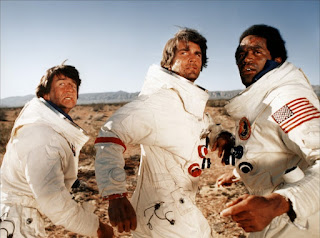
The group of conspirators becomes larger in the second half, when Brubaker, Willis and Walker make a run for it, split up and are stranded in the desert, hunted down by evil-looking but still cute twin helicopters. Capricorn One re-invents itself as a survival-in-the-desert adventure drama, until Elliot Gould's reporter Caulfield finally connects the dots and intervenes. 

Late in the day and in yet another sly twist, Hyams inserts Telly Savalas as acerbic crop duster Albain. His thorny dialogue exchanges with Caulfield are jagged diamonds, and the climactic chase between the two helicopters and the crop-duster biplane is executed with playful panache.

Capricorn One stays on earth, but is still a rollicking ride.


All Ace Black Movie Blog reviews are here.

Tuesday, 16 March 2021

Movie Review: The Day Of The Locust (1975)

A Hollywood drama, The Day Of The Locust is an acerbic yet listless condemnation of an industry's sordid underbelly.

It's the 1930s, and Tod Hackett (William Atherton) arrives in Hollywood with dreams of making it as a set design artist. He finds an apartment at the rundown San Bernardino Arms and meets his neighbours, a collection of wannabes at the margins of the movie industry. He quickly falls in love with Faye Greener (Karen Black), a vivacious extra striving for greater roles, but she rejects him. 

Faye's father Harry (Burgess Meredith) is a former small-time vaudevillian and now a door-to-door salesman in poor health, peddling a miracle cure. He collapses in the apartment of inhibited accountant Homer Simpson (Donald Sutherland), which leads to Faye and Homer starting a muted relationship.

Tod secures a job in the studio art department run by Claude Estee (Richard Dysart) and Ned Grote (John Hillerman), and never loses hope of winning Faye's heart. He meets her friends Miguel (Pepe Serna), who is involved in cockfighting, and cowboy Earle Shoop (Bo Hopkins). Tod and Faye attend a fake healing church sermon run by Big Sister (Geraldine Page), and survive a spectacular on-set calamity while filming a recreation of the Battle of Waterloo.

An adaptation of the 1939 book by Nathanael West, The Day Of The Locust attempts to shine a light on the victims of Hollywood's unforgiving culture. But the film is an overlong and momentum-free effort, a suffocatingly boring journey through the gutter of the boulevard of broken dreams. 

The riffraff characters are a collection of down-and-outs lacking self awareness and pathetically still pursuing the bright lights. They are uniformly unappealing and one-dimensional in their capacity to hit the same notes and achieve the same outcome, director John Schlesinger unable to generate sympathy or trace engaging arcs.

And so Tod expresses his love for Faye early, she makes it clear he's not good enough for her, and this dynamic remains unchanged, much like their careers are stalled in the same place. She gravitates towards accountant Homer, who may have some wealth but compensates with a vacuous personality. Donald Sutherland sleepwalks through the role with a startled, deer-in-the-headlights look, except that a deer may have more to say than Homer does.

Elsewhere the cockfighting subplot and stag film interlude offer crass symbolism about Hollywood's sex-obsessed and bloodthirsty ruthlessness, while too much time is invested in Harry Greener before he mercifully expires. Other characters including studio executive Claude Estee, excitable cowboy Earle Shop, madame Mary Dove, foul-mouthed dwarf Abe and child actor Adore (Jackie Earle Haley) may have been more prominent in early drafts, but in the final product they barely register and simply add clutter and bemusement.

The set designs are attractive, and if nothing else The Day Of The Locust is always gorgeous to look at. The drama ends with a gargoylian opera of stampedic violence, fantastical puss popping into the oblivious eye of a movie premiere. As metaphors go its an appropriately overripe ending to a bloated yet dreary spectacle.


All Ace Black Movie Blog Reviews are here.

Tuesday, 28 January 2020

The Movies Of Karen Black


All movies starring Karen Black and reviewed on the Ace Black Movie Blog are linked below:


All Ace Black Movie Blog reviews are here.
The Movie Star Index is here.

Tuesday, 18 December 2018

Movie Review: Family Plot (1976)


A comedy thriller, Family Plot is Alfred Hitchcock's final film. A pleasant enough experience enlivened by an excellent cast, the story features intersecting narratives treated with a light touch.

Blanche Tyler (Barbara Harris) is a fake psychic, milking small amounts out of desperate clients. But the elderly Mrs. Julia Rainbird (Cathleen Nesbitt) offers Blanche $10,000 if she can discreetly locate her long lost nephew who stands to gain a large inheritance. Blanche presses her boyfriend and taxi driver George (Bruce Dern) into service, and he identifies the missing man as Edward Shoebridge, who is apparently dead and buried. George also locates gas station owner Joseph Maloney (Ed Lauter), who seems to have had a keen interest in declaring Ed dead.

In the meantime, Arthur Adamson (William Devane) is a seemingly respected jeweller, but along with his lover Fran (Karen Black) runs an elaborate kidnapping scam, capturing then releasing hostages in exchange for precious diamonds. Joseph alerts Arthur that George and Blanche are investigating Edward Shoebridge's background, triggering more devious plots.

For what proved to be his final outing, Hitchcock chooses to maintain a peppy and humorous attitude. Family Plot contains no suspense or horror, almost as if Hitchcock was acknowledging his brand of wicked and sophisticated prey-on-your-fears cinema was no longer relevant in an era now offering darker psychological material such as Don't Look Now and more brutal punctuation marks as in Deliverance.

So Family Plot plays like an amateur investigative mystery engaged to a suave criminal tale. Blanche and George are a likeable scrappy and argumentative couple chasing after a dream payday by poking around the puzzle of a grave that may be empty. Arthur and Fran are smooth criminals dressed up as respectable citizens pulling off non-violent kidnappings. The two stories of course will come together, dragging along no shortage of plot holes and a void of competent law enforcement.

Screenwriter Ernest Lehman worked with Hitchcock on North By Northwest, and the most obvious look back at Hitchcock's past comes courtesy of a trouble-on-the-isolated-highway sequence, Blanche and George grappling with a sabotaged car then an attempted run-down. Even here Hitchcock chooses to inject an overdose of comedy with Blanche's histrionics inside the car defanging any attempt at invoking genuine danger.

The ensemble cast is sturdy and helps to drive the film forward. The trio of Bruce Dern, William Devane and Ed Lauter represents a strong collection of beady-eyed men up to various degrees of no good. Barbara Harris and Karen Black do their part to complete the set of greed-inspired characters.

Villainous secrets and colourful mischief intermingle around the Family Plot, but for better or for worse, the master of suspense signs off with a harmless wink.


All Ace Black Blog Movie Reviews are here.


Monday, 9 July 2018

Movie Review: Airport 1975 (1974)


An in-flight disaster movie, Airport 1975 is cheap, cheesy, and the birth ground for countless classic cliches.

Columbia Air Lines Flight 409 is a red eye from Washington to Los Angeles on board a Boeing 747. The head flight attendant is Nancy Pryor (Karen Black), who has a troubled relationship with her non-committal boyfriend Captain Alan Murdock (Charlton Heston), the airline's Chief Flight Instructor.

Captain Stacy (Efrem Zimbalist, Jr.) is in charge of the flight. The passengers include Mrs. Patroni (Susan Clark), who is the wife of the airline's Vice President for Operations Joe Patroni (George Kennedy), a couple of nuns (Helen Reddy and Martha Scott), a young girl being transferred for a kidney transplant (Linda Blair), a retired movie star (Gloria Swanson, playing herself), a trio of drinking buddies, and a heavy drinking older woman (Myrna Loy).

Meanwhile, businessman Scott Freeman (Dana Andrews) takes off in his small Beechcraft plane to fly to a meeting. Due to severe fog both flights are diverted to Salt Lake City. Freeman suffers a massive in-flight heart attack, and his out of control small plane strikes the cockpit of the 747. The flight deck crew are all incapacitated, and Nancy has to take over the controls. Over patchy radio communications, Murdock and Joe Patroni have to keep Nancy calm and find a way to help her.

Directed by Jack Smight, Airport 1975 is the first sequel to 1970's Airport. Featuring a large cast of mostly fading star names packed into the plane with really nothing to do, the film is most famous for giving life to most of the stereotypes later mercilessly exploited in 1980's Airplane!. The singing nun, the sick child, the drunk guys, the token black dudes, the fading movie diva: they are all here. As are the macho Charlton Heston and George Kennedy, barking away in loud voices at no one in particular and bumbling about trying to shout and shove their way to a solution.

The special effects are low quality, the characters are cardboard cutouts, the dialogue is laughably bad, and the female flight attendants are subjected to rampant sexism. And for a disaster movie the film is remarkably devoid of any sort of excitement, action or suspense. The mid-air collision literally takes place in the blink of an eye. What precedes the mishap is boring, and what follows mainly consists of Karen Black sitting in the Captain's chair, looking particularly cross-eyed as she follows mundane instructions over the radio.

Back in the passenger compartments the actors are up to nothing in particular, and even Linda Blair as the young transplant patient does not appear unduly concerned. Just when you need the devil to show up and add some head-spinning carnage and turbulence-induced vomit to a movie, he is nowhere to be found.


All Ace Black Blog Movie Reviews are here.


Saturday, 5 May 2018

Movie Review: Five Easy Pieces (1970)


A character study drama, Five Easy Pieces looks at the lost promise of youth through the lens of a man who has simply stopped caring.

Bobby (Jack Nicholson) is a disenchanted blue collar labourer working on oil derricks in the California desert. Once a talented pianist, Bobby comes from an artistic family but has frittered away his life. He generally cares about nothing, repeatedly cheats on his girlfriend Rayette (Karen Black), and fights with his only friend Elton (Billy "Green" Bush). Despite being repeatedly victimized by Bobby's attitude and infidelity, Rayette always allows herself to be charmed back into his arms.

Bobby's sister Partita (Lois Smith) informs him that their father is very sick. He heads out on a road trip with Rayette to the family home in rural Washington State, where he finds his father in a catatonic state but is nevertheless immediately entranced by his brother's fiancee Catherine (Susan Anspach).

Directed by Bob Rafelson, Five Easy Pieces is a bleak look at manhood in crisis. Powered by a potent Jack Nicholson performance thriving in Bobby's emotional scorched earth policy, the film is an unblinking look at a life draining away. While it's almost impossible not to stand and stare as Bobby disappears into his own vacuum, Five Easy Pieces also suffers from the pungent unlikability of a leading character who does everything wrong on the way to doing nothing at all.

The pattern is set early, with Bobby dismissive of Rayette, unable to commit to anything, and generally settling for stubbornly satisfying his base instincts to the detriment of his long term happiness. Rafelson's narrative conundrum is where to take Bobby when he starts at the bottom, and the answer runs around in the repetitive circles of mistreating Rayette and winning her back.

A couple of key scenes break the monotony. Stuck in a highway traffic jam, Bobby climbs into the back of a small truck hauling furniture and starts playing the piano, offering a glimpse of how his gumption could have been channeled in the right directions. And later on the road trip, he tangles with a diner waitress in a battle of wits resulting in a Pyrrhic victory. Even when ordering breakfast, Bobby demands to be right at the expense of being successful.

László Kovács adds some excellent cinematography, capturing industrial vistas against spectacular skies, while Rafelson sprinkles some touches of humour, including a filth-obsessed random traveler who joins part of the road trip.

But the plot deficiencies are difficult to completely cover up. The reasons behind the disintegration of Bobby's life are only tangentially hinted at, his crippled relationship with his father a possible crucial fork in the road of his past life. But now Bobby is empty on the inside and only capable of boorish behaviour, a man with nowhere to go except deeper into the desolation of his own making.


All Ace Black Movie Blog reviews are here.