Showing posts with label David McCallum. Show all posts

Friday, 6 May 2022

Movie Review: How To Steal The World (1968)

A low-budget spy adventure, How To Steal The World is devoid of wit but stocked full of bad special effects and disinterested acting.

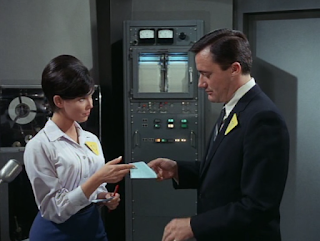
Near Macau, UNCLE agents Napoleon Solo (Robert Vaughn) and Ilya Kuryakin (David McCallum) fail to capture THRUSH leader Mr. Webb (Peter Mark Richman), who escapes with the help of Margitta Kingsley (Eleanor Parker). She is the wife of UNCLE agent Robert Kingsley (Barry Sullivan), who soon disappears. Solo and Kuryakin are dispatched to investigate.

From his headquarters in the Himalayas, Robert has hatched a well-intentioned plan to eliminate world violence by releasing a docile gas. He assembles seven renowned scientists to help perfect the formula, and hires General Harmon (Leslie Nielsen) to provide base security. Unbeknownst to Robert, Mr. Webb and Margitta are monitoring his every move on behalf of THRUSH, waiting to pounce and usurp his world domination plans.

The eighth and final feature film cobbled together from television episodes of The Man From UNCLE, How To Steal The World is a tired affair, operating well past the series' best-by date. The hallmark joie de vivre is gone, replaced by a sense of fatigue. Vaughn and McCallum go through the motions with robotic indifference, Solo and Kuryakin rarely actually doing anything other than offering themselves as targets. The clever banter and winks of humour are replaced by long stretches of silence, the Norman Hudis script apparently not even trying. 

The rest of the cast members operate in bland or over-animated modes, while Eleanor Parker manages both, lounging on her back when she's not vamping for the camera. Leslie Nielsen as the general eager to create peace through violence is too far removed from reality to classify as either intentionally funny or unintentionally awful.

The story is an over-complicated and still nonsensical control-the-world plot cluttered by too many scientists donning monk robes (?), while THRUSH adds a muddled conspiracy on top of a conspiracy. Worse of all are the truly atrocious visual effects, director Sutton Roley frequently inserting stock footage whenever a shot is too expensive for the television-level budget. The discontinuous, jarring, and cheesy results start to carry dangerous echoes of none other than Plan 9 From Outer Space. 

Lacking even Jerry Goldsmith's music, How To Steal The World is a lesson in incompetent opportunism.


All Ace Black Movie Blog reviews are here.

Friday, 11 March 2022

Movie Review: One Spy Too Many (1966)

A lightweight spy adventure, One Spy Too Many mixes thrills with wit on a low budget.

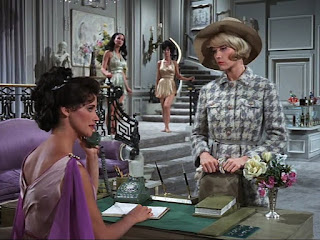
A United States military base is infiltrated by henchman Parviz (David Sheiner). He helps his megalomaniac industrialist boss Alexander (Rip Torn) steal a new chemical weapon that eliminates the will to fight. Agents Napoleon Solo (Robert Vaughn) and Illya Kuryakin (David McCallum) of the United Network Command for Law and Enforcement (U.N.C.L.E.) are dispatched by their boss Waverly (Leo G. Carroll) to investigate and retrieve the stolen gas.

They cross paths with Alexander's soon-to-be-ex-wife Tracey (Dorothy Provine), who is also hunting down Alexander to have him sign divorce papers and retrieve a million dollars he owes her. Tracey tags along with Solo and Kuryakin on a journey to Greece, where they encounter shady archaeologist Kavon (David Opatoshu), and uncover Alexander's plot to subjugate an Asian country as a first step towards ruling the world.

Director Joseph Sargent mushes together two episodes from The Man From U.N.C.L.E. television series, adds some saucy scenes of sexy flirtation, and emerges with a James Bond knock-off theatrical release. The third in the U.N.C.L.E movie series, One Spy Too Many never takes itself seriously, and the lighthearted attitude works. This is a fun adventure with bright ideas and sharp elbows, despite all the shortcomings.

The television origins are obvious, starting with the boxy aspect ratio. The sets look cheap, the evil plot is barely explained and jumps around between various disconnected objectives, and the action scenes are clumsily staged. The threat of violence is always more implied than real, and indeed Solo and Kuryakin make it through the film with a minimal infliction of bodily harm.

But plenty of fun can be found in many corners. Rip Torn is a worthy villain as Alexander (wanting to be Great), his low-key performance doing more with less, and Alexander's obsession with violating the Ten Commandments is a nice touch. His sidekicks and fellow bad guys are memorable, including the resourceful Parviz and muscleman Ingo (Cal Boulder). A life-sized chess match between Alexander and Solo using human pieces is clever. Solo and Kuryakin find themselves in plenty of good and humorous mortal danger: Solo is tied to a table in readiness for bifurcation, while Kuryakin first has to dodge lethal farm equipment then endures mummification.

Dorothy Provine is intentionally irritating in a Doris Day-type role as the extra and unneeded spy. The true infusion of sex appeal arrives courtesy of Yvonne Craig as U.N.C.L.E's omnipresent "control", intent on attracting Solo's attention, and Donna Michelle as a seductive princess. 

One Spy Too Many lacks polish, but embraces scrappy swagger.


All Ace Black Movie Blog reviews are here.
Wednesday, 14 June 2017

Movie Review: The Greatest Story Ever Told (1965)


A slow-moving version of Jesus' life story as described in the Gospel, The Greatest Story Ever Told lacks cinematic heart and soul. The film best resembles a well-intentioned but creatively challenged Catholic high school play on a big budget.

Jesus is born in a Bethlehem barn, in the presence of three elderly men who traveled a long distance guided by a bright star. The Roman client king Herod the Great (Claude Rains), fearing a prophecy about the birth of a great leader, orders the killing of all infants in Bethlehem, but Jesus is smuggled to safety. More than thirty years later John the Baptist (Charlton Heston) is proclaiming the imminent arrival of God's messenger, calling on all to repent and baptizing them in the Jordan river.

Jesus (Max von Sydow) appears and is baptized by John, before heading to the hills and meeting the Dark Hermit (Donald Pleasence), a personification of Satan. Jesus then returns to civilization and starts preaching his teachings of love, tolerance and humility, gaining followers including James, Matthew, and Judas (David McCallum). King Herod Antipas (Jose Ferrer) starts to hear of Jesus, his followers and his healing miracles, as does the prefect of Judaea Pontius Pilate (Telly Savalas). With Jesus' followers multiplying and his reputation spreading, King Herod and Pontius Pilate conspire to arrest him.

A grand, costly film produced and directed by George Stevens, The Greatest Story Ever Told arrived late in the cycle of Hollywood's historical epics, and helped bring to an end the popularity of the genre. For all its good intentions, the film is stiff, overly reverential, and awkwardly staged. At close to three and a half hours (there are also longer and shorter versions), it is also protracted and tiresome, with a snoozy Alfred Newman music score.

Adding to the sense of stagey aloofness, the film was shot with the single camera Cinerama process. The already slow pacing suffers from the resultant stiff character placement and interactions, with very few close-ups and characters seemingly never facing each other even when exchanging dialogue. Many scenes feature static postcard-style arrangements, and most of the film suffers from Every Spoken Word Is Important And Shall Be Recorded In A Future Film syndrome.

The film runs through most of the highlights of Jesus' life, although surprisingly his walk on water and feeding the multitudes occur off-camera. The raising of Lazarus is a highlight, but Stevens focuses on reactions rather than the event itself.

Continuing the trend previously seen in The Longest Day and How The West Was Won, Stevens employed pretty much every star name in Hollywood. A familiar face appears in almost every role, including Van Heflin, Dorothy McGuire, Martin Landau, Roddy McDowall, Michael Ansara, Carroll Baker, Angela Lansbury, Robert Loggia, Shelley Winters, Sal Mineo and Sidney Poitier. Most of the stars get one scene, and some have literally a few seconds of screen time. And it only takes about two seconds for John Wayne's cowboy drawl to ruin the film's emotional highlight.

Faring better are Max von Sydow and Charlton Heston in the two most prominent roles. von Sydow was cast because he was a relative unknown, and brings a quiet dignity to the proceedings, doing his best in difficult circumstances. Heston knows a cheesy epic when he sees one, and tears into the role of John The Baptist with venom.

The Greatest Story Ever Told is useful as a straightforward history lesson on a familiar topic, but is much less engaging as a movie.


All Ace Black Movie Blog reviews are here.