Showing posts with label Shelley Winters. Show all posts

Saturday, 18 October 2025

Movie Review: City On Fire (1979)


Genre: Disaster Thriller  
Director: Alvin Rakoff  
Starring: Barry Newman, Susan Clark, Shelley Winters, Leslie Nielsen, Ava Gardner, Henry Fonda, James Franciscus  
Running Time: 106 minutes  

Synopsis: A disgruntled ex-employee sabotages an oil refinery, causing a massive firestorm that consumes the adjacent city. Mass casualties ensue, and among those caught in the flames are a heroic doctor (Barry Newman), the corrupt Mayor (Leslie Neilsen), a wealthy benefactor (Susan Clark) who has a relationship with both, a dedicated nurse (Shelley Winters), an alcoholic television news personality (Ava Gardner), her producer (James Franciscus), and the city's Fire Chief (Henry Fonda). Evacuating the main hospital becomes a focal point of rescue efforts.

What Works Well: The opening scenes are standard and inoffensive in attempting to set the context, and the set-on-fire stunt performers are excellent.

What Does Not Work As Well: This Canadian production is a dreadful attempt to join the tail end of the 1970s disaster movie parade. Almost hilariously bad but often just painful, the writing and acting are atrocious, with numerous lines of dialogue quotable as tone-deaf treasures. Leslie Neilsen unintentionally practices for his impending niche, but Henry Fonda (reciting his lines with a dead-eyed lack of conviction) and Ava Gardner (overplaying the drunken schtick) jointly win the most embarrassing prize. The production values and special effects betray a limited budget, while the final hospital evacuation sequence takes forever, and mostly features extras.

Key Quote:
Fire Chief: All it takes is one man, could be anybody... your neighbor, my neighbor... one man to destroy a city.


All Ace Black Movie Blog reviews are here.

Saturday, 16 March 2024

Movie Review: Cry Of The City (1948)


Genre: Noir Crime Drama  
Director: Robert Siodmak  
Starring: Victor Mature, Richard Conte, Shelley Winters, Debra Paget  
Running Time: 95 minutes  

Synopsis: Criminal Martin Rome (Richard Conte) is badly wounded and in police custody after killing a cop in a botched robbery. Police Lieutenant Vittorio Candella (Victor Mature) was Martin's childhood friend, and now questions him about another heist involving precious jewelry. Slimy lawyer Niles (Berry Kroeger) wants Martin to confess to the jewelry theft, which would implicate Martin's lover Teena Ricante (Debra Paget). She becomes the target of a police hunt, and Martin plots an escape to reveal the truth. 

What Works Well: A textured script (by Richard Murphy and Ben Hecht) is full of ambiguous motivation layers supplementing director Robert Siodmak's investment in doomed noir fundamentals. Martin Rome is identified early as a cop killer destined for the electric chair, but emerges as a complex protagonist driven by an unlikely love and willing to do the dirty work for others. Shady characters lurk in every corner, including Niles the lawyer, Brenda (Shelley Winters) the midnight lady, a shifty prison trusty (Walter Baldwin), a foreign doctor (Konstantin Shayne) providing questionable services, and Martin's impressionable younger brother Tony (Tommy Cook). Towering over them all is a giant masseuse (Hope Emerson) who redefines "handful". Emotional ties are woven through a friendship-from-childhood between Lieutenant Candella and Martin's family, adding nuance to some gorgeously filmed New York nighttime streetscapes.

What Does Not Work As Well: The characters just keep on coming - late into the third act, Siodmak is still finding new people and new places to introduce. And in a packed agenda, the editing and pacing demonstrate a tendency to overemphasize minor points.

Conclusion: The city's cry echoes with dazzling desperation.


All Ace Black Movie Blog reviews are here.

Saturday, 4 November 2023

Movie Review: Odds Against Tomorrow (1959)


Genre: Crime Drama
Director: Robert Wise
Starring: Harry Belafonte, Robert Ryan, Ed Begley, Shelley Winters, Gloria Grahame
Running Time: 95 minutes

Synopsis: Disgraced ex-cop Burke (Ed Begley) recruits ex-con Slater (Robert Ryan) and indebted gambling addict Johnny Ingram (Harry Belafonte) for a bank robbery job. Slater is unhappily attached to Lorry (Shirley Winters) and eyeing neighbour Helen (Gloria Grahame). Johnny is under pressure to repay his debts while trying to be a father to a young daughter and attempting to win back ex-wife Ruth (Kim Hamilton). Slater is a racist and resents partnering with the black Johnny for the robbery, but desperation forces them together.

What Works Well: A commitment to deep character focus results in an engrossing human-centred crime drama. Director Robert Wise and writer Abraham Polonsky (blacklisted at the time) adapt the William P. McGivern novel with emphasis on emotional despair and inner demons driving men to crime. Johnny is a flawed but sympathetic nightclub performer trying to be a family man, but even the more despicable Slater is rounded into a full-fledged person, thanks to a lived-in Robert Ryan performance. Wise uses close quarters and close-ups to convey hardship, complemented by exceptionally crisp cinematography (courtesy of Joseph C. Brun) and an evocative John Lewis jazz score.

What Does Not Work As Well: The wait for the actual heist is quite long, and once it arrives, it's a slipshod mess of non-planning and animosity.

Conclusion: A portrait of the men behind the crimes that rarely pay.


All Ace Black Movie Blog reviews are here.

Friday, 30 June 2023

Movie Review: Cleopatra Jones (1973)


Genre: Blaxploitation Action
Director: Jack Starrett
Starring: Tamara Dobson, Shelley Winters, Bernie Casey, Antonio Fargas
Running Time: 89 minutes

Synopsis: In Turkey, American Special Agent Cleopatra Jones (Tamara Dobson) oversees the destruction of a poppy field. In Los Angeles, drug cartel leader Mommy (Shelley Winters) retaliates by instigating a police raid on a black youth charity house. Cleopatra reunites with her lover Reuben (Bernie Casey) and uses her martial arts skills to target Mommy's operation, including numerous goons, corrupt cops, and a distribution gang run by Doodlebug (Antonio Fargas).

What Works Well: The statuesque protagonist proudly displays a succession of stunning outfits and hair styles. Most black characters are portrayed sympathetically, and with villain Mommy squaring off against Jones, the female empowerment message is strong on both sides of the law. Director Jack Starrett stages a decent car chase and nudges the vibe in less-than-serious directions, accompanied by a serviceable music score.

What Does Not Work As Well: Tamara Dobson is more a model than an actress, and creates a talent void at the film's core. Most of the acting is depressingly appalling, led by a Shelley Winters performance that starts over-the-top and races towards a full-on cartoon character. The martial arts action scenes are stiff, the production looks cheap, and the editing often lacks fluidity. Little about the plot passes basic scrutiny, and most of the one-liners fall on the wrong side of cringey.

Conclusion: A choppy salute to worthy causes.


All Ace Black Movie Blog reviews are here.

Saturday, 16 October 2021

Movie Review: Winchester '73 (1950)

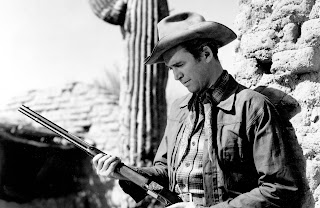
A revenge western adventure, Winchester '73 enjoys a rich set of characters and multiple story lines connected by a prized rifle.

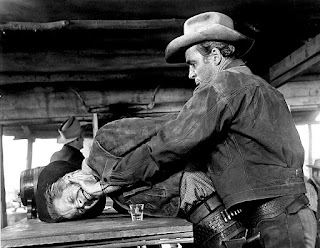
Lin McAdam (James Stewart) and his friend High-Spade Frankie Wilson (Millard Mitchell) track down Dutch Henry Brown (Stephen McNally) in Dodge City. Lin has a personal revenge motive and wants Dutch dead, but marshal Wyatt Earp (Will Geer) seizes all weapons in the name of law and order. Instead, Lin and Dutch compete in a target shooting competition, with a coveted Winchester '73 rifle as the prize.

Lin: Awful lot of law for a little cowtown.
Wyatt: This is the kind of cowtown that needs a lot of law.

Lin wins the competition but Dutch seizes the rifle and scampers out of town. Dutch is headed to Tascosa, but along the way he loses the rifle in a poker game to weapons trader Joe Lamont (John McIntire). Lin persists in hunting down Dutch, and still ahead are encounters with Indian leader Young Bull (Rock Hudson), saloon girl Lola Manners (Shelley Winters) and her fiance Steve (Charles Drake), an inexperienced cavalry squad led by Sergeant Wilkes (Jay C. Flippen), and reckless criminal Waco Johnnie Dean (Dan Duryea), the fastest gun in Texas.

The first collaboration between star James Stewart and director Anthony Mann, Winchester '73 provides Stewart an opportunity to harden his image. Intent on revenge, capable of violence, and undeterred by any obstacle, Lin McAdam is a template for a redefined, morally more vague and much more interesting western protagonist. He has purposefully entered a moral grey zone by seeking vengeance the old fashioned way, but he comes from an honourable background and may still find a pathway to future domesticity.

The eloquent and witty script by Borden Chase and Robert L. Richards provides rich surroundings for a complex adventure. The rifle, marketed as "The Gun That Won The West", is a clever plot device, regularly changing hands and at some point owned by all the character types associated with the frontier: lawmen, criminals, Indians, cowards, traveling salesmen and soldiers. 

Dutch: Haven't I seen you somewhere?
Lola: I've been somewhere.

The episodic structure works in the movie's favour. The revenge story provides an arc, but otherwise Fleischer never reveals where the action will move to next, and even Lin's quest contains twisty revelations. Notable characters are introduced late, act unpredictably, and some meet an abrupt demise. Other than the drawn-out target shooting competition, the pacing is brisk, and the drama alternates between showdowns, edgy dialogue interactions, and soulful reflections. William H. Daniels contributes crisp black and white cinematography, while editor Edward Curtiss strives for coherence during the many action scenes.
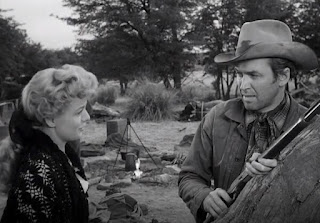
And as much as Lin is a memorable protagonist and Dutch a worthy villain, Winchester '73 is stocked full of other colourful characters brought to life by a stellar cast making the most of limited screen time. Millard Mitchell as High-Spade is not only a loyal friend but also a sage conscience, keeping an eye on Lin's pursuit of vengeance and always reminding him of his essence. 

High-Spade, referring to Lin's father: Did you ever wonder what he'd think about you hunting down Dutch Henry?
Lin: He'd understand. He taught me to hunt.
High-Spade: Not men. Hunting for food, that's alright. Hunting a man to kill him? You're beginning to like it.
Lin: That's where you're wrong. I don't like it. Some things a man has to do, so he does 'em.

Will Geer offers a unique and impressively laid-back take on Wyatt Earp, while John McIntire as weapons trader Joe Lamont exerts dominant authority even when outnumbered by Dutch and his ragtag men. Sergeant Wilkes is new to the west, and Jay C. Flippen affords him the curiosity to learn from Lin and High-Spade, even as the trio discover they met before on a different battlefield. And then Dan Duryea arrives to steal the back-end of the movie as the over-energized Waco Johnnie Dean.

Waco: What was I saying?
Lola: You were talking about yourself.
Waco: Where did I stop?
Lola: You didn't. But you can now. I already know all about Waco Johnny Dean, the fastest gun in Texas.
Waco: Texas? Lady, why limit me?


Shelley Winters enjoys some good lines but otherwise suffers as the only woman in world defined by men. Rock Hudson is an unconvincing Indian leader and Tony Curtis has a small role as a member of the cavalry who briefly gets to hold the rifle.

A formidable weapon, Winchester '73 is owned by many, but only rests in rightful hands.



All Ace Black Movie Blog reviews are here.

Monday, 26 April 2021

Movie Review: A Place In The Sun (1951)

A romantic tragedy, A Place In The Sun explores the promise and pitfalls of the American Dream through the story of a man intent on ascending from rags to riches.

Brought up poor by missionary parents, penniless George Eastman (Montgomery Clift) arrives in the city dominated by the Eastman business of his uncle Charles (Herbert Hayes). Put to work on the bathing suit assembly line to learn the ropes, George catches the eye of production worker Alice Tripp (Shelley Winters). They start a romance, despite strict rules forbidding the Eastmans from liaising with lowly workers.

It's not long before Alice is pregnant and leaning on George to fund an abortion or get married. But his attention has shifted. Now in a more senior role at work, he is mesmerized by wealthy socialite Angela Vickers (Elizabeth Taylor) and they are soon madly in love. She introduces him to her parents and the countryside elites, and he appears close to being accepted as a member of the influential class. But the increasingly desperate Alice represents a serious obstacle, and George starts to consider drastic solutions.

An adaptation of the 1925 novel An American Tragedy by Theodore Dreiser, A Place In The Sun is an elegantly mounted and torrid drama. Producer and director George Stevens, working from a script by Michael Wilson and Harry Brown, seeks the passionate, sometimes tortured, drive for success within an initially humble man, drawing out a hardening resolve to ditch the past and embrace the glittering symbols of success.

This is a representative story of a nation's pursuit of happiness, but George does not invest the effort to earn his shot at success. Promoted because of the family name, he does little to justify advancement. Indeed, he struggles to hold a conversation or even look comfortable, his deep-rooted sense of inferiority forged by a difficult upbringing. 

George's desire for betterment is ignited by an infatuation that turns to love, and it helps that Elizabeth Taylor, all of 17 at the time of filming, creates in Angela Vickers an alluring woman and welcoming gateway to a different future. The perfect anti-dote to Montgomery's haunting performance filled with physical discomfort and emotionally awkward despondency, Taylor's Angela represents the promise of leisure, horseback riding, motorboat frolicking and cocktail parties, a world apart from where and how George grew up.

But his luggage is heavy, both in terms of the hesitancy in his soul and the consequences of his ill-considered affair with Alice, now a full fledged albatross around his neck. In the final act the drama extends into the courtroom, Stevens exploring what it means to be guilty and the sharp lines always safeguarding the rich and discarding wannabes to a fate defined by character flaws.

The black and white cinematography courtesy of William C. Mellor is stellar, and Stevens deploys soft dissolves and superimposed imagery to bore into George's psyche. Some of the stylistic touches are groundbreaking, including an isolated radio on a pier broadcasting grim news while the rich enjoy their motorboat fun.

Some are born into A Place In The Sun, others earn it, but most pretenders struggle to escape the anonymity of the shadows.


All Ace Black Movie Blog reviews are here.

Tuesday, 18 June 2019

Movie Review: The Night Of The Hunter (1955)


A thriller fable about the clash between good and evil, The Night Of The Hunter combines child-level fantasy with religion-tinged intimidation and a majestic visual style.

During the Great Depression, self-appointed Reverend Harry Powell (Robert Mitchum) roams the rural United States, preying on widowed women, stealing their money and killing them.

Farmer Ben Harper (Peter Graves) kills two men during a robbery and escapes with $10,000 to help feed his family. With the police in hot pursuit, Ben hides the stolen money in a secret location known only to his young children John and Pearl (Billy Chapin and Sally Jane Bruce) and is then arrested.

Harry serves a short sentence for car theft and meets Ben in prison, learning about the stolen cash. After Ben's execution for murder, Harry charms Ben's widow Willa (Shelley Winters) and soon marries her. He tries to extract information about the money's hiding place from the children, but John and Pearl are resilient and resourceful, and will eventually receive help from the kindly Rachel Cooper (Lillian Gish).

In his one and only directorial outing, actor Charles Laughton crafts a creepy children-in-peril thriller packed with noir stylistic elements. Written by James Agee as an adaptation of Davis Grubb's 1953 book which in turn was inspired by real murderer Harry Powers, the film is a visual treat. Many scenes are frame-worthy and look simply gorgeous, with brilliant use of silhouettes and lighting, the background often as important as the foreground, many frames staged with a stunning eye for visual excellence.

With LOVE tattooed on his right fist fingers and HATE on the left, Harry Powell is one of the slimiest and persistent villains to haunt the big screen. Robert Mitchum's laid back style is perfectly matched to the character's lackadaisical manner, as Powell hunts the weakest of the weak, targeting widows and children as they scrape to survive during an economic meltdown. And he does it all while spouting religious drivel both to gain instant societal respect and to intimidate the uninformed.

And yet this is a fairytale, and Laughton pulls back ever so slightly on the menace factor whenever it threatens to become too serious. Nature's quiet observance, represented by the stunning montage of animals overseeing a crystalline boat trip, ensures balance is maintained no matter how desperate the situation appears. The children's conflicted purity proves equal to Reverend Powell's sinister threat, and other forces of good in the form of Rachel Cooper will line up on their side to even out the battle.

Cooper is a genuinely devout woman, and Agee's astute script reveals the two sides of religion. Powell deploys doctrine for manipulation and personal gain, while Rachel dedicates her life to charity and helping others during desperate times.

The Night Of The Hunter stands unique as a dark story of disguised evil unleashed on the unsuspecting land, both a parable about economic devastation and a reaffirmation of the good and bad dichotomy within the human condition.


All Ace Black Blog Movie Reviews are here.

Wednesday, 19 December 2018

Movie Review: Lolita (1962)


A story of hebephilia as recounted by the predator, Lolita walks a fine line in creating a credibly monstrous man and surrounding him with competing carnal impulses.

In a prologue, college teacher Humbert Humbert (James Mason) invades the home of filmmaker Clare Quilty (Peter Sellers). The two men engage in an argument, Humbert accusing Quilty of ruining his life before shooting him dead.

In flashback to four years prior, divorced writer Humbert arrives from Europe to the New Hampshire boarding house of widow Charlotte Haze (Shelley Winters), where he plans to spend the summer before starting a teaching job in Ohio. Charlotte immediately sets her eyes on Humbert, but he prefers younger lovers and is smitten by her teenaged daughter Dolores, nicknamed Lolita (Sue Lyon). He endures Charlotte's obvious advances while writing scandalous fantasies in his diary about her daughter.

Lolita herself is rebelling against her mother and interested in seducing Humbert as well as enjoying the company of other boys. Charlotte senses her daughter is a threat and sends her off to summer camp. Humbert marries Charlotte as a convenient ruse to stay close to Lolita, but soon realizes he cannot tolerate his new wife. She discovers his diary, setting off events that allow Humbert and Lolita to indulge their lust while he attempts to control every aspect of her life.

Directed by Stanley Kubrick from an initial script treatment by Russian author Vladimir Nabokov adapting his own 1955 novel, Lolita's remarkable achievement is that the film got made at all, given the cinematic constraints of 1962. Kubrick threads the needle by casting newcomer Sue Lyon (15 years old by the time filming wrapped; the novel's Lolita is 12), never mentioning the girl's age, and using whispers and innuendo to set up the central seductions and fading to black at just the right moments.

The story tackles issues of lust, obsession, jealousy, possession and layers of lying. Humbert is the narrator, and the enigma created by Nabokov resides in the natural willingness to sympathize with a storyteller who in this case is preying on a young adolescent. Kubrick elicits a perfect performance out of James Mason, the actor finding the creepiness in Humbert's sick pursuit of Lolita, his obsession emanating from a rotten core and eating away at his soul. The thin strands of sympathy are woven out of Lolita's willingness to engage as a seductress herself, and gradual revelations of other twisted agendas.

The character of Clare Quilty is expanded from the book, and riding on an unforgettable Peter Sellers performance the slimy artist/filmmaker emerges as the dark Humbert's even darker double. A combination of guilty conscience, dogged rival and sinister shadow, Quilty appears at key moments to engage with Humbert, offering opportunities to pause and retreat or dive deeper into the moral abyss.

Despite the rich content, the running length of 152 minutes is excessive. After the initial pursuit and seduction, the second half sags into the slow motion wreckage of a mutually destructive relationship, Humbert's incessant determination to control Lolita blinding him to his emotional downfall. Kubrick prolongs a few scenes longer than needed, and some of the shouting matches descend into tiresome theatricality.

Confronted by Mason and Sellers in fine form, Shelley Winters and Sue Lyon hold their own. Winters as Charlotte oozes desperation to find her man, throwing herself physically and emotionally at a stranger she knows nothing about. Lyon is a revelation, her Lolita standing up to all the adults in the room, strategically advancing and retreating as she schemes her way to some form of salvation.

An exploration of insidious functional derangement, Lolita is thought provoking, disturbing and fascinating.


All Ace Black Blog Movie Reviews are here.

Saturday, 16 September 2017

Movie Review: Saskatchewan (1954)


A fairly routine Western, Saskatchewan (also clumsily known as O'Rourke Of The Canadian Mounted) examines tensions with native tribes from the Canadian perspective.

The setting is Western Canada in the 1870s. Thomas O'Rourke (Alan Ladd) was orphaned as a child and raised by the peaceful Cree tribe. Now a member of the Mounted Police, he is a soul brother of Cajou (Jay Silverheels). Together they stumble across Grace Markey (Shelley Winters), the only survivor of an attack on a wagon convoy by the aggressive American Sioux tribe. Empowered by their recent stunning victory over General Custer, the Sioux are planning to expand their influence northwards.

O'Rourke clashes with his new stuffy commander Benton (Robert Douglas), whose hard-nosed approach to the Cree creates an opening for the Sioux to bait the Cree into a warmongering alliance. Meanwhile US Marshall Carl Smith (Hugh O'Brian) arrives to arrest Grace, who is accused of killing her lover, who happened to be Smith's brother. With help from good natured scout Batouche (J. Carrol Naish), O'Rourke has to figure out a way to avoid a bloodbath and broker peace when all around him are agitating for a fight.

Filmed in rich, gorgeous colour in Banff National Park, Alberta, and directed with galloping efficiency by Raoul Walsh, Saskatchewan is proficient and also rather uninspired. Unlike the scenery, the characters are for the most part monochromatic, and the stock dialogue is delivered in clipped, read-the-damned-lines mode. Shelley Winters serves up flagrant sex appeal in low cut tops, her sub-plot stuck in neutral as O'Rourke bashes Marshall Smith at regular intervals to demonstrate turf supremacy.

Walsh does better staging the larger action scenes, finding enough extras for impressive legions of Mounted Police in resplendent but not-safe-for-battle redcoats and native tribes to stalk each other and occasionally charge. Despite a couple of impressive explosions the bloodshed is kept to respectable levels, the film's premise hinging on highlighting the relatively better relationships built with the natives in Canada compared to the United States.

In addition to the various levels of enmity between the white man and the natives, there is also enough within the main plot to tease out rivalries between different tribes as well as tensions inside the RCMP as clueless by-the-book commanders ignore the wisdom of trail-smart troops. Walsh rides his story to a climax somewhere between rousing and clunky, but the real highlight comes earlier in a most Canadian wrinkle for a standard western: a canoe chase.


All Ace Black Blog Movie Reviews are here.


Tuesday, 13 December 2016

Movie Review: The Poseidon Adventure (1972)


An epic disaster-at-sea story, The Poseidon Adventure helped to ignite the 1970s catastrophe movie cycle and is one of the best examples of the genre.

It's New Year's Eve, and the ocean liner S.S. Poseidon is on a journey from New York to Athens. The passengers include fiery Reverend Frank Scott (Gene Hackman), who has a frayed relationship with the Church and encourages individuals to strongly believe in themselves first. Just after midnight an underwater earthquake in the Mediterranean unleashes a massive wave, and despite the best efforts of Captain Harrison (Leslie Nielsen), the Poseidon is struck and turned upside down, still barely afloat. The surviving passengers in the grand dining room are split on whether to stay put and wait for help, or make their way upwards nearer the surface.

Scott argues strongly that a perilous climb up towards the hull is the only path to salvation, but he convinces only a small group of passengers to follow his lead. His followers include ex-cop Mike Rogo (Ernest Borgnine) and his ex-prostitute wife Linda (Stella Stevens), teenager Susan (Pamela Sue Martin) and her bratty but knowledgeable younger brother Robin (Eric Shea), band singer Nonnie (Carol Lynley), elderly single man James Martin (Red Buttons), older married Jewish couple Manny and Belle Rosen (Jack Albertson and Shelley Winters), and crew member Acres (Roddy McDowall). They start their ascent and are barely able to stay ahead of the rising waters, while frequent explosions rock their perilous surroundings. Scott and Rogo repeatedly clash, and not all the group members will make it to the hull and the chance at a rescue.

Directed by Ronald Neame, The Poseidon Adventure was producer Irwin Allen's first big-screen success. An adaptation of the Paul Gallico book, the film closely adheres to the now familiar formula of a small group of survivors navigating their way out of a disaster zone, with many candidates lined up to win sympathy and then summarily die. The Poseidon Adventure expertly delivers the requisite mix of thrills and human drama, and invests plenty of time in rounding out its characters into relatively interesting people with distinct personalities. Reverend Scott's small flock is a surprisingly memorable group, and they add immeasurably to the film's enjoyment.

The special effects and sets are excellent for the era. Using models, camera tricks and specialty sets, Neame and his production team create a disaster zone for the ages, tipping over a massive ship, creating numerous sets filled with fires, destruction and dead bodies, plus some surreal environments just for good measure: a mammoth blue Christmas tree becomes an essential climbing structure; an upside barbershop and an upside men's bathroom add nothing to the story but are unforgettable touches. Elsewhere, the film offers up a maze of inverted hallways, shafts, staircases, catwalks and submerged rooms for the survivors to try and navigate.

The script is co-written by Stirling Silliphant and Wendell Mayes, and provides plenty of bonus fun in the form of obvious religious parallelisms with the Pilgrim's Progress. Scott is a troubled but passionate reverend, and he works hard to convince a group of strangers, a combination of saints and sinners, to become his followers before leading them up to the light. Scott even gets to drag that Christmas tree over his shoulder in a symbolic nod to the cross. On the way to the top Scott's congregation stumbles across another larger group in an almost catatonic state, following a man of science (the ship's doctor) in the wrong direction.

The cast get into the spirit and deliver wide-eyed and loud performances, suitably amplified to compete with the surreal surroundings. Ernest Borgnine goes furthest to the extremes of boorishness as ex-cop Rogo, and he gets competition from Shelley Winters as the overweight ex-swimmer trudging along with the group, waiting for her moment of divinity to float to the surface. Gene Hackman is the only bona fide current star in the group, and he keeps a straight face and intense tone as a man who finds his mission in the bowels of an upside ocean liner.

The Poseidon Adventure is irresistible Hollywood entertainment: plenty of has-beens, overturned, on fire, in the water, but always looking up.


All Ace Black Blog Movie Reviews are here.


Saturday, 24 September 2016

Movie Review: The Young Savages (1961)


A tight crime and courtroom drama, The Young Savages energetically probes the culture of youth-gone-bad on the streets of Harlem.

In Harlem, three members of the Italian American street gang the Thunderbirds stab to death Roberto Escalante, a blind member of the rival Puerto Rican Horsemen gang. The three culprits are soon apprehended: Arthur Reardon is the combustible leader, Anthony "Batman" Aposto is a dimwit, and Danny diPace is still a juvenile at fifteen, escaping a broken home. Daniel Cole (Edward Andrews) is the ambitious District Attorney about to launch a campaign to become Governor. He agrees with assistant DA Hank Bell (Burt Lancaster) to charge the three boys with first degree murder and seek the death penalty.

With help from Detective Gunderson (Telly Savalas), Bell starts to put together the case. He is originally from the same Harlem neighbourhood, and in his younger days used to date Mary diPace (Shelley Winters), Danny's mother. Bell's wife Karin (Dina Merrill) holds liberal views espousing tolerance and understanding of the social conditions driving youth to violence. As Bell delves into the details of the murder and the backgrounds of the victim and the assailants, he finds more than meets the eye. But with the Puerto Rican community baying for revenge and Cole seeking the good publicity of a quick conviction, there is little room for compassion.

Directed by John Frankenheimer, The Young Savages is a gritty film, intent on seeking all sides a complex societal issue. A dramatic companion piece to West Side Story, Frankenheimer delivers a thoughtful, well-rounded exposition of the hidden factors that drive youth into trouble on the streets. What starts as a straightforward brutal murder of a helpless kid in broad daylight turns into much more, with complex and varied motivation and no easy answers.

The film draws energy from the menace of alleys dominated by wild kids engaged in their own civil war. The black and white cinematography, courtesy of Lionel Lindon, is a perfect fit for a rough Harlem dominated by dog-eat-dog sensibilities, petty turf wars and sneering youth finding a better fit among peers than at home. Bell is proud to have escaped this ghetto and believes anyone who also tries should succeed. It is ironically left to his well-bred wife Karin to prod him into seeing that not all kids will have the same opportunities, and some will be left behind to fend for themselves with knives as the primary survival tool.

The climax in the courtroom veers more towards social commentary to the detriment of pragmatic legal reality. Bell seeks to punish guilt but only in the right doses while accounting for evil intent, peer pressure and abject lack of intellect. He also tries to find space for the sensibilities of his wife, his boss and the victims' families. It is all a bit too much for one case to absorb and one attorney to deliver, and his improvisation away from a senior lawyer's discipline undermines credibility.

Burt Lancaster delivers a typically sturdy performance, ably assisted by small but precise roles from Dina Merrill and Shelley Winters. Merrill is cool and collected, almost icy, as Bell's life partner in the new world he created for himself. Winters is ruffled and frantic as the woman left behind: Bell could have been Danny's father, a scenario that Mary holds onto as her greatest achievement and he looks back on as his greatest escape. Such are the margins of life between savagery and civilization.


All Ace Black Blog Movie Reviews are here.