Showing posts with label James Woods. Show all posts

Wednesday, 17 June 2026

Movie Review: Best Seller (1987)


Genre: Thriller  
Director: John Flynn  
Starring: Brian Dennehy, James Woods  
Running Time: 95 minutes  

Synopsis: Police officer and celebrated writer Dennis Meechum (Brian Dennehy) became famous after publishing a best-selling book about a notorious heist that left several officers dead. 15 years later Dennis is a single dad, tired of policing, and suffering from writer's block. Professional assassin Cleve (James Woods) approaches Dennis to write a non-fiction book exposing the ruthless methods of wealthy industrialist Madlock. The skeptical Dennis investigates Cleve's story, and his own life is soon endangered.

What Works Well: This briskly-paced thriller mixes an original premise and moments of action with a thorny buddy story, Larry Cohen's script most interested in the intriguing dynamics between detective and assassin. Dennis is following a scent without losing sight of his purpose, while Cleve's psychotic yet strangely sympathetic hitman is seeking respect and redemption. James Woods delivers one of his best performances, finding a cool edge but never over-stepping into theatricality.
 
What Does Not Work As Well: Unfortunately, the secondary characters are barely sketched in, creating a hollow chamber around the plot idea. The capitalistic villain Madlock could have been so much more, and the women in Dennis' life (his daughter and agent) are reduced to stock representations. The middle act struggles for content and overcooks Cleve's smugness and Dennis' cynicism.

Key Quote:
Cleve (to Dennis): You need me. We need each other.


All Ace Black Movie Blog reviews are here.

Movie Review: Cop (1988)


Genre: Crime Thriller  
Director: James B. Harris  
Starring: James Woods, Charles Durning, Lesley Ann Warren  
Running Time: 110 minutes  

Synopsis: Highly stressed Los Angeles Police Detective Lloyd Hopkins (James Woods) takes on the case of a young woman brutally murdered in her apartment. After his wife and daughter leave him, Lloyd immerses himself in the investigation, concluding that the victim was a feminist and the assailant enjoys poetry and may be a serial killer. Supported by Detective "Dutch" Peltz (Charles Durning), Lloyd tangles with corrupt Deputy Sherriff Delbert Haines (Charles Haid) before seeking insight from feminist author Kathleen McCarthy (Lesley Ann Warren).

What Works Well: Director and writer James B. Harris adapts the James Ellroy book into a gritty crime procedural with neo-noir vibes. Despite no shortage of violence and suspense, the focus is on the character of Lloyd Hopkins, a restless detective with strong convictions, a short temper, and dubious morals, unable to get out of his own way. James Woods injects unrelenting energy into the role, powering through a sordid plot punctuated by sex and blood.

What Does Not Work As Well: The frequency of coincidences and vague plot points is high, even for this type of hard boiled everyone-is-shady thriller. Lloyd's inability to ever read a room and modulate his behaviour confines him to the status of a ticking time bomb, while the third act suffers from an exceptionally poorly defined villain and barely explained motives.

Key Quote:
Lloyd: Well, there's some good news and there's some bad news. The good news is you're right - I'm a cop and I've gotta take you in. The bad news is I've been suspended and I don't give a fuck.


All Ace Black Movie Blog reviews are here.

Monday, 6 April 2026

Movie Review: Pretty Persuasion (2005)


Genre: High School Satire  
Director: Marcos Siega  
Starring: Evan Rachel Wood, Ron Livingston, James Woods, Selma Blair  
Running Time: 109 minutes  

Synopsis: At a posh Beverly Hills high school, 15-year-old Kimberly (Evan Rachel Wood) aspires to become an actress, but remains sore that her best friend Brittany apparently stole her boyfriend. Kimberly helps new Muslim student Randa adapt to her surroundings, and they navigate around English teacher Mr. Anderson (Ron Livingston), who has a reputation as a molester. Meanwhile, Kimberly's unpleasant home life is dominated by her father Hank (James Woods), a loud-mouthed racist. A school production of the Diary of Anne Frank provides Kimberly an opportunity to achieve multiple objectives.

What Works Well: This snarky high school satire takes aim at multiple targets, and often succeeds with cold-eyed efficiency. Lecherous teachers, catty best friends, self-obsessed wealthy parents, vacuous boyfriends, trophy third wives, attention-seeking journalists, sex-as-a-weapon, and showtime lawyers are all on the agenda. Evan Rachel Wood excels as the psychotically calculating calm in the middle of the storm, Kimberly's genius manipulations revealed with deliberate pacing through well-crafted flashbacks.

What Does Not Work As Well: The tone oscillates sometimes wildly between humorous, hurtful, and plain crude, before veering towards too-dark territory in the final act. 

Key Quote:
Kimberly: So, Brittany, this is Randa. Randa's from the Middle East, but she's really sweet. She doesn't say much, though.
Brittany: Hi! I know all about the immigrant experience, how hard it can be - I'm Canadian.


All Ace Black Movie Blog reviews are here.

Monday, 2 February 2026

Movie Review: The Getaway (1994)


Genre: Crime Thriller  
Director: Roger Donaldson  
Starring: Alec Baldwin, Kim Basinger, Michael Madsen, Jennifer Tilly, James Woods, Richard Farnsworth, Philip Seymour Hoffman  
Running Time: 116 minutes  

Synopsis: Master thief "Doc" McCoy (Alec Baldwin) and his wife Carol (Kim Basinger) join fellow criminal Rudy (Michael Madsen) to free a drug cartel member, but after the job Rudy abandons Doc, who spends time in a Mexican jail. Carol trades sexual favours with crime lord Benyon (James Woods) in exchange for Doc's freedom, and Benyon again partners Doc with Rudy to hold up an Arizona dog racing track. The theft turns violent, Rudy attempts a double-cross, but Doc and Carol end up with the heist money and on the run to El Paso, hotly pursued by Rudy and Benyon's men.

What Works Well: This faithful remake of the 1972 Sam Peckinpah original offers sun-scorched southwest locations, well-staged action scenes, and an enjoyable collection of bad and worse criminals doggedly plotting against each other. Kim Basinger is a significant upgrade on Ali MacGraw, and the heat between real-life couple Baldwin and Basinger is intensified by Doc's understandable annoyance at his wife's sexual liaison with Benyon. 

What Does Not Work As Well: While the production is slick and competent, it's also hard to justify. Alec Baldwin tries to exude a sense of cool but is no match for Steve McQueen, and many of the weaknesses carry over from the original. These include Rudy's cartoonish ability to escape death, and his prolonged side-quest romance with a veterinarian's lusty wife (Jennifer Tilly). Doc's pursuit of an unworthy low-level train station thief only serves to prolong the running time.

Key Quote:
Rudy Travis: It's been my experience that having friends is overrated.


All Ace Black Movie Blog reviews are here.

Monday, 22 May 2023

Movie Review: Too Big To Fail (2011)


Genre: Drama
Director: Curtis Hanson
Starring: William Hurt, Billy Crudup, Paul Giamatti, James Woods, Cynthia Nixon, Bill Pullman
Running Time: 98 minutes

Synopsis: In 2008, US Treasury Secretary Henry Paulson (William Hurt) and his team are thrust into an unfolding economic crisis when major investment banks start incurring huge losses due to mortgage defaults. A deal is arranged to bail out Bear Stearns, then investors turn on Lehman Brothers, where CEO Dick Fuld (James Woods) is slow to react. Paulson has to assess how far the government can intervene, with insurance giant AIG starting to wobble and international credit drying up.

What Works Well: Based on actual events, Andrew Ross Sorkin's book is adapted into a gripping behind-the-scenes drama, capturing the world's most influential bankers grappling with existential dilemmas as the global economy teeters on the brink of collapse. Director Curtis Hanson maintains compact control with a chiseled running length and clear but brief explanations of the crisis causes and status. A dream cast (also featuring Topher Grace, Kathy Baker, Tony Shalhoub, John Heard, and Edward Asner as Warren Buffet) ensures quality in every role.

What Does Not Work As Well: A parade of middle-aged (mostly) white men conversing in meetings and phone calls is the limit of this drama, and beyond the most key characters, keeping track of the blizzard of individual and corporate names is next to impossible.

Conclusion: Bankers rescuing bankers can generate surprising cinematic tension.


All Ace Black Movie Blog reviews are here.

Thursday, 17 March 2022

Movie Review: The General's Daughter (1999)

A murder mystery and thriller set in a military milieu, The General's Daughter offers slick production values but suffers from over-convoluted plotting.

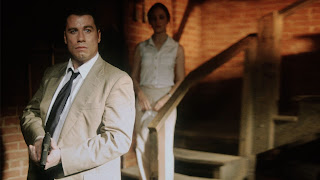
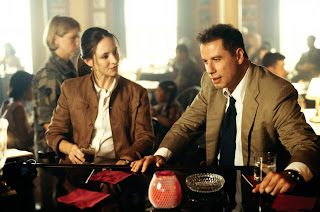
On an army base in Georgia, Chief Warrant Officer Paul Brenner (John Travolta) of the Army's Criminal Investigation Division wraps up a sting operation. His next case is the murder of Captain Elisabeth Campbell (Leslie Stefanson), found naked and tied-up on the ground at an urban combat training facility. Elisabeth was an instructor in psychological operations, and also the daughter of celebrated General Joe Campbell (James Cromwell), who is about to retire and enter politics.

Assisting Brenner is his former romantic partner, rape investigator and Chief Warrant Officer Sarah Sunhill (Madeleine Stowe). They initially focus on Elisabeth's shifty commander Colonel Bob Moore (James Woods) as a prime suspect. But soon the investigation becomes more complex, and secrets are revealed about Elisabeth's kinky sex life and her turbulent time at the West Point training academy.

A sordid sex-and-violence crime mystery complicated by honour-bound military traditions, The General's Daughter is polished but overstuffed. The Nelson DeMille novel is transferred to the screen with handsome visuals by cinematographer Peter Menzies Jr., and director Simon West maintains a brisk pace and decorates with military hardware. But the investigative elements are overburdened by motivations straining credibility before devolving into a frantic whodunnit guessing game.

Christopher Bertolini and William Goldman collaborated on the script, and after a bright start they settle down to spraying suspicion on every character in turn, Agatha Christie style. Everyone has a motive and a secret to hide, and Brenner tosses accusations with limited evidence. The truth, once revealed, is bizarre enough to draw groans rather than admiration. The plot tends to wave at moral issues without properly engaging, just as it leaves murder investigation threads dangling. 

But the cross-cutting personal agendas maintain positive energy levels, and The General's Daughter is an effective conversation starter, posing difficult questions about toxicity and inertia within established institutions. At the heart of the drama are serious topics of rape, psychological damage, women in the military, personal sacrifice weighed against reputational damage, political ambitions, and a damaged father-daughter relationship. 

John Travolta is a robust presence at the heart of the action, and Madeleine Stowe is steady but could have benefited from more involvement. Best of all is James Woods, who injects an unsettling beady intensity into his few scenes. To maximize the number of suspects, the cast also finds space for Timothy Hutton, Clarence Williams III, Mark Boone Jr., and two redneck police officers named Yardley.

Eager and capable, The General's Daughter also favours excess over control.


All Ace Black Movie Blog reviews are here.

Sunday, 25 April 2021

Movie Review: White House Down (2013)

An action thriller about the attempted violent overthrow of the United States President, White House Down carves out territory on the knowing side of preposterous.

Army veteran and Capitol Police officer John Cale (Channing Tatum) is part of the security detail for Speaker of the House Eli Raphelson (Richard Jenkins). Cale's 11-year-old daughter Emily (Joey King) accompanies him to the White House, where Carol Finnerty (Maggie Gyllenhaal) of the Secret Service interviews Cale for a position on the President's security team. Father and daughter then join a White House tour.

United States President James Sawyer (Jamie Foxx) is seeking global support for a bold but controversial Middle East peace plan. But traitorous Senior Secret Service Agent Martin Walker (James Woods) has assembled a team of mercenaries to storm the White House and overthrow Sawyer's government. The mercenaries are led by Emil Stenz (Jason Clarke), and include psychotic white supremacist Killick (Kevin Rankin) and computer hacker Skip Tyler (Jimmi Simpson). 

The invaders take over the White House and seize hostages, demanding a $400 million ransom. Cale breaks loose and fights back, managing to extract Sawyer from Walker's clutches, while Emily captures and uploads video of the unfolding drama. Cale needs to keep Sawyer safe and rescue Emily as the full extent of Walker's plot becomes clear.

Silly, noisy, often stupid, overlong and saddled with graceless CGI, White House Down is also watchable because it never takes itself too seriously. While Olympus Has Fallen, also released in 2013 with a similar plot, is grittier and better, here director Roland Emmerich lets loose his (literal) flag-waving tendencies while destroying chunks of the White House (again), and whenever faced with a choice between subtle and ludicrous, chooses over-the-top. The entertainment level is of the brainless variety, but within that constraint, fun can found.

And so Cale and Sawyer engage in a ridiculous car chase, driving in circles around the fountain of the White House lawn. The bad guys alternate between one-shot, one-kill expediency and cross-eyed incompetence, depending on the script requirements. CGI-created machines crash at regular intervals in a horrible dissolution of unconvincing pixels, and any quip is a good quip, whether smart or sophomoric.

The extended preamble to introduce the characters and set the context is welcome. But the film is otherwise overlong at a wholly unnecessary 131 minutes, and despite the length, critical plot points are half-baked. It's deep into the crisis before Walker's real intentions are finally revealed in a jumbled rush, and until then the ransom demand is a limp excuse for the unfolding carnage.

The reliable cast is filled with talent and helps overcome some of the goofiness. Channing Tatum is up to the task of saving the day, and bites into the role of John Cale with grim determination to (in no particular order) keep the President safe, extricate his daughter from the clutches of maniacal seditionists, and earn himself a position with the Secret Service in the world's worst on-the-job interview. The White House may be down, but as long as a job can still be earned, it's not quite out.


All Ace Black Movie Blog reviews are here.

Sunday, 6 January 2019

Movie Review: Videodrome (1983)


A science fiction gorefest, Videodrome delves into the world of media consumption and mind control.

In Toronto, Max Renn (James Woods) is a scrappy television executive running a low-rated television channel specializing in softcore pornography and violence, and always on the lookout for more shocking content. His assistant Harlan (Peter Dvorsky) monitors global satellite transmissions to find the next big thing, and stumbles on an illicit porn-and-torture broadcast named Videodrome featuring young naked women being flogged. Harlan traces the signal origin to Pittsburgh.

Max is hooked on the visceral and titillating Videodrome content, and shares it with his kinky girlfriend Nicki (Debbie Harry), sending her over the edge of seeking pain with her pleasure. He becomes obsessed with finding out more, a search that leads him to Bianca O'Blivion (Sonja Smits), the daughter of reclusive self-proclaimed media guru Brian O'Blivion. Max also meets the mysterious Barry Convex (Leslie Carlson), who operates the Spectacular Optical Corporation, an eyeglasses front company.

From the twisted mind of writer and director David Cronenberg, Videodrome is a pinnacle of weird horror. Emerging at the height of the video cassette recorder boom and with the television channel universe starting to mushroom, the film ponders the implications and opportunities of insatiable appetite for unconstrained media. Incredibly, in ways Cronenberg would never have imagined, the film only became more relevant when the online world exponentially multiplied media availability.

The furtive Videodrome raw images sink their teeth into Max's brain, causing unseen damage. Soon he is hallucinating and unable to resist the lure of seeing what is on the next tape. He literally sticks his head into the welcoming television set to get swallowed up. His torso opens to create a cavity for tapes to be inserted straight into his soul. Content and consumer become one: he is what he sees, his actions programmed by what he consumes.

Cronenberg delivers his bleak vision of media as a subverted weapon with an abundance of organic and slimy gore, the special effects crew doing a superlative job of creating a nightmare where hallucinations meld with reality and Max starts to live in a surreal and bloody zone not of his making. All around him Cronenberg creates a wretched world of creeping media influence, including Bianca running a depressing maze-like shelter for vagrants to do nothing but watch individual television sets.

The final act of Videodrome spirals a bit out of control and into abstract assassination territory with Max reduced to a manipulated pawn by the new media creators, and talk of the "new flesh" leaping into directions Cronenberg chooses not to expound on. Nevertheless, the weirdness quotient never drops, and Videodrome opens numerous avenues for still pertinent debate.


All Ace Black Blog Movie Reviews are here.


Saturday, 15 October 2016

Movie Review: Night Moves (1975)


A neo-noir detective thriller, Night Moves is an engrossing character study ironically elevated by an almost incomprehensible plot featuring large gaps and plenty of edges.

Through his friend Nick (Kenneth Mars), Los Angeles based former pro footballer and now private detective Harry Moseby (Gene Hackman) is hired by has-been movie starlet and multiple divorcée Arlene Iverson (Janet Ward) to find her runaway 16 year old daughter Delly (Melanie Griffith). Arlene is less interested in Delly's well-being and more in need of the money generated by her daughter's trust fund. Just as he starts his investigation Harry stumbles on his wife Ellen (Susan Clark) having an affair under his nose with a man called Marty Heller (Harris Yulin). He pushes on regardless and starts to uncover the web of Delly's friends, including greasy mechanic Quentin (James Woods), caustic movie stunt director Joey Ziegler (Edward Binns) and handsome stunt pilot Marv Ellman (Anthony Costello).

Learning that Delly is an uninhibited sexpot who is sleeping her way through her mother's former lovers, Harry makes his way to the Florida keys where he finds Delly hanging out with Arlene's second ex-husband Tom Iverson (John Crawford). Tom appears to have already been ensnared by Delly's sexual charms, but his partner Paula (Jennifer Warren) is nevertheless curiously still standing by him. Harry is attracted to Paula but struggles to make sense of what is going on and is unsure if he should return Delly to her mother. A grisly underwater discovery suddenly makes the case a lot more complicated.

Directed by Arthur Penn and written by Alan Sharp, Night Moves is a beautiful mess. With some jarring editing, audacious risks and a plot that scribbles on the periphery of character disintegration, the movie could have dissolved into irrelevance. Instead Penn conjures up a companion piece to The Big Sleep, stripped of even the pretense of thorny heroism. The story of Night Moves is littered with holes, ill-defined motivations and at least one incredible coincidence. It does not matter. The focus is on Harry Moseby standing witness to his family life and career crumbling around his ears, while he intellectually believes that there is something he can do about it.

The signs are clear early on that Moseby's detective skills fall short. This is a man who could not detect his own wife having an affair, and later cannot untangle the relationship between Tom and Paula. He thinks he is saving Delly by depositing her back with her mother, but that proves to be the worst possible move. All the time he is obsessed with replaying and demonstrating a chess match where a winning strategy involving clever knight moves was missed and the game lost. Moseby is a man always running behind events, falling further back every time he uncovers another piece of the puzzle, and most unfortunately oblivious to his own incompetence.

Penn is not just satisfied with an in depth look at one miserable character: he surrounds him with all that the mid-1970s had to offer in terms of a dispirited society, where 1960s communal idealism crashed against Watergate and the oil crisis, triggering an era of unfettered narcissism. Arlene is a silicone enhanced has-been collecting ex-husbands and still acting the role of being interested in her daughter, while her only real desire is income continuance.

Meanwhile, Delly is not waiting for anyone: she has appropriated the sexual revolution for her selfish purpose, devouring her mother's former lovers in service of personal pleasure. At 16, she is already deploying sex as a weapon of mass escapism across the country. Meanwhile, the movie industry is a cover for illicit activities, the exportation of American culture through on-screen magic a cover-up for a nefarious scheme involving cultural imports.

Moseby walks into this cesspool believing that he is actually good, and Gene Hackman is brilliant at portraying a pathetic man catching up too late with his own incompetence. Ruffled, betrayed, and played repeatedly for a fool, Hackman ensures that Moseby is an unforgettable tragic figure. The supporting cast members share the screen time, planets circling Moseby's dying sun. Particularly effective are Melanie Griffith and James Woods, who both make strong marks in early roles.

Night Moves ends with Moseby coming to terms with the limits of his talent. After chasing the truth back and forth across the country, his fate is simplified into small circles, so that even he can understand it.


All Ace Black Blog Movie Reviews are here.


Monday, 8 August 2016

Movie Review: Contact (1997)


A science drama, Contact is an intelligent story about the passion to search for a connection with alien beings, and the implications once the unthinkable becomes true.

As a young girl, Ellie Arroway (Jena Malone) was encouraged to pursue astronomy by her father Ted (David Morse). The grown up Ellie (Jodie Foster) graduated from MIT and developed a passion for seeking signals transmitted by aliens. While on assignment at an observatory in Puerto Rico, Ellie establishes a rapport with fellow scientist Kent Clark (William Fichtner), and has a brief but passionate affair with Christian philosopher Palmer Joss (Matthew McConaughey). The Puerto Rico assignment is eventually shut down by National Science Foundation Director David Drumlin (Tom Skerritt), who does not believe that searching for alien signals is worthwhile research.

Ellie finds private funding through the Hadden Corporation, led by the extremely rich but dying tycoon S.R. Hadden (John Hurt), and establishes her team at the Very Large Array (VLA) of massive listening satellite dishes in New Mexico. After months of effort Ellie stumbles onto a signal transmitted from the Vega star system. Her discovery unleashes a global frenzy, with the White House getting involved in the form of Chief of Staff Rachel Constantine (Angela Bassett) and National Security Advisor Michael Kitz (James Woods). Then Ellie's team uncovers more: the alien signal contains a coded message and reams of advanced data including the blueprints for an advanced, massive machine.

Directed by Robert Zemeckis and based on the novel by celebrated astronomer Carl Sagan, Contact is a spiritual successor to 2001: A Space Odyssey and Close Encounters Of The Third Kind. Although neither as fantastical as Kubrick's epic nor as fuzzy as Spielberg's opus, Contact brings its own attitude to the search for intelligent life: a science-first stance, a willingness to take a pragmatic look at how politics will interfere with any major discovery, and a deliberate eagerness to delve into the debate about the role of religion when the time comes for human interaction with another species.

The film excels at maintaining a clear-headed, science-based perspective through the eyes of Ellie, including the frustrating chase for funds, clashes with superiors, disappointing initiatives that lead to nothing, and long hours, days and years of research sustained only by hope and belief that a breakthrough must be just around the next frequency.

And when contact is made and Ellie shakes the world with her discovery, Zemeckis takes his time to capture the frenzied reaction. From President Clinton (masterfully weaved into the film) and his army of White House suits to religious zealots, and passing through the journalists and talking heads on the cable news networks and Chevrolet Vega enthusiasts, the world will react to alien communications in unpredictable ways, and Contact imagines the outpouring of emotion and insanity with plenty of colour.

Some parts of the film don't work as well. There is a serious sabotage incident that appears far-fetched and ultimately neither adds to nor deletes from the story. As the machine is being built at enormous cost, Zemeckis dials back the curiosity factor and does not even attempt to explain how it may be expected to work. And the personal scenes between Ellie and Palmer too conveniently and quickly devolve into a complicated relationship that mirrors the tension between her science and his religious philosophy.

Jodie Foster is at the core of the drama, and allows Ellie to not only be a bright and fiercely determined scientist, but also a human being with faults. She has to check her anger and attitude at meetings, and is too honest when it matters least. As Sagan intended, Ellie carries with her the struggle of women scientists to stand alongside the men, and more than once Ellie has to swallow her pride and plan a recovery after men brutishly shove their interests ahead of her rights. The supporting cast is adequate, but none of the men around Ellie achieve much depth.

The film ends with a journey sequence driven by spectacular special effects, and a conclusion built on sober reflection. The search for evidence finds belief and the intrinsically faithful find evidence. The quest to find answers will continue, built on advancements measured simultaneously in light years and milliseconds.


All Ace Black Blog Movie Reviews are here.


Saturday, 19 March 2016

Movie Review: Once Upon A Time In America (1984)


A New York gangster epic spanning 35 years in the life of two friends, Once Upon A Time In America is Sergio Leone's final film, and a masterpiece of provocative storytelling. The extended director's cut (with restored footage) clocks in at a mammoth 251 minutes, and it's a fascinating viewing experienced, reminiscent of a complex ancient tragedy with central characters both heroic and deeply flawed.

The film unfolds in three different time periods concurrently: 1920, the early 1930s, and 1968. The narrative starts in 1932, with gangster Noodles (Robert De Niro) being hunted down after having seemingly betrayed his pals and long-time criminal associates. He evades capture, but is surprised to discover the gang's stash of $1 million in emergency cash missing. He buys a one-way ticket out of New York. Close to 35 years later, Noodles returns to the city, drawn back by mysterious messages suggesting there is unfinished business for him to attend to.

In flashbacks to the dusty streets of Lower East Side Manhattan in 1920, a group of Jewish kids are forming themselves into a gang consisting of the scrappy Noodles and his friends Cockeye, Patsy and the youngest Dominic. They pass their days committing petty crimes and evading policeman Aiello (Danny Aiello). Noodles has a crush on the relatively sophisticated girl-next-door Deborah (Jennifer Connelly), whose family runs the local diner where her brother Fat Moe works. In contrast to Deborah, the local slut-to-be is Peggy, and she affords the boys their first sexual experiences.

The lanky Max moves into the neighbourhood from Brooklyn, and becomes quick friends with Noodles. Together they plot a path for their ragtag bunch to gain more influence, which results in confrontations with older and more established street thugs. After one such skirmish, Noodles is caught and imprisoned for 12 years. The grown up Max (James Woods), Cockeye (William Forsythe) and Patsy (James Hayden) welcome back Noodles when he is released in 1931. Max has forged the young men into a slick group of criminals, profiting from the illegal alcohol trade as well as prostitution and assorted other criminal activity.

Noodles reconnects with Deborah (Elizabeth McGovern), who is now a budding dancing star, and he also quickly reintegrates back into the gang as they get involved in a high stakes jewel theft with crime boss Frankie (Joe Pesci) and disgusting Detroit mobster Joe (Burt Young). Max and Noodles begin to clash over the gang's direction, with Noodles wanting to remain more independent while Max chases the riches afforded by association with powerful men like Frankie. Noodles stages an elaborate date with Deborah that starts well but ends in disaster, and finds some alternative comfort in the arms of the willing Eve (Darlanne Fleugel). Max embarks on a relationship with good time girl Carol (Tuesday Weld). When the end of Prohibition draws near, the schism between Noodles and Max grows dangerously wider.

Based on the autobiographical book The Hoods by Harry Grey, Once Upon A Time In America is Leone's ode to the American dream through the lens of friendship, social turmoil, violence, crime and a shrouded mystery that will serve as a final punctuation mark. The film had a troubled release history, with an initial studio-butchered 139 minute North American version rendering the film incomprehensible. The initial 229 minute European release was Leone's original vision. Some 30 years later, the painstaking restoration of 22 essential minutes for the extended director's cut further elevates a masterpiece of grandiose filmmaking.

Playing off the themes of his Dollars trilogy, Leone remains fascinated by the relationships that form between men on the wrong side of the law, where concepts of honour and trust are relative and friendships are created on the run and threatened by the shadow of the next big score. The core story is the bond between Noodles and Max, forged in childhood, finding a common ambition, surviving Noodles' stint in prison, and then hitting the rocks of unbridled greed.

For Max being a middling criminal with comfortable wealth is not enough, he wants to reach for the brass ring of unconstrained power and enormous riches. For the more grounded Noodles, winning the heart of Deborah is more important than all the money in the world, and when her love proves elusive, taking any more risks seems pointless. The relationship between the two men ruptures in the worst possible way, with judgement day for both awaiting more than 30 years later.

The pace is slow and deliberate, but the movie never fades. This is effectively three rich films in one viewing experience, and by presenting the story in non-chronological order, Leone reveals the ties that bind across the decades. Scenes rarely linger for too long, and when they do, there is good reason: young Patsy confronting a cupcake on a staircase and carefully weighing the benefits of an expensive dessert against sex is a dazzling reminder of the crevasse between childhood reality and adulthood aspirations.

The movie carries a tone of sad nostalgia in each of its three eras, with the recreation of the bustling Lower East Side Jewish neighbourhood circa 1920 a particularly brilliant visual feat. The brooding Manhattan Bridge is used as a stunning backdrop to the ramshackle origins of Noodles and Max, while Ennio Morricone conjures up one of his best music scores, and it's all in the key of sad.

For all the human drama, this is a film about criminals, and when it's time for violence, Leone does not hold back. Characters are tortured, beaten senseless and summarily executed, there are stabbings, close-range shootings, and plenty of violence involving women and children. A prolonged, harrowing rape scene is physically painful to watch, emphasizing a criminal's hopelessly shallow understanding of the difference between romance and dominance.

Robert De Niro and James Woods create an enduring pair, both actors at the top of their form and delivering seminal performances. Woods holds back just enough of his intensity to create the undercurrent of menace that drives his character's brashness. De Niro finds the space where a kid turns to crime to climb out of his low status, but has no social skills to thrive in middle class domesticity and no desire to go looking for anything more.

The early formative scenes benefit from some terrific child performances, with the personalities of Noodles (Scott Tiler), Max (Rusty Jacobs), Cockeye (Adrian Curran), Patsy (Brian Bloom), Dominic (Noah Moazezi), Fat Moe (Mike Monetti), and Peggy (Julie Cohen) all created seemingly effortlessly by the young cast. And most impressive is Jennifer Connelly in her big screen debut at 14 years old, managing to outshine Elizabeth McGovern in defining young Deborah.

At over four hours long, there are bound to be some missteps. An essential sub-plot involving union boss Jimmy O'Donnell (Treat Williams) seems to have suffered most in the editing room, while Joe Pesci's Frankie is also a character who has undue influence compared to his limited screen time. But these are minor quibbles. Once Upon A Time In America is an audacious feat, a gangster film that manages to be both intimate and flamboyant, and easily among the most monumental achievements in the history of film.


All Ace Black Blog Movie Reviews are here.


Monday, 20 July 2015

Movie Review: Nixon (1995)


A thorough but subjective political biography, Nixon features a dedicated Anthony Hopkins performance in the title role, but otherwise suffers from an unbalanced tone and never finds a rational perspective.

With the evolving Watergate scandal of the early 1970s providing an anchor point, the film jumps around the history of President Richard Nixon's life. There are scenes from his childhood years, with Nixon raised in a relatively poor but proud household. His strict father owned a grocery store and saw life as a daily struggle, while his mother (Mary Steenburgen) took on the duties of instilling the fear of God in her children. Tragedies involving tuberculosis struck two of Nixon's brothers during his formative years. An ineffective football player in college, Nixon's lack of a tony education at an elite university remained a constant source of inferiority and self-doubt.

Nixon rose to prominence as part of Senator McCarthy's communist witch hunt team, and became a two-term Vice President under President Eisenhower. There are vague hints that Nixon was involved in planning the Bay of Pigs fiasco. His long-term backroom team consisted of advisors Bob Haldeman (James Woods), John Ehrlichman (J.T. Walsh), and John N. Mitchell (E.G. Marshall), and together they seemed destined for the top. But Nixon's political career was derailed when he narrowly lost the 1960 presidential election to the young, suave and rich John Kennedy, a defeat that deeply humiliated Nixon. A further setback in the 1962 California Governor's race seemed to end Nixon's career in politics. He makes a promise to his wife Pat (Joan Allen) to never run again for public office.

The assassinations of John and Bobby Kennedy and President Lyndon Johnson's surprise decision not to run in the 1968 election collectively pave the way for an unlikely comeback. Spurred on by a group of right-wing businessmen and anti-Castro dissidents, Nixon achieves his dream and is elected President. He is immediately confronted by a nation deeply divided over the bloody Vietnam War, a conflict that Nixon struggles to end. With the assistance of Secretary of State Henry Kissinger (Paul Sorvino), Nixon achieves better success in foreign relation, with his 1972 visit to China a particular highlight.

But with leaks to the media creating a steady stream of bad news stories, Nixon's White House descends into a siege mentality, and he believes all the bad news stories to be personal attacks. Nixon introduces an elaborate eavesdropping system to have all his conversations taped, and a surreptitious team of "plumbers" including Howard Hunt (Ed Harris) and Gordon Liddy (John Diehl) is created to plug leaks and dig up dirt on Nixon's perceived enemies. The plumbers initiate the clumsy Watergate break-in, and the subsequent White House cover-up proves to be the undoing of the President.

Directed and co-written by Oliver Stone, Nixon is an impressive history of probably the most controversial President to ever occupy the Oval Office. With the Director's Cut running towards 210 minutes, the film is an in-depth retrospective and attempts to touch all the key events in Nixon's life, from childhood to resignation. With Anthony Hopkins dominating the screen with a bearish stance and a politician's larger than life persona, the film rarely drags, despite its enormous breadth.

But what Stone fails to do is settle on an angle of approach. The film mixes tones of conspiracy into a straightforward biopic and adds elements of overwrought tragedy. Stone clearly has limited respect or admiration for his subject, and spends an inordinate amount of time presenting Nixon as an uncouth brawler, close to paranoid, probably involved in a deep dark conspiracy, obsessed with Kennedy, and unable to separate his personal identity from the nation's politics. It's a disappointingly shallow treatment of a complex subject, with the director's disdain wrapped in an auteur's vision of grandeur.

Stone also appears to lose his nerve towards the close of his epic. Perhaps realizing that a mammoth film about a man being portrayed as almost cartoonishly flawed is a self-contradictory project, Nixon ends with a rush to demonstrate sympathy and elevate Nixon's legacy to places that the film cannot support. When Stone has his opportunities to underline Nixon's achievements, for example the historic trip to China, ending the Vietnam War or thawing the Cold War with Russia, he offers barely any context and instead fritters away these scenes with trite directorial touches and the most inane dialogue between world leaders. Stone goes out of his way to mock Nixon's achievements at every turn, but then realizes his oversights too late.

Stylistically the film falls victim to Stone wanting to provide constant reminders that he is in charge. Intermittent black and white photography, fake grainy film stock, character hallucinations, and editing stunts are deployed in large numbers to jazz up the film, but often serve to distract rather than enrich. The Director's Cut features a particularly awful long scene featuring a meeting between Nixon and CIA Director Richard Helms (Sam Waterston). The sequence is bloated with endless close-ups of flowers, and should have forever remained on the cutting room floor.

The scenes between Nixon and his wife Pat emerge as the best avenue to get to know the man, and here Stone does better. With Joan Allen standing her ground against Hopkins, the stressed connection between career politician and suffering wife provides a lens onto Nixon's talents: charming when needed, always persuasive, quite stubborn, and power hungry at the expense of almost everything else. From the huge supporting cast, James Woods as Bob Haldeman, Powers Boothe as Alexander Haig and David Hyde Pierce as John Dean make the deepest indents. Paul Sorvino and Bob Hoskins have fun in breezy portrayals of Kissinger and J. Edgar Hoover respectively.

Nixon is a flawed epic, a biography that impresses in scope and dedication but that also veers too far into jaundiced territory to do justice to its subject.


All Ace Black Blog Movie Reviews are here.


Sunday, 1 March 2015

Movie Review: The Virgin Suicides (1999)


A tender story of how girlhood can go terribly wrong, The Virgin Suicides is a wispy tragedy, softly unfolding with a sentient style.

It's 1975, in the suburbs of Detroit. Mr. and Mrs. Lisbon (James Woods and Kathleen Turner) have five daughters ranging in age from 13 to 17. Mr. Lisbon is a schoolteacher, his wife a homemaker, and they are deeply religious, keeping their daughters sheltered and away from social activities. Therese (Leslie Hayman), Mary (A. J. Cook), Bonnie (Chelse Swain), Lux (Kirsten Dunst), and Cecilia (Hanna R. Hall) become the subject of fascination bordering on obsession for the boys in their neighbourhood. The level of curiosity is amplified when the youngest girl Cecilia attempts suicide by slashing her wrists, but she is saved.

Dr. Horniker (Danny DeVito) advises the Lisbons that they need to allow their daughters to mingle more with their classmates. The first party hosted by the girls ends tragically when Cecilia does indeed succeed in killing herself. The surviving sisters tentatively start to socialize more, but when the free-spirited Lux falls under the spell of Trip Fontaine (Josh Hartnett), the coolest boy in the school, Mr. and Mrs. Lisbon clamp down harder, triggering grim consequences.

Sofia Coppola's directorial debut, adapting the Jeffrey Eugenides novel, is a hypnotizing journey into the perilous world of growing up. The Virgin Suicides is a bleak story delivered with a delicate touch, capturing the suburban melancholia that emerges with the loss of innocence. Coppola bathes the film in happy colours, soft light, and an airy, remarkably open atmosphere, contrasting the image of flourishing suburbia with the suffocation within families behind closed doors. Death is hovering nearby, the disease-infested neighbourhood elm trees the subject of much agony: should they be left to die naturally or chopped to avoid infecting others.

Seen through the eyes of teenaged boys, The Virgin Suicides treats girls in adolescence as a fragile mystery fraught with peril. They are easily knocked off course by good intentions tarnished with religious dogma, misguided parental rules metastasizing into a horror show of desperation fuelled by confinement. And the film stands outside the girls and observes them as objects of fascination, young women emerging as enigmas to their parents, and most acutely to the boys who would, under normal circumstances, become the men in their lives.

Despite the raging drama of girls fighting to breathe the oxygen of adulthood, Coppola constructs The Virgin Suicides with remarkable calm, and the film avoids guilt trips, finger pointing and recriminations. Below the seemingly staid surface, the tension may boil, but in the day to day lives of the girls, their school and their neighbourhood, the emotions are in check. Smatterings of gossip and interludes of uneasy silences hint at the turmoil; most of what is wrong is left unsaid. The soundtrack by French duo Air perfectly captures the dolefulness of the film, Playground Love a devastatingly evocative theme song.

In addition to Woods, Turner and DeVito, the supporting cast is sprinkled with interesting faces. As Trip Fontaine, Josh Hartnett delivers a refreshingly assured and animated performance. Michael ParĂ© plays the adult Trip, Scott Glenn has a small role as a priest, and Giovanni Ribisi provides low-key narration. A young Hayden Christensen appears as one of the neighbourhood boys.

But this is a story of five sisters, and as the most adventurous of the Lisbon daughters, Kirsten Dunst shines in a role that lives in the twilight zone between individualism and calamity. Never outwardly rebellious, Dunst allows Lux to smile through life's limits as her young mind assesses ever dwindling options, from breaking a strict curfew to exploring what the roof has to offer when the outdoors are off limits. And when the conditions of growing up become even more stifling, she invites the curious boys indoors, to discover for themselves the images of truncated hope.


All Ace Black Blog Movie Reviews are here.


Saturday, 19 October 2013

Movie Review: Against All Odds (1984)


An overcomplicated romantic drama with neo-noir elements, Against All Odds packs way too much plot around an unconvincing love triangle, but also manages to sprinkle some excellent moments that hint at what could have been a better movie.

Veteran Los Angeles Outlaws footballer Terry Brogan (Jeff Bridges) is reaching the end of his career. Injury prone and considered too old, he is cut from the team, despite having the sympathy of coach Hank Sully (Alex Karras). Deep in debt, Brogan gets no help from his lawyer friend Steve Kirsch (Saul Rubinek) and so accepts an assignment from slimy gambling czar and nightclub owner Jake Wise (James Woods). Wise wants Brogan to find his lover Jessie Wyler (Rachel Ward), who took off on him and stole $50,000 in the process.

Jessie is the daughter of Grace (Jane Greer), the owner of the Outlaws. Grace is married to political fixer Ben Caxton (Richard Widmark), who is working behind the scenes with Kirsch to grease the gears and secure approval for Grace's coveted mountainside development project. Brogan tracks down Jessie in Mexico, and they become lovers, hiding out in the jungle and ignoring Jake's ever more frantic phone messages. Jake finally dispatches Sully to find both Brogan and Jessie, triggering unexpected bloodshed and a return to Los Angeles, as the sordid worlds of football gambling and political corruption collide in a frenzy of blackmail, back-stabbing and violence.

Against All Odds contains several memorable highlights that belong in a better movie. Terry and Jessie make steamy love in a Mayan temple, causing the walls to sweat. Kid Creole and the Coconuts perform the smoothly corrupt My Male Curiosity in Jake's nightclub. Terry and Jake engage in a hair raising, high speed Porsche versus Ferrari duel on the road, weaving in and out of traffic in an old fashioned, dim-witted mano-a-mano confrontation, among the best crazy car chases put to film.

And the closing shot strikes gold. Director Taylor Hackford sustains a long hold on Jessie as she stands on her future and stares longingly as her past leaves her behind, enhanced by Phil Collins' legendary Against All Odds (Take a Look at Me Now), one of the finest tragic tunes from the films of the 1980s.

But a lot also goes wrong in this movie, a loose updating of 1947's Out Of The Past. There are too many plot threads blowing in the wind and competing for attention. Jake, Kirsch, Grace, Sully and Caxon from a dense nexus of evil-doers, engaged in political corruption, illegal gambling, match fixing, and greedy developers outmanoeuvring environmental activists. With too much going on, the love and lust elements take a back seat and the second half of the film, back in Los Angeles, spirals out of control. Terry gets involved in ridiculous situations to create artificial thriller elements, Jessie's actions are irrational, seemingly manufactured to needlessly prolong a damaged love triangle.

The film finally begins to teeter on the edge of a parody rather than an homage to the film noir genre. Bloodied dead bodies are stashed in bathrooms, guard dogs growl, a minor corporate secretary (Swoosie Kurtz) suddenly reemerges to help Terry break into a safe, guns are waved all over the place, and James Woods as Jake Wise descends into manic intensity mode, blood vessels about to pop as both his love life and corrupt business empire are threatened.

James Bridges and Rachel Ward do generate sustained heat, although Ward's acting is simply not up to par. Her delivery is wooden, almost amateurish, and except for that final shot, she struggles to generate any genuine emotion. Bridges is better, frequently shirtless and more believable as a slightly dim football player with the rug of his life suddenly pulled out from below him. The Eric Hughes script simply forgets to demonstrate any source of attraction between Jessie and Jake, leaving part of the romantic conflict woefully vacant, and reducing James Woods' role to that of slimeball extraordinaire. Richard Widmark and Jane Greer (who starred in Out Of The Past) add welcome veteran sophistication to the supporting cast.

While not exactly a car wreck, Against All Odds is more a lingering curiosity than a good film. There are moments that deserve standing and staring, but also a lot of nondescript debris cluttering the scene.


All Ace Black Blog Movie Reviews are here.