Showing posts with label Billy Crudup. Show all posts

Wednesday, 17 December 2025

Movie Review: Jay Kelly (2025)


Genre: Drama  
Director: Noah Baumbach  
Starring: George Clooney, Adam Sandler, Laura Dern, Billy Crudup, Patrick Wilson, Stacy Keach, Emily Mortimer, Greta Gerwig, Isla Fisher, Jim Broadbent, Riley Keogh  
Running Time: 132 minutes  

Synopsis: Jay Kelly (George Clooney) has enjoyed a 35-year career as a movie star. He wraps-up filming on his latest production, and his manager and life-long friend Ron (Adam Sandler) expects Jay to quickly transition to his next project. But a chance encounter with Timothy (Billy Crudup), a former friend from acting school days, forces Jay to re-evaluate his life. Having neglected all his family relationships, he takes off to Europe with Ron and publicist Liz (Laura Dern) to get reacquainted with his daughter, but forging genuine human connections does not come naturally to a lifelong actor.

What Works Well: Reflecting aspects of star George Clooney's reality, this is an introspective, thoughtful, yet also peppy and often humorous examination of choices. The script (cowritten by director Noah Baumbach and co-star Emily Mortimer) is neither judgmental nor moralizing, and avoids pat resolutions. Achieving and sustaining movie star fame meant Jay was never a good father, and he gained much more from his friendship with Ron than he ever reciprocated. Decisions and actions are presented as realities and trade-offs rather than rectifiable regrets, and Jay's reflections are rich with in-the-moment dilemmas, awkwardness, and poignancy. The superlative cast includes Stacy Keach as Jay's father, Patrick Wilson as another actor managed by Ron, Jim Broadbent as a mentor, and Riley Keogh as one of Jay's daughters. Many of the supporting characters are provided with well-rounded lives to add depth, texture, and context.

What Does Not Work As Well: The running time is longer than it needs to be.

Key Quote:
Jay Kelly (acting a death scene): That's the crazy thing...everything you thought you were...isn't true.


All Ace Black Movie Blog reviews are here.

Friday, 29 August 2025

Movie Review: Mission: Impossible III (2006)


Genre: Action Thriller  
Director: J.J. Abrams  
Starring: Tom Cruise, Michelle Monaghan, Philip Seymour Hoffman, Ving Rhames, Laurence Fishburne, Billy Crudup, Maggie Q, Jonathan Rhys Meyers, Keri Russell  
Running Time: 126 minutes  


Synopsis: Impossible Missions Force Agent Ethan Hunt (Tom Cruise) is engaged to Julia (Michelle Monaghan), having retired from field duty and settled into the role of a trainer. But when his former trainee Lindsey (Keri Russell) is captured by elusive international weapons dealer Owen Davian (Philip Seymour Hoffman), Ethan returns to duty with his team to mount a rescue in Berlin. He next attempts to kidnap Davian from a Vatican gala to prevent him from peddling the dangerous "Rabbit's Foot" device, but Ethan's exploits have far-reaching consequences involving IMF Directors Musgrave (Billy Crudup) and Brassel (Laurence Fishburne), with a showdown in Shanghai.

What Works Well: The third installment in the franchise achieves superb polish, director J.J. Abrams finally unlocking the potential of the series. Tight editing, a controlled running time, and a steady stream of highlights deliver perfect measures of suspense (the abduction of Davian from the Vatican), stunts (plentiful, but the high-rise jumps in Shanghai are spectacular), and plain high-intensity action (the bridge ambush). Grit (Lindsey's rescue and aftermath) mixes with romance (Cruise and Monaghan sharing good chemistry). The globe-trotting plot is easy to follow, helped by a cast stacked with quality. Philip Seymour Hoffman is a terrific cold-blooded villain and worthy adversary to Cruise's combination of athleticism and intensity.

What Does Not Work As Well: The "Rabbit's Foot" deserved a better explanation, and the political machinations within the IMF Director ranks are half-baked.

Key Quote:
Lindsey (under fire with Ethan in the middle of a firefight): I'm out. How many rounds you got?
Ethan (checks weapon): Enough.
[rises, fires one shot, and takes out the opponent]
Ethan: Now I'm out.


All Ace Black Movie Blog reviews are here.

Saturday, 17 February 2024

Movie Review: Where'd You Go, Bernadette (2019)


Genre: Comedy Drama  
Director: Richard Linklater  
Starring: Cate Blanchett, Billy Crudup, Kristen Wiig, Laurence Fishburne, Judy Greer  
Running Time: 109 minutes  

Synopsis: In Seattle, Bernadette Fox (Cate Blanchett) lives in a fixer-upper mansion with her husband Elgie (Billy Crudup), a Microsoft executive, and their teenaged daughter Bee. Bernadette was once a rising star in the world of architecture, but stopped working after a series of set-backs. She now avoids socializing, relying on an India-based digital assistant for most tasks, and particularly dislikes her intrusive neighbour Audrey (Kristen Wiig). When Bee proposes a family trip to Antarctica, Bernadette's stress levels spike.

What Works Well: The first two thirds offer a razor-sharp comic-dramatic portrait of a strong-willed woman in emotional trouble. With Cate Blanchett in fine form, director and co-writer Richard Linklater adapts Maria Semple's book with an emphasis on Bernadette gliding through life using a caustic attitude to avoid confronting depression. Laughs combine with revelations, all anchored by a warm mother-daughter relationship offering an escape route from the doldrums.

What Does Not Work As Well: The final act is a bland let-down, descending into a schmalzy combination of glacier scenery and simple solutions suddenly available in the remotest corner of the planet. Some characters, including a therapist (Judy Greer) and an FBI agent, enter with a flourish but are then summarily abandoned. 

Conclusion: Bernadette sparkles when restless in Seattle, but slips when surrounded by ice.


All Ace Black Movie Blog reviews are here.

Monday, 22 May 2023

Movie Review: Too Big To Fail (2011)


Genre: Drama
Director: Curtis Hanson
Starring: William Hurt, Billy Crudup, Paul Giamatti, James Woods, Cynthia Nixon, Bill Pullman
Running Time: 98 minutes

Synopsis: In 2008, US Treasury Secretary Henry Paulson (William Hurt) and his team are thrust into an unfolding economic crisis when major investment banks start incurring huge losses due to mortgage defaults. A deal is arranged to bail out Bear Stearns, then investors turn on Lehman Brothers, where CEO Dick Fuld (James Woods) is slow to react. Paulson has to assess how far the government can intervene, with insurance giant AIG starting to wobble and international credit drying up.

What Works Well: Based on actual events, Andrew Ross Sorkin's book is adapted into a gripping behind-the-scenes drama, capturing the world's most influential bankers grappling with existential dilemmas as the global economy teeters on the brink of collapse. Director Curtis Hanson maintains compact control with a chiseled running length and clear but brief explanations of the crisis causes and status. A dream cast (also featuring Topher Grace, Kathy Baker, Tony Shalhoub, John Heard, and Edward Asner as Warren Buffet) ensures quality in every role.

What Does Not Work As Well: A parade of middle-aged (mostly) white men conversing in meetings and phone calls is the limit of this drama, and beyond the most key characters, keeping track of the blizzard of individual and corporate names is next to impossible.

Conclusion: Bankers rescuing bankers can generate surprising cinematic tension.


All Ace Black Movie Blog reviews are here.

Sunday, 7 May 2023

Movie Review: The Stanford Prison Experiment (2015)


Genre: Psychological Drama
Director: Kyle Patrick Alvarez
Starring: Billy Crudup, Olivia Thirlby, Michael Angarano, Ezra Miller, Tye Sheridan
Running Time: 122 minutes

Synopsis: In 1971, Stanford University psychology professor Philip Zimbardo (Billy Crudup) recruits male student volunteers for a 2-week experiment. Some students are designated as prisoners, while others are assigned the role of guards, with an empty university building wing used as the mock prison. Within hours, guards including "John Wayne" (Michael Angarano) start to deploy psychological pressure and the threat of physical brutality, pushing Prisoner 8612 (Ezra Miller) among others to the breaking point. Zimbardo starts to lose perspective, alarming his psychologist girlfriend Christina (Olivia Thirlby).

What Works Well: Based on actual events, this is a stark and often harrowing exploration of human susceptibility. Guards succumb to power trips, prisoners take refuge in fight-or-cower self-preservation, and Zimbardo embraces illusions of grandeur. At the core are students who signed up for an easy $15/day, now trapped in a psychological and physical nightmare. The minimalist sets, mostly confined to administratively-coloured hallways, add to the surreal sense of detachment from reality.

What Does Not Work As Well: Zimbardo's background and his research objectives are glossed over, leaving the experiment unanchored. The prisoners and guards are never humanized outside the experiment, robbing them of transformation arcs, while Tim Talbott's screenplay is ultimately unbalanced, pulling hard towards outrage unsupported by the postscript.

Conclusion: An essential but still difficult-to-watch exposition of psychological frailties.


All Ace Black Movie Blog reviews are here.

Wednesday, 21 December 2022

Movie Review: After The Wedding (2019)


Genre: Family Drama
Director: Bart Freundlich
Starring: Julianne Moore, Michelle Williams, and Billy Crudup
Running Time: 110 minutes

Synopsis: Isabel (Michelle Williams) runs a cash-strapped orphanage in India. Successful businesswoman Theresa (Julianne Moore) summons Isabel to New York City to discuss a potential large donation. After meeting Theresa's husband Oscar (Billy Crudup) and about-to-be-married daughter Grace (Abby Quinn), Isabel realizes she has deep and painful connections with Theresa's family.

What Works Well: This remake of a 2006 Danish-Swedish film is stocked full of twists, and the continuous stream of surprises demands attention. Searing commentary on themes of parental responsibility, guilt, and the messy search for redemption and resolution surfaces through the revelations. Michelle Williams (dour) and Julianne Moore (smug) navigate emotional traumas with confidence.

What Doesn't Work As Well: Too much of a good thing - the sheer number of shocks from the past and present results in emotional overload and eventually numbs the impact. From a stand-back stance, some character motivations are dubious.

Conclusion: A rollercoaster of disclosures, with both smooth and bumpy sections.


All Ace Black Movie Blog reviews are here.

Saturday, 7 July 2018

Movie Review: 20th Century Women (2016)


A coming of age drama, 20th Century Women is a sincere slice of life, capturing a time and place in the interlaced lives of five people.

It's 1979, in Santa Barbara, California. Jamie Fields (Lucas Jade Zumann) is 15 years old, transitioning from boyhood to adulthood. His divorced and progressive mom Dorothea (Annette Bening) runs a rooming house, and is worried she may not be able to properly guide Jamie on her own. The only adult male presence in the house is William (Billy Crudup), a tenant and handyman helping with home renovations. Dorothea turns to another tenant Abbie (Greta Gerwig), and Jamie's long-term friend Julie (Elle Fanning), and asks them to be more involved in Jamie's life.

Abbie is a free spirited aspiring photographer dealing with the aftermath of treatment for cervical cancer while embarking on a relationship with William. Julie often platonically sleeps with Jamie, and wants to remain close friends with him although she is sexually active with others. Julie and Abbie do engage more with Jamie, introducing him to the punk music scene, feminism and female sexuality issues, and Dorothea starts to regret what she asked for.

Directed and written by Mike Mills based partially on his experiences during adolescence, 20th Century Women is an often fascinating look at growing up in a perfectly imperfect environment. Capturing the awkward era 10 years on from the end of the 1960s, with Dorothea's hippie generation well and truly disillusioned and dealing with the wreckage of  broken relationships and life's unmet expectations, the film plays out against a backdrop of President Jimmy Carter lamenting a trend towards selfish narcissism, the punk music movement tearing itself apart three years after birth, and the ideals of feminism clumsily starting to seep into mainstream pragmatism.

Mills clearly intended the film as a salute to his mother, and as brought to life by a sparkling Annette Bening, Dorothea is a fascinating woman. Always well-meaning and trying to combine natural parental anxieties with a genuinely liberal approach and a willingness to move along with the times, she acknowledges her shortcomings and turns to others for help, although the consequences are not what she expected.

And guidance for her son, if that's what it is, comes from two other women who help make the film a uniquely character-rich experience. Abbie is simultaneously sad and lively, Julie is brooding and precocious, and they both represent women who came of age in the 1970s. They are benefitting from a new world affording them independence, sexual liberation, and career opportunities, but anyway struggling with home, health and relationship issues while trying to decipher the much more chaotic societal signposts. Greta Gerwig and Elle Fanning are both perfectly cast and with Bening create a triumphant triangle of talent around the willing Lucas Jade Zumann as Jamie.

Billy Crudup is not as fortunate, the character of William somewhat underwritten as Mills focuses on the female influences. And somewhat understandably, the film rather peters out in its final chapter.

With multiple narrators providing various perspectives, and with subtle use of humour, flashbacks, and brief flash forwards, 20th Century Women is an eloquent look back at how the future is shaped, warts and all.


All Ace Black Blog Movie Reviews are here.


Sunday, 17 December 2017

Movie Review: Alien: Covenant (2017)


A science fiction horror drama, Alien: Covenant continues the origins story chronologically preceding the first film. Covenant is a jumble of recycled content, lacking in thrills, scares and fresh ideas.

In a prologue, the synthetic David (Michael Fassbender) from the Prometheus story converses with his creator, business magnate Peter Weyland (Guy Pearce). David has strong self-awareness and surmises that his ability to out-survive humans makes him superior.

Eleven years after the Prometheus expedition, the starship Covenant is on a journey to start a colony on the distant planet Origae-6, with 2,000 colonists in stasis and more than one thousand embryos. With seven years of travel remaining, the Covenant is violently buffeted by a stellar burst and the captain is killed. The on-board synthetic Walter (also Michael Fassbender), a more advanced version of David, helps the surviving crew members, including the new Captain Oram (Billy Crudup), Daniels (Katherine Waterston) and Tennessee (Danny McBride) to repair the ship.

The crew receive a distress signal from a nearby but previously unknown and highly inhabitable planet. Oram diverts the mission to the promising new destination, and leads a landing team to explore the surface. Soon a couple of crew members are infected by dust-like spores and violently killed by aliens that emerge from their bodies. With the landing crew having trouble communicating with the orbiting Covenant, Oram, Daniels and the others are saved by the sudden appearance of David, who survived the Prometheus mission and has mastered the art of co-existing with the aliens.

Directed by Ridley Scott, Alien: Covenant often looks gorgeous but is otherwise a laborious and inferior retread of the same old plot elements. A spaceship isolated in deep space. A crew dealing with internal tensions. A distress signal from an unknown planet. A cautious exploration of the surface. A discovery of a crashed vessel. Cue the face huggers and body bursters. This is a franchise rehashing ideas introduced nearly 40 years ago, wrapped in a new skin but unable to hide the lack of substance.

The series has moved from genuinely frightening and difficult to destroy villains to lightweight philosophical dissertations about creation and the enduring value of humans. In the process the aliens have become an irritating sideshow in their own movies, trotted out at regular intervals to cause some havoc before being bundled back into their box.

The two roles for Michael Fassbender acknowledge the series' strongest point, and condemn how little it has to offer. Scott capitalizes on his main asset, and the actor delivers with two complex characters. David, representing a wrong turn in the programming of synthetics, harbours a serious God fetish and finds plenty of alone time to experiment with designing perfect creatures. Walter is an advancement and a retreat, more focused on serving his human creators. In both incarnations Fassbender dominates the screen with quiet authority.

The rest of the characters are watered down and unimpressive derivations from previous chapters, neither Billy Crudup as Oram nor Katherine Waterston as Daniels bringing much that is new. The one neat little twist is plenty of marital pairings among the crew members resulting in elevated panic as spouses are placed in peril.

Alien: Covenant may be a new ship with some new faces, but it covers the same old space.


All Ace Black Blog Movie Reviews are here.


Thursday, 20 April 2017

Movie Review: Rudderless (2014)


A drama set in the world of grief and music, Rudderless tackles the seemingly insurmountable difficulties of carrying on with life after a crushing family tragedy.

College student Josh (Miles Heizer) is killed in an on-campus school shooting, sending his father Sam (Billy Crudup), a marketing executive, into a depression. Two years later, Sam has quit his job, moved two hours out of town, is living on a boat and working as a lowly painter. His ex-wife Emily (Felicity Huffman) drops off some of Josh's old items, and Sam stumbles onto song recordings and lyrics that Josh was working on.

He performs one of Josh's songs during open mic night at The Trill tavern, attracting the attention of Quentin (Anton Yelchin), a young man who insists that they team up and perform together. Sam is reluctant but eventually yields, and gradually the band Rudderless is formed, gaining local prominence with the help of music shop owner Del (Laurence Fishburne). Sam helps Quentin mature as a man, but with the reappearance of Josh's old girlfriend Kate Ann (Selena Gomez), the events of the past are about to again rock Sam's life.

The directorial debut of William H. Macy (who also has a small role as the tavern's owner), Rudderless combines music and mourning as it ventures into rarely explored territory. The world of hurt in the shadow of a mass shooting makes for difficult story telling material, but Macy along with screenwriters Jeff Robison and Casey Twenter construct a highly watchable and heartfelt drama.

The songs are of the soulful soft rock white-man-with-a-guitar variety, not nearly as unique as the film makes them out, and the musical performance segments are more numerous and longer than they need to be. Macy finds better traction when the focus is on Sam, and then in the dynamic between Sam and Quentin. Josh's ghost is never far away from Sam's new stripped-down life, much as he wants to avoid it, and his interactions with Quentin and the other young men of the band are built on a rickety foundation of deep hurt.

Without ever showing what happened at the school shooting, the film drops steady hints that no matter how many houses he paints, beers he drinks or songs he sings, Sam will not be able to avoid confronting the past. His own actions inadvertently but finally open the door for recent history to storm in, and it is as painful as Sam knew it would be. The final act hits some, but not all, the high notes it aims at, as this chapter of the grief journey maybe ends too tidily.

Rudderless rides on a majestic Billy Crudup performance as he revisits the musical world that made him Almost Famous. Here his performance is built on active emotional hide and seek, and Crudup perfectly captures a grieving father bottling up a yearning to scream at himself and the world. Anton Yelchin is all about the intensity of youth making something happen out of the haziest opportunity. One of the film's strengths is in only hinting at Quentin's troubled past and present, Sam's help remaining at the superficial level, the damaged ex-father not equipped to re-assume fatherly duties.

Rudderless is about new beginnings setting sail, but only after catching the winds of the past.


All Ace Black Blog Movie Reviews are here.


Sunday, 8 January 2017

Movie Review: Blood Ties (2013)


A good brother - bad brother cop drama, Blood Ties features a superlative cast but is undermined by an overwhelming lack of originality and chemistry.

It's the 1970s in New York City, and police officer Frank Pierzynski (Billy Crudup) arrests criminal Anthony Scarfo (Matthias Schoenaerts) and reignites a romantic relationship with Scarfo's wife Vanessa (Zoe Saldana). Meanwhile Frank's brother Chris (Clive Owen) is released from prison and despite an uneasy brotherly dynamic, Frank tries to help Chris go straight. Chris accepts a job at an auto garage, reconnects with his wife Monica (Marion Cotillard), and establishes a new relationship with Natalie (Mila Kunis).

Frank and Chris were brought up by their father Leon (James Caan) after their mother abandoned the family. Leon is now physically ailing and just wants the brothers to get along. But Chris is soon sucked back into a life of crime and gets involved in gangland murders and armed heists, placing Frank in the awkward position of having to pursue his brother. Meanwhile Scarfo is stewing in jail, plotting revenge against Frank.

Directed by Guillaume Canet as a remake of French film in turn adapted from a French novel, Blood Ties labours its way towards offering nothing new. All the ingredients are there, from the gritty 1970s New York setting to the conflicted characters living in the shadows of emotional damage built up over a lifetime of disappointments and betrayals. But the film lands with a dull thud of inertness, the performers almost seeming disinterested, the script never building a head of steam, and a general sense of ennui suffocates the movie.

Which is unfortunate, since the cast is full of talent. Clive Owen, Billy Crudup, Zoe Saldana, Marion Cotillard, Mila Kunis, James Caan and Matthias Schoenaerts should enliven any film. But the screenplay, co-written by Canet and James Gray, is unable to locate an adequate spark. The interactions remain dull and subdued, Frank and Chris too often squabbling, sulking and wrestling like children. Scarfo hisses stereotypical evil and the women suffer most in being unable to justify why they are hanging around this assortment of losers. James Caan tries his best to inject some dynamism but errs on the side of overcooking the father trying too hard to make up for the flaws of the past.

The few action scenes are well executed, and Canet does succeed in capturing the spirit of a grainy, crime-infested New York filled with over-sized cars transporting villains from one sleaze-infested neighbourhood to another. Blood Ties has the look, but it only serves as reminder that almost everything else is missing.


All Ace Black Blog Movie Reviews are here.


Friday, 30 December 2016

Movie Review: Jackie (2016)


A drama focusing on the week after the assassination of President John F. Kennedy, Jackie is the personal story of a wife and mother forced to grieve in front of the entire, shocked world.

A week after the assassination, Life reporter Theodore H. White (Billy Crudup) is summoned by Jackie Kennedy (Natalie Portman) to the Kennedy's Hyannis Port, Massachusetts estate for a private interview. In flashback, the events immediately before, during and after the harrowing assassination in Dallas are presented from her perspective.

Jackie has to contend with the sudden death of her husband, her young children losing their father, making funeral arrangements with the leaders of the world attending, and the incoming Johnson administration, all while adjusting to the end of her life as First Lady. She uses the interview to help shape President Kennedy's legacy as an idyllic Camelot-like brief but shining period in US history.

Directed by Pablo Larraín, Jackie focuses on the other victim of November 22, 1963. While the nation lost a leader, a woman lost her husband and her life as she had planned it came to an appalling end. The film intercuts interview scenes, with Jackie and Theodore sitting face to face and staring straight at the camera, with flashbacks to the events of the past week. Jackie's imperative to gather herself in a calculated manner while in the glare of the world's spotlight translates somewhat to the film, and a sense of theatre sometimes stands in the way of human warmth. The machinations behind Jackie planning JFK's funeral procession also receive inordinate attention.

The film is otherwise an intense personal experience, delving into the soul of a woman still processing a massive shock, forced to transition instantaneously from a world of elegance to cleaning the blood and brains of her husband from her face and pink Chanel suit. The interview scenes reveal a steely-eyed but still shaken former first lady intent on framing her husband's tenure in the best possible light. Theodore takes the brunt of her decompressing attitude, as she unloads her emotions with a mixture of haughtiness and raw anger at the injustice befalling her family.

The flashbacks look slightly to the side of world-shaping events, Jackie the unwilling secondary character in a tragedy that kills her husband, his bloodied head in her lap, and forces her to witness a change in administration and the inevitable pressure to move out of her White House all while maintaining poise in front of her children and the world.

Natalie Portman is excellent in a controlled performance, and is ably supported by Crudup as White and Peter Sarsgaard as Bobby Kennedy. John Hurt appears as a pragmatic priest comforting Jackie as she processes her losses.

Larraín uses Jackie's redecoration of the White House, as featured in a groundbreaking February 1962 television documentary special, as a framing device to emphasize her passion for history and understanding of the continuum represented by successive Presidents. Misconstrued as a vanity project, Jackie wanted to bring to life the real men behind the legends who occupied the people's building.

Now she has to hurriedly add her husband, prematurely, to the ranks of leaders who contributed to nation building. His youth, enthusiasm, love for the arts and sense of idealistic optimism leads Jackie to the Camelot metaphor, ironically helping to create a legend out of a short-lived presidency. As one former first lady departs centre stage, the power of the media to shape a national narrative emerges from the margins, in readiness for more turmoil in the decades ahead.


All Ace Black Blog Movie Reviews are here.


Tuesday, 5 April 2016

Movie Review: Big Fish (2003)


A heartfelt father-son drama with fantasy overtones, Big Fish goes looking for the magic ingredient that makes every man a multi-generational legend in his own family.

Journalist Will Bloom (Billy Crudup) is happily married to Josephine (Marion Cotillard) and living in Paris, as far away as he can from his elderly father Edward (Albert Finney). Will has had enough of Edward's propensity for telling tall tales at every opportunity, with the final straw arriving on Will's wedding day when Edward stole the limelight yet again by repeating an outlandish story about catching a huge fish the day Will was born using his wedding ring as a lure. When he hears from his mother Sandra (Jessica Lange) that Edward's cancer has deteriorated and he is near death, Will and the pregnant Josephine travel back to Alabama, with Will seeking a reconciliation with his dad.

Despite Will's pleadings, Edward cannot help himself: his conversation consists of repeated re-tellings of fantastical tales from his life, including as a young boy confronting a fortune-telling local witch (Helena Bonham Carter). As a young man (played by Ewan McGregor), Edward tangled with Karl the man-eating giant (Matthew McGrory), stumbled through a swamp and into a mythical and idyllic town called Spectre, and worked for a circus master with a dangerous secret (Danny DeVito). He met and doggedly pursued the love of his life Sandra (portrayed as a young woman by Alison Lohman) and teamed up with conjoined twins while on a secret military mission in North Korea. Will has to find a way to come to terms with Edward's unique perspective on a life well lived, before it's too late.

Directed by Tim Burton as a combination family drama and supernatural fairy tale, Big Fish adapts the Daniel Wallace novel and delves into the difficult waters where fathers and sons disconnect. The film is colourful, engaging and exudes a sense of wonder, all derived from Edward's unique take on his own life. The tension between father and son at life's denouement is appropriately less well developed, with both men quite stubbornly attached to their interpretation of how the stories of life should be recalled. The film does generate a warm glow from an accurate portrayal of a difficult family dynamic, and also avoids rushing towards any easy answers or pat reconciliations.

Big Fish mixes modern-day scenes of a dying dad staunchly defending his version of life in front of a disbelieving and quite frustrated son, with frequent long flashbacks to Edward's incredible life chapters. Burton is the perfect director to portray a glorified past through the lens of a fanciful imagination, with Will's inability to straddle the chasm between bland truth and embellished storytelling at the heart of his self-imposed estrangement. The film's aesthetics are beautiful, if too perfect in the way that well-polished stories scrub off all the inconvenient details and emphasize the storyteller's vivid heroics.

Billy Crudup, Albert Finney and Ewan McGregor are serviceable if all a bit theatrical in their portrayals of Will, the elder Edward and Edward as a young man respectively. Danny DeVito, Helena Bonham Carter and Steve Buscemi as a long-lost poet who turns into a Wall Street shark continue in the same vein of slight overacting for maximum effect.

Some of the stories from Edward's life are allegorical, others are amalgams, and still others are slight modifications of the truth. As an ambitious traveling salesman he lived a full life on his own terms, and ultimately his stories are his own definition of a soul on a quest for adventure and happiness. The arc of his life revolves around his deep love for Sandra, with many of his quests driven by his need to identify her, find her, win her heart, and then stay faithful despite the travails of life.

Will may or may not appreciate his dad's ability to turn the ordinary pages of life into a fabulous story of a love pursued, won and treasured, but he will never forget that big fish his dad caught on the day he was born.


All Ace Black Blog Movie Reviews are here.


Thursday, 12 November 2015

Movie Review: Inventing The Abbotts (1997)


A coming of age drama, Inventing The Abbotts has good intentions and decent characters, but also gets bogged down in a narrow narrative scope that veers towards the tiresome.

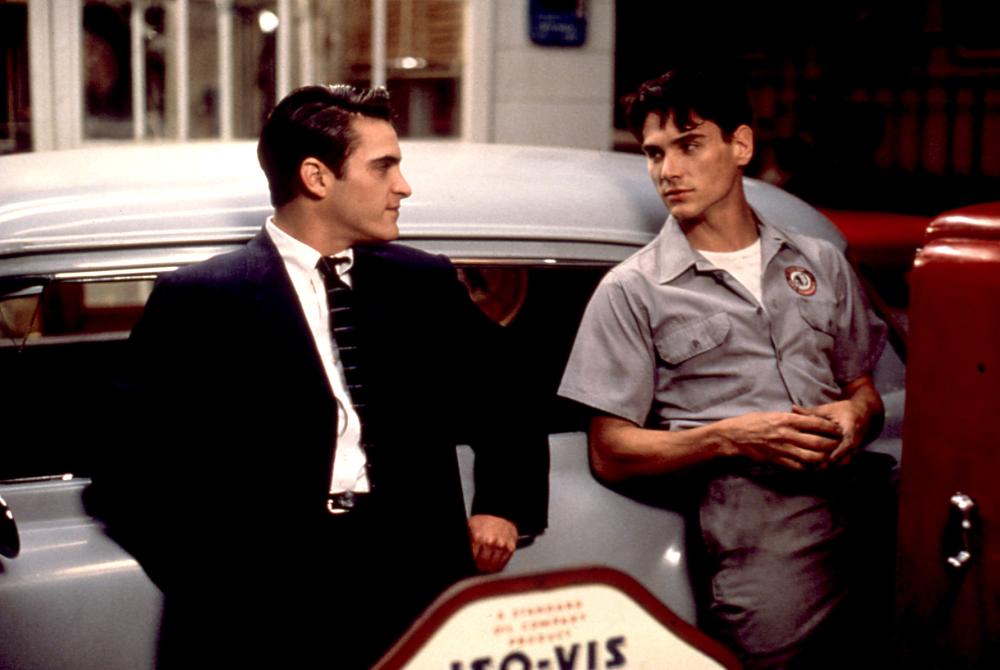
The small Midwest town of Haley, Illinois, in the 1950s. Teenaged brothers Jacey (Billy Crudup) and Doug Holt (Joaquin Phoenix) are brought up by single mom Helen (Kathy Baker), their father having died a long time ago. Jacey is intense, driven and determined to move ahead in life. Doug is much more mellow and awkward. Haley is dominated by the rich Abbott family, presided over by patriarch Lloyd (Will Patton).

The three Abbott daughters are objects of fascination and desire. Alice (Joana Going) is about to get married. The wild Eleanor (Jennifer Connelly) does all she can to irritate her father, including carrying on an affair with Jacey. The more timid Pamela (Liv Tyler) has eyes for Doug, but he is also infatuated with Eleanor. As Jacey and Doug transition from high school to college, Jacey runs afoul of Lloyd's anger, Eleanor disappears from town, Doug has an on-again, off-again relationship with Pamela, and the complicated history involving Lloyd, Helen and the boys' dead father emerges.

A slice-of-life drama and romance, Inventing The Abbotts aims for a poignant vibe, nurtured by a love and anger in a small town milieu. Director Pat O'Connor occasionally succeeds in touching the tender chords of young hearts evolving into adults. But as the film progresses into its second half, the story (originally a Sue Miller novel) narrows down to Jacey's soulless obsession with all things Abbott, while Doug and Pamela discover new ways to hurt each other. Instead of seizing opportunities to become adults, the boys' behaviour more often than not appears to regress, confining the film into a limited emotional box.

In its better moments, the film does offer tastes of flavourful topics. There are intertwined themes of classicism, with the Holts inherently seeing themselves as subsidiary to the rich Abbotts, but the Abbott girls also struggling against their own family's reputation. The shadows cast by fathers, present or missing, also provide rich grounds for exploration, with Lloyd Abbott and Helen's deceased husband sharing a history that will be painfully and gradually revealed. The relationship between the two brothers Jacey and Doug is fraught with minefields, and the film takes no shortcuts towards brotherly reconciliation.

The performances are consistent with the material, and the limited character growth means that the acting need only be satisfactory rather than stellar. Joaquin Phoenix occupies the emotional centre of the film, and provides Doug with the awkwardness of small town youth beginning to grapple with adult problems. Billy Crudup infuses Jacey with bitter fervor as a young man who believes that the world owes him, but Crudup is most hampered by a script that forgets to allow Jacey to grow up.

Among the girls, Jennifer Connelly succeeds in making Eleanor an object of boyhood fantasy but then disappears from the film for a long period. Liv Tyler is honest as the down-to-earth Pamela, living in her sister's shadow. As the parents Kathy Baker and Will Patton are adequate in support, but again their characters remain at a steady state. Michael Keaton provides uncredited narration as the grown-up Doug.

Inventing The Abbotts is sometimes pleasingly wistful, and just as often, painfully wasteful.


All Ace Black Blog Movie Reviews are here.