Showing posts with label Kathleen Turner. Show all posts

Friday, 10 January 2025

Movie Review: Moonlight And Valentino (1995)


Genre: Drama  
Director: David Anspaugh  
Starring: Elizabeth Perkins, Gwyneth Paltrow, Kathleen Turner, Whoopi Goldberg  
Running Time: 105 minutes  

Synopsis: College poetry teacher Rebecca (Elizabeth Perkins) is devastated when her husband is killed by a car while jogging. She receives emotional support from her neighbour Sylvie (Whoopie Goldberg); younger sister Lucy (Gwyneth Paltrow); and ex-stepmother Alberta (Kathleen Turner). Sylvie's marriage is in trouble, Lucy is a morose loner with body image insecurity, and Alberta is an unlikeable Wall Street executive. The months pass, and Rebecca finally perks up when a handsome housepainter (Jon Bon Jovi) appears in the neighbourhood.

What Works Well: The talented cast delivers reliably steady performances, achieving small victories for quiet moments of discomfort and dry humour. The idyllic wealthy suburban setting is quaint.

What Does Not Work As Well: Based on the autobiographical book by Ellen Simon (Neil's daughter), this is an aimless and listless drama. Beneath the soft focus packaging is an unconvincing exploration of grief involving poorly defined characters who fail to transition from glib to genuine. The pacing is languid, few if any insights register, and some late-in-the-day revelations appear out of nowhere and smack of narrative desperation. 

Key Quote:
Alberta: I'd rather imagine a man than know him for sure.


All Ace Black Movie Blog reviews are here.

Saturday, 4 November 2023

Movie Review: The Estate (2022)


Genre: Comedy
Director: Dean Craig
Starring: Toni Collette, Anna Faris, Kathleen Turner, David Duchovny, Rosemarie DeWitt, Ron Livingston
Running Time: 96 minutes

Synopsis: Siblings Macey and Savannah (Toni Collette and Anna Faris) are struggling financially and about to lose their coffee shop business. Macey is more responsible but unlucky in life and love, while Savannah is flighty and scrappy. When they learn that their rich Aunt Hilda (Kathleen Turner) is about to die, they rush to her house to try and weasel their way into her will. Unfortunately, cousin Beatrice (Rosemarie DeWitt) and her husband James (Ron Livingston) are already there with the same agenda, as is cousin "call me Dick" Richard (David Duchovny). 

What Works Well: Some of the jokes land well and the quality cast members buy into the silly premise, with David Duchovny having the most fun as the oily cousin absolutely no one wants to have. A side-track involving Aunt Hilda's long-lost high school sweetheart (Danny Vinson) scores with all-out audacity.

What Does Not Work As Well: Director Dean Craig's flimsy script leans heavily on far-fetched character actions and frequent vulgarity, sacrificing smarts and wit along the way. Neither Aunt Hilda nor any of her relatives are deserving of sympathy, severely hampering enjoyment.

Conclusion: The crass treatment of a flimsy premise deserves no windfall.


All Ace Black Movie Blog reviews are here.

Friday, 6 October 2023

Movie Review: The Swearing Jar (2022)


Genre: Romantic Drama
Director: Lindsay MacKay
Starring: Adelaide Clemens, Patrick J. Adams, Douglas Smith, Kathleen Turner
Running Time: 111 minutes

Synopsis: School teacher and aspiring singer/songwriter Carey (Adelaide Clemens) informs her husband Simon (Patrick J. Adams) that she is pregnant. They agree to curtail their swearing habit, and then break the news to his caustic mother Bev (Kathleen Turner). Carey suffers mood swings, but also notices Simon's increasingly weird behaviour. In a separate timeline, Carey is drawn into a potential romance with guitarist and bookstore clerk Owen (Douglas Smith). A third sequence features Carey performing her songs at an intimate gathering, accompanied by Owen on guitar.

What Works Well: Writer Kate Hewlitt adapts her own play into this Canadian production, and eloquently explores themes of love, trust, loss, and longing. Director Lindsay MacKay finds soulful notes filled with glow, wit, and realism in the pregnancy, romance, and performance components of Carey's life, gradually connecting the fragile threads. The dramatic tones are low-key and enlivened by small humorous touches, many courtesy of Kathleen Turner's lived-in abrasiveness, while Adelaide Clemens delivers a grounded performance and finds good chemistry with both Patrick J. Adams and Douglas Smith.

What Does Not Work As Well: The script is only made possible by many characters hiding many secrets from each other, a device that ultimately undermines the consistency of emotions on display. The songs are certainly organic and heartfelt, but remain amateur compositions delivered by music dabblers. 

Conclusion: Counters contrivances with a bittersweet attitude and thoughtful assembly.


All Ace Black Movie Blog reviews are here.

Friday, 3 July 2015

Movie Review: The Jewel Of The Nile (1985)


A sequel to 1984's Romancing The Stone, The Jewel Of The Nile reunites author Joan Wilder and adventurer Jack Colton for another madcap adventure, this time in the Arabian desert. The attitude and quality are good, but this is a purely derivative project.

Six months after chasing a massive jewel in the South American jungles, Joan (Kathleen Turner) and Jack (Michael Douglas) are cruising the Mediterranean and getting on each other's nerves. She wants to head back to New York while he is happy to live the good life of doing nothing. Joan is approached by the mysterious wealthy tribal leader Omar (Spiros Focás), who asks her to accompany him to his unnamed kingdom and write a puff piece to bolster his popularity. Jack is then approached by Omar's enemies, who want him to find the "jewel of the Nile", apparently the inspirational source of mystical inspiration. Also making a sudden reappearance is treasure hunter Ralph (Danny DeVito), seeking revenge on Jack after ending up with nothing but prison time at the end of the South American escapade.

Joan soon finds herself effectively a prisoner in Omar's sprawling compound, and realizes that he has fascist-like evil intentions to grab more power by pretending to have supernatural powers. Jack and Ralph arrive just in time along with Omar's opponents to help rescue Joan, who in the meantime has stumbled upon a humble prisoner (Avner Eisenberg) who holds the key to stop Omar's power grab. But Jack is still intent on finding the precious large jewel, causing continued tension in his relationship with Joan.

Quickly launched into production after the unexpected success of Romancing The Stone, The Jewel Of The Nile reunites Douglas, Turner and DeVito, but without director Robert Zemeckis. Lewis Teague takes over directing duties and delivers a functional effort that ticks off all the boxes of action and romance, but never finds any new angles of originality.

The Jewel Of The Nile slips into a succession of set-piece highlights, most notably Jack conniving an escape and destroying Omar's compound into the bargain behind the controls of an F-16 fighter jet that never leaves the ground but nevertheless causes destructive and comic havoc. Other cliffhangers include a train-top battle, Jack and Joan suspended over an endless pit of death while rats and acid gradually degrade the ropes keeping them alive, and a grand finale with Omar putting on a cheesy special effects show to convince the masses of his powers.

But there is an unshakable sense of going through the motions, emphasized by Jack and Joan often reduced to the role of spectators rather than protagonists. The action is mostly instigated by others, and our heroes rarely do much more than clumsily find a way out the latest mess. The humour is there but it's also obvious, as is the hissing villainy of Omar and his grim henchmen.

The film is saved by the unmistakable chemistry between Douglas and Turner, and the ups and downs of their relationship rise above all the noisy bullets and explosions to create a decent romantic anchor. DeVito also hits his stride and gets the best laughs in his quest to get the better of Jack, if only once. The lack of depth in the story and the stereotypical portrayal of Arabian tribal culture is balanced by the original twist on the true nature of the jewel that sets Jack off on his quest.

The Jewel Of The Nile wins no prizes for inventiveness, but does provide a pleasant enough romp through the desert.


All Ace Black Blog Movie Reviews are here.


Wednesday, 24 June 2015

Movie Review: Romancing The Stone (1984)


An action adventure romance, Romancing The Stone carries a lighthearted attitude into a jungle romp and emerges with plenty to smile about.

Joan Wilder (Kathleen Turner) is a New York-based best-selling author of soapy romances. Lonely and timid, Joan's quiet life could not be more different than Angelina's, the resourceful and fearless heroine of her books, but she still aspires to find the perfect chivalrous husband.

One day Joan receives a mysterious package in the mail containing an arcane map. In Colombia, Joan's brother-in-law is killed by thugs working for the brutal Colonel Zolo (Manuel Ojeda), who is looking for the map. Meanwhile, in Cartagena Joan's sister Elaine (Mary Ellen Trainor) is kidnapped by treasure-hunting cousins Ralph (Danny DeVito) and Ira (Zack Norman). Joan has to travel to Colombia to exchange the map for Elaine's freedom.

From the moment Joan steps off the plane she is in a lot of trouble, boarding the wrong bus, heading in the wrong direction, and being pursued by both Zolo and Ralph. Stranded in the remote mountains and about to be harmed by Zolo, Joan is rescued by Jack T. Colton (Michael Douglas), a mysterious and somewhat conceited adventurer. Joan buys Jack's services to escort her to Cartagena, but there are plenty of wild adventures to be had avoiding bad guys and discovering clues to the buried treasure before Joan can try and save Elaine's life.

With Raiders Of The Lost Ark (1981) having revived the old-fashioned thrill-a-minute adventure genre, Romancing The Stone arrived just in time to take full advantage, although the script was actually written by waitress Diane Thomas before Raiders ever hit the screens. With his career in a bit of a lull Douglas took on production duties and appointed relative unknown Robert Zemeckis to direct. The film sparkles with a sense of fun and boasts an attitude that straddles a fine line between irreverent and sincere. Romancing The Stone rides the wave of Turner's sultry sex appeal, Douglas' suddenly re-emergent leading man status, and Danny DeVito's comic relief.

The script lacks a sharp wit and dry edge, instead focusing on a more feminine perspective as Joan breaks out of a self-imposed shell to find her risk-taking spirit. In the bargain she discovers passion with Jack, and Romancing The Stone works because of the surprisingly good attraction between the novelist uncovering her wild side and the maverick learning that it feels good to have a companion.

Zemeckis keeps the action hopping in the Colombia jungle (actual filming took place in Mexico), but with a notable over-reliance on routine chase-and-shoot scenes, with almost all bullets missing their target. Ojeda as Zolo makes for an effective if utterly cartoonish villain, and DeVito establishes his credentials as a bumbling sidekick riding his luck with a greedy reach exceeding his capabilities.

Romancing The Stone does not necessarily offer much that is new, but it delivers on its simple promises with a toothy crocodile smile.


All Ace Black Blog Movie Reviews are here.


Sunday, 1 March 2015

Movie Review: The Virgin Suicides (1999)


A tender story of how girlhood can go terribly wrong, The Virgin Suicides is a wispy tragedy, softly unfolding with a sentient style.

It's 1975, in the suburbs of Detroit. Mr. and Mrs. Lisbon (James Woods and Kathleen Turner) have five daughters ranging in age from 13 to 17. Mr. Lisbon is a schoolteacher, his wife a homemaker, and they are deeply religious, keeping their daughters sheltered and away from social activities. Therese (Leslie Hayman), Mary (A. J. Cook), Bonnie (Chelse Swain), Lux (Kirsten Dunst), and Cecilia (Hanna R. Hall) become the subject of fascination bordering on obsession for the boys in their neighbourhood. The level of curiosity is amplified when the youngest girl Cecilia attempts suicide by slashing her wrists, but she is saved.

Dr. Horniker (Danny DeVito) advises the Lisbons that they need to allow their daughters to mingle more with their classmates. The first party hosted by the girls ends tragically when Cecilia does indeed succeed in killing herself. The surviving sisters tentatively start to socialize more, but when the free-spirited Lux falls under the spell of Trip Fontaine (Josh Hartnett), the coolest boy in the school, Mr. and Mrs. Lisbon clamp down harder, triggering grim consequences.

Sofia Coppola's directorial debut, adapting the Jeffrey Eugenides novel, is a hypnotizing journey into the perilous world of growing up. The Virgin Suicides is a bleak story delivered with a delicate touch, capturing the suburban melancholia that emerges with the loss of innocence. Coppola bathes the film in happy colours, soft light, and an airy, remarkably open atmosphere, contrasting the image of flourishing suburbia with the suffocation within families behind closed doors. Death is hovering nearby, the disease-infested neighbourhood elm trees the subject of much agony: should they be left to die naturally or chopped to avoid infecting others.

Seen through the eyes of teenaged boys, The Virgin Suicides treats girls in adolescence as a fragile mystery fraught with peril. They are easily knocked off course by good intentions tarnished with religious dogma, misguided parental rules metastasizing into a horror show of desperation fuelled by confinement. And the film stands outside the girls and observes them as objects of fascination, young women emerging as enigmas to their parents, and most acutely to the boys who would, under normal circumstances, become the men in their lives.

Despite the raging drama of girls fighting to breathe the oxygen of adulthood, Coppola constructs The Virgin Suicides with remarkable calm, and the film avoids guilt trips, finger pointing and recriminations. Below the seemingly staid surface, the tension may boil, but in the day to day lives of the girls, their school and their neighbourhood, the emotions are in check. Smatterings of gossip and interludes of uneasy silences hint at the turmoil; most of what is wrong is left unsaid. The soundtrack by French duo Air perfectly captures the dolefulness of the film, Playground Love a devastatingly evocative theme song.

In addition to Woods, Turner and DeVito, the supporting cast is sprinkled with interesting faces. As Trip Fontaine, Josh Hartnett delivers a refreshingly assured and animated performance. Michael Paré plays the adult Trip, Scott Glenn has a small role as a priest, and Giovanni Ribisi provides low-key narration. A young Hayden Christensen appears as one of the neighbourhood boys.

But this is a story of five sisters, and as the most adventurous of the Lisbon daughters, Kirsten Dunst shines in a role that lives in the twilight zone between individualism and calamity. Never outwardly rebellious, Dunst allows Lux to smile through life's limits as her young mind assesses ever dwindling options, from breaking a strict curfew to exploring what the roof has to offer when the outdoors are off limits. And when the conditions of growing up become even more stifling, she invites the curious boys indoors, to discover for themselves the images of truncated hope.


All Ace Black Blog Movie Reviews are here.


Tuesday, 19 November 2013

Movie Review: Switching Channels (1988)


A lame remake of The Front Page and His Girl Friday, Switching Channels is dull, uninspired, and singularly lacking in wit and chemistry.

Christy Colleran (Kathleen Turner) is the star anchor at the Chicago-based Satellite News Network, where her ex-husband John "Sully" Sullivan (Burt Reynolds) is the station director. When an overworked Christy finally reaches the point of exhaustion, she is packed off on a forced vacation, where she meets and falls in love with smooth businessman Blaine Bingham (Christopher Reeve). Christy returns to Chicago on a high, announcing that she is quitting the news business and marrying Blaine.

Sully does not want to lose his star on-air talent, and he still harbours hopes of winning back Christy. He proceeds to conjure up every possible obstacle to place in the way of Blaine, while tempting Christy back to her career by getting her to interview Ike Roscoe (Henry Gibson), a death-row inmate about to be executed for killing a drug-dealing cop, in the hopes that the exposure will force the Governor to issue a pardon. Meanwhile, Attorney General  Roy Ridnitz (Ned Beatty) is himself running for Governor, and wants to make sure that Roscoe fries to further his own tough-on-crime credentials.

The fourth big screen version of the Broadway comedy The Front Page by Ben Hecht and Charles MacArthur, Switching Channels is as unnecessary as it is awful. With pedestrian direction by Ted Kotcheff and a juvenile Jonathan Reynolds script, the film attempts to modernize the premise to the world of television, but has a dreadful time trying to find laughs, and fails miserably at every opportunity.

Burt Reynolds' performance is simply annoying, while Kathleen Turner is off the mark, seemingly over-acting in desperation to appear either witty or ditzy, but instead coming across as fatally bland. Reynolds and Turner together never threaten to display any sign of a spark, and indeed are reported to have clashed throughout filming. Christopher Reeve suffers the most, his Blaine Bingham a phantom personality, stood up as an easy cardboard target for Sully's darts.

The film ends with that time-trampled old favourite from the films of yesteryear, herds of men running in groups in and out of rooms and across hallways, lowest common denominator comedy that pre-teens may find funny, but really just serving as an embarrassing confirmation that some comic elements are best left in their own era.

Switching Channels clumsily fumbles with the dials, but only manages to find aggravating static.


All Ace Black Blog Movie Reviews are here.


Friday, 19 July 2013

Movie Review: Peggy Sue Got Married (1986)


A time travel comedy romance, Peggy Sue Got Married is an amicable journey into the world of second chances.

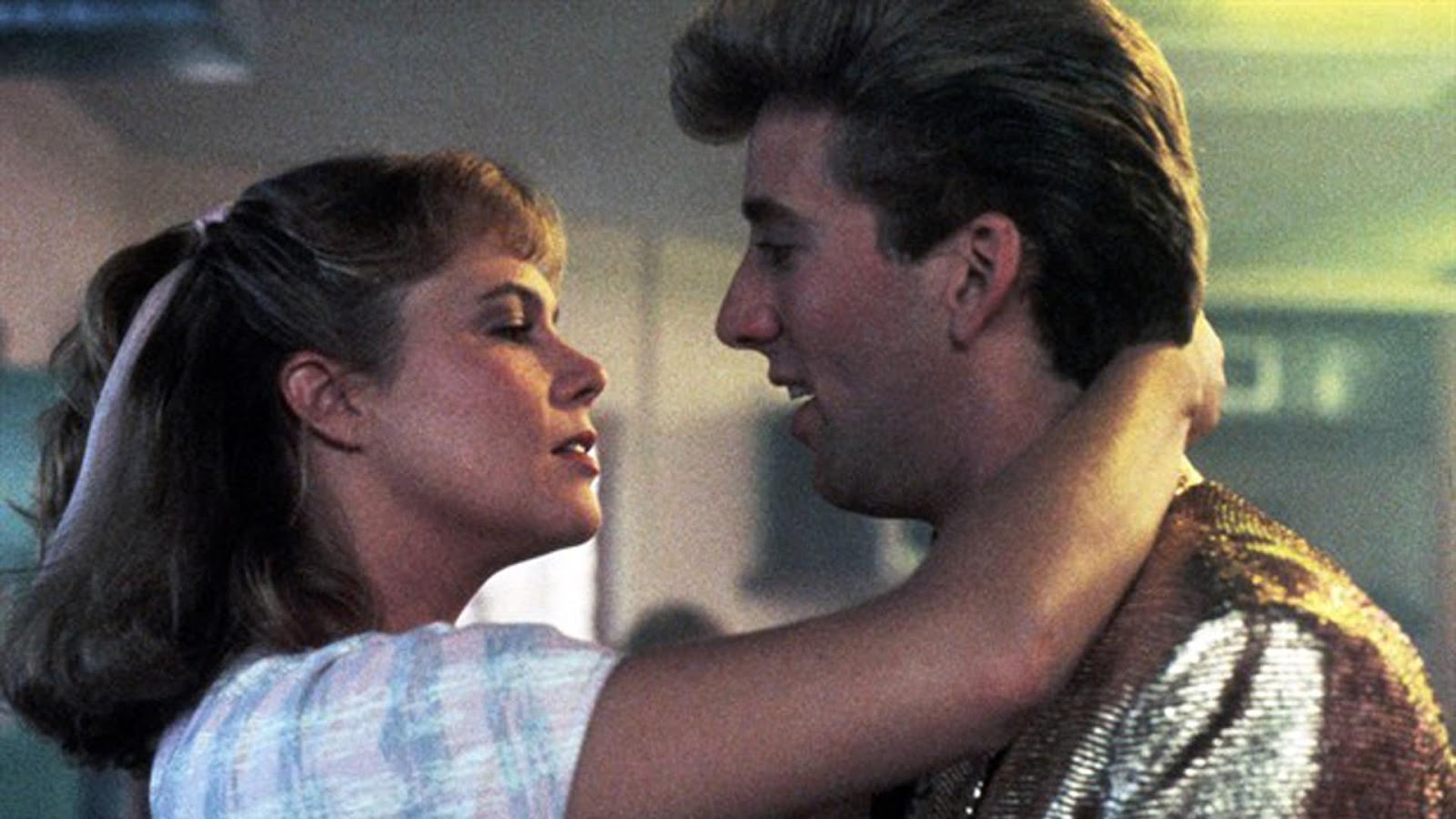
Peggy Sue (Kathleen Turner) is an unwilling participant in her high school's 25-year reunion, but she is prodded to attend by daughter Beth (Helen Hunt). Peggy Sue's marriage to high school sweetheart Charlie (Nicolas Cage) has fallen apart, with Charlie cheating on her after having abandoned ambitions of a musical career to become a cheesy electronics salesman. At the reunion Peggy Sue catches up with old friends and classmates, including Richard (Barry Miller) who used to be the school's outcast nerd but is now a successful businessman. No one at the reunion knows the whereabouts of Michael (Kevin J. O'Connor), the dreamy and athletic class idealist.

After being anointed reunion queen, Peggy Sue faints and wakes up 25 years in the past, a few days before her 18th birthday. Her relationship with Charlie is on shaky ground, and although he is full of love, passion and promise, with her knowledge of the future, Peggy Sue cools towards him. She establishes a warmer friendship with Richard, and boldly sidles up to the aloof Michael, resulting in one memorable night. With the ability to make different decisions about the rest of her life, Peggy Sue tries to define what the right choices should look like.

After the time-travel-to-the-1950s success of Back To The Future (1984) and the boost of 1960's nostalgia provided by The Big Chill (1983), Peggy Sue Got Married straddles the two and lands in 1960. But rather than the broad comedy of DeLoreans-as-time-machines-powered-by-lightning or the examination of a generation losing touch with its principles, Peggy Sue Got Married is a more intimate, personal experience. One person, one unlikely opportunity to make a few different decisions and change the entire trajectory of a life that has seemingly turned miserable. What will Peggy Sue do?

In one of his smaller, more restrained outings, director Francis Ford Coppola keeps the mood light and the spirits high. Once she is transported back in time, Peggy Sue takes her predicament in stride, and settles down to life as an 18 year old teenager with all the benefits that come from 25 additional years of experience. She immediately senses the opportunity to do things differently, and to interact on a mature level with her parents (Barbara Harris and Don Murray) and sister (a young Sofia Coppola, already displaying the wooden delivery that would steer her to directing rather than acting).

And at school, free from the clique mind-set of her younger self, she breaks out of her peer group and rectifies two regrets by reaching out to the geeky Richard and the dark Michael. Although her actions in connecting with outcasts serve her ego, she also helps both boys become better men. And by looking again at a young, ambitious and talented Charlie, Peggy Sue experiences again what attracted her to him, and the dangers of a young love that she now knows will go astray.

Kathleen Turner, around 32 years old at the time of filming, transitions easily from a middle-aged woman going through a marriage crisis to a teenager enjoying a life of dates, parties, and exam failures. She gives the young Peggy Sue the sarcastic smarts that only come from a life of painful mistakes, much to the befuddlement of parents, teachers and classmates. Turner was nominated for the Best Actress Academy Award.

Nicolas Cage, Coppola's nephew and a decade younger than Turner, spends most of the movie as the young Charlie, and delivers his typical messy intensity, this time buffeted by a girlfriend who seems suddenly more self-assured and less entranced by his big dreams of artistic success. Jim Carrey, Joan Allen and Maureen O'Sullivan have small roles in the impressively deep cast.

Peggy Sue Got Married arrives at an understated conclusion, consistent with the tone of the movie. Small changes make a big difference, and big decisions can be accommodated with heart, rather than a backlash.


All Ace Black Blog Movie Reviews are here.


Tuesday, 12 October 2010

Movie Review: Body Heat (1981)


About 30 years after the film noir era was supposed to have ended, writer and director Lawrence Kasdan conjures up what may be the best example of the genre.

Body Heat is memorably dominated by oppressive heat: the debilitating heat wave that mother nature has unleashed on Florida; the sensual heat of bodies rubbing against each other; the evil heat of fires caused by arson; and the suffocating heat of the ever-present cigarettes that most of the characters cannot stop smoking. Kasdan grabs control of the temperature dial, cranks to the right, and never relents.

In the middle of this heat, Ned Racine (William Hurt) is a small town lawyer in Florida. He's not a good lawyer, but that does not seem to bother Matty Walker (Kathleen Turner), a rich and unhappily married woman who meets Ned and seduces him with all the lust and sex that he can handle. Matty soon has Ned convinced that they need to murder Matty's husband Edmund (Richard Crenna) so that they can together inherit his massive fortune.

They pull off the murder, and Ned's life quickly starts to unravel, as he realizes that Matty is not exactly what she appears to be, and that he may have unwittingly stepped into an elaborate scheme way more complex than he can handle.

Body Heat catapulted both William Hurt and Kathleen Turner into super-stardom, and both are outstanding. Hurt portrays the sleazy and dim-witted Racine as both realistic and sympathetic. Turner, in her film debut, is outstanding as the lethal seductress, attracting and ensnaring Racine with passionate heat that is nothing but camouflage as she coldly manipulates him to serve her plot.

The quirky supporting cast adds to the enjoyment. Ted Danson as the only other lawyer in town and J.A. Preston as the local police detective undergo interesting transformations, from being friends with Racine to suspecting him of murder. Richard Crenna and Mickey Rourke add great depth to the film in minor but critical roles.

Kasdan's script includes many memorable lines and exchanges of dialogue, from Matty telling Ned "You're not too smart, are you? I like that in a man", to Ned telling Matty "You shouldn't wear that body". It's all clever, adult, and dangerous, perhaps too witty to apply to all the characters in this movie, but hugely successful as entertainment.

In all its elements, Body Heat simply crackles.


All Ace Black Blog Movie Reviews are here.