Showing posts with label Kirsten Dunst. Show all posts

Sunday, 1 February 2026

Movie Review: Crazy/Beautiful (2001)


Genre: Romance  
Director: John Stockwell  
Starring: Kirsten Dunst, Jay Hernandez, Bruce Davison  
Running Time: 99 minutes  

Synopsis: High school student Carlos (Jay Hernandez) comes from a Hispanic family living on the wrong side of town, but he is nevertheless a good student, a star on the football team, and applying to a military academy. His classmate Nicole (Kirsten Dunst) is the daughter of a wealthy congressman (Bruce Davison). She is also a frequently drunk party girl rebelling against a perceived lack of affection at home. Carlos and Nicole start an intense romantic relationship, but their different backgrounds will cause tension.

What Works Well: Nicole is crazy, Carlos is beautiful, and this "opposites attract" romance carries an admirable intensity. Kirsten Dunst demonstrates impressive range in revealing Nicole's seething anger at a father ignoring her while accommodating his new bride and dotting over a new baby. That the dad takes on a greater role as the drama unfolds is credit to a script willing to treat parents as more than afterthoughts in a teen romance. Tensions between neighbouring communities, peer pressure from the distinct circles of friends surrounding the lovers, and hints of future opportunities all add further texture.

What Does Not Work As Well: Carlos' life plan along the straight-and-narrow path of academic and athletic excellence is fundamentally at odds with succumbing to a distraction like Nicole, and their romance never reconciles this disconnect. The final act is emotionally impressive and allows Dunst to sparkle, but also represents simplistic solutions to deep-seated behavioural issues. 

Key Quote:
Carlos (to Nicole): I want to take you away from everything that makes you crazy.


All Ace Black Movie Blog reviews are here.

Monday, 30 September 2024

Movie Review: Civil War (2024)


Genre: War Drama  
Director: Alex Garland  
Starring: Kirsten Dunst, Cailee Spaeny, Wagner Moura, Stephen McKinley Henderson, Jesse Plemons  
Running Time: 109 minutes  

Synopsis: The United States is in the grips of a civil war, with the Western Forces of California and Texas rebelling against a three-term President (Nick Offerman) and advancing on Washington DC. Veteran war photographer Lee Smith (Kirsten Dunst) and reporter Joel (Wagner Moura) embark on a hazardous trip from New York to the capital, intending to interview the President. They reluctantly agree to give a ride to elderly journalist Sammy (Stephen McKinley Henderson) and young upstart photographer Jessie (Cailee Spaeny). Their trip will expose them to the horrors of a country tearing itself apart.

What Works Well: Writer and director Alex Garland transposes carnage associated with failed states into the heart of a democratic superpower, and allows four members of the press to witness the consequent disintegration. The visuals are violent and jarring, often accompanied by innovatively nihilistic music, or just silence. Kirsten Dunst as the seen-in-all-before photographer masks sorrow with a caustic attitude, and the final 30 minutes feature an exhilarating assault on what was once the seat of global power.

What Does Not Work As Well: The war's politics, causes and strategies are kept intentionally vague, leaving just the ground-eye-view as context. Lee, Joel, Sammy and Jessie are therefore asked to carry the dramatic weight, but they are at best sketched-in characters, heavily reliant on stereotype definitions.  

Key Quote:
Lee: Every time I survived a war zone, I thought I was sending a warning home - "Don't do this". But here we are.


All Ace Black Movie Blog reviews are here.

Saturday, 8 January 2022

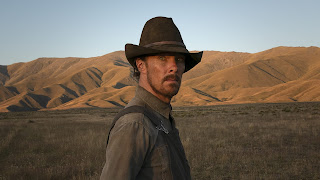
Movie Review: The Power Of The Dog (2021)

A character-driven drama set in a western milieu, The Power Of The Dog boasts visual beauty, slow pacing, and a remarkably sparse story.

In Montana of 1925, brothers Phil and George Burbank (Benedict Cumberbatch and Jesse Plemons) own and run a cattle ranch. Phil idolizes the memory of deceased cowboy Bronco Henry, who taught him all he knows about ranching 25 years ago. He is also a brash leader and enjoys belittling others, especially George, who is calmer and quieter. After a cattle drive to a nearby trading town, George quickly courts and marries the widow Rose Gordon (Kirsten Dunst), who runs an inn and restaurant. Her teenaged son Peter (Kodi Smit-McPhee) loves to create paper flowers and has feminine tendencies, making him an easy target for Phil. 

Phil believes Rose is a cheap gold-digger not really in love with George and only looking for a cut of the Burbanks' wealth. When George is away, Rose is intimidated and starts to drink heavily. Peter enrolls in medical school, but on a visit back to the ranch, the dynamic between him and Phil starts to change.

For a film clocking in at 126 minutes, remarkably little happens in The Power Of The Dog. Director and writer Jane Campion adapts a book by Thomas Savage, and is primarily interested in the rugged beauty of the landscape, a place where men are men and any man lacking macho swagger is a misfit and soft target. Phil, George, Rose, and Peter create a compelling quartet of characters brought together by a hasty union, and Phil's grim but conflicted and intentionally aggravating persona pulses a steady crackle of tension through the inter-personal dynamics.

While the film is not exactly a slog, the pacing is near-moribund. A good three quarters of the movie invests in the foundational set-up, a long and ultimately pointless dinner party sequence among the slow-moving, often circular distractions. Campion finally progresses beyond Phil's underhanded insults and towards character evolutions, some unpredictability, and a heightened sense of drama. Needs and weaknesses are revealed, and a double-ended low-key duel unfolds. The thematic arc remains subtle, evocations of a changing west quietly exposed through intellect as an emergent clandestine weapon on the prairies.

With narrative momentum barely providing any competition, the actors grab centre-stage. Benedict Cumberbatch conveys dominant sweaty presence with an intensity crafted to hide tortured secrets. Jesse Plemons and Kirsten Dunst are adequate foils, while Kodi Smit-McPhee gains impressive stature and prominence in the final act.

Lyrical and soulful, The Power Of The Dog is also an embrace of cinematic lethargy.


All Ace Black Movie Blog reviews are here.

Saturday, 18 December 2021

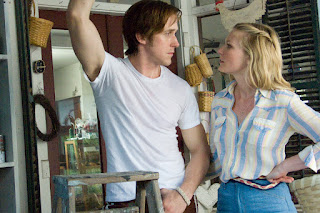
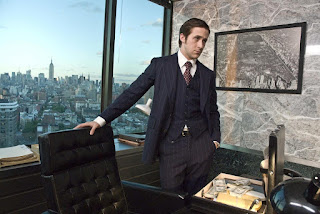
Movie Review: All Good Things (2010)

A crime drama inspired by real events, All Good Things is a fascinating story hampered by an emotional void.

In 2003, David Marks (Ryan Gosling) is testifying in a courtroom, and events are revealed in flashback. In the early 1970s, Sanford Marks (Frank Langella) is a New York City real estate tycoon. His son David is a young man traumatized by the death of his mother when he was young, and now resisting his father's pressure to get involved in the family business. Instead, David marries aspiring medical student Katie McCarthy (Kirsten Dunst) and they relocate to Vermont and open the All Good Things country store.

But David eventually succumbs to his father's wishes and the newlyweds relocate to New York. A fissure develops between Katie and David when he denies her wish to start a family. They grow apart, and he withdraws into an incommunicative shell. The detachment turns to hostility, and over the years bad things start to happen to the people around David, including Katie, his friend Deborah Lehrman (Lily Rabe), and lonely old man Malvern Bump (Philip Baker Hall).

Director Andrew Jarecki steps away from documentaries but stays close to a version of reality, All Good Things inspired by the true story of Robert Durst. Co-writers Marcus Hinchey and Marc Smerling fictionalize the remarkable sequence of events resulting in two suspicious deaths and one missing person over several decades, all swirling around the troubled son of a real estate magnate.

With a quiet mood, a sense of dread, and good use of short and sharp flashbacks, the film is always compelling. But for a relatively brisk length of 101 minutes, the set-up takes a long time. Throughout the first half, David is generally sympathetic (with hints of distress) as a free-spirited scion pushing against a stern father. Once events move towards nefarious intentions, his switch to a withdrawn and mostly silent antagonist leaves behind a disorienting vacuum in the form of an expressionless plotter of evil.

This is no fault of Ryan Gosling, who embodies an enigmatic man descending into an unfortunately unspoken inner hell. It is left to Kirsten Dunst to provide a warm heart and soul, and the film turns cold once Katie is sidelined. But David's grotesque adventures continue, and a final chapter brings in sharp-shooting old codger Malvern Bump, a bizarre cross-dressing sub-plot, and a sudden rise in prominence for the previously barely relevant Deborah. Again the actual plot elements are engrossing, but by now also disjointed.

All Good Things fades towards disheartening resolutions. But the film's release triggered a series of subsequent milestones, including interviews, a documentary, and criminal charges, in a circular case of representative art re-influencing reality.


All Ace Black Blog Movie reviews are here. 

Sunday, 17 October 2021

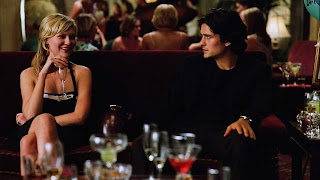
Movie Review: Elizabethtown (2005)

A romantic drama-comedy exploring themes of loss, Elizabethtown is a sweet but uneven journey through the complexities of family ties and coping with failure.

In Oregon, Drew Baylor (Orlando Bloom) is a superstar shoe designer at the Mercury sportswear company. When his latest design flops, eccentric owner Phil DeVoss (Alec Baldwin) faces a billion dollar loss, and Drew's girlfriend Ellen (Jessica Biel) distances herself from their relationship. Drew considers suicide, but his sister Heather (Judy Greer) calls with news their father Mitch has died suddenly while on a trip to his hometown of Elizabethtown, Kentucky.

On the near-empty overnight flight, Drew befriends perky flight attendant Claire Colburn (Kirsten Dunst). In Elizabethtown he meets his father's friends and relatives, and understands the depth of affection towards Mitch, although the Baylors never welcomed Drew's mother Hollie (Susan Sarandon). Over the coming few days Drew and Claire continue to see each, while Hollie causes waves by showing up for the memorial service.

Written, directed, and co-produced by Cameron Crowe, Elizabethtown is an uncoordinated but still engaging mishmash. Humour, drama, romance, culture shock, grief, a travelogue, and familial conflicts take turns setting the tone. The result is awkward, sometimes jarring, but always reasonably watchable despite an overstuffed, often whiny, soundtrack, although the inclusion of Lynyrd Skynyrd's Freebird makes up for a lot of the dross.

The film suffers most trying to define a narrative flow and logical transitions, and never really finds the magic formula. Segments exist in isolation almost as stand-alone ideas. A chunk of time is occupied in developing the romance between Drew and Claire, although their conversations border on obtuse. Frustratingly, Claire is confined to the prototypical perfect potential girlfriend who just happens to land in the protagonist's lap as an emotional saviour in his most desperate hour.

Then another long sequence gives the stage (literally) to Susan Sarandon as Hollie, trying in one night to make up for a lifetime of estrangement from Mitch's family. A final chapter steers (again, literally) into a road trip of southern landmarks. Drew grieving his career fiasco and the loss of his father are supposed to provide an arc, but the dramatic themes are only modestly refined.

The humour is derived from some typical familial quirks, including the uncles, aunts, cousins, and nephews Drew has to get to know in a hurry. Cousin Jesse (Paul Schneider), once in a Lynyrd Skynyrd tribute band, is now raising a very loud kid and is a particular source of laughs. At the hotel, Drew's room is on the same floor as a raucous wedding event, another venue for passable chuckles. 

A running joke is that Elizabethtown is difficult to find on the map. This hometown contains some charm, but is also easy to bypass.


All Ace Black Movie Blog reviews are here.

Monday, 30 August 2021

Movie Review: Marie Antoinette (2006)

A historical drama, Marie Antoinette is a relatively sympathetic view of a young woman thriving in a foreign environment of detached excess.

It's 1770, and 14-year-old Maria Antonia (Kirsten Dunst) is selected by her mother Empress Maria-Theresa (Marianne Faithfull) of Austria to marry the Dauphin (heir apparent) of France (Jason Schwartzman). The arranged marriage is intended to strengthen relations between the two countries. Maria leaves her life behind, with Austrian diplomat Florimond Claude (Steve Coogan) and letters from her mother providing the only link back home. 

After the marriage, and despite Maria's best efforts, the Dauphin is uninterested in sex. Instead he is obsessed with fox hunting and lock mechanics. The failure to produce an heir increases the gossip and pressure on Maria. But along with a small group of friends she embarks on a life of parties, fashion, food and drink. Once the couple ascend to the throne as King Louis XVI and Marie Antoinette, her unconstrained behaviour further antagonizes the suffering public.

An exercise in eye-popping imagery, Marie Antoinette presents the French monarchy as a lavish institution governed by protocol, but also a limitless playground for a young queen-in-waiting. Director Sofia Coppola wrote the screenplay as an adaptation of the Antonia Fraser book, and deploys giggly playfulness, hallways full of audible gossip, and modern music to underline an outsider's invasion of a staid Versailles. The film bursts with colour, as costumes, ridiculous wigs, make-up, and designer foods command centre stage in an uninterrupted demonstration of privilege.

Once Marie settles in France, all events take place at the palace, apart from a few trips to the opera. The disassociation between monarchy and populace is total, Coppola disinterested in historical context and traditional narratives but successfully conveying a royal family existing in a blissful bubble sheltered by luxurious landscaping. When the revolution arrives at the doorstep of Louis XVI and his bride, it is an intrusion out of nowhere.

The isolation does limit the storytelling scope, and a large supporting cast featuring Judy Davis, Rip Torn, Rose Byrne, Asia Argento, Molly Shannon, and Danny Huston is mostly lost among all the chef creations, shoe designs, latest fabrics, and fashion statements. Jamie Dornan fares better as a romantic interest for the young queen after she is provided with a private dwelling and her relationship with the king dissipates into a friendship.

Earlier, Marie's patient attempts to sexually activate her husband provide the one source of dramatic tension. It's a prolonged and sometimes funny affair, the lack of activity in the royal bed creating a crisis in two countries. Marie Antoinette lived a decadently clueless life, but she did finally erect an essential union.


All Ace Black Movie Blog reviews are here.

Sunday, 2 February 2020

Movie Review: Little Women (1994)


An amiable adaptation of the 1868 Louisa May Alcott novel, Little Women strives for a cozy tone of sisterly bonding.

Concord, Massachusetts during the Civil War. The March family's financial fortunes take a downturn when father goes off to serve in the war. Marmee (Susan Sarandon) nevertheless stays calm as she instills charitable values in her daughters Jo (Winona Ryder), Meg (Trini Alvarado), Amy (Kirsten Dunst) and Beth (Claire Danes).

The girls meet next-door neighbour Theodor Laurence (Christian Bale). Despite coming from wealth he becomes a constant companion of the sisters and starts to fall in love with Jo. But she is an aspiring writer more interested in starting a career than settling down. With Meg attracting the interest of Theodor's tutor John Brooke (Eric Stoltz), Jo sets off to New York where she meets professor Friedrich Bhaer (Gabriel Byrne), while the grown-up Amy (Samantha Mathis) heads to Paris with the elderly Aunt March (Mary Wickes).

45 years after the 1949 version starring June Allyson, Hollywood returned with the fifth big screen adaptation of the classic story, and the first to be directed by a woman. Gillian Armstrong aims for and generally achieves a Normal Rockwell-inspired mood, the script by Robin Swicord structured as a mostly quaint and family-oriented coming-of-age story.

Which is both an asset and a burden. Little Women never threatens to evolve into anything other than charming storytelling, often flirting with antiquated. The film always looks gorgeous, but also emit the whiff of staginess and almost perfect posing into just the right angle with fireplace lighting to achieve the nostalgic painting resonance.

Armstrong effectively uses the two hours of running time, every incident in the ups and downs of the March family given its due, but without bursting through a fairly narrow band of emotional involvement. The four girls remain short of memorable, just missing a cutting edge or breakout moment, all in favour of calm whimsy.

The talented young cast perform admirably within the confines of the material. Winona Ryder's Jo deserves more bite than provided by Swicord's script, while Christian Bale glides through the film with an appropriate reserve, a young man caught in love with a woman deciding her potential career matters more.

Capable but less than notable, Little Women is faithfully decorous.


All Ace Black Blog Movie Reviews are here.


Tuesday, 12 February 2019

Movie Review: The Two Faces Of January (2014)


An on-the-run thriller, The Two Faces Of January aims for a mysterious and steamy premise but stumbles on a lack of smarts and sophistication.

Athens, 1962. Rydal (Oscar Isaac) is an American tour guide and small time hustler. He is estranged from his family and recently skipped his father's funeral. Rydal spots American couple Chester and Colette MacFarland (Viggo Mortensen and Kirsten Dunst) enjoying their vacation, and is captivated by Colette's beauty. He befriends the pair, and learns that Chester is a wealthy investment banker.

A private detective catches up with Chester and attempts to shake him down to recover money Chester lost on behalf of dubious investors. Rydal stumbles upon the violent struggle between detective and banker, and helps Chester and Colette escape to Crete and also arranges for fake passports to allow them to flee the country. As the authorities start to catch up, tensions increase between the hard drinking Chester and the resourceful Rydal, with Colette caught between the two.

Author Patricia Highsmith is best known for writing Strangers On A Train and The Talented Mr. Ripley. The Two Faces Of January was published in 1964, and is here brought to the screen by Hossein Amini, who also penned the screenplay. The title refers to the two faces of the Roman god Janus, an appropriately obscure reference to the unsatisfying plot. While the first half of the film holds plenty of promise, unfortunately the back end fades away into an uninspiring battle of wits.

The introduction of the sun-drenched Grecian settings and the intriguing characters create rich possibilities for story development. Rydal's shifty street smarts, Chester's shady background, the festering psychological wounds of Rydal's anger at his deceased dad, and the classic romantic triangle build up a sturdy narrative foundation.

But is all goes to nought. Chester starts to drink heavily, stupid decisions layer on top of each other, the trio push deeper into the Crete countryscape, and the film starts to resemble a wilderness adventure. A midnight sojourn into cavernous Greek ruins provides a backdrop for more bad judgment on all sides, necessitated by the plot but far from convincing. The final 45 minutes are consumed by a tired and rather inane game of cat and mouse that miserably fails to build up any tension.

A late and desperate lunge to bolster the surrogate father theme is unconvincing, Amini having failed to nurture the human connections necessary to earn the payoff.

The cast deserved better. Although Mortensen, Dunst and Isaac never stretch, they appear committed to the material and offer enough intensity to hint at what could have been a better movie. As it is, neither of January's faces offers the requisite allure.


All Ace Black Blog Movie Reviews are here.

Monday, 6 August 2018

Movie Review: Midnight Special (2016)


A science fiction chase thriller, Midnight Special has a few ideas mainly derived from other movies, and generally wastes them.

In rural Texas, eight year old Alton Meyer (Jaeden Lieberher) is kidnapped by his father Roy (Michael Shannon) and accomplice Lucas (Joel Edgerton). Alton was being raised by a religious cult under the leadership of Calvin Meyer (Sam Shepard). The cult worshipped Alton as he appeared to possess superhuman special powers, including emitting light beams from his eyes and sharing visions and knowledge of supernatural events. Alton mainly functions at night, his eyes covered by shades whenever he is near bright light.

The FBI raids Meyer's ranch, worried that the cult members were stockpiling weapons in readiness for a day of reckoning foretold by Alton. Paul Sevier (Adam Driver) of the National Security Agency participates in the interrogations, and deciphers some of Alton's coded messages, identifying a likely location where he may be headed. Meanwhile, Roy and Lucas connect with Alton's mother Sarah (Kirsten Dunst), as they make their way with the boy to a mysterious rendezvous location pursued by the cult members and the government.

Written and directed by Jeff Nichols, Midnight Special borrows heavily from two Spielberg science fiction classics. Alton is a stranded alien with special powers trying to find his way home, evoking E.T., while the search for a secret location that could be a rendezvous with a superior interplanetary species comes from Close Encounter Of The Third Kind. It's also not a stretch to find echoes of Spielberg's Sugarland Express here as well.

The ideas are borrowed, but the quality of execution and narrative momentum is not. Nichols botches his pacing by playing hide and seek with his plot, the essentials of the story barely progressing from the opening scene to the final 5 minutes. Alton is abducted in the opening credit sequence; Nichols drops obtuse hints about his story for the next 100 minutes, which consist of one long drive and not much else of consequence. Then Midnight Special wraps up with some glistening CGI-created effects set to wondrous music.

Along the way Roy and Lucas prove to be rough-and-tumble kidnappers with relatively good intentions, while Sarah does not quite seem to know what her role is supposed to be. The government types scurry around one step behind the action and botch every opportunity they have to grab a hold of the situation. The religious cult sub-story fades in, then out, then in, before being unceremoniously dropped in its entirety.

The rather tired premise that anyone or anything a bit special attracts ideas of worship or weaponization rumbles in the background. Most of what makes it onto the screen is a distraction, the journey to an empty field existing in a core narrative void. Midnight Special pretends to have a story to tell, but it delivers tepid leftovers devoid of substance.


All Ace Black Blog Movie Reviews are here.


Monday, 24 July 2017

Movie Review: The Beguiled (2017)


A Civil War psychological drama, The Beguiled is a more lyrical remake of Don Siegel's 1971 classic. Director Sofia Coppola softens some of the edges but maintains a keen focus on the theme of emotional and physical survival.

Rural Virginia, in the fourth year of the American Civil War. While out collecting mushrooms, 12 year old Amy (Oona Laurence) stumbles onto badly wounded Union soldier Corporal John McBurney (Colin Farrell) and helps him back to the school for girls run by Miss Martha (Nicole Kidman) and teacher Edwina (Kirsten Dunst). With the war raging, only a few students have remained at the school, including the eldest Alicia (Elle Fanning), who is bored of all the repetitive lessons.

Martha agrees to temporarily shelter McBurney and tends to his leg wound, but fully intends to hand him over to Confederate troops as soon as he recovers. The soldier's presence at the school disrupts the status quo, and he quickly appreciates that he has limited time to influence the women and avoid a prisoner's fate. McBurney uses a combination of flattery, gratitude and seduction to turn the women to his side, but also ignites jealousies and conflict.

Director Coppola also wrote and co-produced the film, and The Beguiled overflows with her hallmark soft veneer of natural beauty, gentle light and flowing aesthetics hiding simmering tension. The physical setting is a wooded corner of Virginia at the interface between battlefields - heard but not seen - and an old fashioned school clinging to the vestiges of a disappearing way of life. But the real location of the film lies in the hearts and minds of seven women, suddenly awakened by a manly presence. Coppola aims her attention at the women's emotional state, and McBurney probing for openings to chart a path to freedom through charm, flattery and deception.

Coppola spreads the 94 minutes of running time across four of the women. Miss Martha is the pragmatic leader, the woman responsible for the girls and the facility. Yet a man is a man, and despite her cold and calculating demeanour she is not beyond appreciating what McBurney may offer. Teacher Edwina is older than the other girls, caught in a nowheresville life with relatively plain looks. It does not take McBurney long to identify her as the weakest link.

Alicia is blossoming into a woman, her sexual awakening kicked into overdrive by the soldier's presence. And finally young Amy can lay claim to having found McBurney, and is just old enough to harbour a crush that he can exploit.

Despite the short length the film does drag in the middle act before picking up again as the climax approaches with an eruption of colliding aspirations fueled by alcohol. Compared to the original Coppola strips out some of the characters and more radical incidents from the narrative, leaving the mostly calm interplay between the central characters to carry the entire load of the film, and at times the energy dips to saggy levels.

But the performances are uniformly good, with Kirsten Dunst the most quietly expressive, her searching, desperate eyes betraying a heart all too ready to believe in empty promises. Colin Farrell brings to the role more charm and less obvious dominance compared to Clint Eastwood.

The Beguiled is a meditation on the damage unleashed when war seeps inside the walls of civility. The big guns rage outside, but they are no match for the turmoil within.


All Ace Black Blog Movie Reviews are here.


Sunday, 19 March 2017

Movie Review: Hidden Figures (2016)


A feel-good drama recognizing the scientific contributions of three black women, Hidden Figures has an inspirational story to tell but is also packed with over-amplified melodrama.

It's 1961, and three black women work as "computers" on the nascent NASA space program in Virginia. Katherine Goble (Taraji P. Henson) is a mathematical genius whose potential has not yet been recognized; Dorothy Vaughan (Octavia Spencer) is being held back from a supervisory position she richly deserves, and Mary Jackson (Janelle MonĂ¡e) has ambitions to be an engineer but faces obstacles due to segregation laws. With the Soviet Union comprehensively winning the space race, director of the Space Task Group (STG) Al Harrison (Kevin Costner) and his head engineer Paul Stafford (Jim Parsons) are under increasing pressure to place a man into space.

Katherine is recruited into the STG and starts to prove her worth despite entrenched racist attitudes. Dorothy spots the emergence of computers as a key new technology and takes the initiative to teach herself and her team computer programming. Mary refuses to take no for an answer, and pushes to get accepted into the courses she needs for an engineering degree. As the countdown continues to John Glen's maiden flight, the three women play an increasingly prominent role.

An adaptation of the Margot Lee Shetterly book directed by Theodore Melfi, Hidden Figures shines a light on the previously unheralded contributions of three remarkable women who toiled against both gender and racial discrimination. Their story is irresistibly uplifting, and the film is a celebration of quiet dignity, persistence and strength of character against seemingly impossible odds.

The film does several things well. The challenge of developing the science of safely launching objects and people into orbit is tackled at regular intervals. The language may be simplified, but the hard work of inventing the math of space exploration is captured. And Melfi recreates the cerebral workplaces of the era to good effect. White men in white shirts dominate the hallowed halls of science, a pale background of uniformity against which Katherine, Dorothy and Mary literally stand out as coloured invaders.

But this being Hollywood, Hidden Figures also takes every opportunity to push a quiet story to over-saturated levels. While there is no expectation of documentary-levels of realism, the film ironically cheapens the women's achievements by adding large doses of mediocre mythology. Black women earning respect in a white male dominated world should generate sufficient drama; here the real accomplishments are obscured by superficial incidents of racial discrimination that are either fully made up or over exaggerated.

Melfi, who also co-wrote the film, invests too much time on Katherine running back and forth to the coloured ladies room, a case of first inventing a crisis and then not knowing when to let go. Dorothy's leadership of her team is elevated to a military style, invade-the-computer room heroics. Mary's courtroom highlight scene is another long stretch of the truth. The climax is most egregious, offending the space program with contrived last-minute panics.

The three lead actresses rise above the material and are uniformly excellent, with Taraji P. Henson shining brightest. Kevin Costner is his steady self, while the supporting cast includes telling contributions from Mahershala Ali as Katherine's romantic interest and Kirsten Dunst as a prim supervisor hiding behind passive racist attitudes.

Hidden Figures is stirring story partially compromised by suspect storytelling.


All Ace Black Blog Movie Reviews are here.


Thursday, 9 July 2015

Movie Review: Wimbledon (2004)


A romantic comedy set during the esteemed tennis tournament, Wimbledon is harmless enough but also so incredibly light in terms of content that it threatens to blow away well before the 98 minutes are up.

Peter Colt (Paul Bettany) is an English veteran tennis player on the pro circuit, once ranked eleventh in the world but now considered well past his prime. The Wimbledon tournament is about to begin and Colt receives a wild card entry, consistent with his status as a rank outsider. He accepts a new job as a tennis pro at a country club, and intends to announce his retirement as soon as he is eliminated.

At the start of the two-week tournament Peter meets rising American star Lizzie Bradbury (Kirsten Dunst), embarking on her first Wimbledon but already considered among the favourites. Peter and Lizzie start a friendship that develops into a romance. Lizzie's father Dennis (Sam Neill) considers the relationship a distraction that will hinder his daughter's progress, and he tries to stop the couple from seeing each other. But rejuvenated by love, Peter goes on an unlikely winning streak, and his further progress in the tournament is dependent on being able to continue the affair with Lizzie.

Wimbledon is a good looking film with attractive leads and a toney setting. But it's also a film where precious little actually happens. Peter and Lizzie meet, fall in love, encounter some routine complications, play a lot of tennis, and that's about it. An extraordinary amount of time is actually consumed showing tennis games being played, and the final climactic match extends for a good 20 minutes of screen time, betraying the lack of narrative momentum.

Director Richard Loncraine works the lightweight script as best as he can, but cannot conjure up much subject matter. The perfunctory threats to the relationship come in the shape of the rather harmless Dennis. A younger, more aggressive McEnroesque American tennis player and potential romance rival (Austin Nichols) is portrayed in such broad strokes that he never registers. The assortment of friends who are supposed to enliven rom-coms are reduced to Peter's boring training partner and a corny agent (Jon Favreau), both of whom are utterly forgettable. The attempts at comedy and wit are more miss than hit.

Paul Bettany and Kirsten Dunst are likeable enough, and what pleasure there is in the film is derived from two actors who are both better than the material, although neither convince as pro tennis players in the on-court action scenes. Bettany gives Peter some depth, and the premise of a fading star lucking into one last run to glory while battling his inner demons emerges as the most engaging part of the film. That this has almost nothing to do with the bland romance is a suitable summary of the film's deficiencies.


All Ace Black Blog Movie Reviews are here.


Sunday, 14 June 2015

Movie Review: Mona Lisa Smile (2003)


A winds-of-change drama set at Wellesley College in 1953, Mona Lisa Smile tackles women's issues as attitudes transition from a post-War focus on domesticity to the initial rumbles of feminism.

Moving from California, Katherine Watson (Julia Roberts) joins the faculty of the prestigious all-women Wellesley College near Boston as an Art History teacher. In her early thirties, Katherine is already considered dangerously close to being past the age of marriage. Katherine becomes friends with her landlord Nancy (Marcia Gay Harden), who has grown too old too soon after losing her husband, and roommate Amanda (Juliet Stevenson), the independent minded College nurse. And while she finds her students phenomenally smart and well-educated, the entire focus of their lives is on finding a husband before finishing college.

The students include Joan (Julia Stiles), who has potential to study law at Yale should she choose to look past a future as a housewife; Betty (Kirsten Dunst), the most privileged of a privileged bunch and already planning her wedding; Giselle (Maggie Gyllenhaal), a free spirit seeking plenty of sexual adventure and harbouring a deep crush on Professor of Italian Studies Bill Dunbar (Dominic West); and the plain Connie (Ginnifer Goodwin), who is considered least likely to snag a husband.

Katherine tries to instill in her students a greater sense of ambition, urging them to look into futures that could offer something different than husbands, kids and housework. She faces a significant backlash from both the students, who have been raised with predefined expectations, and the College administrators, who do not take kindly to Katherine challenging time-honoured traditions. Katherine also has to sort out her personal life, with Bill taking an interest in her, and her California boyfriend Paul (John Slattery) seeking a commitment.

Directed by Mike Newell, Mona Lisa Smile delves into the status of women as they see themselves. With plenty of intelligent characters at interesting crossroads in life, the film never lacks for variety, opposing viewpoints and conflict.  The script (by Lawrence Konner and Mark Rosenthal) manages to create an academic environment where minds are free to explore big questions about the future, the value of education, and the ambitions of women relative to society's expectations. There is no shortage of perspectives, and the film does a fine job of challenging both old and new attitudes.

Katherine Watson is a catalyst for change, holding on to her principles and not afraid to shake the established structure. Some branches will fall on her head and she will learn as much as she will teach. Mona Lisa Smile gets the pacing of history right, and Katherine discovers that grand societal changes do not come easily or quickly and for every two steps forward there is at least one step back.

The film also has a couple of neat tricks up its sleeve, with a couple of curves in the road ahead for the students over the course of their one year interaction with Katherine. Betty and Joan in particular will find their trajectories disrupted by Katherine, and not in the way that they could have expected. With her mother represent the prevailing feminine power elite, Betty will have the most heated clashes with Katherine, encounters that will change them both. Joan holds the most promise as being open and able to disrupt the status quo, but Katherine will learn the most about the pace of change from Joan's journey.

The film engages because Katherine and her students are women worth knowing in any era, and it is refreshing for a film to feature a cast of uniformly smart women, elevating their discourse and sparring to a refreshingly educated level. They still poke and needle each other and push each other's buttons, but within a context of striving to achieve either the aspirations of the past or the promise of the future.

Filmed on the Wellesley College campus, Mona Lisa Smile tries hard to recapture the 1950s at a New England campus for the elite. But there is a lingering sense of slightly modernized setting and attitudes. Julia Roberts contributes to this by not trying too hard to change a pre-established persona that is strongly linked with a more recent era. Kirsten Dunst, Julia Stiles, Maggie Gyllenhaal and Ginnifer Goodwin represent some of the best young acting talent assembled into one film, but they also go only so far in being convincing as 1950s daughters of what would become the Greatest Generation.

The tension between a woman's outward smile and her internal dissatisfaction gives the film it's name. Mona Lisa Smile does not necessarily provide all the answers, but does perceptively ask some of the questions at the heart of modern social evolution.


All Ace Black Blog Movie Reviews are here.


Tuesday, 21 April 2015

Movie Review: Jumanji (1995)


A fantasy adventure comedy aimed at the pre-teen market, Jumanji stays true to its simple objective of providing basic thrills and some laughs packaged into a straightforward life lesson.

In 1869 two frightened boys bury a mysterious board game deep into the ground in rural New England. One hundred years later the local town has expanded, the Parrish shoe company is the major employer, and at a construction site 12 year old Alan Parrish digs up the board game, called Jumanji, and takes it home. Alan gets into an argument with his stern dad Sam (Jonathan Hyde) about boarding school, before unpacking the game to play with his friend Sarah. The game has magical powers and in each round unleashes dangerous, jungle-themed challenges including rampaging animals. After an early dice throw Alan is consumed by the game and disappears into the virtual jungle world. Sarah is horrified and runs away, abandoning the game and leaving Alan to his unknown fate.

26 years later, orphans Judy and Peter Shepherd (Kirsten Dunst and Bradley Pierce) move into the abandoned Parrish house with their Aunt Nora (Bebe Neuwirth). They soon learn of the legend of the missing Alan Parrish, now rumoured to have been killed by his father. Judy and Peter find the Jumanji board and start to play, not knowing that they are actually continuing the game started by Alan and Sarah. Soon a dice throw frees Alan (Robin Williams) from the jungle. Realizing that the game needs to be played to its conclusion to roll back the chaos being unleashed, Alan goes looking for the grown up Sarah (Bonnie Hunt) to join him, Judy and Peter and finish the game.

Jumanji does not stray far from the simple message that life's journey is full of challenges to be confronted, quitting is not a good idea, and while some things are scary all can be overcome with dedication and persistence. It's an old-fashioned film which avoids irony and sarcasm, and instead offers up an engaging enough multi-generational story.

Director Joe Johnston, adapting the Chris Van Allsburg book, keeps the jungle-themed action and thrills on just the right side of not-too-scary for the intended audience, and although the wild animals and wilder plants unleashed by the game are menacing, no one ever seems to get seriously hurt. Humour is deployed in measured doses to regularly lighten the mood. David Alan Grier, as a former employee at the old Parrish shoe factory who has become a veteran police officer by the time Alan is freed from the game, is a main source of levity.

While the premise is fresh, as an adventure the film loses momentum rather quickly. It is soon predictably apparent that every throw of the dice will result in another calamity and another round of running around, until the dice is thrown again and the process is repeated. The special effects are from the early CGI era and have not aged particularly well. The images of rampaging animals are clunkily superimposed onto the live action, and to all but the youngest eyes, the rather inept outcome is a distraction.

Robin Williams is restrained by his standards but still offers plenty of dynamism. In one her earliest prominent roles, Kirsten Dunst as Judy offers the unruffled assurance of a young teen beginning to gain the sometimes useful courage of youth.

Jumanji is a safari-lite, a harmless romp with the wild animals to gain wisdom in suburbia.


All Ace Black Blog Movie Reviews are here.


Sunday, 1 March 2015

Movie Review: The Virgin Suicides (1999)


A tender story of how girlhood can go terribly wrong, The Virgin Suicides is a wispy tragedy, softly unfolding with a sentient style.

It's 1975, in the suburbs of Detroit. Mr. and Mrs. Lisbon (James Woods and Kathleen Turner) have five daughters ranging in age from 13 to 17. Mr. Lisbon is a schoolteacher, his wife a homemaker, and they are deeply religious, keeping their daughters sheltered and away from social activities. Therese (Leslie Hayman), Mary (A. J. Cook), Bonnie (Chelse Swain), Lux (Kirsten Dunst), and Cecilia (Hanna R. Hall) become the subject of fascination bordering on obsession for the boys in their neighbourhood. The level of curiosity is amplified when the youngest girl Cecilia attempts suicide by slashing her wrists, but she is saved.

Dr. Horniker (Danny DeVito) advises the Lisbons that they need to allow their daughters to mingle more with their classmates. The first party hosted by the girls ends tragically when Cecilia does indeed succeed in killing herself. The surviving sisters tentatively start to socialize more, but when the free-spirited Lux falls under the spell of Trip Fontaine (Josh Hartnett), the coolest boy in the school, Mr. and Mrs. Lisbon clamp down harder, triggering grim consequences.

Sofia Coppola's directorial debut, adapting the Jeffrey Eugenides novel, is a hypnotizing journey into the perilous world of growing up. The Virgin Suicides is a bleak story delivered with a delicate touch, capturing the suburban melancholia that emerges with the loss of innocence. Coppola bathes the film in happy colours, soft light, and an airy, remarkably open atmosphere, contrasting the image of flourishing suburbia with the suffocation within families behind closed doors. Death is hovering nearby, the disease-infested neighbourhood elm trees the subject of much agony: should they be left to die naturally or chopped to avoid infecting others.

Seen through the eyes of teenaged boys, The Virgin Suicides treats girls in adolescence as a fragile mystery fraught with peril. They are easily knocked off course by good intentions tarnished with religious dogma, misguided parental rules metastasizing into a horror show of desperation fuelled by confinement. And the film stands outside the girls and observes them as objects of fascination, young women emerging as enigmas to their parents, and most acutely to the boys who would, under normal circumstances, become the men in their lives.

Despite the raging drama of girls fighting to breathe the oxygen of adulthood, Coppola constructs The Virgin Suicides with remarkable calm, and the film avoids guilt trips, finger pointing and recriminations. Below the seemingly staid surface, the tension may boil, but in the day to day lives of the girls, their school and their neighbourhood, the emotions are in check. Smatterings of gossip and interludes of uneasy silences hint at the turmoil; most of what is wrong is left unsaid. The soundtrack by French duo Air perfectly captures the dolefulness of the film, Playground Love a devastatingly evocative theme song.

In addition to Woods, Turner and DeVito, the supporting cast is sprinkled with interesting faces. As Trip Fontaine, Josh Hartnett delivers a refreshingly assured and animated performance. Michael ParĂ© plays the adult Trip, Scott Glenn has a small role as a priest, and Giovanni Ribisi provides low-key narration. A young Hayden Christensen appears as one of the neighbourhood boys.

But this is a story of five sisters, and as the most adventurous of the Lisbon daughters, Kirsten Dunst shines in a role that lives in the twilight zone between individualism and calamity. Never outwardly rebellious, Dunst allows Lux to smile through life's limits as her young mind assesses ever dwindling options, from breaking a strict curfew to exploring what the roof has to offer when the outdoors are off limits. And when the conditions of growing up become even more stifling, she invites the curious boys indoors, to discover for themselves the images of truncated hope.


All Ace Black Blog Movie Reviews are here.