Showing posts with label Paul Giamatti. Show all posts

Wednesday, 20 August 2025

Movie Review: Parkland (2013)


Genre: Historical Drama  
Director: Peter Landesman  
Starring: Zac Efron, Marcia Gay Harden, Paul Giamatti, Billy Bob Thornton, Jacki Weaver, James Badge Dale, Ron Livingston, Jeremy Strong  
Running Time: 93 minutes  

Synopsis: The film covers the events of November 22, 1963, when US President John F. Kennedy was assassinated in Dallas, and the immediate aftermath. The multiple perspectives include dressmaker Abraham Zapruder (Paul Giamatti), who inadvertently captured the shooting on his 8mm camera; nurse Doris Nelson (Marcia Gay Harden) and doctor Jim Carrico (Zac Efron), who frantically tried to revive the President at Parkland Hospital; the shooter's brother Robert Oswald Jr. (James Badge Dale) and mother Marguerite (Jacki Weaver); and Agents Sorrels (Billy Bob Thornton) and Hosty (Paul Livingston) of the Secret Service and the FBI respectively.

What Works Well: Steering clear of conspiracy theories, this is a fascinating recreation of famous events from less famous vantage points. Writer and director Peter Landesman allows the well-known incidents (the shooting itself, the swearing-in of Vice President Johnson, the Kennedy funeral service) to play in the background or in the corners of the screen. He is more interested in the peripheral yet essential stories of what happened at the hospital, the sudden imperative to keep Johnson safe, the frantic search for a lab to process the Zapruder film, the emotional impact on Zapruder himself, the guilt and self-questioning consuming the men entrusted with protecting the President, and the unwanted boulder of infamy landing on Robert Oswald's life. Small details, including grandkids in the first few frames of the Zapruder film, skull fragments in the emergency room, and the unceremonial wedging-in of Kennedy's casket into the plane for the flight back to DC, transform grand history to intimate reality.

What Does Not Work As Well: By definition this is an events-driven narrative without a central role (Zapruder and Robert Oswald come closest) and no singular focus.

Key Quote: 
Dallas Police Detective, to Robert Oswald: If I were you, I'd consider changing my name. I'd pray I never needed the help of the Dallas Police Department or the federal government again. I'd pack your things and your wife and those two children of yours, and I'd move as far from here as I could. I'd never come back, even to die. But that's just me.


All Ace Black Movie Blog reviews are here.

Saturday, 24 February 2024

Movie Review: The Holdovers (2023)


Genre: Drama  
Director: Alexander Payne  
Starring: Paul Giamatti, Dominic Sessa, Da'Vine Joy Randolph  
Running Time: 133 minutes  

Synopsis: It's 1970, and Paul Hunham (Paul Giamatti) is a teacher of ancient civilizations at the Barton private high school for boys in New England. Never married, he is strict, smelly, and disliked, including by disruptive student Angus Tully (Dominic Sessa). With Christmas approaching, Paul is assigned to care for the "holdover" students not rejoining their families for the Holidays. Also staying behind is cafeteria manager Mary Lamb (Da'Vine Joy Randolph), who recently lost her son in Vietnam. The group of holdover boys is eventually whittled down to just Tully, forcing teacher and student to learn more about each other.

What Works Well: Reminiscent of movies like Scent Of A Woman (1992) and The Paper Chase (1973), this is a simple story of breaking through exterior preconceptions to uncover a human connection. The 1970s milieu is lovingly recreated, and Paul Giamatti embodies the crusty but fragile teacher, caustically holding on to old-fashioned beliefs because that is all he has. Both Hunham and Tully are headstrong but sensitive, resulting in some sparks on the path to revelations.

What Does Not Work As Well: The running time is much too long for the straightforward story, and director Alexander Payne indulges in slow pacing and plenty of padding. Free of narrative surprises or any twists, the drama crawls towards all the expected outcomes, with some puzzling choices like introducing but then dispatching (to a ski trip) four other holdovers.

Conclusion: Heart-felt and well-staged, but also familiar and laborious. 


All Ace Black Movie Blog reviews are here.

Monday, 22 May 2023

Movie Review: Too Big To Fail (2011)


Genre: Drama
Director: Curtis Hanson
Starring: William Hurt, Billy Crudup, Paul Giamatti, James Woods, Cynthia Nixon, Bill Pullman
Running Time: 98 minutes

Synopsis: In 2008, US Treasury Secretary Henry Paulson (William Hurt) and his team are thrust into an unfolding economic crisis when major investment banks start incurring huge losses due to mortgage defaults. A deal is arranged to bail out Bear Stearns, then investors turn on Lehman Brothers, where CEO Dick Fuld (James Woods) is slow to react. Paulson has to assess how far the government can intervene, with insurance giant AIG starting to wobble and international credit drying up.

What Works Well: Based on actual events, Andrew Ross Sorkin's book is adapted into a gripping behind-the-scenes drama, capturing the world's most influential bankers grappling with existential dilemmas as the global economy teeters on the brink of collapse. Director Curtis Hanson maintains compact control with a chiseled running length and clear but brief explanations of the crisis causes and status. A dream cast (also featuring Topher Grace, Kathy Baker, Tony Shalhoub, John Heard, and Edward Asner as Warren Buffet) ensures quality in every role.

What Does Not Work As Well: A parade of middle-aged (mostly) white men conversing in meetings and phone calls is the limit of this drama, and beyond the most key characters, keeping track of the blizzard of individual and corporate names is next to impossible.

Conclusion: Bankers rescuing bankers can generate surprising cinematic tension.


All Ace Black Movie Blog reviews are here.

Sunday, 2 April 2023

Movie Review: Private Life (2018)


Genre: Dramedy
Director: Tamara Jenkins
Starring: Paul Giamatti, Kathryn Hahn, Kayli Carter, Molly Shannon
Running Time: 123 minutes

Synopsis: In New York City, literary couple Richard and Rachel (Paul Giamatti and Kathryn Hahn) are in their forties and desperate to have a child. They continue to pursue invitro fertilization while awaiting the outcome of an adoption application. Richard's step-niece Sadie (Kayli Carter), a floundering college student, is an intriguing possibility as an egg donor, although her mother Cynthia (Molly Shannon) is shocked by the idea.

What Works Well: Writer and director Tamara Jenkins conceives a bitingly funny exploration of an achingly serious topic. Richard and Rachel's all-consuming desperation to pursue parenthood is treated with genuine respect and the all-too-human humour of a stressed couple. The best of intentions result in unintended consequences, exposing mismatched expectations, self-doubt, difficult conversations, emotional pitfalls, vulnerabilities, false hopes, generational divides, and inter-family conflicts. Jenkins infuses the story with an organic New York setting, while touching performances from Giamatti, Hahn, and Carter bring to life three fully rounded characters.

What Does Not Work As Well: Just a few of the dialogue exchanges are over-burdened with scholarly references.

Conclusion: The often vexatious topic of procreation receives charmingly roguish treatment.


All Ace Black Movie Blog reviews are here.

Sunday, 5 December 2021

Movie Review: Gunpowder Milkshake (2021)

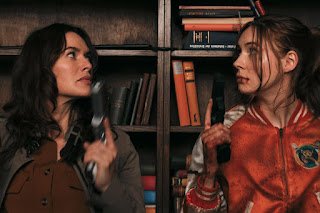
A wild action thriller, Gunpowder Milkshake is a stylish, over-the-top battle fest celebrating girl power. 

Samantha, or simply Sam (Karen Gillan), is an assassin for a shadowy organization known only as The Firm. Her latest job ends in a bloodbath, and one of her victims is the son of powerful gang boss Jim McAlester. 15 years earlier, Sam's mother Scarlet (Lena Headey), also an assassin for The Firm, had to disappear after one of her jobs ended badly.

Nathan (Paul Giamatti) is Sam's handler, and he issues her next assignment, to retrieve money stolen by an accountant. She arms herself with guns provided The Firm's "librarians" Madeleine (Carla Gugino), Florence (Michelle Yeoh), and Anna May (Angela Bassett). 

After Sam kills the accountant, she learns he only stole the money because a vicious gang held his young daughter Emily (Chloe Coleman) hostage. She gets involved to save Emily, disobeying Nathan's orders. With McAlester seeking revenge and The Firm turning against her, Sam is in a lot of trouble, but Nathan provides some support by arranging a surprise reunion.

Gunpowder Milkshake features many good girls with many big guns (and assorted other weaponry), battling many bad guys with just as many big guns (and assorted other weaponry). Director and co-writer Navot Papushado crafts a feminist action extravaganza bathed in surreal neon and ultra-abstract sets, channeling Tarantino, Woo, and Leone with unfettered passion.

The plot is almost irrelevant, providing just enough of a string to hang the thrills on. The dialogue scenes focus on establishing a sorority of women, mother-daughter bonds, and surrogate parent relationships. Sam is the node around which her mother, the three librarians and Emily revolve, creating three generations of strong and morally sound women battling to rid the world of men either faceless, evil, or both.

The levels of violence and the action set-pieces are wildly enjoyable at the cartoonish level. The exquisitely choreographed highlights include a hospital battle between Sam and three goons, her arms paralyzed by a serum while the villains are compromised by laughing gas and a previous altercation. This is quickly followed by a cat-and-mouse parkade duel with young Emily (eight and three quarters of a year old) at the wheel. Papushado leaves the best for last, a linear, slow-motion beauty of a single-shot gun-down at a supposedly neutral diner.

At 114 minutes and with next to no genuine narrative depth, the energy does start to flag. A battle at a library goes on, and scene after scene of bone-crunching combat with the women mowing down an army of men get repetitive. But with cool attitude to spare, Gunpowder Milkshake is unapologetically always craving the next explosive slurp.


All Ace Black Movie Blog reviews are here.

Saturday, 19 June 2021

Movie Review: The Negotiator (1998)

A hostage drama, The Negotiator promises a cerebral duel but defaults to flabby and bland thriller cliches.

Lieutenant Danny Roman (Samuel L. Jackson) is the top hostage negotiator with the Chicago Police Department, popular with his colleagues and a media celebrity. After Danny resolves yet another harrowing hostage ordeal by placing himself in danger, his wife Karen (Regina Taylor) pleads with him to take fewer risks. Danny's partner Nate then reveals knowledge of a corrupt group of officers stealing from the pension fund, including members of Internal Affairs, the supposed watchdog.

Nate is soon killed and Danny is framed, losing his badge. About to be charged and imprisoned, he barges into the office of Internal Affairs Inspector Terence Niebaum (J.T. Walsh), taking him and a group of others hostage. Danny will only talk with Lieutenant Chris Sabian (Kevin Spacey), another expert negotiator. A prolonged hostage ordeal follows, with some members of the police force loyal to Danny but others wanting him permanently silenced.

Directed by F. Gary Gray and co-written by James DeMonaco and Kevin Fox, The Negotiator sets the stage for what could have been a gripping battle of wits, but withdraws into mundane territory. After a long and patient introduction to define Danny Roman as a charismatic character worth caring about, the narrative starts to wobble with the half-baked introduction of the corruption plot. A good protagonist needs a worthy villain, but instead too many blank but possibly evil grim-faced police officers, some in suits and others in uniform, are thrown at the screen, none of them defined to any useful degree. 

The result is Danny attempting to smoke out unknown and invisible opponents, robbing the film of meaningful tension. Indeed, as the excessive 140 minutes drag on, incidental hostages Paul Giamatti (as a petty criminal) and Siobhan Fallon (as Niebaum's assistant) emerge as the next most interesting characters, which is not a good thing. 

Kevin Spacey as the other expert negotiator arrives too late into the movie and contributes little. Spacey appears curiously disinterested and is poorly served by an overcrowded command structure with multiple men trying to issue orders that are anyway ignored.

In any event writers DeMonaco and Fox don't have the courage to trust a mental showdown. The Negotiator resorts to computer clicks, procedural shootouts and flash-bang grenades. By the time the conspirators are revealed, the negotiations have long since been defeated by a lack of imagination. 


All Ace Black Movie Blog reviews are here.

Saturday, 12 June 2021

Movie Review: Shoot'Em Up (2007)

A jocular action film, Shoot'Em Up embraces Bugs Bunny cartoon sensibilities in a manic save-the-baby adventure. With non-stop impetus and an irrepressible attitude, this is a thrill ride to savour.

In the middle of the night, carrot-munching loner Smith (Clive Owen) sticks his nose in other people's business by attempting to protect a pregnant woman running from a horde of assassins. She gives birth, but is then killed. Smith escapes with the baby, and becomes the target of Hertz (Paul Giamatti), who is intent on eliminating the infant.

Smith connects with lactating prostitute Donna (Monica Bellucci), who reluctantly agrees to help look after the newborn they now call Oliver. Hertz starts to uncover Smith's elite military background and assembles an army of goons to hunt him down. Smith has to shoot his way out of numerous jams while keeping Donna and Oliver safe. He also uncovers a baby-killing conspiracy involving an evil gun-manufacturing company and a shady political gambit.

Clocking in at a mere 86 minutes, Shoot'Em Up is breathlessly fun and ridiculously entertaining. Writer and director Michael Davis unapologetically parks logic at the door and conjures up a series of outrageous set-pieces, all delivered with panache and feasting on an endless supply of bullets and bad guys.

And several highlights represent brilliant action filmmaking, combining jaw-dropping stuntwork with spirited music and pointed editing. Hertz's army of similarly-dressed men invades Smith's walk-up apartment, and the shoot-out that follows is an adrenaline rush set to Motorhead's Ace Of Spades. Later, Smith drops out of an aircraft, and an exhilarating aerial free-fall battle follows. Back on the ground, wise use of seat belts is demonstrated in a high speed head-on crash. And just for good measure, Davis finds a way to combine yet another shoot-out with an energetic sex session.

The plot propelling the madness is just as knowingly outrageous, having something to do with a secret baby factory, an ailing political candidate, and the gun lobby. None of it is intended to make sense, and it doesn't. Meanwhile, Smith's background is revealed in droplets to colour-in a fittingly damaged protagonist. Clive Owen and Paul Giamatti enjoy themselves in gleeful performances, and cut through the carnage with the symmetrical respect of a cartoon anti-hero and his indestructible nemesis.

The guiltiest of guilty pleasures, Shoot'Em Up fires at will and scores perfect insanity.


All Ace Black Movie Blog reviews are here.

Saturday, 5 October 2019

Movie Review: Big Fat Liar (2002)


A breezy teen comedy about truthfulness and Hollywood's cut-throat culture, Big Fat Liar delivers easy chuckles without exceeding expectations.

14 year old Jason Shepherd (Frankie Muniz) is an expert at lying about everything. When his teacher Ms. Caldwell (Sandra Oh) catches him lying about a homework assignment, Jason has to write a 1,000 word essay in one afternoon. He writes about what he knows and calls the piece Big Fat Liar. Unfortunately, the assignment falls into the hands of evil Hollywood producer Marty Wolf (Paul Giamatti) and Jason is confined to the tedium of summer school.

A few months later Jason and his friend Kaylee (Amanda Bynes) are horrified to catch a trailer for an upcoming movie called Big Fat Liar produced by Wolf. When Jason's parents refuse to believe his idea was stolen, he convinces Kaylee to join him on a trek to Hollywood to confront Wolf. Filming is about to start with Wolf's overworked assistant Monty (Amanda Detmer) doing all the actual work, and Jason will need help from limo driver Frank (Donald Faison) and aging stuntman Vince (Lee Majors) to prove that for once he is not lying.

A reimagination of The Boy Who Cried Wolf fairytale, Big Fat Liar is family-friendly entertainment aimed at young teenagers, and easily hits its modest targets. Parts of the film unfold as a version of Home Alone set in Hollywood, Jason and Kaylee setting up a makeshift command centre in a movie props warehouse and laying a series of traps to force the uncooperative Marty into admitting his theft.

The Dan Schneider screenplay seeks character-driven jokes, and most of the laughs are derived from Jason's ability to quickly make up more elaborate lies to extract himself from the mess created by his previous lie. Director Shawn Levy keeps the mood appropriately light and delivers the film in a compact 88 minutes, with just the one musical montage.

Behind all the laughs is a basic morality tale about the importance of staying close to the truth, Jason sensing the genuine hurt of losing his dad's trust due to the never ending stream of fibs. Meanwhile Schneider mercilessly pokes away at a Hollywood culture portrayed as selfish and mean-spirited. The smarmy Wolf is on a losing streak and desperate for a hit, and stealing from a kid is the least of his worries as he attempts to curry favour with new studio boss Marcus Duncan (Russell Hornsby).

And of course in this town anything good is instigated by assistants, in this case the resourceful Monty, who has the power to disrupt the status quo should she choose to use it.

In the central roles Frankie Muniz and Amanda Bynes radiate confident charisma, and in a commendably cartoonish performance Paul Giamatti physically and mentally throws himself into the exaggerated antagonist role. Every Wolf has his day, until the kids come to play.


All Ace Black Blog Movie Reviews are here.


Sunday, 24 June 2018

Movie Review: Straight Outta Compton (2015)


A biographical drama set in the world of rap music, Straight Outta Compton is a hard hitting history of the band that controversially popularized gangsta rap.

It's 1986 in Compton, a troubled city in Los Angeles county, where gangs and crime are part of daily life and black youth are easily sucked into the turmoil. Eric "Eazy-E" Wright (Jason Mitchell) is a drug dealer, and friends with disc jockey Andre "Dr. Dre" Young (Corey Hawkins), who is already a young father, and O'Shea "Ice Cube" Jackson (O'Shea Jackson Jr.) who writes rap lyrics inspired by street life.

Along with MC Ren and DJ Yella, they form the group N.W.A. (for "Niggaz Wit Attitudes") and record the song Boyz-n-the-Hood with Eazy E on vocals. A local hit, the track catches the attention of manager Jerry Heller (Paul Giamatti), and he signs the band to a record deal, although Heller cozies up to Easy E and ignores formalizing contractual arrangements with the other members. The group records the album Straight Outta Compton, including Ice Cube's controversial track Fuck Tha Police, inspired by the continuous and unjustified police harassment experienced by black youths.

The album is a controversial hit, the gangsta rap subgenre is born, and the group members experience success and fame beyond their wildest dreams. But bitter arguments about money soon turn the friends against each other, with Ice Cube the first to break ranks and launch a solo career.

Directed by F. Gary Gray and co-produced by Ice Cube and Dr. Dre, Straight Outta Compton is an engrossing and sometimes harrowing story about the power of music to launch a million conversations, and the destructive forces of extreme wealth and greed that come attached to fame and fortune. The film tracks the origins of a movement born from the intolerable Black inner-city experience, gangsta rap bursting out of the chest of a self-feeding cycle of hopelessness, poverty, and crime. N.W.A. decided to honestly rap about life on the streets outside their homes, and the imagery was decidedly not pretty but also impossible to ignore.

The film is long at 147 minutes, perhaps tries to tell too many stories, and the final quarter goes relatively soft and mushy compared to what preceded it. With Dr. Dre and Ice Cube behind the project, their perspective receives precedence while colleagues MC Ren and DJ Yella appear short-changed.

But despite some weaknesses there is no doubting the pure strength of the core story. As the world consumed the ballads of Whitney Houston and Lionel Ritchie and the pop tunes of Pet Shop Boy, Mr. Mister, and The Bangles with blissful ignorance, a musical seismic shift was rumbling into being. N.W.A. took rap lyrics to a new extreme of provocation, popularizing a subgenre fuelled by anger, in the process causing widespread outrage and gaining unprecedented notoriety.

It was a wild ride for a group of young men, and it is no surprise that internal divisions and external influences rapidly tore the group apart. The film presents Jerry Heller in a generally unsympathetic light, and there are other unhelpful meddlers looking out for their own bottom line in the form of Priority Records executive Bryan Turner (Tate Ellington) and Death Row records founder Marion "Suge" Knight (R. Marcos Taylor).

But regardless of the causes, ultimately N.W.A. proved to be just an incubating starting point for the varied and successful careers of Dr. Dre and Ice Cube, and the band was only going to ride its initial burst of enraged intensity for so long. The split represents a chaotic highlight in the film, a momentus release of venom, the former friends dissing each other on rival records, the film soaring to a rowdy and profanity-dominated apex.

Straight Outta Compton finds several other peaks, including a Detroit concert where the local police attempt to prevent the group from performing their most notorious hit, Ice Cube unleashing his frustration at a record company office, and Dr. Dre finally having enough of the aimless decadence purchased with too much money. The representations of the songwriting and recording creative process are functional, and several run-ins with law enforcement on the streets of Los Angeles are captured with raw emotion, setting the stage for the infamous Rodney King beating, which here serves as an effective I-told-you-so backdrop to the formative N.W.A experience.

Jason Mitchell, Corey Hawkins and O'Shea Jackson Jr. (Ice Cube's son) are all excellent in bringing the young N.W.A members to life and staying with them as they mature through nine years of insane highs and lows. Paul Giamatti is effective as Jerry Heller, a manager with enough vision to understand that he may have found the next big thing, but always with a self-serving glint in his eye.

Boisterous, loud and coarse, Straight Outta Compton is about voices silenced no more, consequences be damned, and both the personal and broader consequences are plentiful and often painful.


All Ace Black Blog Movie Reviews are here.


Saturday, 18 November 2017

Movie Review: San Andreas (2015)


A disaster epic, San Andreas is saturated with special effects and little else.

Los Angeles Fire Department Air Rescue Pilot Ray Gaines (Dwayne Johnson) is a devoted father to his daughter Blake (Alexandra Daddario) but going through a divorce from his wife Emma (Carla Gugino). Ray and Emma's marriage never recovered from the drowning death of their other daughter Mallory in a rafting accident. Now Emma is moving in with her new boyfriend, architect Daniel Riddick (Ioan Gruffudd).

A massive earthquake destroys the Hoover Dam, where California Institute of Technology Professor Lawrence Hayes (Paul Giamatti), testing his earthquake prediction algorithms, barely escapes with his life. Soon major earthquakes start to hit the coast from Los Angeles to San Francisco. Dr. Hayes does his best to warn people to flee the cities. Ray attempts to rescue his wife in Los Angeles, and then tries to find and rescue Blake, who is stranded in San Francisco with two brothers from England, Ben and Ollie Taylor (Hugo Johnstone-Burt and Art Parkinson).

Directed by Brad Peyton, San Andreas delivers exactly what it promises: mindless, methodical destruction on a grand scale, in many ways a re-do of 1974's Earthquake but with fewer characters and victims. Dams, bridges and buildings are knocked down with mind-numbing regularity, the CGI techs working overtime to create stunning graphics, equal parts awe-inspiring and science-defying. A narrow escape clocks in every ten minutes or so, and our hero Ray, his massive muscles flexing in synch with the earth shaking, does just the right thing at just the right second time and time again.

While watching computer-simulated scenes of devastation is fun, with the tsunami scenes particularly effective San Andreas is aggravating in every other way. Ray appears to forget about his profession entirely and focuses singularly on saving his wife and daughter. A brief perfunctory scene where Ray waves random people to the relative safety of a stadium wall is thrown in just to remind us that the man's job is supposed to be about helping others, not steal helicopters, cars and boats to save family members.

Worse still is the almost complete absence of suffering and mention of casualties. This is a film about the largest quakes in recorded history devastating two crowded cities. Yet hardly anyone dies, and the post-quake streets often appear to be conveniently deserted: plenty of debris and collapsed buildings, yet no bodies, no deaths, and only the most superficial of injuries. When the entirety of the Hoover Dam collapses, the event is shrugged off with a few "too bad" comments. No mention of casualties, and no follow-up related to the impacts of downstream flooding.

Added to the to-be-expected shallow characterizations and stiff acting, San Andreas' bloodless aesthetic enhances a level of plastic artificiality that is difficult to stomach. This is destruction as pure tourism, the equivalent of advertising-saturated glossy magazine imagery to ogle at, free from any meaningful exploration of repercussions.

San Andreas is superficial computer artistry devoid of emotional payoff, a childlike knocking-down of toys with no consequence.


All Ace Black Blog Movie Reviews are here.


Wednesday, 4 October 2017

Movie Review: The Illusionist (2006)


A drama and romance set in the world of royalty, illusions and magic, The Illusionist looks grand but cannot conceal essential plot weaknesses.

The setting is Austria, late in the 19th century. As young adults Eduard and Sophie fell in love but were forcibly separated because he was the son of a lowly cabinet maker and she was from an upper class family. He grew up to be an illusionist using the name Eisenheim (Edward Norton) with a celebrated magic show in Vienna. One night Crown Prince Leopold (Rufus Sewell) attends the performance along with his fiancée, the grown-up Sophie (Jessica Biel). Also in attendance is Leopold's faithful Chief Inspector Walter Uhl (Paul Giamatti).

The chance reunion reignites the passion between Eduard and Sophie, but Leopold is possessive and will not tolerate Sophie leaving him. Meanwhile Walter perceives Eisenheim as a threat to the Crown Prince's prospects, and starts a campaign of intimidation to run Eduard out of town. Eisenheim will have to decide if he has what it takes to tangle with the might of the royal family and fight for his love.

Written and directed by Neil Burger, The Illusionist offers a visually rich aesthetic featuring staid late 19th century Vienna surroundings, with frequent outdoor sojourns to breathe the distinguished  air of a handsomely recreated stately European city. The visual splendor is accompanied by an opulent Phillip Glass music score. Paul Giamatti is another plus, his shifty performance as a Chief Inspector who is also the son of a butcher filled with one-foot-in-each-camp nuance.

But much like a magic show with more sizzle than skill, there is limited substance beneath the magnanimous hand movements. Fundamentally the premise of The Illusionist is deeply troubling, Eisenheim's actions ending at a place where the line between aggressor and victim is severely blurred, with Burger appearing oblivious to the substantial betrayal of sympathy.

Worse still is an attempt at a plot twist that is exceptionally obvious. Kicking off about halfway through the 110 minutes of running time, Eisenheim unfurls a deception that is supposed to encompass the film's audience, but is telegraphed in capital letters. Rather than build towards a surprise, the second half of the film becomes a boring countdown until the glaring trap snaps around Uhl and Leopard.

In the meantime, Eisenheim sits on the stage creating incredible magic of the bring-back-the-dead variety, with no explanation given because all his tricks are CGI-created, and CGI would have been difficult to describe in a 19th century Vienna context. A dour Edward Norton performance does not help.

The Illusionist attempts to conceal suspect substance with stylish subterfuge, but stumbles off the stage.


All Ace Black Blog Movie Reviews are here.


Sunday, 9 July 2017

Movie Review: Morgan (2016)


A science fiction horror flick, Morgan has no new ideas and quickly runs into braindead territory.

In a secretive research facility located deep in the woods and operated by the SynSect company, an experimental human hybrid called Morgan (Anya Taylor-Joy) unexpectedly attacks and injures Dr. Kathy Grieff (Jennifer Jason Leigh). The company dispatches risk management expert Lee Weathers (Kate Mara) to assess the situation. She finds a tight knit team of scientists who designed, conceived and nurtured Morgan under the leadership of Dr. Lui Cheng (Michelle Yeoh).

The other researchers include Dr. Ziegler (Toby Jones) and Dr. Amy Menser (Rose Leslie), who has befriended Morgan and allowed the hybrid to explore the surrounding wooded area, which is perhaps contributing to Morgan's sense of rising anger due to the otherwise confined surroundings. Also at the facility is cook and marksman Skip (Boyd Holbrook). When Dr. Alan Shapiro (Paul Giamatti) arrives to aggressively test Morgan's ability to tolerate taunting, Lee has to quickly decide what action is needed to contain the damage.

Directed by Luke Scott (son of Ridley, who co-produced), Morgan is an irritating and derivative Frankenstein-type effort, falling far short of 2014's similarly themed Ex Machina. Despite starting with a premise that may have held some promise, Scott and writer Seth Owen make all the wrong choices as they somehow concoct to steer the film towards characters literally running around the forest whacking each other with all available weapons.

Prior to the outbreak of bloodshed, precious little is offered in terms of engagement. Neither the science nor the characters are remotely interesting, the team of researchers remaining shallow stock personalities and the protagonist Lee Weathers a coldly calculating and less than emotive presence. Paul Giamatti heats things up with his singular over the top scene, but departs too quickly to leave a mark.

There is one twist in the film, it arrives late but is easy to guess early. Despite the talent in the cast, Morgan is an experiment absolutely not worth saving.


All Ace Black Blog Movie Reviews are here.


Sunday, 2 April 2017

Movie Review: Confidence (2003)


A stylish crime drama, Confidence is a complex sting story told with plenty of panache but not much heart.

The film is told in flashback and narrated by Jake Vig (Edward Burns), who has just been shot in Los Angeles. Three weeks earlier, Jake and his buddies Gordo (Paul Giamatti), Miles (Brian Van Holt) and Al (Louis Lombardi) run a sting inadvertently victimizing crime lord The King (Dustin Hoffman). In return The King has Al killed. Jake averts further casualties by offering to run a sting for The King to recover his losses. Corrupt banker Morgan Price (Robert Forster) is the selected mark.

Jake prepares an elaborate ruse to wire $5 million out of Price's bank to a fake company in Belize. He enlists the help of fellow con artist Lily (Rachel Weisz), and the crew target a corruptible bank Vice President to help make the transfer happen. But local crooked cops Omar Manzano (Luis Guzmán) and Lloyd Whitworth (Donal Logue) are pressured by Special Agent Gunther Butan (Andy García) into harassing Jake, massively complicating the operation.

Directed by James Foley, Confidence is a slick exercise in explaining the mechanics of high stakes cons. This is both the film's triumph and its weakness. The movie's construction is a visually compelling autopsy of how to succeed in crime, narrated by Jake as he dissects every move in detail. As a result the plot remains comprehensible despite its complexity, but because the entire movie is effectively a 97 minute learning course, the passion and character warmth are missing. It's also relatively easy to figure out who is being conned at every given stage.

Setting aside the sense of detachment. Foley focusses on style and delivers in spades. This film is bathed in neon, internal lights, colours, shadows and silhouettes, achieving an absorbing neo-noir aesthetic. There are almost no ordinary shots, as every frame is lovingly constructed from interesting angles and dynamic perspectives. The combination of convoluted plot and rich style deliver a captivating experience.

Jake Vig believes in one thing above all: confidence is the path to riches. He also understands most people's weakness in front of the promise of easy money, and exploits this feebleness to full advantage. Edward Burns internalizes the role and cruises through the film with a cool-under-pressure dogma. Dustin Hoffman sinks his teeth into a pretty insane turn as The King, a crime boss all too aware of his ADHD and exploiting the condition to full effect. There may be few more threatening conditions for crime than a murderous mobster who can't hold a thought for long enough to think. Otherwise the film's brevity is welcome, but comes at the expense of depth. Jake finds his counterpart in Lily, but overall Rachel Weisz and all the other characters have no arc and remain stock representations.

But this is a movie about process rather than people, and Confidence manipulates the cards then plays them with a bullish swagger.


All Ace Black Blog Movie Reviews are here.


Saturday, 18 June 2016

Movie Review: Sideways (2004)


A tender yet funny drama about middle-aged men dealing with life's disappointments, Sideways excels as a quest for joy when all options for happiness appear exhausted.

Failed writer Miles (Paul Giamatti) and his friend Jack (Thomas Haden Church), a has-been actor, head out for a week-long trip to California's wine country to celebrate Jack's upcoming wedding to Christine. Miles is broke, lonely, and deeply depressed due to his divorce two years prior, and his lack of success in getting his book published. Meanwhile, Jack is not really sure he wants to get married, and is more interested in having sexual flings than tasting wine.

Miles and Jack settle at a motel amidst all the wineries. At the Hitching Post restaurant, they connect with waitress Maya (Virginia Madsen), who vaguely knows Miles from his previous trips and is herself nursing scars from a recent divorce. At a local winery, they also connect with server Stephanie (Sandra Oh), and Jack is immediately attracted to her. Miles and Maya start a tentative courtship based on their mutual love of wine, while Jack and Stephanie engage in a passionate affair. But with plenty of deception and half-truths generated by Jack's selective interpretation of the truth, trouble lies ahead for both men.

Written and directed by Alexander Payne, Sideways finds humour in the ordinariness of middle age pathos. The film honours the achievement of nothing where many men wallow, as both Miles and Jack have little to show for lives half lived except failed attempts at happiness and false expectations of a better future. The film stays focused on the men, their fading hopes and divergent attitudes towards the future, as Miles is weighed down by the past while Jack is intent on living for today.

Despite the odds they find suitable mates in wine country. Maya is just as emotionally scarred as Miles but is handling it better, while Stephanie is enjoying a life of carefree adventure. The relationships take on the colours of the men, as Miles and Maya proceed slowly and carefully, Jack and Stephanie rush into physical intimacy with wild abandon, and the outcomes carry echoes from the past into the future.

Payne's writing is stellar, and the film stands on the shoulders of the sturdy yet complex friendship Payne creates between Miles and Jack. Although a study in contrasts, the foundations of the relationship are clear: Miles is downbeat but smart, Jack is a dense optimist. They complement each other, and both are at crossroads in life where they need each other, warts and all. Miles needs Jack's encouragement to have any chance to move past his depression, and Jack needs Miles as a logic check against his impending marriage. Miles can't always trust himself because of his depression, and he wonders how much he can trust Jack, who is, after all, an actor, albeit a fading one.

The film uses wine as shorthand for depth of sophistication, if not exactly intellect. Wine is portrayed as a tragic ending worth celebrating, the more convoluted the plight of the fragile grape, the more worthwhile the taste. Wine and whine are also companions, Miles' endless laments about his failure in love, life and publishing matched only by his eloquent descriptions of all things related to wine and winemaking.

In the two lead role, Paul Giamatti and Thomas Haden Church create an enduring pair of friends. Giamatti has never been better, and in Miles finds the perfect role to suit his persona: cerebral but flawed and weighed down by luggage of his own making. Church is the perfect foil, and gives Jack a bounciness stemming from an inability to admit that with fading looks and creeping age, Jack's bright future as an actor is firmly behind him. Virginia Madsen turns Maya into a rich, complex red, while Sandra Oh mimics an in-your-face blast of popping champagne.

Sideways finds the sorrow and the laughs that come when forward momentum is well and truly lost, life starts drifting sideways, and it is suddenly apparent that for now, sideways is better than backwards.


All Ace Black Blog Movie Reviews are here.


Monday, 28 March 2016

Movie Review: The Truman Show (1998)


An astute commentary on television culture's evolution, The Truman Show also explores the limits of human tolerance for the ordinary. The film is an engrossing examination of the societal condition, and as fascinating as its central show.

Television producer Christof (Ed Harris) has created a monstrously successful live, perpetual television show, tracking the minute-by-minute life of Truman Burbank (Jim Carrey), the only non-actor. Inserted from birth into a custom-built community of Seahaven, which is one humongous dome-enclosed and climate-controlled film set, Truman has no idea that every second of his life is being broadcast live to millions of viewers, using more than 5,000 hidden cameras.

Truman think he works as an insurance agent, and believes he is married to Meryl (Laura Linney, as actress Hannah Gill), that his best friend since school is Marlon (Roland Emmerich, as actor Louis Coltrane), and that his father died in a boating accident. Over the show's remarkable 30 years of continuous broadcast, various outside activists have tried to infiltrate the set to free Truman. He has never forgotten Lauren (Natascha McElhone, as actress Sylvia), an extra hired to play a high school student who tried to help him escape before she was bundled off the set. When the actor who played his father unexpectedly reappears in his life, Truman starts to suspect that something is not quite right and starts to question the world around him.

Directed by Peter Weir and written by Andrew Niccol, The Truman Show expands the reality television concept to an unsettling edge, and in the process contemplates human boundaries of control, comfort and compliance. The film is thoughtful, often profound, but also tackles its serious issue with humour. The act of viewing and enjoying Truman's story is itself part of the societal guilty-pleasure dilemma. The film is also unsettling enough to raise doubts about any life: if Truman is so deluded about his reality, who is to say what is defined as real and what is not?

Everything in Seahaven is designed to be idyllic, and to convince Truman that he has no reason to want to leave. Ironically, Christof's attempts to instill the emotional fear of leaving and segregate Truman from the outside world create the most compelling moments of drama for the viewers of the show. And once Truman starts to suspect that everything is too perfect, it becomes increasingly difficult to convince him to settle for his artificial surroundings.

The film plays on the parallel themes of obsession with other people's lives, and the essence of the human condition. The viewers of the show are transfixed, immobile, living their lives vicariously through the television set and following Truman's ups and downs rather than getting on with creating their own memories. The further Truman pushes to escape his sad life, the more entrenched the viewers are in front of the television. It's a sad indictment of the culture, where society cares more about an artificial world labelled as reality than actual existence.

Also permeating through the film is Christof's relationship with Truman, presented as a surrogate for the mysteries of the bond between God and man. Christof loves Truman like a son, and wants him to be safe and content. But Truman has free will, and eventually learns to use it. As much as Christof will try and send cosmic signals about what may be the appropriate path, it will ultimately be man's actions that will govern his fate.

The Truman Show is one of Jim Carrey's most complete performances. Staying as far as he can from the elastic mugging and physical comedy which made him famous, Carrey as Truman conveys innocence, curiosity and ultimately a willingness to question and confront. In addition to excellent supporting performances from Ed Harris, Laura Linney, Noah Emmerich and Natascha McElhone, the cast also includes Paul Giamatti as Christof's chief control room manager.

What is comfortable is not what is necessarily right. The Truman Show finds the spirit of a simple man yearning for a challenge, part of the never ending quest to self-define happiness.


All Ace Black Blog Movie Reviews are here.


Saturday, 17 October 2015

Movie Review: The Ides Of March (2011)


An inside look at the United States political process, The Ides Of March delves into the ruthless backroom machinations that define election campaigns. The film is almost incredible, and also likely too close to the truth for comfort.

Governor of Pennsylvania Mike Morris (George Clooney) and Arkansas Senator Ted Pullman are locked in a tight race for the Democratic party presidential nomination. The next big milestone is the Ohio primary, and both campaign teams are going all out to win. Veteran Paul Zara (Philip Seymour Hoffman) runs Morris' campaign, assisted by the young, bright and idealistic Stephen Meyers (Ryan Gosling). Their opponent is Pullman's campaign manager Tom Duffy (Paul Giamatti). New York Time journalist Ida Horowicz (Marisa Tomei) is covering the nomination battle.

Stephen genuinely believes that Morris is a positive change agent who is capable of great achievements. His attention is momentarily distracted by attractive campaign intern Molly Stearns (Evan Rachel Wood). They seduce each other and start a steamy affair. Meanwhile, Paul is working overtime to try and secure the critical endorsement of influential North Carolina Senator Franklin Thompson (Jeffrey Wright). Considered a king-maker, Thompson is negotiating with both campaigns, effectively selling his support to the candidate who offers him the most attractive White House position. All appears to be going well for Stephen, until he receives a phone call from Duffy, who wants Stephen to defect to the Pullman campaign. A rapid series of cascading events then throws the nomination race into turmoil, threatening to end Stephen's promising career.

Directed and co-written by Clooney as an adaptation of the play Farragut North by Beau Willimon, The Ides Of March exposes a two-faced political system that presents a fake public profile while running on a cut-throat culture of deceit, back-stabbing and betrayal. That politics is a blood sport is not new; that the participants engage with a deadpan matter-of-factness while twisting the knife is never less than disturbing.

The events portrayed are only loosely based on fact, but while too much drama is packed into a few days of campaigning, the individual misdoings all ring true as actual headlines from real political wars. Clooney moves the talk-fest along swiftly, allowing each event to shine brightly but ever so briefly in the glare of the 24/7 news cycle: there is always the next outrage waiting to feed tomorrow's talking heads.

Appropriately, the candidates are the articulate faces of their respective campaigns, but very much secondary characters in the overall context. The strategy, policy, negotiations and message control are the domain of men like Paul, Stephen and Tom. They are the backroom operatives who prefer to stay in the dark, spinning stories to reporters but manipulating events from behind the curtain. The film is a compelling chronicle of a battle of wills, and Clooney constructs it with zest, focusing on soul-destroying compromises driven by the rampant ambition to win at all costs.

A dream cast contributes greatly to the film's appeal, with Philip Seymour Hoffman and Paul Giamatti biting into their roles with glee, allowing Ryan Gosling to adopt the more cerebral and circumspect approach. Stephen is at the centre of the film, and Gosling treats the role as a story of awakening. Stephen transforms from idealistic bright young assistant campaign manager to a veteran of the political wars, a journey that will require him to taste bitter disappointment and discover just how far he will personally go to safeguard his dreams.

Evan Rachel Wood radiates an outer innocence and inner self-indulgence, always hinting that Molly wants to play in a league that may just be too tough for her. Marisa Tomei suffers somewhat from a vaguely underwritten role as the clinical reporter Ida.

Of course by the time Stephen emerges at the other end of the Ohio primary, his idealistic dream is a nightmare of corruption, his path to success littered with victims. But in the high stakes world of politics, the prize comes with the reward of enormous power, justifying all necessary means.


All Ace Black Blog Movie Reviews are here.


Monday, 6 July 2015

Movie Review: Love And Mercy (2014)


A tender biography of musician Brian Wilson, Love And Mercy explores two episodes in the life of the Beach Boys' songwriter: as a young talent at the peak of his creative process, and 20 years later as an older man struggling to find love and regain his footing in the world.

The film unfolds in parallel narratives. In the mid-1960s, the Beach Boys are at the peak of their popularity. After suffering a panic attack, the band's inspiration and main songwriter Brian Wilson (Paul Dano) abandons the latest tour and returns to the studio to write and prepare the recording of the album Pet Sounds. Despite creating a wildly innovative sound, Wilson faces a mountain of criticism for veering towards a more serious musical direction and abandoning the band's successful formula of simple and fun surf tunes.

In the second narrative, it's the 1980s, and an older Wilson (John Cusack) meets Cadillac saleswoman Melinda Ledbetter (Elizabeth Banks). They start a romance but Melinda soon discovers that Brian is a deeply distressed man, suffering under the controlling hand of Dr. Eugene Landy (Paul Giamatti). Landy manipulates Wilson emotionally and keeps him on a steady diet of medications. Melinda has to decide how badly she wants to fight for the chance to salvage a true relationship.

Directed by Bill Pohlad, Love And Mercy closely follows the facts and unveils the ups and downs of superstardom, as expectations collide with personal ambition to create emotional train wrecks. The film is excellent at capturing a deeply personal drama as the young Wilson fights the demons of his upbringing and the desire of his bandmates to keep churning out hits. Instead he unleashes his instrumental and harmonic creativity with some substantial help from mind-altering substances, a decision that cements his status as a genius songwriter and sows the seeds of his decline.

The more modern narrative is almost equally compelling. Wilson the grown man is a shadow of his former self. Years of drug abuse led him into the clutches of Doctor Landy, and smelling a big pay day, Landy assumed control of Wilson's life. The romance between Wilson and Melinda is handled with the maturity that comes when adults carrying plenty of luggage fall in love, and the strength of their nascent bond becomes the foundation on which Melinda will decide to make her unlikely stand.

Pohlad recreates a carefree 1960s filled with parties, music and the heady promises spawned by early success. The film's best moments are in the studio, as Wilson works with experienced session musicians to bring his ideas to life, Love And Mercy a rare film that invests the time to show the hard work behind seemingly effortless creativity. The film peaks with Wilson and the band conjuring up the single Good Vibrations, an iconic song that defined the band and its generation. Good Vibrations was the massive hit that wasn't on Pet Sounds, but it could only have been created in the album's wake.

The 1980s segments are good, but just a bit less inspired. Landy emerges as a smarmy villain, and the battle for Wilson's soul between the evil doctor and the well-intentioned Melinda is still remarkable for being true. But the resolution is rushed, Pohlad's admirable dedication to tell two stories finally catching up with him and the 121 minutes of running time.

Both Paul Dano and John Cusack are excellent in portraying Brian Wilson at very different stages of his life. Dano creates a wide-eyed artist still not quite realizing neither the enormity of his talent nor the trouble he is hurtling towards. Cusack is all about Wilson as damaged goods, a fervent spirit still residing deep in his heart but for the moment concealed by years of abuse, both self-inflicted and dished out by the likes of Landy. Elizabeth Bank is a revelation as Melinda Ledbetter, a woman who has to convince herself that she has the inner strength to both love and fight for a passionate artist in trouble.

Love And Mercy treats its subject with deserved respect, a slice of musical history that transcends an over-hyped industry to celebrate an often overlooked prodigy.


All Ace Black Blog Movie Reviews are here.