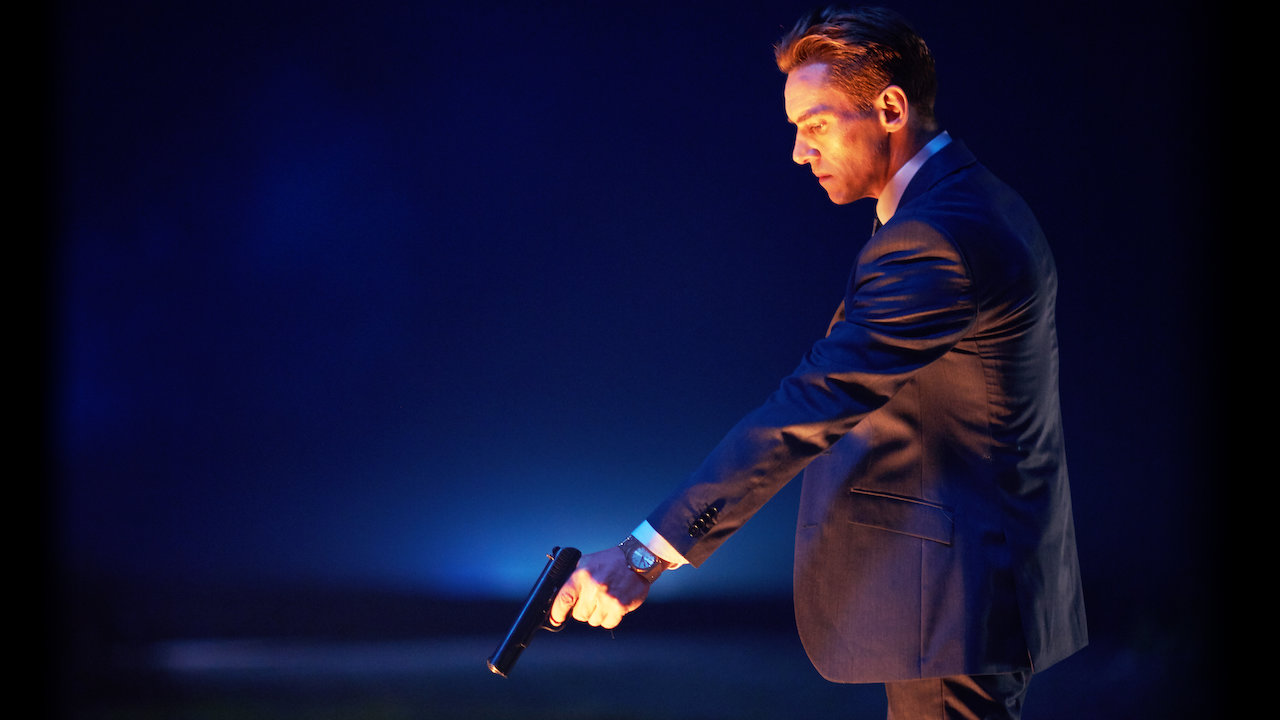
Starring: John Hurt, Richard Burton, Suzanna Hamilton
Saturday, 2 March 2024
Movie Review: Nineteen Eighty-Four (1984)
Starring: John Hurt, Richard Burton, Suzanna Hamilton
Wednesday, 2 September 2020
Movie Review: Damascus Cover (2017)
It's 1989, and the Berlin Wall is tumbling. In that city, Mossad agent Ari Ben-Sion (Jonathan Rhys Meyers) terminates a double-crossing operative feeding information to the Syrians. An Israeli agent in Damascus falls into the hands of Sarraj (Navid Negahban), the Syrian head of Mukhabarat. Fearful that Israel's entire Syrian spy network has been compromised, Mossad boss Miki (John Hurt, in his final role) dispatches Ari to Damascus to extract Angel, the highest ranking covert agent in the city.
In Damascus Ari adopts the identity of German rug dealer Hans Hoffman and cozies up to ex-Nazi-in-hiding Franz Ludin (Jürgen Prochnow), whose housekeeper can help with Angel's extraction. Ari also starts a romance with journalist Kim Johnson (Olivia Thirlby). Syrian military commander General Fouad (Igal Naor) is locked in an internal power struggle with Sarraj, and both men keep close tabs on Ari's movements.
An independent production adapting the book by Howard Kaplan, Damascus Cover dives into the intriguing world of spying and counter-spying in the world's most dangerous neighbourhood. The gimmick-free, human-centred high-tension drama of spies in hostile territory relying on their wits to survive is refreshing, and both the cinematography and locations convey the desired dour mood. But unfortunately too many other elements fall short, compromising the film's quality.
As played by a stiff Jonathan Rhys Meyers, Ari Ben-Sion silently screams "I am a Spy!" in every scene. Whether the fault of the actor or director and co-writer Daniel Zelik Berk, Ari's uncomfortable stance, useless narration and unwillingness to blend in erode credibility. Ari's careless bumbling around in Damascus, from romancing a journalist who can expose his identity (they first met in Jerusalem) to clumsily getting caught with Ludin's housekeeper, mark him as far from fit for purpose.Many other plot points are clunky, including the contrived attempt to humanize Ari by providing him with a bland sob backstory (father died young; child died young). The entire old-Nazis-in-hiding subplot is appended for no useful narrative purpose except perhaps to make the Syrians look bad as ex-Nazi coddlers, and Ari's route to Angel through Ludin's housekeeper is a particularly convoluted mission path.
Of course this being a spy thriller most of the characters are not who they claim to be, and Damascus Cover gets better as more onion layers are peeled. While the exceptionally awkward action climax stumbles as badly as the rest of the film, the denouement is excellent in offering a glimpse into the realpolitik world of puppet masters. Damascus Cover blows its cover early and often, but does leave behind tantalizing shrouds of what could have been.
All Ace Black Blog Movie Reviews are here.
Monday, 9 April 2018
Movie Review: Snowpiercer (2013)
A dystopian science fiction thriller, Snowpiercer shimmers with the story of human conflict and survival in a frozen future.
In the near future, the release of an experimental chemical into the atmosphere to lower soaring temperatures due to climate change goes wrong. A new global ice age is immediately triggered and all life is exterminated. The only survivors are on-board Snowpiercer, a massive ark-like train designed for human survival by genius scientist Wilford (Ed Harris), who predicted the catastrophe. The train is powered by a perpetual motion engine and continuously circumnavigates Earth.
Seventeen years pass. The tail section of the train contains "undesirable" passengers who clambered onto the train uninvited, and are now living in deplorable and overcrowded conditions. They include Curtis (Chris Evans), his friend Edgar (Jamie Bell), their spiritual leader Gilliam (John Hurt) and Tanya (Octavia Spencer), the mother of a young child. They are kept alive with daily doses of disgusting protein bars distributed by armed guards who separate them from the elites at the front. The train's snotty leaders are represented by the insufferable Minister Mason (Tilda Swinton).
When the elites initiate the latest round of forcible child abductions from amongst the undesirables, Curtis, Edgar and Gilliam spark a violent uprising with the intention of storming the front cars and taking control of the train. To pry open the security gates the rebels will need to work with expert gate control designer Namgoong (Song Kang-ho) and his 17 year old daughter Yona (Go Ah-sung), who are both drug addicts.
The first English language film directed by South Korea's Bong Joon-ho (who also co-wrote the script), Snowpiercer is a stunning cinematic achievement. Mixing human drama with expertly crafted thriller elements and superlative action scenes, the film offers unrelenting entertainment based on the French graphic novel Le Transperceneige. The set-up is efficient and compelling. Curtis and his cohorts are introduced and framed as oppressed third class citizens of the train, fed-up with mistreatment and confinement. They each have a background and a story to tell, but collectively they are at the end of their rope and ready to risk everything to overthrow the current order.
Once the storm-the-train plot is set in motion, the action is incessant and drives forward in tandem with the rebels as they progress towards the front. Pitched battles are fought in confined quarters, tactical surprises are sprung and acts of heroism abound. The gore is kept to a manageable level, but there is no mistaking the intensity of this fight for control and dignity.
As the fate of the rebellion ebbs and flows in each successive cabin, the internal and external set designs offer a feast for the eyes and the mind. The ragtag rebels are suddenly exposed to the middle class cabins, including the water manufacturing plant, restaurant services (complete with sushi bar), children's school classes, an aquarium for harvesting seafood, and copious quantities of beef. They also unhappily stumble upon the source of their protein bars.
Meanwhile, as the unstoppable train streaks through the landscape, the glimpses of outside scenery are breathtaking. The Earth is reduced to one destroyed and uninhabitable ice field, the beauty of absolute frozen whiteness juxtaposed with the horrific absence of life.
Snowpiercer is an allegory for social structures and interdependencies, visiting the terrain of Animal Farm and 1984. Who gets to lead, who gets to be exploited, the symbolism of the all-powerful godlike leader and how the head and the tail interact - or not - for the greater good are familiar themes, but rarely has a film dealt better with eternal existential questions about the collective human condition.
Chris Evans find one his best career roles as reluctant rebel Curtis Everett. Evans gets to combine brains with brawn as Curtis steps up to the role of frontline leader, and he emerges as a bonafide circumspect protagonist. Tilda Swinton as the conniving Minister Mason is the other standout performer.
Curtis' disruptive actions open Snowpiercer's doors literally and figuratively, and as always, it's up to every individual member of a social order to choose which of the available doors to walk through, with consequences ranging from inspirational to disastrous.
All Ace Black Blog Movie Reviews are here.
Thursday, 8 June 2017
Movie Review: V For Vendetta (2005)
A dystopian political conspiracy thriller, V For Vendetta is a satisfyingly complex comic adaptation, delivered with plenty of vigour and bold style.
A near-future England is ruled by a fascist anti-immigration homophobic government under High Chancellor Adam Sutler (John Hurt). The rest of the world has disintegrated into chaos with a civil war raging in the United States. On Guy Fawkes night in London, a mysterious masked man known only as V (Hugo Weaving) initiates a surprise bombing of the Old Bailey, takes over the British Television Network and invites citizens to join him a year later at the demolition of the Houses of Parliament.
V's actions are partially witnessed by Evey Hammond (Natalie Portman), a young BTN employee, and he takes her into his hideout, a cavern filled with historical artwork. Head of New Scotland Yard Eric Finch (Stephen Rea) sets out to investigate, identify and capture V and Evey, while Sutler's head of security Peter Creedy (Tim Pigott-Smith) favours more repressive measures to put a stop to V's plans. With the big night approaching Finch gets closer to uncovering V's background, and in the process discovers a mammoth conspiracy at the origins of England's descent into dictatorship.
Directed by James McTeigue and co-written by the Wachowskis as an adaptation of a limited comic book series, V For Vendetta threads the needle to park its loyalties with counter-revolutionaries, bombers, and freedom fighters all in the name of a fight for justice against an oppressive regime. A film that remarkably gains in relevance with the passing years, V For Vendetta is brimming with plot and characters, 132 breathless minutes counting down to one defining midnight.
The movie almost suffers from too much going on, but it's all relevant, and incendiary themes abound. V launches a one-man campaign of terrorism, hoping to reignite the passion of a nation. Chancellor Sutler spreads his hateful anti-immigration and homophobic poison through propagandist television talking heads, including the "Voice of London" Lewis Prothero (Roger Allam), all in the name of protecting the country against foreign turmoil. The Stockholm Syndrome is at the heart of the relationship between Evey and V. A secret bioweapons program, human experiments and the creation of false crises are gradually revealed as dark plots at the heart of societal transformation, and even within a totalitarian regime, there are rivalries to be exploited.
In lesser hands the story could have spiraled out of control, but McTeigue allows the threads to intertwine with reasonably effortless beauty. V, Evey and Finch each get the necessary time to evolve and contribute, the film gaining in power as it glides towards a stunning climax.
Aesthetically V For Vendetta is a perfect comic adaptation, centred on a masked crusader and surrounding him with a grim city suffering through its darkest days. The film remains grounded in characters and real world physics and avoids ruinous excessive special effects, and even the grand ending is more about people than events.
Hugo Weaving dominates with his silky booming voice from behind a mask, a literate poet crusader unafraid to destroy in order to rebuild. Natalie Portman plays Evey as a victim and an inspiration, a young woman destined to first witness and then play a role at the crossroads of history.
Despite some oversaturation at the margins, V For Vendetta is rich in both spirit and provocation.
All Ace Black Blog Movie Reviews are here.
Friday, 30 December 2016
Movie Review: Jackie (2016)
A drama focusing on the week after the assassination of President John F. Kennedy, Jackie is the personal story of a wife and mother forced to grieve in front of the entire, shocked world.
A week after the assassination, Life reporter Theodore H. White (Billy Crudup) is summoned by Jackie Kennedy (Natalie Portman) to the Kennedy's Hyannis Port, Massachusetts estate for a private interview. In flashback, the events immediately before, during and after the harrowing assassination in Dallas are presented from her perspective.
Jackie has to contend with the sudden death of her husband, her young children losing their father, making funeral arrangements with the leaders of the world attending, and the incoming Johnson administration, all while adjusting to the end of her life as First Lady. She uses the interview to help shape President Kennedy's legacy as an idyllic Camelot-like brief but shining period in US history.
Directed by Pablo Larraín, Jackie focuses on the other victim of November 22, 1963. While the nation lost a leader, a woman lost her husband and her life as she had planned it came to an appalling end. The film intercuts interview scenes, with Jackie and Theodore sitting face to face and staring straight at the camera, with flashbacks to the events of the past week. Jackie's imperative to gather herself in a calculated manner while in the glare of the world's spotlight translates somewhat to the film, and a sense of theatre sometimes stands in the way of human warmth. The machinations behind Jackie planning JFK's funeral procession also receive inordinate attention.
The film is otherwise an intense personal experience, delving into the soul of a woman still processing a massive shock, forced to transition instantaneously from a world of elegance to cleaning the blood and brains of her husband from her face and pink Chanel suit. The interview scenes reveal a steely-eyed but still shaken former first lady intent on framing her husband's tenure in the best possible light. Theodore takes the brunt of her decompressing attitude, as she unloads her emotions with a mixture of haughtiness and raw anger at the injustice befalling her family.
The flashbacks look slightly to the side of world-shaping events, Jackie the unwilling secondary character in a tragedy that kills her husband, his bloodied head in her lap, and forces her to witness a change in administration and the inevitable pressure to move out of her White House all while maintaining poise in front of her children and the world.
Natalie Portman is excellent in a controlled performance, and is ably supported by Crudup as White and Peter Sarsgaard as Bobby Kennedy. John Hurt appears as a pragmatic priest comforting Jackie as she processes her losses.
Larraín uses Jackie's redecoration of the White House, as featured in a groundbreaking February 1962 television documentary special, as a framing device to emphasize her passion for history and understanding of the continuum represented by successive Presidents. Misconstrued as a vanity project, Jackie wanted to bring to life the real men behind the legends who occupied the people's building.
Now she has to hurriedly add her husband, prematurely, to the ranks of leaders who contributed to nation building. His youth, enthusiasm, love for the arts and sense of idealistic optimism leads Jackie to the Camelot metaphor, ironically helping to create a legend out of a short-lived presidency. As one former first lady departs centre stage, the power of the media to shape a national narrative emerges from the margins, in readiness for more turmoil in the decades ahead.
All Ace Black Blog Movie Reviews are here.
Saturday, 10 December 2016
Movie Review: Midnight Express (1978)
A brutal prison drama, Midnight Express is a grim descent into the nightmare of foreign land captivity at its worst.
Billy Hayes (Brad Davis), a young American tourist in Istanbul, attempts to smuggle some hashish out of the country to sell to his friends back home. He is caught at the airport, and receives no help from mysterious American agent Tex (Bo Hopkins). The Turkish authorities are eager to make an example of him: he is tried and sentenced to spend years in a decrepit, overcrowded prison. The head prison guard is the brutal Hamidou (Paul L. Smith), and Billy survives by making friends with fellow foreign prisoners, including the excitable Jimmy (Randy Quaid), the laid back and friendly Erich (Norbert Weisser) and the elderly Max (John Hurt).
Despite the interventions of his father (Mike Kellin) and a sweaty local lawyer, all attempts to secure Billy's freedom fail. Worse is to come, when after years in captivity his release date is shockingly pushed back. Billy and the fellow prisoners start plotting escape plans, but life in prison will take every bad turn possible. At Billy's lowest point, a visit from his girlfriend Susan (Irene Miracle) proves to be a turning point.
Directed by Alan Parker and based on Hayes' real-life experiences, Midnight Express makes for harrowing viewing. Billy's adventure is not for the faint hearted. This is a story of overzealous local authorities sending a message to the international drug smuggling community by throwing the book at a young man, and what follows in terms of physical and emotional torture is difficult to take.
The film's trajectory is linear and unrelenting. Once Billy falls into the hands of the Turkish authorities there is no escaping the cascading horrific events that follow. There are frequent physical beatings, humiliation and isolation, all in a filthy environment controlled by sadistic guards. The layered cruelty coupled with hopelessness inevitably lead to a slow descent into madness, and Parker never flinches from placing all elements of the agonizing journey on the screen.
Oliver Stone wrote the script (adapting Hayes' book), and takes all possible liberties to make Billy as sympathetic as possible, in the process turning the entire Turkish nation into a cesspool of villainy. The valid criticism of the film is the sharp definition between the foreign prisoners as all worthy of empathy and the portrayal of every Turkish character, from judges and lawyers to guards and prisoners, as corrupt, mean, barbarous, conniving and backstabbing rapists. In addition to prison head guard Hamidou, local prisoner Rifki (Paolo Bonacelli) is a despicable weasel inside the walls, and embodies the worst of what Stone wants to portray about Turkey.
Brad Davis does well in the central role of Billy Hayes, finding the right amounts of determination, intensity and rage. The supporting cast is fragmented, although John Hurt leaves a mark as the seemingly perpetually doped prisoner Max.
Almost physically painful to watch, Midnight Express is an uncompromising cautionary tale delivered with unblinking fervour.
All Ace Black Blog Movie Reviews are here.
Monday, 8 August 2016
Movie Review: Contact (1997)
A science drama, Contact is an intelligent story about the passion to search for a connection with alien beings, and the implications once the unthinkable becomes true.
As a young girl, Ellie Arroway (Jena Malone) was encouraged to pursue astronomy by her father Ted (David Morse). The grown up Ellie (Jodie Foster) graduated from MIT and developed a passion for seeking signals transmitted by aliens. While on assignment at an observatory in Puerto Rico, Ellie establishes a rapport with fellow scientist Kent Clark (William Fichtner), and has a brief but passionate affair with Christian philosopher Palmer Joss (Matthew McConaughey). The Puerto Rico assignment is eventually shut down by National Science Foundation Director David Drumlin (Tom Skerritt), who does not believe that searching for alien signals is worthwhile research.
Ellie finds private funding through the Hadden Corporation, led by the extremely rich but dying tycoon S.R. Hadden (John Hurt), and establishes her team at the Very Large Array (VLA) of massive listening satellite dishes in New Mexico. After months of effort Ellie stumbles onto a signal transmitted from the Vega star system. Her discovery unleashes a global frenzy, with the White House getting involved in the form of Chief of Staff Rachel Constantine (Angela Bassett) and National Security Advisor Michael Kitz (James Woods). Then Ellie's team uncovers more: the alien signal contains a coded message and reams of advanced data including the blueprints for an advanced, massive machine.
Directed by Robert Zemeckis and based on the novel by celebrated astronomer Carl Sagan, Contact is a spiritual successor to 2001: A Space Odyssey and Close Encounters Of The Third Kind. Although neither as fantastical as Kubrick's epic nor as fuzzy as Spielberg's opus, Contact brings its own attitude to the search for intelligent life: a science-first stance, a willingness to take a pragmatic look at how politics will interfere with any major discovery, and a deliberate eagerness to delve into the debate about the role of religion when the time comes for human interaction with another species.
The film excels at maintaining a clear-headed, science-based perspective through the eyes of Ellie, including the frustrating chase for funds, clashes with superiors, disappointing initiatives that lead to nothing, and long hours, days and years of research sustained only by hope and belief that a breakthrough must be just around the next frequency.
And when contact is made and Ellie shakes the world with her discovery, Zemeckis takes his time to capture the frenzied reaction. From President Clinton (masterfully weaved into the film) and his army of White House suits to religious zealots, and passing through the journalists and talking heads on the cable news networks and Chevrolet Vega enthusiasts, the world will react to alien communications in unpredictable ways, and Contact imagines the outpouring of emotion and insanity with plenty of colour.
Some parts of the film don't work as well. There is a serious sabotage incident that appears far-fetched and ultimately neither adds to nor deletes from the story. As the machine is being built at enormous cost, Zemeckis dials back the curiosity factor and does not even attempt to explain how it may be expected to work. And the personal scenes between Ellie and Palmer too conveniently and quickly devolve into a complicated relationship that mirrors the tension between her science and his religious philosophy.
Jodie Foster is at the core of the drama, and allows Ellie to not only be a bright and fiercely determined scientist, but also a human being with faults. She has to check her anger and attitude at meetings, and is too honest when it matters least. As Sagan intended, Ellie carries with her the struggle of women scientists to stand alongside the men, and more than once Ellie has to swallow her pride and plan a recovery after men brutishly shove their interests ahead of her rights. The supporting cast is adequate, but none of the men around Ellie achieve much depth.
The film ends with a journey sequence driven by spectacular special effects, and a conclusion built on sober reflection. The search for evidence finds belief and the intrinsically faithful find evidence. The quest to find answers will continue, built on advancements measured simultaneously in light years and milliseconds.
All Ace Black Blog Movie Reviews are here.
Sunday, 24 April 2016
Movie Review: The Osterman Weekend (1983)
A muddled thriller and the final film directed by Sam Peckinpah, The Osterman Weekend has a weak script and distracted execution.
CIA agent Laurence Fassett (John Hurt) loses his wife to an assassination. His subsequent investigation leads him to uncover a Soviet spy network known as Omega, consisting of three former college classmates: plastic surgeon Richard Tremayne (Dennis Hopper), stock trader Joseph Cardone (Chris Sarandon) and television producer with radical tendencies Bernie Osterman (Craig T. Nelson). Fassett convinces CIA director Maxwell Danforth (Burt Lancaster) that he can turn at least one of the spies into a double agent, with the help of controversial television journalist John Tanner (Rutger Hauer), also a former classmate of the men.
Fassett and Danforth lean on Tanner and cajole him into helping out with the plot. On a weekend when the Omega three are converging at Tanner's secluded house with their wives, Fassett wires the place up with numerous cameras and microphones. From a command post in the woods Fassett then orchestrates mind games against the spies to try to unhinge them and get at least one of them to consider becoming a double. But all is not what it seems, and before the weekend is over Tanner's family will be endangered.
Other than a top notch cast in decent form, not much about The Osterman Weekend works. Based on a Robert Ludlum novel, the film was a B-production that gained unexpected, and as it turned out, undeserved cachet when Peckinpah signed on as director, despite his failing health. By then considered a washed-up force, Peckinpah accepted the opportunity to restart his career, which led to many star names signing on to the project.
They need not have bothered. The script is mostly stuck in the early 1970s (the book was published in 1972), when the theme of surveillance was fresh and scary and captured in a spate of films like The Conversation and The Anderson Tapes. Here Peckinpah takes advantage of one more decade of sexual liberation on the screen by injecting plenty of scenes of bedroom frolicking as captured by hidden cameras, but it's all a sideshow that serves to needlessly distract from an already convoluted premise. Merete Van Kamp (Fassett's wife), Meg Foster (Tanner's wife), Helen Shaver (Tremayne's frequently drugged wife) and Cassie Yates (Cardone's wife) take turns appearing in various stages of undress, and it's almost all gratuitous.
But at least the sex and nudity are understandable as exploitation. The spy versus spy script is almost beyond comprehension, a victim of a lazy adaptation by Alan Sharp, perhaps grappling with weak source material. The reasons behind the central assassination of Fassett's wife are glossed over. The actual crimes committed by the Omega threesome are never explained. What proves to be incredibly sloppy approval from Danforth for Fassett to proceed with his high-risk, well-resourced mission turns out to be an inexcusable gaping hole.
When the bullets start flying and the violence escalates, the film offers middle-aged white collar men who are suddenly experts at combat and exceptional survival skills. And Tanner's profession as a hard-hitting, in-your-face journalist and interviewer exposing military cover-ups awkwardly mixes in an altogether dissonant tone that simply does not fit with the rest of the film's theme.
There is enough talent in the cast to ensure that The Osterman Weekend is not a total loss, with John Hurt committed in the most complex role as the emotionally wounded agent Fassett. Rutger Hauer, in the midst of his career purple patch, Craig T. Nelson, despite a bit of a ridiculous moustache, and a stodgy Lancaster are all serviceable.
True to form the project ended with Peckinpah embroiled in a battle with the producers, who wrestled control of the final cut and re-edited the film to try and improve legibility. By the end of 1984 Peckinpah was dead, aged 59. The Osterman Weekend is mess of a final note to end a career on, but perhaps also a most appropriate one.
All Ace Black Movie Blog reviews are here.
Wednesday, 13 January 2016
The Movies Of John Hurt
All movies starring John Hurt and reviewed on the Ace Black Movie Blog are linked below:
A Man For All Seasons (1966)
Midnight Express (1978)
Alien (1979)
The Elephant Man (1980)
Heaven's Gate (1980)
The Osterman Weekend (1983)
Nineteen Eighty-Four (1984)
Sunday, 15 September 2013
Movie Review: Alien (1979)
A suspense and gore horror movie set in deepest space, Alien is genre-melding classic that redefined the limits of science fiction, launched the career of Sigourney Weaver, and hatched a long-running franchise.The commercial freighter Nostromo is heading back to Earth on a months-long journey, carrying 20 million tons of ore mined on distant planets. The crew of seven consists of Captain Dallas (Tom Skerritt), Executive Officer Kane (John Hurt), Science Officer Ash (Ian Holm), Warrant Officer Ripley (Weaver), Navigator Lambert (Veronica Cartwright), Chief Engineer Parker (Yaphet Kotto) and Engineering Technician Brett (Harry Dean Stanton). They are supposed to sleep through most of the journey, but halfway to Earth they are unexpectedly awakened by Mother, the on-board master computer, when Nostromo receives what appears to be a distress signal from a nearby planet.
Dallas, Kane and Lambert descend to the surface of the mysterious planet and discover the remains of a mammoth alien space ship, and deep within it large organic pods harbouring a form of alien life. When Kane gets too close to one of the pods, a small slimy alien being jumps out and attaches itself to his face, crashing through his helmet. Although Ripley insists that the immobilized Kane should be quarantined, Ash ignores her and allows him back on board with the alien still attached. Although Kane appears to make a remarkable recovery, the horror is just beginning, and the Nostromo is soon infected with an ugly, highly intelligent, fast moving, viciously lethal, rapidly growing alien, intent on killing off the crew.
Director Ridley Scott creates an unglamourous, utilitarian environment on board the Nostromo, dominated by endless dank corridors, large industrial equipment, finicky strobe lights, grease stains, oozing leaks, and endless places to hide. Awash in dark murky colours, space exploration is no longer an exciting adventure with lightsabers, laser guns and wars between the planets; it's just mundane soul-destroying blue collar work, and the crew are essentially long distance truck drivers doing their job, bickering, complaining about work conditions and arguing about their pay and bonus.
Within this routine Scott drops in an intruder species that has evolved to survive and kill with maximum efficiency, and Alien draws enormous strength from the lack of symmetry in the ensuing conflict. The crew are beset by infighting and lack of mutual respect, and are definitely not equipped to defend themselves. The alien is nimble, brutal, and soon, very large. It's not a fair fight, there is no help on the way, and nowhere to escape. The suspense is immediate, and Scott makes the most of it. As Dallas orders his team to fan out and hunt down the alien within the grim bowels of the ship, it is painfully apparent that the hunters are the prey, and they know it.
While Alien is dominated by long periods of building suspense, it is punctuated by short, sharp, often gory punctuation marks, Scott sprinkling into his movie several highly effective and memorable scenes of horror that are forever embedded into the cultural landscape. The alien latching itself onto Kane's head is just the beginning. There is a creature birth, a pesky cat, a robot meltdown, and a final confrontation where horror and suspense come together at close quarters, human and alien facing off both knowing that only one can survive.
Scott enhances the impact of the film by quickly establishing a distinct character for every crew member, the opening 45 minutes both setting the context and defining the essential traits of the seven-person team. Dallas is decisive but mostly concerned about steering the ship back to Earth. Kane is thoughtful, Ash scientifically inquisitive and not beyond breaching protocol to satisfy his curiosity. Lambert is a follower while Ripley understands the importance of respecting well-established regulations and not afraid of standing up for what she believes is right. Parker and Brett are resourceful around the ship's mechanical components, but see themselves as separate and a class below the other five. When confronted by a determined common enemy, the individuality of the crew members heightens the sense of dread.Sigourney Weaver's Ripley starts on the periphery and gradually moves to the centre of the movie, and by the end Ripley emerges as the unlikely crew leader, willing to sacrifice the mission to ensure some measure of survival. She would return in future episodes to confront her demons, as of course would many aliens. Alien is an irresistible start to a conflict between the species, the Nostromo a ship that stumbled onto humanity's most formidable enemy.
All Ace Black Blog Movie Reviews are here.
Saturday, 16 March 2013
Movie Review: A Man For All Seasons (1966)
The biography of Sir Thomas More based on Robert Bolt's play, A Man For All Seasons is a distinguished talkfest and engrossingly well-acted. The story of a principled member of the intelligentsia refusing to bend to the will of his king brings to life the high stakes political games of sixteenth century England which shaped the future of both religion and the monarchy.
It's the early 1500s, and Cardinal Wolsey (Orson Welles) summons the independent-minded member of the Privy Council Sir Thomas More (Paul Scofield) to discuss a looming crisis. King Henry VIII (Robert Shaw) is trying to circumvent the church and invent the necessary laws allowing him to divorce his wife Catherine of Aragon and marry mistress Anne Boleyn. A principled lawyer, Sir Thomas sees no legal reason for the Pope to grant an annulment, and resists the pressure to support the King's machinations.
Sir Thomas is later appointed by the King to the powerful position of Lord Chancellor. His wife Alice (Wendy Hiller), daughter Margaret (Susannah York), son-in-law William Roper (Corin Redgrave) and friend the Duke of Norfolk (Nigel Davenport) are all outspoken and provide him with varying opinions about the unfolding battle between the King and the Church. Henry desperately wants the necessary legal cover for the annulment, but Sir Thomas stands by his principles and resigns his office, maintaining silence as the King breaks away from the Catholic Church and declares himself head of the Church of England. Thomas Cromwell (Leo McKern), a senior advisor to the King, and Richard Rich (John Hurt), an ambitious but morally weak man, start to plot against More.
Effectively a series of long, thoughtful conversations among a diverse group of powerful politicians, A Man For All Seasons builds authoritative momentum from complex characters. The personality contrasts allow the film to sparkle. Sir Thomas, King Henry, Cromwell and Rich all bring markedly different skills to their positions of influence. More is steeped in principle, King Henry wields his power with flamboyant madness, Cromwell is the conniving back-room operator, and Rich is the weaselly weakling, seeking undeserved position simply to satisfy naked ambition.
With nothing going on except the talking, A Man For All Seasons is all about the acting, the sets, and the costumes. The cast deliver with perfection, immersing themselves in their characters and making full use of the excellent prose in Robert Bolt's screenplay. In an Academy Award winning performance, Paul Scofield reprises his stage role and gives Sir Thomas a dignified air and a calmness that comes from possessing the deepest convictions. With More easily able to reconcile the laws of the land with the rules of the Church, Scofield portrays a man patient with others of lesser intellect and at peace with the destiny that comes from standing on principle and opposing the will of the King.
In one his earliest film roles, John Hurt portrays Rich with searching eyes and a brain racing in all the wrong directions. Hurt captures the tentativeness of man out of his depth but riding a blind drive for power, and as More sacrifices all to stay true to his values, Rich slowly but surely sacrifices all his morals in an ugly grab for higher office. Leo McKern succeeds in portraying Cromwell as the worst example of a dark political operator, alternating between promises and threats, all delivered in couched language, to serve the master of the day and extend his own reach. In a relatively small role, Robert Shaw has fun as King Henry VIII, all bombast, loud laughter, and pomposity fuelled by exaggerated arrogance and blind entitlement. Vanessa Redgrave appears in an end-credited cameo as a radiant Anne Boleyn.
Director Fred Zinnemann, who also produced, directs at a stately pace and does his best to find some exteriors, but has to be satisfied with some repetitive river-boat taxi shots, predictable gardens and static gargoyles. He does better bringing lush interiors to life, the set designs of A Man For All Seasons recreating the grandeur of life in the top echelons of English society, as well as the dark offices and holding cells where the real decisions are made and implemented.
Resisting the will of the King is ultimately not about right or wrong. Rather, Sir Thomas More demonstrated a pure example of supreme personal courage to be true to his own bedrock beliefs, no matter what the sacrifice.
All Ace Black Movie Blog reviews are here.
Thursday, 26 January 2012
Movie Review: Tinker Tailor Soldier Spy (2011)
The latest adaptation of John Le Carre's Tinker Tailor Soldier Spy is an immersive film: rather than just recounting a spy story, it creates a spy experience, the tale of George Smiley's pursuit of traitors unfolding through a thick and entrancing fog of war.It's 1973, and Control (John Hurt), the head of Britain's secret intelligence services, suspects that the Russians have planted a mole near the top of England's spy hierarchy. He sends agent Jim Prideaux (Mark Strong) to Budapest to try and uncover information that would reveal the identity of the traitor. The mission ends disastrously with Prideaux shot and captured by the Russians; Control is forced to resign and dies soon afterwards. Percy Alleline takes over as Control, surrounded by the ambitious trio of Bill Haydon (Colin Firth), Roy Bland (Ciaran Hinds) and Toby Esterhase (David Dencik). One of these four is the mole.
The Civil Service calls in retired veteran spy George Smiley (Gary Oldman) to delve into the shroud of secrecy and try to unmask the double agent. He becomes aware of a Russian spy codenamed Witchcraft, cultivated by Alleline and his friends to impress the Americans. Except that instead of feeding Witchcraft intelligence scrubbed of value, one of the British agents is happily selling top secrets. Smiley has to lay a careful trap to catch the traitor in the act.
Tinker Tailor Soldier Spy is constructed like a thousand piece puzzle, with only a few pieces visible at any one time, and the relationships between the revealed fragments always a mystery to be understood several scenes later. Director Tomas Alfredson demands patience, concentration and trust: although at times the plot is dangerously close to incoherent, Alfredson almost always manages to pull together a more understandable picture and uncover convoluted links when needed. But he does so only at the measured pace that real-world spies have to negotiate, rather than the artificially compressed time most movies default to.
Stylistically, Tinker Tailor Soldier Spy is all grim greys, dark browns, reflected light, and depressing interiors. Spies are uneasy under the bright lights, and Dutch cinematographer Hoyte van Hoytema allows his cameras to delve into the heaviness of deadly uncertainty that exists in the corners of the intelligence world. There is nothing in the film's visual style that can be misconstrued as cheerful.
The performances are uniformly perfect, avoiding the flashiness that would stand out like a death wish in the spy world, and focusing instead on the "suspect everyone" ethic required for survival. The British agents need to guard against each other more than they need to worry about foreign threats, in a case of the unknown unknowns being far more dangerous than the known unknowns. Gary Oldman shines as the understated master spy George Smiley, navigating the maze of internal intrigue with the smoothness of a man who helped to build the maze. Oldman's screen presence finally grows up in this role, letting go the final vestiges of his odd young man persona and fully embodying a wily veteran who has seen too much of the ugly side of silent wars.
John Hurt portrays Control as a deeply weathered man resigned to falling victim to the multitude of knives about to be plunged into his back courtesy of his own team, his only regret not uncovering one final traitor before the end of his career. Colin Firth makes an interesting choice to slip into a supportive role following The King's Speech. Along with Ciaran Hinds, David Dencik and Toby Jones, they embody all that is dangerous about ambition in the spy game: too confident in their own career ladder climbing abilities to compensate for potentially fatal blindspots.
Tinker Tailor Soldier Spy is intellectually challenging and visually engrossing: grown men playing deadly games in the shadows of war, clamouring after personal glory under the pretext of serving the best interests of their country.
All Ace Black Blog Movie Reviews are here.