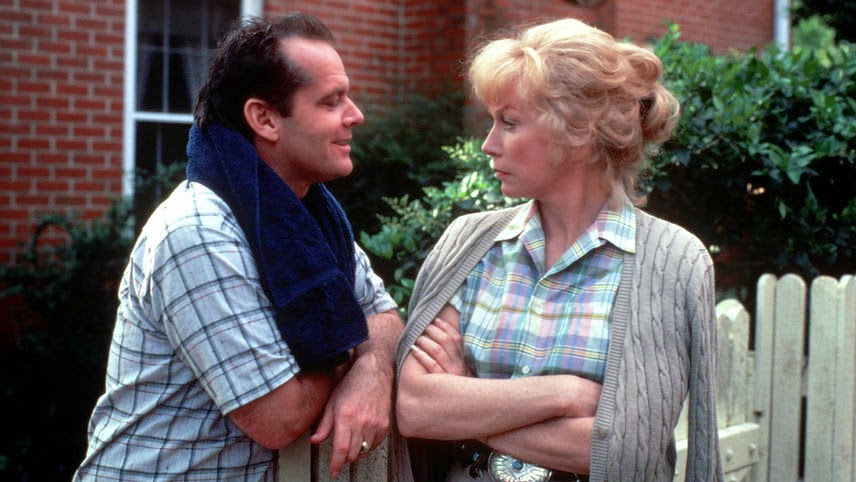
What Works Well: Nora Ephron adapted her own semi-autobiographical book for the screen, and the dream duo of Meryl Streep and Jack Nicholson ensure an eminently watchable experience. Director Mike Nichols adopts a patient stance with long uninterrupted takes to develop a sense of couplehood familiarity. The mix of chuckles and acrimony is true to life, and the supporting cast (featuring Stockard Channing, Jeff Daniels, Catherine O'Hara, Maureen Stapleton, and Kevin Spacey in an early role) is full of talent.
Sunday, 29 January 2023
Movie Review: Heartburn (1986)
What Works Well: Nora Ephron adapted her own semi-autobiographical book for the screen, and the dream duo of Meryl Streep and Jack Nicholson ensure an eminently watchable experience. Director Mike Nichols adopts a patient stance with long uninterrupted takes to develop a sense of couplehood familiarity. The mix of chuckles and acrimony is true to life, and the supporting cast (featuring Stockard Channing, Jeff Daniels, Catherine O'Hara, Maureen Stapleton, and Kevin Spacey in an early role) is full of talent.
Saturday, 29 August 2020
Movie Review: Carnal Knowledge (1971)
Jonathan (Jack Nicholson) and Sandy (singer Arthur Garfunkel) are best friends entering college, and obsessed with women and sex. Jonathan is selfish, judges women by their looks, seeks the thrill of the chase and has no desire to settle down. Sandy is more sensitive and interested in finding and falling in love with a soul mate. After a tentative start Sandy makes progress with fellow college student Susan (Candice Bergen), but Jonathan swoops in and starts to also date Susan on the side.
Years later the men are professionals and Sandy is married to Susan, although the passion has seeped out of the relationship. Jonathan is very much single and for his next conquest pursues part-time actress Bobbie (Ann-Margret), who has the dream shapely figure he has always coveted. Fuelled by sex their relationship peaks early and starts a slow descent, Bobbie craving the long-term commitment that Jonathan is not interested in. Meanwhile Sandy moves on from Susan, and starts a relationship with Cindy (Cynthia O'Neal).
Fairly shocking for its era due to a singular obsession with frank discussions about sexual desires, Carnal Knowledge helped usher in brazen and turbulent on-screen depictions of sex and lust among adults. Written by cartoonist and author Jules Feiffer and directed by Mike Nichols, the film features plenty of profanity, scenes of frollicking and lovemaking, and some risque nudity, as the evolving male perspective on sexual relationships gets a rigorous test.
As far as content and plot, Carnal Knowledge has a one-track mind and gets bogged down in prolonged talky scenes more suitable for the stage. The focus on Jonathan and Sandy is tight, the women in their orbit often unceremoniously dumped as the men move on. In a few scenes the emotions run high and tempers boil over, Nicholson and Ann-Margret engaging in an exhausting shout fest as their union circles the drain.Nichols enlivens the dialogue with innovative camera work, the background and foreground often equally important, the talking sometimes occurring off-screen and the passive but interested listeners given prominence.
Carnal Knowledge continued Jack Nicholson's rise to prominence as one of the most exciting and edgy talents in Hollywood. Brash and fully aware of his narcissism, Nicholson portrays Jonathan as an emotional risk methodically shunning opportunities for his own happiness. In one his rare movie outings Garfunkel is not bad, but definitely overshadowed.
With plenty of bravura oscillating from the highs of sexual fulfillment to the lows of depression, Ann-Margret matches Nicholson is one of her best career performances. Carol Kane and Rita Moreno arrive late with telling contributions, Moreno leaving a searing impression as the only remaining destination once burnout edges out titillation.
Sexual adventurism veering far away from monogamy carries a buzz, but at a cost. Carnal Knowledge meanders to the place where selfishness folds in on itself, what was once easy pleasure now in need of sordid mind tricks and expert but passionless help.
All Ace Black Movie Blog reviews are here.
Saturday, 15 December 2018
Movie Review: About Schmidt (2002)
A low key character study, About Schmidt combines pathos and humour to explore the vestiges of a colourless life.
In Omaha, Warren Schmidt (Jack Nicholson) retires from a middle management position at a large insurance company. Warren's career fizzled as he settled for mediocrity at work and at home, where the love has long seeped out of his marriage to the controlling Helen (June Squibb). He remains close with his daughter Jeannie (Hope Davis), who has relocated to Denver, although Warren does not think much of her fiancé Randall (Dermot Mulroney), a waterbed salesman.
Warren struggles to adjust to retirement, and dreads the impending road trips planned by Helen in an outsized Winnebago. He sponsors an African child in need and starts to express his frustrations in long letters to the young boy. An unexpected tragedy strikes Helen, and Warren finds himself alone. A road trip to Denver follows, where he meets Randall's quirky family including his mother Roberta (Kathy Bates).
Directed and co-written by Alexander Payne, About Schmidt is an adaptation of a novel by Louis Begley. Despite an over-reliance on narration (in the form of Warren reading out his own letters) and the absence of a traditional plot, the film settles down to experience the emotions of one nondescript man in featureless middle America. Payne may as well be sending a nostalgic note to his hometown of Omaha: immaterial and inconsequential, but ultimately meaningful and satisfying in unexpected ways.
Payne captures all that is charming about urban environments that have long since lost all their charm. The restaurants, offices, homes and banquet halls all carry the stench of 1960s decor and unimaginative stylings, places stuck in time serving people who don't know or care enough to notice. The glum aesthetic adds to Schmidt's downbeat mood, or maybe helped create it through years of sameness.
At the heart of the depressed urban environment is Warren Schmidt, a quiet man now facing a countdown to the end of his life, his insurance background heightening awareness of exactly how many years he has left. With not many (if any) achievements to look back on with pride, Warren is subdued, bored, listless and restless, all with the resigned air of pragmatism. In an absorbing performance Nicholson pulls back and bottles up his exaggerated tendencies, allowing Schmidt to observe, react and mostly just lament a life that amounted to very little.
Payne peppers his film with character-driven humour, with Randall and his family a rich source of chuckles. Waterbeds, pyramid schemes, a dim-witted brother and a libidinous mother all enter Warren's life, forcing him to ponder whether any texture is better than no texture at all.
About Schmidt is about the sands of time running out, but with a few surprises lurking in the deceptively featureless remaining grains.
All Ace Black Blog Movie Reviews are here.
Saturday, 5 May 2018
Movie Review: Five Easy Pieces (1970)
A character study drama, Five Easy Pieces looks at the lost promise of youth through the lens of a man who has simply stopped caring.
Bobby (Jack Nicholson) is a disenchanted blue collar labourer working on oil derricks in the California desert. Once a talented pianist, Bobby comes from an artistic family but has frittered away his life. He generally cares about nothing, repeatedly cheats on his girlfriend Rayette (Karen Black), and fights with his only friend Elton (Billy "Green" Bush). Despite being repeatedly victimized by Bobby's attitude and infidelity, Rayette always allows herself to be charmed back into his arms.
Bobby's sister Partita (Lois Smith) informs him that their father is very sick. He heads out on a road trip with Rayette to the family home in rural Washington State, where he finds his father in a catatonic state but is nevertheless immediately entranced by his brother's fiancee Catherine (Susan Anspach).
Directed by Bob Rafelson, Five Easy Pieces is a bleak look at manhood in crisis. Powered by a potent Jack Nicholson performance thriving in Bobby's emotional scorched earth policy, the film is an unblinking look at a life draining away. While it's almost impossible not to stand and stare as Bobby disappears into his own vacuum, Five Easy Pieces also suffers from the pungent unlikability of a leading character who does everything wrong on the way to doing nothing at all.
The pattern is set early, with Bobby dismissive of Rayette, unable to commit to anything, and generally settling for stubbornly satisfying his base instincts to the detriment of his long term happiness. Rafelson's narrative conundrum is where to take Bobby when he starts at the bottom, and the answer runs around in the repetitive circles of mistreating Rayette and winning her back.
A couple of key scenes break the monotony. Stuck in a highway traffic jam, Bobby climbs into the back of a small truck hauling furniture and starts playing the piano, offering a glimpse of how his gumption could have been channeled in the right directions. And later on the road trip, he tangles with a diner waitress in a battle of wits resulting in a Pyrrhic victory. Even when ordering breakfast, Bobby demands to be right at the expense of being successful.
László Kovács adds some excellent cinematography, capturing industrial vistas against spectacular skies, while Rafelson sprinkles some touches of humour, including a filth-obsessed random traveler who joins part of the road trip.
But the plot deficiencies are difficult to completely cover up. The reasons behind the disintegration of Bobby's life are only tangentially hinted at, his crippled relationship with his father a possible crucial fork in the road of his past life. But now Bobby is empty on the inside and only capable of boorish behaviour, a man with nowhere to go except deeper into the desolation of his own making.
All Ace Black Movie Blog reviews are here.
Friday, 29 December 2017
Movie Review: Anger Management (2003)
A lukewarm comedy, Anger Management has half of a good idea and not enough creative talent to expand the concept into a film.
Emotionally scarred by the bullying he received as a child, Dave (Adam Sandler) is a meek man, taken advantage of by his boss and unwilling to display public affection towards his long-term girlfriend Linda (Marisa Tomei). Despite Dave's calm demeanour, an incident onboard a plane spirals out of control, Dave grabs a flight attendant by the arm and finds himself in court, sentenced to anger management classes.
His appointed therapist Dr. Buddy Rydell (Jack Nicholson), who happens to have been sitting next to Dave on that flight, has unconventional methods, and when Dave has another physical altercation with a blind man and a restaurant server resulting in a more severe sentence, Buddy takes full control of Dave's life. The therapist moves in with Dave and repeatedly pushes his buttons to try and snap him out of his docile passive-aggressive emotions.
Directed by Peter Segal, Anger Management is an attempted buddy comedy. That the career trajectories of Jack Nicholson and Adam Sandler would ever meet is astounding, but unfortunately the results veer much closer to Sandler's typical output: unrefined, silly, immature and underdeveloped.
Sandler himself is actually fine, playing a man keeping his emotions in check and too sequestered in his head for his own good. The problems with Anger Management reside in an exceptionally weak script by David S. Dorfman. The story never recovers from setting the therapist Rydell totally loose on Dave's life with ridiculously unprofessional conduct, including Rydell moving into Dave's apartment and straight into his bed. The narrative crosses the line from witty to lazy early and often, and never recovers.
Which is a pity, because the film does contain the germ of a decent comedy. In better hands and with intelligent development, the challenge of overcoming excessive passiveness to get on with life carries promise. Only flashes of what could have been interesting make it into Anger Management, mainly in scenes where Dave's emotional detachment land him in as much trouble as any actual release of anger.
But otherwise Sandler fans would be much the happier, particularly as Segal has no control over Nicholson. He surrenders to his worst tendencies of overacting and scenery chewing, effectively Nicholson playing Nicholson at the lowest common denominator. Tomei is wasted in a token role, and the rest of the cast includes John Turturro, January Jones and Krista Allen as Rydell's patients, and an uncredited Heather Graham in a single scene as Dave's seductive test.
Anger Management settles down expectantly on the therapist's couch, but receives incompetent treatment.
All Ace Black Blog Movie Reviews are here.
Friday, 1 September 2017
Movie Review: The Bucket List (2007)
A comedy and drama about an unlikely friendship late in life, The Bucket List is better than its seemingly flimsy premise may suggest.
Edward Cole (Jack Nicholson) is a surly and extremely wealthy hospital tycoon. Carter Chambers (Morgan Freeman) is a kindly but well-read mechanic. The two men end up in adjacent hospital beds, both battling cancer and undergoing chemotherapy treatment. Their relationship gets off to a rocky start but gradually the two men warm up to each other. When they are both given only months to live, Edward and Carter create a bucket list of things they want to do before they die.
They embark together on a trip of a lifetime to knock off as many items as they can, including skydiving, car racing and a trip to the pyramids, with help from Edward's assistant Thomas (Sean Hayes). Carter's wife Virginia (Beverly Todd) deeply resents her husband taking off with a new friend when he has a limited amount of remaining time to spend with family. As Edward and Carter travel the world together, they form a deep bond and broach painful topics, including religion, family and their deepest regrets.
Movies about genuine friendships between men rarely strike the requisite chords, and often veer towards either mindless brohood or grim and stoic mutual respect. Here two veteran actors in Morgan Freeman and Jack Nicholson working with astute director Rob Reiner and a Justin Zackham script take on an often awkward topic, and pull it off with surprising ease.
Mixing mild comedy with increasing levels of serious discourse, The Bucket List wanders into territory where men are at their most vulnerable: saying sorry, admitting mistakes, debating core beliefs and leaving no regrets behind. Family man Carter has to face being selfish to pursue his bucket list despite his wife unspooling a professional guilt drama. Hard nosed Edward has to come to terms with what it means to actually care about someone beyond making money off perfunctory health care facilities.
These are heavy emotional rocks for men to turn over, and the premise of death knocking firmly on the door of life allows Edward and Carter to literally and figuratively go to places they would have otherwise never ventured near.
Reiner steps back and allows his two stars to shine, only infrequently falling into mundane travelogue moments (the Great Wall) or unfunny farce (at the racetrack). Otherwise he ensures that Edward and Carter build up their characters gradually, the men naturally revealing more of their psyches to each other as the trip progresses and the end nears in under 100 minutes.
Nicholson plays a slightly toned down version of his typical outspoken devil-may-care persona, with Freeman a perfect foil as the thoughtful blue collar worker, full of trivia, worldly belief and calm resignation.
The Bucket List is funny and melancholy, two superstar actors effortlessly teaming up to write a final chapter.
All Ace Black Blog Movie Reviews are here.
Sunday, 13 August 2017
Movie Review: How Do You Know (2010)
An insipid romance, How Do You Know is a torturous two hours of nothingness.
At 31 years old Lisa Jorgenson (Reese Witherspoon) is cut from the US national baseball team. She starts dating two men: professional baseball star Matty Reynolds (Owen Wilson) and businessman George Madison (Paul Rudd). Matty is rich, handsome and superficial, but starts to genuinely care about Lisa. George is head of a large corporation, but he is facing a serious fraud investigation related to falsifying tax records. George's pregnant personal assistant Annie (Kathryn Hahn) is loyal, but his domineering father Charles (Jack Nicholson) appears to be behind all that is bad in George's life.
Lisa moves into Matty's swanky apartment, but he misbehaves just enough to push here away and into the waiting arms of George. Meanwhile, Charles is trying to find a way to stay out of trouble with regulators by pushing George deeper into the hole.
Written, directed and co-produced by James L. Brooks, How Do You Know may be the moment a once great filmmaker finally hit the wall with a dull thud. From the uninspired title to the stultifying pacing and abject lack of content, How Do You Know is devoid of laughs, drama or genuine emotion of any kind. The film rolls over and dies early, with neither Brooks nor the cast able to generate even the faintest of pulses.
The one interesting element in the plot would have been Lisa dealing with the rejection of being summarily cut from the sport she loved. Witherspoon tries hard in a couple of scenes to convey the trauma of dealing with the emptiness that resides on the other side of the dream, but Brooks soon loses interest and resumes the ping pong between Matty and George. Witherspoon is reduced to hauling her luggage back and forth between the two men, by buses and taxis, in an unbelievable display of bankrupt writing.
Meanwhile the two men stay at the most superficial level, Matty the playboy athlete and George the honest businessman. Neither progress an inch from their starting positions, and two hours into the movie Matty is still being a dork and George is still all innocent puppy admiration. In a desperate attempt to stretch the proceedings to two hours, Brooks introduces several scenes in which the characters agree to not talk, and then proceed to not communicate, thereby setting up more excruciating scenes to cover the same ground.
How Do You Know is sad late career misfire for Brooks as director and Nicholson as a film star, and they both took a long, possibly permanent hiatus after this debacle.
All Ace Black Blog Movie Reviews are here.
Saturday, 28 January 2017
Movie Review: The Last Detail (1973)
A slice-of-life drama about fleeting friendships and the oppressive responsibilities of military life in a civilian context, The Last Detail is an unforgettable low-key road trip.
At the U.S. Naval base in Norfolk, Virginia, Signalman Billy "Badass" Buddusky (Jack Nicholson) and Gunner's Mate Richard "Mule" Mulhall (Otis Young) are given a new assignment: escort 18 year old prisoner Seaman Larry Meadows (Randy Quaid) by train and bus to Portsmouth Naval Prison. Meadows has been convicted of attempting to steal $40 from a charity jar, and sentenced to a ridiculous seven years because he targeted the favourite charity of the naval base commander's wife.
Badass and Mule hatch a plan to make the most of the trip to break the dull monotony of life on the base. They plot to deliver Meadows to Portsmouth as quickly as possible and then spend a week living it up. But Badass starts to feel sorry for the goofy, oversized kleptomaniac Meadows, and decides to give the kid a good time to make up for what he will lose while serving his sentence. Badass and Mule prolong their stay in New York and then Boston, and introduce Meadows to alcohol and women, while helping him build up his assertiveness.
Directed by Hal Ashby and written by Robert Towne, The Last Detail is an understated piece of quintessential 1970s film making. The story of a prison escort detail triggering a road trip cannot be any simpler. The layered theme of psychological confinement holding back all three men emerges slowly, and finally takes over the film with unusual potency.
Stylistically Ashby bathes the film in harsh tones, browns, yellows and whites dominating many of the scenes to represent the unmistakably bleak outlook for all three men. From nondescript cheap motel rooms to characterless diners, the film crawls along an uninspired America surviving through one day just to get to the next similarly joyless day.
And traversing this terrain is one man in handcuffs and two men just as confined in their careers. Meadows cannot help his kleptomania and will be paying the price behind bars for a long time. Badass and Mule are prisoners of their own making. Lifers in the Navy, now stuck inside a military machine but on land and away from any war, their prospects are more grim than anything Meadows faces: at least he gets variety in locale and a release to look forward to. They get nothing except more of the same.
The road trip is a brief escape for all three men, Meadows getting his first introduction to drinking, chanting with hippies, whoring and generally being purposelessly loose. Badass and Mule enjoy the freedom of breaking some rules away from the eyes of authority and doing good by being bad. The three men form a bond of friendship anchored by sailing outside the lines.
Jack Nicholson dominates the film as the anti-authoritarian man reluctantly resigned to a life under the thumb of authority, but seeking every opportunity to bend the rules. Otis Young allows Mule to be a counterbalance, a sailor more invested in the daily regulations of his career but gradually allowing his resistance to crumble. Randy Quaid delivers one of his finest career performances as the clueless Meadows, a man-sized boy with his fate already in the hands of others. Carol Kane, Nancy Allen and Gilda Radner appear in small early career supporting roles.
The Last Detail momentarily challenges all the small details in the inconsequential lives of three men, but the vast emptiness of soul confinement is an overpowering, if quiet, force.
All Ace Black Movie Blog reviews are here.
Monday, 7 September 2015
Movie Review: Blood And Wine (1996)
An effective neo-noir, Blood And Wine assembles all the elements for a stirring ride through the wilderness of human greed and desperation.
In Florida, Alex Gates (Jack Nicholson) is a wine merchant, struggling to maintain his lifestyle as his business slowly fails and his wealth evaporates. His marriage to Suzanne (Judy Davis) is falling apart, her broken leg and excessive drinking a direct result of his long absences and unconvincing excuses. Alex's relationship with his son Jason (Stephen Dorff) is also heavily strained, Jason preferring the tranquility of fishing with his friend Henry (Harold Perrineau Jr.) to dealing with his dad. And Alex is now having an affair with the much younger Gabby (Jennifer Lopez), the Cuban nanny for the wealthy Reece family.
Attempting to solve all his problems, Alex teams up with ex-convict and safe cracker Vic Spansky (Michael Caine) to steal a precious necklace from the Reece household. But what Alex plans as a simple theft and getaway to a new life with Gabby turns sour when Suzanne intervenes, the necklace ends up in Jason's possession, Vic reveals extremely violent tendencies, and Jason and Gabby start a steamy relationship.
Another collaboration between director Bob Rafelson and star Jack Nicholson, Blood And Wine is an engaging modern film noir. Filmed with a vivid aesthetic that emphasizes the Florida heat and creates a nowhere-to-hide glare, Blood And Wine is set in a no middle ground context where men like Alex can either live up to the neighbourhood expectations and be rich, or fade into oblivion.
With his home life already a train wreck and his business failing, Alex will make a last grab for glory and attempt to steal his way to riches while trading-in the literally broken Suzanne for sexpot Gabby. Of course, although he believes otherwise, Alex cannot control for all the variables. Suzanne's fury, Vic's psychosis and Jason's principles all create a minefield in the path of the carefully conceived plot, and little will go according to the original plan. Meanwhile, the suddenly unemployed Gabby has to decide which path offers her the best opportunity for future security.
While the plot and performances satisfy and the narrative convolutions ensure a high and consistent level of unpredictable enjoyment, the film suffers somewhat from being almost too traditionally faithful to most of the noir tenets. Rafelson lines up and marches out the usual components: infidelity, violence, sex as a tactic, sweet talk, obsessive lying, double-crosses, a woman playing against men, and a precious treasure at the middle of it all. Only the private detective in a trench coat and the hapless local police are missing.
But the key characters are all well developed and more than make up for the modest level of originality. Vic is struggling with a respiratory disease, and his sense of one last opportunity for happiness before the finality of death drives his nothing-to-lose attitude. Michael Caine has tremendous fun with the dichotomy of a surprisingly dangerous old safe cracker unable to control his violent urges to resolve messy situations. Lopez has rarely been better on the big screen, and Gabby is provided with a rich background as an illegal escapee from Cuba trading on her good looks while seeking the man who can help provide a more established life. Alex is easy pickings for Nicholson, while Stephen Dorff is perhaps the least convincing, the role of Jason falling between the cracks of pervasive acrimony.
Blood And Wine may not be a perfect mix, but it nevertheless oozes out of the bottle with an intoxicating smell of attractive menace.
All Ace Black Blog Movie Reviews are here.
Monday, 25 May 2015
Movie Review: Terms Of Endearment (1983)
A family life drama-comedy with spectacular acting performances by a dream cast, Terms Of Endearment is a masterpiece of authentic emotions.
In Texas, Aurora Greenway (Shirley MacLaine) has always been slightly paranoid and definitely overprotective of her only daughter Emma. Aurora was widowed at a young age, leaving her relationship with Emma as the one true connection in her life. When Emma (Debra Winger) grows into a young woman and decides to marry school teacher Flap Horton (Jeff Daniels), Aurora certainly does not approve, believing Flap to be unworthy. Around the same time, retired astronaut Garrett Breedlove (Jack Nicholson) moves into the house next door. A party-loving, womanizing and free-spirited bachelor, Garrett is a man denying his age.
Emma and Flap push ahead and get married anyway, and eventually start a family and move to Des Moines. As the years pass Aurora remains in close touch with her daughter, the two sharing their lives over frequent phone calls, and despite plenty of arguments and no shortage of agitation, their love and commitment to each other never wavers. Seeking physical closeness, Aurora finally works up the courage to start a relationship with Garrett, about 15 years after he became her neighbour. With three kids to raise and Flap's limited earning power causing a financial burden, Emma's marriage starts to seriously fray, and both she and Flap are subjected to extramarital temptations. The threat of another relocation and a serious illness are yet to come.
Directed and written by James L. Brooks in his directorial debut, and based on the Larry McMurtry book, Terms Of Endearment is a perfectly polished gem. For the full 131 minutes, not a scene is wasted, Brooks trusting his audience to keep up as the film gallops through the years using short, often funny and frequently poignant scenes. Chronicling the bond between Aurora and Emma from birth and through about 40 years of life, Brooks nails the ups and downs that define the unique cycles of frustration and happiness between mother and daughter, with undying love providing the sturdy foundation upon which two lives are lived.
Brooks' singular achievement is in creating uniquely memorable characters and then treating them with utmost realism. Aurora, Emma and Garrett are a simply unforgettable trio, three people living life on their own stubborn terms but yet behaving fully within the normal rules where selfishness, sacrifice and life's surprises require a steady stream of critical decisions. There are no heroics in Terms Of Endearment; just happiness and heartache generated by the life's little successes and failures.
And because laughs and tears punctuate life's milestones, Brooks includes plenty of both. The emotions are always there, but even at the darkest moments they rarely veer towards exaggerated agitation. In a peak moment of frustration Aurora does let loose at a hospital nurse station, but it's a scene that is equally funny and heartbreaking, capturing a devoted mother willing to move mountains for her daughter.
Terms Of Endearment features astounding acting from the three principals. Shirley MacLaine and Jack Nicholson deliver some of their best work in their long and celebrated careers. MacLaine won the Best Actress Academy Award for what may have been her last great performance, bringing to life Aurora as a proud woman of the South dealing with the changing times and her own evolving needs. Nicholson took a step back from the madness and murderous urges that had began to define him after The Shining and The Postman Always Rings Twice, and nabbed the Best Supporting Actor Academy Award as Garrett the astronaut, a man determined to turn his past celebrity into a life of irresponsible pleasure.
And Emma was undoubtedly Debra Winger's finest on-screen moment. Winger celebrates Emma as a feisty woman full of love, laughter and a singular determination to meet life on her own terms while forging friendships, sharing every moment with Aurora and adoring and tolerating Flap in equal measures. It's a performance for the ages, and Winger was also nominated as Best Actress but lost out to MacLaine.
In addition to Daniels, Danny DeVito as Aurora's long-time admirer and John Lithgow as Emma's amorous banker round out the cast.
Towards the end of Terms Of Endearment, Emma and Aurora share a moment. It's a brief locking of the eyes, without a word being spoken, Winger and MacLaine pouring their characters into a few seconds representing a lifelong bond, a breathtaking ending, a sorrowful beginning, a heartfelt thank you, and the meaning of love itself. It's an unforgettable instant in an enduring treasure of a movie.
All Ace Black Blog Movie Reviews are here.
Sunday, 24 May 2015
Movie Review: Wolf (1994)
The story of an American werewolf in corporate New York, Wolf shows promise as a metaphor for adults, but then loses its edge by insisting on following the childish werewolves-on-the-loose path.
Respected book editor-in-chief Will Randall (Jack Nicholson) is bitten by a wolf after a car accident in the snowy Vermont mountains. Back in New York, Will finds himself a victim of a corporate shuffle. Tycoon Raymond Alden (Christopher Plummer) is the new publishing house owner, and he demotes Will and assigns young and hungry marketing executive Stewart Swinton (James Spader) into his position. Will's life hits rock bottom when he discovers his wife Charlotte (Kate Nelligan) having an affair with Stewart.
But Will also starts to feel the after-effects of the wolf bite: his senses are amplified, he feels younger, more vigorous, and more aggressive. He meets Alden's daughter Laura (Michelle Pfeiffer), an aloof heiress, and starts to plot his revenge to reclaim his job and make Stewart and Charlotte suffer. But then Will starts to lose control of what is happening to him at night, when the werewolf within him emerges and goes hunting for blood and adventure. A brutal murder is then committed, and Will emerges as a suspect.
Directed by Mike Nichols, Wolf tries to appeal to two distinct audiences and by doing so fails them both. The first half displays promise as an analogy of the need for an emotional rebirth to survive middle age trauma, as Nichols explores the symbolism of Will discovering and then adopting wolf-like tactics to fight for his patch of the corporate and relationship jungle.
But once the film transitions in its second half to actual werewolf adventures, howlings in the night, wolves hunting deer and eventually murder and mayhem in Central Park, it veers sharply away from its intellectual premise. With this heavyweight cast there is nothing to be gained chasing special effects, blood, gore and werewolves battling each other, complete with incompetent detectives attempting to solve murder-by-wolf.
Mayhem caused by werewolves has of course been done before many times, and with much better horror and special effects, including in 1981's An American Werewolf In London. By insisting on chasing the thrill-seeking audience Wolf loses its purpose and surrenders the cerebral advantage.
Casting Jack Nicholson as a wolf is almost too easy, but he does a fine job adopting a more-is-less philosophy. Nicholson keeps Will sharp but low-key, and remains remarkably calm even when the werewolf transformations start. Laura Alden is an interesting but underwritten role, and Pfeiffer can't do much with it. More effective is Spader as the power-hungry Stewart Swinton, a shrewd natural wolf in man's clothing.
Wolf ends up being not scary enough, not gory enough, and not smart enough, as it howls at the moon of confused objectives.
All Ace Black Blog Movie Reviews are here.
Thursday, 25 December 2014
Movie Review: The Pledge (2001)
A thoughtful psychological crime drama, The Pledge plays with a patient mood while grappling with a brutal murder and the search for the mysterious predator.
In Reno, Nevada, police detective Jerry Black (Jack Nicholson) is retiring. On his last working day, the brutalized body of a young blonde girl named Ginny is discovered in a snowy field. Jerry pledges to the victims' mother (Patricia Clarkson) that no matter what, he will bring the murderer to justice. Toby (Benicio del Toro), a dimwitted vagabond aboriginal, is arrested and detective Stan Krolak (Aaron Eckhart) extracts a confession from him, declaring the case closed.
Jerry doubts that Toby is the killer, and after retirement he continues his informal investigation, interviewing Ginny's grandmother Annalise (Vanessa Redgrave); the victim's best friend at school; and the father (Mickey Rourke) of another young blonde girl who met the same fate as Ginny. He gains a vague picture of the killer's car model and colour, and a murky connection between the crimes and porcupines.
Jerry purchases a gas station along the main highway in the rural area where he believes the next murder may happen. As the months pass, he befriends single mom Lori (Robin Wright Penn), who has a young blonde daughter Chrissy (Pauline Roberts) about the same age as the previous victims. Gradually, Jerry starts to encounter men who could be suspects. But Jerry is also hearing voices in his head, and may be starting to lose his grip on reality.
Directed by Sean Penn, The Pledge is an adaptation of the Friedrich Dürrenmatt book. This is a film that takes a deep breath from the surrounding landscape, and focusses on characters, atmosphere and emotion. There is little action that takes place on screen, but plenty that goes on in the thoughts, fears, and hopes of Jerry Black as he tries to fulfill the promise he made to the distraught mother of a young victim.
Penn's pacing is deliberate, but nevertheless engrossing. Within the forgotten back road setting where time is slow, towns are small, cars are old and technology is outdated, the film is packed with tiny unsettling moments, indications that all is not well, neither in the rural community stalked by a vicious child killer, nor in Jerry's mind. Jerry could be suffering from old-age, post-retirement emotional turmoil, the stress of his pledge, or something else altogether more serious. Penn provides hints, but never any clear resolutions. What is for sure is that some danger is lurking and closing in, and Jerry is welcoming, almost eager to face his nemesis. Whether or not he is ready is another question.
While The Pledge unfolds on its own terms towards a rich and rumpled conclusion, it does suffer from almost too much silence, as the details of Jerry's deliberate actions are sacrificed in search of style and a brooding aesthetic.
Jack Nicholson provides a thankfully subdued performance, staying well within himself despite the mounting stress. Jerry Black is a stoic, calculating character, well past the days of running after suspects and now more interested in laying an elaborate trap and waiting for the right time to pounce. Nicholson conveys a man under self-imposed pressure, with his judgement increasingly clouded. He may or may not be using Lori and Chrissy as a lure; he likely does not quite know anymore whether his need for a family is in conflict with the burning desire to solve a crime.
In support, almost every one-scene role is brought to life by a prominent actor. In addition to Clarkson, del Toro, Eckhart, Wright Penn, Rourke and Redgrave, Helen Mirren makes an appearance as a psychiatrist, Harry Dean Stanton is the original owner of the gas station purchased by Jerry, and Sam Shepard is a police detective.
The Pledge weaves a spell and luxuriates in its foggy density, as much a crime mystery as a thought-provoking sojourn to the place where promises become obsessions.
All Ace Black Blog Movie Reviews are here.
Tuesday, 16 December 2014
Movie Review: The King Of Marvin Gardens (1972)
A low-key character study set in Atlantic City, The King Of Marvin Gardens celebrates early 1970s minimalism but toils to create drama around a small group of dreamers and drifters.
David Staebler (Jack Nicholson) works as an overnight talk show host at a Philadelphia radio station, entertaining his audience with long-winded fictional stories. David lives in a large house with his grandfather and seems to be sleepwalking through life in a state of minor depression. At the request of his brother Jason (Bruce Dern), David travels to Atlantic City, where he meets Jason's girlfriends Sally (Ellen Burstyn) and Jessica (Julia Anne Robinson).
Jason is a perpetual dreamer, always on the lookout for the next big deal, and is involved with some unsavoury Atlantic City criminal types including crime boss Lewis (Scatman Crothers). Jason's latest vague scheme is to build a casino resort on a tiny island off the coast of Hawaii, and he wants David's support. The naïve Sally and Jessica dream of joining Jason in Hawaii, while engaging in their own competition to be Jason's prime play mate. With Jason full of ambition but utterly lacking in focus or ability, David has to decide how close he wants to be to his brother, while Sally and Jessica head towards a resolution of their own.
Directed by Bob Rafelson in one of six collaborations with Nicholson, The King Of Marvin Gardens zooms in on four people and stays there. With a rudimentary story that never intends to go anywhere, the script (by Jacob Brackman and Rafelson) takes its time to delve into the shifting emotions of David, Jason, Sally and Jessica. While the foursome are interesting enough, it is an undoubted struggle to sustain attention even for the shortish 104 minute running time.
It is clear early that David is carrying emotional wounds and is repressing his life to guard against any shocks. It's a different role for Nicholson, allowing him to stay deep within himself and express annoyance with minimal expressions and gestures. Jason is equally easy to categorize: a small time hustler who will always end up on the losing side of any deal. Jason is introduced in a jail cell, and he never does anything to suggest that his half-baked schemes will help him find better outcomes. Bruce Dern grabs the role and runs with it, making a splash but falling short of finding a glimmer of pathos that may have helped the film glow. Neither David nor Jason undergo much of a transformation as the two brothers bump up against each other and find little willingness for change.
Sally and Jessica are both potentially compelling characters, but the film only offers piecemeal hints about their backstory, and they are never rounded out into people. It's a wasted opportunity to expand the film into a wider circle. The movie is Julia Ann Robinson's one major film credit before her tragic death in 1975.
To make up for the relative leanness of the material, The King Of Marvin Gardens boasts plenty of style. The opening scene is a classic close up of a Nicholson monologue in dark surroundings, Rafelson revealing the setting and context ever so slowly and with a large dose of cleverness. The rest of the film is full of compelling Atlantic City scenery from the early 1970s, when old glories had well and truly faded and a thick sense of defeatism hung heavy over the boardwalk. Rafelson also takes several surreal side trips into dreamlike scenes that are fascinating in their non sequitur state. One such sequence features the foursome staging a simulated Miss America pageant, while other scenes suddenly transpose the characters to unusual settings on the beach.
The King Of Marvin Gardens is an adequate curiosity, never achieving regal status but presenting a worthwhile stroll in the company of conflicted brothers.
All Ace Black Blog Movie Reviews are here.
Wednesday, 15 October 2014
Movie Review: The Departed (2006)
The film that finally delivered the Best Director Academy Award to Martin Scorsese, The Departed is a slick police drama centred on an epic battle to wrest control of Boston's underworld away from an entrenched mobster lord. A stellar cast helps to balance the film's more overwrought elements.
Frank Costello (Jack Nicholson) is the head of Boston's largest criminal syndicate, brutally engaged in grand scale extortion, trafficking and wanton violence. Police Captain Queenan (Martin Sheen) and his deputy Staff Sergeant Dignam (Mark Wahlberg) spot an opportunity to infiltrate Costello's empire by inserting new police graduate Billy Costigan (Leonardo DiCaprio) as an undercover mole. Billy is from the wrong side of town, and a manufactured criminal record as well as his chequered family history eventually gain him entry into Frank's inner circle.
Costello: I don't want to be a product of my environment. I want my environment to be a product of me.
But Frank has his own agent working inside the police department. Staff Sergeant Colin Sullivan (Matt Damon) is considered by his boss Captain Ellerbyone (Alec Baldwin) to be of the brightest officers on the force, but Sullivan is on the criminal payroll and ensures that Frank stays one step ahead of enforcement efforts to nab him. First Sullivan and then Costigan get romantically involved with psychologist Dr. Madolyn Madden (Vera Farmiga). With Costigan beginning to buckle under the tension of his double life, both Costello and Queenan come to the realization that there are moles within their organizations, leading to a ferocious settling of the scores.
FBI Agent Lazio: Do you have anyone in with Costello presently?
Dignam: Maybe. Maybe not. Maybe fuck yourself. My theory on Feds is, they're like mushrooms: feed them shit and keep them in the dark.
Written by William Monahan as an adaptation of the 2002 Hong Kong film Internal Affairs, The Departed is hard-hitting, loud and drenched in testosterone. At 151 minutes the film is probably a good half hour too long, and the second half bogs down in a seemingly endless find-the-mole pursuit driven by justified paranoia. But The Departed overcomes its weaker points thanks to a grim attitude of survival at all costs, with the characters of Costello, Costigan and Sullivan playing dangerous games of deception to further their careers in an uncaring world.
Costello: One of us had to die. With me, it tends to be the other guy.
Scorsese creates a world where men rule with incessant shouting, intimidation and cursing, and proceed to create spectacular messes. The police department is a cesspool of competing agendas and mistrust, and Frank Costello's criminal empire is barely held together by the iron will of one man who sees enemies everywhere. The agencies on both sides of the law appear equally dysfunctional and distasteful. Dr. Madden is the only woman of relevance in the cast, and she seems off-centre and out of place, getting in the way of the men's ruinous agendas.
The script is a treasure of caustic one liners. Before the guns are drawn (and eventually they are, in large numbers), the characters of The Departed fire ballistic words at each other. No calm sentence will do when it can be replaced by a fine-tuned verbal barrage, and Monahan excels at creating enduring quotable exchanges. In the hands of an exceptional cast, The Departed becomes an intellectual sparring match, a multi-pronged battle of wits where the acts are always violent, but not anymore so that the fierce thoughts that precede them.
(a police surveillance operation is not going well; there are blind spots, and officers are losing their sight lines and losing their cool).
Dignam: This is incredible. Who put the fucking cameras in this place?
Surveillance Guy: Who the fuck are you?
Dignam: I'm the guy who does his job. You must be the other guy.
The Departed basks in the glow of the current generation of superstar actors in the form of DiCaprio, Damon and Wahlberg rubbing shoulders with elder statesmen Nicholson, Sheen and Baldwin. DiCaprio and Damon deliver the requisite intensity as the men taking the highest risks to prove themselves and alter the outcome of the battle for street control. In terms of balance among the stars, the film probably has too much of Nicholson and too little of Wahlberg, Sheen and Baldwin.
The Departed reaches a climax of brutal bloodletting that delivers the requisite shock and gore, but also undermines a lot of the build up. When killing suddenly becomes too easy and everyone is a target, the careful game of cat-and-mouse that unfolded over several years is inevitably diminished.
There is no question that Scorsese has crafted better gems. Taxi Driver, Raging Bull and Goodfellas, among others, are greater artistic achievements and more deserving of Academy Award recognition. The Departed proved to be the opportunity to correct past oversights in recognizing one of Hollywood's greatest ever directors; fortunately, it is also a provocative story of conflicted men pushing their fate into dangerous territory, where Scorsese happens to be most comfortable.
All Ace Black Blog Movie Reviews are here.
Thursday, 9 October 2014
Movie Review: A Few Good Men (1992)
A military court drama with a superb cast and a razor sharp script, A Few Good Men is an exhilarating story of murder, cover-up, honour and unexpected determination.When Private Santiago is killed at the Guantanamo Bay Naval Base in Cuba, Lieutenant Daniel Kaffee (Tom Cruise) is put in charge of representing the two defendants. Marines Dawson (Wolfgang Bodison) and Downey (James Marshall) don't deny that they intended to rough up Santiago as a disciplinary measure, but they claim that they were ordered to do so. Lieutenant Commander JoAnne Galloway (Demi Moore) and Lieutenant Weinberg (Kevin Pollak) join Kaffee's defence team.
Initially, the cocky Daniel is looking for a quick plea-bargain with his counterpart Captain Ross (Kevin Bacon), but a visit to the Naval Base and a meeting with Guantanamo's commander Colonel Nathan Jessup (Jack Nicholson) begin to reveal a deeper story. Santiago was an underperforming Marine, Jessup wanted him kept on the base and "trained", and Lieutenant Kendrick (Kiefer Sutherland) was eager to please, over the objections of Lieutenant Colonel Markinson (J. T. Walsh). But Jessup tells Kaffee that Santiago was granted a transfer, and was murdered shortly before he was due to leave the base. Egged on by Galloway, Kaffee finds the courage to keep investigating. He takes the case to a court martial and argues on behalf of the defendants, resulting in a titanic battle for the truth.
Jessup, talking to Kaffee: I run my unit how I run my unit. You want to investigate me, roll the dice and take your chances. I eat breakfast 300 yards from 4000 Cubans who are trained to kill me, so don't think for one second that you can come down here, flash a badge, and make me nervous.
Written by Aaron Sorkin (adapting his play) and directed by Rob Reiner, A Few Good Men is a gripping experience. The film engages immediately, the complex mystery of what happened to Private Santiago providing layers of depth, the Guantanamo crime setting adding a stab of danger, while the evolution of Daniel Kaffee from carefree arrogance to intense commitment provides a compelling arc. For the entire running length of 138 minutes Reiner does not release the tension, instead building a courtroom emotional rollercoaster as Kaffee's case ebbs and flows, the plucky defence team taking on the establishment and trying to shake the defendants loose from the grip of a seemingly straightforward verdict of guilt.
The film's central clash is translated into a climactic confrontation between Kaffee the unsure attorney and Jessup the wily Colonel on the witness stand. As the sparks finally fly, Tom Cruise and Jack Nicholson are both brilliant, bouncing off each other in a battle of wills that is destined to destroy either the lawyer or the soldier. Cruise grows from boy to man as he accepts his destiny to dominate courtrooms, while Nicholson delivers one his all-time great performances as the arrogant base commander, as sure of his methods and motives as he is oblivious to his creeping maniacal tendencies.
Jessup: I'll answer the question. You want answers?
Kaffee: I think I'm entitled!
Jessup: You want answers?!
Kaffee: I want the truth!
Jessup: You can't handle the truth! Son, we live in a world that has walls, and those walls have to be guarded by men with guns. Who's gonna do it? You? You, Lieutenant Weinberg? I have a greater responsibility than you can possibly fathom. You weep for Santiago and you curse the Marines. You have that luxury. You have the luxury of not knowing what I know, that Santiago's death, while tragic, probably saved lives. And my existence, while grotesque and incomprehensible to you, saves lives! You don't want the truth, because deep down in places you don't talk about at parties, you want me on that wall. You need me on that wall. We use words like "honor", "code", "loyalty". We use these words as the backbone of a life spent defending something. You use them as a punchline. I have neither the time nor the inclination to explain myself to a man who rises and sleeps under the blanket of the very freedom that I provide, and then questions the manner in which I provide it! I would rather you just said "thank you", and went on your way. Otherwise, I suggest you pick up a weapon, and stand a post. Either way, I don't give a damn what you think you are entitled to!
The supporting cast is filled with superior talent in every key role. Moore is sometimes awkward but in keeping with JoAnne Galloway's slightly misfit character, and Kevin Pollak as Weinberg provides the calm brains to complement Kaffee's instinctive charisma. Kiefer Sutherland, Kevin Bacon, and J.T. Walsh round out the men in uniform holding different moral perspectives on the same incident.
A Few Good Men finds soldiers of all ranks believing that they are doing the right things for the right reasons. When the outcome is tragic, the foundation is set for an epic showdown in search of justice.
All Ace Black Blog Movie Reviews are here.
Saturday, 6 September 2014
Movie Review: Hoffa (1992)
A biography of the legendary leader of the Teamsters Union, Hoffa bounces on the surface of superficiality and never comes close to properly exploring neither the person nor the issues that defined him.
The film starts in 1975 on the day Hoffa (Jack Nicholson) died, as he and his close associate Bobby Ciaro (Danny DeVito) wait for a meeting in the parking lot of a secluded diner. Flashbacks recount the story of Hoffa's rise to power. He first meets Ciaro in the 1930s, as Hoffa fights to organize truck drivers into a union. Hoffa is not afraid of violent methods, and one of his trusted friends Billy Flynn (Robert Prosky) is killed in a fire bombing gone wrong. There are frequent large scale and vicious clashes between pro- and anti-union forces.
A turning point in the struggle for workers' right is an alliance that Hoffa creates with organized crime, represented by mob boss D'Allesandro (Armand Assante). The Teamsters Union is formed and Hoffa gains power, money, influence and notoriety, but still presents himself as a man of the people. Ciaro gradually becomes Hoffa's closest advisor, while Pete Connelly (John C. Reilly) is also admitted into Hoffa's inner circle. But Hoffa becomes a target for anti-corruption officials and politicians, including an idealistic Bobby Kennedy (Kevin Anderson), precipitating his spectacular downfall.
Hoffa's problems are many, but start with a surprisingly spineless script by David Mamet. Every opportunity to delve into Hoffa's background, motivation, and leadership talent is missed, the film often fading away just when Hoffa is getting into his groove. Moments that should have been seminal, such as Hoffa exerting his influence on Ciaro during their foundational truck ride, or the critical negotiations with the mob, are just edited out in an astounding example of either lazy writing or clueless editing.
The film is also silent about Hoffa's upbringing and influences, and he is just presented as the mysterious organizer dropped into a period of labour strife and inspired by...nothing. And too much time is spent on a ponderous imagining of Hoffa's final hours, his mysterious disappearance theorized as a meeting-gone-wrong at an out of the way roadside diner.
Equally poor is the treatment of all secondary characters, who are sketched in the most rudimentary manner. Bobby Ciaro is a fictional amalgamation of Hoffa's associates but too often the movie appears to be about him, while the other union bosses, underworld types, family members, politicians and enforcement officials drift in and out of the film at perfunctory intervals, offering no context and spouting stock lines.
Danny DeVito's directing is sometimes clever but mostly succeeds in amateurishly pointing to itself, with an over-reliance on rookie zoom and pan tricks, and flourishing musical crescendos every time a large-scale brawl erupts between armies of extras.
The good moments in Hoffa come courtesy of some good set designs, including the recreation of grim 1930s blue collar work environments. The large crowd scenes are well-handled, and Nicholson does his best to salvage a person out of the wreckage of the script. In a performance that is mostly under control, Nicholson at least finds the inner fire and magnetic intensity that drove Hoffa from grimy obscurity to the riches bestowed on the top union boss in the land.
Underwhelming and lacklustre, Hoffa is cause for a grievance.
All Ace Black Blog Movie Reviews are here.