Showing posts with label Meryl Streep. Show all posts

Wednesday, 1 July 2026

Movie Review: Postcards From The Edge (1990)


Genre: Dramedy  
Director: Mike Nichols  
Starring: Meryl Streep, Shirley MacLaine, Gene Hackman, Dennis Quaid, Richard Dreyfuss  
Running Time: 101 minutes  

Synopsis: Movie actress Suzanne Vale (Meryl Streep) is abusing drugs, and is eventually checked into rehab by her mother, Hollywood legend Doris Mann (Shirley MacLaine). After recovering, Suzanne moves in with her mother as an insurance requirement as she tries to rebuild her career with an unbecoming role in a low-budget film. She has to deal with her mother's alcoholic narcissism and a deceptive suitor (Dennis Quaid), but finds support from a caring director (Gene Hackman) and an emergency room surgeon (Richard Dreyfuss).

What Works Well: This adaptation of Carrie Fisher's semi-autobiographical book features two reliably excellent performances from Meryl Streep and Shirley MacLaine. The focus is on stardom-induced self-absorption translating into unintentional pressure passed down from mother to daughter, amplifying dysfunction in both generations. While the dramatic moments are genuine, director Mike Nichols also has fun portraying quirky on-set dynamics as Suzanne navigates the idiosyncrasies of directors and producers.

What Does Not Work As Well: A nonchalant attitude results in frivolous treatment of important topics, including addiction, parenting, workplace toxicity, and exploitive men. The absence of meaningful secondary characters and glorified cameos from Gene Hackman and Richard Dreyfus add to an overall sense of dismissiveness. Some bizarre narrative choices result in three songs being performed in full, betraying a lack of conviction in the core strength of the material.

Key Quote:
Doris: I was such an awful mother... what if you had a mother like Joan Crawford or Lana Turner?
Suzanne: These are the options? You, Joan, or Lana?


All Ace Black Movie Blog reviews are here.

Sunday, 27 July 2025

Movie Review: Silkwood (1983)


Genre: Biographical Drama  
Director: Mike Nichols  
Starring: Meryl Streep, Kurt Russell, Cher, Craig T. Nelson, Fred Ward, Diana Scarwid  
Running Time: 131 minutes  

Synopsis: It's the 1970s in Oklahoma, and Karen Silkwood (Meryl Streep) is a technician at a manufacturing plant for plutonium rods. Her co-workers include her partner Drew (Kurt Russell) and best friend and housemate Dolly (Cher). Training and safety standards at the plant are lax, and employees are frequently exposed to radiation, although most of them are just happy to have a job. A union decertification effort and several contamination scares prompt Karen to become active in trying to improve safety, placing her in conflict with both management and co-workers.

What Works Well: Based on actual events, this is an in-depth look at blue collar life, with Meryl Streep excelling in the conflicted, lived-in role of a would-be whistleblower. Far from glamourizing Karen Silkwood, director Mike Nichols and writers Nora Ephron and Alice Arlen create a warts-and-all portrait of a working class woman engaged in the daily grind of a thankless job, bruised by a divorce and separation from her kids, and enjoying a relationship with Drew and the ups and downs of a friendship with Dolly. Once she starts to care about safety at work, her already ramshackle home life starts to disintegrate, testing all her commitments. 

What Does Not Work As Well: The balance tilts heavily towards domestic issues, reducing Karen's search for answers at the plant to a few scenes of note-taking and cabinet searching. The perspectives of co-workers are short-changed into traditional cold shouldering, while management (heartless) and union (self-serving) leaders are painted with singular colours.

Key Quote:
Drew: Sweetheart, it's like you're two people. I'm in love with one of them. But the other one is just...
Karen: ...a real pain in the ass.


All Ace Black Movie Blog reviews are here.

Movie Review: The House Of The Spirits (1993)


Genre: Drama  
Director: Bille August  
Starring: Meryl Streep, Jeremy Irons, Glenn Close, Vanessa Redgrave, Winona Ryder, Antonio Banderas  
Running Time: 146 minutes  

Synopsis: The setting is Chile, starting in the 1920s and spanning three generations. Esteban (Jeremy Irons) works hard to earn his fortune, and after his intended bride tragically dies, he marries her psychic sister Clara (Meryl Streep). Esteban rises to become an influential landowner and then a politician, but his sexually repressed spinster sister Ferula (Glenn Close) is a source of constant irritation. With socialism threatening Esteban's conservative ruling class, his daughter Blanca (Winona Ryder) falls in love with peasant revolutionary leader Pedro (Antonio Banderas), adding strife to the household.

What Works Well: This adaptation of Isabel Allende's novel is a never-dull gallop through 50 years of a family's ups-and-downs. A country's evolution and the rise of the working class provide a crackling context for Esteban's trajectory from hardworking labourer to powerful landlord, culminating in an unexpected encounter with humility. The women in his life are a source of tragedy, love, pleasure, frustration, joy, and anger, converging into difficult-to-learn lessons about what matters. Clara's subtle supernatural abilities provide a magic sparkle in an otherwise grounded milieu, while the visuals capture both beautiful landscapes and meticulous indoor sets.

What Does Not Work As Well: The South American soul of the story is degraded by the Anglo-American dominated cast, while the packed-in incidents allow limited opportunities for reflection. The narrative flow appears initially unsure whether to place Clara or Esteban at the drama's centre.

Key Quote:
Ferula: I set my curse on you, Esteban! You will always be alone! Your body and soul will shrivel up and you'll die like a dog!


All Ace Black Movie Blog reviews are here.

Sunday, 29 December 2024

Movie Review: Music Of The Heart (1999)


Genre: Musical Biography  
Director: Wes Craven  
Starring: Meryl Streep, Aidan Quinn, Angela Bassett, Cloris Leachman  
Running Time: 123 minutes  

Synopsis: When her husband leaves her for another woman, Roberta Guaspari (Meryl Streep) has to raise her two sons alone and start life over again. Her only skill is teaching the violin, and her friend Brian (Aidan Quinn) connects her with Harlem inner-city school principal Janet Williams (Angela Bassett), who gives Roberta a substitute teaching opportunity. The kids react well to her relatively stern methods, but after the violin teaching program takes off, new challenges await.

What Works Well: Wes Craven leaves behind suspense and horror to direct this edge-free, competent, and familiar biography. Meryl Streep ensures a base level of excellence in the central role, and allows Roberta's frailties and imperfections to round the character. The disadvantaged-kids-inspired-by-a-dedicated-teacher is a well-worn narrative device, but still delivers the desired feel-good vibes. 

What Does Not Work As Well: The structure is a mushy combination of episodic, repetitive, and predictable, and ultimately prolonged into an interminable final act hampered by a foregone conclusion. Aidan Quinn as the love interest, Cloris Leachman as Roberta's mom, and Angela Bassett as the well-meaning but overworked principal are all efficient but strictly linear. The kids are unusually passive for this sub-genre.

Key Quote:
Roberta (to her students before a big concert): I want you all to play from your heart.


All Ace Black Movie Blog reviews are here.

Friday, 8 November 2024

Movie Review: Still Of The Night (1982)


Genre: Suspense Thriller  
Director: Robert Benton  
Starring: Meryl Streep, Roy Scheider, Jessica Tandy  
Running Time: 93 minutes  

Synopsis: In Manhattan, psychiatrist Dr. Sam Rice (Roy Scheider) investigates the murder of his long-term client George Bynum (Josef Sommer), an art auction house manager. Sam is intrigued by George's alluring mistress and co-worker Brooke Reynolds (Meryl Streep), who appears distraught but may also be hiding a secret. Sam consults with his mother Grace (Jessica Tandy), also a therapist, and recalls conversations from his sessions with George. He starts to fall in love with Brooke, but also becomes a murder target.

What Works Well: Director and co-writer Robert Benton crafts a passable homage to Alfred Hitchcock, packed with references to classics like Vertigo (a falling death), The Birds (an attack by a bird, and co-starring Jessica Tandy), North By Northwest (a critical auction scene), Spellbound (an elaborate dream sequence), and Rear Window (a voyeuristic view into a neighbouring building). Meryl Streep wraps fragility within mystery as an alluring icy blonde, feeding Sam's doubts on whether Brooke should be embraced or avoided. Scenes of suspense mix with plot revelations to maintain momentum within a brisk running time.

What Does Not Work As Well: The continuous Hitchcock references threaten an outbreak of unintended satire, and the resolution, once revealed, is constipated and less than satisfying. Jessica Tandy is underused, and the 17 year age difference between Scheider and Streep erodes chemistry from their jagged romance. 

Key Quote:
Grace: We're probably dealing with a woman who on the surface seems childlike and innocent, but underneath is capable of extreme violence.


All Ace Black Movie Blog reviews are here.

Sunday, 4 February 2024

Movie Review: Lions For Lambs (2007)


Genre: Drama  
Director: Robert Redford  
Starring: Meryl Streep, Robert Redford, Tom Cruise, Michael Pena, Andrew Garfield  
Running Time: 92 minutes  

Synopsis: Three separate events take place concurrently. In Washington DC, veteran reporter Janine Roth (Meryl Streep) is granted an interview with up-and-coming Senator Jasper Irving (Tom Cruise), who outlines a new military strategy for US troops in Afghanistan. In that country, soldiers Arian (Derek Luke) and Ernest (Michael Pena) are caught on a snowy ridge and have to defend themselves against enemy forces. At a California college, political science Professor Malley (Robert Redford) discusses the responsibility of citizen involvement in politics with his student Todd (Andrew Garfield).

What Works Well: Written by Matthew Michael Carnahan, this is an honest and balanced debate about the United States simultaneously waging two disastrous wars in Afghanistan and Iraq. Lions For Lambs (the reference is to brave soldiers serving the whims of incompetent leaders) covers the political and intellectual angles on either side of troops dealing with on-the-ground reality. Potent themes include the media's role in a corporate world, failing to learn the Vietnam War lessons, and the rapid erosion of trust in government among young people. The stellar cast ensures engagement throughout the dialogue-heavy scenes, Tom Cruise particularly effective as the charmingly brash Senator not yet scarred by failure. 

What Does Not Work As Well: Although various viewpoints from across the political and generational spectrums are presented, the glare of the obvious regularly defeats subtle messaging.

Conclusion: While soldiers do the actual fighting, the influence battle is waged through verbal sparring.


All Ace Black Movie Blog reviews are here.

Sunday, 29 January 2023

Movie Review: Heartburn (1986)


Genre: Romantic Drama
Director: Mike Nichols
Starring: Meryl Streep, Jack Nicholson
Running Time: 109 minutes

Synopsis: Food writer Rachel Samstat (Meryl Streep) falls in love with political columnist Mark Forman (Jack Nicholson), despite his reputation as a hopeless womanizer. They get married, move into a Washington DC house in need of extensive renovations, and start a family. Rachel is enjoying a blissfully happy life until she realizes Mark is cheating on her.

What Works Well: Nora Ephron adapted her own semi-autobiographical book for the screen, and the dream duo of Meryl Streep and Jack Nicholson ensure an eminently watchable experience. Director Mike Nichols adopts a patient stance with long uninterrupted takes to develop a sense of couplehood familiarity. The mix of chuckles and acrimony is true to life, and the supporting cast (featuring Stockard Channing, Jeff Daniels, Catherine O'Hara, Maureen Stapleton, and Kevin Spacey in an early role) is full of talent.

What Does Not Work As Well: Several scenes appear improvised and hint at lazy writing. The story is only interested in Rachel's perspective, and ultimately she is the less interesting character. With Mark never afforded an opportunity to reveal his inner demons, Nichols abandons the philanderer instead of probing essential motivations, resulting in a superficial rather than insightful exploration of a failed marriage.

Conclusion: Acting talent salvages shallow plotting.


All Ace Black Movie Blog reviews are here.

Sunday, 6 November 2022

Movie Review: Evening (2007)

A romantic drama, Evening boasts a stellar cast but chokes on a labored story intent on squeezing recycled emotions out of dreary characters.

In the present, the elderly Ann (Vanessa Redgrave) is near death, spending her last hours at home in bed being cared for by daughters Nina (Toni Collette) and Connie (Natasha Richardson). Nina is surprised when a semi-hallucinatory Ann recalls a man called Harris as her first love. Flashbacks reveal a seminal weekend from 50 years ago.

In the 1950's, Ann (Claire Danes) travels to a swanky Newport mansion to attend the wedding of her best friend Lila (Mamie Gummer). Ann reconnects with Lila's brother Buddy (Hugh Dancy), a frequently drunk aspiring writer who has harboured a crush on Ann since they were in college. Buddy introduces Ann to his friend Harris (Patrick Wilson), a handsome doctor. She is immediately smitten, but her romantic pursuit is complicated when she learns both Buddy and Lila may also be in love with Harris.

An adaptation of the book by Susan Minot, Evening is pretty as a postcard and just as disposable. Minot wrote the script with Michael Cunningham, and what may have worked on the page as thematic permission to seek self-kindness is cruelly exposed on the screen. Director Lajos Koltai exploits Ann's transitioning mental state to wedge trite mystical moments (stars, butterflies, a night nurse dressed in an angelic gown) into a stultifyingly inert narrative.

Despite the presence of an all-star cast of women (Glenn Close and Meryl Streep also have small roles), the characters are consumed by ruinous judgment, overheated dialogue, and lethargic pacing circling the same miserable laments for two hours. The most incurable problems ironically stem from the men. Buddy is allowed to wreck multiple scenes as the obnoxious drunk heartbroken young man, and his exit, while meant to be tragic, is cheerworthy. Worse still is Harris, the doctor supposedly igniting everyone's passion reduced to a stone-faced non-presence with the personality of a brick wall.

Meanwhile back in the present, Nina (the free spirit) and Connie (the responsible homemaker) bicker according to the rules of stereotypical cinematic sisters, with an unexpected pregnancy thrown in to satisfy the circle of life. Vanessa Redgrave spends the entire movie in bed babbling about one weekend in her life and trying to separate reality from fantasy. Her fever dreams were undoubtedly more entertaining than this Evening.


All Ace Black Movie Blog reviews are here.

Sunday, 19 June 2022

Movie Review: The Bridges Of Madison County (1995)

A romantic drama, The Bridges Of Madison County is soulful and scenic, but also remarkably slow.

In the present day, siblings Carolyn and Michael Johnson convene at the Iowa home of their recently deceased mother Francesca (Meryl Streep). They are surprised at her wish to be cremated with the ashes dispersed from a local bridge. Carolyn and Michael then uncover a set of Francesca's journals containing the details of a secret four-day affair she had in the 1960s.

In a flashback to 1965, National Geographic photographer Robert Kincaid (Clint Eastwood) is traveling through the area on assignment to photograph local bridges. With her husband Richard away at the state fair with the two kids, Francesca helps Kincaid with directions. During the drive then over dinner, they get acquainted. She is originally from Italy, now quietly unfulfilled as an underappreciated mother, housekeeper, and faithful wife in rural Iowa. He is a free-spirited, divorced, and happily unattached world traveler. They develop a deep bond that evolves into a passionate romance.

An adaptation of the 1992 best-selling novel by Robert James Waller, The Bridges Of Madison County fully invests in a love powerful enough to upend lives and launch long-dormant dreams. Eastwood also directs, and the Richard LaGravenese script is dedicated to the singular objective of demonstrating how passion can unexpectedly spark when least expected.

Most of the film consists of Francesca and Robert conversing, the relationship evolving from an awkward introduction to a complete and mutual surrender to the force ignited between them. The 134 minutes smolder with building fervour, but the languid pacing threatens to overwhelm the available material. The central love story is only briefly interrupted by interspersed scenes of Carolyn and Michael coming to terms with who their mother really was. 

Eastwood the actor is predictably miscast as a romantic lead, and never appears comfortable as a man-of-the-world discovering true love for the first time. Fortunately, the drama is made tolerable by Streep's superlative acting. She overcomes a dubious accent to convey awakening emotions of delight, excitement, and craving for a man who nourishes her soul, and who may whisk her away from the corn fields.

The third act maturely tackles the theme of life's one grand love colliding with here-and-now pragmatism. Answers and resolutions only emerge through pain and trade-offs, The Bridges Of Madison County silent - but also slightly bored - witnesses to secrets of pleasure and sacrifice.


All Ace Black Movie Blog reviews are here.

Wednesday, 1 June 2022

Movie Review: Before And After (1996)

A choppy crime and legal drama, Before And After flounders in search of logic and focus.

In a rural Massachusetts community, pediatrician Dr. Carolyn Ryan (Meryl Streep) is married to industrial sculptor Ben (Liam Neeson). Their life is shattered when their son Jacob (Edward Furlong) becomes the prime suspect in the murder of local teenager Martha Taverner. Jacob, who is now missing, was the last person seen with the victim.

Carolyn is convinced it's all a misunderstanding. But Ben finds and destroys apparent evidence of foul play he finds in the trunk of Jacob's car. When the young man is apprehended, Carolyn and Ben hire lawyer Panos Demeris (Alfred Molina) to mount a defence. Not satisfied with evidence tampering, Ben fabricates a fake narrative to try and secure a not guilty verdict for his son.

An adaptation of a Rosellen Brown book, Before And After features a decent small-town mood, and the occasional spark in conveying a family in turmoil. As the narrator pondering the life-changing impact of a sudden crisis, daughter Judith (Julia Weldon) adds a peripheral but important observer's presence.

But otherwise, this drama barely rises above routine television fare, the Ted Tally script several drafts away from cinematic quality and never settling on a compelling theme. Stooping to the level of an asinine story, director Barbet Schroeder fails to leverage the talent at his disposal. Meryl Streep is caught in material well beneath her standards and delivers a disengaged, almost comatose performance. Liam Neeson oscillates between concerned father and outright boor working hard to make a bad situation worse.

Schroeder builds up to legal showdowns but never enters the courtroom, engaging instead in pre and post theatrics. Other structural problems arrive early then multiply. Ben never pauses to think whether the evidence in his son's trunk may vindicate rather incriminate, while prime suspect Jacob remains silent when it suits the script, then suddenly decides to spill the beans. Still thinking he is the smartest person in the community when plenty of clues suggest otherwise, Ben concots a web of lies that would never survive rudimentary examination. By this bewildering point, father, mother, son, and lawyer carry divergent agendas and different versions of the same events into the legal proceedings.

The one consistent thread is a dad's complex and misplaced devotion expressed through ill-advised acts and short-tempered confrontations. Guilty or not, with Ben as a father Jacob is already doomed.


All Ace Black Movie Blog reviews are here.

Saturday, 9 April 2022

Movie Review: Let Them All Talk (2020)

A dramedy about friendship, Let Them All Talk is a pleasantly scattered literary sailing.

Alice Hughes (Meryl Streep) is a New York-based prize-winner author. Afraid of flying but invited to receive a prestigious award in London, she decides to cross the Atlantic on the Queen Mary 2. Alice invites her nephew Tyler (Lucas Hedges) to join the trip, along with her two best friends from college days: Susan (Dianne Wiest) now advocates for prisoners' rights, while Roberta (Candice Bergen) is divorced, has a lowly retail job, and is seeking a rich husband. Alice's new agent Karen (Gemma Chan) also makes the trip, desperate to uncover information about her secretive client's latest manuscript.

During the crossing Tyler and Karen start hanging out, while decades of tension surface between Alice and Roberta, who believes she was the subject of her friend's most celebrated book. Susan tries to play peacemaker, Roberta is on the prowl for a rich man, Alice privately works on her new book, and the whole group is intrigued when they spot world-famous crime novel author Kelvin Kranz (Daniel Algrant) among the passengers.

A streamlined production directed by Steven Soderbergh and (loosely) written by Deborah Eisenberg, Let Them All Talk is an honest title. With plenty of improvisation spicing up awkward connections, this is a series of short and bright conversations between interesting characters as a luxury liner powers across the ocean. The spectacular cast is afforded almost free reign to steer scenes, and they deliver natural interactions with enough discipline to maintain coherence, landing short of profound but well above frivolous.

The number of passengers on this particular sailing is suspiciously low (the background is often empty), but the setup is an otherwise snug trip filled with the threat of revelations. Soderbergh served as his own cinematographer and editor, and keeps the scenes sharp. Conversations end without a moment of fat, building a convincing sense of eavesdropping on mid-life luggage with more to the story than these characters will ever be comfortable sharing. The budding but awkward romance between Tyler and Karen mixes well with Alice's haughtiness and layers of passive-aggressiveness harboured by Roberta, but the side-quest involving crime author Kranz is an only partially successful catalyst.

Through the simple premise the film perhaps over-reaches for some lofty themes. Alice is enamored with an obscure Welsh writer, and expresses her admiration with lyrical discourse about the ties that bind across time and generations. Her exploration of the human condition is worthwhile, but also sets her well apart and underlines the disconnect with her friends.

The final act finds bittersweet twists, as Let Them All Talk happily charts a choppy course, the untidy resolutions mimicking life's unscripted surprises.


All Ace Black Movie Blog reviews are here.

Saturday, 19 March 2022

Movie Review: The Laundromat (2019)

A mildly satirical comedy anthology, The Laundromat features loosely related mini-stories inspired by the murky and bizarre world of off-shore tax havens.

Lawyers Mossack (Gary Oldman) and Fonseca (Antonio Baderas) speak directly to the camera. They explain how their Panama-based law firm helps wealthy clients avoid taxes through layers of shell companies registered in tax haven countries, and run by pay-per-signature Caribbean-based "directors".

Three stories explore the industry's different angles. In New York, Ellen Martin (Meryl Streep) loses her husband in a tour boat accident that claims 21 lives. The owners of the tour boat company discover that their cheaply-purchased insurance coverage is fraudulent. Ellen learns the fraudsters are hiding beneath shell companies and impossible to track. Meanwhile, a Las Vegas condominium Ellen was hoping to purchase is snapped up by shady Russians paying in cash.

African billionaire Charles is cheating on his wife, and his daughter Simone catches him in the act. He tries to placate her by gifting her control of a shell company worth millions. But a surprise awaits both Simone and her mom.

British businessman Maywood (Matthias Schoenaerts) is in China, trying to blackmail corrupt businesswoman Gu Kailai (Rosalind Chao) into creating another shell company for his benefit. They are both in danger as China clamps down on corruption.

Inspired by real events and the Panama Papers revelations, enough spot-the-star talent features in The Laundromat to avoid a total loss. Director Steven Soderbergh can attract a quality cast, and minor roles are populated by notables like James Cromwell, Sharon Stone, Robert Patrick, Jeffrey Wright, and David Schwimmer.

But otherwise this is a half-hearted and never convincing effort to cinematically expose the lawyers, bankers, shell companies, and shady characters helping the rich avoid taxes. While 2015's The Big Short aced the combination of explaining and exposing the mortgage crisis complexities from multiple perspectives, here writer Scott Z. Burns simply flounders with dead-ended narrative fragments.

The start is strong enough, and the boating tragedy and subsequent non-insurance debacle shows promise. But even this plot meanders into a tangential real estate sub-story before being summarily abandoned in favour of the tired soap-opera featuring Charles' family. The third story in China drops in without context or purpose. 

Soderbergh loses further focus by steering towards poorly explained links between tax shelters and the need for campaign finance reform, a topic unrelated to any of the vignettes. As the narrative thrust fizzles, The Laundromat concludes with embarrassing straight-to-the-audience preachiness, landing with a hollow clank.


All Ace Black Movie Blog reviews are here.

Movie Review: The French Lieutenant's Woman (1981)

A romantic drama with parallel stories in two timelines, The French Lieutenant's Woman is visually gorgeous, but slow-paced and emotionally uninvolving.

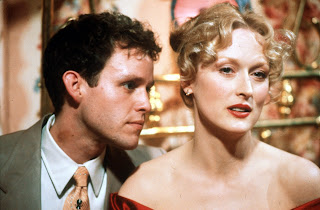
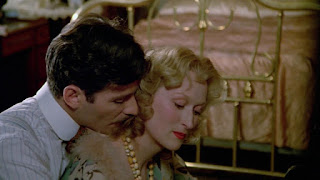
In the seaside English village of Lyme, American actress Anna (Meryl Streep) and English actor Mike (Jeremy Irons) have the leading roles in a movie production filming a Victorian love story. Anna and Mike start an affair, which mirrors the film's events.

In the Victorian narrative, Miss Sarah Woodruff (Streep) is a fallen woman, with a sullied reputation of having slept with a french lieutenant who promptly abandoned her. Charles Henry Smithson (Irons) is a palaeontologist looking for fossils in the area. He proposes marriage to Ernestina Freeman (Lynsey Baxter), the daughter of a wealthy industrialist.

But once Charles sets eyes on Sarah, he is immediately smitten. They start seeing each other in secret, with Charles determined to uncover her story. Sarah secures employment as secretary to the crusty Mrs. Poulteney (Patience Collier), while Charles starts to doubt his commitment to Ernestina. He seeks the counsel of Dr. Grogan (Leo McKern) to better understand Sarah's melancholic state.

An adaptation of the John Fowles book with a script by Harold Painter, The French Lieutenant's Woman is successful at coherently capturing two separate but related tales of illicit passion. Director Karel Reisz deftly weaves Anna and Mike's modern-day affair through the more dominant Victorian-set story, and within 127 minutes both are rounded into viable dramas.

Despite the high quality production values, the pacing is slow and creeps into ponderous, even with twin stories competing for screen time. Several scenes in the Victorian story line add little to the narrative and could have been trimmed. But while the clocks tick slowly, the visual beauty is opulent. The cinematography by Freddie Francis is lush and lively, with plenty of outdoor filming animating a rustic rural England with rich greenery, vibrant town streets, and a wind-swept sea-side.

Although both couples grapple with the intensity of uncontrolled lust, unfortunately none of the four central characters emerge with credit, undermining the level of possible engagement. Sarah discloses little that can be trusted, and she emerges as primarily manipulative and happy to snare with victimhood. Charles is a prototypical weak male chasing after the image of distant beauty, willfully and woefully undermining all his future prospects. Anna and Mike fare worse, both of them shallow and looking for the on-set thrill with no rational plan for the post-filming future. 

While the characters are sometime infuriating and always less than empathetic, the performances are stellar. Meryl Streep excels in both roles, hiding thoughtful connivance behind tentative fragility as Sarah, and modernizing similar talents as Anna. Jeremy Irons is a perfect foil, love-struck and gullible in both eras.

The French Lieutenant's Woman exposes human frailties when love shrouds reason.The theme lacks inspiration, but is still presented with artistry.


All Ace Black Movie Blog reviews are here.

Friday, 18 February 2022

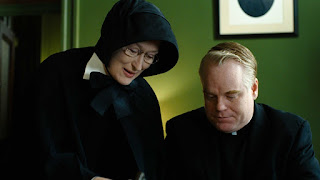
Movie Review: Doubt (2008)

A drama about possible misconduct involving a priest, Doubt boasts a talented cast but is firmly trapped in sterile stage origins.

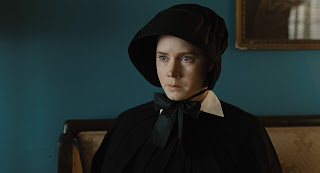
The setting is 1964 in the Bronx. At a Catholic church also serving as a school for the community, the stern and old-fashioned principal Sister Aloysius Beauvier (Meryl Streep) keeps a close watch on the children's behaviour. She also notices when Father Brendan Flynn (Philip Seymour Hoffman) delivers a sermon about doubt, and airs her thoughts to the younger Sister James (Amy Adams), the school's eighth grade history teacher.

Sister James then observes Flynn interacting, perhaps inappropriately but she is not quite sure, with the school's only black child, altar boy Donald Miller. She confides in Sister Beauvier, who decides to confront Flynn and accuse him of improper behaviour. He denies any wrongdoing. Sister Beauvier continues to investigate, and reaches out to the boy's mother Mrs. Miller (Viola Davis) to better understand his home environment.

Directed and written by John Patrick Shanley based on his play, Doubt is a series of verbal clashes all taking place in and around the Catholic school. Barely rising above the status of a filmed play, Doubt leans heavily on the Seriousness of the Topic and the star actors to salvage some level of cinematic drama.

Streep, Hoffman, Adams, and Davis (who gets just the one scene) step forward and offer their theatrical best, but it's not enough. Shanley endlessly circles the same drain of Beauvier having her doubts about Flynn's behaviour but not quite the evidence she needs, and so they spar, then spar again, and then spar some more, repeating the same couched accusations and the same offended denials. Her rage and his defensiveness both escalate, but the power dynamics are wayward and the words fail to spark.

Sister James and Mrs. Miller are relegated to side-characters and observers, their attitudes perhaps indicative of the era but still far from helpful. Sister James naively bends with the wind, and Mrs. Miller hints her son should tough it out and accept mistreatment as long as he graduates.

The running time is padded with irrelevant details from Sister James' classroom, featuring boys and girls trying to be boys and girls but stifled by rigid codes of conduct enforced with relish by Sister Beauvier.

Almost as a late afterthought Doubt works its way to the rot eating away at a Catholic church allowing serial offenders to thrive, and the futility of women speaking out against a centuries-old male-dominated hierarchy. The topic is of tragic importance, here fumbled into cold, static discourse.


All Ace Black Movie Blog reviews are here.

Saturday, 29 January 2022

Movie Review: Sophie's Choice (1982)

A dark drama and romance, Sophie's Choice mixes a story of an agitated friendship with the horrors of concentration camp survival. The overextended plot is enlivened by an outstanding Meryl Streep performance.

Two years after the end of World War Two, aspiring writer Stingo (Peter MacNicol) moves from the South to an apartment in Brooklyn. He meets his lively and loud upstairs neighbours, Polish immigrant Sophie Zawistowski (Streep) and her lover Nathan Landau (Kevin Kline), a Jewish biologist. The couple's relationship is tumultuous due to Nathan's wild mood swings and descents into fits of unwarranted jealousy.

Although she comes from a Catholic family, Sophie is a survivor of the Auschwitz Nazi concentration camp. After the war, Nathan and his brother, a doctor, helped her recover from malnutrition. As Stingo makes progress on his book, he develops a deep friendship bordering on love with both Sophie and Nathan. Gradually Sophie reveals her family's harrowing wartime experiences, while Stingo also discovers Nathan's secrets.

An adaptation of the book by William Styron directed by Alan J. Pakula, Sophie's Choice combines a troubled companionship triangle with heartrending flashbacks to wartime in Poland. The overarching theme addresses the far-reaching impacts of emotional and mental damage whether acknowledged or denied, the search for recovery and happiness buffeted by overwhelming dark forces.

The weighty subject matter does deserve considerate treatment, but the film clocks in at an inexcusable 151 minutes, and spends far too much time on the Brooklyn scenes. The pacing often slows to a crawl, Pakula conflating sombre moods with the need to overindulge. 

Fortunately the director is rescued by his leading actress. Meryl Streep delivers one of the most affecting performances in cinema's history, combining a Polish accent for the Brooklyn scenes with speaking in German for the flashbacks. But more critically, she conveys complex fragility and uses the faintest of expressions to hint at painful scars, omissions, and the lies Sophie has told herself just to survive. Whenever Streep is on the screen nothing else matters, her presence eradicating the plodding plot.

In his big screen debut, Kevin Kline is more broad as the erratic Nathan, full of vivacious energy and overrun by mood swings. Peter MacNicol is caught in the thankless narrator/observer/listener role, and predictably disappears into the wallpaper.

The revelations both past and present come tumbling out in the final hour, the scenes at Auschwitz soaring and hinting at the potential for a magnificent movie had the wartime events dominated. As it stands, the resonance of Sophie's experience is diluted by a barely-there backstory about her family and role as mother. Despite a yawning imbalance in narrative thrust, Sophie's Choice serves as a scintillating actress showcase, and a demonstration of a multi-generational talent in peak form.


All Ace Black Movie Blog reviews are here.

Monday, 3 January 2022

Movie Review: Don't Look Up (2021)

An end-of-the-world satire, Don't Look Up holds a mirror to a fractured society where imminent planetary annihilation is a topic of entertainment and debate.

At Michigan State University, astronomy doctoral student Kate Dibiasky (Jennifer Lawrence) discovers a new large comet, with a trajectory to strike and destroy Earth in 6 months. She alerts her Professor Dr. Randall Mindy (Leonardo DiCaprio), and they are soon connected with Dr. Teddy Oglethorpe (Rob Morgan), head of the Planetary Defense Coordination Office. They are granted an audience with US President Janie Orlean (Meryl Streep) and her Chief of Staff (and son) Jason (Jonah Hill), who don't take the threat seriously.

Randall and Kate take their story to the media, landing at the top-rated television show hosted by Brie (Cate Blanchett) and Jack (Tyler Perry). Brie's main takeaway is that Randall is a dishy scientist and she sets out to seduce him. Meanwhile the end-of-the-world threat starts to cause panic, but also political divisions, with the science being questioned. When powerful cellular phone and social media tycoon Peter Isherwell (Mark Rylance) announces the comet contains precious minerals worth trillions, attempts to destroy it are abandoned in favour of trying to exploit the riches, causing further divisions between sidelined scientists and power-hungry politicians.

Both the funniest thing and the scariest thing about Don't Look Up is that it's all too real. Sure, writer and director Adam McKay cannot resist triple-underlining some of his satirical jabs, but unlike in his previous outing, here the glib attitude is controlled and the hits well outnumber the misses.

The premise of a massive comet about to strike Earth may well be the next cataclysmic event facing humanity, but could also stand in for climate change, the next pandemic, or any other large casualty threat. With recent history as an excellent guide, the reactions portrayed in Don't Look Up are more than believable. Memes, ratings, personal attacks, personality cults, denial of science, obfuscation campaigns, political calculus, and profit motives overwhelm the simple truth, inflicting unnecessary death in large numbers.

In a manic example of cramming more as a representation of what counts as important, side-plots and intentional distractions litter the film, some funnier than others. Brie cannot wait to claim Randall as a sexual conquest, threatening his marriage to June (Melanie Lynskey). President Orlean is embroiled in an ever-worsening scandal related to her Supreme Court appointee (Erik Parillo). A politically incorrect pilot (Ron Perlman) leads the initial suicide mission to the comet. After being shunned by the world and having the comet named after her, Dibiasky befriends skater dude Yule (Timothée Chalamet). And most notably, pop star Riley Bina (Ariana Grande) is going through a romantic break-up and reconciliation, a story deemed much more important than the impending end of the world.

A dream cast sharpens all the satirical angles. Despite the abundant talent pool at his disposal, McKay finds meaningful and memorable roles for each, helped by the long 138 minutes of running time. Leonardo DiCaprio has fun as an anxiety-wracked scientist suddenly thrust into the spotlight and labeled an AILF (Astronomer I'd Like to F**k). Mark Rylance is the other stand-out as the truly creepy (no eye contact) tech tycoon holding all the true power, his line delivery a study in understated bludgeoning. Less successful is Jonah Hill as the nepotistic appointment who actually believes he is smart, his contributions rarely clicking.

Openly flirting with species-get-what-they-deserve resignation, Don't Look Up is depressingly funny. 


All Ace Black Movie Blog reviews are here.

Monday, 9 November 2020

Movie Review: Defending Your Life (1991)

A fantasy romance, comedy and drama, Defending Your Life offers a few original after-life ideas but fails to properly exploit the premise.

Los Angeles-based marketing executive Daniel Miller (Albert Brooks) dies in a car crash on his 39th birthday. He is transported to the idyllic campus setting of Judgment City where his life's actions will be evaluated to determine if he deserves to progress or be sent back for another round on Earth. He meets his lawyer Bob Diamond (Rip Torn) and prosecutor Lena Foster (Lee Grant), and learns that nine days of his life will be used as evidence to judge his maturity as measured by acting without fear.

As his case is progressing Daniel meets Julia (Meryl Streep), recently deceased by accidental drowning. They enjoy the perks of Judgment City together, including unlimited food with no weight gain, and quickly fall in love. But it is soon clear Julia has lived impeccably and will be progressing, while Daniel still has a lot to learn about living life to the fullest and will likely be consigned back to the drudgery of another terrestrial life.

Finding an interesting seam between religious dogma and existentialism, Defending Your Life creates a secular afterlife governed by the universe, offering progress towards the joys of larger brain utilization for promising candidates. The only punishment for underachievement is a do-over, and Daniel Miller learns he is, in fact, on his 20th go-round, and still has work to do.

But having gone to the trouble of creating an intriguing premise, writer and director Brooks undersells the concept and tacks on a very earth-like rom-com with all the associated cringiness. Life's accomplishments are reduced to the simplistic objective of acting without fear, and neither prosecutor Foster nor defendor Diamond appear convinced. The film's key hinge scenes, replaying and evaluating Daniel's critical days, are reduced to routine bland vignettes ultimately suggesting little of consequence.

The romance between Daniel and Julia is hustled along at celestial speed from initial meeting to expressions of deep love, the attraction between them based on little more than Meryl Streep's whimsical etheralism. To endear himself Daniel unleashes a stream of corny dialogue that by itself should rush-deliver him back to Earth for swift punishment. Julia is never provided a reason to fall in love, while Brooks skips over any explanations about the rules of post-death romance.

A steady current of mild humour is maintained, mostly drawn from secondary characters and the absurdities of the surroundings. But Brooks as an actor sleepwalks through the film with apathetic bemusement, and Streep delivers one of her least impactful roles, Julia drawn as an elusive ideal rather than a person.

Defending Your Life is tantalizingly close to being good, but surrenders to meek resolutions.


All Ace Black Blog Movie Reviews are here.

Saturday, 19 September 2020

Movie Review: Manhattan (1979)

An intellectual romantic comedy, Manhattan is writer-director Woody Allen's love letter to his borough. Multiple overlapping romantic entanglements among a small group of friends provide rich reflections on a complex city. 

Twice-divorced 42 year old Isaac Davis (Allen) lives in Manhattan and works as a writer for a low-brow live-audience television show. His current girlfriend is 17 year old student Tracy (Mariel Hemingway), and she is more invested in their relationship. Isaac's best friend Yale (Michael Murphy), a teacher, is married but having an affair with writer and editor Mary (Diane Keaton). Isaac and Mary initially clash, but gradually build a friendship.

Isaac learns his ex-wife Jill (Meryl Streep, on the cusp of stardom), who is now in a lesbian relationship, is writing a tell-all book exposing the sordid details of their marriage. He also has a meltdown at work and is forced to look for a new apartment. Then Yale breaks off the affair with Mary and Tracy secures a student position in London, clearing the way for Isaac and Mary to start a serious relationship, but their previous liaisons will linger.

Filmed in wispy black and white, Manhattan opens with a montage of New York cityscapes and Isaac narrating various iterations of self-definition through his impressions of the city. Allen (who co-wrote the script with Marshall Brickman) identifies his main character through the prism of the town's strengths and frustrations, and the film proceeds to tightly focus on a small group of friends navigating emotional ups and downs.

Many hookups and breakups occur during the course of 96 minutes, but Manhattan's beauty resides in the cloud-like narrative progression. Allen weaves the stories into a seamless fabric devoid of melodrama, milestones noted almost in passing through engrossing scenes of dialogue, the city an ever-present backdrop observer.

Allen's trademark neurotic self-obsession here extends to almost all the main characters (Tracy is the most grounded), and a layer of deprecating self-awareness is added to the pulsing anxiety. Isaac admits his problems are small in the overall global context, but personal angst is potentially manageable while the world's crises are not. Both Isaac and Mary are seeing shrinks, although her shrink may need his own better therapist. 

The lovers carry their emotional luggage, accumulated from previous broken marriages, in plain sight, and honesty is close to the surface throughout. Isaac is blunt with Tracy that their relationship has a short shelf life, while both Yale and Mary are mindful their affair is ridiculous and doomed to fail, and yet they are caught in a web of illicit love.

The group of friends exist in an isolated bubble of upper middle class bourgeois writers seemingly oblivious to any other social constructs. With rapidfire elite cultural references to the likes of Flaubert, Freud, Zelda Fitzgerald, Noel Coward, August Strindberg, Fellini, and Bergman, Allen rides a fine line between humour and altogether alienating a large chunk of his audience.

But Manhattan ultimately draws down the curtain on 1970s portrayals of New York. The dangerous, dirty and downbeat city of the past cinematic decade is eased out, replaced with art galleries and museums, a safe Central Park, the Russian Tea Room, elite cocktail gatherings and the glorious Queensboro Bridge at sunrise. Inspired by the optimistic tunes of George Gershwin, the city is set to reinvent itself for a new decade, marked by the red heart of those who choose to love it.


All Ace Black Blog Movie Reviews are here.

Monday, 20 January 2020

Movie Review: Little Women (2019)


An adaptation of the classic Louisa May Alcott book, Little Women is a coming-of-age tale with a focus on women carving out identities while grappling with personal and societal expectations and economic realities.

The film unfolds non-linearly across multiple time zones and locations. In simplified form, the March sisters are from a relatively poor Concord, Massachusetts family and growing up in the shadow of the Civil War. Jo (Saoirse Ronan) is fiercely independent and an aspiring writer. Meg (Emma Watson) loves acting and is a romantic at heart. Amy (Florence Pugh) is a painter and wants to marry well. The youngest Beth (Eliza Scanlen) is a talented pianist. With their father (Bob Odenkirk) serving in the war, Marmee (Laura Dern) instills in the girls a strong sense of service and selflessness.

The Marchs are neighbours of the wealthy and kind Mr. Laurence (Chris Cooper), whose grandson Theodore (Timothée Chalamet) becomes friends with the sisters and falls in love with Jo. She sets out to seek her fortune as a writer in New York, where she meets publisher Mr. Dashwood (Tracy Letts) and clashes with academic Friedrich Bhaer (Louis Garrel). Amy heads to Paris for a cultural trip with Aunt March (Meryl Streep). Meg marries a struggling tutor and starts a family. But a sickness will pull the sisters back home to confront unexpected futures.

The sixth cinematic adaptation of Alcott's novel, the 2019 version is a sprawling and ambitious effort infused with a feminist edge. Clocking in at an overlong 135 minutes, writer and director Greta Gerwig takes her time to fully define the four sisters as rounded characters, and chases down their dreams, trials and tribulations on the path to womanhood. Along the way the sisters bicker, fight and support each other, all underpinned by warm foundations of familial love.


Gerwig structures the film as a dizzying jumping exercise, restlessly bouncing between various points of history in the lives of the four sisters. As a result Little Women rarely flows, some scenes spending a matter of seconds in one time and place before the next scene leaps to somewhere else with someone else at a different time.

But the fine work of the talented cast and the investment in characters does pay off in the final third, where the sometimes scattered narrative puzzle pieces start to come together. The film achieves poignant peaks of genuine emotion built on the discrete strengths and weaknesses of the March sisters, and Gerwig presents a satisfyingly wide array of personal achievements mixed with shades of disappointments, all built on honest passion.

While the emphasis on feminism is sometimes speechy and jarring, here it means the freedom to choose a future vision to pursue, and to defend that choice. And while no two dreams are alike, the sisters pragmatically understand their future, like their past, involves compromise and is not meant to be perfect. Gerwig also places admirable emphasis on economics as an essential part of future plans. Balancing the romantic pursuit of love, marriage's role as an economic benefit emerges as a theme.

Little Women enjoys stellar production design, the film recreating interiors and exteriors of the mid to late 1800s with an easy sense of place and time. This is a period piece unafraid to march into the open, as the March sisters stride into a post-war world with every intention to help define it.


All Ace Black Blog Movie Reviews are here.