Showing posts with label John Lithgow. Show all posts

Saturday, 13 September 2025

Movie Review: Silent Fall (1994)


Genre: Crime Mystery  
Director: Bruce Beresford  
Starring: Richard Dreyfuss, Linda Hamilton, Liv Tyler, J.T. Walsh, John Lithgow  
Running Time: 101 minutes  

Synopsis: Autistic and incommunicative 9 year-old child Tim Warden (Ben Faulkner) witnesses the brutal stabbing double-murder of his wealthy parents. Therapist Dr. Jake Rainer (Richard Dreyfuss) has a checkered history working with autistic children, and is persuaded by Sheriff Mitch Rivers (J.T. Walsh) to try and unlock what Tim witnessed. Tim's older sister Sylvie (Liv Tyler) helps Jake gain the child's confidence, while Jake's wife Karen (Linda Hamilton) and his rival Dr. Rene Harlinger (John Lithgow) also influence his involvement.

What Works Well: The premise of a child witnessing a murder is intriguing (and has been seen before), and director Bruce Beresford adds gloss to the impressive-looking suburban estate settings. Richard Dreyfuss is never less than committed to the role, and Dr. Rainer is provided with just enough background context to keep him interesting. J.T. Walsh and John Lithgow provide good support.

What Does Not Work As Well: After a robust opening, a murder that would have shocked the community is somehow marginalized and the plotting settles down to overly laid-back beats, Dr. Rainer designated by the script as the only person who can get into Tim's head. Every opportunity to show rather than tell is studiously avoided in a mystery that lacks suspects, suspense, and detective work. Not surprisingly, the outcome is easy to guess, notwithstanding late-in-the-day revelations. Linda Hamilton as the nagging wife is unfortunately wasted.

Key Quote:
Jake (to the incommunicative Tim): What are you seeing in there?


All Ace Black Movie Blog reviews are here.

Sunday, 9 March 2025

Movie Review: Conclave (2024)


Genre: Drama  
Director: Edward Berger  
Starring: Ralph Fiennes, Stanley Tucci, John Lithgow, Isabella Rossellini  
Running Time: 120 minutes  

Synopsis: When the pope dies, Dean of Cardinals Thomas Lawrence (Ralph Fiennes) is entrusted with organizing the election of a successor. The frontrunners include liberal Cardinal Aldo Bellini (Stanley Tucci), Cardinal Adeyemi who may become the first black pope, the conservative Cardinal Tedesco, and the politically savvy Cardinal Tremblay (John Lithgow). The arrival of the hitherto unknown and sanguine Cardinal Benitez of Kabul causes a stir, and when the early voting rounds prove inconclusive, Lawrence has to manage startling revelations that may impact the outcome. 

What Works Well: The stellar cast exudes quiet quality, and the exemplary set designs (recreating the Vatican with artistic license) and costumes establish an elegant backdrop for a heady mixture of global power, personal ambition, and the weight of history. Compelling dramatic themes emerge from the internecine conflict between liberal and progressive values colliding with the fallibility of men held to impossible standards. Muscular music adds considerable thump to the stark political intrigue.

What Does Not Work As Well: The sophisticated ambience is let down by simplistic plotting, which degenerates into sordid scandal-of-the-day expositions. Peter Straughan's script surrenders to unworthy amateur detective exploits as revelations about an illegitimate love child, money-for-votes corruption, and secret medical histories disrupt proceedings. The cardinals demonstrate naked ambition, short tempers, and back-stabbing behaviour worthy of neophyte local politicians, while a terrorist sub-plot adds nothing of relevance. 

Key Quote:
Cardinal Benitez: The church is not the past. It is what we do next.


All Ace Black Movie Blog reviews are here.

Saturday, 6 January 2024

Movie Review: 2010: The Year We Make Contact (1984)


Genre: Science Fiction Drama 
Director: Peter Hyams 
Starring: Roy Scheider, Helen Mirren, John Lithgow, Bob Balaban, Keir Dullea 
Running Time: 116 minutes 

Synopsis: Nine years after the spaceship Discovery inexplicably malfunctioned near Jupiter, Dr. Heywood Floyd (Roy Scheider) joins the Leonov Soviet mission to uncover what happened. He is accompanied by American scientists Curnow (John Lithgow) and Chandra (Bob Balaban), while the Leonov is commanded by Tanya Kirbuk (Helen Mirren). Once near Jupiter, they detect organic signals from the moon Europa, and Floyd starts to understand what happened to Discovery's commander David Bowman (Keir Dullea) and its on-board computer system HAL 9000 (voice of Douglas Rain). Back on Earth, a geopolitical conflict threatens to erupt into a catastrophic war.

What Works Well: The adaptation of Arthur C. Clarke's sequel book stands on its own merits, with slick special effects, a strong cast, a sense of purpose, and extrapolated Cold War tensions spilling into space. Director and writer Peter Hyams keeps the sci-fi drama more traditionally approachable and less mystical, and does well in building tension through compact episodes towards an existential final act. Keir Dullea reprises the role of Bowman through brief but essential interventions, and HAL 9000 earns a poignant artificial intelligence arch.

What Does Not Work As Well: The exclamatory final message borders on hokey, and although cerebral, 2010 never threatens to reach the inspirational levels of 2001.

Conclusion: A proficient nuts and bolts underpinning for a space opus.


All Ace Black Movie Blog reviews are here.

Thursday, 14 May 2020

Movie Review: The Is 40 (2012)


A slice-of-life raunchy comedy, The Is 40 is a cluttered but often hilarious adventure through the chaos and confusion of life's middle phase.

Married couple Pete and Debbie (Paul Rudd and Leslie Mann) are both celebrating their 40th birthdays in the same week. While he is laid back and inattentive, she is having trouble accepting the reality of middle age. They are dealing with the stress of raising two girls, 13 year old Sadie and 8 year old Charlotte (Maude and Iris Apatow), plus the potential financial collapse of Pete's independent music label business and thousands of dollars in missing revenue from Debbie's small boutique.

Pete's father Larry (Albert Brooks) is a financial drain, while Debbie's dad Oliver (John Lithgow) is cold and distant. But most of all the couple now mostly antagonize each other. The sexual spark is gone, he resents her secret smoking habit, she despises his inability to control his cupcake intake, and they can rarely have a moment alone together. With their arguments getting louder and more frequent and impacting the happiness of their daughters, the marriage approaches a breaking point.

With co-producer, director and writer Judd Apatow zooming into his forties, married to Mann and raising the two daughters featured in the movie, This Is 40 is a family affair. The heartfelt albeit amplified exploration of the stresses and strains of kids, parents, finances and careers experienced by the sandwich generation creates fertile ground for pointed adult humour. In search of the big laughs (often found) the film does focus more on rub points and irritations, although Apatow does provide Pete and Debbie with one idyllic sequence at a holiday resort where they rediscover each other free of all externalities.

This Is 40 sprawls out to 133 minutes, and Apatow is almost right in thinking all his ideas are good ideas, but many of them are also irrelevant sideshows. The rampant improvised dialogue often hits the mark, and is therefore allowed to run, prolonging many scenes. Melissa McCarthy shows up for an extended sequence as a rival mother at Sadie's high school. It's a hilarious foul-mouthed turn, but almost unrelated to the rest of the film. Megan Fox also gets plenty of screen time as the suspiciously wealthy enchantress salesperson at Debbie's boutique in a sideplot about employee theft that steers towards a cul-de-sac.

Albert Brooks and John Lithgow are heavyweight support players, and so both get their share of screentime, earned or not. Jason Segel also pops up in a small role as a physical trainer. But obvious mid-age flab emerges in the repetitive arguments between Pete and Debbie, the two verbally sparring in every other scene of the film's second half, often circling the same ground with new versions of the same insults as Sadie joins them in tedious three-way screaming matches.

Paul Rudd is dependable, but Leslie Mann is brilliant. In a sparkling comedic performance riding the sharp edge between exasperation and self-deprecation, Mann sets the film's tone and grabs hold of a woman's disproportionate responsibility in setting a household's pulse. With Pete often hiding in the bathroom or avoiding his responsibilities altogether, Debbie, almost despite herself, embraces the challenge of making 40 work, a mission both seemingly impossible and fraught with zingers.


All Ace Black Blog Movie Reviews are here.


Sunday, 5 January 2020

Movie Review: Bombshell (2019)


A drama based on the true story of women fighting back against a lecherous media boss, Bombshell features excellent performances but a fragmented narrative.

In 2015 Fox News television star anchor Megyn Kelly (Charlize Theron) becomes a household name for all the wrong reasons when she tangles with Republican Party presidential nominee Donald Trump. Meanwhile afternoon show host Gretchen Carlson (Nicole Kidman) is collecting evidence and planning to sue Fox News CEO Roger Ailes (John Lithgow) for sexual harassment after he demotes her to a less favourable viewing spot for refusing his advances.

Young, attractive and ambitious Kayla Pospisil (Margot Robbie) leaves Carlson's team to join the higher profile Bill O'Reilly show, and soon catches Ailes' eye. He subjects her to humiliating harassment with a promise of career advancement. Carlson is finally fired and launches her lawsuit, throwing the network into turmoil. Her legal team is desperate for other women to step forward and share their harassment stories, with Megyn's refusal to publicly support Ailes causing shockwaves.

Roger Ailes' dismissal was an early milestone just in advance of the #metoo era, and Bombshell goes inside the inner sanctum of Fox News to recreate events leading up to his downfall. Writer Charles Randolph and director Jay Roach focus on the courage of three women, real-life anchors Kelly and Carlson, with Kayla representing an amalgamation of other employees.

The film is polished, inspiring and disjointed. The three women barely share any screen time together, their struggles representing loosely connected but quite separate chapters. Their stories ultimately converge to help shine a light on the truth, but this power in numbers remains primarily off-screen.

While Carlson's lawsuit was the trigger event leading to Ailes downfall, her story gets the least amount of screen time, and Kidman is often reduced to a secondary presence. In contrast Charlize Theron is most prominent and coldly efficient as Kelly. Her early clash with Donald Trump and subsequent media storm was an early sign of the candidate's unorthodox and unfiltered approach, but is ultimately tangential to Bombshell's central theme. Theron shines late in the film, as the implications of revealing (or not) Kelly's truth start to weigh on her shoulders.

Kayla depicts every enthusiastic young woman caught in shark-infested waters without a sturdy raft. With Margot Robbie in sensational form, she emerges as the heart and soul of the film, the next generation of women paying the price for debauchers maintaining their hold on power for far too long.

Roach paints a vivid picture of rampant sexism at Fox News, where women were routinely objectified and pressured into wearing leg-revealing outfits. Rumours of "leg cameras", transparent anchor tables as a tactic to attract gawking viewers, and private elevators to Ailes' office swirled through the hallways.

The downfall of men who sexually exploited women was an overdue workplace revolution, and Bombshell is a genuine if not cinematically spectacular salute to the brave women who helped make it happen.


All Ace Black Blog Movie Reviews are here.


Monday, 22 April 2019

Movie Review: Pet Sematary (2019)


A horror film about meddling with life after death, Pet Sematary offers chilling ambiance but is over-reliant on traditional jump scares.

In search of a slower pace and more family time, Dr. Louis Creed (Jason Clarke) relocates his life from Boston to rural Maine. His wife Rachel (Amy Seimetz), nine year old daughter Ellie (Jeté Laurence) and infant son Gage are initially happy with the transition, although the massive trucks speeding along the nearby country road are disconcerting. Rachel harbours deep guilt from childhood over the gruesome death of her sister. Her mood is not improved when the family discover a spooky pet cemetery in the woods behind their new home.

Meanwhile, Louis starts work at a local clinic and experiences a disturbing incident when a young man dies violently but appears to haunt Louis with talk of calamities to come. When Ellie's pet cat Church expires, grizzled neighbour Jud (John Lithgow) guides Louis to haunted grounds beyond the cemetery where whatever is buried comes back alive. Louis takes a chance to try and bring Church to life, starting a violent chain of unintended consequences.

The 1983 Stephen King novel was first adapted to the screen in 1989. Thirty years later, co-directors Kevin Kölsch and Dennis Widmyer working from a Jeff Buhler script recreate King's vision of a forbidden yet tempting place where willing humans have the ability to experiment with regenerating life. The film is effective in creating a bleak mood with death haunting the family's past and present. A steady start introduces the family dynamics and their ominous new surroundings, and once Lewis' patient dies quickly followed by Ellie's cat, the second half offers a tightening grip of unrelenting horror.

Pet Sematary delves into themes of persistent guilt casting a lifelong shadow. Rachel blames herself for the traumatic death of her deformed sister at a young age, an incident replayed and leveraged by Kölsch and Widmyer to good effect. Back in the present Lewis is overwhelmed with guilt when things start going wrong for the family he relocated to new surroundings, increasing the dark appeal of meddling with nature in a desperate attempt to set things right.

And the film does find a focus on the intoxicating magnetism of controlling life and death. Jud is honest about the inexorable pull of the haunted soils. The ramifications of meddling with the dead are not all good, and yet the enormous power to reinstate life cannot be resisted, especially when combined with human emotional failings and the medical imperative to save lives even when all seems lost.

While the story offers plenty of opportunities for interpretation, on the screen Kölsch and Widmyer resort to relatively safe and traditional genre elements. Things go bump in the night, doors creek, the wind howls, and intimidating creatures make sudden appearances from the shadows. It's all reasonably effective, but also quite predictable.

Pet Sematary may not break much new ground, but does place a worthwhile marker in familiar territory.


All Ace Black Blog Movie Reviews are here.


Thursday, 19 July 2018

Movie Review: Miss Sloane (2016)


A spirited political thriller, Miss Sloane boasts a phenomenal Jessica Chastain performance and a rewarding plot.

In Washington DC, high-powered lobbyist Elizabeth Sloane (Chastain) is dragged in front of a congressional hearing presided over by Senator Sperling (John Lithgow) investigating allegations of unlawful influence peddling. In flashback, the events of the prior three months are revealed. Sloane is the star lobbyist at the firm of Cole Kravitz & Waterman managed by George Dupont (Sam Waterston), currently working for Indonesian interests to oppose a proposed palm oil tax bill.

She refuses an assignment by the gun lobby, represented by Bill Sanford (Chuck Shamata), to oppose a pending gun control bill. Instead, she defects to the smaller firm of Peterson Wyatt, run by Rodolfo Schmidt (Mark Strong), to lobby for the legislation and takes half her team with her, although loyal researcher Jane Molloy (Alison Pill) refuses to join the exodus. Despite being massively outspent, Sloane's team make progress in securing congressional votes. Team member Esme Manucharian (Gugu Mbatha-Raw), herself a victim of gun violence, emerges as an eloquent spokesperson. In desperation, Dupont and Sanford launch a smear campaign targeting Sloane's reputation.

Directed by John Madden, Miss Sloane is an electrifying talkfest. Thanks to a gripping Jonathan Perera script, this is a remarkably taut story centred on a captivating character who redefines what it means to be highly-strung. The 132 minutes of drama whiz by effortlessly, Madden building up an irresistible head of steam with a classic David versus Goliath battle for control of the soul of Congress over one of the most heated issues in American politics.

Elizabeth Sloane is one of the most compelling women to command a movie. Addicted to psychotic drugs that keep her awake, she works 16 hours a day, thinks and talks twice as fast as everyone else, and runs laps around her opponents. She also does not hesitate to use and hurt people close to her, abuses the trust of others, and leads a lonely life that includes hiring male prostitutes to emotionlessly satisfy her sexual desires. Ironically, her latest gigolo Forde (Jake Lacy) gets closest to cajoling personal thoughts out of her overactive mind. Chastain gives the performance of her life, and is never better than when fine cracks finally start to appear in Sloane's seemingly impenetrable armour.

And Perera surrounds Sloane with plenty of worthwhile allies and enemies. Esme Manucharian blossoms from behind-the-desk researcher to media star under Sloane's tutelage, but the master lobbyist still has other plans for her young protégé. Rodolfo Schmidt thinks he knows what he is doing when he hires Sloane, but is soon barely hanging on as she rumbles through his firm like a tornado. And Jane Molloy, who stays at the slick firm of Cole Kravitz & Waterman to battle against the gun control bill, finally has a chance to emerge from Sloane's shadow and create her own legacy.

Multiple story lines are nurtured, developed and brought together in the film's final third. The proposed tax on Indonesia palm oil, the gun control bill, the campaign to sully Sloane's reputation, the bitter battle between firms, and Sloane's own crystallizing view of her personal morality come together in a stunning climax. Miss Sloane plays a high stakes game in the unforgiving political arena, where both the strategic maneuvering and the price to be paid are spectacular.


All Ace Black Blog Movie Reviews are here.


Saturday, 2 June 2018

Movie Review: Beatriz At Dinner (2017)


A social drama, Beatriz At Dinner sets up interesting conversational pieces but leaves them dangling.

In Los Angeles, Beatriz (Salma Hayek) is a natural healer and massage therapist, working at a cancer treatment clinic. She is depressed because her pet goat was recently killed by a neighbour. One afternoon Beatriz drive to the swanky home of her client Kathy (Connie Britton) to provide a massage ahead of Kathy's small dinner party. Beatriz's car fails to restart and she is invited to stay for dinner, where the guest of honour is business tycoon Doug Strutt (John Lithgow). 

Beatriz and Doug immediately clash. He looks down on her immigrant roots, and she senses that he is a heartless developer with little regard for the wellbeing of the communities where he builds his hotels and shopping centres. When Beatriz learns that Doug also enjoys big-game hunting she snaps, and the evening takes a turn towards open hostility.

Directed by Miguel Arteta and written by Mike White, Beatriz At Dinner fearlessly takes a seat at the table where societal divisions are laid bare. The front lines where tensions simmer between poor and rich, Hispanics and whites, recent immigrants and less recent colonialists, animal loving vegetarians and animal killing meat eaters, spiritualists and capitalists are all represented by Beatriz's reluctant invasion of Kathy's party. Doug embodies the source of all the ills Beatriz struggles daily to heal, and this is one dinner party where she will call out her demons, pleasantries be damned.

Despite an intense Salma Hayek performance and a suitably smug turn by John Lithgow, the film stalls once it makes its points. Arteta and White struggle to steer the film towards a satisfying ending, and indeed they try a few different iterations on for size. Eventually Beatriz At Dinner settles for abstract visuals and pretty pictures of floating lanterns and water, where meaning is imagined rather than conveyed.

The brief 83 minutes of running time betray an inability to flesh out any of the supporting characters, with Connie Britton, Chloë Sevigny, Jay Duplass, Amy Landecker and David Warshofsky sacrificed to make up the numbers and confined to the shallowest of backgrounds.

Beatriz At Dinner serves up a few deliciously awkward moments of social tension, but the desert is no more than mediocre.


All Ace Black Blog Movie Reviews are here.


Monday, 1 January 2018

Movie Review: Harry And The Hendersons (1987)


A family-oriented fantasy comedy with some dramatic elements, Harry And The Hendersons carries an environment-friendly message in a fun and frantic package featuring a lovable monster.

Amateur hunter George Henderson (John Lithgow), his wife Nancy (Melinda Dillon) and their kids are on a family trip in the Northwest wilderness when they inadvertently strike a Big Foot-like creature with their car. Thinking that the oversized animal is dead they transport him back home to Seattle. But Big Foot (actor Kevin Peter Hall as the suit performer) is very much alive. He wakes up and unleashes chaos and destruction on the family home, before settling down and developing an affinity towards the family.

The Hendersons name their new houseguest Harry. He demonstrates caring emotions and proves to be a vegetarian and lover of animals, and his empathy rubs off on George. Meanwhile obsessed big game hunter Jacques LaFleur (David Suchet) and cranky academic turned crappy museum curator Dr. Wallace Wrightwood (Don Ameche) are desperately searching for Harry and closing in on the Hendersons. When Harry goes loose in Seattle, George has to find a way to save his new friend and restore order to his household.

Directed by William Dear, Harry And The Hendersons is a lightweight but enjoyable variation on E.T. This time it's the mythical Big Foot that proves to be more friendly pet than alien threat, but otherwise the same primary theme of learning to live together despite (huge, in this case) superficial differences dominates Harry.

Dear also co-wrote the script, and it tilts towards some broad slapstick comedy, as well as a more clearly defined villain in the form of dogged hunter LaFleur. But as usual the more interesting quests are the quiet ones, and George's transformative journey is what ultimately matters. He starts the film as an avid hunter teaching his young son all about guns and killing animals. Along with his vegetarianism Harry's reaction to all the stuffed animals on the family walls is an alternative view of nature, nudging George towards a change of heart.

Harry And The Henderson is aided by a terrific Rick Baker monster creation. With his expressive face and lumbering stance, it's easy to develop affection towards Harry. Big Foot creates his own mischievous personality and helps carry the film over it's rather saggy midsection.

The performances are what can be expected in a relatively modest family entertainment package. Overacting is the flavour of the day from all involved, and the lack of nuance sometimes lowers the enjoyment level to sitcom standards. Not surprisingly, the film did spawn a television series.

Staying well within modest ambitions, Harry And The Hendersons is happy, harmless and hairy fun.


All Ace Black Blog Movie Reviews are here.


Sunday, 6 November 2016

Movie Review: Kinsey (2004)


A biographical drama about the scientist who revolutionized the understanding of sexuality, Kinsey treats its subject with well-rounded respect, revealing the man's determination and faults. The film is an efficient recounting of a unique career, suffering only slightly from some character repetitiveness.

At Indiana University in the 1930s, insect researcher Professor Al Kinsey develops an interest in researching human sexuality. In flashback, Kinsey's background is revealed. Born to a strict father (John Lithgow), Kinsey refuses to follow the path of engineering and chooses biology instead. He pursues an interest in the migration and evolution of gall wasps, and meets and marries Clara McMillen (Laura Linney). His early sexual experiences with his wife as well as his bisexuality contribute to his curiosity about human sexuality as a science. The current texts in circulation are religious and moralistic nonsense disguised as fact.

Kinsey recruits his students including Clyde Martin (Peter Sarsgaard), Wardell Pomeroy (Chris O'Donnell) and Paul Gebhard (Timothy Hutton) to form the core of a research team. Supported by university president Herman Wells (Oliver Platt) and funded by the Rockefeller Foundation represented by Alan Gregg (Dylan Baker), Kinsey and his researchers fan out across the country interviewing thousands. The research findings, first published in the late 1940s, shake the foundations of American society. The former insect professor becomes a celebrity and household name. But a backlash also awaits, and Kinsey's singular obsession with the pure science of sexuality takes a personal and professional toll.

Directed and written by Bill Condon, Kinsey clocks in at under two hours and wastes no time on padding. This is a disciplined, focused film, stylishly divulging the man, the mission and the consequences. Enough background is added to create context without getting lost in side quests. Condon captures the clever simplicity of Kinsey's observational and interview methods, and then the ground shift of awakening unleashed by the resultant research.

Al Kinsey is presented as a visionary, a pioneer and a flawed man, inheriting a lot of more from his intolerable father than he wishes to admit. The scenes of Kinsey's early life are interspersed throughout the film with a light touch, colouring childhood influences in subtle shades. Kinsey the adult becomes dogmatic about his science the way his father was about his brand of religion. After demonstrating a propensity for diving deeply into a narrow topic with his improbable gall wasp obsession, he locks onto sexuality as pure science, reducing human intercourse to a subject stripped of emotional, psychological or societal resonance.

Liam Neeson contributes to the film's appeal, owning the role and settling quickly to embody the scientist as beady-eyed, stubborn and sure of his stance as others recoil in shock when the covers are thrown off to reveal exactly what is going on in the national bedroom. Neeson's intensity helps to ride out the more repetitious scenes, Condon overemphasizing his main character's obtusely stubborn traits. Laura Linney excels as his wife Clara "Mac" McMillan, first astounded by her husband's liberal views of sexuality and then embracing what freedom may mean to her and her marriage. Peter Sarsgaard as Clyde Martin is the most prominent of the researchers who bring Kinsey's research methods to life both professionally and personally.

Kinsey emerges as a dispassionately cold proponent of understanding human coupling for the sake of reckless exploration and personal satisfaction, and eventually pushes too hard and too fast. For all the good that the research achieved, this is a story of the quixotic renegade shoving society two steps forward but one step very much backwards: support seeps away, damage is caused within the team, and a shocked nation reaches the point of too much information. Scientific advancement can be a messy and imperfect path.


All Ace Black Blog Movie Reviews are here.


Tuesday, 18 October 2016

Movie Review: The Accountant (2016)


An action thriller with a rich story and plenty of style, The Accountant is an intelligent and inventive addition to the genre.

Department of Treasury Agent Ray King (J.K. Simmons) recruits analyst Marybeth Medina (Cynthia Addai-Robinson) to dig into a mysterious accountant who appears to have ties with some of the world's worst criminals. Now going under the name Chris Wolff (Ben Affleck), the accountant is a mathematical savant with a high functioning form of autism. He leads a double life as a nondescript local store-front accountant while surreptitiously traveling the world and working for shady clients with major financial secrets to hide.

As Medina digs into the accountant's mysterious identity and background, Wolff's next assignment is a legitimate forensic audit of a large Chicago-based robotics company headed by Lamar Blackburn (John Lithgow), where junior accountant Dana Cummings (Anna Kendrick) has accidentally stumbled upon financial irregularities. Wolff uncovers a dangerous and well-hidden secret that triggers a round of brutal violence leaving him and Dana in mortal danger from a well-armed hit squad, while Medina unearths more twists in Wolff's past.

Directed by Gavin O'Connor and written by Bill Dubuque, The Accountant surprises with a crisp introduction of a new screen action hero. With tired sequels, reboots and comic book adaptations flailing and failing to gain traction, credit to the The Accountant for venturing into original territory. The concept of an autistic mathematical genius as a conflicted protagonist, capable of untangling dense annual financial statements and disposing of ruthless killers with equal effectiveness, is a breath of fresh air. Far from a clean-cut hero, the accountant holds morally ambiguous ground, helping dubious clients while toiling towards difficult to discern ulterior motives.

The film's pacing and construction is also commendable. O'Connor displays remarkable patience, allowing the rich story to unfurl its various sails in an intriguing first hour. There are several flashbacks, some to Wolff's childhood, others to a bloody massacre at a mafia hideout, and still others to a prison stint. The exploits of Agent King and analyst Medina run in parallel with Wolff's latest investigation into the robotics company, and only deep into the film do all the pieces start to fit together, and even then there are more clever surprises to come. When the puzzle picture starts to take shape, it's a satisfyingly elegant mosaic, and a sturdy foundation on which to build a franchise.

The Accountant is weakest when it mimics routine action flicks, and does suffer from one over-the-top combat scene, a prolonged one-against-many home invasion that could have been extracted from any Jason Bourne movie. But most of the 128 minutes of running time are preoccupied with more intelligent fare, and the accountant's uncovering of financial deviousness is more thrilling than any conventional gun play. Even more captivating is his agony when his forensic work is interrupted: this is man who absolutely needs to see every task through to full completion, and can mentally fall off a dark edge in the pragmatic world of enough is enough.

Chris Wolff is an almost perfect role for Ben Affleck. Inexpressive, introspective, alone and with a lumbering gait, the actor does not need to stretch much. The supporting cast is good but predictable, Kendrick at 31 years old still able to pull off the ingenue trick, J.K. Simmons extracting maximum gruffness out of Agent King while Addai-Robinson gets a role with depth and potential as the analyst with a dark past of her own. Jon Bernthal makes for a handsome but lethal leader of an intimidation and murder squad.

Both smart and stirring, The Accountant's pen and sword are equally mighty.


All Ace Black Blog Movie Reviews are here.


Tuesday, 9 June 2015

Movie Review: The Homesman (2014)


A pretty-to-look-at western exploring themes of survival within the desolation of frontier territory, The Homesman offers a relatively original premise and a unique perspective, but otherwise gets bogged down in lengthy stretches devoid of meaningful progression.

In the tiny western town of Loup City in the Nebraska Territory, Mary Bee Cuddy (Hilary Swank) is a wealthy single woman, looking after a homestead all by herself and still hoping to attract a husband. But her plain looks and bossy personality keep any potential suitors well away. After a long and severe winter, three married women from the small local community exhibit signs of severe mental instability due to child loss, abuse and isolation. After a plea from Reverend Dowd (John Lithgow), Mary Bee is the only person who volunteers to accompany the women on a grueling five week wagon journey to the much larger community of Hebron, Iowa, where a church can offer some medical care.

At the start of the trip Mary Bee saves the life of a grizzled loner who calls himself George Briggs (Tommy Lee Jones), and tempts him with money to accompany her. He reluctantly agrees, they pick up the sick women and set off into the wilderness. Along the way they will encounter hostile Indians and bandits, with their non-communicative, irrational and sometimes hostile patients further complicating an already difficult trek.

Directed by Jones and adapted from the book by Glendon Swarthout, The Homesman offers a rare women's view of the west. Unfolding at a slow and deliberate pace, the film presents the frontier as unforgiving and arduous, a place where women are pushed to the limits of endurance, often shouldering the full load of housekeeping, parenting and crop-tending and striving to meet the unrealistic expectations of the rough men they call husbands and fathers.

The prevailing theme is rampant emotional damage, with all the main characters in The Homesman long-term casualties of the survival grind. The men do suffer, but use sadistic or violent behaviour as an outlet. The women are only able to absorb so much before aging fast and folding within themselves. While the three wives who have psychologically collapsed can no longer conceal the trauma, Mary Bee is also battling roaring demons fed by loneliness, rejection and despair, and waiting to emerge at a time of their choosing.

As a viewing experience, The Homesman struggles to offer much beyond its relatively unique perspective. The flashbacks used to provide context around the sick wives' traumas are muddled and insufficient to draw them out as characters. Mary Bee's cargo therefore remains impersonal, and the entire film hinges on the relationship between her and George. The tension between a determined and desperate woman and a frontiersman well past caring about anything other than the money in his pocket does provide a decent narrative foundation. But rather than evolve over the course of the journey, they will both simply reveal more of their true selves, and the film settles for being an examination of two people choosing different paths to cope with the rigours of the wild west.

The film is visually beautiful, Jones and his cinematographer Rodrigo Prieto taking their time with plenty of open vista shots of an untamed west coloured by exquisite sunsets, Mary Bee's slow-moving wagon incongruously making its way through stunning but hostile and rarely traveled terrain.

In the two central roles Swank and Jones do not disappoint, and deliver solemn performances filled with the pain of past mistakes and the uncertainty of the present. In addition to Lithgow, the supporting cast also includes James Spader as a land developer who tangles with George, and a brief, late appearance by Meryl Streep, a city dweller whose calm presence provides a sharp contrast between the struggles in the territories and the relative comforts afforded in established larger communities.

The Homesman offers a journey that travels at the speed of two mules pulling a heavy wagon. It's not always graceful, but it does move ahead stubbornly, on its own terms.


All Ace Black Blog Movie Reviews are here.


Monday, 25 May 2015

Movie Review: Terms Of Endearment (1983)


A family life drama-comedy with spectacular acting performances by a dream cast, Terms Of Endearment is a masterpiece of authentic emotions.

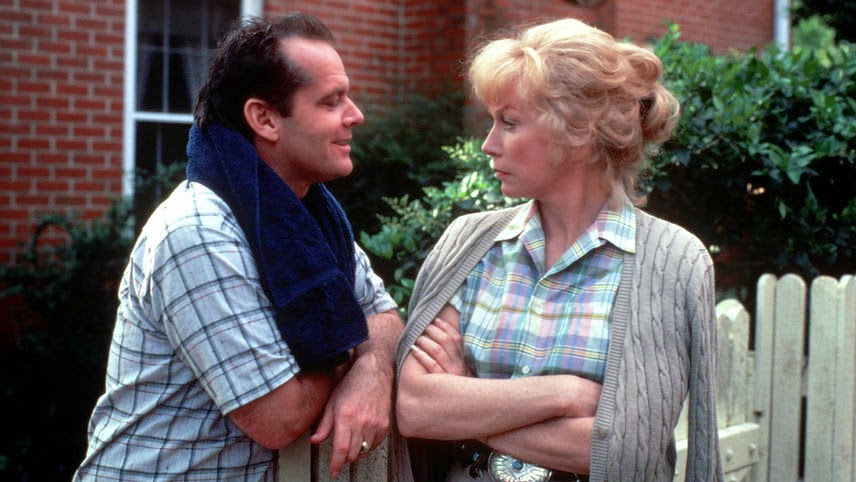
In Texas, Aurora Greenway (Shirley MacLaine) has always been slightly paranoid and definitely overprotective of her only daughter Emma. Aurora was widowed at a young age, leaving her relationship with Emma as the one true connection in her life. When Emma (Debra Winger) grows into a young woman and decides to marry school teacher Flap Horton (Jeff Daniels), Aurora certainly does not approve, believing Flap to be unworthy. Around the same time, retired astronaut Garrett Breedlove (Jack Nicholson) moves into the house next door. A party-loving, womanizing and free-spirited bachelor, Garrett is a man denying his age.

Emma and Flap push ahead and get married anyway, and eventually start a family and move to Des Moines. As the years pass Aurora remains in close touch with her daughter, the two sharing their lives over frequent phone calls, and despite plenty of arguments and no shortage of agitation, their love and commitment to each other never wavers. Seeking physical closeness, Aurora finally works up the courage to start a relationship with Garrett, about 15 years after he became her neighbour. With three kids to raise and Flap's limited earning power causing a financial burden, Emma's marriage starts to seriously fray, and both she and Flap are subjected to extramarital temptations. The threat of another relocation and a serious illness are yet to come.

Directed and written by James L. Brooks in his directorial debut, and based on the Larry McMurtry book, Terms Of Endearment is a perfectly polished gem. For the full 131 minutes, not a scene is wasted, Brooks trusting his audience to keep up as the film gallops through the years using short, often funny and frequently poignant scenes. Chronicling the bond between Aurora and Emma from birth and through about 40 years of life, Brooks nails the ups and downs that define the unique cycles of frustration and happiness between mother and daughter, with undying love providing the sturdy foundation upon which two lives are lived.

Brooks' singular achievement is in creating uniquely memorable characters and then treating them with utmost realism. Aurora, Emma and Garrett are a simply unforgettable trio, three people living life on their own stubborn terms but yet behaving fully within the normal rules where selfishness, sacrifice and life's surprises require a steady stream of critical decisions. There are no heroics in Terms Of Endearment; just happiness and heartache generated by the life's little successes and failures.

And because laughs and tears punctuate life's milestones, Brooks includes plenty of both. The emotions are always there, but even at the darkest moments they rarely veer towards exaggerated agitation. In a peak moment of frustration Aurora does let loose at a hospital nurse station, but it's a scene that is equally funny and heartbreaking, capturing a devoted mother willing to move mountains for her daughter.

Terms Of Endearment features astounding acting from the three principals. Shirley MacLaine and Jack Nicholson deliver some of their best work in their long and celebrated careers. MacLaine won the Best Actress Academy Award for what may have been her last great performance, bringing to life Aurora as a proud woman of the South dealing with the changing times and her own evolving needs. Nicholson took a step back from the madness and murderous urges that had began to define him after The Shining and The Postman Always Rings Twice, and nabbed the Best Supporting Actor Academy Award as Garrett the astronaut, a man determined to turn his past celebrity into a life of irresponsible pleasure.

And Emma was undoubtedly Debra Winger's finest on-screen moment. Winger celebrates Emma as a feisty woman full of love, laughter and a singular determination to meet life on her own terms while forging friendships, sharing every moment with Aurora and adoring and tolerating Flap in equal measures. It's a performance for the ages, and Winger was also nominated as Best Actress but lost out to MacLaine.

In addition to Daniels, Danny DeVito as Aurora's long-time admirer and John Lithgow as Emma's amorous banker round out the cast.

Towards the end of Terms Of Endearment, Emma and Aurora share a moment. It's a brief locking of the eyes, without a word being spoken, Winger and MacLaine pouring their characters into a few seconds representing a lifelong bond, a breathtaking ending, a sorrowful beginning, a heartfelt thank you, and the meaning of love itself. It's an unforgettable instant in an enduring treasure of a movie.


All Ace Black Blog Movie Reviews are here.