Showing posts with label Film Review. Show all posts
Sunday, 22 May 2016
Movie Review: Prometheus (2012)
A deep-space science fiction horror adventure, Prometheus builds up towards some tense moments with a space crew searching for superior alien beings who may have created humanity. But despite a glossy production, the film's lofty themes are not matched by shoddy characterizations and perfunctory expositions.
In the year 2089, scientists and lovers Elizabeth Shaw (Noomi Rapace) and Charlie Holloway (Logan Marshall-Green) discover ancient caves in Scotland denoting alien shapes and a star map. The imagery matches others found throughout the world, leading Shaw and Holloway to conclude that aliens, dubbed The Engineers, created humankind. Aging billionaire tycoon Peter Weyland (Guy Pearce), seeking the secret to eternal life, is enthralled enough to fund an expedition to make contact with humanity's creators.
By 2093, the Weyland-funded spaceship Prometheus arrives near the destination planet. Shaw and Holloway lead the scientific expedition and are accompanied by a motley crew of other experts and explorers. The icy cold Meredith Vickers (Charlize Theron) commands the mission with authoritative zeal, and the vessel is captained by the more laid back Janek (Idris Elba). The robot-in-charge is David (Michael Fassbender), and he keeps the ship functioning until the crew awakens. They land and start to explore the planet's surface, finding dome-shaped installations seemingly built by the Engineers. But there are also signs that the Engineers themselves ran into trouble, and the Prometheus crew is soon threatened by internal strife as well as a horrific external menace.
Directed by Ridley Scott, Prometheus is a prequel-of-sorts to Alien, but with a more philosophical focus. The film never quite decides what it wants to be, and ends up as an uneven mishmash of origins-of-life philosophy, creature-versus-human battles for survival, and petty human conflicts. The aesthetics are gorgeous on the alien planet surface, and there are moments of effective and yucky-gooey horror, but the film is sold short by a script that truncates thoughtfulness in a rush to create conflict.
The film introduces concepts related to no less than the creation of humanity and the relationship between the creator and the created. But lacking proper courage to delve into its own themes, the conversation is limited to ancient scrawls on cave walls, and a few dialogue exchanges that barely go beyond the superficial. The extent of explaining the entire thesis behind a superior race creating humanity resides with interpretations of ancient carvings, a quite dubious premise on which to launch a trillion dollar expedition.
Instead of exploring big ideas with conviction, the script (by Jon Spaihts and Damon Lindelof) hurriedly seeks villains with an agenda, and populates the crew with excitable and cursory characters lacking in depth and context rushing to betray one another and unleash predictable surprises.
The year may be 2093, but scientific rigour and on-board procedures have taken many steps backwards. The Prometheus crew is made up of unconvincing scientists, technicians and assorted victims-to-be. Discipline is the first casualty even before any threats appear, and the slipshod trampling over dangerous artifacts and mishandling of potentially deadly foreign matter denotes a script rushing to set-pieces and leaving large plot holes in its wake. And when they arrive, many of the highlights appear to mimic the better moments from Alien.
Shaw gets a sketched-in background story, and Noomi Rapace is effective as the most empathetic of the characters, often holding the film together. She also enjoys the most memorable moment, an impromptu self-administered emergency surgery. Michael Fassbender is also good as David the robot-in-human-form, but his secretive machinations are derivative and occasionally cross the line into ludicrous mad-scientist villainy.
Prometheus is one third interesting science, one third questionable ideology, and one third character interaction balderdash.
All Ace Black Blog Movie Reviews are here.
Saturday, 21 May 2016
Movie Review: The Siege (1998)
A New York City under martial law terrorism thriller, The Siege is a weird combination of the prescient and the ridiculous.
The CIA in cooperation with U.S. Army General William Devereaux (Bruce Willis) caries out the extra-judicial abduction and extradition of Sheik Akhmed bin Talal, the accused mastermind behind a spate of terrorist attacks against US interests. The Sheik's supporters, working out of various Brooklyn-based cells, initiate a terrorism campaign in New York City to secure his release, including blowing up a bus full of civilians. FBI Agent Anthony "Hub" Hubbard (Denzel Washington) and his Lebanese-born partner Agent Frank Haddad (Tony Shalhoub) try to make sense of the attacks but are kept in the dark by CIA officer Elise Kraft (Annette Bening), who hovers around the investigation both helping and hindering Hub's work.
Elise eventually reveals to Hub that she controls an agent with contacts among the terrorists, a man named Samir Nazhde (Sami Bouajila). Before Hub can do enough to disrupt the cells, more attacks are unleashed and civilians casualties mount, causing an uproar across the country. The calls for the army to be deployed in New York intensify, leading to a confrontation between Devereaux and Hubbard.
Directed by Edward Zwick, The Siege was released three years before the events of September 11, 2001. As such, the film deserves credit for predicting a lot of what happens when a country and a city are placed in the cross hairs of terrorists. The backlash against the Muslim community, the demands to throw immigrants out of the country, the illegal torture of suspects, and the hysteria that leads to the erosion of civil liberties all actually did happen in various forms after 9/11, and here Zwick and his team of three screenwriters capture close variations of the same.
Much less successful are the characterizations and some of the depictions of conflict between various arms of a government under crisis. The Siege is quick to have the FBI, the CIA and the Army at each others' throats, issuing threats with guns and rifles drawn, and arresting and incarcerating each other. While there are always jurisdictional turf wars, tensions and finger pointing, The Siege carries this element to ludicrous extremes and starts to lose credibility as soon as Hubble and Elise fail to communicate at the most basic level.
And in general, the characters are quite one-dimensional despite an impressive cast. Annette Bening gets the most to work with as Elise gradually reveals a backstory inspired by the 1990-91 Gulf War, but otherwise there is little depth to Hubbard, Haddad and Devereaux. Also lacking is any thoughtful context to the acts of terrorism as spoken by the perpetrators. They remain silent and faceless killers, their agenda and motivations filled in by others.
The Siege does enjoy well-polished moments of tension and urban horror as cruel atrocities are committed against an urban population. The depictions of the US Army as a blunt instrument that only knows to crudely trample on whatever terrain it is deployed to also ring true. In tackling the thorny issue of how to react to bloodthirsty terrorists without resorting to their tactics, the film manages to be prophetic and preposterous in equal measures..
All Ace Black Blog Movie Reviews are here.
Sunday, 15 May 2016
Movie Review: Money Monster (2016)
A hostage thriller, Money Monster addresses the collision between television celebrity business advice and the real world where investment decisions can have ruinous implications.
Lee Gates (George Clooney) hosts the weekly live Money Monster show on cable television where he dishes out stock investment tips in a glib flash-and-dash format. The more grounded Patty Fenn (Julia Roberts) is his producer, and she stitches the show together despite Lee's often juvenile antics. During live filming, the stage is invaded by Kyle Budwell (Jack O'Connell), a deeply disturbed man waving a gun. He forces Lee to put on an explosive vest and insists that the cameras keep rolling.
Kyle is upset that he followed Lee's advice on a previous show and invested all his life savings in the stock of a company called IBIS Global Capital, run by CEO Walt Camby (Dominic West), who has now disappeared. IBIS stock promptly tanked when the company lost $800 million due to a so-called algorithm glitch. Live on-air, Kyle rails against the corrupt system. With Patty communicating through his earpiece, Lee regains his composure and tries to buy time by trying to find answers as to what really went wrong with the stock. The solution to the mystery of the missing millions passes through IBIS Chief of Communications Diane Lester (Caitriona Balfe), as well as an algorithm expert in Seoul, hackers in Iceland, and a miners' strike in South Africa.
Directed by Jodie Foster, Money Monster works well when it's within the confines of the television studio. With an unstable Kyle hijacking the show, Lee's world flashing before his eyes and Patty trying to maintain some semblance of control, Foster constructs a taut story that gives a face to the victims of stock market machinations and exposes the shallow world of television punditry. The film maintains a steady current of tension, with the aggressor's instability invading the carefully crafted world of slick marketing, and just the right drizzle of humour injected to keep the drama in check.
The script (co-written by Alan Di Fiore, Jim Kouf and Jamie Linden) works its way to the uncomfortable foundations of the modern system of capitalism. Honest blue collar working men like Kyle are the recession victims, and their only mistake is trusting the make-believe world of charlatans like Lee Gates, a modern-day snake oil salesman. Walt Camby is revered for creating wealth by transferring money using inexplicable software, and while he is the celebrity of the business world men like Kyle simply pay the price in wrecked lives.
The parts of the film away from the studio are not as impressive. Foster takes brief sojourns to Asia, Europe and Africa to underline the interconnected modern world of global finance, but these scenes end up being mere snippets. The final third breaks out of the studio completely with the quest for answers spilling into the streets of Manhattan, and the film starts to unfortunately resemble a contrived Bruce Willis type action film.
The two central performances are excellent and never flag. George Clooney and Julia Roberts, despite sharing few scenes together, exude smooth star charisma and confidence. Clooney's wattage translates perfectly to the cocky personality of Lee Gates, forced through the hostage ordeal to see himself as others see him. Roberts' calm performance allows Patty to emerge as the one voice of reason is a world gone quite mad in pursuit of riches and revenge. Jack O'Connell is suitably unhinged, giving Kyle depth as a man seeking apologies and answers, but not without faults of his own.
In a world where money is virtual and no questions are asked as long as wealth is created out of thin air, Money Monster has no heroes, just victims and charlatans.
All Ace Black Blog Movie Reviews are here.
Labels:
Film Review,
George Clooney,
Jack O'Connell,
Julia Roberts,
Movie Review
Saturday, 23 April 2016
Movie Review: Raiders Of The Lost Ark (1981)
A boisterous adventure with excitement around every corner, Raiders Of The Lost Ark introduced a new screen hero in the form of Indiana Jones and repopularized the clean fun of escapist treasure hunt movies with clean-cut heroes racing against hissing villains.
It's 1936, and archaeologist Indiana Jones (Harrison Ford) battles through the jungles of South America, invades a booby-trapped ancient temple, overcomes a couple of betrayals and gets his hands on a precious golden idol. Unfortunately, at the moment of triumph his rival René Belloq (Paul Freeman) seizes the treasure, and Indy barely escapes with his life.
Back at the college campus where Indiana has a day job as tweedy professor alongside museum curator Dr. Marcus Brody (Denholm Elliott), he is hired by government officials to track down the lost Ark of the Covenant, a long lost stone casket with mythical powers believed to contain the remnants of the ten commandments. The Nazis are close to uncovering the Ark's burial site in the Egyptian desert, and any army carrying the Ark would be undefeatable.
Indiana swings into action and makes a stop in Nepal, where he reconnects with the feisty Marion Ravenwood (Karen Allen), the daughter of Indy's former professor who has in her possession an ancient medallion essential to finding the Ark. In Egypt Indy and Marion team up with Sallah (John Rhys-Davies), an expert excavator, and they have to fend off repeated assassination and kidnapping attempts and race against Belloq and his Nazi-financed expedition to uncover the Ark's whereabouts.
After the phenomenal success of Jaws, Star Wars, and Close Encounter Of The Third Kind, George Lucas and Steven Spielberg were the hottest filmmakers in Hollywood. They teamed up on Raiders Of The Lost Ark, with Lucas producing and Spielberg directing, to launch what would become one of the most famous and successful franchises in film history. Inspired by the matinee serials of the 1930s, Raiders is a rollicking thrill-a-minute adventure, with a handsome and endlessly resourceful hero, a feisty ex-girlfriend, a faithful side-kick, and despicable villains, all fuelled by an old-fashioned globe-spanning chase for hidden treasure.
A joie-de-vivre permeates every cliffhanger moment, the outcome of each climax never in doubt, just the ingenuity of the escape. Several of the film's scenes have become instantly recognizable and legendary screen moments: Indy escaping from a massive rolling boulder in the film's opening sequence; confronting a band of thugs in a Cairo market, including a showdown with a seriously determined sword-wielding assassin; Indy and Marion contending with a massive snake pit; and Indy wrestling for control of a truck, sliding underneath the chassis and using his whip to pull himself back up.
The character of Indiana Jones is the gadget-free James Bond of archaeology. There is no difficult situation that he cannot handle, often by improvising solutions when all seems lost. Using his whip (often), his gun (rarely) and his smarts (always), he may take the occasional beating but always manoeuvres the elements to his advantage. A plane propeller helps him against a sturdier foe in a punishing fist fight, fearsome snakes slithering out of wall cavities point the way to survival, and he has no hesitation latching on to the outside of a Nazi U-boat to pursue his objective (how he survives the subsequent journey is left to the imagination).
The John Williams music score is suitably rousing (with more than a passing resemblance to the Star Wars music). Spielberg and cinematographer Douglas Slocombe stylishly elevate the film beyond its simple adventure status by frequently playing with lights, shadows and silhouettes, and finding interesting perspectives at every opportunity. Many of these angles involve projecting Jones' image as a shadow, emphasizing the man but not the actor, helping to turn the fedora-wearing, whip-carrying image into iconic status.
While most of the action is PG-rated and thrilling for the younger set, Raiders also carries an unexpected edge to keep the adults alert: Spielberg sprinkles some serious violence, blood splatter and gore into the adventure, and the sadism of chief Nazi torture merchant Major Arnold Toht (Ronald Lacey) is a particularly effective example of pure vileness.
Spielberg plucked Harrison Ford from the supporting Han Solo role and Indiana Jones turned him into the megastar of the 1980s. Already 40 years old and a good 15 years after his early uncredited film appearances, Ford found his niche as the ruggedly handsome hero radiating smart determination and not fully aware of his animal magnetism. Karen Allen has rarely been better as his ex-flame, now out-drinking the locals at her bar in Nepal while waiting for her opportunity to again match wits with the man who abandoned her under murky circumstances.
Raiders Of The Ark is a classy adventure with an irresistible attitude: self-deprecating, playful, fast paced and brimming with fun.
All Ace Black Blog Movie Reviews are here.
Labels:
Film Review,
Harrison Ford,
Karen Allen,
Movie Review
Thursday, 7 April 2016
Movie Review: Adventureland (2009)
A teenage romance with a mix of comedy and drama, Adventureland seeks the wistfulness of a troubled young romance. The film enjoys a few good moments but is unable to escape the limitations of quite boring central characters.
In Pittsburgh of 1987, acknowledged virgin James Brennan (Jesse Eisenberg) is dumped by his latest short-term girlfriend. He nevertheless graduates from high school with grand plans to spend the summer in Europe and then attend journalism school at Columbia University. But when his dad's demotion stresses the family finances, James finds himself short of money and has to accept a summer job at the Adventureland local amusement park, considered pretty much the most degrading job a local teenager can find.
The park is run by Bobby (Bill Hader) and his sister Paulette (Kristen Wiig), and James makes friends with lanky and cynical co-worker Joel (Martin Starr). James soon sets eyes on another colleague, the enigmatic Emily (Kristen Stewart), better known as Em, and they start a tentative courtship. But unknown to anyone, Em is carrying on an affair with the park's hunky maintenance technician Mike Connell (Ryan Reynolds), a married man who claims to be an almost-famous musician who once shared the stage with Lou Reed. Things do start to get serious between James and Em, although the arrival of sexpot teenager Lisa P (Margarita Levieva) to work at the park complicates matters.
Directed and written by Greg Mottola fresh from his success helming Superbad, Adventureland aims for a touch of romantic nostalgia within the confines of a quite miserable amusement park, where the games are rigged, kids' puke is part of the ambience, and immature classless men stroke their masculinity by chasing large fuzzy toys. In terms of finding a setting for a love story, Adventureland is original and Mottola sprinkles in regular doses of amusement park human yuk to keep his tale grounded.
Less successful are the central characters. Neither James nor Em offer much that is new, and they are teenagers that have been seen many times before, and in better films than this. It does not help that Mottola overplays the teenage angst angle in a fruitless search for some depth. James and Em both come from seemingly well-to-do middle class families, yet in pursuit of the requisite "troubled background" James' inability to afford a trip to Europe and Em's failure to get along with her step-mother are presented as crises of existential proportions. All the parents in the film are presented as disconnected and distant, in another area where the script falls short.
Mottola appears more interested in jamming as many 1980s songs into the film as possible, and the soundtrack is relentless, quickly tiresome (many of the music selections simply are not that good), and quite loud, often drowning out the lines of dialogue.
Jesse Eisenberg puts on his best I'm-a-bit-of-a-doofus-but-I'm-still-cool persona, and it's well suited to the movie. Kristen Stewart is all about a dark exterior hiding something that is always smoldering, whether its passion or anger at the world in general. Ryan Reynolds sleeps walks through his few scenes. The supporting cast is patchy, and includes good performances from Bill Hader and Kristen Wiig, a ridiculously over-the-top sultry turn from Margarita Levieva, and a few too many forgettable hangers-on.
Adventureland features long stretches where not much happens other than standard teenage anxiety, plenty of alcohol consumption, and even more pot smoking. When in doubt and in search of a cause, break out the illicit substances.
All Ace Black Blog Movie Reviews are here.
Tuesday, 5 April 2016
Movie Review: Big Fish (2003)
A heartfelt father-son drama with fantasy overtones, Big Fish goes looking for the magic ingredient that makes every man a multi-generational legend in his own family.
Journalist Will Bloom (Billy Crudup) is happily married to Josephine (Marion Cotillard) and living in Paris, as far away as he can from his elderly father Edward (Albert Finney). Will has had enough of Edward's propensity for telling tall tales at every opportunity, with the final straw arriving on Will's wedding day when Edward stole the limelight yet again by repeating an outlandish story about catching a huge fish the day Will was born using his wedding ring as a lure. When he hears from his mother Sandra (Jessica Lange) that Edward's cancer has deteriorated and he is near death, Will and the pregnant Josephine travel back to Alabama, with Will seeking a reconciliation with his dad.
Despite Will's pleadings, Edward cannot help himself: his conversation consists of repeated re-tellings of fantastical tales from his life, including as a young boy confronting a fortune-telling local witch (Helena Bonham Carter). As a young man (played by Ewan McGregor), Edward tangled with Karl the man-eating giant (Matthew McGrory), stumbled through a swamp and into a mythical and idyllic town called Spectre, and worked for a circus master with a dangerous secret (Danny DeVito). He met and doggedly pursued the love of his life Sandra (portrayed as a young woman by Alison Lohman) and teamed up with conjoined twins while on a secret military mission in North Korea. Will has to find a way to come to terms with Edward's unique perspective on a life well lived, before it's too late.
Directed by Tim Burton as a combination family drama and supernatural fairy tale, Big Fish adapts the Daniel Wallace novel and delves into the difficult waters where fathers and sons disconnect. The film is colourful, engaging and exudes a sense of wonder, all derived from Edward's unique take on his own life. The tension between father and son at life's denouement is appropriately less well developed, with both men quite stubbornly attached to their interpretation of how the stories of life should be recalled. The film does generate a warm glow from an accurate portrayal of a difficult family dynamic, and also avoids rushing towards any easy answers or pat reconciliations.
Big Fish mixes modern-day scenes of a dying dad staunchly defending his version of life in front of a disbelieving and quite frustrated son, with frequent long flashbacks to Edward's incredible life chapters. Burton is the perfect director to portray a glorified past through the lens of a fanciful imagination, with Will's inability to straddle the chasm between bland truth and embellished storytelling at the heart of his self-imposed estrangement. The film's aesthetics are beautiful, if too perfect in the way that well-polished stories scrub off all the inconvenient details and emphasize the storyteller's vivid heroics.
Billy Crudup, Albert Finney and Ewan McGregor are serviceable if all a bit theatrical in their portrayals of Will, the elder Edward and Edward as a young man respectively. Danny DeVito, Helena Bonham Carter and Steve Buscemi as a long-lost poet who turns into a Wall Street shark continue in the same vein of slight overacting for maximum effect.
Some of the stories from Edward's life are allegorical, others are amalgams, and still others are slight modifications of the truth. As an ambitious traveling salesman he lived a full life on his own terms, and ultimately his stories are his own definition of a soul on a quest for adventure and happiness. The arc of his life revolves around his deep love for Sandra, with many of his quests driven by his need to identify her, find her, win her heart, and then stay faithful despite the travails of life.
Will may or may not appreciate his dad's ability to turn the ordinary pages of life into a fabulous story of a love pursued, won and treasured, but he will never forget that big fish his dad caught on the day he was born.
All Ace Black Blog Movie Reviews are here.
Saturday, 2 April 2016
Movie Review: Angel Heart (1987)
A mix of film noir, horror and the supernatural, Angel Heart finds a good mood but veers towards literal and figurative overkill in its second half.
New York, 1955. Two-bit Manhattan private detective Harry Angel (Mickey Rourke) is called to Harlem and hired by the mysteriously well-dressed and wealthy Louis Cyphre (Robert De Niro) to find out whether a pre-war crooner by the show-biz name of Johnny Favorite is alive or dead. Favorite was badly hurt in the war, and is supposed to be in a vegetative state in hospital, but Cyphre suspects a ruse. He claims to have a contract with Favorite and wants to make sure that the singer is not reneging on his end of the deal by faking long-term sickness or death.
Angel snoops around the hospital and indeed finds a cover-up. A doctor Fowler was paid a lot of money to pretend that Favorite remained a long-term patient. Instead, the bandaged but recovering singer was smuggled out of the hospital in 1943 by a man and a woman who took him south. Angel's investigation leads him to New Orleans, where he meets Favorite's pre-war associates including fortune teller Margaret Krusemark (Charlotte Rampling), musician Toots Sweet (Brownie McGhee), and the passionate Epiphany Proudfoot (Lisa Bonet), the daughter of Favorite's former lover. Angel finds himself embroiled in the dangerous world of the occult, just as people start showing up dead all around him, victims of gruesome murders.
Director Alan Parker himself created the screenplay out of the William Hjortsberg 1978 novel Falling Angel, and the emphasis is on atmosphere, symbolism and a prevailing sense of dread. The film is punctuated by hallucinatory interludes featuring figures shrouded in black, blood-splattered walls, slowly rotating fans, mirrors, clattering elevator doors throwing large shadows on the wall, and disturbingly omnipresent chickens. Parker plays with light, silhouettes and the juxtaposition of reality, imagination and memory fragments, and Angel Heart works well as an unhinging, dangerous and stylish piece of film making.
The plot is less successful. The second half of the film starts to resemble a train wreck, as characters are introduced and unceremoniously killed-off in macabre fashion. Chickens are sacrificed, rabid dogs are unleashed, henchmen jump out of the shadows, and both internal and external organs are misused for heinous purposes. It's all in the service of a narrative arc that firmly sets its course towards a supernatural resolution, but in the process Parker shortchanges his characters. When the twist ending arrives, it feels rushed. A more thorough, less sensationalist-obsessed exploration of both the contract between Cyphre and Favorite and Favorite's attempt to escape his obligations would have helped maintain a better balance between mysterious and mythical.
Mickey Rourke is quite excellent, and delivers a confident performance as a low-profile gumshoe thrust into a high stakes maze riddled with death. Robert De Niro makes a theatrical impact in just a few scenes, focussing on enigmatic presence as he eats an egg as a history lesson in domination and fills out large empty rooms with oozing manipulation. Lisa Bonet shocked the world at the time by jumping from a wholesome image on television's family-friendly The Cosby Show and into the earthy role of the 17 year old chicken-killing, voodoo dabbling, single mother Epiphany, and sharing a steamy and yet horrifying sex scene with Rourke.
Angel Heart is dark, unsettling, and imaginative but also ultimately too quick to favour gore over noir.
All Ace Black Blog Movie Reviews are here.
Monday, 28 March 2016
Movie Review: The Truman Show (1998)
An astute commentary on television culture's evolution, The Truman Show also explores the limits of human tolerance for the ordinary. The film is an engrossing examination of the societal condition, and as fascinating as its central show.
Television producer Christof (Ed Harris) has created a monstrously successful live, perpetual television show, tracking the minute-by-minute life of Truman Burbank (Jim Carrey), the only non-actor. Inserted from birth into a custom-built community of Seahaven, which is one humongous dome-enclosed and climate-controlled film set, Truman has no idea that every second of his life is being broadcast live to millions of viewers, using more than 5,000 hidden cameras.
Truman think he works as an insurance agent, and believes he is married to Meryl (Laura Linney, as actress Hannah Gill), that his best friend since school is Marlon (Roland Emmerich, as actor Louis Coltrane), and that his father died in a boating accident. Over the show's remarkable 30 years of continuous broadcast, various outside activists have tried to infiltrate the set to free Truman. He has never forgotten Lauren (Natascha McElhone, as actress Sylvia), an extra hired to play a high school student who tried to help him escape before she was bundled off the set. When the actor who played his father unexpectedly reappears in his life, Truman starts to suspect that something is not quite right and starts to question the world around him.
Directed by Peter Weir and written by Andrew Niccol, The Truman Show expands the reality television concept to an unsettling edge, and in the process contemplates human boundaries of control, comfort and compliance. The film is thoughtful, often profound, but also tackles its serious issue with humour. The act of viewing and enjoying Truman's story is itself part of the societal guilty-pleasure dilemma. The film is also unsettling enough to raise doubts about any life: if Truman is so deluded about his reality, who is to say what is defined as real and what is not?
Everything in Seahaven is designed to be idyllic, and to convince Truman that he has no reason to want to leave. Ironically, Christof's attempts to instill the emotional fear of leaving and segregate Truman from the outside world create the most compelling moments of drama for the viewers of the show. And once Truman starts to suspect that everything is too perfect, it becomes increasingly difficult to convince him to settle for his artificial surroundings.
The film plays on the parallel themes of obsession with other people's lives, and the essence of the human condition. The viewers of the show are transfixed, immobile, living their lives vicariously through the television set and following Truman's ups and downs rather than getting on with creating their own memories. The further Truman pushes to escape his sad life, the more entrenched the viewers are in front of the television. It's a sad indictment of the culture, where society cares more about an artificial world labelled as reality than actual existence.
Also permeating through the film is Christof's relationship with Truman, presented as a surrogate for the mysteries of the bond between God and man. Christof loves Truman like a son, and wants him to be safe and content. But Truman has free will, and eventually learns to use it. As much as Christof will try and send cosmic signals about what may be the appropriate path, it will ultimately be man's actions that will govern his fate.
The Truman Show is one of Jim Carrey's most complete performances. Staying as far as he can from the elastic mugging and physical comedy which made him famous, Carrey as Truman conveys innocence, curiosity and ultimately a willingness to question and confront. In addition to excellent supporting performances from Ed Harris, Laura Linney, Noah Emmerich and Natascha McElhone, the cast also includes Paul Giamatti as Christof's chief control room manager.
What is comfortable is not what is necessarily right. The Truman Show finds the spirit of a simple man yearning for a challenge, part of the never ending quest to self-define happiness.
All Ace Black Blog Movie Reviews are here.
Saturday, 26 March 2016
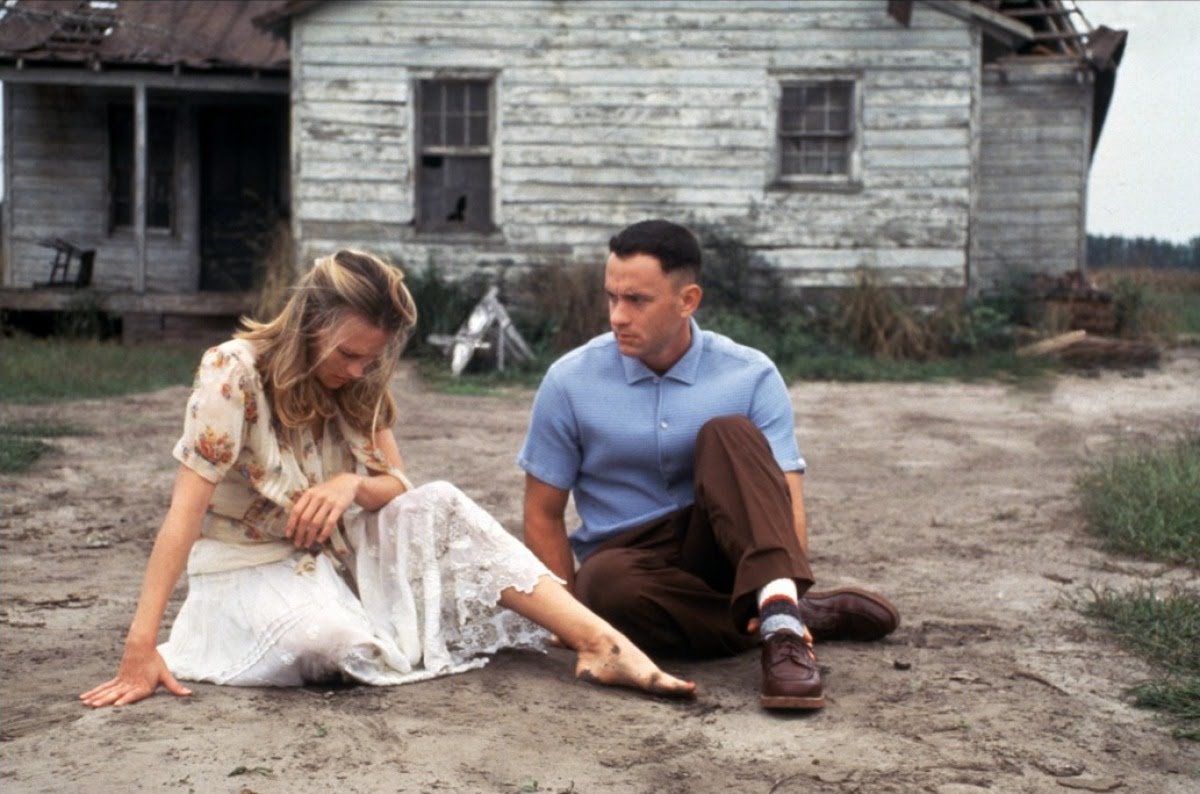
Movie Review: Forrest Gump (1994)
A comedy-drama about the American dream in the 20th century, Forrest Gump is an irresistible romp through pop culture history with one simpleton who is always in the right place at the right time.
The film is mostly told in flashback, with Forrest Gump (Tom Hanks) sitting at a bus stop recounting his story to a succession of strangers next to him. Born in rural Alabama, Forrest has a low IQ of 75, but his mother (Sally Field) does all she can to make sure he feels normal and gets a decent education. As a child Forrest is hampered by a bent spine, and his only friend is Jenny, an almost angelic schoolmate growing up in an abusive household.
While avoiding bullies, Forrest discovers that he can outrun anyone, and his speed becomes his ticket to a college education, where he becomes a star if clueless football running back. He then joins the Army and serves a tour in the Vietnam War, where he meets Lieutenant Dan Taylor (Gary Sinise) and fellow Alabaman Bubba Blue (Mykelti Williamson), a wannabe shrimp fisherman. Forrest's simple outlook on life help him to become a battlefield hero, and after the war he finds success first as a table tennis champion and then as a shrimp businessman. All the time Forrest tries to maintain contact with Jenny (Robin Wright), the one love of his life, as she joins the cultural revolution and struggles to overcome the shadow of her childhood.
An Eric Roth screenplay adaptation of a Winston Groom novel directed by Robert Zemeckis, Forrest Gump is an easy to digest lesson in the art of seizing the sometimes ridiculous opportunities of life. Forrest remains true to core principles derived from a rural upbringing and a saint of a mother, and reaps the benefits from always doing well for others. Both funny and poignant but never demanding, the film is a smooth balm of reassurance that the American dream works even for idiots, as long they carry good intentions and retain human values.
Riding a steady Tom Hanks performance that mixes naive whimsy with the positivity emanating from believing the best about every situation, the film paints with the broad brush of nostalgia from the 1960s and 1970s. Forrest somehow finds himself over a 20 year period an unlikely hero on the college football field, in the Vietnam jungle, in the thick of the Cold War, in the world of business, and helping to define the cultural zeitgeist. It does not take a genius to positively shape global events much less the lives of others, and in the process of contributing to history, Forrest becomes a regular and celebrated guest at the White House. In an early deployment of clever CGI, Hanks as Gump is seamlessly inserted into many historical film reels, interacting with the likes of Presidents Kennedy and Nixon.
Despite a longish running time of over 140 minutes, Zemeckis never lingers on any one chapter. Highlights include the childhood scenes with Forrest's mother doing everything she needs to do to get him enrolled in school, and an epic Vietnam War firefight that sets the stage for Forrest's heroics and long-term future business success and friendship with Lieutenant Dan. Late in the film Forrest simply goes for a run; a really, really long run to leave the past behind and come to terms with the thing called life.
The impossible, long-distance candle of love that Forrest holds for Jenny ties the film together. Forrest unwittingly ends up a winner at everything that he doesn't intend to do, but his singular intention to win her love proves to be the toughest challenge of his life. Robin Wright brings Jenny to soulful life with plenty of angelic pragmatism, a victim of abuse whose life was spun into the wrong orbit at an early age and never quite recovered. Forrest Gump succeeds not only as a story of a man who rises above his lowly station to achieve remarkable success; but also because it lingers on the heartache of a woman severely damaged in childhood, struggling to hang on despite the constant devotion of her one true friend.
All Ace Black Blog Movie Reviews are here.
Labels:
Film Review,
Gary Sinise,
Movie Review,
Robin Wright,
Sally Field,
Tom Hanks
Saturday, 19 March 2016
Movie Review: Once Upon A Time In America (1984)
A New York gangster epic spanning 35 years in the life of two friends, Once Upon A Time In America is Sergio Leone's final film, and a masterpiece of provocative storytelling. The extended director's cut (with restored footage) clocks in at a mammoth 251 minutes, and it's a fascinating viewing experienced, reminiscent of a complex ancient tragedy with central characters both heroic and deeply flawed.
The film unfolds in three different time periods concurrently: 1920, the early 1930s, and 1968. The narrative starts in 1932, with gangster Noodles (Robert De Niro) being hunted down after having seemingly betrayed his pals and long-time criminal associates. He evades capture, but is surprised to discover the gang's stash of $1 million in emergency cash missing. He buys a one-way ticket out of New York. Close to 35 years later, Noodles returns to the city, drawn back by mysterious messages suggesting there is unfinished business for him to attend to.
In flashbacks to the dusty streets of Lower East Side Manhattan in 1920, a group of Jewish kids are forming themselves into a gang consisting of the scrappy Noodles and his friends Cockeye, Patsy and the youngest Dominic. They pass their days committing petty crimes and evading policeman Aiello (Danny Aiello). Noodles has a crush on the relatively sophisticated girl-next-door Deborah (Jennifer Connelly), whose family runs the local diner where her brother Fat Moe works. In contrast to Deborah, the local slut-to-be is Peggy, and she affords the boys their first sexual experiences.
The lanky Max moves into the neighbourhood from Brooklyn, and becomes quick friends with Noodles. Together they plot a path for their ragtag bunch to gain more influence, which results in confrontations with older and more established street thugs. After one such skirmish, Noodles is caught and imprisoned for 12 years. The grown up Max (James Woods), Cockeye (William Forsythe) and Patsy (James Hayden) welcome back Noodles when he is released in 1931. Max has forged the young men into a slick group of criminals, profiting from the illegal alcohol trade as well as prostitution and assorted other criminal activity.
Noodles reconnects with Deborah (Elizabeth McGovern), who is now a budding dancing star, and he also quickly reintegrates back into the gang as they get involved in a high stakes jewel theft with crime boss Frankie (Joe Pesci) and disgusting Detroit mobster Joe (Burt Young). Max and Noodles begin to clash over the gang's direction, with Noodles wanting to remain more independent while Max chases the riches afforded by association with powerful men like Frankie. Noodles stages an elaborate date with Deborah that starts well but ends in disaster, and finds some alternative comfort in the arms of the willing Eve (Darlanne Fleugel). Max embarks on a relationship with good time girl Carol (Tuesday Weld). When the end of Prohibition draws near, the schism between Noodles and Max grows dangerously wider.
Based on the autobiographical book The Hoods by Harry Grey, Once Upon A Time In America is Leone's ode to the American dream through the lens of friendship, social turmoil, violence, crime and a shrouded mystery that will serve as a final punctuation mark. The film had a troubled release history, with an initial studio-butchered 139 minute North American version rendering the film incomprehensible. The initial 229 minute European release was Leone's original vision. Some 30 years later, the painstaking restoration of 22 essential minutes for the extended director's cut further elevates a masterpiece of grandiose filmmaking.
Playing off the themes of his Dollars trilogy, Leone remains fascinated by the relationships that form between men on the wrong side of the law, where concepts of honour and trust are relative and friendships are created on the run and threatened by the shadow of the next big score. The core story is the bond between Noodles and Max, forged in childhood, finding a common ambition, surviving Noodles' stint in prison, and then hitting the rocks of unbridled greed.
For Max being a middling criminal with comfortable wealth is not enough, he wants to reach for the brass ring of unconstrained power and enormous riches. For the more grounded Noodles, winning the heart of Deborah is more important than all the money in the world, and when her love proves elusive, taking any more risks seems pointless. The relationship between the two men ruptures in the worst possible way, with judgement day for both awaiting more than 30 years later.
The pace is slow and deliberate, but the movie never fades. This is effectively three rich films in one viewing experience, and by presenting the story in non-chronological order, Leone reveals the ties that bind across the decades. Scenes rarely linger for too long, and when they do, there is good reason: young Patsy confronting a cupcake on a staircase and carefully weighing the benefits of an expensive dessert against sex is a dazzling reminder of the crevasse between childhood reality and adulthood aspirations.
The movie carries a tone of sad nostalgia in each of its three eras, with the recreation of the bustling Lower East Side Jewish neighbourhood circa 1920 a particularly brilliant visual feat. The brooding Manhattan Bridge is used as a stunning backdrop to the ramshackle origins of Noodles and Max, while Ennio Morricone conjures up one of his best music scores, and it's all in the key of sad.
For all the human drama, this is a film about criminals, and when it's time for violence, Leone does not hold back. Characters are tortured, beaten senseless and summarily executed, there are stabbings, close-range shootings, and plenty of violence involving women and children. A prolonged, harrowing rape scene is physically painful to watch, emphasizing a criminal's hopelessly shallow understanding of the difference between romance and dominance.
Robert De Niro and James Woods create an enduring pair, both actors at the top of their form and delivering seminal performances. Woods holds back just enough of his intensity to create the undercurrent of menace that drives his character's brashness. De Niro finds the space where a kid turns to crime to climb out of his low status, but has no social skills to thrive in middle class domesticity and no desire to go looking for anything more.
The early formative scenes benefit from some terrific child performances, with the personalities of Noodles (Scott Tiler), Max (Rusty Jacobs), Cockeye (Adrian Curran), Patsy (Brian Bloom), Dominic (Noah Moazezi), Fat Moe (Mike Monetti), and Peggy (Julie Cohen) all created seemingly effortlessly by the young cast. And most impressive is Jennifer Connelly in her big screen debut at 14 years old, managing to outshine Elizabeth McGovern in defining young Deborah.
At over four hours long, there are bound to be some missteps. An essential sub-plot involving union boss Jimmy O'Donnell (Treat Williams) seems to have suffered most in the editing room, while Joe Pesci's Frankie is also a character who has undue influence compared to his limited screen time. But these are minor quibbles. Once Upon A Time In America is an audacious feat, a gangster film that manages to be both intimate and flamboyant, and easily among the most monumental achievements in the history of film.
All Ace Black Blog Movie Reviews are here.
Saturday, 12 March 2016
Movie Review: Driving Miss Daisy (1989)
A simple two-person character study, Driving Miss Daisy enjoys excellent central performances but rides an utterly linear path to nowhere in particular.
Georgia, 1948. Daisy Werthan (Jessica Tandy) is a stubborn 72 year old rich Jewish woman, living alone in her big house with her faithful kitchen servant. When she crashes her car in a driveway mishap, her son Boolie (Dan Aykroyd), a local businessman, insists on getting her a driver, and hires the elderly Hoke Colburn (Morgan Freeman). Hoke is amiable and professional but nevertheless it takes Daisy several weeks to admit that she needs help. Eventually she succumbs and accepts to have Hoke drive her to all her errands and visits.
Daisy initially treats Hoke as the hired help and barely trusts him. But over the years she warms up to his company, and teaches him to read while he helps tend to her vegetable garden. Their friendship deepens and together they witness episodes of racism and antisemitism as the South goes through radical social changes.
An adaptation of an off-Broadway play directed by Bruce Beresford, Driving Miss Daisy is a small, modest film, an intimate look at a friendship that evolves over 12 years against a backdrop of social upheavel. The focus on the complexities of relationships in the crusty elderly years is refreshing, and the film remains stubbornly faithful to a low-key pace and tone, consistent with the greying years.
Daisy and Hoke are interesting enough characters to carry the film. Daisy is now rich but has never forgotten growing up in poverty, and she goes out of her way to avoid demonstrations of wealth. She is also headstrong, humourless, and set in her ways. Hoke is a survivor, keenly aware of the social position occupied by an older black man in the deep South of 1948. He is nevertheless full of wisdom, pride and unafraid to (always respectfully) express opinions that contradict his employers.
The film establishes its premise and central characters in the first 30 minutes, and then sputters and occasionally stalls down the dusty backroads of history. While Tandy, Freeman, and (more surprisingly) Aykroyd are never less than excellent, the Alfred Uhry scripts struggles to find a narrative thrust. Driving Miss Daisy defaults to a series of vignettes, Hoke in the front seat, Daisy in the back, exchanging sometimes sharp but often superficial views as the years pass them by and the car models are updated. The little episodes add up to a deepening friendship, but precious little emotional resonance is actually generated.
In an admittedly weak year, Driving Miss Daisy won the Best Film Academy Award, ahead of more celebrated movies such as Born On The Fourth Of July, Field Of Dreams and Dead Poets Society. Beresford was not even nominated for Best Director. Sometimes, an uncomplicated drive in the country remarkably seizes the day.
All Ace Black Blog Movie Reviews are here.
Labels:
Dan Aykroyd,
Film Review,
Jessica Tandy,
Morgan Freeman,
Movie Review
Tuesday, 8 March 2016
Movie Review: Jurassic Park (1993)
A science-gone-wrong monster epic from director Steven Spielberg and writer Michael Crichton, Jurassic Park boasts ground-breaking special effects but is an otherwise strangely dull, plotless and bordering on boring monsters-on-the-loose thriller.
Eccentric tycoon John Hammond (Richard Attenborough) has created the Jurassic Park tourist destination filled with cloned dinosaurs on the tropical island paradise of Isla Nublar. Before the park opens to the public, a misbehaving dinosaur kills a worker, prompting investors represented by lawyer Donald Gennaro (Martin Ferrero) to insist on an expert independent safety audit. Paleontologist Dr. Alan Grant (Sam Neill), paleobotanist Dr. Ellie Sattler (Laura Dern) and chaos theorist Dr. Ian Malcolm (Jeff Goldblum) are recruited to inspect the site. Hammond's grandchildren Tim and Alexis drop by for a visit just as the experts start their work.
The scientists are awed by the sight of recreated dinosaurs roaming the island within areas segregated by electrified fences. Hammond explains the cloning science, with the dinosaur DNA obtained from mosquitoes trapped for millennia in fossilized tree sap. But the park's weakness resides with disgruntled computer systems programmer Dennis Nedry (Wayne Knight), a slob of a man seeking greater financial rewards. When Dennis deactivates parts of the security system to steal dinosaur embryos, he sets off a series of events that allows the dinosaurs to roam free, placing the lives of the scientists and Hammond's grandchildren at risk.
Jurassic Park is a visual treat, and by the standards of 1993, the special effects are magnificent. Spielberg brings assorted dinosaurs to realistic life, and watching the actors interact with the ancient beasts is a thrilling experience.
At least, until the novelty wears off and the mind begins to wander towards the empty space where the non-existent narrative is supposed to reside. Crichton co-wrote the screenplay, and he brings his typical sloppy habits to the fore. The film has no meaningful human dimension, and the actors are left to grapple with plastic characters spouting stock phrases, while tiny, underdeveloped plot fragments are strewn all over the island. At the heart of the film's problems is the premise that all the security and computer systems of a multi-billion dollar investment can be entrusted to a single underpaid sloven like Dennis Nedry. The conspiracy to steal embryos is never more than a barely-baked idea to unleash chaos.
Elsewhere, there is a tired sub-theme about Dr. Grant being intolerant of children, so of course he is saddled with saving the lives of young Tim and Alexis once the dinosaurs break out. Dr. Malcolm's chaos theories are presented as next to inexplicable, while Dr. Sattler starts down the road of exploring why a Triceratops is falling regularly ill, but that's another plot point that is summarily abandoned.
Jurassic Park defaults to a series of well-executed set-pieces that nevertheless become irritatingly predictable: monsters attack, humans run for their lives. An endless sequence features a mammoth Tyrannosaurus Rex toying with the car in which Tim and Alexis are hiding. Later on, the vicious Velociraptors take their turn to hunt the humans, eventually cornering the kids in the kitchen.
With Spielberg at the helm and the film heavily slanted towards the pre-teen demographic easily mesmerized by dinosaurs, there is never an actual risk that any character of consequence will actually get hurt, and all the violence is incongruously bloodless. It's innocent vanilla fun, a clash of creatures never intended to co-exist, and that's as deep as the themes of the film are allowed to go.
Jurassic Park deserves recognition for raising the special effects bar and demonstrating what magic is possible with a combination of CGI and animatronics. But as a film it is a surprisingly soulless exercise in juvenile storytelling: two hours of screams, roars and not much substance.
All Ace Black Blog Movie Reviews are here.
Sunday, 6 March 2016
Movie Review: In Bruges (2008)
An ingenuous character study, In Bruges follows two hit men as they hide out in the sleepy Belgian city awaiting their next orders. What follows is a delightfully unpredictable study of the human condition.
Ray (Colin Farrell) and Ken (Brendan Gleeson) are two Irish hit men ordered to lay low in Bruges by their excitable foul-mouthed boss Harry (Ralph Fiennes). With the Christmas tourist season at its peak, the two are forced to share a room at a small hotel operated by the pregnant Marie (Thekla Reuten). Ray is young, restless, and tortured by a recent mission-gone-bad. Ken is older, wiser, calmer, and more experienced. Ray is immediately bored in Bruges, completely oblivious to the city's charming culture and sense of history. Ken is entranced, and keen to take in all that Bruges has to offer.
Ray finds ways to get himself into trouble. He meets Chloë (Clémence Poésy), who may be a drug dealer pretending to be a film crew assistant. She may also be a specialist in seducing and mugging tourists, along with her skinhead ex-boyfriend Eirik (Jérémie Renier). Ray also meets Jimmy (Jordan Prentice), a drug-addicted, prostitute-chasing dwarf actor filming a surreal homage to Don't Look Now. When Harry finally makes contact with Ken to issue his next set of orders, a volatile situation ignites.
Written and directed by Martin McDonagh, In Bruges is a cerebral gem. Unfolding in layers to reveal secrets, agonies and deeply-respected codes of honour, the film marches to its own tune, taking every unexpected turn, avoiding the routine in favour of the quirky, and working its way to original territory where death is a punishment, an escape and a sacrifice. The film is a low-key exploration of two men at opposite ends of their careers, approaching the next chapter with a recent crisis in the rear view mirror and a lot worse to come.
Ray and Ken are compelling enough, but McDonagh first adds the city of Bruges itself as a stellar co-star, and then Harry makes a personal appearance in the final third to pour fuel on an already simmering fire. Bruges is a captivating locale, and used as a device to underline the contrast between the two assassins. Ray is traumatized well beyond caring which city he is in, while Ken relishes the opportunity to take time off and immerse himself in the culture. The men continuously clash over their daily agenda, with a delicious irony to be revealed only when Harry's reasoning behind the choice of city is revealed.Colin Farrell has rarely been better. He presents Ray as a man undergoing a quiet catastrophe, looking for ways to distract himself that don't involve boring sight seeing. Brendan Gleeson is also at his best in one of his most prominent roles, Ken a quiet, loyal soldier who will always do what is necessary until confronted with a sublime situation where the act of killing simply can't win.
The supporting characters further enrich the film. Hotel owner Marie, seductress Chloë, her violent boyfriend Eirik, the American dwarf actor Jimmy, plus illegal gun dealer Yuri (Eric Godon) all initially appear to be incidental to Ray and Ken's break from the job of killing. Once Harry wades into the sleepy city everyone who has come into contact with the hit men will have a role to play in defining their future.
The life of assassins is not for the faint of heart or the error prone, but that does not mean it can't be frequently funny. The laughs are sharp, the set-pieces often hilarious, and on many occasions quite politically incorrect. In Bruges, death holds hands with dark humour and together they saunter down alleyways steeped in history, filled with echoes of plans gone horribly wrong.
All Ace Black Blog Movie Reviews are here.
Labels:
Brendan Gleeson,
Colin Farrell,
Film Review,
Movie Review,
Ralph Fiennes
Friday, 4 March 2016
Movie Review: Inside Out (2015)
An animated drama-comedy about the inner workings of a young girl's brain, Inside Out pushes all the right emotional buttons but also suffers from Disney's frustratingly formulaic "journey" clichés.
Riley Anderson (voice of Kaitlyn Dias) is a girl from Minnesota, and her brain headquarters is controlled by five emotions. The dominant Joy (Amy Poehler) does her best to keep Riley happy, but she is often hampered by Sadness (Phyllis Smith). They are supported by occasional interventions from the combustible Anger (Lewis Black), the perpetually frantic Fear (Bill Hader) and the snooty Disgust (Mindy Kaling). Riley grows into a generally happy child who loves hockey, her family, and friends, with Joy working hard to create and store mostly cheerful memories within Riley's brain.
When Riley is eleven, her father (Kyle MacLachlan) and mother (Diane Lane) decide to relocate the family to San Francisco. This turns into a stressful experience, and Joy struggles to keep Riley positive. Sadness becomes more influential, and a struggle between her and Joy results in both of them inadvertently ejected out of the brain's headquarters and into the cavernous, complex areas of the brain where long-term memories and long-forgotten experiences are stored. Riley slips into a depression as Anger, Fear and Disgust unsuccessfully struggle to maintain control while Joy and Sadness embark on a complex journey to make their way back to HQ.
A Disney / Pixar production directed by Pete Docter and Ronnie Del Carmen, Inside Out is a polished children's tale, aimed at the pre-teen market with enough edge and humour to also keep their parents well entertained. For the intended target, the premise is relatively original and the animation imaginative, with Riley's brain proving to be expansive, rich territory to house a story about what makes us human.
Docter co-wrote the script, and does not shy away from some sensitive topics. The complications that come with major life changes, stressed parents unintentionally straining their kids, and the perils of depression come to the fore, and as much as Inside Out is a comedy, it offers avenues for serious conversations about somber challenges triggered by life's milestones.As a movie, the first half is by far stronger. Docter has breezy fun establishing Riley's emotional-drivers and the brain's workings, finding winning metaphors in shiny globes representing memories, a vault-like system for storing core, foundational events, and suspended islands that bring to life her various personalities. Joy is the tireless leader of Riley's emotions, the pursuit of happiness usually able to dominate other, less constructive emotions. Amy Poehler delivers a dedicated and energetic voice performance to convey Joy's irrepressible attitude.
But the more serious second half gets bogged down in one of Disney's all-too-familiar journey treks, Joy and Sadness having to find their way back to HQ through the deep recesses of Riley's brain. Here events, locations and characters are much more hit-and-miss, long-lost imaginary friend Bing Bong (Richard Kind) only partially successful, a short-cut through an abstraction chamber missing the mark entirely, while a cut-out boyfriend image also drops in and out with little context. The film bogs down, intermittently tiresome and sometimes repetitive as Riley's personality islands suffer the effects of her dysfunctional emotions.
Regardless of some shortcomings, Inside Out deserves enormous credit for steering away from any kind of antagonist, both in Riley's real life and in her brain. There are no bad guys or villains; Riley's troubles are triggered by everyday events, her balance tipped by unintended pressures. The perils lie within, as do the solutions. And the film moves towards a clever, unexpected outcome, with a mature lesson about the complementary role of all that makes us function emotionally.
Inside Out peeks inside the brain and finds familiar organized chaos helping to create moments both funny and sad, and fertile ground for the human process of emotional growth.
All Ace Black Blog Movie Reviews are here.
Labels:
Amy Poehler,
Diane Lane,
Film Review,
Kyle MacLachlan,
Movie Review
Subscribe to:
Posts (Atom)