Showing posts with label James Spader. Show all posts

Wednesday, 25 October 2023

Movie Review: Stargate (1994)


Genre: Science Fiction Adventure
Director: Roland Emmerich
Starring: Kurt Russell, James Spader, Jaye Davidson, Viveca Lindfors
Running Time: 121 minutes

Synopsis: In 1928, a mysterious gate is discovered at an Egyptian archeological site. In the present, archeologist and linguist Dr. Daniel Jackson (James Spader) is summoned by Dr. Catherine Langford (Viveca Lindfors) to a secret research facility where he deciphers the gate's ancient activation symbols. Daniel is joined by Colonel Jack O'Neil (Kurt Russell) and a group of marines as they pass through the gate and travel through space. They emerge at a distant desert planet where an ancient civilization is enslaved by the ruthless Ra (Jaye Davidson).

What Works Well: The opening act conveys a sense of mystery and exploration, and the two main characters carry initial promise: Spader's misunderstood scientist is a frumpled mess, while Russell's military man is grieving the accidental death of his child. The visuals are pristine, and David Arnold's music adds suitable flourish.

What Does Not Work As Well: Neither the science nor the fiction work well. The objectives of the traverse-the-gate mission are barely explained, and once the group arrives at the dusty planet, the narrative defaults to a trite save-the-locals-with-assault-rifles theme. A romance is slapped on and of course the Colonel finds a reason to live. Dr. Langford checks out entirely, while the evil Ra, having conquered space, time, and entire planets, somehow has trouble disposing of a small and lightly-armed group.  

Conclusion: An intriguing premise is lost in the desert of simplistic exposition.


All Ace Black Movie Blog reviews are here.

Saturday, 1 April 2023

Movie Review: Sex, Lies, And Videotape (1989)


Genre: Psychological Dramedy
Director: Steven Soderbergh
Starring: James Spader, Andie MacDowell, Peter Gallagher, Laura San Giacomo
Running Time: 100 minutes

Synopsis: In Baton Rouge, the sexually repressed Ann (Andie MacDowell) is married to lawyer John (Peter Gallagher), who is having an affair with her sister Cynthia (Laura San Giacomo). John's old high school friend Graham (James Spader) moves back into town. Ann is intrigued by her husband's ex-pal, and discovers his psychological ailment plus his hobby of videotaping women discussing their sexual desires. Cynthia is soon vying with her sister for Graham's attention.

What Works Well: Steven Soderbergh's grounded directorial debut overcomes a modest budget to deliver a jolt to adult-oriented dramas. Puncturing the facade of normalcy, the quietly potent narrative delves below the surface of decorum to reveal rarely disclosed social drivers and tumultuous emotions. The four characters all have secrets and talents, and are ironically united in innovating devious pathways around painful truths. The video camera is a mirror, a non-judgmental observer, and a hiding place, offering refuge from the discomforts of human to human discourse. James Spader, Andie MacDowell, Peter Gallagher, and Laura San Giacomo all achieve career highlights.

What Does Not Work As Well: Graham's essential back-story is tangentially described but never shown.

Conclusion: When the video camera is on, sex and lies have nowhere to hide.


All Ace Black Movie Blog reviews are here.

Saturday, 5 November 2022

Movie Review: Secretary (2002)

A kinky romance with traces of humour, Secretary plays a love variation on peculiar keys.

In a nondescript Florida suburb, Lee Holloway (Maggie Gyllenhaal) is released from an institution after treatment for a self-harm incident. She still has strong urges to cut herself, but goes to secretarial school and achieves good scores. Much to the delight of her mother Joan (Lesley Ann Warren), Lee lands a job as a secretary for lawyer E. Edward Grey (James Spader), who works out of a house lavishly converted into a boutique office. Lee also maintains a tepid friendship with the willing Peter (Jeremy Davies).

Edward wants his correspondence prepared on typewriters rather than computers, and warns Lee the job will be boring. He also has awkward idiosyncratic tendencies and a halting verbal communication style. He discovers Lee's self-harm urges, and counters them by spanking her when she commits work errors. The slappings trigger Lee's sexual awakening and embrace of submissiveness, but what promises to be an enjoyable sadomasochistic romance stumbles on Edward's mounting embarrassment.

An adaptation and extrapolation of a Mary Gaitskill story written for the screen by Erin Cressida Wilson, Secretary is a romance on the edge. Director Steven Shainberg allows a unique vibe to permeate through the slowly developing attraction between the strange lawyer and recovering secretary, and they meet in the middle where he bends her over on his desk - presumably to get a close-up view of her typing mistakes - and she discovers joy in pain inflicted by others.

Both Lee and Edward are wired a bit differently, and the movie rejoices in two troubled adults finding a release outlet. The science is dubious around submission curing her propensity for self-harm, and Edward's psychological complexities are never even afforded a label. But Shainberg succeeds at the difficult task of cheering on two kooky protagonists as they push unlikely buttons to achieve a quirky brand of happiness.

The visuals are as offbeat as the characters. With the outdoors a suburban wasteland of nothingness, most of the drama unfurls within Edward's office, and production designer Amy Danger conjures up a stunning setting. Filled with organic browns and greens interrupted by imposing hallways and doors, the office exudes wild fertility, and provides a perfect environment for a budding romance and a shelter for sexual exploration. Angelo Badalamenti's soft but sensual score captures sly dynamics.

In a breakthrough role, Maggie Gyllenhaal dominates the core of the movie with a captivating performance, finding the intersection of insecurity and curiosity. James Spader creates an impenetrable counterpoint, his psychological complexities just as deep but less superficially obvious. 

Secretary finds love within troubled psyches, the someone-for-everyone expression of control and devotion landing with a smack.


All Ace Black Movie Blog reviews are here.

Saturday, 26 February 2022

Movie Review: Crash (1996)

A weird drama about sexuality fuelled by a fascination with car accidents, Crash pretends to have something important to say but fails to articulate. 

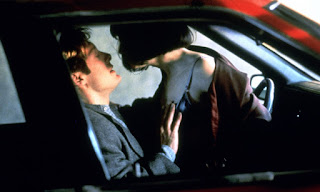
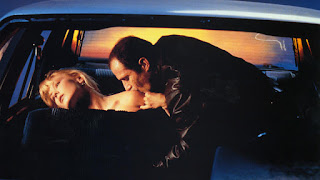
In Toronto, film producer James Ballard (James Spader) has an open marriage with Catherine (Deborah Kara Unger), and they both enjoy kinky sex with each other and with strangers. James is hurt in a head-on car collision and forced to recuperate at a hospital. He is strangely aroused by the idea and reality of vehicular carnage, and is soon having car sex with Dr. Helen Remington (Holly Hunter), who was in the other car involved in the crash. 

James, Catherine, and Helen are drawn into the strange orbit of Vaughan (Elias Koteas), a man obsessed with scars and death. In front of a live audience, Vaughan theatrically recreates famous car crashes that claimed celebrity lives. His entourage also includes Gabrielle (Rosanna Arquette), who needs braces to support severely damaged legs. A pernicious mix of arousal, sexual coupling, dangerous driving, and road crashes irresistibly draws the group together.

In adapting the J.G. Ballard book, director and writer David Cronenberg deserves some credit for going out there and looking for something new within the dark recesses of the adult human psyche, and his cast join him for a raw journey into a bizarre world. Filmed with an aloof, cold core dominated by mechanical eroticism, highways scarring cities, and traffic dominating the landscape, Crash invents a sexual fetish and runs with it.

The problem is that beyond the shock of the premise, the story has nowhere to go. The circle forming around the whacko Vaughan is too far gone to ever pause and generate sympathy. The characters are undefined and stuck in an emotional void only satisfied by pushing deeper into the invented space where crashes, scars, and sex come together. Not surprisingly the audience is left behind, somewhere between bewildered and exasperated by the incessant coupling and the concept of crunched automobiles as aphrodisiacs.

In the absence of a traditional narrative, the large blanks can be filled with any explanation. Pick from humanity subsumed by machines, crashes as metaphors for the human imperative to come together, a symbiotic cycle of machine damage causing human scars both physical and mental, and the uncomfortably close distance between flirting with death and creating life. It's all up for grabs, but all profound attempts at psycho analysis are, at best, bent out of shape.


All Ace Black Movie Blog reviews are here.

Tuesday, 28 November 2017

Movie Review: Less Than Zero (1987)


A coming-of-age drugs-and-sex morality tales, Less Than Zero oozes style but reeks of plastic music-video superficiality.

Classmates Clay (Andrew McCarthy), his girlfriend Blair (Jami Gertz), and Julian (Robert Downey Jr.) were best friends from wealthy families at their Los Angeles high school. After graduation Clay heads out to college, Blair stays in LA to pursue a modeling career, and Julian dreams of successful business investment ventures using his father's money. At Thanksgiving Clay discovers that Blair and Julian are sleeping together, and at Christmas he returns home for another visit at Blair's request.

Clay finds Julian broke, addicted, and descending into a spiral of hard drugs supplied by slick dealer Rip (James Spader). Julian is still charismatic and dreaming of his next big venture, but running on empty, and owing Rip a lot of money. Clay reconnects with Blair and they rekindle their relationship as they try to help Julian break out of his destructive cycle.

A loose adaptation of Bret Easton Ellis' celebrated book about life among LA's decadent teens, Less Than Zero is loud but exceedingly tedious. Self-consciously directed by Marek Kanievska, the film looks sumptuous, with every frame an attempted work of art, Kanievska particularly fond of symmetrical framing and glitzy hyperactive lights puncturing the LA nights. The music, for better or for worse, is the other notable achievement, Less Than Zero featuring a nonstop soundtrack of what passed for cool rock and party tunes in the mid to late 1980s.

Otherwise this is a story about teenagers attending parties and dabbling in unconstrained sex, drugs, and rock'n'roll dreams, but unfortunately the film drops to the vacuous level of its protagonists. Clay and Blair attend party after party, usually looking for Julian as he struggles through his latest drug-induced haze, only to restart the same cycle the next day. Kanievska may have intended the endless succession of parties with throbbing music and stroboscopic lights to meld into one long 98 minutes as a metaphor for lives being wasted on indistinguishable highs, but as a viewing experience, the film dances up a sweat in one place and gets nowhere fast.

Apart from the insatiable appetite for all-night parties featuring flickering mountains of monitors as the decor object of choice, the film struggles to reconcile the main character interactions with their age. Andrew McCarthy, Jami Gertz, Robert Downey Jr., and James Spader represent core and loose affiliates of the Brat Pack, and here they fail to convince as 19 year olds six months out of high school. The actors range in age from 22 (Gertz) to 27 (Spader), and the dialogue, courtesy of a Harley Peyton script, suggests thirtysomethings rather than spoiled teenagers. McCarthy comes off worst in his perpetual dreamlike state. Downey Jr. and Spader are suitably intense and slimy respectively, while Gertz is adequate.

With plenty of throbbing ostentation, Less Than Zero is not wholly negative, but it is less than meets the eye.


All Ace Black Blog Movie Reviews are here.


Friday, 25 December 2015

Movie Review: Wall Street (1987)


A dynamic, glitzy drama set in the world of super-rich investors, Wall Street is both a celebration and condemnation of capitalism's worst excesses. Oliver Stone creates a dazzling story of wealth gone mad, a playground for egotistical men where profits rule, the stakes are routinely measured in millions, and the careers of ordinary mortals are cheaply bought and discarded.

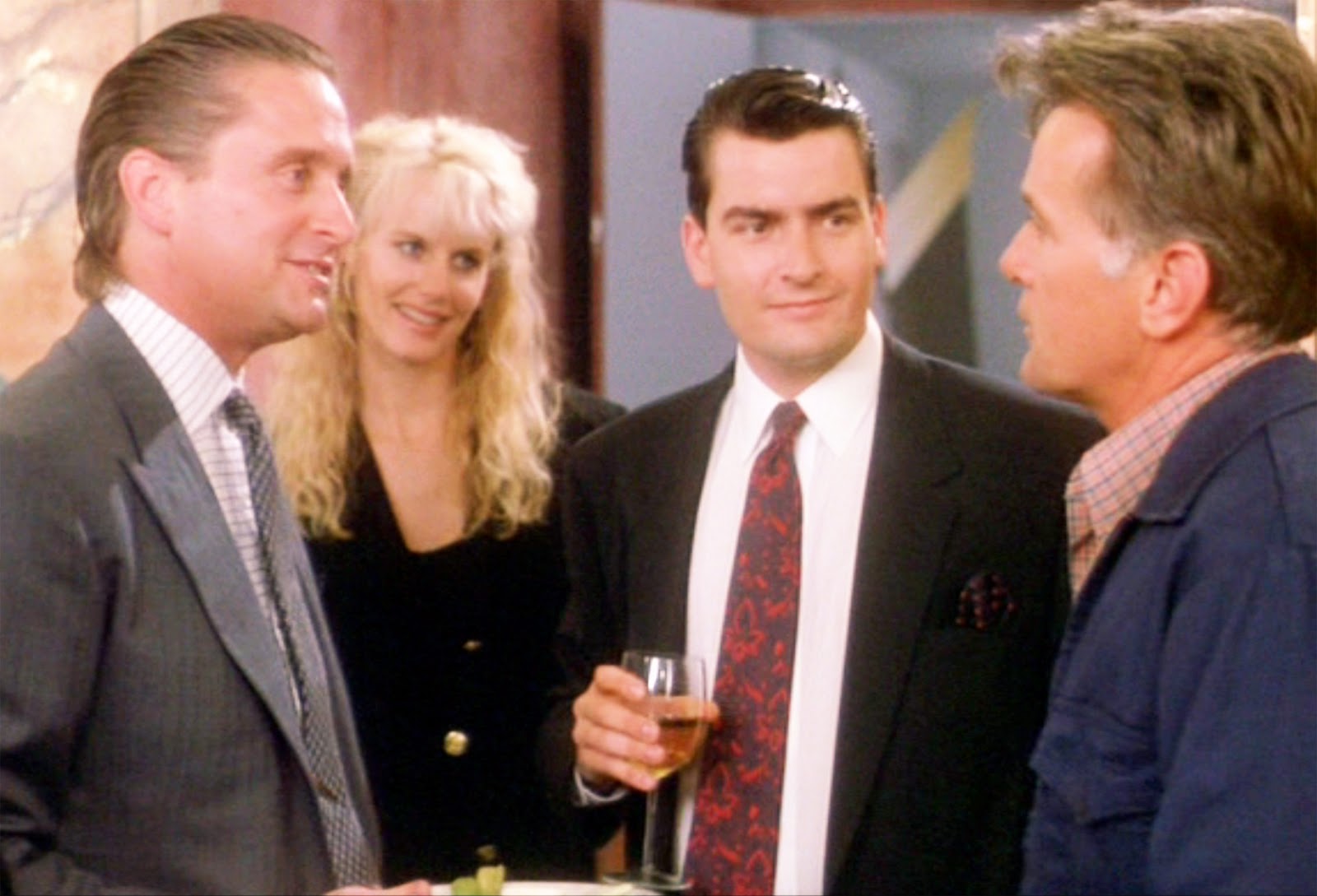
Bud Fox (Charlie Sheen) is a young but ambitious stockbroker at a middling Manhattan investment firm, still making cold calls to try and build up a client base. His father Carl (Martin Sheen) is a humble and honest aircraft maintenance crew chief at Bluestar, a fledgling airline. Bud's persistence finally pays off when he lands the extremely wealthy and ruthless corporate investor Gordon Gekko (Michael Douglas) as a client. Gekko likes what he sees in Bud, and takes him under his wing, exposing him to the power of inside information, the art of taking over corporations and breaking them up for great gains, and a world where obscene amounts of short-term profits can be derived from high-stakes stock price manipulation.

Gekko: The most valuable commodity I know of is information.

Bud's education includes meeting Sir Larry Wildman (Terence Stamp), an even wealthier investors and one of Gekko's chief rivals in the global corporate take-over game. Buoyed by success and fueled by Gekko's money, Bud starts tapping his college friends, including lawyer Roger Barnes (James Spader), to seek insider tips on upcoming mergers, and to set up bogus trading accounts to hide his activities from the Securities and Exchange Commission. Now very rich, Bud's life is fully transformed. He buys a swanky apartment and starts a serious relationship with glamorous interior designer Darien Taylor (Daryl Hannah). But when one of Gekko's upcoming deals threatens to hit close to home, Bud has to finally decide who he really is.

Gekko: What's worth doing is worth doing for money.

Fresh from the success of 1986's Platoon, director Oliver Stone moves from the jungles of Vietnam to the equally treacherous and shadowy terrain occupied by the manipulators of the global finance system. Wall Street is high-paced, magnetic and seductively glossy. Tracing the arc of  protagonist Bud Fox, Stone steps behind the curtain and into the offices of the power brokers who actually determine the winners and losers on Wall Street. It is a place both difficult to resist and absolutely corrupt, free of quaint principles related to morality and humanity, and driven solely by greed and profit.

Stone succeeds in making the world of Gordon Gekko fabulously attractive. For ambitious young men like Bud Fox, it's not difficult to be sucked into the promise of a life filled with limousines, lavish restaurants, expensive suits, glamorous women, high-end real estate and millions in the bank. It's a castle in the sky floating on high-stakes gambling with the odds tilted in favour of the Gekko's who profit from widespread malfeasance, and Stone builds up the allure with plenty of pizazz.  It's not easy to make financial transaction look exciting, and Stone pulls it off with energetic camera work and in-your-face scenes capturing the frenzy of the trading floors and the adrenaline rush of deal making in real time.

Gekko, talking to Bud: Wake up, will ya, pal? If you're not inside, you're outside, okay? And I'm not talking a $400,000 a year working Wall Street stiff flying first class and being comfortable, I'm talking about liquid. Rich enough to have your own jet. Rich enough not to waste time. Fifty, a hundred million dollars, buddy. A player, or nothing. Now, you had what it took to get into my office; the real question is whether you got what it takes to stay.

Not all of the film works perfectly. There are a couple of scenes, one between Bud and his father Carl and another between Bud and Gekko, where exaggerated emotions and shouting replace intelligent discourse. And Bud's awakening to the damage that Gekko and his ilk can cause is treated simplistically and rather abruptly. But overall, the script (co-written by Stone and Stanley Weiser) triumphs thanks to a treasure trove of sharp exchanges and observations, mostly courtesy of Gekko, that serve to define a caustic perspective on not just the world of capitalism, but the human condition itself.

The character of Gordon Gekko is an enduring symbol of the decade of greed, and Michael Douglas won the Best Actor Academy Award for creating a believable, even sympathetic, merchant of money. Gekko creates wealth, no matter the consequences, and Douglas' cold-eyed portrayal allows the character to make sense in a world where the limits of capitalism are unconstrained. Bud Fox may be the sympathetic core of the film, but Gordon Gekko emerges as its true voice, an unrepentant genius exploiting the system and selling his vision to anyone wishing to share the dividends.

Gekko, addressing an audience of corporate shareholders: The point is, ladies and gentlemen, that greed, for lack of a better word, is good. Greed is right, greed works. Greed clarifies, cuts through, and captures the essence of the evolutionary spirit. Greed, in all of its forms: greed for life, for money, for love, knowledge, has marked the upward surge of mankind.

Charlie Sheen does enough to carry Bud's journey without ever transcending the role. Daryl Hannah does well as the prestigious lover who comes with the money, unapologetic in her pursuit of the life that millions can buy. In addition to James Spader, the deep supporting cast includes roles for Hal Holbrook as a old-fashioned investor who still looks for long-term company value, Sean Young as Gekko's wife, and John C. McGinley as Bud's animated colleague, left behind when Bud moves into the stratosphere of investing.

Gekko: It's a zero sum game – somebody wins, somebody loses. Money itself isn't lost or made, it's simply transferred – from one perception to another. Like magic. This painting here? I bought it ten years ago for sixty thousand dollars. I could sell it today for six hundred. The illusion has become real, and the more real it becomes, the more desperately they want it. Capitalism at its finest.

Wall Street invests in quality film making and vigorous, character-driven storytelling, and achieves an exhilarating return on investment.


All Ace Black Blog Movie Reviews are here.


Tuesday, 9 June 2015

Movie Review: The Homesman (2014)


A pretty-to-look-at western exploring themes of survival within the desolation of frontier territory, The Homesman offers a relatively original premise and a unique perspective, but otherwise gets bogged down in lengthy stretches devoid of meaningful progression.

In the tiny western town of Loup City in the Nebraska Territory, Mary Bee Cuddy (Hilary Swank) is a wealthy single woman, looking after a homestead all by herself and still hoping to attract a husband. But her plain looks and bossy personality keep any potential suitors well away. After a long and severe winter, three married women from the small local community exhibit signs of severe mental instability due to child loss, abuse and isolation. After a plea from Reverend Dowd (John Lithgow), Mary Bee is the only person who volunteers to accompany the women on a grueling five week wagon journey to the much larger community of Hebron, Iowa, where a church can offer some medical care.

At the start of the trip Mary Bee saves the life of a grizzled loner who calls himself George Briggs (Tommy Lee Jones), and tempts him with money to accompany her. He reluctantly agrees, they pick up the sick women and set off into the wilderness. Along the way they will encounter hostile Indians and bandits, with their non-communicative, irrational and sometimes hostile patients further complicating an already difficult trek.

Directed by Jones and adapted from the book by Glendon Swarthout, The Homesman offers a rare women's view of the west. Unfolding at a slow and deliberate pace, the film presents the frontier as unforgiving and arduous, a place where women are pushed to the limits of endurance, often shouldering the full load of housekeeping, parenting and crop-tending and striving to meet the unrealistic expectations of the rough men they call husbands and fathers.

The prevailing theme is rampant emotional damage, with all the main characters in The Homesman long-term casualties of the survival grind. The men do suffer, but use sadistic or violent behaviour as an outlet. The women are only able to absorb so much before aging fast and folding within themselves. While the three wives who have psychologically collapsed can no longer conceal the trauma, Mary Bee is also battling roaring demons fed by loneliness, rejection and despair, and waiting to emerge at a time of their choosing.

As a viewing experience, The Homesman struggles to offer much beyond its relatively unique perspective. The flashbacks used to provide context around the sick wives' traumas are muddled and insufficient to draw them out as characters. Mary Bee's cargo therefore remains impersonal, and the entire film hinges on the relationship between her and George. The tension between a determined and desperate woman and a frontiersman well past caring about anything other than the money in his pocket does provide a decent narrative foundation. But rather than evolve over the course of the journey, they will both simply reveal more of their true selves, and the film settles for being an examination of two people choosing different paths to cope with the rigours of the wild west.

The film is visually beautiful, Jones and his cinematographer Rodrigo Prieto taking their time with plenty of open vista shots of an untamed west coloured by exquisite sunsets, Mary Bee's slow-moving wagon incongruously making its way through stunning but hostile and rarely traveled terrain.

In the two central roles Swank and Jones do not disappoint, and deliver solemn performances filled with the pain of past mistakes and the uncertainty of the present. In addition to Lithgow, the supporting cast also includes James Spader as a land developer who tangles with George, and a brief, late appearance by Meryl Streep, a city dweller whose calm presence provides a sharp contrast between the struggles in the territories and the relative comforts afforded in established larger communities.

The Homesman offers a journey that travels at the speed of two mules pulling a heavy wagon. It's not always graceful, but it does move ahead stubbornly, on its own terms.


All Ace Black Blog Movie Reviews are here.


Sunday, 24 May 2015

Movie Review: Wolf (1994)


The story of an American werewolf in corporate New York, Wolf shows promise as a metaphor for adults, but then loses its edge by insisting on following the childish werewolves-on-the-loose path.

Respected book editor-in-chief Will Randall (Jack Nicholson) is bitten by a wolf after a car accident in the snowy Vermont mountains. Back in New York, Will finds himself a victim of a corporate shuffle. Tycoon Raymond Alden (Christopher Plummer) is the new publishing house owner, and he demotes Will and assigns young and hungry marketing executive Stewart Swinton (James Spader) into his position. Will's life hits rock bottom when he discovers his wife Charlotte (Kate Nelligan) having an affair with Stewart.

But Will also starts to feel the after-effects of the wolf bite: his senses are amplified, he feels younger, more vigorous, and more aggressive. He meets Alden's daughter Laura (Michelle Pfeiffer), an aloof heiress, and starts to plot his revenge to reclaim his job and make Stewart and Charlotte suffer. But then Will starts to lose control of what is happening to him at night, when the werewolf within him emerges and goes hunting for blood and adventure. A brutal murder is then committed, and Will emerges as a suspect.

Directed by Mike Nichols, Wolf tries to appeal to two distinct audiences and by doing so fails them both. The first half displays promise as an analogy of the need for an emotional rebirth to survive middle age trauma, as Nichols explores the symbolism of Will discovering and then adopting wolf-like tactics to fight for his patch of the corporate and relationship jungle.

But once the film transitions in its second half to actual werewolf adventures, howlings in the night, wolves hunting deer and eventually murder and mayhem in Central Park, it veers sharply away from its intellectual premise. With this heavyweight cast there is nothing to be gained chasing special effects, blood, gore and werewolves battling each other, complete with incompetent detectives attempting to solve murder-by-wolf.

Mayhem caused by werewolves has of course been done before many times, and with much better horror and special effects, including in 1981's An American Werewolf In London. By insisting on chasing the thrill-seeking audience Wolf loses its purpose and surrenders the cerebral advantage.

Casting Jack Nicholson as a wolf is almost too easy, but he does a fine job adopting a more-is-less philosophy. Nicholson keeps Will sharp but low-key, and remains remarkably calm even when the werewolf transformations start. Laura Alden is an interesting but underwritten role, and Pfeiffer can't do much with it. More effective is Spader as the power-hungry Stewart Swinton, a shrewd natural wolf in man's clothing.

Wolf ends up being not scary enough, not gory enough, and not smart enough, as it howls at the moon of confused objectives.


All Ace Black Blog Movie Reviews are here.


Sunday, 22 February 2015

Movie Review: Pretty In Pink (1986)


A high school comedy, romance and drama wrapped into a pink package, Pretty In Pink delves into the politics of love across social class divides, and finds real teenagers grappling with the details of growing up.

Andie (Molly Ringwald) comes from a lower income family and lives on the wrong side of the tracks with her father Jack (Harry Dean Stanton), who has not yet recovered from being abandoned by his wife. Andie is clever, resourceful and takes on the responsibility of keeping her father somewhat functional. At a high school dominated by rich kids, Andie fends off the sexual advances of the lecherous Steff (James Spader), but harbours a crush on his shy friend Blane (Andrew McCarthy). Both Steff and Blane come from monied families and social norms dictate that they stay away from poor girls like Andie. Meanwhile, Andie's best friend since childhood is the extroverted Duckie (Jon Cryer). He is deeply infatuated with her, but she just considers him a reliable if sometimes annoying buddy.

Blane finds the courage to approach Andie and they start dating. Steff is incredulous that his best friend is associating with what he considers an unworthy girl, while Duckie is heartbroken that the love of his life has eyes for someone else. With the big night of the prom approaching, Andie finds herself at the centre of a turbulent romantic drama with ripple effects disturbing established expectations.

Written by John Hughes, directed by Howard Deutch, and packed with new wave music from the likes of The Psychedelic Furs, Orchestral Manoeuvres in the Dark and New Order, Pretty In Pink is a cultural milestone. It followed on the heels of Sixteen Candles and The Breakfast Club, as Hughes established himself the dean of smart high school films, with Molly Ringwald his primary muse and a generational role model. Andrew McCarthy's presence helps to classify Pretty In Pink as part of the loosely defined 1980s brat pack series of films.

The story itself is a simple riff on Romeo and Juliet, with teenage emotions exaggerated by throbbing hormones and the intensity of the high school experience. Pretty In Pink may be a touch over-scrubbed. Andie is just a shade too perfect, Blane carries a hint of white knight, and Duckie's individualistic free spirit at times reaches into comic relief territory. The ending (changed from the original intent) caters more to fairy tale fantasies rather than gritty reality.

But Hughes again demonstrates his unusually high level of respect for many his characters, with Andie, Duckie, Blane and Jack all developed into rounded people worth knowing. Even Andie's friend and boss at the mall record store Iona (a sparkly Annie Potts) benefits from creditable depth. And the characters all come to life within an efficient 96 minute package.

Through his characters and with a mix of humour and pathos driven by the thumping soundtrack, Hughes delves into some of his favourite issues, including the fuzzy borders between friendship and love, the cliques that dominate high school social interaction, and building difficult bridges across chasms of wealth and privilege. Other than Jack, this is a discovery world made up exclusively of teens, the school teachers a mere inconvenience to be navigated on the road to understanding the truths that define adulthood.

Molly Ringwald is at her best, her subtle expressions a constant source of critical embellishment. Ringwald narrows her eyes, cocks her head and purses her mouth just so, never over elaborating and always with the quizzical innocence of a mature teenager walking the tightrope towards becoming a grown-up. Andie loves pink; Ringwald adds the texture, shades and patterns to bring the one colour to cheerful life.


All Ace Black Blog Movie Reviews are here.


Wednesday, 28 January 2015

Sunday, 13 March 2011

Movie Review: White Palace (1990)


Two souls with nothing in common except the deep lingering sorrow from the devastating loss of a loved one develop an unlikely relationship.

Max (James Spader), a twentysomething marketing manager in St. Louis, is still coming to terms with the loss of his wife in a car accident. Withdrawing from the lives of his friends, he leads a lonely, somber existence, until he meets Nora (Susan Sarandon), a fortysomething working class cashier at a greasy fast food restaurant. Nora, in addition to being a fan of Marilyn Monroe, is also suffering from the loss of her 14 year old son.

Nora smokes a lot, drinks a lot and has a messy house. Max is a neatness freak and lives in a spotless apartment. But the sex is terrific, and soon Max and Nora are spending a lot of time together. She doubts that he will ever fully let her into his middle-class life, and he doubts that he has any sort of a life to let her into. While the age gap is wide, the class divide is sharper, and both Max and Nora will need to confront their own lives to give their relationship any kind of hope.

A two-person character study, White Palace works thanks to Sarandon. Playing a subtle variation on the character that would make her a legend in 1991's Thelma and Louise, Sarandon is magnetic as Nora, hiding her loss and disappointment behind obvious brassiness. Spader suffers in comparison, his lack of emotion and nuance attempting to pass as a trait of a young, naive and hurting character, but is much more likely due to limited acting ability.

A colourful secondary cast is somewhat underused, as director Luis Mandoki keeps the focus tight on Max and Nora. Kathy Bates is Max's Mom, and we mostly just hear her voice on his answering machine. Eileen Brennan is Nora's clairvoyant sister, and basically gets two scenes. Jason Alexander, before becoming famous as George in television's Seinfeld, is the most prominent of Max's friends.

St. Louis is a refreshing change from typical movie locations, and Mandoki resists the urge to overplay the city's tourist destinations.

White Palace does not overreach, and delivers on its premise: sometimes the challenges in a relationship are not the obvious and visible disparities, but the hidden and unspoken truths.


All Ace Black Blog Movie Reviews are here.