Showing posts with label Leonardo DiCaprio. Show all posts

Sunday, 4 January 2026

Movie Review: One Battle After Another (2025)


Genre: Action Thriller  
Director: Paul Thomas Anderson  
Starring: Leonardo DiCaprio, Sean Penn, Benicio Del Toro, Regina Hall, Teyana Taylor, Chase Infiniti  
Running Time: 162 minutes  

Synopsis: Bob Ferguson (Leonardo DiCaprio) and Perfidia Beverly Hills (Teyana Taylor) are lovers and members of the far-left revolutionary group "French 75". They conduct operations to free detained illegal immigrants, and in one of their raids Perfidia humiliates military officer Colonel Steven J. Lockjaw (Sean Penn). He develops an intense hatred towards the group while also lusting after Perfidia, who is soon pregnant. After giving birth to Willa she is arrested and the rest of the group members flee into hiding, with Bob looking after Willa as his daughter. Sixteen years later Lockjaw has reasons to find Willa (Chase Infiniti), triggering a mad pursuit and forcing the reluctant Bob back into action.

What Works Well: This is a high energy chase thriller, powered by an edgy political and racial premise, memorable characters, spiky humour, and an original, tense and pulsing music soundtrack. Writer and director Paul Thomas Anderson pokes fun at left and right alike, anti-government revolutionaries devolving into potheads and right-wing nut-cases wallowing in contradictions. With no middle ground, the future available to Willa is grim, as she awakens to a mother who turned traitor, a father lacking any motivation, and worst of all, she's the only high school kid not allowed a cell phone. Teyana Taylor is a force of nature as Perfidia, and the film is poorer when she is sidelined, but Benicio Del Toro fills the gap as an unflappable martial arts instructor.

What Does Not Work As Well: The running time is beyond bloated, with lax editing resulting in almost every scene running well longer than needed. And all the extra time is invested in stylistic extensions rather than the human condition: the main characters barely progress in outlook, understanding, or self-awareness.

Key Quote:
Lockjaw (in a meeting with white nationalists): Gentlemen, I have engaged the enemy face to face in battle, and in the dark alleys and shadows of espionage. I was once raped in reverse.


All Ace Black Movie Blog reviews are here.

Monday, 3 January 2022

Movie Review: Don't Look Up (2021)

An end-of-the-world satire, Don't Look Up holds a mirror to a fractured society where imminent planetary annihilation is a topic of entertainment and debate.

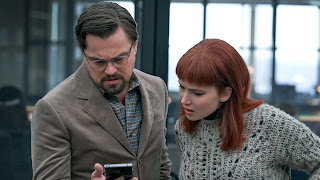
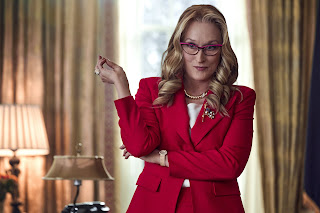
At Michigan State University, astronomy doctoral student Kate Dibiasky (Jennifer Lawrence) discovers a new large comet, with a trajectory to strike and destroy Earth in 6 months. She alerts her Professor Dr. Randall Mindy (Leonardo DiCaprio), and they are soon connected with Dr. Teddy Oglethorpe (Rob Morgan), head of the Planetary Defense Coordination Office. They are granted an audience with US President Janie Orlean (Meryl Streep) and her Chief of Staff (and son) Jason (Jonah Hill), who don't take the threat seriously.

Randall and Kate take their story to the media, landing at the top-rated television show hosted by Brie (Cate Blanchett) and Jack (Tyler Perry). Brie's main takeaway is that Randall is a dishy scientist and she sets out to seduce him. Meanwhile the end-of-the-world threat starts to cause panic, but also political divisions, with the science being questioned. When powerful cellular phone and social media tycoon Peter Isherwell (Mark Rylance) announces the comet contains precious minerals worth trillions, attempts to destroy it are abandoned in favour of trying to exploit the riches, causing further divisions between sidelined scientists and power-hungry politicians.

Both the funniest thing and the scariest thing about Don't Look Up is that it's all too real. Sure, writer and director Adam McKay cannot resist triple-underlining some of his satirical jabs, but unlike in his previous outing, here the glib attitude is controlled and the hits well outnumber the misses.

The premise of a massive comet about to strike Earth may well be the next cataclysmic event facing humanity, but could also stand in for climate change, the next pandemic, or any other large casualty threat. With recent history as an excellent guide, the reactions portrayed in Don't Look Up are more than believable. Memes, ratings, personal attacks, personality cults, denial of science, obfuscation campaigns, political calculus, and profit motives overwhelm the simple truth, inflicting unnecessary death in large numbers.

In a manic example of cramming more as a representation of what counts as important, side-plots and intentional distractions litter the film, some funnier than others. Brie cannot wait to claim Randall as a sexual conquest, threatening his marriage to June (Melanie Lynskey). President Orlean is embroiled in an ever-worsening scandal related to her Supreme Court appointee (Erik Parillo). A politically incorrect pilot (Ron Perlman) leads the initial suicide mission to the comet. After being shunned by the world and having the comet named after her, Dibiasky befriends skater dude Yule (Timothée Chalamet). And most notably, pop star Riley Bina (Ariana Grande) is going through a romantic break-up and reconciliation, a story deemed much more important than the impending end of the world.

A dream cast sharpens all the satirical angles. Despite the abundant talent pool at his disposal, McKay finds meaningful and memorable roles for each, helped by the long 138 minutes of running time. Leonardo DiCaprio has fun as an anxiety-wracked scientist suddenly thrust into the spotlight and labeled an AILF (Astronomer I'd Like to F**k). Mark Rylance is the other stand-out as the truly creepy (no eye contact) tech tycoon holding all the true power, his line delivery a study in understated bludgeoning. Less successful is Jonah Hill as the nepotistic appointment who actually believes he is smart, his contributions rarely clicking.

Openly flirting with species-get-what-they-deserve resignation, Don't Look Up is depressingly funny. 


All Ace Black Movie Blog reviews are here.

Thursday, 30 April 2020

Movie Review: The Beach (2000)


A story of adventurism seeking docile fulfillment, The Beach succeeds with themes and visuals but fails in creating worthwhile characters.

Richard (Leonardo DiCaprio) is a young American seeking adventure in Thailand. At his hotel he notices the attractive Françoise (Virginie Ledoyen), but she is with boyfriend Étienne (Guillaume Canet). Richard next encounters the unhinged Daffy (Robert Carlyle), who speaks of a secret beach paradise located on an isolated island, and leaves Richard a map to follow. Richard convinces Françoise and Étienne to join him on a quest to find the beach but also reveals the secret map to another group of tourists.

After a long trek and swim, the trio traverse a marijuana plantation protected by armed guards. They then find the idyllic and stunningly beautiful lagoon with a small community of like-minded people from around the world living nearby, led by Sal (Tilda Swinton). Richard luxuriates in a life of idle nothingness and pursues a relationship with Françoise, alienating Étienne, before unexpected events disrupt this version of paradise.

Fully investing in rich visual beauty, The Beach explores the desire to seek what few others have found. What lies at the end of the rainbow and the human propensity to ruin every unspoiled patch of earth is the subject of the John Hodge script, adapting Alex Garland's book. Danny Boyle directs with a here-and-now emphasis, Richard's story dispensing with background and context and just assuming a generational malaise driving a search for exclusivity.

The film works at the personal level as a cautionary tale about the youthful pursuit of an abstract utopia, an escape from social norms where love and beauty are easily acquired for next to no cost. For all his drive to find unique adventure Richard appears content to settle in a place where every day is like every day until the beach starts to reveal its physical and mental dangers, severely disrupting any sense of permanent vacation.

The Beach also functions as a pointed metaphor for foreign intervention and meddling in ancient lands. Sal's community is made up of Americans and Europeans occupying a slice of heaven in Asia, and the foreigners never stop to consider the impact of their actions on the land they are exploiting for selfish fantasies. Needless to say it all threatens to end badly, Richard's personal actions and the group's broader self-indulgence contributing to a fall from this occupied Eden.

But with flat and selfish characters in every corner, ultimately The Beach only dips its toes in any sense of emotional investment. Richard and his fellow adventurers offer nothing beyond the pursuit of an egotistical ideal where leisure is the only objective and success is measured by the achievement of hedonism. As the final act starts to unravel into mythical sidequests, the absence of any sense of empathy and responsibility eats away at the heart of the film, and it's no great loss when the community frays when confronted by hardship.

Leonardo DiCaprio fulfils the objective of cavorting shirtless most of the time, and generally keeps Richard centred on the relentless pursuit of the same uniqueness as everyone else. The rest of the underpowered cast cannot escape the suffocating but beautiful sands of characters checking out of society, only to discover the exceptionally fleeting pleasure of dropping out.


All Ace Black Blog Movie Reviews are here.


Sunday, 19 April 2020

Movie Review: J. Edgar (2011)


A biography of the legendary FBI Director, J. Edgar sparkles in patches but otherwise wallows in the greyness of a secretive personality.

In a rather clumsy narrative device, most of the film's events unfold in flashback as Hoover (Leonardo DiCaprio) recounts key events to a young agent. In 1919, Hoover's mentor Attorney General Palmer narrowly escapes an assassination attempt. Placed in charge of finding the perpetrators, Hoover establishes his reputation at the Bureau of Investigation by clamping down on criminals he perceives as anarchists and communist agitators. Even as he matures Hoover remains deeply influenced by his domineering mother Anna Marie (Judi Dench). He romantically pursues secretary Helen Gandy (Naomi Watts) but she only wants to focus on her career and becomes his permanent confidential assistant.

The 1932 kidnapping of celebrity aviator Charles Lindbergh's baby son grabs the nation's attention, and Hoover argues for increased money and resources for a politically independent national crime fighting agency. In 1935 he is appointed the first head the new Federal Bureau of Investigation, and proceeds to create a professional organization using increasingly scientific methods to combat crime. New college graduate Clyde Tolson (Armie Hammer) is one of the agents recruited by Hoover, leading to a lifelong friendship - and more - between the two men. As his career progresses Hoover builds a collection of secret files, and uses his knowledge of sordid personal details to maintain his grip on power under a succession of United States Presidents.

Hoover was in charge of the FBI and its predecessor agency from 1924 until his death in 1972, a total of 48 years. Dedicated to crime fighting and an expert at consolidating power and navigating around politicians, Hoover was an enigma, a master at keeping and using secrets, and as such a most difficult man to decipher.

Director Clint Eastwood, working from a script by Dustin Lance Black, has a go at finding the human being behind the legend. Despite a mammoth length of 140 minutes, the film is only partially successful. Eastwood bathes the screen in the grey and pale brown of government bureaucracy, and initially gives about equal time to crime fighting and personal insights. But when tackling Hoover's character, J. Edgar first suggests an overbearing mother with her claws deep in her son's psyche then sinks too far and too deep into the mud of the relationship between Hoover and Tolson.

Rumours of Hoover's homosexuality have long swirled around his legacy, and here Eastwood portrays a deep friendship and long-lasting companionship, underpinned by Hoover resisting the expression of a present love, leaving Tolson more tortured than content until it's too late.

Regardless of how much truth resides in this version of the relationship between the two men, the lovers' subplot becomes the overriding obsession of the film, dramatically detracting from any other aspect of Hoover's life. In the film's final act professional machinations at the FBI are relegated to interruptive snippets, the crime fighting almost forgotten. And overall, after the Lindbergh case Eastwood generally loses interest in the FBI's activities and how Hoover shaped them in favour of some quick and dirty arrest recreations and conversations about secret files used to cow Presidents into staying out of Hoover's hair.

The film requires Hoover, his assistant Helen Gandy and Tolson to age about half a century, with a decision made to have DiCaprio, Watts and Hammer play the characters throughout. It's a huge ask from the makeup department, and they generally fail. DiCaprio can play young but as an old man is never anything other than DiCaprio in bad old man makeup. Hammer suffers mightily, his aging transforming him into a survivor of a cinematic zombie apocalypse, and that's before a severe health crisis befalls the character. Watts emerges with the least amount damage, her aging portrayed relatively realistically and with grace.

With unmistakable quality on both sides of the camera J. Edgar sustains its weight, but not without evidence of sagging.


All Ace Black Blog Movie Reviews are here.


Sunday, 19 January 2020

Movie Review: Once Upon A Time...In Hollywood (2019)


A comedy-drama, Once Upon A Time...In Hollywood lovingly recreates a slice of time and place but is also inexcusably flabby and lacking in narrative purpose.

In Hollywood of 1969, Rick Dalton (Leonardo DiCaprio) is struggling to find acting work. He used to be a television western series star working with his best friend and stunt double Cliff Booth (Brad Pitt), but Rick failed in his attempted transition to big-screen roles. Now he is reduced to guest-starring on television shows, although agent Marvin Schwarz (Al Pacino) offers him the chance to star in Rome-filmed Spaghetti Westerns. Rick is also dealing with the ignominy of losing his driver's licence due a drinking problem, with Cliff now driving him everywhere.

Rick is neighbours with celebrated director Roman Polanski and his wife actress Sharon Tate (Margot Robbie). She is enjoying her burgeoning stardom and spends an afternoon at the movies watching one of her recent films. Meanwhile as Rick shoots his latest television guest role, Cliff stumbles upon the hangout of the creepy Charles Manson cult at the isolated ranch of his old buddy George Spahn (Bruce Dern).

Featuring a series of vignettes rather than a cohesive plot, Quentin Tarantino writes and directs an ode to an era. 1969 is an assassination-weary inflection point as hippie idealism transitions to 1970s cynicism, with the horrors perpetuated by the Manson maniacs bringing death to the heart of Hollywood. Tarantino uses the looming threat of murder as a backdrop, but otherwise is more interested in celebrating the friendship between Rick and Cliff.

Their bond is the heart of the film, two men with their best days behind them and now confronting fading career prospects, but doing it together. Rick has good and bad moments filming the television pilot, both disappointing and surprising himself before taking a crack at the Italian movie industry. Cliff stands by his friend through thick and thin, picking up scraps of work but mostly supporting Rick because he has essentially nothing else to lean on.

Rick's struggle to accept his career trajectory is an intermittent theme. His drinking and denial get in the way of any positive initiative for transformation, although sparks of pride and talent point to a potential path towards redefinition.

The Sharon Tate chapter stands alone, and is a bittersweet and mostly dialogue-free tribute to an actress delighted by the prospect of her own success. The Manson cult menace intrudes onto both storylines starting with Cliff's visit to the Spahn Movie Ranch, the film's best scene featuring the stuntman infiltrating a twilight zone occupied by lost souls.

Tarantino prolongs the essentially plotless film to a wholly unnecessary 161 minutes. Most scenes are artificially stretched prompting a dance with tedium, and many sequences (hello Bruce Lee and Steve McQueen) are quite pointless. The quest for grandeur is misguided and frequently deflates the film's momentum.

Visually the film is drenched in stark California sunlight, and the production design is excellent in recreating Los Angeles circa 1969 without relying on digital gimmicks. DiCaprio, Pitt and Robbie occupy their roles with relaxed confidence.

The subversive climax features the usual Tarantino outburst of violence mixed with a mean streak of humour, here slightly less bloody than usual but still featuring dollops of gore. Once Upon A Time...In Hollywood expresses a genuine love for the town where movies live, but the good intentions suffer from fundamental narrative fragmentation and plenty of egotistical oversaturation.


All Ace Black Blog Movie Reviews are here.


Sunday, 5 June 2016

Movie Review: Catch Me If You Can (2002)


A light-hearted chase drama inspired by real events, Catch Me If You Can is treat for the eyes and the mind. The story of master con artist and cheque fraudster Frank Abagnale Jr. is a breezy tale told with a bouncy spirit.

In New York of the early 1960s, 16 year old Frank Abagnale Jr. (Leonardo DiCaprio) grows up idolizing his father Frank Sr. (Christopher Walken), an independently-minded businessman who constantly runs into money problems. When Frank Sr.'s marriage to passionate Frenchwoman Paula (Nathalie Baye) falls apart due to his financial difficulties and her infidelity, Frank Jr.'s life is shattered and he goes on the run. Having inherited his father's instincts for charming people into parting with money, Frank survives by cashing fraudulent cheques at various banks.

Frank Abagnale Sr.: Two little mice fell in a bucket of cream. The first mouse quickly gave up and drowned. The second mouse, wouldn't quit. He struggled so hard that eventually he churned that cream into butter and crawled out. Gentlemen, as of this moment, I am that second mouse.

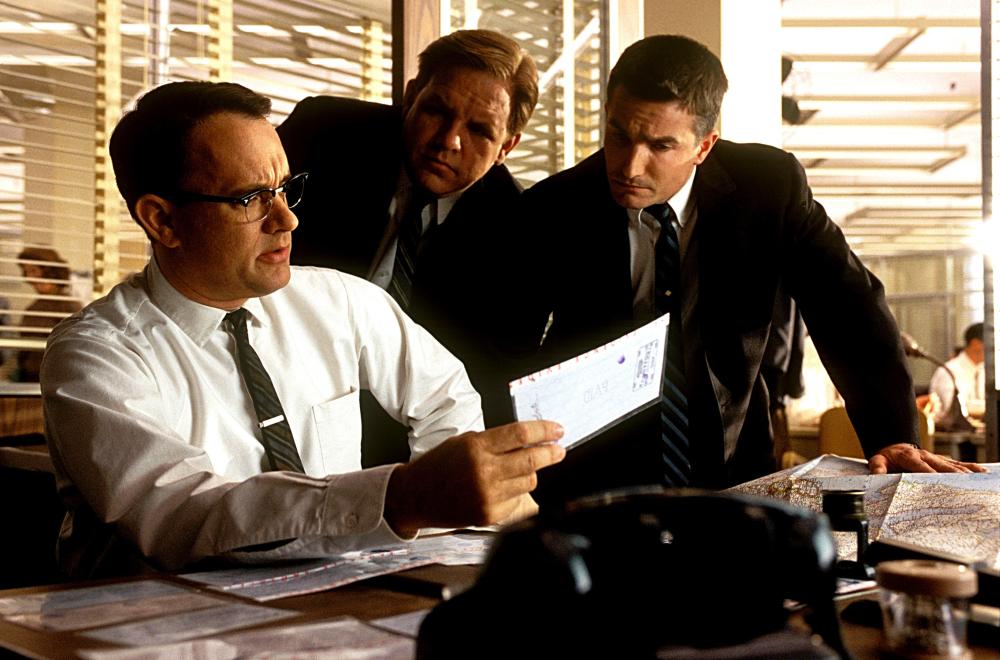
Wanting more, driven by a desire to recover all that his Dad lost, and appreciating the power of a slick uniform, Frank pretends to be a Pan Am co-pilot. He starts forging payroll cheques, and is soon flying around the country, amassing a fortune in cash, and leaving a long trail of victimized banks in his wake. His exploits grab the attention of FBI bank fraud agent Carl Hanratty (Tom Hanks), who starts a years-long pursuit. But the FBI man is always half a step behind the con artist, and Frank has more tricks up his sleeve and new personas to disappear into.

Directed by Steven Spielberg and based on the book by the same name co-written by Abagnale, Catch Me If You Can is an engaging, remarkably entertaining film. Approximately 80 percent based on reality (according to Abagnale himself), the film focuses on one kid on the run possessing extraordinary self-confidence and one dour FBI agent determined to catch up to him. By avoiding all buddy movie and action cliches that could have crept into the narrative, Spielberg and his screenwriter Jeff Nathanson produce an original, funny and character-driven film, with the momentum generated by intellect and the human condition.

Frank Sr.: You know why the Yankees always win, Frank?
Frank Jr.: 'Cause they have Mickey Mantle?
Frank Sr.: No, it's 'cause the other teams can't stop staring at those damn pinstripes.

It's takes a perpetrator and a victim to run a successful con, and the film delights in showing the various ways Frank is able to either get what he wants or escape from sticky situations using confidence and the razzle dazzle of image and props. He's both the struggling mouse and the Yankees in pinstripes. Whether it's a Pan Am pilot's outfit, a doctor's white coat, a shiny pendant, or a wallet full of junk, he distracts and sweet talks in equal measure. He succeeds to the tune of millions in cash, even conniving to get a high class call girl to pay him for a night of pleasure.

Compared to real events the film overplays the two key relationships in Frank's life, and that's quite excusable because Spielberg knows what makes a good screen drama. Frank is provided with regular touch points with his father, whose life is on an endless downward spiral that only he fails to see. Frank Jr.'s motivation is to set all that went wrong in his dad's life, but for Frank Sr. the struggle is the life, and he takes joy not in escaping the bucket, but watching his son churn for another day.

The in-pursuit relationship between Frank and Carl is also enriched for cinematic purposes (and to provide Tom Hanks with more to do). The film features Christmas time phone calls between the two men to affirm the emptiness and broken homes they share, and to build a bond that comes to fruition in the final act.

Leonardo DiCaprio and Tom Hanks are both excellent, smoothly building complex characters continuously longing for something just out of reach. Christopher Walken gives Frank Sr. the doomed air of a smart man determined to fight a system that merciless crushes him into nothingness, but that is no reason for him to stop the fight.  The rich cast also features small but telling roles for Martin Sheen, James Brolin, Amy Adams and Jennifer Garner.

Catch Me If You Can features a stunning throwback opening credit sequence by Kuntzel+Deygas that recalls the best of Saul Bass. A whimsical, curious John Williams progressive jazz music score enhances the 1960s vibe.

Cool, creative and captivating, Catch Me If You Can is a cat and mouse game at its finest.


All Ace Black Blog Movie Reviews are here.


Saturday, 6 February 2016

Movie Review: Gangs Of New York (2002)


A raucous story of revenge among the rabble, Martin Scorsese's Gangs Of New York is impressive but also overwrought, more a visual treat than a cerebral triumph.

New York City, 1846. At Paradise Square in the poor and crime-ridden Five Points neighbourhood, rival gangs square off for a grand battle with rudimentary but lethal weapons. The Natives are led by William "Bill the Butcher" Cutting (Daniel Day-Lewis), and consider themselves rightful residents and true Americans. The Dead Rabbits are more recent Irish Catholic immigrants, inspired by "Priest" Vallon (Liam Neeson). The Natives win the battle, and Bill kills the Priest. Vallon's son witnesses his father's death and escapes.

16 years later, the grown-up Amsterdam Vallon (Leonardo DiCaprio) returns to the old neighbourhood, seeking revenge. Bill The Butcher is now the undisputed king of Five Points, controlling all crime activities, as well as the law in the form of officer Jack Mulraney (John C. Reilly). Bill, who still despises new immigrants, has also forged an uneasy alliance with politician Boss Tweed (Jim Broadbent), who is more welcoming of new arrivals as potential voters.

Amsterdam starts a relationship with professional thief Jenny Everdeane (Cameron Diaz) and becomes a trusted advisor to Bill even as he plots to kill him. But with the civil war raging and a military conscription draft about to be imposed, there is growing unrest on the streets of New York City, and Amsterdam's quest for Bill's blood will encounter some surprising twists.

Gangs Of New York delves into a slice of history almost lost in the shrouds of time. The social anarchy of Manhattan's poor neighbourhoods between 1846 and 1862 is now all but erased from collective memory, socially and metaphorically eradicated, built upon and transformed into a modern multicultural metropolis teaming with tourists.

But this is where Scorsese goes looking for the origins of American civility and democracy, and identifies Five Points as ground zero for cultural accommodation, a place where natives and newcomers (both relative terms) squared up to each other and literally engaged in slaughter before concepts of civilized discourse seeped down to street level. In parallel the nation was defining its soul in the bloody Civil War, a conflict that may as well have been occurring on another planet as far as Five Points residents were concerned. Eventually the national and local civil wars intersect in the orgy of violence known as the Draft Riots, and the bloodletting nudges the City towards understanding its future destiny.

The film boils down the intriguing social context to a simple story of revenge, and while compelling in its intensity, the story goes marginally too far in personalizing history. Amsterdam's lust for vengeance is a relatively small story to carry a 160 minute film, and other than the magnificent sets, Scorsese cannot build much around it. Amsterdam is dour and Bill The Butcher is larger than life, but otherwise the film is surprisingly devoid of any memorable secondary characters, sub-plots, or even noteworthy incidents. The likes of Cameron Diaz, John C Reilly and Jim Broadbent are too often reduced to shallow representations, and Liam Neeson's seemingly interesting Father Vallon is knocked-off early.

But when the story gets bogged down, there is always something compelling to look at. Gangs Of New York is extraordinary as a set design feast. Recalling the lavish era of Hollywood reproducing history on sound stages, the imagined New York City of the 1860s was recreated at Rome's Cinecittà studios. The film looks gorgeous, a cross between theatrical set-piece and crime-infested but irresistible Les Misérables inspired nightmare.

Diplomacy only prevails when thugs get tired of killing, and even the Gangs Of New York start to understand that a history of greatness will only be achieved when the blood-letting ceases, and other, still imperfect tools, like voting, start to take hold. The one spectacular celebration of violence arrives early in the form of the blood thirsty rumble in the square. Once victory is proclaimed and the bodies are cleaned up, the film settles down to a long, drawn-out and colourful story of a young man seeking self-defined justice but also finding himself in danger of falling under the spell of his prey. DiCaprio and Day-Lewis, moody and flamboyant respectively, are more than capable of carrying the film, and Gangs Of New York rides their talent to a rousing ending that, while still victimized by indiscriminate violence, carries echoes of a personal and national history finally taking shape.


All Ace Black Blog Movie Reviews are here.


Thursday, 4 February 2016

Movie Review: The Revenant (2015)


An epic story of survival in the wilderness, The Revenant is a stunningly beautiful western exploring the limits of human endurance against a backdrop of frontier barbarism.

It's 1823, and a scrappy team of fur trappers deep in the barely explored territories of the northern Louisiana Purchase is attacked and mostly slaughtered by natives. A small group of trappers escapes the massacre, including experienced hunter Hugh Glass (Leonardo DiCaprio), his half-native son Hawk (Forrest Goodluck), the greedy and selfish John Fitzgerald (Tom Hardy), young trapper Jim Bridger (Will Poulter), and Andrew Henry (Domhnall Gleeson), the leader of the party.

Glass is inspired by visions and memories of his deceased wife (Grace Dove), and starts to guide the party overland towards Fort Kiowa. But Fitzgerald, who is living with the scars of being partially scalped by natives, challenges his leadership at every step. Meanwhile, a native chief and his men are searching in the same area for Powaqa, a native woman kidnapped by a party of French explorers.

While out scouting ahead of his group, Glass is attacked and badly mauled by a grizzly bear and scarcely hangs on to life. Henry leaves him in the care of Fitzgerald, Hawk and Bridger, who promise to give him a decent burial once he expires. But Fitzgerald had ideas of his own, and Glass is abandoned in the wilderness, badly hurt but very much alive. He embarks on a long journey back to a semblance of civilization, his determination to stay alive despite the harsh elements fuelled by a burning desire to seek revenge.

The Revenant is a grim, ferocious western, a story of individual survival in an untamed land. Directed by Alejandro González Iñárritu and running for a surprisingly swift 156 minutes with relatively little dialogue, the film is a feast for the eyes and a challenge for the mind, offering a raw beauty but also unrelenting and almost physically exhausting to watch. For the men carving a path in uncharted territories, every step is a struggle, and every encounter with man, beast or nature a potentially existential battle.

Loosely inspired by the real adventures of fur trapper Hugh Glass, the story is a deglamourized view of how the west was explored. Men expire suddenly and sometimes in large numbers, and the deaths are often gruesome, bodies left behind with no semblance of dignity. Encounters with natives are mostly wordless. Sometimes a common humanity is found; more often killing comes first, followed by a startling absence of emotion. And nature still dominates, whether through a blanket of uncompromising winter eager to consume men's feeble attempts to exploit the land, or with wild animals stomping their turf and blithely dismissing human competition.

Filmed in British Columbia and Alberta, The Revenant is visually stunning. Iñárritu and cinematographer Emmanuel Lubezki capture imposing vistas of winter in the wild, for the most part ignoring CGI and embracing the harsh reality of the frontier. The actors and crew famously battled deep-freeze temperatures and filming was limited to one hour at dusk, infusing the film with sunset hues and a genuine sense of end-of-the-day cold exhaustion. Lubezki's cameras are just as impressive in close-up shots, with plenty of point-of-view perspectives and fluid movements circling the characters as they confront the unforgiving landscape.

Leonardo DiCaprio dominates the film with a dedicated performance filled with passion and intensity. His version of Hugh Glass is a man of few words but plenty of resources and an unrivalled devotion to survival. The rest of the cast members are often difficult to differentiate, buried beneath layers of grey rags, bushy beards and thick accents.

The Revenant's main theme is life and death walking close together. For the trappers, explorers and natives, nature offers life and demands death in return. Glass' encounter with the bear pushes him into the clutches of annihilation, but the film treats existence as a binary condition, either alive or not, and with Glass life persists. Enraged by a sense of injustice and equipped with exceptional survivalist skills, he will have another, almost metaphorical encounter with an animal, this time simulating a full rebirth.

Glass works his way back to an approximation of functional health and achieves dominion over life and death, this time with the power to decide whether man or nature get the final say. The fragile journey of a father and husband from near extinction to mastery over man's fate is the story of humanity, where savagery and compassion compete for the evolutionary space within.


All Ace Black Blog Movie Reviews are here.


Saturday, 27 June 2015

Movie Review: Blood Diamond (2006)


A geopolitical action drama about the trade in African war zone diamonds, Blood Diamond is a masterpiece. With remarkable fluidity and through an engrossing story, the film delves into the multiple woes inflicted on Africa in the name of greed, power and the chase for personal fortunes.

In Sierra Leone, the family of fisherman Solomon Vandy (Djimon Hounsou) is shattered by the raging civil war. Solomon is enslaved by the brutal Revolutionary United Front (RUF) and put to work in a diamond mine. His son Dia is also eventually captured by the RUF and transformed into a child soldier. While working in the mine, Solomon finds a rare large pink diamond. In the chaos caused by a government troop attack, he hurriedly manages to bury it.

Danny Archer (Leonardo DiCaprio) is a scrappy arms dealer who illegally trades weapons for diamonds, and then exports the gems out of neighbouring Liberia. Born in what was Rhodesia, orphaned at an early age and trained by South Africa's apartheid army, Danny is cynical about the prospects of Africa ever breaking out of the violence cycle. When his latest deal goes bad, Danny spends the night in jail where he crosses paths with Solomon and hears about the large pink diamond. Danny also meets journalist Maddy Bowen (Jennifer Connelly), who is investigating how the illegal trade in diamonds helps to finance Africa's civil wars.

With the RUF gaining in strength and attacking the capital Freetown, Danny pressures Solomon into showing him where the buried diamond is. In return Danny promises to help find Solomon's family. As the country disintegrates into chaos, South African mercenaries enter the conflict to try and seize control of the mines. Danny relentlessly pursues the diamond, Solomon remains intent on reuniting with his family, and Maddy realizes that Danny has all the information she needs to link Africa's agony with the international diamond trade.

Directed by Edward Zwick, Blood Diamond is an example of how to expertly construct a beautiful message film. The Charles Leavitt script tackles not only blood diamonds but also the horror of child soldiers, the agony of mass civilian displacement and the continuous anarchy of violence that grips Africa, and does it through a provocative story that ties international consumerism with the convulsions of a continent in turmoil. Blood Diamond is never preachy, but through its human-centred and action-packed narrative, its makes its points with devastating power.

At 143 minutes, the film has epic ambitions, and it does not disappoint. Against a canvass of multiple themes, the focus on just the three characters works remarkably well. Archer as the cynical mercenary both benefiting from and perpetuating turmoil, Solomon as the local victim caught up in the greed of other and Maddy as the idealistic but determined foreign observer provide plenty of opportunities for Zwick to vigorously chase after the threads that come together in the mines, villages and cities of Sierra Leone.

The action set-pieces are delivered with explosive bombast. Highlights include the RUF's attack on Freetown and the mercenary army's helicopter pummeling a diamond mine, in both cases Zwick capturing what it means to be caught up in the chaos of a battle zone. Cinematographer Eduardo Serra and the understated but poignant music by James Newton Howard contribute to the majesty of Africa's landscape and misery of squalor, death and destruction.

But for all the weaponry and brutality on display, Blood Diamond is much more about story than action. This is a lament about a continent blessed with beauty and natural resources but cursed with conflict, barbarism and death. The script spares no villains, and points fingers at international corporations, outside meddlers, local governments, barbaric revolutionaries, internal strife and unadulterated greed. The uniforms on all sides are different and range from suits to ragtag fatigues, but their actions have the same outcomes and harm the same victims, men, women and children displaced, enslaved, militarized, hacked and killed.

Leonardo DiCaprio delivers one of his career-best performances as Danny Archer. DiCaprio sustains a cocky Rhodesian / South African accent and attitude, an African man who has personally experienced the worst that the continent has to offer and in return is contributing to its decline. Djimon Hounsou as Solomon is equally authoritative as Archer's counterpoint, a simple man who survives on pure optimism about his family's future. Jennifer Connelly does her best in the lesser role of journalist Maddy Bowen, a character that required more grime, less glamour and more pragmatism than the script was able to offer.

The film's themes are captured in two simple metaphors, the acronym TIA (This Is Africa) and the red soil that feeds the continent and hides its riches. Before his quest for the large diamond is over, Danny Archer will understand his true role in both. Blood Diamond is an absorbing experience, an eloquent yet hard-hitting exploration of the agonizing tragedies afflicting a continent and shaming the world.


All Ace Black Blog Movie Reviews are here.


Thursday, 23 October 2014

Movie Review: The Quick And The Dead (1995)


A western with all the style and none of the substance, The Quick And The Dead is filled with clever artistic touches but is also well short when it comes to essential elements like rounded characters and plot depth.

In the small town of Redemption, former outlaw John Herod (Gene Hackman) rules over the population with an iron fist as a self-appointed sheriff, judge and executioner. The Lady (Sharon Stone) rides into town seeking revenge against Herod for an ancient wrong, and registers to participate in an annual quick draw gunfight elimination contest, hoping to give Herod his due. The other entrants include gunslinger Ace Hanlon (Lance Henriksen), bounty hunter Clay Cantrell (Keith David), and The Kid (Leonardo DiCaprio), who claims to be Herod's son. Herod also forces his former partner in crime Cort (Russell Crowe) to join the contest.

Cort has renounced violence and become a priest, but Herod is having none of it, holding Cort in shackles and forcing him to participate in the gunfight series or die. As the contestants are thinned out through successive and increasingly deadly duels, The Kid, The Lady and Cort emerge as the main challengers looking knock Herod off his perch. But beating the old man at his own brutal game will not be easy.

Directed by Sam Raimi and co-produced by Stone, the film is notable for featuring significant pre-stardom roles for DiCaprio and Crowe, both promoted and supported by Stone. In a case of too many ideas all poorly developed, the film tries, with limited success, to be an amalgamation of relevant classic western themes, including revenge, corruption, betrayal, profiteering, redemption and the struggle between religion and the gun.

But Raimi does deliver on all the required aesthetics. The Quick And The Dead looks gorgeous, from Stone's layered clothes to the town's simple layout. The camera angles are often brilliant, the gunfights are filmed with plenty of panache, and the town's clock tower stands witness to all manner of courage and death on the dusty main street. There are plenty of Leonesque touches, from tight close-ups of the eyes to the long dusters used by Herod's men, plus a few special Raimiesque flourishes when it comes to portraying bullet damage.

But The Quick And The Dead is missing almost everything else. The characters are presented in broad brush format, the backstories are rudimentary, the dialogue is a barrage of recycles clichés, and The Lady's revenge motive is borrowed wholesale from Once Upon A Time In The West.

The plot is reduced to a series of successive gunfights, the film falling into the trap of too many punchlines and not enough set-up. Any showdown moment loses its impact when repeated endlessly, and The Quick And The Dead has too many moments when one gunfighter is quick, and the other dead.


All Ace Black Blog Movie Reviews are here.


Wednesday, 15 October 2014

Movie Review: The Departed (2006)


The film that finally delivered the Best Director Academy Award to Martin Scorsese, The Departed is a slick police drama centred on an epic battle to wrest control of Boston's underworld away from an entrenched mobster lord. A stellar cast helps to balance the film's more overwrought elements.

Frank Costello (Jack Nicholson) is the head of Boston's largest criminal syndicate, brutally engaged in grand scale extortion, trafficking and wanton violence. Police Captain Queenan (Martin Sheen) and his deputy Staff Sergeant Dignam (Mark Wahlberg) spot an opportunity to infiltrate Costello's empire by inserting new police graduate Billy Costigan (Leonardo DiCaprio) as an undercover mole. Billy is from the wrong side of town, and a manufactured criminal record as well as his chequered family history eventually gain him entry into Frank's inner circle.

Costello: I don't want to be a product of my environment. I want my environment to be a product of me.

But Frank has his own agent working inside the police department. Staff Sergeant Colin Sullivan (Matt Damon) is considered by his boss Captain Ellerbyone (Alec Baldwin) to be of the brightest officers on the force, but Sullivan is on the criminal payroll and ensures that Frank stays one step ahead of enforcement efforts to nab him. First Sullivan and then Costigan get romantically involved with psychologist Dr. Madolyn Madden (Vera Farmiga). With Costigan beginning to buckle under the tension of his double life, both Costello and Queenan come to the realization that there are moles within their organizations, leading to a ferocious settling of the scores.

FBI Agent Lazio: Do you have anyone in with Costello presently?
Dignam: Maybe. Maybe not. Maybe fuck yourself. My theory on Feds is, they're like mushrooms: feed them shit and keep them in the dark.

Written by William Monahan as an adaptation of the 2002 Hong Kong film Internal Affairs, The Departed is hard-hitting, loud and drenched in testosterone. At 151 minutes the film is probably a good half hour too long, and the second half bogs down in a seemingly endless find-the-mole pursuit driven by justified paranoia. But The Departed overcomes its weaker points thanks to a grim attitude of survival at all costs, with the characters of Costello, Costigan and Sullivan playing dangerous games of deception to further their careers in an uncaring world.

Costello: One of us had to die. With me, it tends to be the other guy.

Scorsese creates a world where men rule with incessant shouting, intimidation and cursing, and proceed to create spectacular messes. The police department is a cesspool of competing agendas and mistrust, and Frank Costello's criminal empire is barely held together by the iron will of one man who sees enemies everywhere. The agencies on both sides of the law appear equally dysfunctional and distasteful. Dr. Madden is the only woman of relevance in the cast, and she seems off-centre and out of place, getting in the way of the men's ruinous agendas.

The script is a treasure of caustic one liners. Before the guns are drawn (and eventually they are, in large numbers), the characters of The Departed fire ballistic words at each other. No calm sentence will do when it can be replaced by a fine-tuned verbal barrage, and Monahan excels at creating enduring quotable exchanges. In the hands of an exceptional cast, The Departed becomes an intellectual sparring match, a multi-pronged battle of wits where the acts are always violent, but not anymore so that the fierce thoughts that precede them.

(a police surveillance operation is not going well; there are blind spots, and officers are losing their sight lines and losing their cool).
Dignam: This is incredible. Who put the fucking cameras in this place?
Surveillance Guy: Who the fuck are you?
Dignam: I'm the guy who does his job. You must be the other guy.

The Departed basks in the glow of the current generation of superstar actors in the form of DiCaprio, Damon and Wahlberg rubbing shoulders with elder statesmen Nicholson, Sheen and Baldwin. DiCaprio and Damon deliver the requisite intensity as the men taking the highest risks to prove themselves and alter the outcome of the battle for street control. In terms of balance among the stars, the film probably has too much of Nicholson and too little of Wahlberg, Sheen and Baldwin.

The Departed reaches a climax of brutal bloodletting that delivers the requisite shock and gore, but also undermines a lot of the build up. When killing suddenly becomes too easy and everyone is a target, the careful game of cat-and-mouse that unfolded over several years is inevitably diminished.

There is no question that Scorsese has crafted better gems. Taxi Driver, Raging Bull and Goodfellas, among others, are greater artistic achievements and more deserving of Academy Award recognition. The Departed proved to be the opportunity to correct past oversights in recognizing one of Hollywood's greatest ever directors; fortunately, it is also a provocative story of conflicted men pushing their fate into dangerous territory, where Scorsese happens to be most comfortable.


All Ace Black Blog Movie Reviews are here.


Wednesday, 18 June 2014

Movie Review: The Aviator (2004)


The biography of Howard Hughes as he carves his legend in the worlds of film, flight, and business, The Aviator is the grand story of one rich but flawed man's visionary approach to life. Leonardo DiCaprio's performance is inspired, and Martin Scorsese directs with controlled audacity.

After a brief introductory glimpse of Hughes as a young boy being bathed by his mother as she emphasizes disease phobias, the film starts in 1927 with Hughes (DiCaprio) in his early twenties having inherited his family's immense fortune and control of the Houston-based Hughes Tool Company. But Hughes is not interested in running a tool company, and has settled in California to produce and direct the movie Hell's Angels about aviators in the Great War. Hughes hires Noah Dietrich (John C. Reilly) as his right hand man, and spares no cost to create an epic and ultimately successful film outside the studio system. Hughes also meets and starts a relationship with Katharine Hepburn (Cate Blanchett).

Hughes translates his love of aviation into an aircraft manufacturing business and pours his resources to push innovations that make planes lighter and faster. He puts himself at risk by insisting on flying prototypes and attempting to set speed records, and is awarded contracts by the US Air Force and fledgling civilian company TWA. But Hughes is also suffering from obsessive-compulsive disorder, and gradually his behaviour becomes more erratic. He breaks up with Hepburn and soon befriends another star in Ava Gardner (Kate Beckinsale). With the eruption of World War Two Hughes becomes a major contractor to the defence industry, and starts to develop the Hercules, a gigantic "flying boat" military transport airplane, an ambitious project that consumes inordinate time and resources.

After the war he takes control of TWA and unveils plans to start providing civilian flights across the Atlantic, which puts him in direct competition with Pan American Airways and its powerful chairman Juan Trippe (Alec Baldwin). Trippe is well connected politically and calls on his friend Senator Owen Brewster (Alan Alda) to block TWA and to eventually start an intimidation campaign against Hughes. With his mental state worsening, Hughes faces the ultimate political battle to save his business and his legacy.

Despite a length of 170 minutes, The Aviator is a joy to watch and an unconditionally engrossing experience. Martin Scorsese directs John Logan's script with an eye firmly on the man at the centre of the legend, and creates a portrait of a flawed genius carving his own path, creating his own rules, and reshaping history. The Aviator portrays Hughes as a true one of a kind, a headstrong tycoon innovator possessing the courage of his convictions, always willing to create and fund a new reality whenever useless constraints get in the way of his achievements.

But he is also sick and undiagnosed, and DiCaprio is at his best as Hughes starts to lose the grip on his mind and his ability to practically function. Hughes' fear of germs consumes his life, and his increasingly damaged mind starts to freeze into endless sentence loops, behaviour that compromises Hughes' ability to lead and inspire. There is a thin line between genius and debilitation, and Hughes often crosses into the dark territory of an outstanding intellect misfiring badly. DiCaprio takes Hughes to the highest peaks of achievement and the lowest depths of self-imposed isolation in a driven performance deservedly nominated for the Best Actor Academy Award.

The Aviator is filled with moments that count as supreme brilliance, extreme folly and plain obsession all at once. Hughes micromanages Hell's Angels, hiring a meteorologist to predict the cloud formations that Hughes demands as the perfect backdrop to the aerial combat scenes. He then shoots endless reels and oversees a mammoth editing process, but the end result is a masterpiece. Hughes' fight with Trippe and Pan American is Quixotic, one man tilting at the windmills of an establishment backed by impressive political forces. And Hughes' tenacity in the face of all the technical impossibilities of the Hercules sums up his ever-strengthening resolve in the face of a seemingly never ending list of challenges. The Aviator is a study of the science of making the impossible possible, granted through a man with the resources to buy his way towards new solutions.

Scorsese eschews CGA and uses scale models to recreate the world of Hughes' aircrafts, from World War One fighters to military spy planes and finally the mammoth Spruce Goose, as the Hercules became known. The use of models gives the film a rich, old fashioned texture, and avoids the distraction created by the inevitable transition between real and digital screen images.

The rich supporting cast is full of first class talent, and Cate Blanchett won the Best Supporting Actress Academy Award for her turn as Katharine Hepburn. Blanchett initially plays Hepburn as Hughes' female equivalent, an independent woman changing the rules of her industry, but a fateful trip to her family home in New England is telling: Hughes does nothing to try and fit in, and instead exposes the hypocrisy of rich people touting socialism as a viable political solution. Hepburn, for all her public independence, blends in with her family. Their relationship is never the same again.

In one of her best career roles, Kate Beckinsale also does an excellent job as Ava Gardner, as strong as Hepburn in dealing with her man but with fewer outward revolutionary airs. Gardner plays a crucial role in bringing Hughes back to his feet when he most needs a boost. Alec Baldwin and Alan Alda create a formidable duo in opposition to Hughes, the embodiment of industrial / political entangled sleaze corrupting the system. Jude Law and Willem Dafoe have small but sharp single scene roles, Law as Errol Flynn and Dafoe as a journalist possessing compromising photos of Hepburn with her new lover Spencer Tracy.

A magical union between talented filmmakers and an outstanding subject, The Aviator simply soars.


All Ace Black Blog Movie Reviews are here.


Friday, 18 April 2014

Movie Review: Titanic (1997)


A spectacular and tragic epic, Titanic is a haunting love story set within one of the most somber disasters of modern times.

In 1996, treasure hunter Brock Lovett (Bill Paxton) retrieves a safe from the wreck of Titanic and finds within it a portrait of a nude young woman wearing only a precious necklace. The elderly Rose Dawson Calvert (Gloria Stuart) hears of the find on the news, and steps forward as the woman in the portrait, joining Brock's search vessel to recount her story.

Southampton, 1912. On the way to the United States, a young Rose (Kate Winslet) boards the gigantic new ocean liner Titanic with her mother Ruth (Frances Fisher) and wealthy fiancé Cal (Billy Zane) as first class passengers. The free-spirited Rose is being forced to marry the detestable Cal for financial reasons. Meanwhile, on the Southampton waterfront scrappy young artist Jack Dawson (Leonardo DiCaprio) wins his third class ticket in a poker game just before Titanic departs, and joins the maiden voyage of the unsinkable ship.

With Cal's behaviour confirming her worst suspicions about a miserable future that lies in wait, a disconsolate Rose attempts to commit suicide by throwing herself overboard. Jacks talks her out of it, and much to the disgust of Cal, his bodyguard Lovejoy (David Warner) and Ruth, Rose and Jack start a friendship which evolves into a romance across class lines. Jack encourages Rose to follow her passion and break free from the shackles of Ruth of Cal.
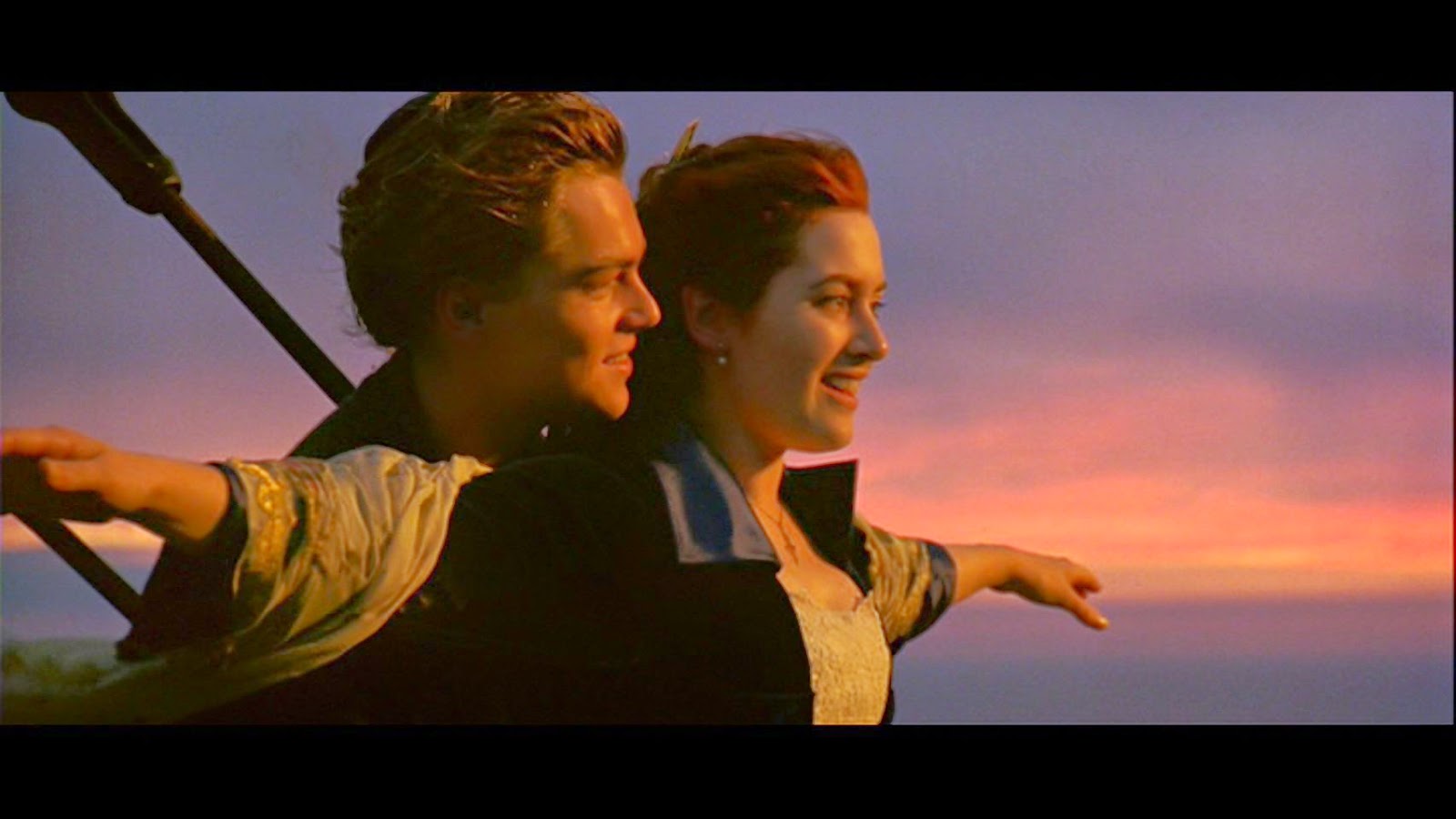
As her sense of adventure comes to life, Rose poses nude for Jack wearing the priceless Heart of the Ocean necklace, a gift from Cal. Meanwhile, Titanic's Captain Edward John Smith (Bernard Hill) is encouraged by J. Bruce Ismay (Jonathan Hyde), an executive with the ship's owner White Star Line, to travel as fast as possible. This makes Titanic less manoeuvrable in the dangerous North Atlantic waters, and when an iceberg is spotted late, the great ship is unable to avoid a ruinous collision. With the hull torn open and several compartments flooded, the ship's designer Thomas Andrews (Victor Garber) realizes that Titanic will indeed sink within a couple of hours. In the ensuing chaos of more than 2,200 people attempting an evacuation into the chilly waters of the Atlantic and a criminal undersupply of lifeboats, Rose and Jack try to save their love and each other.

Directed by James Cameron and featuring a dazzling full-scale reconstruction of the doomed ship and incredible special effects, Titanic soars by placing a small, very human love story at the heart of unimaginable tragedy. The Romeo and Juliet romance between Jack and Rose provides a tender face to the victims of the disaster, and transcends the headlines to create warm poignancy in the midst of chilling death.

The mammoth 194 minutes of running time pass by effortlessly. The first hour establishes the modern-day preface and the characters on board the doomed ship. Cameron, who also wrote the script after meticulously researching the passengers and their background, mixes his fictional lovers with real-life participants in the drama, including the "unsinkable" Molly Brown (Kathy Bates), Captain Smith, cut-throat executive Ismay and humble designer Andrews. Many of the ship's famous first-class passengers, officers, crew and band members are also based on real-life counterparts.

The second hour focusses on the rapidly deepening relationship between Jack and Rose. This is a transformational experience for Rose. Although her independent streak was always there, Jack awakens her spirit, and she progresses from obedient daughter and unhappy fiancée to a woman embracing what life can offer. Finding the courage to pose for Jack is the hinge event of her life, as she literally and figuratively sheds the past and embraces opportunity.

The final hour is a simply awe-inspiring recreation of the Titanic's sinking. Using a combination of special effects, death-defying stunts and filming in gigantic tanks, the loss of Titanic is recreated as a poetic calamity on an unimaginable scale. As the grand ship sinks, passengers die in agony and the worst of human behaviour comes to the fore, Jack and Rose fight to stay alive and stay together, and Cameron finds the essence of life, surrounded by death. Titanic's demise in the shadow of Jack and Rose's love is, quite simply, one of the finest prolonged sequences set to film.

The denouement is back on Brock Lovett's ship, as both Brock and the elderly Rose find what they have long been looking for.

DiCaprio and Winslet were both catapulted into superstardom, as they gave Jack and Rose the simple innocence and determined rebellion the propels young love against all obstacles. Kathy Bates as the brassy Molly Brown and Billy Zane as the privileged but selfish Cal are the most prominent members of a deep supporting cast.

Titanic was the most expensive film ever made upon its release, and went on to become the world's highest grossing film, until surpassed by Cameron's own Avatar (2009). Titanic is a remarkable triumph, one of cinema's all-time crowning achievements in both visual excellence and emotional impact.


All Ace Black Blog Movie Reviews are here.


Monday, 7 April 2014

Movie Review: The Great Gatsby (2013)


A funky adaptation of the F. Scott Fitzgerald novel, The Great Gatsby targets a young audience by mixing modern music into the 1920s setting. The film is artistic and vibrant, but falls short in the search for authentic soul.

With a booming stock market fuelling the New York of the Roaring Twenties, Nick Carraway (Tobey Maguire) is trying to make a career for himself as a bond trader. Next door to Nick's small house in the Long Island village of West Egg is the grand mansion of the mysterious and extremely wealthy Jay Gatsby (Leonardo DiCaprio). Every weekend, all of New York's social elite descend onto the Gatsby mansion to attend lavish and wild parties, although few of the guests know who Gatsby is and none of them know how he accumulated his wealth.

Nick's cousin Daisy (Carey Mulligan) lives across the bay with her husband Tom Buchanan (Joel Edgerton), and at Daisy's house Nick meets golf pro Jordan Baker (Elizabeth Debicki). Nick also learns that Tom is carrying on an affair with Myrtle Wilson (Isla Fisher), the wife of car mechanic George (Jason Clarke). As Nick and Gatsby become friends, Nick learns that Daisy was the love of Gatsby's life, and their idyllic romance was rudely interrupted by the Great War. Now Gatsby has scrapped his way from abject poverty to ridiculous wealth, and wants to win Daisy back. But despite his infidelities Tom will not give up on his wife so easily, triggering a cascading series of tragic events.

The Great Gatsby is full of colour, music, energy and style. Director Baz Luhrmann stages the grand love story of Jay Gatsby with plenty of larger than life panache, the set designs creating vivid landscapes into which the characters are carefully placed. The backdrops, lighting, colours, silhouettes and costumes are close to perfect, but this is where The Great Gatsby starts to falter: The film resembles a series of impeccable set pieces storyboarding the Fitzgerald novel.

With every frame a meticulous composition, the outcome is a glossy poster rather than a thoughtful interpretation, a face value recreation that is unable to get past events and into character depth. The screenplay by Luhrmann and Craig Pearce finds no penetration, Gatsby's profound sense of loss and longing distinctly missing within all the glitz.

But the film's sheer aesthetic brilliance and instinctive rush to beauty are undeniable. The inclusion of modern party music by Jay Z, Beyonce, Lana Del Ray, will.i.am and Jack White, among others, is a typically audacious Luhrmann move intended to make the film more relevant to a young and modern audience. The injection of energy is potent and the lyrical content of the selections is well matched to the narrative. But mixing new music into a 90 year old setting only serves to more fully block the film's ability to delve into the essence of its central romance.

And rather than bringing characters to life, the actors veer into the earnest theatricality of being consumed by the story's reputation. Leonardo DiCaprio oozes charisma fuelled by inexplicable millions, and does bring to Gatsby vulnerability if not poignancy. Maguire adds little as a too passive Carraway, and Mulligan fully looks the part as Daisy but remains an inaccessible scintillation rather than a real person. In a bullish performance Joel Edgerton as Tom Buchanan emerges as the only other presence strong enough to compete with the exuberant surroundings.

A feast for the eyes and ears but not so much for the heart, The Great Gatsby is fun and provocative but not so evocative.


All Ace Black Movie Blog Reviews are here.