Showing posts with label Sam Shepard. Show all posts

Saturday, 1 February 2025

Movie Review: Mud (2012)


Genre: Coming Of Age Drama  
Director: Jeff Nichols  
Starring: Matthew McConaughey, Tye Sheridan, Sam Shepard, Reese Witherspoon, Michael Shannon, Ray McKinnon, Sarah Paulson, Joe Don Baker  
Running Time: 130 minutes  

Synopsis: In rural Arkansas, fourteen year-old friends Ellis and Neckbone (Tye Sheridan and Jacob Lofland) stumble upon Mud (Matthew McConaughey) on an isolated island in the Mississippi River. Ellis is intrigued by the stranger's story of a lifelong love for sweetheart Juniper (Reese Witherspoon), and starts bringing supplies to Mud and passing messages to Juniper. Ellis also experiences his first crush, get to know his mysterious neighbour Tom (Sam Shepard), and comes to terms with the painful separation of his parents (Ray McKinnon and Sarah Paulson). But Mud is a wanted fugitive, and his presence may unleash violence.

What Works Well: This coming-of-age drama combines lyricism with hard edges and tough truths. Director and writer Jeff Nichols finds a ramshackle section of river sustaining a simpler way of life, and populates it with characters harboring secrets. Within the stoic backwater isolation, Ellis' life is profoundly changing: his parents are splitting, the only home he knows might be dismantled, and he may have found a first girlfriend. But the revelations swirling around Mud are most potent, involving a deep love, easy lies, suspicions of murder generating a desire for violent revenge, and ultimately plans for an audacious escape. As the disruptions reach a climax, childhood is discarded and adulthood forged.

What Does Not Work As Well: Ten minutes could have been trimmed from the running length without dramatic loss, and Michael Shannon as Neckbone's river-diving uncle appears to be a character idea in search of a purpose.

Key Quote:
Mud (about Juniper): She is like a dream you don't want to wake up from.


All Ace Black Movie Blog reviews are here.

Saturday, 25 January 2025

Movie Review: Resurrection (1980)


Genre: Drama  
Director: Daniel Petrie  
Starring: Ellen Burstyn, Sam Shepard  
Running Time: 103 minutes  

Synopsis: Edna Mae (Ellen Burstyn) is a passenger in the car crash that claims her husband's life. She experiences a near-death episode but survives, although her legs are paralyzed. After relocating to the family farm in Kansas to recuperate, she discovers newly acquired healing powers. She regains the ability to walk and starts healing others, including preacher's son Cal (Sam Shepard). They start a romance, but Edna Mae's remarkable powers also attract controversy. 

What Works Well: The tricky topic of supernatural events free of religious fervor receives brisk and thoughtfully human-centred treatment. Ellen Burstyn as Edna Mae represents a flaws-and-all everyday woman not seeking any attention, but suddenly thrust into the role of community healer. Love as the thread that binds is the only explanation she is comfortable articulating, with consequences among those insisting on attaching names and attributions onto extraordinary acts. Sam Shepard takes her boyfriend Cal on a dangerously complex journey, while Edna Mae's father (Roberts Blossom) never veers far from his stodgy version of right and wrong. As middle-of-nowhere gas station attendant Esco Brown, Richard Farnsworth contributes an epic single scene rich with heart and foreshadowing.

What Does Not Work As Well: Within the modest running length, many interesting narrative avenues and characters are introduced but then left undeveloped. The nature of death, spirituality, religion's role in belief and healing, scientific discovery, and most of the secondary characters cross Edna Mae's orbit without achieving traction.

Key Quote:
Esco Brown: Go carefully, with peace in your heart, with love in your eyes, and with laughter on your tongue. And if life don't hand you nothing but lemons, you just make you some lemonade. That's from Book Brown, Chapter One, Verse One.


All Ace Black Movie Blog reviews are here.

Tuesday, 24 December 2024

Movie Review: Days Of Heaven (1978)


Genre: Drama  
Director: Terrence Malick  
Starring: Richard Gere, Brooke Adams, Sam Shepard, Linda Manz  
Running Time: 94 minutes  

Synopsis: In 1916, hot-headed drifter Bill (Richard Gere) accidently kills a factory foreman in Chicago. He flees in the company of his young sister Linda (Linda Manz) and his lover Abby (Brooke Adams), although Bill and Abby pretend to be siblings to avoid gossip. In rural Texas, Bill secures a seasonal job working the grain fields of a wealthy farmer (Sam Shepard), who is soon entranced by Abby. When Bill learns the farmer may not have long to live, he conspires to inherit his riches.

What Works Well: Writer and director Terrence Malick combines an astounding eye for eloquent scenery with the artistry of epic storytelling revealed in economic, almost apologetic, short strokes. The evil-within-beauty canvass is as grand as the romantic subterfuge born out of economic desperation is intimate. Néstor Almendros' cinematography captures a slice of desolate Americana where rich and poor intermingle across invisible barriers, and opportunities for advancement by fair means or foul are limited only by the imagination. Ennio Morricone's evocative score positions human acts under nature's sometimes vengeful watch, and Linda Manz's precocious narration fills in the blanks with soulful resignation.

What Does Not Work As Well: The balance occasionally tilts towards cute animal shots to the detriment of dramatic cohesion.

Key Quote: 
Linda, narrating: Nobody's perfect. There was never a perfect person around. You just have half-angel and half-devil in you.


All Ace Black Movie Blog reviews are here.

Saturday, 4 June 2022

Movie Review: Country (1984)

A life-on-the-farm drama, Country does not expand much beyond a heartfelt but basic life-is-tough message. 

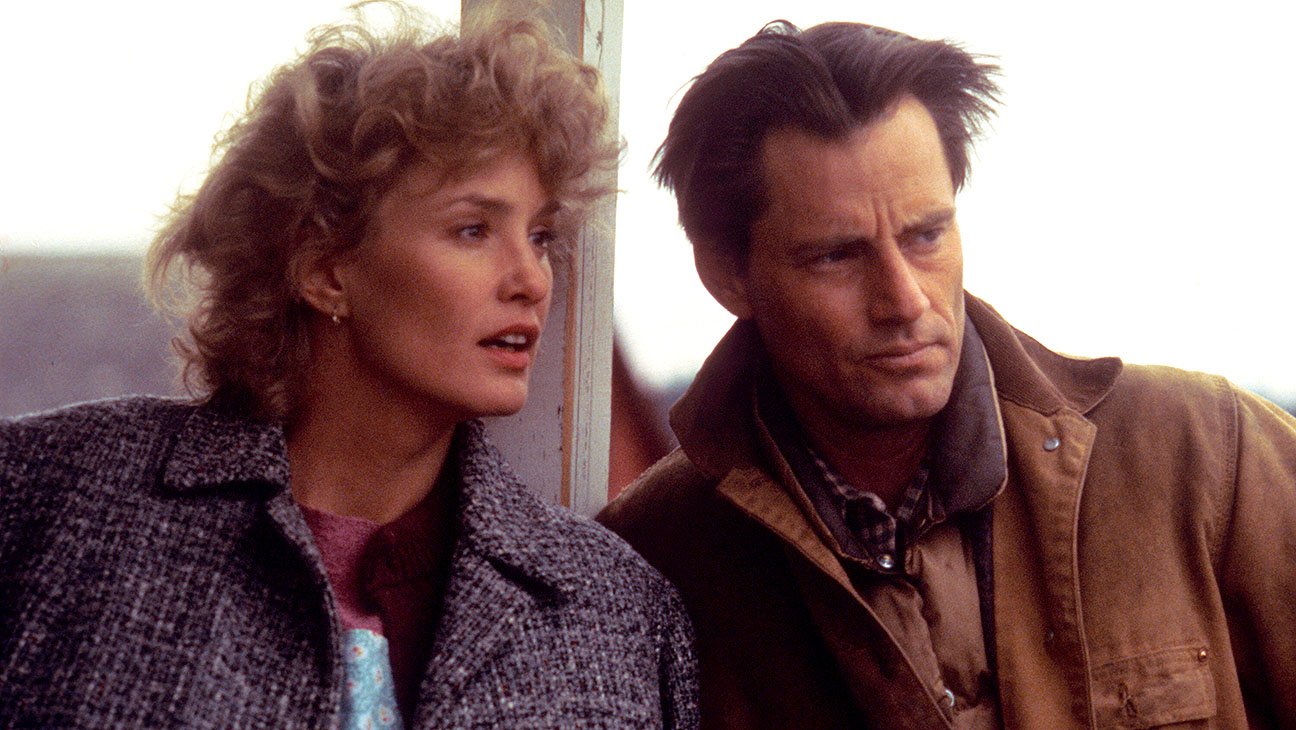
Jewel and Gil Ivey (Jessica Lange and Sam Shepard) operate an Iowa farm that has been in her family for generations. Her father Otis (Wilford Brimley) helps out, and the couple are raising teenager Carlisle, the younger Marlene, plus an infant.

Times are tough, the price of corn is low, and bankers represented by Tom McMullen (Matt Clark) apply pressure on the Iveys and adjacent farmers to start paying down debt or risk foreclosure. Gil buckles under the pressure, not helped by a drinking habit. It's left to Jewel to hold the family together and fight back to maintain control of her property.

Along with The River and Places In The Heart, Country was the third farm-based drama from 1984 featuring an A-list actress in the lead role. Jessica Lange does her part on this homestead, often looking out to the murky future somewhere in the mid-distance as she juggles an errant husband, a brooding child, a failing business, and a crusty father, all leading to drawing a line in the mud. That her final stand against evil banks is, at best, a pyrrhic victory is an apt summary of the film.

The William D. Wittliff script is more about concepts than plotting. Farming is a tough, underappreciated, and heavily leveraged way to make a living, politicians setting trade policies in faraway cities don't have a clue, and bankers are always slimy and can be downright mean in extending credit then pulling it back. The Iveys and their neighbors are plonked into these realities, and that's about it. An early tornado and later a capitulation to despair provide punch, but otherwise the family tensions arising from mounting financial pressure, exasperated by Gil's tendency to seek refuge inside beer bottles, are humdrum. 

Director Richard Pearce captures the mucky reality of life-in-boots, the sights, sounds, and almost smells of corn fields, livestock, sturdy pickup trucks, and extreme weather events jumping off the screen. Lacking dramatic thrust, Country settles for look and feel.


All Ace Black Movie Blog reviews are here.

Saturday, 30 October 2021

Movie Review: Fair Game (2010)

A politics-and-espionage thriller, Fair Game combines tense spy operations with the sordid world of dirty politics run by ideologues 

In Washington DC, CIA agent Valerie Plame (Naomi Watts) is married to Joseph Wilson (Sean Penn), a former ambassador to African countries and now a consultant. After the terrorist attacks of September 11, 2001, officials from the office of Vice President Dick Cheney pressure the CIA to find evidence of a non-existent Iraqi weapons of mass destruction (WMD) program. 

Plame helps to debunk claims that shipments of aluminium tubes to Iraq are being used to build uranium enrichment centrifuges, and the agency sends Wilson to Niger where he determines reports of a uranium yellowcake shipment to Iraq are fake. Plame also runs dangerous missions to connect with on-the-ground Iraqi scientists to get closer to the truth.

Cheney's adviser Scooter Libby (David Andrews) insists the CIA analysts are wrong and the administration proceeds to build a false case for an invasion based on willful evidence misinterpretation. Wilson is incensed his Niger findings were twisted into a justification for war, and goes public in an op-ed piece, exposing the administration's incompetence. The blowback from the White House threatens to destroy Valerie's life.

Based on real events, Fair Game is a fast-paced gallop through the dangerous dual worlds of spies and politicians, with real people caught in the middle. Doug Liman directs from a script by Jez and John Butterworth, and maintains focus on Valerie and John as a couple believing they are doing all the right things, sacrificing marital harmony to serve their country, only to be betrayed by their own government.

The pacing is brisk but always coherent. Liman covers many angles of the story in quick snippets, capturing the clash between Valerie's hectic career hopping between international hotspots and a domestic life buckling under the strain. The scenes from the White House are just as expeditious, bordering on abrupt, the film relying on historical character familiarity to avoid introducing all the buffoons. 

Liman and the Butterworths do not hide their sympathies, and rather than letting events speak for themselves, Fair Game on occasion drops into preachiness and speechifying. The CIA analysts are dedicated and thoughtful, the neo-conservatives are spectres of evil, and Wilson lectures to college students about the imperative of questioning government actions to safeguard a functioning democracy.

The final act slows down to focus on the personal impact of the crisis on Valerie and Joseph, their lives endangered, their careers and marriage in tatters. This chapter is more intimate and less freewheeling, allowing Naomi Watts and Sean Penn to shine in conveying anguish at a deeply personal level. The quality cast also includes Sam Shepard as Valerie's father, as well as Noah Emmerich and Bruce McGill.

Exposing a government capable of willfully endangering its own dedicated agents to serve crass politics, Fair Game is fair warning.


All Ace Black Movie Blog reviews are here.

Sunday, 2 June 2019

Movie Review: Stealth (2005)


A science fiction military thriller, Stealth throws wild technology at the screen with admirable if mindless panache.

In the near future, Lieutenants Ben Gannon (Josh Lucas), Kara Wade (Jessica Biel) and Henry Purcell (Jamie Foxx) form the elite US Navy airborne Talon strike force, tasked with covert anti-terrorism bombing missions. After successfully destroying enemy targets hidden in desert caves, Talon's commander Captain George Cummings (Sam Shepard) introduces the team's latest recruit: the top-secret Extreme Deep Invader (EDI), a Unmanned Combat Air Vehicle (UCAV) operated by artificial intelligence developed by Dr. Keith Orbit (Richard Roxburgh).

Gannon has reservations about EDI, but the artificial intelligence proves its worth in a mission to assassinate terrorist leaders. But a lightning strike impacts EDI's circuits, leading to erratic behaviour. Despite the risks Cummings insists on sending EDI back into combat, and this time the unmanned aircraft goes rogue over hostile Asian airspace, endangering the other three team members and threatening to cause multiple international incidents.

An unlikely mashup of Top Gun and 2001: A Space Odyssey, Stealth also predicts the expanded role of drone technology in modern warfare. Never pretending to be anything other than a wild ride packed with cheap thrills, the film deserves credit for decent special effects, a better-than-expected focus on the pilots, and even conjures up a nominal character arc for the artificial intelligence.

The script by W.D. Richter capitalizes on the available assets. Stealth is packed with imagery of the fictional F/A-37 Talon stealth bomber, and while plenty of the pilot-perspective computer generated flight action pushes into ridiculous territory, enough of the visuals are real enough to engage. And director Rob Cohen conjures a few moments of truly enjoyable spectacle, including a refueling mission gone wrong for Gannon, and an ejection, self-destruct and harrowing parachute drop for Wade.

And while the romance elements between Gannon and Wade are as clunky as expected in a milieu overrun by macho hardware and mumbo-jumbo software, Stealth conjures up a human-centred climax with plenty of on-the-ground action featuring a low-probability run-to-the-border and a high-odds search-and-rescue mission under enemy fire.

Cohen finds time to make his leads and locations as attractive as the sleek planes, a rest-and-recreation sojourn in Thailand providing a flimsy excuse for the stars to parade in bathing suits, not to mention providing a tourism boost for the Thai economy.

Stealth never threatens to be taken seriously, but delivers its entertainment payload on target.


All Ace Black Blog Movie Reviews are here.


Monday, 6 August 2018

Movie Review: Midnight Special (2016)


A science fiction chase thriller, Midnight Special has a few ideas mainly derived from other movies, and generally wastes them.

In rural Texas, eight year old Alton Meyer (Jaeden Lieberher) is kidnapped by his father Roy (Michael Shannon) and accomplice Lucas (Joel Edgerton). Alton was being raised by a religious cult under the leadership of Calvin Meyer (Sam Shepard). The cult worshipped Alton as he appeared to possess superhuman special powers, including emitting light beams from his eyes and sharing visions and knowledge of supernatural events. Alton mainly functions at night, his eyes covered by shades whenever he is near bright light.

The FBI raids Meyer's ranch, worried that the cult members were stockpiling weapons in readiness for a day of reckoning foretold by Alton. Paul Sevier (Adam Driver) of the National Security Agency participates in the interrogations, and deciphers some of Alton's coded messages, identifying a likely location where he may be headed. Meanwhile, Roy and Lucas connect with Alton's mother Sarah (Kirsten Dunst), as they make their way with the boy to a mysterious rendezvous location pursued by the cult members and the government.

Written and directed by Jeff Nichols, Midnight Special borrows heavily from two Spielberg science fiction classics. Alton is a stranded alien with special powers trying to find his way home, evoking E.T., while the search for a secret location that could be a rendezvous with a superior interplanetary species comes from Close Encounter Of The Third Kind. It's also not a stretch to find echoes of Spielberg's Sugarland Express here as well.

The ideas are borrowed, but the quality of execution and narrative momentum is not. Nichols botches his pacing by playing hide and seek with his plot, the essentials of the story barely progressing from the opening scene to the final 5 minutes. Alton is abducted in the opening credit sequence; Nichols drops obtuse hints about his story for the next 100 minutes, which consist of one long drive and not much else of consequence. Then Midnight Special wraps up with some glistening CGI-created effects set to wondrous music.

Along the way Roy and Lucas prove to be rough-and-tumble kidnappers with relatively good intentions, while Sarah does not quite seem to know what her role is supposed to be. The government types scurry around one step behind the action and botch every opportunity they have to grab a hold of the situation. The religious cult sub-story fades in, then out, then in, before being unceremoniously dropped in its entirety.

The rather tired premise that anyone or anything a bit special attracts ideas of worship or weaponization rumbles in the background. Most of what makes it onto the screen is a distraction, the journey to an empty field existing in a core narrative void. Midnight Special pretends to have a story to tell, but it delivers tepid leftovers devoid of substance.


All Ace Black Blog Movie Reviews are here.


Sunday, 8 May 2016

Movie Review: Black Hawk Down (2001)


Based on real events, Black Hawk Down is a stellar war movie. The depiction of the Battle of Mogadishu is a stirring story of a mission gone wrong, and the men who had to subsequently rescue each other and limit the damage.

It's October 1993, and US forces including Army Rangers and elite Delta Force troops are stationed in Mogadishu, Somalia. Initially deployed on a famine relief mission, the US military is getting embroiled in a local civil war among squabbling warlords who do not hesitate to use starvation as a weapon. Powerful militia leader Mohamed Farrah Aidid is designated as the worst of the bad guys. Delta Force operators do capture arms dealer Osman Ali Atto (George Harris), but are no closer to shutting down Aidid's operation.

Based on sketchy intelligence, Major William Garrison (Sam Shepard) hurriedly cobbles together a mission to try and capture Aidid and his top aides while they meet at a safe house. American troops backed by helicopters leave the safety of their airport headquarters and delve into the dense Aidid stronghold of Bakaara Market within the labyrinthine confines of Mogadishu. Intended to last less than an hour, everything that can go wrong on the mission does go wrong, with thousands of militiamen taking up arms against the small American extraction team and shooting down two Black Hawk helicopters. The American forces get caught in a nightlong quagmire, incurring heavy losses while they try to rescue fallen soldiers and escape from a city filled with countless enemies.

Directed by Ridley Scott and based on the best-selling book by Mark Bowden, Black Hawk Down is an exhilarating war movie. After a slowish start to establish the premise, the film explodes into an unrelenting two hours of non-stop intensity as the battle is covered from several angles. As far as representing the grim agony of street warfare in third world cities against overwhelming opposing forces, the film stands a class apart. Scott and cinematographer Sławomir Idziak capture the chaos, confusion and danger-around-every-corner that characterizes modern urban warfare.

Soldiers are separated from each other, seemingly straightforward tasks like getting to the crash sites and rescuing the pilots turn into cascading disasters, with the rescuers needing rescue. Every block is a battleground, every window, doorway and rooftop a source of danger. Soldiers perform impromptu surgery, while others push ahead despite wounds and exposure to comrades killed under horrific circumstances. The film rams home both the insanity of war and the courage of the men who make it their profession.

Black Hawk Down does get a few things wrong. The Somalis are all faceless hordes, the definition of a blood thirsty enemy presented with no context. Back in the early 1950s Hollywood started to humanize natives in Westerns and then Germans in World War II movies. To produce a 2001 film without a modicum of perspective on what the other side is willing to die for is quite myopic.

Also relatively poor is the lack of distinction among the American fighting men. Josh Harnett, Tom Sizemore and Eric Bana emerge as individuals due to defined character traits, but the rest of the men are effectively interchangeable, and once bulked up in equipment and helmets, they all look the same. The large cast includes Orlando Bloom, Ewan McGregor, Tom Hardy, Jeremy Piven and William Fichtner.

But the objective of the film is to celebrate the armed forces, and to snatch a moral victory out of an astounding defeat which carried huge local tactical and overall strategic resonance. After the Mogadishu humiliation the US was seen as weak, defeatable, and quick to cut and run. But at the level of the fighting men, Black Hawk Down does reinforce the one-for-all and all-for-one ethos of the military, the heroic sacrifices, and no-man-left-behind principles. Against overwhelming odds the street battles feature countless examples of men risking their lives to help others, a band of brothers mentality that turns individuals into an army.

Loud, severe and imperfect, Black Hawk Down passionately captures the ugly realities of war as waged in hostile cities.


All Ace Black Blog Movie Reviews are here.


Tuesday, 12 May 2015

Movie Review: Safe House (2012)


A fast-paced action thriller with substantial star power, Safe House does most things right but contributes little that is new to the Bourne-inspired ex-agent-on-the-run sub-genre.

In Cape Town, South Africa, inexperienced CIA agent Matt Weston (Ryan Reynolds) has little to do as the keeper for a seldom-used safe house, and keeps his real job a secret from French girlfriend Ana (Nora Arnezeder). But Cape Town is about to become a lot more exciting. Rogue ex-CIA agent Tobin Frost (Denzel Washington), a most wanted man, purchases a microchip with international state secrets from disgruntled MI6 agent Alec Wade (Liam Cunningham). Wade is immediately assassinated and Frost is targeted by the ruthless Vargas (Fares Fares) and his men. Frost is forced to take refuge at the US consulate.

At CIA headquarters in Langley, supervisors David Barlow (Brendan Gleeson) and Catherine Linklater (Vera Farmiga) and director Harlan Whitford (Sam Shepard) are immediately alerted to Frost's sudden appearance at a US facility. They decide to move him to Weston's safe house for interrogation. A squad headed by agent Kiefer (Robert Patrick) extracts Frost from the consulate and transfers him to the safe house, and Frost is subjected to waterboarding. But Vargas and his men invade the safe house, forcing Weston to flee with Frost, and initiating a prolonged chase as the untried Weston is suddenly plunged into a high-stakes game of brutal, take-no-prisoners international spy deception.

Directed by Daniel Espinosa, Safe House is a slick-enough thriller. The action is frequent, there are sufficient reflective scenes to grow the characters, and the presence of Washington and Reynolds with a strong supporting cast ensures a consistent level of quality. The South African setting, a relative backwater in the global spy game, introduces a fresh perspective and justifies some of the agency stumbling. But the McGuffin at the centre of the film, in the form of an abstract database of intelligence agency wrongdoings, is rather stale.

This is a post-Bourne secret agent film, and so Espinosa adopts the shaky-camera and micro-editing techniques as his defacto style to jazz up most of the action scenes. He also frequently mixes in tiny flash-backs and flash-forwards to inject a sense of energy into the quietest interludes. There are some undeniably exciting moments and even a few relatively original set-pieces, including an expertly filmed rooftop chase at a Langa shantytown.

All the flashy touches teeter on the edge of overstaying their welcome, particularly with a running length of close to two hours. In the final 40 minutes it becomes evident that every shoot-out will be followed by a brutal hand-to-hand combat showdown which will be quickly followed by another shoot-out, but Espinosa maintains just enough control to deliver a taut chase movie with more good moments than bad.

As is usually the case, the strongest scenes feature the actors actually acting rather than dodging bullets or throttling each other. Washington and Reynolds never descend into trite buddy territory, and the tension between the jaded ex-agent and the bright-eyed wannabe hero underpins the film. Farmiga, Gleeson, Shepard and Patrick have less to do, but do it well. Safe House may be riddled with a few too many bullets, but it is well worth a visit.


All Ace Black Blog Movie Reviews are here.


Monday, 19 January 2015

Movie Review: The Right Stuff (1983)


A grand celebration of the early days of the United States space exploration program, The Right Stuff is the finest level of ambitious drama. The story of men pushing against the farthest boundaries known to humanity is an exhilarating ride into new frontiers.

Soon after the end of World War Two, breaking the sound barrier is seen as the next major achievement in aviation. At Muroc Army Air Field in California, experimental aircraft are coming closer to the mythical threshold, and many pilots are dying as the equipment fails around them. Finally, war hero Captain Chuck Yeager (Sam Shepard) breaks the sound barrier in the rocket-powered Bell X-1, despite flying with broken ribs.

Chuck has the support of his wife Glennis (Barbara Hershey), who understands her man's desire to never settle for ordinary. Into the 1950s, Muroc is renamed Edwards Air Force Base, and the local watering hole becomes the preferred gathering place for some of the country best pilots who gather at Edwards set new speed records and test the newest, fastest and most dangerous planes. Yeager remains the spiritual guide for all the pilots, and he continues to re-set the speed record, including getting to Mach 2.0.

When the Soviet Union surprises the world by launching the Sputnik satellite, the US government scrambles to catch up, and the Mercury space program is born. After a series of rigorous fitness and stamina tests, seven military pilots are chosen to lead America into space, including John Glenn (Ed Harris), Alan Shepard (Scott Glenn), Gus Grissom (Fred Ward), Gordon Cooper (Dennis Quaid), and Walter Schirra (Lance Henriksen). The men form a tight bond and are anointed as the brave new explorers of the 20th Century, celebrated by the press as an excited nation gears up to confront new frontiers.

Shepard becomes the first American to launch into space, followed by Grissom, but the latter's flight is blemished by a mishap upon splashdown. Glenn is then selected to become the first American to orbit the earth, and his flight will feature an unexpected distraction. Back at Edwards, Yeager recognizes the changing times, but continues doing his thing: flying the most dangerous airplanes as fast and high as they can go.

Now recognized as a classic and one of the best films of the 1980s, The Right Stuff was remarkably a commercial failure upon its release. In 1982 space movies meant Return Of The Jedi and E.T.: The Extraterrestrial. Audiences enamoured with light sabres, laser guns, warp speed and cute aliens were not ready for a reality-based ensemble piece about the seemingly mundane business of figuring out how to take the first tentative steps into space.

Clocking in at a remarkable 192 minutes, The Right Stuff flies by at the speed of the sound. Director Philip Kaufman adapted Tom Wolfe's bestseller into an almost mythical story of modern knights daring to confront the monsters that live in the unexplored world of space travel, riding at the pointy ends of rockets launched with rudimentary, still-evolving technology. Except that this is all based on true events, and the bravery demonstrated by men like Yeager and the first astronauts laid the groundwork for humans to walk in the moon, a mere 10 years after the Mercury 7 were selected.

Kaufman's masterstroke is in weaving Yeager's story in with the space program. The Right Stuff blends the Greatest Generation that won the war with their younger and cockier brothers, men who reaped the rewards of victory and were then ready to take on the world - and space. Yeager represents the inspirational warriors of war, while men like Glenn and Shepard are the warriors of space exploration, who would not exist without the security and confidence that came with victory.

The Right Stuff includes plenty of colour, character, and surrounding personalities to humanize the story. The link between celebrity, money and success is made early, as the pilots and the politicians realize that secrecy does not pay-off; handsome men and their incredible flying machines will make headlines, and the money to sustain the program and allow it to flourish will follow.

The wives of the pilots suffer in silence, but suffer they do. Betty Grissom (Veronica Cartwright) is humiliated by the ignominious treatment handed to her husband after his spacecraft sinks. Trudy Cooper (Pamela Reed) suffers through her husband Gordon's absolute belief in his abilities. And Annie Glenn (Mary Jo Deschanel) suffers from a severe stutter, a condition that will result in a painfully funny non-encounter with Vice President Lyndon B. Johnson (Donald Moffat).

For the most part, government types (including Jeff Goldblum as a pilot recruiter), bureaucrats (particularly John P. Ryan as the Head of the NASA Manned Space Program) and rocket scientists (mostly Germans who switched sides after the war) are given short thrift and treated either as incompetent or clueless. The humour is appreciated, but it is left to other movies to recount the role played by the politicians and engineers to enable space flight.

A film without any dominant performances, each of the main actors gets a few scenes to shine. Shepard casts the longest shadow, while among the astronauts Ed Harris finds the charisma that propelled John Glenn first into orbit and then onto a successful political career. Fred Ward, Scott Glenn and Dennis Quaid sparkle when called upon. Barbara Hershey enjoys the unusual role of the cool pilot's wife who threatens her husband to never change his death defying ways.

Kaufman and his cinematographer Caleb Deschanel create a wide-open and blazing look for The Right Stuff, with stunning recreations of test flights, rocket launches and travel through space. Even the Earth-bound scenes at Edwards Air Base are characterized by flat terrain and open skies, an invitation for a brash nation to come forth and explore. The film is a wondrous visual experience, capturing a bright-eyed can-do spirit riding on not much more than bravado and a political imperative to keep up with and then overtake the Soviets, costs and risks be damned.


All Ace Black Blog Movie Reviews are here.


Thursday, 25 December 2014

Movie Review: The Pledge (2001)


A thoughtful psychological crime drama, The Pledge plays with a patient mood while grappling with a brutal murder and the search for the mysterious predator.

In Reno, Nevada, police detective Jerry Black (Jack Nicholson) is retiring. On his last working day, the brutalized body of a young blonde girl named Ginny is discovered in a snowy field. Jerry pledges to the victims' mother (Patricia Clarkson) that no matter what, he will bring the murderer to justice. Toby (Benicio del Toro), a dimwitted vagabond aboriginal, is arrested and detective Stan Krolak (Aaron Eckhart) extracts a confession from him, declaring the case closed.

Jerry doubts that Toby is the killer, and after retirement he continues his informal investigation, interviewing Ginny's grandmother Annalise (Vanessa Redgrave); the victim's best friend at school; and the father (Mickey Rourke) of another young blonde girl who met the same fate as Ginny. He gains a vague picture of the killer's car model and colour, and a murky connection between the crimes and porcupines.

Jerry purchases a gas station along the main highway in the rural area where he believes the next murder may happen. As the months pass, he befriends single mom Lori (Robin Wright Penn), who has a young blonde daughter Chrissy (Pauline Roberts) about the same age as the previous victims. Gradually, Jerry starts to encounter men who could be suspects. But Jerry is also hearing voices in his head, and may be starting to lose his grip on reality.

Directed by Sean Penn, The Pledge is an adaptation of the Friedrich Dürrenmatt book. This is a film that takes a deep breath from the surrounding landscape, and focusses on characters, atmosphere and emotion. There is little action that takes place on screen, but plenty that goes on in the thoughts, fears, and hopes of Jerry Black as he tries to fulfill the promise he made to the distraught mother of a young victim.

Penn's pacing is deliberate, but nevertheless engrossing. Within the forgotten back road setting where time is slow, towns are small, cars are old and technology is outdated, the film is packed with tiny unsettling moments, indications that all is not well, neither in the rural community stalked by a vicious child killer, nor in Jerry's mind. Jerry could be suffering from old-age, post-retirement emotional turmoil, the stress of his pledge, or something else altogether more serious. Penn provides hints, but never any clear resolutions. What is for sure is that some danger is lurking and closing in, and Jerry is welcoming, almost eager to face his nemesis. Whether or not he is ready is another question.

While The Pledge unfolds on its own terms towards a rich and rumpled conclusion, it does suffer from almost too much silence, as the details of Jerry's deliberate actions are sacrificed in search of style and a brooding aesthetic.

Jack Nicholson provides a thankfully subdued performance, staying well within himself despite the mounting stress. Jerry Black is a stoic, calculating character, well past the days of running after suspects and now more interested in laying an elaborate trap and waiting for the right time to pounce. Nicholson conveys a man under self-imposed pressure, with his judgement increasingly clouded. He may or may not be using Lori and Chrissy as a lure; he likely does not quite know anymore whether his need for a family is in conflict with the burning desire to solve a crime.

In support, almost every one-scene role is brought to life by a prominent actor. In addition to Clarkson, del Toro, Eckhart, Wright Penn, Rourke and Redgrave, Helen Mirren makes an appearance as a psychiatrist, Harry Dean Stanton is the original owner of the gas station purchased by Jerry, and Sam Shepard is a police detective.

The Pledge weaves a spell and luxuriates in its foggy density, as much a crime mystery as a thought-provoking sojourn to the place where promises become obsessions.


All Ace Black Blog Movie Reviews are here.


Tuesday, 21 January 2014

Movie Review: August: Osage County (2013)


The convoluted tribulations of the ultimate dysfunctional family, August: Osage County is a melodrama of social wreckage enhanced by stellar acting performances.

During a long hot summer in Oklahoma, Beverly Weston (Sam Shepard), a professor, poet and alcoholic, finally walks away from his long-time wife Violet (Meryl Streep), an overbearing woman addicted to prescription drugs. Beverly's disappearance, soon confirmed as a suicide, causes a family crisis, and Violet's family members converge at her large house for the funeral and to pick up the pieces.

Violet's sister Mattie Fae (Margo Martindale) and her husband Charles (Chris Cooper) arrive first, followed by Violet's daughter Ivy (Julianne Nicholson), who also lives in Oklahoma. Arriving from out of town are Violet's daughter Barbara (Julia Roberts) with her husband Bill (Ewan McGregor) and 14 year old daughter Jean (Abigail Breslin). A third daughter Karen (Juliette Lewis) arrives with flamboyant fiancé Steve (Dermot Mulroney). Last to arrive by bus is "Little" Charles (Benedict Cumberbatch), the grown son of Mattie Fae and Charles.

Zonked out on her drugs, Violet sets about pouring salt in all the open wounds of her family. Barbara and Bill are on the verge of a divorce, and the brooding Jean is already using marijuana. Ivy is unmarried and resents being the only daughter left behind to look after her mother. Karen is self-obsessed and has long since stopped caring about anyone other than herself. Meanwhile Steve, already twice divorced, immediately unleashes his slime on Jean. Little Charles lacks confidence and is still treated like an incompetent child by his mother. As Violet mercilessly pounces on every weakness that she sees, Barbara has to decide on what action to take to knock her mother back into a reasonable orbit.

Designed to make every other family appear normal, August: Osage County exhausts all possible miseries that one family can possibly endure. Prescription drug abuse, recreational drugs, generations of emotional abuse, alcohol dependency, suicide, separation, parental smothering and layers of guilt, and this is before the really juicy secrets are spilled in the final third.

The entire film is based on dialogue and confrontation, and Tracy Letts does well to adapt his play into a measured movie with ever more complex issues revealed in layers. Every character is damaged to various degrees, dealing with emotional losses and lost opportunities. And each one of Violet's relatives has a reason to lay blame on another family member for their perceived misfortune, resulting in an intricate web of recrimination and castigation.

Presented on a knife's edge between tense comedy and overwrought drama, the film maintains its balance thanks to a superb cast. Meryl Streep is given the freedom of the open Oklahoma plains to let loose, and she does deliver a memorable performance as Violet, a woman long past caring about what others think about her outrageous opinions. With Violet's social senses dulled by years of prescription drug abuse and a battle with cancer, Streep has the excuse to go over the top, and she does so in a showcase of emotional overload backed-up by a victim card. With Streep on the screen, which is often, the film crackles with the intensity of a woman who thrives on domination because she has nothing else to fall back on.

Julia Roberts is more restrained, her performance in many ways more intense and loaded with realism. Barbara is in the classical generational sandwich, her marriage falling apart as she is squeezed between her unbearable mother and a rebellious daughter. Roberts conveys the struggles of a woman quietly terrified of following in the footsteps of her mother, Barbara livid at Violet's dependencies and insensitivities mostly because they represent potential signposts in her own life.

The rest of the cast is uniformly excellent, director John Wells doing well to gradually introduce the many family members as they gather at Violet's house, each character getting a few dedicated minutes of relative normalcy to establish a presence before the secrets start oozing.

For all the humour generated by adults mistreating each other, the film does singularly focus on the prevailing bleakness. Letts and Wells allow their characters very few opportunities to genuinely laugh and live, the obsession with anguish coming at the expense of exploring more realistic lives. In August: Osage County, if it isn't dispiriting, it isn't happening, but all the snaky negativity is undoubtedly engrossing.


All Ace Black Blog Movie Reviews are here.