Genre: Drama

All Ace Black Movie Blog reviews are here.
Reviews of Classic and Current Movies


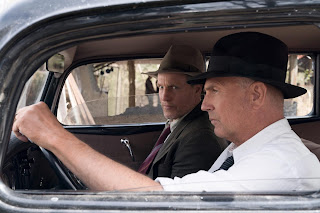
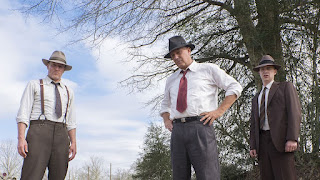
It's 1934 in Texas, and violent criminals Clyde Barrow and Bonnie Parker are folk heroes. After the pair embarrass Governor Miriam "Ma" Ferguson (Kathy Bates) by orchestrating a prison break, she reluctantly agrees to call upon retired Texas Ranger Frank Hamer (Kevin Costner) to hunt down the couple. He teams up with his ex-partner Maney Gault (Woody Harrelson) and despite advancing years and limited physical abilities they hit the road to try and intercept the elusive outlaw couple.
Working on the theory that criminals always go home, Hamer and Maney focus on the Dallas area, but the locals are protective of the famous couple and close ranks. Bonnie and Clyde's killing spree continues, with several police officers murdered and the FBI helpless. Hamer and Maney maintain a dogged pursuit and cross into neighbouring Oklahoma then Louisiana, and gradually gather enough clues to close-in on their targets.
An essential antidote to the romanticism of Bonnie And Clyde (1967), The Highwaymen is the other side of the story. Here the criminals are infrequently spotted bloodthirsty killers, ambushing and murdering police officers for fun, including Bonnie applying the final shotgun blast to the head of already fallen men. The John Fusco script demonstrates no sympathy towards any societal or economic justifications. Clyde's father (William Sadler) gets one long scene to try and explain his son's actions, and is summarily deflated by Hamer.
As for the folk hero status of the two murderers, The Highwaymen adopts an exasperated shake-of-the-head stance. For deep-seated reasons, this is a society that venerates anti-authoritarianism. Men like Frank Hamer and Maney Gault can do little other than bypass the nausea and get on with the job.And so director John Lee Hancock settles down to tell the story of two former Texas Rangers, themselves no strangers to bloodletting. They carry deep emotional scars, and at the start of the movie are hiding behind domesticity (Hamer is more successful) to bury the pain. Through Department of Corrections Chief Lee Simmons (John Carroll Lynch), the state calls upon them to unretire and sanctions two more killings.
Hamer and Maney are old, unable to run after suspects, and well past their sharp shooting days. What they do have is guile and experience, and gradually they recreate their partnership dynamic and make progress. Their quest is long, mistakes are made, and more people die. Through a draggy middle act, Hancock struggles to justify 132 minutes of running time, although the stark vistas of Texas and a landscape dotted with ramshackle depression-era migrant camps offer good visuals.
The two veteran actors help ride out the slow patches, the pauses for reflection well-paced to add texture without interrupting flow. Harrelson and Costner both co-produced and equally invest in their roles, Harrelson as Maney in particular showcasing a maturity to now discern the thin margins between right and wrong.
The Highwaymen are destined to arrive at a well-known and culturally iconic climax. The joy is in the journey, and two seasoned experts ensure a worthwhile drive.
All Ace Black Movie Blog reviews are here.
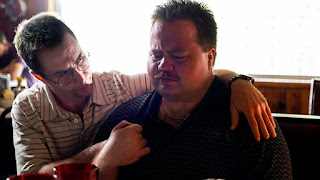
In 1986, Richard Jewell (Paul Walter Hauser) is a mail delivery clerk at an Atlanta law firm. Attorney Watson Bryant (Sam Rockwell) shows some compassion towards Richard, who is overweight and awkwardly over-intrusive, but also respectful of government institutions and planning a law enforcement career.
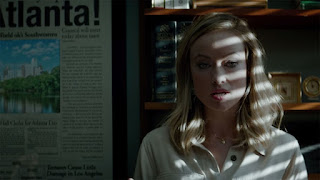
Ten years later Richard remains positive despite being fired from a campus security job for overstepping boundaries. Still living with his mother Bobi (Kathy Bates), Richard secures an Olympic Games security guard position and is assigned to Centennial Park where crowds gather for nightly concerts. FBI agent Tom Shaw (Jon Hamm) and ambitious Atlanta Journal-Constitution reporter Kathy Scruggs (Olivia Wilde) are also covering events at the park.
During a concert Richard spots a suspicious package, raises the alarm, then helps move crowds away. The bomb explodes, causing casualties, but Richard's actions save lives. Initially hailed a hero, the FBI soon suspect Richard is the bomber with a personal glory motive. The suspicions are leaked to Kathy and she splashes the story on the newspaper's front page, turning Richard's life into a living hell. He reaches out to Watson, the only lawyer he knows, for help.
Based on real events, Richard Jewell is the tragedy of a well-meaning ordinary man caught in a maelstrom. Written by Billy Ray and directed by Clint Eastwood, the film maintains focus on Jewel, revealing a kind if slightly tactless personality, always seeking to serve even if his methods veer towards pushy. He achieves a moment of genuine heroism; it's snatched from him by officious incompetence.Richard displays a life-long streak of over-eagerness. But the damage is caused by the toxic combination of an incompetent investigation adopting underhanded tactics, the unconstrained ambition of a newspaper willing to reveal the name of a suspect with no corroboration, and finally senseless media hordes respecting no boundaries and engaging in character assassination and conviction by innuendo before Jewell is even charged (he never was).
The FBI's agent Tom Shaw is a composite, and Eastwood skips past the agency's detective work beyond suspecting the wrong man. Kathy Scruggs is the real journalist who ran with the story based on a leak, and here she deploys naked seduction in pursuit of a career-making story.
At 129 minutes, this is a weighty drama, and the pacing falters after the cloud of suspicion settles on Bobi's house. The subsequent defensive actions and fight-backs are orchestrated by lawyer Watson Bryant as Richard takes a back seat, his respect for law and order rubbing against the government-instigated wrath against him. But thanks to an elegant Paul Walter Hauser performance, Richard Jewell enshrines the legacy of a man who did right, only for others to fumble their responsibilities.
New Yorkers Holly and Gerry Kennedy (Hilary Swank and Gerard Butler) have been married for nine years. They bicker about money, jobs and when to have a baby, but they are still very much in love. When Gerry dies due to a brain tumour, Holly is devastated and left without her soul mate. Her mother Patricia (Kathy Bates) as well as best friends Denise (Lisa Kudrow) and Sharon (Gina Gershon) do their best to console her. Bartender Daniel (Harry Connick Jr.) also offers a shoulder to lean on.
On her 30th birthday Holly receives the first of 10 pre-arranged letters from Gerry, encouraging her to be adventurous and visit his home town in Ireland. While the letters keep her emotionally tied to her deceased husband, she also starts to emerge out of her depression, reuniting with Gerry's parents and meeting his hunky best friend William (Jeffrey Dean Morgan). But finding her new calling in life will be a challenge.
Demonstrating courage to introduce the central couple then kill off the guy within the first 10 minutes, P.S. I Love You immediately dares to be different. Director Richard LaGravenese co-wrote the script adaptation of Cecelia Ahern's book, and allows the love between Holly and Gerry to wash over the grieving widow through a series of flashbacks as she follows his advice in the mysteriously delivered letters.
Gerry's immense continued influence in Holly's life is also conveyed in his occasional post-death presence at their apartment and in her bed, her longing for his voice, touch and companionship emerging as palpable and painfully real.
But LaGravenese also overstates the strength and scope of the story. P.S. I Love You extend to a wholly unnecessary 125 minutes. The editing is flabby, and on several occasions songs are belted out almost in their entirety to pad the running time. The tired cliche of Ireland as a magically perfect place filled with nothing but rolling green hills and jolly salt-of-the-earth types is trotted out for another outing.Hilary Swank and Gerard Butler try their hands at romance with mixed results. They convince as a committed couple, and Swank allows herself to drown in a sea of grief and seething anger at life's unfairness. But they are on much less secure ground in the flashbacks to their earliest meetings as 19 year olds. Both actors are well into their 30s and poor impersonators of footloose teens.
The supporting cast provides good touches of humour. Lisa Kudrow's Denise is on a single-minded mission to find a husband using a utilitarian checklist, and Harry Connick Jr.'s Daniel does not allow the missing filter between his brain and mouth to impede his confidence.
Mixing pathos with playfulness, P.S. I Love You is a poignant if somewhat ponderous postscript.
All Ace Black Movie Blog reviews are here.
A fantasy romance inspired by the confluence of wistful time and divine place, Midnight In Paris finds Woody Allen at his best, crafting a love letter to a city rich with passion and history.
A romantic drama with fantastical elements, Prelude To A Kiss cleverly delves into intriguing topics but ultimately falls short of its mystical targets.
These are not easy themes to delve into, and Prelude To A Kiss inevitably gets in too deep, despite the best of intentions. The film surrenders to fantasy elements that are an essential if metaphorical gateway to core ideas, and in doing so detaches itself too far from reality to achieve any emotional resonance. The film becomes an interesting vehicle to spark conversation, but without itself leaving any form of lasting impression.