Showing posts with label Martin Sheen. Show all posts

Saturday, 6 December 2025

Movie: The Final Countdown (1980)


Genre: Science Fiction  
Director: Don Taylor  
Starring: Kirk Douglas, Martin Sheen, Katharine Ross, Charles Durning, James Farentino  
Running Time: 103 minutes  

Synopsis: Captained by Matthew Yelland (Kirk Douglas), the aircraft carrier USS Nimitz is one of the largest warships in the world. While hosting industrial executive Warren Lasky (Martin Sheen), the vessel passes through a freak electrical storm in the Pacific Ocean. It emerges on December 6, 1941, one day before the Japanese attack on Pearl Harbour. After rescuing Senator Chapman (Charles Durning) and his assistant Laurel (Katharine Ross) from their sinking yacht (destroyed by a Japanese strafing attack), Yelland, Air Group Commander Owens (James Farentino), and Lasky have to decide whether to change the course of history.

What Works Well: An intriguing "what if" conundrum, this is an imaginative sci-fi military adventure. The production values are high (filming took place on the Nimitz with the full cooperation of the US military), and the cast is filled with quality in the key roles, Kirk Douglas and Martin Sheen contributing subdued authority.

What Does Not Work As Well: The premise is much more interesting than the conviction-free execution. Once the Nimitz commanders wrap their heads around the time warp, the movie shifts into sail-in-circles-to-kill-time mode, occupying itself with the fulminating senator, a Japanese pilot plucked from the ocean, and a tepid would-be romance. A good chunk of the running time is consumed by imagery of warplanes taking-off, landing, and conducting surveillance maneuvers. This is dream eye candy material for military hardware fans, but most of these scenes are superfluous to the plot.

Key Quote:
Lasky: Think of the history of the next forty years...
Commander Owens: I have a suspicion history will be a little more difficult to beat than you imagine, Mr. Lasky.


All Ace Black Movie Blog reviews are here.

Saturday, 24 June 2023

Movie Review: Firestarter (1984)


Genre: Science Fiction Horror
Director: Mark L. Lester
Starring: Drew Barrymore, David Keith, Martin Sheen, George C. Scott, Heather Locklear
Running Time: 114 minutes

Synopsis: Andrew McGee (David Keith) and his young daughter Charlene (Drew Barrymore) attempt to escape capture by government agents. Years prior in college, Andrew and fellow student Vicky (Heather Locklear) participated in a mysterious drug trial: Andrew developed the power to control others and Vicky the ability to read minds. Their daughter Charlene was born with pyrokinesis (the capacity to start and stop fires with her mind). Now government agents Hollister (Martin Sheen) and Rainbird (George C. Scott) want to capture Andrew and Charlene to militarize their powers.

What Works Well: The adaptation of Stephen King's novel offers an intriguing concept by evolving his ideas from Carrie with classic child-in-peril thrills. Nine-year-old Drew Barrymore has pouty presence, and director Mark L. Lester delivers the best moments by focusing on her fan-swept face as she expresses uncontrolled anger with heat.

What Does Not Work As Well: The plot is severely undermined by doofus bad guy behaviour, and momentum grinds to a halt in the second half as Charlene and her father are subjected to uncoordinated experiments reminiscent of low-budget mad scientist antics. George C. Scott resorts to chewing the scenery in the absence of any background context for his character's demonic obsession. The special effects are quickly repetitive.

Conclusion: Fire and fury without coherence nor control.


All Ace Black Movie Blog Reviews are here.

Friday, 1 November 2019

Movie Review: Love Happens (2009)


A superficial drama dealing with familial loss with elements of romance and light comedy, Love Happens is stuck in a vague space where dubious psychology meets inferior writing.

Burke Ryan (Aaron Eckhart) is a Ph.D. self-help guru and the author of A-Okay!, a bestseller with tips on surviving grief following the loss of a loved one. Burke's wife was killed in a car crash and his experience prompted the book. In Seattle to run a week-long workshop, he connects with his manager Lane Marshall (Dan Fogler), who is close to finalizing a lucrative multimedia marketing deal to expand Burke's brand.

During the week Burke meets hotel florist Eloise (Jennifer Aniston), who runs a local flower shop with her assistant Marty (Judy Greer). He also bumps into his father-in-law (Martin Sheen), who encourages Burke to stop lying. As Burke helps seminar attendee and former contractor Walter (John Carroll Lynch) work through the anguish of losing his son, Burke and Eloise start dating, and she starts to understand Burke himself has unresolved issues related to his wife's death.

Basing a plot on the world of self-help seminars and pop-psychology is a rickety foundation for a movie. Director Brandon Camp and his co-writer Mike Thompson appear unconcerned, and Love Happens pushes ahead with large chunks of running time dedicated to Burke Ryan leading for-profit workshops where banal truisms and trite platitudes are used to help grief-stricken relatives get on with their lives.

To make matters worse, the film is stacked from end to end with blatant product placements, none worse than a group field trip to a hardware store purportedly to help a grieving contractor reconnect with his true purpose in life. Rarely has a film been burdened with a more obviously grating embedded commercial.

Somewhere within Love Happens a romance is supposed to blossom, but Camp has difficulty bringing it to the screen. No chemistry materializes between Jennifer Aniston and Aaron Eckhart, partly due to the blankness of the Eloise character, who appears to exist for the sole process of awakening Burke to his emotional blindspot. So instead of delivering any romantic sizzle the film goes off on a ghastly tangent involving stealing a pet parrot then freeing it into the wild, which is neither funny nor profound, just dumbfounding.

For all the film's weaknesses, the worst is saved to last, a most cringy on-stage soul-baring fiasco crashing against a hackneyed plot twist telegraphed an hour earlier. Love Happens, except when it doesn't.


All Ace Black Blog Movie Reviews are here.


Monday, 29 July 2019

Movie Review: Badlands (1973)


A crime spree drama and romance, Badlands captures the embellished absurdity of arbitrary murder in service of notoriety.

The setting is rural South Dakota in 1959. In the small and quiet town of Fort Dupree, Kit Carruthers (Martin Sheen) is a laid-back but also restless 25 year old James Dean look-alike working as a garbage collector. He romantically pursues 15 year old Holly Sargis (Sissy Spacek) over the objections of her father (Warren Oates), a painter. Kit changes jobs and becomes a cow farm worker, and as the romance with Holly deepens, he decides that they should take off together on an undefined adventure and nonchalantly kills her father when he tries to intervene.

The two young lovers burn down Holly's house in an attempt to cover their tracks, then escape to the wilderness where they live idyllically for a while in a tree house. But lawmen are on their tracks, and soon a trio of bounty hunters arrive. Kit is ready for them with a shotgun and elaborate traps. The body count rises and Kit and Holly are on the run again, driving across the open landscape towards Montana and Saskatchewan.

A remarkable debut effort from writer, producer and director Terrence Malick, Badlands is loosely based on the real 1958 crime spree of Charles Starkweather and Caril Ann Fugate. Malick independently raised the money for his vision, and crafts a disconcerting and lyrical drama narrated with haunting cluelessness by Holly. The film has an almost accidental beauty to it, a love story on the run in stark and deceptively open terrain, except that as much as Kit loves Holly he also does not hesitate to murder people while she stands by and weaves justifications in her young and infatuated mind.

The film's delicate touch appears to gloss over Kit's twisted mind and evil motives but in reality captures all there is to be said about the brash killer. With Martin Sheen radiating cockiness, Kit is bored, underemployed, uneducated, good looking and seeking a thrill. And maybe the world owes him more than a job as a garbage collector or cow wrangler. And that's enough. Kit decides that shooting Holly's father is faster than arguing with him, and every subsequent murder gets easier and constructs a legend which soon becomes a purpose.

In the intervals between episodes of bloodshed a romance blossoms as Kit and Holly settle into the routine of couples, including sharing (for the most part) domestic duties and slow dancing in the middle of nowhere to music from the car radio. The juxtaposition of an almost innocent love with cold hearted violence ought not to work, but the Badlands are a place where both life and death are easy.

The astounding Spacek was 24 years old at the time of filming but easily passes for 15, and the story is seen through her naive but expressive eyes. Holly is swept up by the attention of an older man, and her life is subsequently simplified into standing by her new found lover and trusting his every action.

Cinematography duties were shared by Tak Fujimoto, Stevan Larner and Brian Probyn, and Badlands often looks stunning. Malick places his protagonists against vast fields, skyscapes and distant mountains, the rich colours of uncontaminated nature exuding an illusory sense of calm.

A road movie punctuated by surreal bursts of terminal violence, Badlands finds the allure of a landscape where all things are possible, including killing as a pathway to infamy for its own sake.


All Ace Black Blog Movie Reviews are here.


Sunday, 7 January 2018

Movie Review: The Subject Was Roses (1968)


A family melodrama comprehensively trapped in its stage origins, The Subject Was Roses is overwrought and uneven but never dull.

After serving in World War Two for three years, Timmy Cleary (Martin Sheen) comes back to his parents' Bronx apartment. His father John (Jack Albertson), a businessman, is proud of his returning son, whom he now perceives as a man. Timmy's mother Nettie (Patricia Neal) has more trouble reconnecting with Timmy, and appears to resent the suddenly closer bond between father and son.

It is soon evident to Timmy that the relationship between his parents, always strained as he was growing up, is now under severe duress. Difficult conversations and arguments between the three family members erupt, with the topics of heated debate including drinking, philandering, religion, real estate, long-ago sacrifices, family commitments and broken dreams.

An adaptation of the 1964 Frank D. Gilroy play with Gilroy himself penning the screenplay, The Subject Was Roses is an overclocked three character study. The directorial debut of Ulu Grosbard (who also directed the Broadway production) is filled with the fire and fury of a middle class marriage well past its best-by date and floundering on the rocks of unmet expectations.

The movie is not far from a filmed play. Albertson and Sheen reprise their stage roles, while Patricia Neal was brought in for big-screen name recognition, and this was her triumphant return after a near-fatal stroke. Grosbard attempts to introduce a couple of awkward sojours outside the cramped apartment, with Nettie's day out proving to be particularly awkward and pointless to the tune of a grating song.

In retrospect, the film suffers from two fundamental weaknesses that are only partially the fault of the original material. By 1968 the Vietnam War was dominating the cultural landscape, and here was a story about a soldier returning from World War Two and walking into the turmoil of...his parents bickering. With the United States in the throes of seminal societal and cultural upheaval, the film becomes a quaint look back at a much more innocent time, despite all the loud arguments.

And to compound matters, Timmy as the returning veteran is the most stable character in the movie. It's as if he was away at a prolonged summer camp, and whatever it was he did in the war, The Subject Was Roses is not interested. More than 20 years prior films like The Best Years Of Our Lives blew the lid off the trauma of the returning soldier, and for Gilroy to not even tangentially approach the topic contributes to an uneven narrative.

What remains is a kitchen table social drama where every scene reveals another rub point between John and Nettie, a couple whose mutual love and affection were very much lost over the years, a middle-class and less sophisticated version of Who's Afraid Of Virginia Woolf?. Nettie is obsessed with looking after her mother and a handicapped sibling (never seen), John never psychologically recovered from a major economic setback, and together they are at their best when engaged in winding each other up, with Timmy firmly stuck in the crossfire.

The script features some sharp dialogue exchanges, Timmy the beneficiary of the best lines, and all three performances are in tune with the overheated emotions, although Neal is by far the most enigmatic.

A typical familial train wreck designed to induce rubber necking, The Subject Was Roses neither disappoints nor enthralls.


All Ace Black Movie Blog reviews are here.

Sunday, 5 June 2016

Movie Review: Catch Me If You Can (2002)


A light-hearted chase drama inspired by real events, Catch Me If You Can is treat for the eyes and the mind. The story of master con artist and cheque fraudster Frank Abagnale Jr. is a breezy tale told with a bouncy spirit.

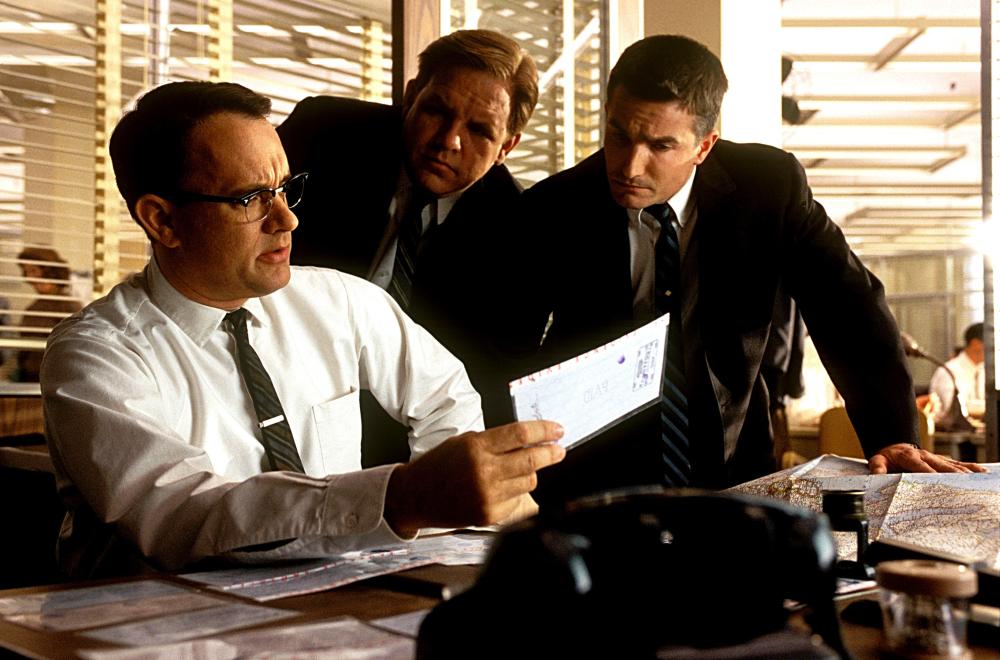
In New York of the early 1960s, 16 year old Frank Abagnale Jr. (Leonardo DiCaprio) grows up idolizing his father Frank Sr. (Christopher Walken), an independently-minded businessman who constantly runs into money problems. When Frank Sr.'s marriage to passionate Frenchwoman Paula (Nathalie Baye) falls apart due to his financial difficulties and her infidelity, Frank Jr.'s life is shattered and he goes on the run. Having inherited his father's instincts for charming people into parting with money, Frank survives by cashing fraudulent cheques at various banks.

Frank Abagnale Sr.: Two little mice fell in a bucket of cream. The first mouse quickly gave up and drowned. The second mouse, wouldn't quit. He struggled so hard that eventually he churned that cream into butter and crawled out. Gentlemen, as of this moment, I am that second mouse.

Wanting more, driven by a desire to recover all that his Dad lost, and appreciating the power of a slick uniform, Frank pretends to be a Pan Am co-pilot. He starts forging payroll cheques, and is soon flying around the country, amassing a fortune in cash, and leaving a long trail of victimized banks in his wake. His exploits grab the attention of FBI bank fraud agent Carl Hanratty (Tom Hanks), who starts a years-long pursuit. But the FBI man is always half a step behind the con artist, and Frank has more tricks up his sleeve and new personas to disappear into.

Directed by Steven Spielberg and based on the book by the same name co-written by Abagnale, Catch Me If You Can is an engaging, remarkably entertaining film. Approximately 80 percent based on reality (according to Abagnale himself), the film focuses on one kid on the run possessing extraordinary self-confidence and one dour FBI agent determined to catch up to him. By avoiding all buddy movie and action cliches that could have crept into the narrative, Spielberg and his screenwriter Jeff Nathanson produce an original, funny and character-driven film, with the momentum generated by intellect and the human condition.

Frank Sr.: You know why the Yankees always win, Frank?
Frank Jr.: 'Cause they have Mickey Mantle?
Frank Sr.: No, it's 'cause the other teams can't stop staring at those damn pinstripes.

It's takes a perpetrator and a victim to run a successful con, and the film delights in showing the various ways Frank is able to either get what he wants or escape from sticky situations using confidence and the razzle dazzle of image and props. He's both the struggling mouse and the Yankees in pinstripes. Whether it's a Pan Am pilot's outfit, a doctor's white coat, a shiny pendant, or a wallet full of junk, he distracts and sweet talks in equal measure. He succeeds to the tune of millions in cash, even conniving to get a high class call girl to pay him for a night of pleasure.

Compared to real events the film overplays the two key relationships in Frank's life, and that's quite excusable because Spielberg knows what makes a good screen drama. Frank is provided with regular touch points with his father, whose life is on an endless downward spiral that only he fails to see. Frank Jr.'s motivation is to set all that went wrong in his dad's life, but for Frank Sr. the struggle is the life, and he takes joy not in escaping the bucket, but watching his son churn for another day.

The in-pursuit relationship between Frank and Carl is also enriched for cinematic purposes (and to provide Tom Hanks with more to do). The film features Christmas time phone calls between the two men to affirm the emptiness and broken homes they share, and to build a bond that comes to fruition in the final act.

Leonardo DiCaprio and Tom Hanks are both excellent, smoothly building complex characters continuously longing for something just out of reach. Christopher Walken gives Frank Sr. the doomed air of a smart man determined to fight a system that merciless crushes him into nothingness, but that is no reason for him to stop the fight.  The rich cast also features small but telling roles for Martin Sheen, James Brolin, Amy Adams and Jennifer Garner.

Catch Me If You Can features a stunning throwback opening credit sequence by Kuntzel+Deygas that recalls the best of Saul Bass. A whimsical, curious John Williams progressive jazz music score enhances the 1960s vibe.

Cool, creative and captivating, Catch Me If You Can is a cat and mouse game at its finest.


All Ace Black Blog Movie Reviews are here.


Friday, 25 December 2015

Movie Review: Wall Street (1987)


A dynamic, glitzy drama set in the world of super-rich investors, Wall Street is both a celebration and condemnation of capitalism's worst excesses. Oliver Stone creates a dazzling story of wealth gone mad, a playground for egotistical men where profits rule, the stakes are routinely measured in millions, and the careers of ordinary mortals are cheaply bought and discarded.

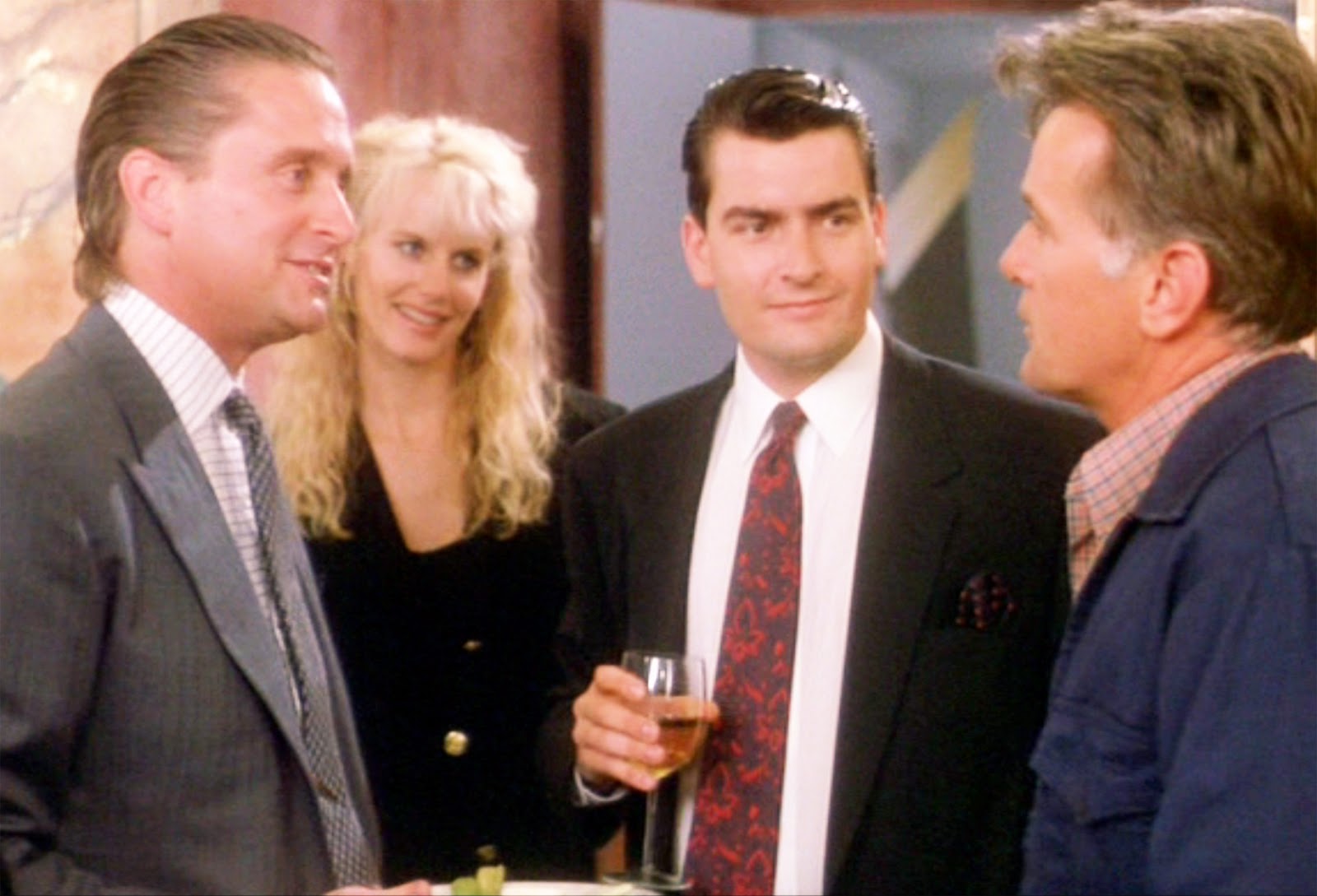
Bud Fox (Charlie Sheen) is a young but ambitious stockbroker at a middling Manhattan investment firm, still making cold calls to try and build up a client base. His father Carl (Martin Sheen) is a humble and honest aircraft maintenance crew chief at Bluestar, a fledgling airline. Bud's persistence finally pays off when he lands the extremely wealthy and ruthless corporate investor Gordon Gekko (Michael Douglas) as a client. Gekko likes what he sees in Bud, and takes him under his wing, exposing him to the power of inside information, the art of taking over corporations and breaking them up for great gains, and a world where obscene amounts of short-term profits can be derived from high-stakes stock price manipulation.

Gekko: The most valuable commodity I know of is information.

Bud's education includes meeting Sir Larry Wildman (Terence Stamp), an even wealthier investors and one of Gekko's chief rivals in the global corporate take-over game. Buoyed by success and fueled by Gekko's money, Bud starts tapping his college friends, including lawyer Roger Barnes (James Spader), to seek insider tips on upcoming mergers, and to set up bogus trading accounts to hide his activities from the Securities and Exchange Commission. Now very rich, Bud's life is fully transformed. He buys a swanky apartment and starts a serious relationship with glamorous interior designer Darien Taylor (Daryl Hannah). But when one of Gekko's upcoming deals threatens to hit close to home, Bud has to finally decide who he really is.

Gekko: What's worth doing is worth doing for money.

Fresh from the success of 1986's Platoon, director Oliver Stone moves from the jungles of Vietnam to the equally treacherous and shadowy terrain occupied by the manipulators of the global finance system. Wall Street is high-paced, magnetic and seductively glossy. Tracing the arc of  protagonist Bud Fox, Stone steps behind the curtain and into the offices of the power brokers who actually determine the winners and losers on Wall Street. It is a place both difficult to resist and absolutely corrupt, free of quaint principles related to morality and humanity, and driven solely by greed and profit.

Stone succeeds in making the world of Gordon Gekko fabulously attractive. For ambitious young men like Bud Fox, it's not difficult to be sucked into the promise of a life filled with limousines, lavish restaurants, expensive suits, glamorous women, high-end real estate and millions in the bank. It's a castle in the sky floating on high-stakes gambling with the odds tilted in favour of the Gekko's who profit from widespread malfeasance, and Stone builds up the allure with plenty of pizazz.  It's not easy to make financial transaction look exciting, and Stone pulls it off with energetic camera work and in-your-face scenes capturing the frenzy of the trading floors and the adrenaline rush of deal making in real time.

Gekko, talking to Bud: Wake up, will ya, pal? If you're not inside, you're outside, okay? And I'm not talking a $400,000 a year working Wall Street stiff flying first class and being comfortable, I'm talking about liquid. Rich enough to have your own jet. Rich enough not to waste time. Fifty, a hundred million dollars, buddy. A player, or nothing. Now, you had what it took to get into my office; the real question is whether you got what it takes to stay.

Not all of the film works perfectly. There are a couple of scenes, one between Bud and his father Carl and another between Bud and Gekko, where exaggerated emotions and shouting replace intelligent discourse. And Bud's awakening to the damage that Gekko and his ilk can cause is treated simplistically and rather abruptly. But overall, the script (co-written by Stone and Stanley Weiser) triumphs thanks to a treasure trove of sharp exchanges and observations, mostly courtesy of Gekko, that serve to define a caustic perspective on not just the world of capitalism, but the human condition itself.

The character of Gordon Gekko is an enduring symbol of the decade of greed, and Michael Douglas won the Best Actor Academy Award for creating a believable, even sympathetic, merchant of money. Gekko creates wealth, no matter the consequences, and Douglas' cold-eyed portrayal allows the character to make sense in a world where the limits of capitalism are unconstrained. Bud Fox may be the sympathetic core of the film, but Gordon Gekko emerges as its true voice, an unrepentant genius exploiting the system and selling his vision to anyone wishing to share the dividends.

Gekko, addressing an audience of corporate shareholders: The point is, ladies and gentlemen, that greed, for lack of a better word, is good. Greed is right, greed works. Greed clarifies, cuts through, and captures the essence of the evolutionary spirit. Greed, in all of its forms: greed for life, for money, for love, knowledge, has marked the upward surge of mankind.

Charlie Sheen does enough to carry Bud's journey without ever transcending the role. Daryl Hannah does well as the prestigious lover who comes with the money, unapologetic in her pursuit of the life that millions can buy. In addition to James Spader, the deep supporting cast includes roles for Hal Holbrook as a old-fashioned investor who still looks for long-term company value, Sean Young as Gekko's wife, and John C. McGinley as Bud's animated colleague, left behind when Bud moves into the stratosphere of investing.

Gekko: It's a zero sum game – somebody wins, somebody loses. Money itself isn't lost or made, it's simply transferred – from one perception to another. Like magic. This painting here? I bought it ten years ago for sixty thousand dollars. I could sell it today for six hundred. The illusion has become real, and the more real it becomes, the more desperately they want it. Capitalism at its finest.

Wall Street invests in quality film making and vigorous, character-driven storytelling, and achieves an exhilarating return on investment.


All Ace Black Blog Movie Reviews are here.


Tuesday, 14 July 2015

Movie Review: Seeking A Friend For The End Of The World (2012)


A romance-comedy set against an upcoming end-of-the-world scenario, Seeking A Friend For The End Of The World is wistful masterpiece, an exceptionally fresh take on an old genre. The flickering connection between two neighbours falling in love as the planet faces extinction touches the collective human soul.

A large asteroid is on a collision path with Earth, nothing can avert the tragedy and impact is expected in three weeks. The planet will be destroyed. Insurance salesman Dodge (Steve Carell) has been abandoned by his wife, but tries to maintain a semblance of normalcy by actually showing up for work. Remarkably, some customers are still calling him. Dodge is introverted, refuses to partake in the debauchery that adults are now engaging in, and deeply regrets giving up on Olivia, the high school love of his life.

His next door neighbour is Penny (Keira Knightley), who is involved in a disintegrating relationship with boyfriend Owen (Adam Brody). Penny is lively, disorganized, can sleep through anything, and is desperate to reconnect with her parents. When riots and looting break out Dodge and Penny flee the neighbourhood together, along with Sorry, an abandoned dog. Penny promises to help Dodge find Olivia, and with all commercial flights grounded he promises to help her find a plane that can fly her to her parents. Along the way they meet Glenn (William Petersen), who has prepared for the end in his own way, and they share a meal at a restaurant that is now serving a lot more than just food.

As Penny and Dodge fall in love they cross paths with a small-town police officer still fulfilling his duties, and visit Penny's old boyfriend Speck (Derek Luke), who fully intends to survive the apocalypse. As the moment of impact draws near, Penny and Dodge confront the sum total of their lives and are forced to reassess their priorities.

Directed and written by Lorene Scafaria, Seeking A Friend For The End Of The World is a marvelous achievement. By setting a romance against the ticking clock to end all ticking clocks, Scafaria instills doomsday comedy and plenty of raw fervor. The result is a film that soars into the passion of what it means to unexpectedly fall in love, with the world figuratively and literally falling to pieces.

The central romance is a poignant affair, both Dodge and Penny desperate in their own way to salvage something in the few remaining days on earth.  Dodge is downbeat, abandoned and pretty sure that his life has been a total loss. The promise of finding the elusive Olivia provides him with a final spark to pursue. Penny is practical but also frantic, not as much dwelling on the impending end as regretting that her ditziness may have cost her the last chance to say goodbye to her parents. Together they make for an indelible couple embarking on a happily haphazard road trip.

Seeking A Friend does not just exploit its premise as a cheap plot device. In the background of the unfolding romance, Scafaria covers the gamut of how society is likely to react to the end of the world. Some people commit suicide. Others hire assassins to do the dirty deed. Some corporate workers still show up at work, as does Dodge's housekeeper Elsa. Looters take over the streets, but only in some neighbourhoods; other remain untouched. Dodge's friends throw drug-fueled orgies where children are exposed to all the sins of the adults. A neighbourhood restaurant redefines the standards of friendly service. Speck and his buddies hunker down with guns, ammo, pop and chips, fully intending to survive and repopulate earth. Rarely has a romance offered such an immersive backdrop.

Steve Carell and Keira Knightley together deliver some of their best screen work. Carell is excellent as a man resigned to quietly withdrawing from life, and then allows Dodge to ever so gradually come out of his shell under Penny's influence. Knightley is even better, creating in Penny a woman in love with a hectic life and happy to run with it right to the end. Martin Sheen appears late in a pivotal role that packs a sentimental punch.

The film enjoys several stunningly memorable scenes. At Speck's bunker, Penny uses a satellite phone to call her parents. In one of Knightley's career highlights, she is devastatingly heartbreaking talking to a parent that she will likely never see again. Another overwhelming scene has Penny and Dodge stumbling onto a peaceful group of people deciding to calmly wait out the end of the world by enjoying each other's company at a small beach. In stark contrast to the depravity, riots, looting and suicides witnessed earlier, this collection of parents and children just celebrate what they have had and await the end in contentment.

And as the moment of impact finally arrives, Scafaria finds the meaning of life in two people connecting, side by side, finding the only closeness that matters at the time when it matters most. One of the best films of 2012, Seeking A Friend For The End Of The World shines brightest at the most bittersweet end, when love's eternality is most apparent.


All Ace Black Blog Movie Reviews are here.


Saturday, 24 January 2015

Movie Review: Selma (2014)


A biographical drama focusing on a specific chapter in Martin Luther King Jr.'s life, Selma looks for the man behind the image, and finds a leader struggling against self-doubt as he charts a course to change history.

It's 1964, and in the southern United States, blacks have the theoretical right to vote. Practically, they are denied that right by a maze of paperwork and ridiculous civic tests administered by bigots at small-town city halls. In the shadow of the Birmingham church bombing that killed four young girls, black civil rights leader Dr. Martin Luther King (David Oyelowo) raises the issue with President Johnson (Tom Wilkinson), who is sympathetic but distracted by other agendas. Although King and his wife Coretta (Carmen Ejogo) are living under the constant shadow of death threats, King decides to push the issue by organizing peaceful marches deep in the south, and chooses the small town of Selma, Alabama as the rallying point.

Not all blacks are supportive of King's tactics, but he connects with members of The Southern Christian Leadership Conference and they start to organize. Alabama's Governor George Wallace (Tim Roth) does his best to inflame local opinions against King, and local sheriffs are quick to resort to brutality when the marches start. Johnson conspires with FBI Director J. Edgar Hoover (Dylan Baker) to try and intimidate King into stopping the marches by creating a wedge in his relationship with Coretta. But King pushes ahead, the national media pick up the story, the marchers grow in strength, but the number of victims also mounts.

Selma does not spend much time on the marches themselves. Most of the 127 minutes are spent on the backroom politics that shaped public events, and on King's personal struggle to balance duties to his family, with his vision for his people and the trauma of placing individuals in harm's way. King was all of 35 years old when the events of the film took place, and director Ava DuVernay places the focus on the young man carrying an enormous burden, stripped from the legend.

For the first time the subject of a feature film, King in Selma is not just an imposing figure behind a microphone rousing a crowd (although there are several such scenes). Rather, DuVernay is more interested in how one man showed the courage to lead, move thousands, and change a country, despite opposition from the President, apprehension and dissent from on-the-ground black activists, and a marriage being rocked by threats and infidelity. The film is at its best when King is in small groups holding intense conversations, allowing waves of doubt to emerge, talking through the issues, deciding on the next action by assessing the trade offs, and then persuading others to join in.

Much like the marches, Selma moves slowly and deliberately. DuVernay contrasts dark rooms and prison cells with the harsh outside light, and unfurls the narrative at a gradual pace, allowing the enormity of the challenge to sink in. This does mean that the film drags on occasion, waiting for something to actually happen in amongst all the planning. When the climactic marches do finally start, DuVernay effectively marshals armies of extras, uncorks the tension that exists whenever history reaches a turning point, and finds impressive contrasts between those who define the future and those left behind on the sidelines, their raised middle finger a pathetic confirmation of their own extinction.

David Oyelowo steps in the shoes of King with confidence. While the speeches are delivered with the expected powerful cadence, it's in the many smaller, more intimate scenes, either with Coretta or with King's advisors, that Oyelowo shines. He creates the private King, passionate, determined, and yet often uncertain about his actions and the impact of his activism on his family. In a relatively few but pivotal scenes, Carmen Ejogo makes a strong impression, representing the home front where pride and fear reside side by side. Tom Wilkinson never quite gets the right angle on Lyndon Johnson. Martin Sheen and Cuba Gooding, Jr. have small roles in the court battle that helps determine the legality of the marches, while Gionanni Ribisi plays Johnson's main advisor.

Selma does not attempt to be the definitive statement about King, but it does provide a satisfying behind-the-scenes taste of his history-changing impact.


All Ace Black Blog Movie Reviews are here.


Saturday, 1 November 2014

Movie Review: Apocalypse Now (1979)


An epic mess of a war film, Apocalypse Now is a grandiose masterpiece in spite of itself. Francis Ford Coppola overcame legendary disasters to create a staggeringly hellish view of the Vietnam War, and the experience of watching the film is a multisensory marvel.

It's 1969, and US involvement in the Vietnam War is in full swing. Special operations officer Captain Willard (Martin Sheen) is recruited for a covert mission. He is to travel upriver to the remote jungles of Cambodia and eliminate decorated US Colonel Kurtz (Marlon Brando) "with extreme prejudice". Kurtz has gone rogue, establishing his own militia, fighting the war on his own terms, disobeying orders while unleashing extreme brutality. Willard joins the crew of a small navy patrol boat commanded by "Chief" (Albert Hall), and including as crew members California surfer Lance Johnson (Sam Bottoms); a New Orleans "Chef" (Frederic Forrest); and young gunner Miller (Laurence Fishburne).

The patrol boat is provided with a transportation lift by the Cavalry Regiment of Lieutenant Colonel Kilgore (Robert Duvall), an eccentric commander looking for surfing opportunities and happy to unleash the fury of his helicopters on a Vietnamese village to secure a beach with excellent waves. Willard and his patrol crew next stumble onto a garish special entertainment event for US troops featuring Playboy playmates. Further upriver is a hellish battle zone for a bridge, with uncoordinated US troops trading fire with the Vietcong at close quarters. With the crew of the small boat now battered and bewildered, Willard gets ever closer to Kurtz' hideout, and come to understand that his already murky mission will be a lot more complex than he ever realized.

Years behind schedule and millions over budget, Apocalypse Now, a loose adaptation of Joseph Conrad's Heart of Darkness, was a legendary production. An already arduous filming schedule in the Philippines was regularly disrupted. A typhoon destroyed the Playboy set, the payroll was stolen, the on-location sound recordings proved to be virtually useless, Martin Sheen suffered a heart attack during filming, and Marlon Brando was monstrously overweight.

During a prolonged post-production period, Coppola and his editing team weaved movie making magic and created a classic depiction of an out of control war. Apocalypse Now is a feast of colour cinematography by Vittorio Storaro, complemented by an overwhelming soundtrack featuring audacious musical selections. As Willard makes his way upriver, what unfolds before him is an amplified and grotesque celebration of a war machine churning with death. In the jungles of Vietnam entirely new realities become the new, obscene, normal.

Kilgore glorifies death to others, appears to personally have absolute immunity, and dismisses the mechanics of war as minor obstacles on the way to find good surfing beaches. A metaphor for the entire war from the American perspective, the entertainment spectacle with the Playboy bunnies is lit up against all theoretically good principles of warfare. Tantalizing soldiers with playmates must have seemed like a good idea to someone with no idea about the theatre of war. The event predictably disintegrates into a riot: fighting men become more so in the middle of a jungle, losing all discipline.

The deafening bridge battle strips away any veneer of orderly in-battle glory. Here at the unknown edges of comprehension, soldiers are operating on mechanical hyperdrive, fighting against an unseen but nearby enemy for essential turf, hundreds of miles away from anything recognizable.

Exposed to the ravages of a war seemingly feeding on its own momentum, Willard and the patrol boat crew slip into Cambodia's surreal tribal lands where sticks and spears are still the weapons of choice. Kurtz has his hideout here, and he represents the exclamation mark at the end of the prevailing madness. When civilization disintegrates and man adopts killing as sports and entertainment, what makes more sense than a reset back to the most ancient and barbarous tribal practices?

Robert Duvall gets the showiest role as Kilgore, and creates an iconic, career-defining character. Kilgore responds with annoyance at the fear of others as bombs explode all around him, Duvall standing tall and riding a peak with one of the best lines of dialogue about war's dehumanization.

Kilgore: You smell that? Do you smell that? Napalm, son. Nothing else in the world smells like that. I love the smell of napalm in the morning. You know, one time we had a hill bombed, for 12 hours. When it was all over, I walked up. We didn't find one of 'em, not one stinkin' dink body. The smell, you know that gasoline smell, the whole hill. Smelled like . . . victory. Someday this war's gonna end.

Martin Sheen is more of a spectator presence at the heart of the film, Willard an interested observer on a mission rather than an instigator. Brando adds unexpected and unwelcome heft for the final 45 minutes. Ironically, it is Dennis Hopper as a fast talking photojournalist at Kurtz's compound who becomes the more memorable personality as the end of Willard's journey. The supporting cast also includes small roles for Harrison Ford and Scott Glenn. Apocalypse Now started filming in 1976, with Ford a relative unknown. By the time it was released in August 1979, he was a global star thanks to 1977's Star Wars.

The final third of Apocalypse Now descends into unintentional and grim disarray. Coppola never found a coherent ending for his film. Brando showed up to the set comically bloated, so all the Colonel Kurtz scenes are filmed with partial lighting and black shadows to try and hide the fat. Having Brando move like a decorated soldier was out of the question, so he is reduced to mostly sitting and reading incomprehensible texts. Coppola debated among three endings, and the chosen climax is both befitting in its almost otherworldly drowning into the macabre, and unconditionally befuddling. The definitive film about war as an out of control hell finds its own place of anguish to end on, a case of Coppola stumbling into the darkest corner only to find a new description of the worst possible nightmare.


All Ace Black Blog Movie Reviews are here.


Wednesday, 15 October 2014

Movie Review: The Departed (2006)


The film that finally delivered the Best Director Academy Award to Martin Scorsese, The Departed is a slick police drama centred on an epic battle to wrest control of Boston's underworld away from an entrenched mobster lord. A stellar cast helps to balance the film's more overwrought elements.

Frank Costello (Jack Nicholson) is the head of Boston's largest criminal syndicate, brutally engaged in grand scale extortion, trafficking and wanton violence. Police Captain Queenan (Martin Sheen) and his deputy Staff Sergeant Dignam (Mark Wahlberg) spot an opportunity to infiltrate Costello's empire by inserting new police graduate Billy Costigan (Leonardo DiCaprio) as an undercover mole. Billy is from the wrong side of town, and a manufactured criminal record as well as his chequered family history eventually gain him entry into Frank's inner circle.

Costello: I don't want to be a product of my environment. I want my environment to be a product of me.

But Frank has his own agent working inside the police department. Staff Sergeant Colin Sullivan (Matt Damon) is considered by his boss Captain Ellerbyone (Alec Baldwin) to be of the brightest officers on the force, but Sullivan is on the criminal payroll and ensures that Frank stays one step ahead of enforcement efforts to nab him. First Sullivan and then Costigan get romantically involved with psychologist Dr. Madolyn Madden (Vera Farmiga). With Costigan beginning to buckle under the tension of his double life, both Costello and Queenan come to the realization that there are moles within their organizations, leading to a ferocious settling of the scores.

FBI Agent Lazio: Do you have anyone in with Costello presently?
Dignam: Maybe. Maybe not. Maybe fuck yourself. My theory on Feds is, they're like mushrooms: feed them shit and keep them in the dark.

Written by William Monahan as an adaptation of the 2002 Hong Kong film Internal Affairs, The Departed is hard-hitting, loud and drenched in testosterone. At 151 minutes the film is probably a good half hour too long, and the second half bogs down in a seemingly endless find-the-mole pursuit driven by justified paranoia. But The Departed overcomes its weaker points thanks to a grim attitude of survival at all costs, with the characters of Costello, Costigan and Sullivan playing dangerous games of deception to further their careers in an uncaring world.

Costello: One of us had to die. With me, it tends to be the other guy.

Scorsese creates a world where men rule with incessant shouting, intimidation and cursing, and proceed to create spectacular messes. The police department is a cesspool of competing agendas and mistrust, and Frank Costello's criminal empire is barely held together by the iron will of one man who sees enemies everywhere. The agencies on both sides of the law appear equally dysfunctional and distasteful. Dr. Madden is the only woman of relevance in the cast, and she seems off-centre and out of place, getting in the way of the men's ruinous agendas.

The script is a treasure of caustic one liners. Before the guns are drawn (and eventually they are, in large numbers), the characters of The Departed fire ballistic words at each other. No calm sentence will do when it can be replaced by a fine-tuned verbal barrage, and Monahan excels at creating enduring quotable exchanges. In the hands of an exceptional cast, The Departed becomes an intellectual sparring match, a multi-pronged battle of wits where the acts are always violent, but not anymore so that the fierce thoughts that precede them.

(a police surveillance operation is not going well; there are blind spots, and officers are losing their sight lines and losing their cool).
Dignam: This is incredible. Who put the fucking cameras in this place?
Surveillance Guy: Who the fuck are you?
Dignam: I'm the guy who does his job. You must be the other guy.

The Departed basks in the glow of the current generation of superstar actors in the form of DiCaprio, Damon and Wahlberg rubbing shoulders with elder statesmen Nicholson, Sheen and Baldwin. DiCaprio and Damon deliver the requisite intensity as the men taking the highest risks to prove themselves and alter the outcome of the battle for street control. In terms of balance among the stars, the film probably has too much of Nicholson and too little of Wahlberg, Sheen and Baldwin.

The Departed reaches a climax of brutal bloodletting that delivers the requisite shock and gore, but also undermines a lot of the build up. When killing suddenly becomes too easy and everyone is a target, the careful game of cat-and-mouse that unfolded over several years is inevitably diminished.

There is no question that Scorsese has crafted better gems. Taxi Driver, Raging Bull and Goodfellas, among others, are greater artistic achievements and more deserving of Academy Award recognition. The Departed proved to be the opportunity to correct past oversights in recognizing one of Hollywood's greatest ever directors; fortunately, it is also a provocative story of conflicted men pushing their fate into dangerous territory, where Scorsese happens to be most comfortable.


All Ace Black Blog Movie Reviews are here.