Showing posts with label Edward Norton. Show all posts

Saturday, 7 January 2023

Movie Review: Glass Onion: A Knives Out Mystery (2022)


Genre: Comic Murder Mystery
Director: Rian Johnson
Starring: Daniel Craig, Edward Norton, Janelle Monáe, Kate Hudson, Kathryn Hahn, Dave Bautista
Running Time: 139 minutes

Synopsis: During the Covid pandemic, billionaire business tycoon Miles Bron (Edward Norton) invites a group of rich friends to his lavish island resort. The invitees include a fashion mogul (Kate Hudson), a video game streamer (Dave Bautista), the governor of Connecticut (Kathryn Hahn), Miles' chief scientist (Leslie Odom Jr.), and Miles' ex-business partner Andi (Janelle Monáe). Detective Benoit Blanc (Daniel Craig) joins the party, although no one knows how he was invited. Everyone has something to hide, the intended harmless whodunnit game is quickly derailed, and Blanc has to sort through what is really going on.

What Works Well: This first sequel aims for broader laughs, plus a glitzy and vivid lifestyle-of-the-rich-and-famous aesthetic. Director and writer Rian Johnson aces the opening hour of character introductions and context setting, with the cast members letting loose and enjoying themselves. Miles' glass-dominated resort is a Bondian wonder, and within it the back-stabbing greed and corruption revelations score direct hits on the dilapidating foundations of modern celebrity, business, and political culture.

What Does Not Work As Well: The mystery, murder, and crime solving elements are clumsy and toothless, with flashbacks and shifting perspectives cluttering the flow. Two murders compete for attention with a mediocre sub-plot about a new energy source, while Blanc's deductions are ultimately shoved to the side in favor of a fire-and-destruction climax. The running time is needlessly too long.

Conclusion: The island offers fun in the sun, but the frolicing is unwieldy.


All Ace Black Movie Blog reviews are here.

Saturday, 26 November 2022

Movie Review: American History X (1998)

A forceful and violent crime drama, American History X lifts the lid on the evils of white supremacy and racial hatred corroding civil society's fabric.

In the Venice Beach area of Los Angeles, white supremacist Derek Vinyard (Edward Norton) kills two Black men breaking into his car. Derek started down the path of extremism as a young teenager when his firefighter father was killed by a Black man. Released after serving a three year sentence, Derek is reformed and eager to prevent his 17-year-old brother Danny (Edward Furlong) from following in his footsteps.

Danny is already falling under the spell of local white supremacist leader Cameron Alexander (Stacy Keach) and the boorish behaviour of neo-Nazi Seth Ryan (Ethan Suplee). However, his high school history teacher Dr. Bob Sweeney (Avery Brooks), who also taught Derek, still believes Danny can be saved. With the threat of hate-motivated violence always nearby, Derek has limited time to influence his brother.

A startling exposé of a virulent ideology, American History X is a past-and-present story of attempted redemption. David McKenna's screenplay spares no pain delving into the heart of hatred, and Edward Norton delivers a cunning performance, especially in the flashback scenes, to demonstrate coiled reasoning fed by fear of the other and released through unchecked violence.

Using an obvious but still effective technique, director Tony Kaye films the flashback scenes in black and white and the present in colour. The sequences charting Derek's rise to street level notoriety as a white supremacist leader are stronger, including a dinner table ruckus where his mother (Beverly D'Angelo) and her new partner (Elliot Gould) finally encounter the beast within the young man. A duel on the basketball courts with Black youth and a raid on a Korean-owned convenience store both buzz with the undercurrent of a scrappy movement gaining strength with local victories.

Derek emerges from prison a different man intent on steering his brother Danny away from hate, and the transformation is only partially successful. Kaye takes the necessary time to reveal what went on behind the prison walls, but when finally stitched together, that part of the story remains dubious. Even less convincing is Danny's response to Derek's U-turn, which shortchanges the effort required to undo years of organic indoctrination.

Despite the shortcuts and a clumsy ending, American History X is painful and stark, achieving shock with relevance.


All Ace Black Movie Blog reviews are here.

Sunday, 19 December 2021

Movie Review: Primal Fear (1996)

A crime and courtroom drama, Primal Fear boasts a satisfyingly convoluted case brought to life by a terrific cast and one spectacular debut.

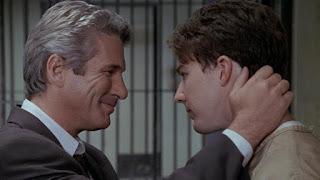
In Chicago, the respected Archbishop Rushman (Stanley Anderson) is brutally murdered. The police quickly arrest altar boy Aaron Stampler (Edward Norton) as he is escaping from the scene covered in blood. Celebrity defence lawyer Martin Vail (Richard Gere) offers his services to Aaron pro bono. Prosecutor Janet Venable (Laura Linney), one of Martin's ex-lovers, is assigned to the case, with a mandate from her boss District Attorney John Shaughnessy (John Mahoney) to secure a conviction and the death penalty.

The prosecution's case against Aaron is strong but lacks a motive. Martin interviews the stuttering, soft-spoken Aaron, and determines the simple young man from Kentucky is incapable of murder. Martin recruits psychologist Dr. Molly Arrington (Frances McDormand) to evaluate Aaron, while his team uncover several plots swirling around the Archbishop, including a politically-driven land development deal and evidence of sexual impropriety. In the courtroom of Judge Shoat (Alfre Woodard), Martin and Janet square off, but in an already complicated and high-profile case, surprises await them both. 

An adaptation of the William Diehl novel directed by Gregory Hoblit, Primal Fear is a richly textured drama. Packed with revelations, the plot finds new twists at regular intervals, and despite plenty of artistic freedoms stays just on the right side of cinematically credible. The Archbishop's murder is only the starting point, and before long sub-plots related to corrupt business deals, pedophilia, and personality disorders merge into a grand, multi-faceted mystery.

Of course some of the detours are elaborate distractions to cast doubt and open new avenues of potential guilt and innocence, prolonging the fundamental guessing game around Aaron's role. The altar boy as an innocent victim caught in the wrong place at the wrong time is Martin's thesis for the defence, but Aaron could also have been a pawn in much larger game, or holding his own difficult-to-uncover motive. 

In his big screen debut, Edward Norton's performance as the hesitant, deferential, and scared Aaron is a stunning bolt of lightning. But then Martin and Dr. Arrington delve further into the defendant's psyche and reveal much more to his character, and Norton moves to a higher level of dominance, evolving into a formidable and unpredictable presence.

The rest of the cast is packed with talent, Richard Gere infusing Martin Vail with plenty of depth and arrogant confidence in the central role. In contrast Laura Linney struggles with a choppy definition of prosecutor Janet Venable, often caught in unconvincing demonstrations of tough mannerisms.

At 130 minutes, Primal Fear goes on, and along with writers Steve Shagan and Ann Biderman, Hoblit could have tightened the pacing. A foot race involving another alter boy with something to hide is wholly unnecessary, some of the courtroom shenanigans could have been truncated, and the sexual tension between Martin and Janet is overplayed and loops in repetitive circles.

But Primal Fear is an overall gripping legal thriller. The courtroom manoeuvres maintain a pointed level of drama as intersecting battles of wits and wills play out, some plain to see, others just plain devious.


All Ace Black Movie Blog reviews are here.

Tuesday, 14 September 2021

Movie Review: Fight Club (1999)

A drama about rediscovering masculinity in all the wrong places, Fight Club releases demons from the darkest recesses of the male psyche.

Suffering from insomnia, the narrator "Jack" (Edward Norton) is stuck in a soulless job he hates, assessing the need for auto recalls on behalf of a car manufacturer. He discovers that by joining support groups and pretending to suffer from ailments, he can release his emotions and sleep better. But this new habit is disrupted when he bumps into Marla Singer (Helena Bonham Carter), another impostor pulling the same stunt.

Jack meets cool and ebullient soap salesperson Tyler Durden (Brad Pitt), and soon thereafter Jack's apartment blows up. He crashes at Tyler's place, a derelict house in an isolated part of town. Jack and Tyler start a fistfight and enjoy the experience of releasing their manliness. Soon Tyler is gaining a mythical reputation for organizing secretive underground fistfights among a growing group of men. Similar clubs sprout up across the country, and Marla re-emerges as Tyler's energetic sex partner. But as Tyler pushes towards more extremes of carnage, Jack starts to question their bond.

An adaptation of the novel by Chuck Palahniuk, Fight Club is an anti-consumerism, anti-domestication diatribe. David Fincher directs the Jim Uhls script as a journey to the bottom, Jack following Tyler's lead and stripping life down to the nothingness of pain, apathy, and the rejection of social constructs. The movie is hard-hitting, dark, grungy and sometimes acidly funny, but also overlong and repetitive.

The theme of freedom through rediscovery of base male instincts is tackled with a wink. Tyler and Jack embark upon a journey where happiness in a purposeless world is found in an anarchic fondness for destroying things (starting with themselves and other men) and demonstrating sexual prowess with incredible, long-stamina sex. Masculinity's peak is also a nadir, a potential-filled starting point celebrated as a destination where nothing is accomplished. The men who accept the fight club rules and achieve the promised freedom from society's shackles are reduced to subservient slaves, incapable of thinking for themselves.

The film's pacing is uneven. Once the characters are established and the fight club instigated, Fincher frequently punches the same ticket, lingering at numerous basement brawls between interchangeable and half-naked sweaty men knocking the stuffing out of each other. The message of men finding an escape from their dull lives by releasing their medieval selves is delivered with repeated blows to the head and eventually starts to lose impact.

Which is a cue for more dangerous pranks, property destruction, and sabotage to bring down a society promoting male de-clawing. Tyler's unleashing of his knucklehead army to instigate large-scale mayhem is also Jack's prompt to finally question where his new and unconstrained friend is headed. The plot twist is not difficult to spot, the insomnia and weasel traits introduced as gateways to a new paradigm. Although filled with vivid images of crude deconstruction, Fight Club does stage its most potent struggle in a lonely place.


All Ace Black Movie Blog reviews are here.

Sunday, 8 August 2021

Movie Review: Red Dragon (2002)

A serial killer suspense drama, Red Dragon is a fulfilling mix of mortal psychological mind games and dogged detective work.

In 1980, the FBI's Will Graham (Edward Norton) barely escapes with his life when he identifies his mentor and confidant, forensic psychiatrist Hannibal Lecter (Anthony Hopkins), as a cannibalistic serial killer. Lecter is imprisoned for life and Will retires.

Years later, two families are slaughtered in their homes, one month apart. The FBI's Jack Crawford (Harvey Keitel) presses Will back into service to investigate the crime scenes before the killer strikes again. Recognizing the work of a psychologically disturbed killer, Will turns to the incarcerated Lecter for advice, while tabloid reporter Freddy Lounds (Philip Seymour Hoffman) salivates after the next headline.

Meanwhile lab technician Francis Dolarhyde (Ralph Fiennes) is fighting self-hate, insecurities about a minor facial disfigurement, and boiling inner demons. He starts dating work colleague Reba McClane (Emily Watson), who is blind. Dolarhyde and Lecter exchange correspondence, and Will's wife Molly (Mary-Louise Parker) and son are soon placed in danger.

A satisfying prequel to Silence Of The Lambs, Red Dragon is a taut and moody suspense thriller, benefitting from a strong cast, two deranged villains, and an emphasis on patient detective work. Director Brett Ratner adopts a stark and straightforward style, allowing the characters to dominate and confining visual artistry to the background. Ted Tally's script (adopting the 1981 book by Thomas Harris) avoids horror cliches, focusing instead on the painstaking work required to penetrate sick minds.

Despite building excellent momentum, the film does suffer from a few weaknesses. Edward Norton is an unconvincing presence at the centre of the drama, his Will Graham lacking sufficient weight to counter Lecter and Dolarhyde. The massacres of two families and the race to prevent a third atrocity are somehow relegated to a sideshow in the final act, as the danger becomes more personal for Reba and Will but also less broadly threatening. And for all the red dragon artistry and literature references, the damage in Dolarhyde's mind remains superficially abstract.

But working with what he has, Ralph Fiennes as Dolarhyde does open a second front of twisted yet almost pathetic criminality, and Ratner invests in the world of a serial killer struggling to overcome severe inferiorities. His strife is revealed through the enhanced emotional senses of Reba, Emily Watson bringing to life an intriguing character desperate to be treated as a woman rather than a blind person.

Although Hannibal Lecter is sidelined in his cell for most of the film, Anthony Hopkins ensures his malevolence is never far from Will's psyche. Lecter's gift of manipulation knows no bounds, and he uses Will's request for help as an opportunity to plot a remote yet savage revenge. The brilliant cannibal may be incarcerated, but everyone else is just a pawn on his heinous chess board as he orchestrates a fearsome collision between fragility and fury.


All Ace Black Movie Blog reviews are here.

Saturday, 27 July 2019

Movie Review: The People vs. Larry Flynt (1996)


A biography of the infamous pornographer, The People vs. Larry Flynt delves into a smut peddler's unlikely influence on redefining the legal limits of free speech.

From humble childhood beginnings in Kentucky selling moonshine, by the early 1970s the brash Larry Flynt (Woody Harrelson) is the owner of strip clubs in Cincinnati. A relentless womanizer, he nevertheless falls in love with Althea (Courtney Love). To promote his strippers he starts publishing Hustler magazine with the help of his brother Jimmy (Brett Harrelson), and orients the content to the working man, pushing the boundaries of explicit sexual imagery. Flynt also lands a coup by publishing nude photos of former first lady Jacqueline Onassis, and becomes unimaginably wealthy.

The magazine incurs the wrath of self-appointed guardians of public morality, including Charles Keating (James Cromwell). Numerous lawsuits and legal charges stemming from accusations of obscenity follow. Young lawyer Alan Isaacman (Edward Norton) offers his services and defends Larry's right to free speech and to satirically mock public figures, including televangelist Jerry Falwell (Richard Paul). Then an unidentified sniper attempts to assassinate Flynt, altering his life forever.

Notable societal milestones often originate from unlikely margins. Hustler's right to publish outlandish sarcasm landed in front of the United States Supreme Court in 1988, and in The People vs. Larry Flynt the writing team of Scott Alexander and Larry Karaszewski trace an obscenity merchant's willingness to push boundaries all the way to the highest court.

Along the way, director Milos Forman crafts a baroque drama and wild romance, perhaps a pure embodiment of the American Dream. The 1960s sexual revolution and the anti-authoritarian sentiments of the early 1970s built the stage onto which Flynt strides to rewrite the rules of glossy sexual imagery for mainstream sale. That he finds a large audience and faces momentus opposition is no surprise, but Flynt uses his wealth and success to push ahead and take on his critics in various courtrooms. He wraps his empire in the flag of free expression, highlighting the hypocrisy of violent imagery depicting illegal acts being far more available and acceptable than pornography.

The People vs. Larry Flynt is also a love story, Flynt finding in Althea Leasure his perfect kindred spirit. Emotionally damaged from a difficult childhood, she loves sex as much as he does and possesses a sharp business mind to help keep pushing Hustler to new limits. Rock singer Courtney Love is exceptional in the role, starting out as a bright spark before descending to the wobbly depths of drug addiction and disease.

Along with the glitzy depiction of a rise from rags to riches, the film does spend considerable time in dark and depressing territory. Flynt takes the weirdest detour towards combining new-found Christianity with pornography, then the assassination attempt incapacitates him physically and emotionally. Addiction, depression, and mental anguish become constant companions, and Forman wades through musty territory to expose the rays of light within an unraveling mind.

The People vs. Larry Flynt depicts a real-life circus act in all its grandiose dysfunction, one man breaking barriers and paying the price in a volatile mix of pornography, love and law.


All Ace Black Blog Movie Reviews are here.


Monday, 29 April 2019

Movie Review: Collateral Beauty (2016)


A drama with touches of humour addressing the consequences of personal loss and profound grief, Collateral Beauty is well meaning but excessively sententious.

In New York City, marketing executive Howard (Will Smith) is still in a deep depression two years after the death of his daughter. To try and cope with his grief he writes angry letters to the abstract concepts of Death, Love and Time. His business partners Whit (Edward Norton), Clare (Kate Winslet) and Simon (Michael Peña) are facing a deadline to sell the company, but cannot seal the deal without Howard, the majority shareholder.

In desperation the partners decide to hire struggling theatre actors to engage with Howard, either to snap him out of his funk or prove he is incapable of functioning. Brigitte (Helen Mirren), Amy (Keira Knightley) and Raffi (Jacob Latimore) agree to impersonate Death, Love and Time respectively. Howard does take the initiative to join a support group managed by Madeleine (Naomie Harris), while the hired actors learn that Whit, Clare and Simon are facing personal issues of their own.

Death is part of life, love persists despite everything, and time is precious and should not be wasted are universal themes straight from the bottom shelf of simplistic self-help pop-psychology. Collateral Beauty wears these concepts with utmost reverence, and weaves around them a saccharin story befitting the excessively maudlin mood.

The clunky plot is an excuse to construct the rickety device of actors impersonating abstract concepts and ambushing Howard in street-level interventions. And it's no surprise whatsoever when backstories are introduced for Whit, Clare and Simon to double down on the sappiness of Howard's ordeal and give the hired actors more people to fix, Hollywood style.

But it's not all totally bad. Director David Frankel, working from a spec script by Allan Loeb, has an embarrassment of acting riches at his disposal, and makes reasonably good use of the talented cast given the emotional immaturity of the material. The shortish running-time of 97 minutes is shared equally among the many of stars on display, and most of them get at least a couple of scenes to shine. Helen Mirren appears to have the most fun as a never-will-be actress romping through the role of Death.

The perfectly sparkling locations featuring New York City decked out for Christmas fit perfectly within the film's simplistically magical ethos, but Loeb's dialogue exchanges needed at least one more thorough polish to scrub away the many awkward artificialities.

Collateral Beauty tries to achieve a whimsical fairytale vibe, but lands firmly on the wrong side of cloying.


All Ace Black Blog Movie Reviews are here.


Saturday, 1 September 2018

Movie Review: Rounders (1998)


A poker drama, Rounders captures the culture of incessant gambling and the spirit of the game, but the human characters and motivations are only partially convincing.

In New York, Mike McDermott (Matt Damon) is a gifted but small-scale young poker player and part-time law school student dreaming of making it big at the Las Vegas tables. Trying to raise quick money, he loses all his cash on one hand playing against Teddy KGB (John Malkovich), the Russian cutthroat operator of a gambling den. Mike gives up poker, accepts a job as a delivery driver offered by his friend Knish (John Turturro), and settles down with girlfriend Jo (Gretchen Mol).

But when Mike's old poker buddy Lester "Worm" Murphy (Edward Norton) is released from prison, Mike cannot resist: he is soon back to the tables with Worm, straining his relationship with Jo. Worm is a full-fledged gambling addict and cannot help but cheat at every hand, and to make matters worse, owes money all over town. Soon loan shark Grama (Michael Rispoli) comes around to collect, and Mike is caught between being loyal to his friend or straightening out his life.

Rounders tries to have it both ways in terms of a grim tone and a pleasant protagonist, and rarely succeeds. The film works hard to create the seedy, pessimistic and overbearing ambience of classic gambling dramas like The Hustler, The Color Of Money and California Split. But built entirely upon Matt Damon's sunny and boyish persona, the central character of Mike McDermott is way too cheerful, positive and resourceful to fit into the film's intended groove, and the crippling narration does not help.

Mike wants the keep the girl, make the money, chase his dream, impress his law school professor, and remain loyal to his past friendship with Worm. He spouts earnest lines about the philosophy of the game while he goes about his business with happy-go-lucky optimism, a fundamental disconnect between the tough-as-nails world of illicit gambling dens and a man who wants to do well for himself and good by all.

Worm is a more realistic fit in the desperate gambling world. Better yet, Teddy KGB is an instant classic tertiary character (the name alone deserves an award), John Malkovich sinking his teeth into the combustible Russian with a brilliant accent, alternating between a smooth as silk card player and dishing out implied threats of violence most extreme.

Director John Dahl does the best he can with the script by David Levien and Brian Koppelman, and occasionally the film sputters to life, usually at the poker tables. Rounders is credited with accurately conveying the mind games and tension that drive card duels, and embraces the theme of poker as a game of skill rather than luck. Regardless, the speed and precision with which Mike predicts other players' cards remains difficult to believe for the uninitiated, and late in the film the deciphering of a critical "tell" is celebrated rather than explained.

As for plot and storyline, Rounders does not offer much, nor is it expected do. Gambling dramas are a study of characters battling unseen internal demons, except here while the talk is tough, the protagonist's disposition is more suited to a fluffy pillow fight.


All Ace Black Blog Movie Reviews are here.


Wednesday, 4 October 2017

Movie Review: The Illusionist (2006)


A drama and romance set in the world of royalty, illusions and magic, The Illusionist looks grand but cannot conceal essential plot weaknesses.

The setting is Austria, late in the 19th century. As young adults Eduard and Sophie fell in love but were forcibly separated because he was the son of a lowly cabinet maker and she was from an upper class family. He grew up to be an illusionist using the name Eisenheim (Edward Norton) with a celebrated magic show in Vienna. One night Crown Prince Leopold (Rufus Sewell) attends the performance along with his fiancée, the grown-up Sophie (Jessica Biel). Also in attendance is Leopold's faithful Chief Inspector Walter Uhl (Paul Giamatti).

The chance reunion reignites the passion between Eduard and Sophie, but Leopold is possessive and will not tolerate Sophie leaving him. Meanwhile Walter perceives Eisenheim as a threat to the Crown Prince's prospects, and starts a campaign of intimidation to run Eduard out of town. Eisenheim will have to decide if he has what it takes to tangle with the might of the royal family and fight for his love.

Written and directed by Neil Burger, The Illusionist offers a visually rich aesthetic featuring staid late 19th century Vienna surroundings, with frequent outdoor sojourns to breathe the distinguished  air of a handsomely recreated stately European city. The visual splendor is accompanied by an opulent Phillip Glass music score. Paul Giamatti is another plus, his shifty performance as a Chief Inspector who is also the son of a butcher filled with one-foot-in-each-camp nuance.

But much like a magic show with more sizzle than skill, there is limited substance beneath the magnanimous hand movements. Fundamentally the premise of The Illusionist is deeply troubling, Eisenheim's actions ending at a place where the line between aggressor and victim is severely blurred, with Burger appearing oblivious to the substantial betrayal of sympathy.

Worse still is an attempt at a plot twist that is exceptionally obvious. Kicking off about halfway through the 110 minutes of running time, Eisenheim unfurls a deception that is supposed to encompass the film's audience, but is telegraphed in capital letters. Rather than build towards a surprise, the second half of the film becomes a boring countdown until the glaring trap snaps around Uhl and Leopard.

In the meantime, Eisenheim sits on the stage creating incredible magic of the bring-back-the-dead variety, with no explanation given because all his tricks are CGI-created, and CGI would have been difficult to describe in a 19th century Vienna context. A dour Edward Norton performance does not help.

The Illusionist attempts to conceal suspect substance with stylish subterfuge, but stumbles off the stage.


All Ace Black Blog Movie Reviews are here.


Wednesday, 24 August 2016

Movie Review: Kingdom Of Heaven (2005)


A historical epic based on real events, Kingdom Of Heaven is ambitious in scope and thoughtfully examines turmoil in the Holy Land during the Crusades. While the politics and battles are engaging, the film lacks emotional depth.

It's 1184, about a hundred years after the first wave of crusaders established a Kingdom in Jerusalem. Balian (Orlando Bloom), a blacksmith in the French countryside, has just suffered the loss of his wife through suicide. He reconnects with his father, the respected Baron Godfrey of Ibelin (Liam Neeson), a crusader making his way back to the Holy Land. Godfrey is wounded in a skirmish along the way, but Balian makes it to Jerusalem, where he finds the Leper King Baldwin (Edward Norton) ruling Jerusalem by allowing peaceful coexistence among all faiths and maintaining hold of a tenuous peace with Saracen leader Saladin (Ghassan Massoud).

The Marshal of Jerusalem Tiberias (Jeremy Irons) is an ally of the King, but the Knights Templar, under the leadership of Guy de Lusignan (Marton Csokas) and Raynald of Châtillon (Brendan Gleeson) are blood thirsty and power hungry, eager to set off a war with Saladin to impose Christian rule. To complicate matters, Guy is married to Baldwin's sister Sibylla (Eva Green). Balian settles down to working his father's lands, but with the Knights agitating for a war and Baldwin in ailing health, peace in the Holy Land is about to crumble.

Directed by Ridley Scott, Kingdom Of Heaven combines grand scenes of battle with an individual quest for life's true purpose. The film is passable both as a spectacle and a human drama, but never soars in either direction. Balian's story is interesting but never breaks through to a genuine level of engagement, while the army clashes are intense but often disintegrate into extras being thrown into a meat grinder.

At 144 minutes in length (with a much longer Director's Cut also available), the film is ambitious but doesn't create enough of a central drama to sustain its weight. Balian's story is a search for an objective after he loses his wife and commits murder in a rage, and his ponderous self-reflection does not always sit well in the context of massive historical events. It does not help that most of the dialogue is delivered with self-conscious importance, as if the characters knew they were partaking in events that would one day be chronicled in an important movie.

The rather unimaginative cast is adequate without threatening to compete with the grand sets and historical occasions. Orlando Bloom and Eva Green are promoted beyond their abilities to the front of a large production, and are not helped by an ill-defined and truncated romantic sub-plot. Liam Neeson, Jeremy Irons and Edward Norton carry better gravitas but are unfortunately confined to smallish roles.

The film reaches a highlight with Saladin's siege of Jerusalem, the outnumbered Balian organizing a clever defence, his objective not so much victory but the carving out of a bargaining opportunity. Scott excels at quite stunning scenes of massive armies on the move, long range and close combat action, and city walls being grimly contested to the death.

Screenwriter William Monahan does not try to disguise the film's noble intentions: the Holy Land has been a place of strife and religiously-motivated slaughter for millennia, and the path of peace can only be plotted by characters like the righteous knight Godfrey, the brave blacksmith Balian, and the benevolent King Baldwin. They have their flaws, but they all look past the individual towards the collective and seek accommodation in search of the greater good. Alas, evil co-exists in plain sight, possessing small minds but great power. The bad guys are embodied by Guy and Raynald, and the religious zealots do enough to topple the fragile peace from its perch and reignite war.

Kingdom Of Heaven is a glossy treatment of a sensitive subject, and ultimately goes out of its way to confirm the obvious: in this part of the world the names, affiliations and weapons will change, but violence in the name of God prevails across generations.


All Ace Black Blog Movie Reviews are here.


Sunday, 14 August 2016

Movie Review: Moonrise Kingdom (2012)


An artistic coming-of-age story, Moonrise Kingdom takes a quirky look at young love between two troubled adolescents. The film is a visual delight, and the story includes layers of sharp social commentary.

It's 1965, on a fictional island in New England. Scout Master Randy Ward (Edward Norton) leads a troop of 12 year olds at a summer camp. One morning, Sam Shakusky (Jared Gilman), an orphan and the least popular member of the scout team, goes missing, leaving a polite note behind. Police Captain Duffy Sharp (Bruce Willis) starts a search, and soon discovers that Suzy Bishop, the troubled daughter of Walt (Bill Murray) and Laura (Frances McDormand), is also missing. A year earlier Sam and Suzy met and bonded during a school play performance, and eventually they planned an escape adventure.

Once they learn of the escape, Sam's foster parents immediately disavow him and announce that he is not welcome back at their house. Meanwhile, out in the wilderness Sam uses his scouting skills as he and Suzy hike to a secluded cove, where they set up camp and tentatively start to get intimate. The search intensifies with Ward, his scouts, Sharp and the Bishops frantically trying to find the children, with matters complicated by a relationship between Laura Bishop and the police captain. A representative of Social Services (Tilda Swinton) flies in to help. Sam and Suzy enjoy a few moments of idyllic isolation, but there are surprises and complications ahead, including a mammoth storm.

Directed and co-written by Wes Anderson, Moonrise Kingdom is a fresh take on young and emerging love. With exquisite use of staging, colour and symmetry, Anderson creates a fictional yet potentially real world where the setting is as important as the characters, and the almost magical surroundings contribute to the sense that all is indeed possible. The film thrives on a sense of whimsy as seen through a storytelling lens, and builds to a frantic, blustery finale.

The central characters of Sam and Suzy share the experience of troubled households and loneliness bordering on depression. While keeping the film light, Anderson does not shy away from hinting at the violent tendencies that troubled children are capable of: both Sam and Suzy can and do take care of themselves when needed.

But more sharply, Moonrise Kingdom is about adults contributing to the trauma of children needing something different. Suzy's parents come off worst, seemingly wholly incapable of connecting with their daughter. Meanwhile Sam is suffering through the bullying and ostracizing that comes with being an orphan, and exhibits both the anger and resourcefulness needed to survive in a hostile world. Suzy is so miserable she confides in Sam that she wishes she was an orphan. Pointedly, he responds that he loves her but she doesn't know what she is talking about.

Placing sensual affection at the emotional centre of an idyllically framed, fairytale-like story is mildly startling and adds to the film's uniqueness. The scenes of budding intimacy between the two 12 years old are handled with sensitivity but also honesty, Anderson confronting the reality that two troubled kids are likely to start a journey of sexual exploration sooner than most.

The performances from Jared Gilman and Kara Hayward are touching, and they confront the material with admirable sincerity. They also benefit from a script that allows their characters to be children while yearning to break free of their childhood traumas. For her great escape adventure, Suzy takes along her cat, mounds of cat food, a battery-operated record player, vinyl records and three heavy hardcover books: not exactly items to facilitate a fleet-footed getaway, but fully consistent with what a child would think of.

The adults stick to their assigned supporting roles, with each of Willis, Murray, McDormand and Norton getting limited screen time but also key moments to advance the plot and sketch in Suzy and Sam's background stories.

Poignant and charming, Moonrise Kingdom beams an elegant light over the universal yet intensely personal adventure of childhood graduation.


All Ace Black Blog Movie Reviews are here.


Wednesday, 11 November 2015

Movie Review: Frida (2002)


A biopic of Mexican surrealist painter Frida Kahlo, Frida is filled with passion and deeply-felt human emotions. Salma Hayek shines in the central role, but the script does suffer from some wayward targeting.

As a young girl in Mexico, Frida (Hayek) develops a crush on painter, communist and hopeless womanizer Diego Rivera (Alfred Molina). After getting caught up in a severe bus crash, Frida's life hangs in the balance, and she suffers severe injuries to her back and legs. After many months she eventually recovers enough to resume her life, dedicating herself to painting and reconnecting with Diego. They get married, with Frida understanding that Diego can never be faithful, but he promises to at least be loyal to her.

Frida does not hide her bisexual tendencies, and establishes close relationships with Diego's ex-wife Lupe Marín (Valeria Golino) and sultry mutual friend Tina Modotti (Ashley Judd). With Diego's star rising in the art world, the couple enjoy a stint in New York, with Diego winning a commission from Nelson Rockefeller (Edward Norton). But Frida suffers another personal tragedy, and Diego does manage to hurt his wife with his exceptional inability to resist any woman. A bizarre encounter with none other than Leon Trotsky (Geoffrey Rush), now a fugitive from the Russian revolution that he helped to inspire, completes the inspiration for Frida's works of art.

Directed with panache by Julie Taymor, Frida is a singularly engaging film. The Latin lust for life positively jumps off the screen, and even the most secondary of characters display an ardent desire to contribute. The mix of art, politics and sexuality is captured by Taymor in an intoxicating broth, and Frida benefits from an unabashed, proud and outspoken posture. Frida, Diego and their circle have little time for apologies, justifications or requests for permission: they dive into life with purposeful commitment, and the biography buzzes with the energy of people worth knowing.

At just over two hours, the film is packed with incident and never flags as entertainment. Taymor constructs Frida's life around several tragic milestones, starting with the harrowing bus crash, and tracks her evolution from fledgling classical artist to a woman able to capture life's agonies in surreal, grotesque and captivating images. Life throws plenty of challenges Frida's way, and she navigates through them with a headstrong determination to embrace each obstacle and remain in charge, no matter what. With short but plentiful scenes the film builds and maintains momentum consistent with a woman who throws back twice as hard.

The film does steal some focus away from its main character. Although the story is recounted from Frida's perspective and her emotions remain at the core of all events, much of the second half of the film does centre on Diego, and at least as much time is invested in his character development and artistic achievements. His unwillingness to compromise his politics and his inability to refrain from casual sex dominate large segments of screen time, with Frida reduced to victim, observer or both. While her life with Diego clearly influenced Frida's art, the film tilts the balance more towards Diego as the source of inspiration and less on Frida as the artist who drew stimulation from a fascinating man.

Salma Hayek is excellent at every stage of Frida's life, and allows the character's flaws, vulnerabilities, strengths and desires to meld into a complete person. Alfred Molina matches Hayek scene for scene, and although Diego's arc is simpler, Molina is able to demonstrate that an overweight and outspoken frumpy man can exert an inexorable and long-lasting force on women. Antonio Banderas gets a small role as a member of Diego's intellectual circle.

The film's visual aesthetic is frequently inspired by Frida's paintings, and Taymor cleverly weaves the artwork into the narrative scenes without drawing attention to them, allowing the sometimes gruesome beauty to speak for itself. Life inspires art, and Frida is a worthy celebration of a fascinating artist's tumultuous journey.


All Ace Black Blog Movie Reviews are here.


Wednesday, 21 October 2015

Movie Review: Pride And Glory (2008)


A police corruption procedural drama, Pride And Glory flirts with a promising premise, but fails to deliver any new angles and dissolves into sub-standard territory.

The New York City police department is thrown into turmoil when four officers on the anti-narcotics unit are killed in a shootout with criminal Angel Tezo and his gang. The slain men all reported to Francis "Franny" Tierney Jr. (Noah Emmerich), a well-meaning commanding officer and the son of Police Chief Frank Tierney Sr. (Jon Voight). Frank Sr. convinces his other son Ray (Edward Norton) to help in the shooting investigation. Ray previously was involved in the drug wars, but grew disillusioned when he was embroiled in a false testimony scandal.

Officer Jimmy Egan (Colin Farrell) is a member of the anti-drug squad, and is also the brother-in-law of Franny and Ray. Jimmy is the informal leader of a group of corrupt officers receiving large payments from drug dealers. The four officers were killed because Jimmy was trying to squeeze out Tezo in favour of Casado, another crime king. Ray reluctantly starts his investigation, and it does not take him long to uncover the ring of corruption within the police department, triggering a moral and familial dilemma involving Ray, Frank, Franny and Jimmy.

Treading over the well-worn territory of honour, deep-seated corruption, and the police officer's unspoken code of conduct, Pride And Glory adds the interesting twist of multiple members of the same family embroiled in a swirling controversy triggered by the slaughter of four officers. But the promising start slowly but surely gives way to sideways drift, and eventually the movie arrives at a complete stall.

The screenplay by Gavin O'Connor and Joe Carnahan fails to capitalize on the set-up, leaving the characters undeveloped and the actors struggling with plenty of tough words but little context. The film defaults to a series of scenes with men angry at each other and doubling up on threats, but the details of the corruption, the motivations and the backstories are at best hinted at and more commonly just ignored.

There are a few action scenes but these are more muddled than effective, director Gavin O'Connor proving incapable of adding any zest to the proceedings. The frazzled ending, once it arrives after an overlong 130 minutes of running time, is a disastrous mano-a-mano fist fight followed by a botched robbery and a flash mob that just happens to be at the right place at the right time to tidy up the plot in a most unsatisfying manner.

Edward Norton is the one actor to emerge with any credit, and he tries to infuse Ray with some self-reflection and evidence of a troubled past to round out the character. Jon Voight, Colin Farrell and Noah Emmerich are sturdy but hampered by the unimaginative writing. The women in the lives of the police officers are reduced to the bittiest of meaningless roles, the opportunity to properly delve into family pressures once again registering as a bad miss.

Pride And Glory flickers early, but is then extinguished into blandness and is ultimately as forgettable as its title.


All Ace Black Blog Movie Reviews are here.