Showing posts with label Jeffrey Wright. Show all posts

Sunday, 15 February 2026

Movie Review: Hold The Dark (2018)


Genre: Drama Thriller  
Director: Jeremy Saulnier  
Starring: Jeffrey Wright, Alexander Skarsgard, James Badge Dale, Riley Keough  
Running Time: 125 minutes  

Synopsis: In the remote village of Keelut, Alaska, Medora Slone (Riley Keough) summons published author and wolf hunter Russell Core (Jeffrey Wright) to track down and kill the wolf who devoured her young son. The terrain is treacherous, the locals suspicious, the daylight hours short, and the wolves a constant threat. But then Russell stumbles upon a shocking discovery, prompting the return of Melora's husband Vernon (Alexander Skarsgard) from the Iraq War. Vernon's friend Cheeon (Julian Black Antelope) and police Chief Donald Marium (James Badge Dale) also get involved as violence erupts.

What Works Well: The adaptation of the William Giraldi book allows a foreboding mood of dark isolation to hang heavy in the air. Keelut may just as well be located in the middle ages, and this is a place where outsiders are unwelcome, the sun only dares to appear for a few hours each day, and humans need animal instincts to match the unforgiving environment.

What Does Not Work As Well: Beyond the setting and ambience, not much else connects. The trudging narrative lacks a central focus, the primary perspective meandering from Medora to Russell then onto Donald and Vernon, with Cheeon also grabbing a bloody moment in the spotlight. Russell is the most constant presence, but he is just a reactive observer. The theme of locals being as one with nature (and specifically wolves) as a survival imperative, setting them far from civilized behaviour, emerges with crusty layers of soulless opaqueness.

Key Quote:
Cheeon: When we're killed, the past is killed. When kids are killed... that's different. When kids are killed, the future dies. There's no life without a future.


All Ace Black Movie Blog reviews are here.

Monday, 8 April 2024

Movie Review: American Fiction (2023)


Genre: Drama Comedy  
Director: Cord Jefferson  
Starring: Jeffrey Wright, Tracee Ellis Ross, Erika Alexander, John Ortiz, Adam Brody, Issa Rae, Stirling L. Brown  
Running Time: 117 minutes  

Synopsis: Dr. Thelonious "Monk" Ellison (Jeffrey Wright) is a black professor and author, labouring in obscurity because he does not care to write about black issues. Close to burn out, he spends time with his family in Massachusetts, where successive health crises strike his sister Lisa (Tracee Ellis Ross) and mother Agnes (Leslie Uggams). Monk starts a romance with Coraline (Erika Alexander) and witnesses the success of new author Sintara (Issa Rae), whose debut novel about the "raw" black experience is celebrated in literary circles. As a joke Monk cranks out his own "raw" novel under a pseudonym, and it is immediately acclaimed a classic.

What Works Well: Wrapping biting satire around caustic social commentary, writer and director Cord Jefferson uses dry humour to expose hypocrisy in culture and the fleeting superficiality of topics-du-jour. Neither the weight of family tragedies descending on Monk nor his academic pursuits are of any interest to anyone else. But his throwaway crass novel about black thugs is suddenly all the rage amongst elites pretending to care. And when he tests insincerity limits by insisting on a vulgar title, the frenzy only intensifies. Jeffrey Wright rides Monk's downs-and-ups with an appropriate sense of bemused detachment. 

What Does Not Work As Well: The secondary characters surrounding Monk succumb to quantity over quality, adding some value but mostly accumulating into a pile of clutter and padding.

Conclusion: Perceptively on-trend.


All Ace Black Movie Blog reviews are here.

Saturday, 9 December 2023

Movie Review: Rustin (2023)


Genre: Biographical Drama
Director: George C. Wolfe
Starring: Colman Domingo, Aml Ameen, Jeffrey Wright, Chris Rock
Running Time: 106 minutes

Synopsis: In 1960, openly gay black civil rights activist Bayard Rustin (Colman Domingo) is a confidant of Dr. Martin Luther King (Aml Ameen). When Rustin's sexuality is weaponized during activist in-fighting, the two men have a falling out. In 1963 Rustin conceives of a march on Washington DC to pressure the Kennedy administration into passing civil rights laws. King and Rustin resolve their differences and Rustin is appointed head of the march planning committee. He galvanizes his team to meet tight deadlines, but opponents again threaten a smear campaign to derail his progress.

What Works Well: The human-scaled story of an unsung hero is delivered at an energetic pace and in a straightforward style, with Rustin's charismatic leadership forming the centerpiece of Colman Domingo's commanding yet accessible performance. The backroom arguments and disagreements amongst leaders of the civil rights movement (including roles for Glynn Turman, Jeffrey Wright, and Chris Rock) add surprising texture, while the scenes of volunteers mobilizing resources from across the country to stage a remarkable event carry the requisite chaotic power.

What Does Not Work As Well: As a behind-the-scenes look at a behind-the-scenes organizer, the movie is decidedly more administrative than inspirational. Rustin's cluttered romantic liaisons do convey the era's multi-pronged dangers for homosexuals, but also distract from the primary quest. The crescendo of the 1963 march on Washington DC is more presumed than portrayed, as Martin Luther King's influence is relegated to the narrative background. 

Conclusion: Proficient and poised, but lacking punch.


All Ace Black Movie Blog reviews are here.

Monday, 11 October 2021

Movie Review: The Public (2018)

A drama about the plight of the homeless, The Public tackles a serious subject with sensitivity and some humour, but unsurprisingly flounders for a resolution.

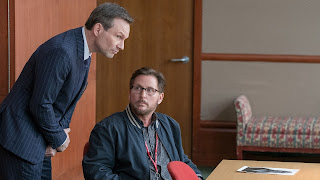
Cincinnati is in the grips of a cold snap. Librarian Stuart Goodson (Emilio Estevez), recovering from a troubled personal history, is on friendly terms with the community of homeless people who seek warmth at the Central Public Library. Junior librarian Myra (Jena Malone) and security officer Ernesto (Jacob Vargas) work with Stuart, and Anderson (Jeffrey Wright) is their boss. After Stuart befriends neighbour Angela (Taylor Schilling), his job is threatened by district attorney Josh Davis (Christian Slater), who blames Stuart for exposing the library to a lawsuit launched by a mistreated customer.

On a particularly chilly night, homeless man Jackson (Michael K. Williams) organizes a group of homeless people into refusing to leave the library at closing time, insisting it should remain open as a shelter. An unusual siege ensues, and police crisis negotiator Bill Ramstead (Alec Baldwin) is called in. Stuart is thrust into an unexpected media spotlight and wrongly portrayed as a hostage taker by conceited local television reporter Rebecca Parks (Gabrielle Union).

Packed full of plot, characters and incidents, the first half of The Public is full of ambition. Writer, director, co-producer and star Emilio Estevez holds nothing back in spotlighting the now tragically prevalent social failure of homeless people in ever larger numbers struggling for the basics of survival. The setting is Cincinnati, but the story equally applies to many other major cities.

With notable efficiency, Estevez ties together several key characters to the core topic. Stuart himself is not far removed from a life on the streets. Neighbour and new romantic partner Angela is still batting down corrosive addictions that bedevilled her past. And crisis negotiator Bill Ramstead is looking for his missing son in church basements. 

Characters like library boss Anderson and junior librarian Myra are full of good intentions to save the world and save others, but their actions in response to the library takeover will define their essence. Meanwhile, wannabe mayor Josh Davis is the representation of nauseating politicians seeking power through the expediency of soundbites and simplistic solutions to complex problems.

The script is unfortunately less successful in defining the homeless group. They are scrubbed clean of most dangers and reduced to harmless tourist depictions. The more fundamental narrative weaknesses come to the fore after the library takeover. Estevez does not seem to have a clear course to chart, and the second half drags, unnecessarily stretching the running time to over two hours, with a lot of people sitting around and not doing much of anything.

An intractable problem predictably settles for a climax exposing, if only for a night, the failure of policy makers to care for their community's most vulnerable members. The Public strips away the excuses, but also stalls in the stacks.


All Ace Black Movie Blog reviews are here.

Thursday, 14 May 2020

Movie Review: The Invasion (2007)


A science fiction thriller, The Invasion features a good if familiar build-up but falls victim to tired hide-and-seek trivialities.

Debris from a space shuttle disaster carries a fungus-like organism to Earth. When infected victims fall asleep, they are transformed to emotionless beings devoid of any passion but still eager to hunt down and spread the infection to others. Tucker Kaufman (Jeremy Northam) is a Director at the Center for Disease Control and among the first to be infected. He uses his position of authority to quickly spread the disease.

In Washington DC, psychiatrist Dr. Carol Bennell (Nicole Kidman) is Tucker's ex-wife with primary custody of their young son Oliver. She is friends with Dr. Ben Driscoll (Daniel Craig) but reluctant to evolve the relationship. Her patient Wendy Lenk (Veronica Cartwright) starts to describe her husband's weirdly emotionless behaviour, and gradually Carol notices increasing numbers of impassive people. Along with Ben and his colleague Dr. Stephen Galeano (Jeffrey Wright), Carol has to keep Oliver safe and figure out how to stop the infections while fending off hordes of pursuers.

Another iteration of the Invasion Of The Body Snatchers story, this version introduces peace-on-earth as an added bonus of a uniformly conformist society. But the David Kajganich script carries little conviction to push towards any valid intellectual debate. Instead a limp denouement undermines any pretense of cerebral intentions, and what remains is a largely forgettable chase thriller.

Which is unfortunate for Nicole Kidman. Her performance as a resilient doctor and mother coping with the unfolding horror is much better than the material. Director Oliver Hirschbiegel is rarely able to surround her with worthwhile plot elements, and the film's prolonged climax has all the freshness of a leftover 1980s Steven Seagal guns cars and helicopter flick. As Kidman does her best to wring drama out of the must-stay-awake imperative, the horror elements remain half-hearted and meld into warmed-over chase action.

In contrast the first 40 minutes are better as tension builds in measured doses and Carol is introduced as a well-rounded smart and caring character worth knowing. Veronica Cartwright provides welcome linkage back to the 1978 version, but Daniel Craig, Jeffrey Wright and Jeremy Northam barely register in underwritten roles. The Invasion is a story told once too often, now truncated in both title and depth.


All Ace Black Blog Movie Reviews are here.


Tuesday, 4 February 2020

Movie Review: A Single Shot (2013)


A suspense drama, A Single Shot explores themes of guilt and despair as one flawed man's life is forever changed by a moment of carelessness.

John Moon (Sam Rockwell) lives alone in a mobile home, deep in the woods. While poaching a deer he inadvertently shoots and kills a young woman. He hides her body then stumbles upon an abandoned ramshackle encampment where he finds and keeps a box full of seemingly stolen cash.

Hoping to patch up his marriage to Jess (Kelly Reilly), John follows the advice of his frequently drunk friend Simon (Jeffrey Wright) and reaches out to lawyer Pitt (William H. Macy), who is eager to ask questions more awkward than his wardrobe. Jess is not interested in a reconciliation and appears to be hanging out with the wrong types. John's loneliness and sense of guilt are further stressed when he finds himself under threat from creepy criminals Obadiah (Joe Anderson) and Waylon (Jason Isaacs), who want their cash back.

A backcountry drama, A Single Shot luxuriates in barely comprehensible accents and a hostile environment where tough terrain, uncompromising townfolk and seedy ex-cons co-mingle uneasily. The raw material threatens a potentially cold and calculating human-centred thriller, but director David M. Rosenthal is unable to harness the available elements into a satisfying whole.

The culprit is a weak script written by Matthew F. Jones as an adaptation of his own book. While John Moon is a compelling enough central character and Sam Rockwell brings him to life in an appropriately moody performance, most of the film's events are suspect. Moon is subjected to a campaign of intimidation that makes no sense upon just rudimentary examination, and the bad guys in the form of Obadiah and Waylon look the part but are otherwise devoid of context.

The third act defaults to plenty of violence and blood-letting, although Rosenthal does find a poignant resolution which almost salvages the entire film. After John stumbles into an opportunity to make symmetrical amends with an act of agonizing heroism, the burden of guilt nevertheless conspires to have the final say.


All Ace Black Blog Movie Reviews are here.


Saturday, 14 December 2019

Movie Review: Shaft (2000)


A next-generation sequel and reboot, Shaft reaches for a cool vibe but stumbles on shallow stock characters and a dull story.

In New York City, detective John Shaft (Samuel L. Jackson) roughs up snotty and racist rich kid Walter Wade Jr. (Christian Bale), who has just been arrested for a murder. The only witness to Wade's crime is bartender Diane Palmieri (Toni Collette), and she immediately goes into hiding. Walter is released on bail and promptly flees to Switzerland. Two years later Shaft tangles with local drug gang leader Peoples (Jeffrey Wright), then re-arrests Wade as soon as he lands back on US soil.

Again the justice system fails and Wade is released on bail, enraging Shaft who quits the force and vows to pursue private justice. Wade wants to silence Diane before she testifies against him, and hires Peoples to do the dirty work. Shaft gets help from detective Vasquez (Vanessa Williams) and taxi driver Rasaan (Busta Rhymes), but has to overcome crooked cops Roselli (Dan Hedaya) and Groves (Ruben Santiago-Hudson) in his quest to find and save Diane.

The original Shaft spawned two sequels, but after 1973's Shaft In Africa the series fizzled along with the blaxploitation sub-genre. A full 27 years later the 2000 entry picks up with the nephew of the original character in the lead role. Richard Roundtree does get to reprise his star-making turn in a few incidental scenes, still as a private investigator and now waiting for his nephew to experience the futility of working within the system.

The problem with Shaft in 2000 is its utter routineness. Director and co-writer John Singleton is unable to elevate the film beyond standard-fare Hollywood-style police work and masculine posturing, with frequent nods to broken officialdom perforated by corruption and justice tilted heavily towards white rich people. These are well-worn themes, and no amount of profanity (in almost every sentence) can elevate the film towards a new edge.

The script certainly does not help. The find-the-witness central quest is misplaced into an environment where scores are settled with bullets flying around every corner and dead bodies piling up on the street. The thought that after all the killing some sort of court case will determine Wade's fate is quaint, and too thin a thread to hang a film on. The complete absence of any character backstories adds a lightweight feel to 99 minutes of superficiality.

Samuel L. Jackson slices through the film oozing self-confidence but lacking any depth. Singleton delivers a few deft directorial touches and handles the frequent shootouts with decent cohesion, and Isaac Hayes' classic Theme from Shaft enlivens the otherwise forgettable soundtrack. But rather than a cool cat, in 2000 Shaft is just another angry cop.


All Ace Black Blog Movie Reviews are here.


Saturday, 17 October 2015

Movie Review: The Ides Of March (2011)


An inside look at the United States political process, The Ides Of March delves into the ruthless backroom machinations that define election campaigns. The film is almost incredible, and also likely too close to the truth for comfort.

Governor of Pennsylvania Mike Morris (George Clooney) and Arkansas Senator Ted Pullman are locked in a tight race for the Democratic party presidential nomination. The next big milestone is the Ohio primary, and both campaign teams are going all out to win. Veteran Paul Zara (Philip Seymour Hoffman) runs Morris' campaign, assisted by the young, bright and idealistic Stephen Meyers (Ryan Gosling). Their opponent is Pullman's campaign manager Tom Duffy (Paul Giamatti). New York Time journalist Ida Horowicz (Marisa Tomei) is covering the nomination battle.

Stephen genuinely believes that Morris is a positive change agent who is capable of great achievements. His attention is momentarily distracted by attractive campaign intern Molly Stearns (Evan Rachel Wood). They seduce each other and start a steamy affair. Meanwhile, Paul is working overtime to try and secure the critical endorsement of influential North Carolina Senator Franklin Thompson (Jeffrey Wright). Considered a king-maker, Thompson is negotiating with both campaigns, effectively selling his support to the candidate who offers him the most attractive White House position. All appears to be going well for Stephen, until he receives a phone call from Duffy, who wants Stephen to defect to the Pullman campaign. A rapid series of cascading events then throws the nomination race into turmoil, threatening to end Stephen's promising career.

Directed and co-written by Clooney as an adaptation of the play Farragut North by Beau Willimon, The Ides Of March exposes a two-faced political system that presents a fake public profile while running on a cut-throat culture of deceit, back-stabbing and betrayal. That politics is a blood sport is not new; that the participants engage with a deadpan matter-of-factness while twisting the knife is never less than disturbing.

The events portrayed are only loosely based on fact, but while too much drama is packed into a few days of campaigning, the individual misdoings all ring true as actual headlines from real political wars. Clooney moves the talk-fest along swiftly, allowing each event to shine brightly but ever so briefly in the glare of the 24/7 news cycle: there is always the next outrage waiting to feed tomorrow's talking heads.

Appropriately, the candidates are the articulate faces of their respective campaigns, but very much secondary characters in the overall context. The strategy, policy, negotiations and message control are the domain of men like Paul, Stephen and Tom. They are the backroom operatives who prefer to stay in the dark, spinning stories to reporters but manipulating events from behind the curtain. The film is a compelling chronicle of a battle of wills, and Clooney constructs it with zest, focusing on soul-destroying compromises driven by the rampant ambition to win at all costs.

A dream cast contributes greatly to the film's appeal, with Philip Seymour Hoffman and Paul Giamatti biting into their roles with glee, allowing Ryan Gosling to adopt the more cerebral and circumspect approach. Stephen is at the centre of the film, and Gosling treats the role as a story of awakening. Stephen transforms from idealistic bright young assistant campaign manager to a veteran of the political wars, a journey that will require him to taste bitter disappointment and discover just how far he will personally go to safeguard his dreams.

Evan Rachel Wood radiates an outer innocence and inner self-indulgence, always hinting that Molly wants to play in a league that may just be too tough for her. Marisa Tomei suffers somewhat from a vaguely underwritten role as the clinical reporter Ida.

Of course by the time Stephen emerges at the other end of the Ohio primary, his idealistic dream is a nightmare of corruption, his path to success littered with victims. But in the high stakes world of politics, the prize comes with the reward of enormous power, justifying all necessary means.


All Ace Black Blog Movie Reviews are here.


Friday, 13 February 2015

Movie Review: Syriana (2005)


An intellectual tour-de-force delving into the morass of Middle East geo-politics, Syriana launches a thrilling multi-pronged probe of its subject, and emerges with a realistic portrait of a depressing impasse.

The film tackles several interlinked sub-stories. Weary CIA Agent Bob Barnes (George Clooney) tangles with arms dealers in Tehran, and in the process loses control of a sophisticated anti-tank missile. His next assignment is to travel to Beirut and assassinate Prince Nassir (Alexander Siddig), the progressive heir to an oil-rich Arab country. Once in Beirut, Barnes crosses paths with the militant group Hezbollah, particularly the brutal Mussawi (Mark Strong).

Big oil companies in the US want Nassir out of the way because he threatens to upset the status quo. Idealistic energy consultant Bryan Woodman (Matt Damon) overcomes the tragic loss of his young son to become Nassir's trusted advisor, and together they plan Nassir's modernization of his country.

A large merger of oil companies Connex and Killen is unfolding in the United States. The consolidated company will control vast oil and gas reserves in the Middle East and Asia, and is most interested in stability. Attorney Bennett Holiday (Jeffrey Wright) is hired to investigate the proposed merger, which appears to be a fait accompli. Bennet's boss is political power broker Dean Whiting (Christopher Plummer), working behind the scenes to ensure that the more compliant Prince Meshal (Akbar Kurtha) ascends to the throne instead of Nassir.

The merger of Connex and Killen results in mass layoffs in the oil fields of the Middle East. One of the casualties is Pakistani migrant worker Wasim (Mazhar Munir) and once unemployed he drifts under the Islamist influence of charismatic recruiter Muhammad Sheikh Agiza (Amr Waked). Wasim is radicalized and prepared for a terrorist suicide mission, using the anti-tank missile seized in Tehran.

Delving into the world of Middle East politics is a daunting task, and Syriana succeeds with aplomb. The fast paced episodic structure preferred by director Stephen Gaghan (adapting the book See No Evil by Robert Baer) is a perfect fit with the fragmented yet labyrinthine relationships that define the region. And other than ignoring the Palestinian/Israeli conflict, Gaghan expertly assembles the pieces of the puzzle and tightly packs the 128 minutes of running time with multiple stories of ever increasing tension.

While Syriana's structure works in its favour, it also allows Gaghan to get away with some short-hand. The various stories hold enormous impact thanks to the short sharp jabs style of delivery, but this also leaves plenty that is unsaid and unexplained. The need to fill in the blanks serves the film's intellectual credentials but also gives it a free pass to gloss over what could have been interesting details.

There are few happy emotions in Syriana. The film mimics the Middle East's pathetic entrapment into a cycle of pessimism driven by greed and the crushing imperatives of oil, which flows along with espionage, arms trading, corruption, corporotocracy, torture, extremes of wealth and poverty, militant Islam and terrorism. The polluted streams of evil feed off each other and accelerate the downward spiral of violence and subjugation, sucking entire societies into the vortex. Progressive voices are trampled because the system is dependent on maintaining the existing structure among the entrenched power brokers, and change represents an unacceptable risk to the production of oil and profits.

The ensemble cast members are all appropriately dour or conniving. Clooney won the Best Supporting Actor Academy Award for his portrayal of Bob Barnes (effectively Baer's character), a disillusioned agent who has seen too many battles and too many betrayals in the back alleys of the Middle East, but knows of no other life. Christopher Plummer is at his oily best as a literal backroom kingmaker. Matt Damon and Akbar Kurtha represent the earnest but naive attitude of optimism that occasionally sprouts in the region, and their characters predictably hurtle towards the impenetrable brick wall of international rules set by others. Also in the cast are Chris Cooper as a Killen executive, Amanda Peet as Bryan Woodman's wife, and William Hurt as one of Barnes' few trusted allies at the CIA.

By the time Gaghan wraps up his stories, all his key characters have been profoundly impacted, and of course absolutely no meaningful positive change has been achieved. In the Middle East potential saviours are swallowed by the desert, drowned in oil, and quickly forgotten as the tide of oil-fuelled violence marches on abated.


All Ace Black Blog Movie Reviews are here.