Genre: Dramedy

All Ace Black Movie Blog reviews are here.
Reviews of Classic and Current Movies


In Greece of 1948, Noelle Page (Marie-France Pisier) is imprisoned ahead of being tried for the murder of Catherine Alexander (Susan Sarandon). During a visit by her business tycoon husband Constantin Demeris (Raf Vallone), she recounts her story in flashback.
In Marseille of 1939, Noelle is young and beautiful but from a poor family. Her father sells her to a store owner in a sex-for-cash transaction, and Noelle starts to discover her power over men. She flees and makes her way to Paris, where she meets dashing American fighter pilot Larry Douglas (John Beck), who is volunteering with the RAF as World War Two erupts. They fall deeply in love but he then leaves for service and never fulfils a promise that he will return and they will get married. Noelle lands a job as a fashion model then discovers she is pregnant with Larry's baby.
In Washington DC, the enterprising Catherine lands a job as an assistant to Bill Fraser (Clu Gulager) at a public relations firm. With America about to enter the war, she meets Larry. They experience a rough start then fall in love and get married. After the war Larry finds it difficult to hold a job. Back in France, Noelle embarks on a long-term plan to win back her man, using her sexuality to achieve movie stardom then luring Demeris into a marriage.Sidney Sheldon's 1973 best-selling page-turner comes to the screen at an epic, no-expenses-spared length of 165 minutes, screenwriter Herman Raucher seemingly intent on capturing all the book's details. The go-big-or-go-home approach works. Director Charles Jarrott delivers a big-budget, handsome-looking production, with rich cinematography by Fred J. Koenekamp and evocative (but judiciously deployed) Michel Legrand music. Costumes, hairstyles, and set designs (before, during, and after the war) are all stellar, with extras animating every scene. The relaxed pacing never slips into boredom, and each of the four lovers involved in the quadrangle are afforded time to develop.
The whirlwind romance between Noelle and Larry is crafted with care to capture a young woman's devastation - then fury - when abandoned, her difficult-to-watch bathtub scene a red punctuation mark. Noelle's desire to reclaim what she believes is hers propels the rest of the drama, Catherine a mere hurdle and Demeris a step-stool to the ultimate objective.
The acting is mostly excellent. Marie-France Pisier covers a lot of ground, sometimes slipping into overclocked emotions but mainly conveying a woman discovering with wonder her inner strength and ability to manipulate with beauty and seduction. Susan Sarandon is the more innocent counterpoint, and Raf Vallone hovers near the edges before stepping into the spotlight with devastating impact. John Beck is adequate but too often slab-like, over-relying on a hunky presence. The impressively deep cast also includes Michael Lerner and Charles Cioffi.
Brimming with plot, scheming, and sensuality, The Other Side Of Midnight finds a twist to suggest hell may indeed have a fury worse than a woman scorned.
All Ace Black Movie Blog reviews are here.
The setting is a small Massachusetts town in 1972. Diana Floss has just been shot dead at the local diner - she was in the wrong place at the wrong time when a gunman attempted to kill his wife. Diana's soft-spoken fiancé Joe Nast (Jake Gyllenhaal) is living with her parents Jojo (Susan Sarandon), a writer, and Ben (Dustin Hoffman), a commercial real estate agent. They navigate the funeral and memorial service together, and meet with prosecutor Mona Camp (Holly Hunter) in preparation for the killer's trial.
Ben wants to move on quickly, and brings Joe in as his new business partner without much pause. They start working on a land assembly deal for big-time developer Mike Mulcahey (Dabney Coleman). But beneath his calm facade Joe is struggling with a couple of secrets: his relationship with Diana had already ended before she was killed; and he is starting to fall in love with Bertie Knox (Ellen Pompeo), who works at the post office and the local bar.
Writer and director Brad Silberling was dating actress Rebecca Schaeffer when she was murdered in 1989, and subsequently he lived for a while with her parents. Moonlight Mile is loosely inspired by his experience. The film adopts a pragmatic, almost detached, attitude towards the loss of a daughter and fiancée, avoiding histrionics but still finding patches of quiet anger, disbelief, and disorientation. Layered on top of the grief are observations about the long-term relationship between Jojo and Ben; Joe sensing entrapment within an unearned son-in-law status; and a burgeoning complex romance with Bertie, who is dealing with an unresolved loss of her own.The uniquely reflective mood challenges norms and ironically provides the drama with an edge. Jojo becomes snappy and her prose dries up, Ben drowns his emotions in work, but their mental state remains remarkably steady, their rage at losing Diana relatively subdued. Susan Sarandon and Dustin Hoffman stay within themselves as a couple well past expressing passion about anything.
Meanwhile Jake Gyllenhaal fills the screen with silent quandary as Joe defaults to present absenteeism in response to shock, guilt, and displacement. He harbours the awful truth about a breakup that now cannot be mentioned, and tags along as Ben unilaterally charts his future, all while hopelessly developing an attraction to Bertie.
The town with one main street is a comfortable cradle, and the 1970s setting is stealthy - the set design is unobtrusive, and only the car models and references to the Vietnam War reveal the era. More prominent is a unique music score featuring eccentric selections from the Stones, Dylan, Bowie, Jethro Tull, and Sly and the Family Stone among others.
Moonlight Mile navigates towards a standard truth-shall-set-you-free moment, but covers the distance with a quizzical attitude set to idiosyncratic tunes.
All Ace Black Movie Blog reviews are here.
Atlantic City is undergoing a transformation, with old heritage buildings and hotels being knocked down to make way for new casinos. Old-timer Lou (Burt Lancaster) is a low-key runner in a small numbers racket, and scratches a few more bucks by caring for his neighbour Grace (Kate Reid), a bed-ridden but demanding widow. Also living in the same building is Sally (Susan Sarandon), a server at a hotel fish bar training to become a croupier and dreaming of a career in Monte Carlo. Through his window, Lou admires Sally's nightly cleansing-with-lemons routine.
Sally's no-good husband Dave (Robert Joy) has run off with her sister Chrissie (Hollis McLaren), but now both show up in Atlantic City and want to stay with Sally. The free-spirited and pregnant Chrissie bonds with Grace over foot massages, while Dave recruits Lou's help to sell drugs he stole from thugs in Philadelphia. When Dave's drug-dealing career comes to a sudden end, Lou is left holding plenty of drugs and cash, and finally has an opportunity to impress Sally and experience his version of the big time.
Set in a milieu of questionable renewal, Atlantic City breathes deeply from the dust of demolition and reconstruction. Director Louis Malle ensure the city is an important lead character and a noisy participant in the process of erasing the past and striding into a future defined as better by virtue of investment.
With the city in a half-state of renewal, no one is satisfied with the present, and Atlantic City is populated with a memorable set characters interacting during personal transitions. In an achingly honest script, writer John Guare laments the past with the romanticized lyricism necessary for the soul's survival. Lou's inclinations to harken back to yesteryear reveal a sometimes pathetic recasting of non-existent past glories, Lou living in a grandeur he built for himself to cover for so much nothingness.Meanwhile, Sally hates her past and lives for a future in Europe, her awful present consisting of peddling fish, battling the stink, and surviving the advances of a casino manager who may hold the key to her future. Her no-good but still soft-touch husband Dave is hustling for better days through drug dealing, Chrissie lives simultaneously in the past and future thanks to her reincarnation beliefs, and Grace feeds off exaggerated references to her dead husband's status in the old underworld.
When even the grandest old hotels are being demolished for something new, hope for a change in fortunes is eternal, and Lou is about to experience the best of times. He inherits more money than he ever handled, and awkwardly, but predictably, buys the most expensive outdated suit he can find. He then sets out to transform his voyeurism into courtship by throwing money at Sally's problems. And for a brief interlude, it appears possible that a sad old man without much of a past and a sad young woman with a vague future can find happiness together.
The entire cast shines, led by Burt Lancaster in a soulful mood, allowing Lou to relax into his advancing years but deftly revealing his small-time foundations. Susan Sarandon conveys Sally's state of constant aggravation in search of a ticket to elsewhere, her eyes quick to realize she needs help from men she will never tolerate.
Atlantic City will change but persevere, in some form. Lou and Sally will also dream of better days past and future, but have less time and ability to redefine who they truly are.
All Ace Black Movie Blog reviews are here.
In Detroit of the early 1990s, semi-retired Dr. Jack Kevorkian (Al Pacino) starts to act on his conviction that doctors should be allowed to help their patients die. With support from his sister Margo (Brenda Vaccaro) and friend Neal Nicol (John Goodman), a medical technician, Kevorkian develops the rudimentary "Mercitron" machine, allowing patients to self administer a cocktail of lethal chemicals. He is careful to videotape interviews with each of his patients as they convey their wish to die, and also records their final moments.
As news spreads of his activities, more patients suffering from debilitating conditions seek his services. Kevorkian triggers a national controversy and debate about the right-to-die, and becomes known as Dr. Death. Michigan's state prosecutors haul him into court on several occasions, but his lawyer Geoffrey Fieger (Danny Huston) is victorious every time, because there is no law against assisting suicide. By the late 1990s, Kevorkian becomes eager to enshrine the right to die into law.
Dr. Kevorkian created his legacy in the moral morass where medicine, religion, and the law intersect. This HBO production tells his story in a rather grey semi-documentary style, the controversial material sidelining any attempts at artistry. Director Barry Levinson and writer Adam Mazer focus on the actions and motivations of a unique historical character, tracing factual events and leaning on Al Pacino to embody the doctor's headstrong idiosyncrasies.
Mazer is sympathetic to Kevorkian's convictions that the medical profession needs to re-assess how patients who want to die are treated. His actions stem from a desire to end suffering and respecting patients' wishes. His opponents in the form of street protesters and state prosecutors are driven by religion and dogma, pushing court cases based on no viable laws. Kevorkian and his lawyer Fieger are able to swat away the court challenges, emboldening the doctor. He then pushes further and starts to challenge new limits with the intent of seeking an audience with the land's highest court.As a single man with no family commitments and near the end of his career, Kevorkian is presented as having nothing to lose as he challenges the status-quo. His motivations stem from personal experiences, and are gradually revealed through Pacino's soulful performance. Levinson rounds out his protagonist with character quirks including frumpy clothing, picky dietary habits, willingness to go on hunger strikes, and, ironically, a steadfast determination to never lend a helping hand when it comes to carrying physical objects.
As portrayed by an animated Danny Huston, lawyer Geoffrey Fieger radiates swagger pushing into arrogance. In comparison, the other characters surrounding Kevorkian are short-changed. Sister Margo and medical technician Neal barely progress beyond props, and advocate-turned-friend Janet Good (Susan Sarandon) is lost in the shuffle.
It may lack panache and cinematic creativity, but You Don't Know Jack does set the record straight in revealing the human behind the moniker.
All Ace Black Movie Blog reviews are here.
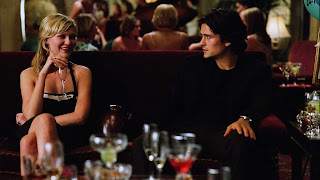
In Oregon, Drew Baylor (Orlando Bloom) is a superstar shoe designer at the Mercury sportswear company. When his latest design flops, eccentric owner Phil DeVoss (Alec Baldwin) faces a billion dollar loss, and Drew's girlfriend Ellen (Jessica Biel) distances herself from their relationship. Drew considers suicide, but his sister Heather (Judy Greer) calls with news their father Mitch has died suddenly while on a trip to his hometown of Elizabethtown, Kentucky.
On the near-empty overnight flight, Drew befriends perky flight attendant Claire Colburn (Kirsten Dunst). In Elizabethtown he meets his father's friends and relatives, and understands the depth of affection towards Mitch, although the Baylors never welcomed Drew's mother Hollie (Susan Sarandon). Over the coming few days Drew and Claire continue to see each, while Hollie causes waves by showing up for the memorial service.
Written, directed, and co-produced by Cameron Crowe, Elizabethtown is an uncoordinated but still engaging mishmash. Humour, drama, romance, culture shock, grief, a travelogue, and familial conflicts take turns setting the tone. The result is awkward, sometimes jarring, but always reasonably watchable despite an overstuffed, often whiny, soundtrack, although the inclusion of Lynyrd Skynyrd's Freebird makes up for a lot of the dross.
The film suffers most trying to define a narrative flow and logical transitions, and never really finds the magic formula. Segments exist in isolation almost as stand-alone ideas. A chunk of time is occupied in developing the romance between Drew and Claire, although their conversations border on obtuse. Frustratingly, Claire is confined to the prototypical perfect potential girlfriend who just happens to land in the protagonist's lap as an emotional saviour in his most desperate hour.Then another long sequence gives the stage (literally) to Susan Sarandon as Hollie, trying in one night to make up for a lifetime of estrangement from Mitch's family. A final chapter steers (again, literally) into a road trip of southern landmarks. Drew grieving his career fiasco and the loss of his father are supposed to provide an arc, but the dramatic themes are only modestly refined.
The humour is derived from some typical familial quirks, including the uncles, aunts, cousins, and nephews Drew has to get to know in a hurry. Cousin Jesse (Paul Schneider), once in a Lynyrd Skynyrd tribute band, is now raising a very loud kid and is a particular source of laughs. At the hotel, Drew's room is on the same floor as a raucous wedding event, another venue for passable chuckles.
A running joke is that Elizabethtown is difficult to find on the map. This hometown contains some charm, but is also easy to bypass.
All Ace Black Movie Blog reviews are here.
New York architect Phillip Dimitrius (John Cassavetes) is experiencing a severe middle age crisis. His work designing casinos for his boss Alonzo (Vittorio Gassman), a semi-respectable mobster, is now a boring chore, and Phillip has lost interest in his wife Antonia (Gena Rowlands), a retired actress attempting a comeback. He also finds his teenaged daughter Miranda (Molly Ringwald) irritating.
When he stumbles upon Antonia seeking intimacy outside their marriage, Phillip packs up his life and heads to Greece with Miranda, desperate to rediscover his passion. In Athens they meet nightclub singer Aretha (Susan Sarandon), and she quickly becomes Phillip's lover. In search of a rustic lifestyle Philip, Aretha and Miranda relocate to a rugged and isolated island, where the only other resident is goat farmer Kalibanos (Raul Julia).
Inspired by Shakespeare's play, Tempest is directed, co-written and co-produced by Paul Mazursky. At a meandering 142 minutes, the signs of bloat are obvious, particularly when the third act loses all focus and falls well short of capping the preceding profundity.
Philip's story is presented in two timelines. On the Greek island, he desperately tries to reinvent himself as a happy recluse, satisfied without all of modernity's luxuries. Aretha and Miranda are less impressed and quite tired of the isolation. In multiple flashbacks, Philip circulates among New York's elites, living in an elegant condominium of his own design, married to Antonia and working for Alonzo. He has all the ingredients for happiness but is imprisoned by the eternal is-this-all-there-is question.Mazursky plays lightly on many themes. Phillip's tortured state of mind is represented by electric storms, conjured up as bookends to his crisis. His attempt at island celibacy, leaving Aretha quite hot and bothered, is the product of a disoriented psyche still partially loyal to Antonia. Philip's inability to come to terms with Miranda blooming into a young adult is a further demonstration of his creeping shortcomings. And joyous singing interludes punctuate the drama, often helping to boost spirits threatened by the eccentricities of a futile battle with the advancing years.
With Raul Julia unconstrained, Kalibanos' buffoonish pursuit of Miranda occupies too much screen time, although his lecherous quest affords Molly Ringwald plenty of scene-stealing opportunities. The rest of the cast members find depth within their characters, Cassavetes allowing the weight of unmet expectations to etch his face, Rowlands matching him as a resilient wife who will find alternatives to an inattentive, distracted and self-obsessed husband.
Phillip's old and new lives are on an inevitable collision course, but whilst the Tempest build-up is spasmodically turbulent, the resolution is simplistically tepid. 
All Ace Black Movie Blog reviews are here.
After her husband died leaving her lonely but rich, middle-aged Mamie Minervini (Sarandon) moved from Brooklyn to Los Angeles to be close to her single daughter Lori (Rose Byrne), a script writer. Both are still processing their grief, and Mamie cannot help but meddle in every detail of her daughter's life.
The exasperated Lori takes a break and moves for a few weeks to New York to film a pilot. Mamie fills her time by volunteering at the hospital, helping a technology store employee pursue night school, babysitting for Lori's friend Jillian (Cecily Strong), then organizing Jillian's vow renewals ceremony. She also meets and starts dating retired police officer Randall Zipper (J.K. Simmons). But she can only tolerate the separation from Lori for so long, and follows her to New York to meddle some more.
A light-hearted character study tracing a woman coping with profound loss and life's curves, The Meddler offers few surprises. But with Susan Sarandon in fine form and enjoying the internal consistency of irritating helpfulness, writer and director Lorene Scafaria stays close to fundamentals. The film avoids large emotional swings, operating instead within a narrow range of plausible eccentricity, and always anchored by a mother and daughter who care enough about each other to seek refuge in forgiveness.
Underlying themes, all tackled with a soft touch, include Mamie's slow journey towards giving herself permission to love again, and Zipper providing her the time and space to do so. Mothering spills into smothering when natural worries about a daughter's love life and career are unbound, while largesse is used as a shortcut to secure attention and relevance.Humour is judiciously deployed, Mamie's cell phone, Zipper's chicken, Lori's dogs and Mamie's dinner back in Brooklyn with the animated family of her deceased husband all a source of chuckles. The blatant single company product placement and boosterism are less enjoyable.
The Meddler ends just a bit further ahead from where it begins. Mamie inches forward in her life as a widow and the mother-daughter bond strengthens while remaining a reliable source of love and vexation. The absence of major transformations ensures a relatively staid experience, but also rings true.
All Ace Black Movie Blog reviews are here.
Retired military police sergeant Hank Deerfield (Tommy Lee Jones) learns that his son Mike, a US Army soldier, recently returned from combat duty in Iraq but has now gone missing. Hank leaves his wife Joan (Susan Saranson) behind and travels to Fort Rudd, New Mexico, to investigate. The Army's First Lieutenant Kirklander (Jason Patric) and local police detective Emily Sanders (Charlize Theron) have no clues explaining Mike's whereabouts.
Before long Mike's dismembered and burned body is found in a field. Kirklander suspects the soldier may have been caught up in drug smuggling activities, while after a thorny start Sanders teams up with Hank to trace his son's movements on the fateful night. Mike's squad members are interviewed, and gradually a disturbing story starts to emerge.
Dark, serious and level-headed, In The Valley Of Elah reveals its secrets slowly. Directer Paul Haggis co-wrote the script with Mark Boal, and uses Tommy Lee Jones' craggy, weather-pummelled face to delve deep into a proud multi-generational military culture hiding the potential for tragedy. With deliberate pacing, the narrative focuses on a compelling small-town investigation complicated by jurisdictional tensions, eventually leading to startling revelations.
Haggis and Boal do have a destination in mind and an agenda to highlight, but they apply a soft touch in delivering the message. Hank as a proud former military man is in no rush to judge the army or his nation's military adventurism. Instead he despises investigative incompetence, bureaucratic foot-dragging and lack of transparency. The disquieting realities of combat-caused dehumanization speak for themselves, and Hank's sorrow deepens with institutional failures placing young men in impossible situations.The narrative weaknesses reside in the relatively poorly defined individuals making up Mike's surviving squad members. This group of young men becomes more influential as the story evolves, but they are afforded little time to emerge as people before suddenly being thrust into the final act's spotlight glare.
Haggis surrounds Hank with small-town context. Detective Sanders operates in the shadow of a military base, and is waging her own low-key battle against workplace sexism. The community is beset by cases of domestic abuse that may be limited to dogs getting hurt, or much worse. And the local businesses consist of eateries, bars and strip joints catering to young men either getting trained to kill or returning from the horrors of killing.
Charlize Theron, Susan Sarandon and Jason Patric support Jones without having to stretch. In a relatively small but impactful performance, Sarandon does convey a mother living under the suffocating shroud of worry imposed by the realities of sons in the military. James Franco, Josh Brolin and Zoe Kazan appear in small roles.
In The Valley Of Elah is a reference to the site of David's battle with Goliath. Combatants still require exceptional courage to step into the jaws of battle, but also exceptional support to step out intact.
All Ace Black Movie Blog reviews are here.