Showing posts with label Michael Douglas. Show all posts

Tuesday, 19 May 2026

Movie Review: Haywire (2011)


Genre: Action  
Director: Steven Soderbergh  
Starring: Gina Carano, Michael Fassbender, Ewan McGregor, Bill Paxton, Channing Tatum, Antonio Banderas, Michael Douglas  
Running Time: 93 minutes  

Synopsis: Agent Mallory Kane (Gina Carano) works for a private intelligence firm led by her ex-lover Kenneth (Ewen McGregor), conducting deniable missions for the CIA's Coblenz (Michael Douglas). After she narrowly escapes a tangle with ex-colleague Aaron (Channing Tatum), flashbacks reveal that her most recent assignments involved rescuing a Chinese national held hostage in Barcelona, and conducting surveillance in Ireland with MI6 agent Paul (Michael Fassbender). Mallory discovers that the two missions are linked and she is being set-up, triggering a quest for revenge.

What Works Well: Mixed martial artist Gina Carano infuses the frequent bone-crunching close-quarters to-the-death fight scenes with more than the usual authenticity. The supporting cast is stacked with talent, and director Steven Soderbergh maintains brisk pacing.

What Does Not Work As Well: Given the short running time, the plot is convoluted, overstuffed, dismissive of important details, and uninterested in textures. All the characters settle into stone-faced killer mode, and the late-in-the-day introduction of Mallory's father (Bill Paxton) is wasted. The multiple climactic battles ride a linear path from exciting to tiresome, Mallory's score-settling reduced to samey shorthand confrontations.

Key Quote:
Paul: I'm assuming the motives of everyone involved are strictly professional.
Kenneth: Paul... the motive is money. The motive is always money.


All Ace Black Movie Blog reviews are here.

Sunday, 14 September 2025

Movie Review: A Chorus Line (1985)


Genre: Musical Drama  
Director: Richard Attenborough  
Starring: Michael Douglas, Terrence Mann, Alyson Reed, Audrey Landers  
Running Time: 118 minutes  

Synopsis: At a Broadway theatre, choreographer Zach (Michael Douglas) and his assistant Larry (Terrence Mann) are presiding over open auditions for eight spots on the chorus line of a new show. A large group of hopeful dancers is whittled down to 17 finalists, and Zach prods them one by one to bare their souls and share their personal stories before he makes the final cuts. The process is complicated by the unannounced arrival of faded star Cassie (Alyson Reed), Zach's former protege (and lover) now struggling for any dancing job.

What Works Well: A difficult-to-film Broadway mega-hit arrives on the screen with middling results. Director Richard Attenborough respects the single-set confines, and provides key finalist dancers with just enough definition to differentiate journeys and highlight collective desperation. The musical numbers are kept relatively short, contributing to an in-control running time, while Michael Douglas conveys chain-smoking stress stemming from the dual responsibility of selecting dancers and influencing career trajectories.

What Does Not Work As Well: Intimacy, energy, and the sense of a shared but competitive experience are notably missing. The story's soul is relegated to the background, the pure passion for dancing and the sacrifice to achieve a shot at anonymous on-stage participation lost in the shuffle. In cinematic terms, only two musical numbers soar: Dance Ten; Looks Three (performed by Audrey Landers as Val) and the ironic finale and show-stopper One (by the ensemble). The few flashbacks to the history between Zach and Cassie just get in the way.

Key Quote:
Zach (addressing the finalists): Since I need great dancers, I can't expect you all to be great actors. So I don't want anybody to try to act.


All Ace Black Movie Blog reviews are here.

Saturday, 1 June 2024

Movie Review: Unlocked (2017)


Genre: Espionage Thriller  
Director: Michael Apted  
Starring: Noomi Rapace, Michael Douglas, Orlando Bloom, Toni Collette, John Malkovich  
Running Time: 98 minutes  

Synopsis: In London, CIA Agent Alice Racine (Noomi Rapace) is an interrogation specialist traumatized by her inability to prevent a bombing in Paris two years ago. She is called back to active service to interrogate an apprehended courier who holds key information about an impending terrorist attack involving biological weapons. Her assignment quickly spirals into a race against time involving Alice's ex-boss Eric Lasch (Michael Douglas), former soldier Jack Alcott (Orlando Bloom), MI5 Intelligence Chief Emily Knowles (Toni Collette), and CIA Europe Division Chief Bob Hunter (John Malkovich).

What Works Well: This a smart, well-constructed, fast-paced, and twist-filled thriller. Writer Peter O'Brien minimizes over-the-top action scenes in favour of strategic and tactical surprises, rewarding concentration, thoughtfulness, and anticipation. With an emphasis on efficiency, veteran director Michael Apted maintains control over content-rich plot machinations fueled by a trust deficit. Noomi Rapace leads a stellar cast with a combination of grim determination and resourcefulness, while Orlando Bloom, John Malkovich, Toni Collette, and Michael Douglas add quality in smallish roles.

What Does Not Work As Well: With so much going on, it's no surprise that some of the details get frazzled, and important characters are short-changed in a crowded cast list. 

Conclusion: Unlocks refreshingly serious spy schemes.


All Ace Black Movie Blog reviews are here.

Saturday, 27 April 2024

Movie Review: Beyond A Reasonable Doubt (2009)


Genre: Legal Thriller  
Director: Peter Hyams  
Starring: Michael Douglas, Amber Tamblyn, Jesse Metcalf  
Running Time: 106 minutes  

Synopsis: In Shreveport, Louisiana, television reporter CJ Nicholas (Jesse Metcalf) pursues a romance with lawyer Ella Crystal (Amber Tamblyn), an assistant to politically ambitious District Attorney Mark Hunter (Michael Douglas). CJ develops a theory that Hunter achieves his perfect conviction rate by planting evidence to frame defendants. Assisted by his work colleague Corey Finley (Joel David Moore), CJ decides to expose Hunter by incriminating himself in a murder case with circumstantial evidence. When his plan misfires, Ella is caught between her boss and her lover.

What Works Well: Without having to stretch, Michael Douglas is predictably good in a smallish role, and a game Amber Tamblyn improves as her character grows in prominence. Slick on-location cinematography and quality production values add polish to the mix of romance, courtroom drama, and a bit of street action.

What Does Not Work As Well: This remake of the 1956 Fritz Lang film never overcomes the bizarre premise of a reporter concocting a ridiculous plot to implicate himself in a murder. That it all goes wrong is utterly predictable. A couple of late-in-the-day narrative twists arrive from nowhere, lack conviction, and just widen the plot holes. Jesse Metcalf falls short of the charisma needed to give the suspect material a boost.

Conclusion: Self-condemned to fail.


All Ace Black Movie Blog reviews are here.

Saturday, 15 April 2023

Movie Review: Don't Say A Word (2001)


Genre: Psychological Thriller
Director: Gary Fleder
Starring: Michael Douglas, Brittany Murphy, Sean Bean, Famke Janssen, Oliver Platt
Running Time: 113 minutes

Synopsis: In New York City, psychiatrist Nathan Conrad (Michael Douglas) is introduced to the case of 18-year-old Elisabeth (Brittany Murphy), a troubled, incommunicative, and violent youth. Nathan and his wife Aggie (Famke Janssen) are then shocked by the kidnapping of their eight year old daughter Jessie by gang leader Patrick (Sean Bean), who wants Nathan to extract from Elisabeth a secret she is hiding about the location of a precious gem. Nathan has limited time to gain Elizabeth's trust and save his daughter.

What Works Well: Slick production quality complements Gary Fleder's assured directing, and the action scenes are expertly staged for maximum excitement. Cross-cutting editing enhances the tense moments. Michael Douglas is reliably sturdy, Famke Janssen contributes beyond the traditional spouse role, and Sean Bean makes for an effective villain.

What Does Not Work As Well: The unnecessarily complicated plot is riddled with logic holes and loose threads, limiting enjoyment to a just-go-with-it exercise. The characters are disappointingly flat, the psychiatry sessions never progress beyond the superficial, and Jennifer Esposito struggles to convince as the detective who gets involved in the case. 

Conclusion: The mix of therapy and thrills rarely excels but does provide passable entertainment.


All Ace Black Movie Blog reviews are here.

Sunday, 7 November 2021

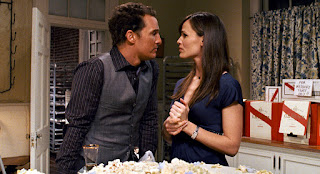
Movie Review: Ghosts Of Girlfriends Past (2009)

A romantic comedy with a fantasy twist, Ghosts Of Girlfriends Past borrows from Charles Dickens on the way to predictable destinations. 

In New York City, Connor Mead (Matthew McConaughey) is a celebrity fashion photographer, enjoying a hedonistic lifestyle, plenty of sex, and no commitments. He travels to the lavish New England estate of his deceased Uncle Wayne (Michael Douglas), where Connor's younger brother Paul (Breckin Meyer) is getting married to Sandra (Lacey Chabert). The wedding party includes doctor Jenny Perotti (Jennifer Garner), Connor's one true love from childhood and the only woman who punctures his Lothario act.

Connor does all he can to sabotage Paul's wedding, including delivering drunken tirades about the futility of love, hitting on Sandra's mother Vonda (Anne Archer), and exposing Paul's past infidelities. But then he is visited by the ghost of Uncle Wayne and the ghost of his first sexual partner Allison (Emma Stone), who guide him on a tour of his past, present and future to demonstrate the consequences of his actions.

A stellar cast and sense of flighty fun elevate Ghosts Of Girlfriends Past beyond the mundane. Co-writers Jon Lucas and Scott Moore deliver a polished script maximizing concept enjoyment and packed with sharp humour, and the stars do the rest, diving into their characters with committed playfulness. The scenes with a ditzy Emma Stone whizzing Connor around his past on a time-traveling bed are a particular delight.

As usual with rom-coms, the peripherals help make or break the experience, and here director Mark Waters has plenty to work with. Wealthy and fun-loving Uncle Wayne was the perfectly enticing bad example on Connor's early life, setting him on a path of selfish gratification. The thorny dynamic between married-couple-to-be Paul and Sandra is a source of steady laughs, as are Sandra's parents "Sarge" (Robert Forster) and the cougar Vonda.

The necessary moments of pathos also register, the brotherly bond between Connor and Paul deployed to good effect, and the eternal but often denied passion between Connor and Jenny an underpinning for both their lives.

Despite the welcome streak of quality, typical genre pitfalls are also on full display. There is never any doubt about the outcome, and Connor's transformation abruptly arrives just in time for the requisite wrapping up of all loose ends. Obvious go-to devices include the destroyed wedding cake, drunken revelations, desperate bridesmaids, and doofus best men.

Ghosts Of Girlfriends Past does enough to justify a breezy trip through time, but still arrives at all the familiar conclusions.


All Ace Black Movie Blog reviews are here.

Wednesday, 16 June 2021

Movie Review: Traffic (2000)

A multi-story crime epic, Traffic is an unblinking look at the illegal drug business on both sides of the US-Mexico border. Law enforcement officials, traffickers, addicts, and their families intermingle in overlapping hard-hitting narratives.

In the US, Judge Robert Wakefield (Michael Douglas) of Ohio is appointed as the President's new drug czar, leading the government's "war on drugs". Wakefield is unaware his high achieving 16-year-old daughter Caroline (Erika Christensen) and her friends are dabbling in hard drugs. When Caroline's addiction becomes obvious, Robert's work and private lives collide and his relationship with wife Barbara (Amy Irving) is strained.

In Mexico, Tijuana police officer Javier Rodriguez (Benicio del Toro) and his partner Manolo Sanchez (Jacob Vargas) are in the middle of a turf war between two drug cartels. Javier is recruited by the powerful General Salazar (Tomas Milian) to help federal anti-drug efforts. On Salazar's instructions, Rodriguez arrests cartel assassin Flores (Clifton Collins, Jr.) who is then tortured for information. Wakefield seeks allies in Mexico and identifies Salazar as a potential force for good.

In San Diego, police officers Montel (Don Cheadle) and Castro (Luis Guzmán) arrest businessman Eduardo Ruiz (Miguel Ferrer), who uses storefronts as cover for a drug distribution network. In return for leniency Ruiz identifies the wealthy Carlos Ayala (Stephen Bauer) as the powerful representative for one of the Tijuana cartels. Ayala is promptly arrested, stunning his pregnant wife Helena (Catherine Zeta-Jones) who is living the high-society life oblivious to her husband's real business. Montel and Castro have to keep Ruiz alive long enough to testify, while Helena gets only slimy support from Ayala's lawyer Arnie (Dennis Quaid) and turns to the assassin Flores for more potent help.

Featuring an ensemble cast, brisk pacing and enough content to easily justify the 147 minutes of running time, Traffic delves into the high-profit, high-risk, high-damage drugs business from multiple perspectives. Written by Stephen Gaghan and directed by Steven Soderbergh, the core message promotes pragmatism about the depth of the problem and the inefficacy of simplistic solutions. The loosely connected stories shine the light on unlimited supply, insatiable demand and unimaginable profits fuelling a business larger than most governments. Not surprisingly, slogans, blunt initiatives and even good intentions fold under the pressure of corruption, addiction and violence.

Traffic is about an underworld filled with ruthless behaviour, but avoids any traditional action scenes. Gaghan and Soderbergh maintain focus on individuals, personalizing the dilemmas and boiling down a gargantuan industry to a human scale. From Ayala's smug confidence that he is untouchable, to young Caroline throwing away her future in search of the next hit, passing through Rodriguez realizing everything right is wrong, the futility of declaring war on a health crisis made worse by bad laws is laid bare.

As the drama jumps between various stories, Soderbergh (also the cinematographer) uses colour to signal locales. The scenes in Mexico start with an overexposed palette of reds and yellows, while Wakefield's journey of learning about his daughter is bathed in deep blues. Helena's scenes resemble a glossy magazine representing unearned wealth and privilege.

Some narrative weaknesses creep in at the edges. Judge Wakefield becomes an unlikely private investigator, taking to the scuzzy parts of town and barging through doors to try and save his daughter. Helena's transformation from clueless wife to shrewd operator is also remarkably swift.

But with the stellar cast in top form, Soderbergh navigates towards faint optimism within individual moments of hope. One victim is at least temporarily saved and some kids get to play a ball game. In a massive sea of despair, small victories have to matter.


All Ace Black Movie Blog reviews are here.
 

Saturday, 24 October 2020

Movie Review: Shining Through (1992)


A World War Two spy drama and romance, Shining Through enjoys sterling production values but suffers from wonky plot elements.

An elderly Linda Voss (Melanie Griffith) is being interviewed by the BBC about her experiences during World War Two. In flashback, she recounts her story starting in 1940. Half-Jewish, raised by working class parents in Queens, fluent in German, and a big fan of movies about war and espionage, Linda secures a secretarial job in Manhattan. She is assigned to assist undercover intelligence officer Ed Leland (Michael Douglas) as he questions German immigrants about the locations of factories and rail lines in their homeland. 

They fall in love, but Linda and Ed's romance is interrupted when the US joins the war and he is deployed behind enemy lines. When he re-emerges she volunteers for a dangerous spy mission to infiltrate a Nazi commander's home and steal bomb-manufacturing secrets. In Berlin Linda connects with Allied spies Friedrichs (John Gielgud) and the alluring Margrete von Eberstein (Joely Richardson). After some mishaps she secures employment as a domestic worker for General Franz-Otto Dietrich (Liam Neeson), and attempts to track down Jewish relatives who may be hiding from the Nazis.

An adaptation of the Susan Isaacs novel written and directed by David Seltzer, Shining Through exudes quality thanks to a polished look. The 1940s are recreated in fine detail, both in the United States and especially in Germany under the Nazis. With filming locations in eastern Germany just after unification, Seltzer captures picturesque streetscapes, buildings, offices, mansions, uniforms, cars, trams and trains from the era. Nazi symbols dominate, Germany on a full war footing but also starting to experience the sting of Allied bombing raids.

But while the visuals are rich, the story is handicapped by a higher than usual level of clunkiness, the plot holes threatening to swallow the entire adventure. Ed is a master spy frequently operating in enemy territory but cannot speak a word of German. He agrees to deploy the untrained and half-Jewish Linda into the field for a crucial mission. The seemingly well-connected and rich Dietrich hires Linda to live in his home and look after his children without the most basic confirmation of her background. She then hustles his young but observant children around on buses and into a fishmonger's store run by an Allied spy.

The action scenes are equally improbable, including a confrontation with a double agent and a climax at a border crossing, both veering towards death-defying over-the-top melodramatics.

Melanie Griffith helps navigate the rough patches with a seductively gutsy performance. Michael Douglas is surprisingly stone faced, and as a result the romance between Ed and Linda operates at only lukewarm temperatures. Liam Neeson hints at a complex character residing within Dietrich, and deserved more screen time.

Peppered with references to 1940s World War Two movies, Shining Through rides an innocent and old fashioned attitude all the way to a pat ending, but the feel-good intentions are forced to shine through perforated logic.


All Ace Black Blog Movie Reviews are here.

Saturday, 1 August 2020

Movie Review: The Star Chamber (1983)


A drama and thriller, The Star Chamber explores the broken justice system from the vantage point of the judge's chair.

In Los Angeles, relatively young Superior Court Judge Steven Hardin (Michael Douglas) starts to get disillusioned with loopholes in the law allowing seemingly guilty defendants to walk free from his courtroom. First an alleged serial murderer is released due to an illegal garbage truck search, then accused child pornographers walk away because of an unlawful traffic stop. 

Dr. Harold Lewin (James Sikking) is the father of one of the victims of the pornography ring, and his trauma haunts Hardin. Meanwhile Detective Harry Lowes (Yaphet Kotto) and his police officers are exposed to the anguish of stumbling upon young murder victims compounded by the court's revolving door. 

Hardin is invited by his mentor Judge Benjamin Caulfield (Hal Holbrook) to join a secret chamber of nine judges who review cases where the law's technicalities interfere with the quest justice. The judges then render their own sentence and dole out vigilante justice through contract killers. Hardin reluctantly joins the group, but is quickly exposed to the pitfalls of the extrajudicial experiment.

The tension between the technicalities of the law, the desire for justice, and society's craving for retribution is fertile territory for compelling drama. While 1973's Magnum Force introduced a vigilante ring of disgruntled police officers, The Star Chamber elevates the rage all the way to the guardians of justice. Individual privacy protections are appropriated in the courtroom into fig leaves allowing criminals to escape their due punishment, and although repetitive and somewhat obvious, the visceral exasperation jumps off the screen. 

Director and co-writer Peter Hyams develops the idea into a decent film, although the plot eventually tries to have it all ways and ends up stranded in routine thriller territory. The stronger first half features courtroom jousts where clever defence lawyers exploit loopholes. Victims' families, the media, police officers, prosecutors and Hardin himself are left to ponder the efficacy of a system where essential evidence is thrown out for the flimsiest of reasons, and even confessions count for nothing.

Once Hardin joins the chamber of august judges, Hyams loses his way. The extrajudicial procedures are presented with incomplete blandness and no second-guessing or genuine debate. The Star Chamber then takes a couple of questionable turns. The gap from sentencing to execution is left unexplained, and after all the effort to fan the flames of rage, Hyams is quick to u-turn his protagonist and throws Hardin into an undignified street level cat-and-mouse game. Other missteps include an early suicide left dangling, an underused role for Sharon Gless as Mrs. Hardin, and a quite useless parkade car chase.

The film looks sleek and glossy, the world of judges presented with ostentatious grandeur while the alleged criminals, whether convicted or not, live on the greasy edge. The gathering of judges carries weight, but some of it is dropped.


All Ace Black Blog Movie Reviews are here.

Wednesday, 4 March 2020

Movie Review: You, Me and Dupree (2006)


A comedy about love, friendship and finding a purpose in life, You, Me and Dupree carries enough laughs and originality to overcome the more mundane moments.

After an idyllic wedding in Hawaii, Molly and Carl (Kate Hudson and Matt Dillon) start their married life together, with Carl employed at the large housing development corporation of Molly's tycoon father Bob Thompson (Michael Douglas). Their lives are quickly disrupted when Carl invites Dupree (Owen Wilson), his friend from high school, to crash on their couch.

Dupree is kind and free-spirited, but his life has still not amounted to much. His sloppy presence creates tension between Molly and Carl, made worse by Bob giving Carl an unexpected promotion but also pressuring him into working long hours. Bob also makes it clear he believes Carl unworthy of marrying Molly and extending his legacy. With the marriage already in trouble, Dupree has to decide how he fits in.

Randy Dupree is a gentle soul, a loyal friend, a poet, aspiring cyclist, and a good cook. He is also hopeless at holding a job or finding any direction to steer his life, and an absolute expert at clogging up the toilet plumbing. Owen Wilson co-produced the film and gives life to an oddball combination of best friend and major irritant, and Dupree is the soul of the movie.

The first half is all about Dupree as a disruptor, but the second part veers towards left field as the guest cleans up and forms a bond of friendship with the emotionally abandoned Molly. The warped relationship triangle extends the film's reach, without ever threatening to break into stellar territory.

Michael LeSieur wrote the script, and with no more than about half the jokes finding a target, You, Me and Dupree bounces along a meandering path looking for detours to provide an edge. While imposing on Molly and Carl's hospitality, Dupree minimizes his job-seeking efforts and instead makes friends with the neighbourhood kids. Meanwhile Carl's stress level at work is cranked to eleven, Michael Douglas giving plenty of venom to too few ideas all related to demeaning his new son-in-law.

Brothers and co-directors Anthony and Joe Russo are perfunctory, generally standing back and allowing the stars to wrangle the material into the usual conflicts about trust, overcoming adversity and rising to the moment. Kate Hudson and Matt Dillon hold the middle ground and provide a platform for Dupree to perform his erratic orbit, themes of blooming late and discovering a calling emerging as warm-enough payoffs.

Seth Rogen appears in a small role as Neil, one of Carl's friends, socially suffocating in his own marriage. In an example of the film's underhanded slyness, Neil's wife and Dupree's crush are influential but never seen.

In You, Me and Dupree three's a crowd, but also reasonably good company.


All Ace Black Blog Movie Reviews are here.


Sunday, 14 July 2019

Movie Review: Wall Street: Money Never Sleeps (2010)


A sequel to the classic 1987 financial drama, Wall Street: Money Never Sleeps is a competent continuation of the story without ever rising to the same heights.

In 2001 Gordon Gekko (Michael Douglas) is released from prison after serving eight years for fraudulent financial activities. By 2008 he is living a quiet life, promoting his book and predicting an economic disaster to come. Ambitious securities trader Jacob Moore (Shia LaBeouf) is in love with Gordon's daughter Winnie (Carey Mulligan), who is not on speaking terms with her father. Jacob works for Keller Zabel Investments, a firm being shaken by the early rumblings of the subprime mortgage crisis.

Rival Bretton James (Josh Brolin) of the firm Churchill Schwartz senses weakness and ends the career of Jacob's boss and mentor Louis Zabel (Frank Langella). Bretton and Gordon share a chequered history, creating an opportunity for Gordon and Jacob to team up against a common foe. In return for Gordon supplying Jacob with information about Bretton's unethical trading conduct, Jacob tries to arrange a reconciliation between Gordon and Winnie. But with the entire financial market system on the verge of collapse, personal agendas may be sideswiped by bigger events.

With the 2008 Great Recession providing a seemingly ideal backdrop, director Oliver Stone returns to the world of greed, backstabbing and unimaginable wealth among the movers and shakers at the epicentre of capitalism. Money Never Sleeps is glitzy and visually hyperkinetic, featuring rushed plot developments, the occasional dizzy torrent of characters and names, and an abundance of split screens superimposed with rapidly changing numbers, charts, and artistic silhouettes.

But for all the moving and shaking, the reality of the financial crisis is more astounding than any fictional story conjured up by co-writers Allan Loeb and Stephen Schiff. Here the script goes searching for memorable moments to rival the Greed is Good speech from the first film, but instead settles for a routine tale of revenge, comebacks, father-daughter tension and an unconvincing romance. Freshness and originality are sorely lacking, and even the ending reaches for sappy when a more biting resolution was available.

Michael Douglas as Gordon Gekko is by far the best thing on display, and the film suffers mightily when he is off-screen. Neither Josh Brolin as the designated new villain nor Shia LaBeouf as the feisty newcomer have the charisma or sparkle to engage, and they are ill served by predictable and bland dialogue exchanges.

The romance between Jacob and Winnie is the weakest part of the film, as they spend most of the time arguing. Carey Mulligan cannot overcome her character's repeated internal inconsistencies, starting with why a woman with left-leaning politics and disgusted by her father's profession would fall for a slick Wall Street guy.

The cast is deep in underutilized talent, including Eli Wallach in his last feature film as a Wall Street veteran and Susan Sarandon as Jacob's mother, overextended on real estate speculation. Charlie Sheen makes a one-scene appearance as Bud Fox, and Sylvia Miles has an equally brief role as a realtor. The soundtrack is an audacious but ultimate incongruous and unsuitable selection of songs written and performed by David Byrne and Brian Eno.

Money Never Sleeps offers a nod to emerging technologies and the fledgling field of alternative energy sources, and a few strong and tense scenes are staged at the Federal Reserve as the most powerful bankers in the country grapple with the meltdown of their entire industry. But while the subject matter is always reasonably engrossing due to the inherent corruption, Wall Street: Money Never Sleeps uses gilded packaging to cover up distinctly familiar fundamentals.


All Ace Black Blog Movie Reviews are here.


Sunday, 20 May 2018

Movie Review: Disclosure (1994)


A drama about sexual harassment and dirty power politics in an office setting, Disclosure presents a compelling story in a sleek package, despite rampant over-the-top tendencies.

In Seattle, Tom Sanders (Michael Douglas) is happily married to lawyer Susan (Caroline Goodall), and expected to be promoted to Vice President at a high-tech company about to yield a financial windfall through a merger. Tom receives news that the company's latest groundbreaking hardware device is experiencing significant quality control issues. He is then shocked to learn that President Bob Garvin (Donald Sutherland) has selected outsider Meredith Johnson (Demi Moore) for the VP job.

Meredith and Tom share a history as passionate lovers. Now she invites him to her office for an after-hours meeting and aggressively initiates sexual contact, which he resists. The next morning Meredith accuses Tom of sexual harassment. He starts receiving anonymous emails from "A Friend" encouraging him to fight back. Tom connects with lawyer Catherine Alvarez (Roma Maffia) and launches a harassment claim of his own. The resulting power struggle rocks the company and threatens Tom's career.

Directed by Barry Levinson and based on a Michael Crichton book, Disclosure is both tawdry and relevant. The film is not far from glossy magazine trash, where all characters believe themselves to be master manipulators and the sets are stylish over-representations of avant garde architecture masterpieces. Yet Disclosure fearlessly dives into the minefield of gender issues in the workplace, tackling the imbalance between men and women and covering all the territory from light pats on the bum to shoulder rubs and unwanted blowjobs in locked offices.

The plot spares no one, and all the characters have something to answer for. Meredith is a maneater, but all she can be accused of is behaving like men have done for ages. Tom Sanders is her principal victim, but he is less than honest with his wife and less than innocent in his treatment of his assistant. Bob Garvin is the master chess player, playing the game several moves ahead of everyone else, and with sickening oiliness. Several other office types, from veteran brown-nosers to young and insecure techies, bring Disclosure's world to life.

The plot does not even stop at the sexual battlefield. The film is also about the high profit, high risk, cut throat world of business mergers, and careers in the fast-paced technology industry. Levinson manages to cram in an exploration of the risks of offshore manufacturing in far-flung low-cost locales (Malaysia, in this case) and the emerging field of virtual reality.

Of course, all the plot elements come crashing together in a less-than-convincing finale filled with the usual assortment of losers licking wounds of various severities and winners who will carry forth into the next sordid campaign. Disclosure takes no prisoners, but dishes out plenty of guilty pleasure.


All Ace Black Blog Movie Reviews are here.


Monday, 2 April 2018

Movie Review: Falling Down (1993)


A psychological drama thriller, Falling Down portrays one man's journey past the edge.

In Los Angeles, middle-aged defence industry white collar worker William Foster (Michael Douglas) finally loses patience with a slow moving traffic jam caused by roadworks. He abandons his car and walks off with his briefcase, mumbling that he is heading home. The incident is witnessed by police Sergeant Martin Prendergast (Robert Duvall), who is retiring that day, having yielded to excessive nagging by his wife Amanda (Tuesday Weld).

Foster is in the throes of a full-fledged mental meltdown. Despite a restraining order he phones his ex-wife Elizabeth (Barbara Hershey) to tell her he is on his way because it's the birthday of their young daughter. On the long walk to Elizabeth's Venice Beach house he first tangles with a Korean shopkeeper then with members of a Hispanic gang, an altercation that provides him with a gym bag full of weapons. He then causes panic at a burger joint. Prendergast and Detective Sandra Torres (Rachel Ticotin) start to connect the dots about the strange man leaving a trail of carnage in his wake.

Directed by Joel Schumacher and written by Ebbe Roe Smith, Falling Down brings to life the secret rage of men who have had enough. With just a touch of humour and plenty of barely controlled fury, Foster plays out what many in his position may wish to do. Unable to dust himself off and try again,  this is a defeated man comprehensively slipping over the sanity threshold and now looking for all the wrong answers in all the wrong places.

It's a serious mental anguish topic, and despite some exaggerated episodes the film does not shy away from the destructive consequences, both in terms of self-harm and the pain and suffering inflicted on family and innocent bystanders.

With both his career and his family life seemingly at an end, Foster's inner demons are unleashed. He uncorks bottled-up racist thoughts, violently destroys a corner store over the cost of a pop can, and refuses to accept petty restaurant schedules for when breakfast can and cannot be served. He lives out the macho dream of having an arsenal at his disposal. And rocket launcher at the ready (with a kid proving how-to instructions), he challenges construction workers to explain, why exactly, the street is being torn up.

Schumacher alternates scenes of Foster's progress towards Elizabeth's house with Prendergast's long and messy last day on the job. The Sergeant first witnesses Foster's rough start to the day and then begins to hear about strange incidents involving a man in a white shirt and necktie instigating altercations in neighbourhoods where such men are not supposed to tread. The structure balances the film, breaks the monotony and allows Michael Douglas and Robert Duvall to share the screen time despite not meeting until late.

Falling Down walks a fine line between important and exploitive. William Foster is everyman on a really bad day, giving way to worst tendencies that are sometimes, sadly, just too powerful to contain.


All Ace Black Blog Movie Reviews are here.


Saturday, 1 April 2017

Movie Review: And So It Goes (2014)


A lightweight romantic comedy set among the grandparent generation, And So It Goes has courage to explore love and sex late in life but little else.

Oren Little (Michael Douglas) is a highly successful real estate agent, looking to retire after one last big sale, but still grieving the death of his wife. As a widower, he has given himself licence to be fully self-absorbed and uninterested in the happiness of others. His neighbours, including the widow Leah (Diane Keaton), generally avoid him or are forced to tolerate him since he owns the building. Leah is a small-venue lounge singer who often breaks down and cries during her performances when she remembers her husband.

Oren's life is turned upside down when his son, a former drug addict on his way to a stint in prison, deposits his ten year old daughter Sarah (Sterling Jerins) with an incredulous Oren. Leah steps in and welcomes Sarah at her place. Gradually young Sarah becomes a catalyst for a relationship to evolve between Oren and Leah.

Directed by Rob Reiner, And So It Goes shifts the typical demographic of romantic comedies by about 35 years, and naturally injects a large dose of age-created cynicism and emotional baggage into the character of Oren Little. But with films like Hope Springs, Something's Gotta Give, It's Complicated and As Good As It Gets having thoroughly ploughed this field relatively recently, Reiner and screenwriter Mark Andrus have little new to offer.

The film's predictability is almost stunning. The interventions of a cute kid and a frequently defecating dog are almost labelled as the antidote to Oren's caustic attitude, and the overall vanilla flavour is emphasized by Oren's son being the most pleasant prison-bound ex-junkie imaginable. The film even skips over the typical tug-of-heart triangle, with Oren having no competition except himself in his quest to win Leah's attention. Reiner himself shows up as a piano player who may have some feelings towards Leah, but this thread is never pursued.

And So It Goes is left with two veteran actors demonstrating why they were best-in-class. Michael Douglas and Diane Keaton go about their business with class and efficiency, hitting all right notes at all the right moments and marginally elevating the film's stature. A few sharp lines of dialogue also help, and Oren's poor handling of the first sexual encounter with Leah is a clever reminder that boys may act like boys at any age. But overall, Reiner is decades away from his trend-setting golden era that started in the mid 1980s, and the film is all about nonthreatening rounded edges.

And So It Goes is about a chance for late love, but it's also a tired latecomer to well-wrinkled themes.


All Ace Black Blog Movie Reviews are here.


Saturday, 9 April 2016

Movie Review: Basic Instinct (1992)


A sex-drenched film noir, Basic Instinct spins a wild yarn of psychologically twisted murder and manipulation. The movie is irresistible, despite careening off the rails of credibility.

In San Francisco, retired rock star Johnny Boz is violently stabbed to death with an ice pick by a mysterious assailant during a kinky sex session. Detectives Nick Curran (Michael Douglas) and Gus Moran (George Dzundza) investigate, and suspicion immediately falls on wealthy socialite Catherine Tramell (Sharon Stone), Boz's frequent sex partner. She is stunningly beautiful, a psychology and literature major, and had previously published a novel featuring the murder of a retired rock star during sex with an ice pick. But there is no physical evidence linking Catherine to the Boz murder and she passes a polygraph test. Instead she quickly turns the tables on Nick, getting into his head, seducing him and starting a torrid affair.

Nick is emotionally vulnerable, still attending sessions with Internal Affairs psychologist Dr. Beth Garner (Jeanne Tripplehorn) after having accidentally shot two tourists. Under Catherine's influence he resumes smoking and drinking, and she openly tells him that she is using him as the model for the central character of her next book, in which a detective falls under the influence of the wrong woman and ends up dead. Nick discovers that Catherine has been surrounded by death all her life. He aggressively tries to out-maneuver her at her own game, but she always appears to be several steps ahead of all her pursuers.

Directed by Paul Verhoeven at his Hollywood peak and written by Joe Eszterhas, Basic Instinct goes all-in on modernizing noir fundamentals with an uninhibited gloss. The femme fatale, the convoluted plot where everyone has something to hide, the hapless detective who may be more victim than hero, the lavish homes of the rich and suspicious, the incessant smoking, and sex and seduction as super weapons. Updated for the 1990s, the film is unapologetically unsubtle and throws it all on the screen, adding liberal doses of wild sex, drug use and lesbianism as items that could only be hinted at when the noir style was at its peak 45 years prior.

The film starts brightly and early on lands a devastating punch with the infamous scene featuring a cool Catherine being interrogated by a band of sweaty detective. The one woman in the room wins the seemingly asymmetrical bout by knock-out, refusing a lawyer, insisting on smoking, and uncrossing her legs. The scene propelled Stone into stardom and the character of Catherine Tramell into movie folkore as one of the most dangerous femme fatales ever conjured up for the screen.

The plot gets more outrageous from there, and into the final third detective Curran is so ensnared in Catherine's web that it's difficult to follow what the overall conspiracy is supposed to look like. Too many names, incidents and events from the past tumble into the present, key plot points are glossed over and unlikely coincidences converge. While the gory murder, energetic sex, and conspiratorial mayhem are never less than fun, the film loses its edge by piling on the contorted lunacy.

While Stone steals the show with a display of overt yet icy sexuality, Michael Douglas plays the emotionally wounded detective perfectly. Curran is barely hanging on at the start of the film, nicknamed "Shooter" and having barely rescued his career from the ignominy of accidentally killing two tourists. He is an easy target for Catherine, and Douglas creates a man who desperately wants to believe he has what it takes to tangle with a clever suspect while he is in fact being hopelessly outplayed at every turn. Jeanne Tripplehorn makes a memorable debut as Dr. Garner, both psychologist and lover to Curran, and hiding plenty of her own secrets.

Basic Instinct is a convolution of connivance, and an enjoyable romp through the excesses of a devious mind.


All Ace Black Blog Movie Reviews are here.


Friday, 25 December 2015

Movie Review: Wall Street (1987)


A dynamic, glitzy drama set in the world of super-rich investors, Wall Street is both a celebration and condemnation of capitalism's worst excesses. Oliver Stone creates a dazzling story of wealth gone mad, a playground for egotistical men where profits rule, the stakes are routinely measured in millions, and the careers of ordinary mortals are cheaply bought and discarded.

Bud Fox (Charlie Sheen) is a young but ambitious stockbroker at a middling Manhattan investment firm, still making cold calls to try and build up a client base. His father Carl (Martin Sheen) is a humble and honest aircraft maintenance crew chief at Bluestar, a fledgling airline. Bud's persistence finally pays off when he lands the extremely wealthy and ruthless corporate investor Gordon Gekko (Michael Douglas) as a client. Gekko likes what he sees in Bud, and takes him under his wing, exposing him to the power of inside information, the art of taking over corporations and breaking them up for great gains, and a world where obscene amounts of short-term profits can be derived from high-stakes stock price manipulation.

Gekko: The most valuable commodity I know of is information.

Bud's education includes meeting Sir Larry Wildman (Terence Stamp), an even wealthier investors and one of Gekko's chief rivals in the global corporate take-over game. Buoyed by success and fueled by Gekko's money, Bud starts tapping his college friends, including lawyer Roger Barnes (James Spader), to seek insider tips on upcoming mergers, and to set up bogus trading accounts to hide his activities from the Securities and Exchange Commission. Now very rich, Bud's life is fully transformed. He buys a swanky apartment and starts a serious relationship with glamorous interior designer Darien Taylor (Daryl Hannah). But when one of Gekko's upcoming deals threatens to hit close to home, Bud has to finally decide who he really is.

Gekko: What's worth doing is worth doing for money.

Fresh from the success of 1986's Platoon, director Oliver Stone moves from the jungles of Vietnam to the equally treacherous and shadowy terrain occupied by the manipulators of the global finance system. Wall Street is high-paced, magnetic and seductively glossy. Tracing the arc of  protagonist Bud Fox, Stone steps behind the curtain and into the offices of the power brokers who actually determine the winners and losers on Wall Street. It is a place both difficult to resist and absolutely corrupt, free of quaint principles related to morality and humanity, and driven solely by greed and profit.

Stone succeeds in making the world of Gordon Gekko fabulously attractive. For ambitious young men like Bud Fox, it's not difficult to be sucked into the promise of a life filled with limousines, lavish restaurants, expensive suits, glamorous women, high-end real estate and millions in the bank. It's a castle in the sky floating on high-stakes gambling with the odds tilted in favour of the Gekko's who profit from widespread malfeasance, and Stone builds up the allure with plenty of pizazz.  It's not easy to make financial transaction look exciting, and Stone pulls it off with energetic camera work and in-your-face scenes capturing the frenzy of the trading floors and the adrenaline rush of deal making in real time.

Gekko, talking to Bud: Wake up, will ya, pal? If you're not inside, you're outside, okay? And I'm not talking a $400,000 a year working Wall Street stiff flying first class and being comfortable, I'm talking about liquid. Rich enough to have your own jet. Rich enough not to waste time. Fifty, a hundred million dollars, buddy. A player, or nothing. Now, you had what it took to get into my office; the real question is whether you got what it takes to stay.

Not all of the film works perfectly. There are a couple of scenes, one between Bud and his father Carl and another between Bud and Gekko, where exaggerated emotions and shouting replace intelligent discourse. And Bud's awakening to the damage that Gekko and his ilk can cause is treated simplistically and rather abruptly. But overall, the script (co-written by Stone and Stanley Weiser) triumphs thanks to a treasure trove of sharp exchanges and observations, mostly courtesy of Gekko, that serve to define a caustic perspective on not just the world of capitalism, but the human condition itself.

The character of Gordon Gekko is an enduring symbol of the decade of greed, and Michael Douglas won the Best Actor Academy Award for creating a believable, even sympathetic, merchant of money. Gekko creates wealth, no matter the consequences, and Douglas' cold-eyed portrayal allows the character to make sense in a world where the limits of capitalism are unconstrained. Bud Fox may be the sympathetic core of the film, but Gordon Gekko emerges as its true voice, an unrepentant genius exploiting the system and selling his vision to anyone wishing to share the dividends.

Gekko, addressing an audience of corporate shareholders: The point is, ladies and gentlemen, that greed, for lack of a better word, is good. Greed is right, greed works. Greed clarifies, cuts through, and captures the essence of the evolutionary spirit. Greed, in all of its forms: greed for life, for money, for love, knowledge, has marked the upward surge of mankind.

Charlie Sheen does enough to carry Bud's journey without ever transcending the role. Daryl Hannah does well as the prestigious lover who comes with the money, unapologetic in her pursuit of the life that millions can buy. In addition to James Spader, the deep supporting cast includes roles for Hal Holbrook as a old-fashioned investor who still looks for long-term company value, Sean Young as Gekko's wife, and John C. McGinley as Bud's animated colleague, left behind when Bud moves into the stratosphere of investing.

Gekko: It's a zero sum game – somebody wins, somebody loses. Money itself isn't lost or made, it's simply transferred – from one perception to another. Like magic. This painting here? I bought it ten years ago for sixty thousand dollars. I could sell it today for six hundred. The illusion has become real, and the more real it becomes, the more desperately they want it. Capitalism at its finest.

Wall Street invests in quality film making and vigorous, character-driven storytelling, and achieves an exhilarating return on investment.


All Ace Black Blog Movie Reviews are here.


Friday, 3 July 2015

Movie Review: The Jewel Of The Nile (1985)


A sequel to 1984's Romancing The Stone, The Jewel Of The Nile reunites author Joan Wilder and adventurer Jack Colton for another madcap adventure, this time in the Arabian desert. The attitude and quality are good, but this is a purely derivative project.

Six months after chasing a massive jewel in the South American jungles, Joan (Kathleen Turner) and Jack (Michael Douglas) are cruising the Mediterranean and getting on each other's nerves. She wants to head back to New York while he is happy to live the good life of doing nothing. Joan is approached by the mysterious wealthy tribal leader Omar (Spiros Focás), who asks her to accompany him to his unnamed kingdom and write a puff piece to bolster his popularity. Jack is then approached by Omar's enemies, who want him to find the "jewel of the Nile", apparently the inspirational source of mystical inspiration. Also making a sudden reappearance is treasure hunter Ralph (Danny DeVito), seeking revenge on Jack after ending up with nothing but prison time at the end of the South American escapade.

Joan soon finds herself effectively a prisoner in Omar's sprawling compound, and realizes that he has fascist-like evil intentions to grab more power by pretending to have supernatural powers. Jack and Ralph arrive just in time along with Omar's opponents to help rescue Joan, who in the meantime has stumbled upon a humble prisoner (Avner Eisenberg) who holds the key to stop Omar's power grab. But Jack is still intent on finding the precious large jewel, causing continued tension in his relationship with Joan.

Quickly launched into production after the unexpected success of Romancing The Stone, The Jewel Of The Nile reunites Douglas, Turner and DeVito, but without director Robert Zemeckis. Lewis Teague takes over directing duties and delivers a functional effort that ticks off all the boxes of action and romance, but never finds any new angles of originality.

The Jewel Of The Nile slips into a succession of set-piece highlights, most notably Jack conniving an escape and destroying Omar's compound into the bargain behind the controls of an F-16 fighter jet that never leaves the ground but nevertheless causes destructive and comic havoc. Other cliffhangers include a train-top battle, Jack and Joan suspended over an endless pit of death while rats and acid gradually degrade the ropes keeping them alive, and a grand finale with Omar putting on a cheesy special effects show to convince the masses of his powers.

But there is an unshakable sense of going through the motions, emphasized by Jack and Joan often reduced to the role of spectators rather than protagonists. The action is mostly instigated by others, and our heroes rarely do much more than clumsily find a way out the latest mess. The humour is there but it's also obvious, as is the hissing villainy of Omar and his grim henchmen.

The film is saved by the unmistakable chemistry between Douglas and Turner, and the ups and downs of their relationship rise above all the noisy bullets and explosions to create a decent romantic anchor. DeVito also hits his stride and gets the best laughs in his quest to get the better of Jack, if only once. The lack of depth in the story and the stereotypical portrayal of Arabian tribal culture is balanced by the original twist on the true nature of the jewel that sets Jack off on his quest.

The Jewel Of The Nile wins no prizes for inventiveness, but does provide a pleasant enough romp through the desert.


All Ace Black Blog Movie Reviews are here.


Wednesday, 24 June 2015

Movie Review: Romancing The Stone (1984)


An action adventure romance, Romancing The Stone carries a lighthearted attitude into a jungle romp and emerges with plenty to smile about.

Joan Wilder (Kathleen Turner) is a New York-based best-selling author of soapy romances. Lonely and timid, Joan's quiet life could not be more different than Angelina's, the resourceful and fearless heroine of her books, but she still aspires to find the perfect chivalrous husband.

One day Joan receives a mysterious package in the mail containing an arcane map. In Colombia, Joan's brother-in-law is killed by thugs working for the brutal Colonel Zolo (Manuel Ojeda), who is looking for the map. Meanwhile, in Cartagena Joan's sister Elaine (Mary Ellen Trainor) is kidnapped by treasure-hunting cousins Ralph (Danny DeVito) and Ira (Zack Norman). Joan has to travel to Colombia to exchange the map for Elaine's freedom.

From the moment Joan steps off the plane she is in a lot of trouble, boarding the wrong bus, heading in the wrong direction, and being pursued by both Zolo and Ralph. Stranded in the remote mountains and about to be harmed by Zolo, Joan is rescued by Jack T. Colton (Michael Douglas), a mysterious and somewhat conceited adventurer. Joan buys Jack's services to escort her to Cartagena, but there are plenty of wild adventures to be had avoiding bad guys and discovering clues to the buried treasure before Joan can try and save Elaine's life.

With Raiders Of The Lost Ark (1981) having revived the old-fashioned thrill-a-minute adventure genre, Romancing The Stone arrived just in time to take full advantage, although the script was actually written by waitress Diane Thomas before Raiders ever hit the screens. With his career in a bit of a lull Douglas took on production duties and appointed relative unknown Robert Zemeckis to direct. The film sparkles with a sense of fun and boasts an attitude that straddles a fine line between irreverent and sincere. Romancing The Stone rides the wave of Turner's sultry sex appeal, Douglas' suddenly re-emergent leading man status, and Danny DeVito's comic relief.

The script lacks a sharp wit and dry edge, instead focusing on a more feminine perspective as Joan breaks out of a self-imposed shell to find her risk-taking spirit. In the bargain she discovers passion with Jack, and Romancing The Stone works because of the surprisingly good attraction between the novelist uncovering her wild side and the maverick learning that it feels good to have a companion.

Zemeckis keeps the action hopping in the Colombia jungle (actual filming took place in Mexico), but with a notable over-reliance on routine chase-and-shoot scenes, with almost all bullets missing their target. Ojeda as Zolo makes for an effective if utterly cartoonish villain, and DeVito establishes his credentials as a bumbling sidekick riding his luck with a greedy reach exceeding his capabilities.

Romancing The Stone does not necessarily offer much that is new, but it delivers on its simple promises with a toothy crocodile smile.


All Ace Black Blog Movie Reviews are here.