Showing posts with label Charlie Sheen. Show all posts
Thursday, 28 January 2016
Movie Review: Ferris Bueller's Day Off (1986)
A comedy about friendship and coming of age, Ferris Bueller's Day Off is a deceptively simple story about a high school teen getting a jump start on life as an adult.
Resourceful Chicago high school senior Ferris Bueller (Matthew Broderick) feigns sickness, fools his parents (Cindy Pickett and Lyman Ward) and skips school for the day. After some effort, he convinces his uptight and frequently sick friend Cameron (Alan Ruck) to also take the day off. Together they concoct a plan to smuggle Ferris' girlfriend Sloane (Mia Sara) out of school, from under the nose of principal Edward Rooney (Jeffrey Jones), a ruse that involves driving the precious vintage Ferrari belonging to Cameron's dad. Ferris also spreads rumours that he is practically on his death bed, triggering an outpouring of sympathy that spreads throughout the city.
Both Rooney and Ferris' sister Jeannie (Jennifer Grey) are convinced that Ferris is not sick at all and separately set out to catch him in the act. Meanwhile Ferris, Cameron and Sloane enjoy a day that includes trips to the Sears Tower observation deck, a Cubs baseball game, a meal at a snooty restaurant, visits to the art gallery and the mercantile exchange, and impromptu participation on a parade float. Rooney and Jeannie suffer their own misadventures as they try to uncover what the trio are up to, and Ferris will need all his wits to wrap up the day with no one the wiser.
Written and directed by John Hughes in the heart of his personal golden era, Ferris Bueller's Day Off is the definitive teen dream movie. The film is funny, fast-paced and also the perfect Chicago travelogue, Hughes showcasing the best that his favourite city has to offer on a gloriously sunny day. The central character is cool, calm and courageous, always several smart steps ahead of anyone trying to ruin his day. And the film's mantra of life moves pretty fast -- if you don't stop and look around once in a while, you could miss it, may as well be the most perfect pre-written excuse to occasionally step off the treadmill and test all of society's rules.
Ferris narrates the film and regularly breaks the fourth wall, adding to his appeal and firmly pulling the audience to his side and against his adversaries. And Ferris' opponents are easy to boo, with Rooney the worst type of bug-eyed foam-at-the-mouth authority figure, and Jeannie the sibling too worried about what her brother is up to rather than carving her own path (her perspective only changes upon meeting her own rebel in the form of Charlie Sheen).
Building on his break-out success in 1983's WarGames, Broderick finds his perfect role as Ferris Bueller. His boyish charm and the sly but disarming smile are deployed to full effect, and it's impossible to dislike his roguishness. Indeed, a large part of the film's appeal lies in Ferris being universally liked by all the high school factions, an impossible ideal that elevates the character's powers to legendary status in teen circles.
While superficially about a kid who takes a day off, Hughes has a couple of not-so-hidden agendas, and he reveals them early. Not too many high school kids skipping school choose to go to an art gallery, the mercantile exchange, or a stuffy restaurant. Fewer still would propose marriage to their girlfriend. These are literal and figurative adult actions and destinations, and the intrepid Ferris is using his last day off crack open the door to the grown-up world that he and his friends will need to soon live in.
And the greater purpose of the day emerges in the relationship between Ferris and Cameron. Initially Ferris' insistence that Cameron join him in skipping school appears self-serving (he needs to drive that Ferrari!), but Cameron's quietly tortured character emerges as the one spot of darkness at the heart of the film. Ferris' agenda blossoms as the afternoon progresses, and rather than achieving personal fulfillment, his goal is revealed to be much more about providing an emotional lift to a friend in need, the most satisfying act on a most lively day off.
All Ace Black Blog Movie Reviews are here.
Friday, 25 December 2015
Movie Review: Wall Street (1987)
A dynamic, glitzy drama set in the world of super-rich investors, Wall Street is both a celebration and condemnation of capitalism's worst excesses. Oliver Stone creates a dazzling story of wealth gone mad, a playground for egotistical men where profits rule, the stakes are routinely measured in millions, and the careers of ordinary mortals are cheaply bought and discarded.
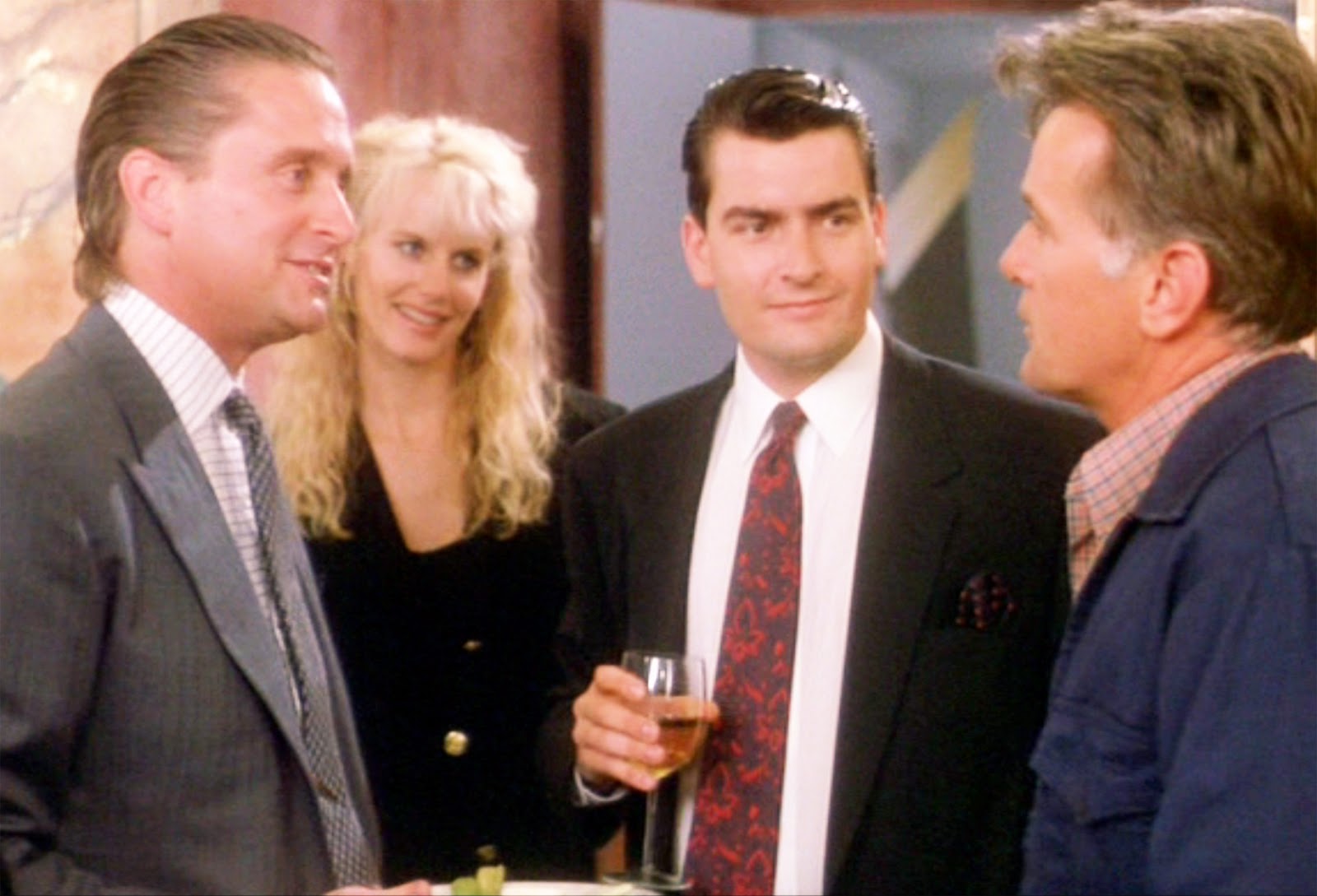
Bud Fox (Charlie Sheen) is a young but ambitious stockbroker at a middling Manhattan investment firm, still making cold calls to try and build up a client base. His father Carl (Martin Sheen) is a humble and honest aircraft maintenance crew chief at Bluestar, a fledgling airline. Bud's persistence finally pays off when he lands the extremely wealthy and ruthless corporate investor Gordon Gekko (Michael Douglas) as a client. Gekko likes what he sees in Bud, and takes him under his wing, exposing him to the power of inside information, the art of taking over corporations and breaking them up for great gains, and a world where obscene amounts of short-term profits can be derived from high-stakes stock price manipulation.
Gekko: The most valuable commodity I know of is information.
Bud's education includes meeting Sir Larry Wildman (Terence Stamp), an even wealthier investors and one of Gekko's chief rivals in the global corporate take-over game. Buoyed by success and fueled by Gekko's money, Bud starts tapping his college friends, including lawyer Roger Barnes (James Spader), to seek insider tips on upcoming mergers, and to set up bogus trading accounts to hide his activities from the Securities and Exchange Commission. Now very rich, Bud's life is fully transformed. He buys a swanky apartment and starts a serious relationship with glamorous interior designer Darien Taylor (Daryl Hannah). But when one of Gekko's upcoming deals threatens to hit close to home, Bud has to finally decide who he really is.
Gekko: What's worth doing is worth doing for money.
Fresh from the success of 1986's Platoon, director Oliver Stone moves from the jungles of Vietnam to the equally treacherous and shadowy terrain occupied by the manipulators of the global finance system. Wall Street is high-paced, magnetic and seductively glossy. Tracing the arc of protagonist Bud Fox, Stone steps behind the curtain and into the offices of the power brokers who actually determine the winners and losers on Wall Street. It is a place both difficult to resist and absolutely corrupt, free of quaint principles related to morality and humanity, and driven solely by greed and profit.
Stone succeeds in making the world of Gordon Gekko fabulously attractive. For ambitious young men like Bud Fox, it's not difficult to be sucked into the promise of a life filled with limousines, lavish restaurants, expensive suits, glamorous women, high-end real estate and millions in the bank. It's a castle in the sky floating on high-stakes gambling with the odds tilted in favour of the Gekko's who profit from widespread malfeasance, and Stone builds up the allure with plenty of pizazz. It's not easy to make financial transaction look exciting, and Stone pulls it off with energetic camera work and in-your-face scenes capturing the frenzy of the trading floors and the adrenaline rush of deal making in real time.
Gekko, talking to Bud: Wake up, will ya, pal? If you're not inside, you're outside, okay? And I'm not talking a $400,000 a year working Wall Street stiff flying first class and being comfortable, I'm talking about liquid. Rich enough to have your own jet. Rich enough not to waste time. Fifty, a hundred million dollars, buddy. A player, or nothing. Now, you had what it took to get into my office; the real question is whether you got what it takes to stay.
Not all of the film works perfectly. There are a couple of scenes, one between Bud and his father Carl and another between Bud and Gekko, where exaggerated emotions and shouting replace intelligent discourse. And Bud's awakening to the damage that Gekko and his ilk can cause is treated simplistically and rather abruptly. But overall, the script (co-written by Stone and Stanley Weiser) triumphs thanks to a treasure trove of sharp exchanges and observations, mostly courtesy of Gekko, that serve to define a caustic perspective on not just the world of capitalism, but the human condition itself.
The character of Gordon Gekko is an enduring symbol of the decade of greed, and Michael Douglas won the Best Actor Academy Award for creating a believable, even sympathetic, merchant of money. Gekko creates wealth, no matter the consequences, and Douglas' cold-eyed portrayal allows the character to make sense in a world where the limits of capitalism are unconstrained. Bud Fox may be the sympathetic core of the film, but Gordon Gekko emerges as its true voice, an unrepentant genius exploiting the system and selling his vision to anyone wishing to share the dividends.
Gekko, addressing an audience of corporate shareholders: The point is, ladies and gentlemen, that greed, for lack of a better word, is good. Greed is right, greed works. Greed clarifies, cuts through, and captures the essence of the evolutionary spirit. Greed, in all of its forms: greed for life, for money, for love, knowledge, has marked the upward surge of mankind.
Charlie Sheen does enough to carry Bud's journey without ever transcending the role. Daryl Hannah does well as the prestigious lover who comes with the money, unapologetic in her pursuit of the life that millions can buy. In addition to James Spader, the deep supporting cast includes roles for Hal Holbrook as a old-fashioned investor who still looks for long-term company value, Sean Young as Gekko's wife, and John C. McGinley as Bud's animated colleague, left behind when Bud moves into the stratosphere of investing.
Gekko: It's a zero sum game – somebody wins, somebody loses. Money itself isn't lost or made, it's simply transferred – from one perception to another. Like magic. This painting here? I bought it ten years ago for sixty thousand dollars. I could sell it today for six hundred. The illusion has become real, and the more real it becomes, the more desperately they want it. Capitalism at its finest.
Wall Street invests in quality film making and vigorous, character-driven storytelling, and achieves an exhilarating return on investment.
All Ace Black Blog Movie Reviews are here.
Sunday, 27 September 2015
The Movies Of Charlie Sheen
All movies starring Charlie Sheen and reviewed on the Ace Black Blog are linked below:
Badlands (1973, uncredited extra)
Apocalypse Now (1979, uncredited Extra)
Red Dawn (1984)
Ferris Bueller's Day Off (1986)
Platoon (1986)
Wall Street (1987)
Eight Men Out (1988)
Young Guns (1988)
The Rookie (1990)
Being John Malkovich (1999, as himself)
Wall Street: Money Never Sleeps (2010, uncredited)
All Ace Black Blog Movie Reviews are here.
The Index of Movie Stars is here.
Labels:
Charlie Sheen,
Film Reviews,
Movie Reviews
Thursday, 5 June 2014
Movie Review: Young Guns (1988)
A western with a cast dominated by a batch of up-and-coming Hollywood male stars, Young Guns is a fairly faithful account of Billy the Kid's early days. Rampant youthfulness dominates the film but cannot make up for the lack of depth.
It's the 1870s in Lincoln County, New Mexico. English cattle rancher John Tunstall (Terence Stamp) specializes in rescuing troubled youth, giving them jobs and an education at his ranch. His latest recruit is young Billy Bonney (Emilio Estevez), a boyish and cocky troublemaker who has apparently already killed a man. Billy joins the other ranch hands in Tunstall's employment: the romantic Doc (Kiefer Sutherland), the serious Dick (Charlie Sheen), the half-Indian Chavez (Lou Diamond Phillips), the appropriately nicknamed Dirty Steve (Dermot Mulroney) and his friend Charlie (Casey Siemaszko). Collectively they call themselves the Regulators.
Tunstall is locked in a nasty dispute over control of the cattle business with Lawrence Murphy (Jack Palance), who has bought the law and is trying to monopolize the local industry. Tunstall has an ally in respected lawyer Alexander McSween (Terry O'Quinn), but this does not save him: Murphy's men kill Tunstall in cold bold. The Regulators vow revenge and are initially deputized to act as lawmen, with Dick assuming a leadership role. But Billy has his own version of dispensing justice, and starts killing rather than arresting men associated with Murphy, further inflaming what became known as the Lincoln County War.
Young Guns forms a cactus pack of sorts to maraud across the west, the six Regulators boasting the presence of Sheen (Platoon), Phillips (La Bamba) and Sutherland (The Lost Boys) soon after their break-out roles. Estevez was already hot property with the success of Stakeout, Repo Man, The Breakfast Club and St. Elmo's Fire. It is an impressive collection of burgeoning talent, and Young Guns is brimming with the potential of ambitious young men. That some of their hairstyles and mannerisms are more suited to the 1980s rather than the 1870s does not seriously diminish the available enjoyment. Estevez gets the showiest role as Billy The Kid, and he enjoys the self-propelling wild-eyed thrill that comes with leaving morality to one side and just engaging in mischievous killing.
The story itself is a slightly fictionalized account of a real and violent dispute characterized by mindless tit-for-tat killings, where men with more guns than brains tried to muscle each other out of the cattle business, and violent revenge took precedence over justice. It was fertile territory for the likes of Billy to shoot first and ask no questions, and director Christopher Cain inserts scenes of well-staged, noisy and often violent gunfights at regular intervals throughout the movie.
It's when the guns are silent that the film is caught short. After the relatively early demise of John Tunstall, the John Fusco script struggles to find a weighty presence capable of carrying the movie. The Regulators are young, naive and simply not very interesting people when they are not engaged in shooting or being shot at. The elementary attempts at some meaningful exchanges of dialogue are quickly blown into the winds of shallowness.
And so Young Guns awkwardly gropes around trying to find various methods of killing time between the action set pieces. Doc falls in love with Murphy's Chinese slave; Dick and Billy compete for the group's leadership, Chavez sneers at everyone who insults his ethnicity, and Dirty Steve spits a lot. None of it is deep, and all of it is mundane.
A rough and ready supporting cast does succeed in bringing to life some real wild west characters. Lawman Pat Garrett (Patrick Wayne), Sheriff William Brady (Danny Kamin), frontiersman Buckshot Roberts (Brian Keith) and outlaw / bounty hunter John Kinney (Allen Keller) make brief but often noisy appearances to play their roles in a nasty little war.
Young Guns fires away at the legends of the west, generating plenty of energetic movement but limited substance.
All Ace Black Movie Blog reviews are here.
Friday, 9 March 2012
Movie Review: The Rookie (1990)
A routine police actioner stuck in the 1970s, The Rookie is not Clint Eastwood's finest moment. Overflowing with cliches, mindless chases, posturing, and hissing through clenched teeth, The Rookie would have been condemned by Inspector Harry Callahan and shot full of holes for lacking any style or originality.
Cigar chomping veteran police Sergeant Nick Pulovski (Eastwood) is on the trail of a violent gang of high-end car thieves, masterminded by the brutally cold Strom (Raul Julia) and the simply crazed Liesl (Sonia Braga). Pulovski's partner is killed by Strom, and young rookie officer David Ackerman (Charlie Sheen) is assigned as his new sidekick. Ackerman has issues of his own, including feeling guilty and responsible for his brother's accidental death when they were both kids, and a strained relationship with his tycoon dad Eugene (Tom Skerritt). Ackerman regularly disrupts the sleep of his wife Sarah (Lara Flynn Boyle) by waking up in the kind of cold sweat seen only in desperate movies.
The search for Strom takes Pulovski and Ackerman on a tour of all the usual hangouts, including the prototypical biker bar. Ackerman gets a beating and a shooting before finally deciding that enough is enough: he finds his inner Rambo and goes on a destructive rampage to clean up the streets, including saving Pulovski but only after he experiences the lusty thigh grip of Liesl in a woman on man rape scene.
Although there is enough talent in on the screen and behind the camera to prevent a total flop, neither Eastwood the director nor Eastwood the actor get any kind of traction, both tripped up by a doomed insistence on recreating a Dirty Harry vibe. It's 15 years past the best-before date, and the script offers nothing to modernize the concept. Many one-liners are thrown at the screen, all hoping for immortality, none coming close although a couple do manage some zing.
The Rookie fails to bother with even the most rudimentary back story for Pulovski, and offers nothing to explain the actions of Strom and Liesl. Raul Julia and Sonia Braga are left to ooze overcooked evil oil through smarmy smiles and depraved eyes, but for no understandable cause. The guilt trip and father issues provided for Ackerman are straight out of the stereotype catalogue, ordered past midnight by very tired minds surrendering to devoid creativity.
Unfortunately in this case, The Rookie is a good description for the amateurish actions of a veteran who should have known better.
All Ace Black Blog Movie Reviews are here.
Labels:
Charlie Sheen,
Clint Eastwood,
Film Review,
Movie Review,
Raul Julia,
Sonia Braga
Thursday, 29 December 2011
Movie Review: Eight Men Out (1988)
The story of the 1919 Black Sox, Eight Men Out is a tale of greed and corruption eating away at all that is good in sports. Director and writer John Sayles recreates with considerable flair the world of baseball in the early 20th century, and an ensemble cast has fun portraying the heroes and villains of the sportsworld in more innocent times.
The 1919 baseball season is drawing to a close, and the Chicago White Sox are the dominant team in the league, and considered to be one of the best teams ever assembled. Featuring the likes of pitcher Eddie Cicotte (David Straithairn), "Shoeless" Joe Jackson (D.B. Sweeney) and shortstop Buck Weaver (John Cusack), and coached by Kid Gleason (John Mahoney), the White Sox are expected to easily win the World Series against the Cincinnati Reds. But the White Sox players are unhappy with team owner Charles Comiskey (Clifton James): he is tight-fisted and less than generous with perks and bonuses. Resentment festers, and it is ripe for exploitation by unscrupulous criminals looking to make a killing by betting against the Sox.
New York's shadowy master gambler Arnold Rothstein (Michael Lerner) is finally convinced that several players are open to a cash payout in exchange for losing, and he organizes the fix through intermediaries. Players such as Chick Gandil, Swede Risberg and Lefty Williams eagerly go along with the plan and recruit several other Sox. Cicotte is at first hesitant but later joins in, while Jackson goes along but can't read or write, and is unsure what he is agreeing to. Weaver is approached to join the fix but refuses to participate, although he also doesn't alert anyone that trouble is brewing. Gleason can sense that something is wrong with his team, but has no evidence of wrongdoing. Chicago perform poorly and lose the World Series; the players eventually face the consequences, in the court of law, the court of public opinion, and the court of baseball's newly appointed commissioner.
With no single character or actor dominating Eight Men Out, it is David Straithairn's Eddie Cicotte who best represents the mind space of underpaid athletes unable to resist a cash injection worth more than a season's wages to throw a few games. Straithairn portrays Cicotte as never enthusiastic about the fix, but upset enough about his treatment by team owner Charles Comiskey that he is eventually willing to forgo glory for cash.
John Cusack as Buck Weaver is also memorable, a man who rejected the cash and played for the glory of winning, but paid with his career for not bringing the fix to light when he had the opportunity. Charlie Sheen in a small role as player Happy Felsch and Christopher Lloyd as colourful moneyman Bill Burns animate the supporting cast.
Sayles' writing is sharp, the dialogue filled with zingers and deft jibes as reporters, ball players, gamblers, and shadowy criminals circle each other looking for a story, an edge, or a payday.
But Sayles' exceptional achievement in bringing the story to film is his embrace of uncertainty. There are numerous legends and various versions of the truth that swirl around events such as a fixed World Series, and Sayles avoids the temptation of tidying up all the factoids. While Eight Men Out does sometime meander to the outskirts of what appears relevant, the film is brave enough to capture a story without nailing down every last detail.
Hence, the film suggests that the players were unsure if they were throwing a few games or the whole series; Shoeless Joe Jackson, portrayed as quite dim, never seems aware of what he is getting himself into, and appears to play hard despite accepting the cash. Several layers of corrupt money men were involved, from masterminds like Rothstein to local goons, and the dots between them are not cleanly connected; and the players never received all of what they were promised, yet were intimidated enough to continue with the fix, or ironically bound by the code of wanting to finish what they started.
With elite athletes in all sports arenas still on the lookout for illicit methods to get rich almost a hundred years after the Black Sox scandal, Eight Men Out is a sad reminder that the lure of the dollar for personal gain has always been the most corrupting force in professional sports.
All Ace Black Blog Movie Reviews are here.
Labels:
Charlie Sheen,
Christopher Lloyd,
Film Review,
John Cusack,
Movie Review
Sunday, 18 September 2011
Movie Review: Platoon (1986)
An intense front-line view of a most muddled conflict, Platoon is a close-up examination of the human damage caused by war, and also one of the best war movies ever made. Director Oliver Stone wrote the story based on his personal experiences in Vietnam, and his narrative is unblinking in its portrayal of all that is wrong with war, from politicians sacrificing the lower classes to the resultant irreparable emotional devastation of those who do the killing.Chris Taylor (Charlie Sheen) is a college student who has willingly enlisted in the army, and he arrives for combat duty in Vietnam of 1967. Oppressive heat, low morale, disgruntled troops, ineffective jungle patrols and clueless commanders are just some of the challenges that he immediately faces, and this is before any enemy encounters.
Chris learns that two fearless sergeants are the de facto leaders of his Bravo Company: Sergeant Elias (Willem Dafoe) stands up for his men and encourages a loose attitude and plenty of camaraderie. Sergeant Barnes (Tom Berenger) is all intensity, having long since adopted a kill'em all individualistic attitude. The men of Bravo Company are divided, with some supporting Elias and others idolizing Barnes. Elias and Barnes are on an inevitable collision course, and after Barnes loses all discipline during a raid on a Vietnamese village, they become mortal enemies.
Chris witnesses the intensifying conflict between the men and survives skirmishes of ever increasing ferocity with the North Vietnamese Army, culminating in a massive gory and desperate battle, during which Chris has to apply all that he has learned from both Elias and Barnes just to try and live for another day.
Stone enriches Platoon by not glossing over the little details that dominate a soldier's experience: the insatiable bugs feeding on human flesh; the endless marching in the impenetrable jungle; digging trenches in the energy-sapping heat; the devastating fatigue causing soldiers to fall asleep at critical moments; and the endless, tense waiting for encounters with the enemy.
And when these enemy encounters do occur, Stone, cinematographer Robert Richardson, and editor Claire Simpson emphasize the overwhelming chaos and confusion. Platoon's battle scenes play out in limited light, the enemy mostly seen as shadows, tactics and strategies utterly lost in the anarchy of the battlefield.
The central theme of Platoon is the contrast in the education of Chris at the hands of Elias and Barnes. Both are exceptional warriors, but while Elias has retained his humanity and is still killing for a greater purpose, Barnes has adopted killing for the sake of killing and no longer cares to delve into the subtleties of when should the killing be justified.
Both men have their followers, and Platoon poses the question as to which form of soldier is needed to win a war. At the personal level, Stone ends the film with Chris standing at the most important fork in his life, having absorbed and internalized characteristics from both Elias and Barnes. Whether he becomes more like Elias or more like Barnes will determine which part of Chris will die, and when.Tom Berenger and Willem Dafoe lead the testosterone drenched cast, both diving into their roles as jungle combatants with stone-faced relish. Charlie Sheen, with a successful future career still in his hands should he choose not to snort it, finds the balance between the bewilderment of the new recruit thrown into battle and the grim determination of a smart soldier willing to learn and survive. A large supporting cast of at-the-time relative unknowns includes the likes of Forest Whitaker, Johnny Depp and Kevin Dillon.
Platoon condemns war by staring at its horror, a reminder that while the dead represent the tragedy, the survivors and those who do the killing are plunged into the same universe of infernal misery.
All Ace Black Blog Movie Reviews are here.
Saturday, 26 February 2011
Movie Review: Red Dawn (1984)
World War III starts with Soviet and Cuban soldiers invading the United States and occupying large swaths of the land of the free. But America is also the home of the brave, and in a small rural Colorado town, a group of high school teenagers take refuge in the mountains and wage guerilla warfare against the occupiers.
Red Dawn deserves some credit for imagining an outlier Cold War scenario, and examining the consequences of bringing a foreign war to the United States. The portrayal of citizen resistance against foreign occupiers in a modern global conflict is inherently intriguing. The premise could have been worthwhile, except that Red Dawn does not help itself with an asinine script courtesy of director John Milius and Kevin Reynolds.
The occupying Cuban and Soviet forces are generally portrayed as vicious buffoons, despite somehow possessing the skills to pull off a successful invasion to begin with, and the lines of dialogue throughout the movie would make an eighth grader proud. The combat sequences have a lot of bullets perforating any sense of reality with non-survivable wounds. Red Dawn does earn back some respect by not flinching from the ultimate outcome: victory has to be found within the ashes of annihilation.
The cast features emerging and veteran talent. Patrick Swayze leads the teenage rebels, joined by his brother Charlie Sheen. C. Thomas Howell, Jennifer Grey and Lea Thompson are also in the group. Powers Boothe joins them briefly as a downed fighter pilot, and Harry Dean Stanton has a single but memorable scene as the incarcerated dad of Swayze and Sheen. Deep into the cast Ben Johnson and William Smith add colour to secondary characters.
Red Dawn's tragedy lies in the lingering impression that with an injection of just some quality, a classic was at hand. Alas, this resembles a comic book for juveniles.
All Ace Black Movie Blog reviews are here.
Red Dawn's tragedy lies in the lingering impression that with an injection of just some quality, a classic was at hand. Alas, this resembles a comic book for juveniles.
All Ace Black Movie Blog reviews are here.
Subscribe to:
Posts (Atom)