Showing posts with label Barbara Hershey. Show all posts

Saturday, 22 April 2023

Movie Review: Tin Men (1987)


Genre: Dramedy
Director: Barry Levinson
Starring: Richard Dreyfuss, Danny DeVito, Barbara Hershey
Running Time: 112 minutes

Synopsis: In Baltimore of 1963, rival aluminum siding salesmen Bill "BB" Babowsky (Richard Dreyfuss) and Ernest Tilley (Danny DeVito) get into an escalating feud after a fender bender damages their Cadillacs. Both men deploy scams to close sales as a routine part of business, but while BB is a smooth and single ladies' man, Tilley is on a losing streak and in a thorny marriage with Nora (Barbara Hershey). With a newly-created commission investigating the industry's devious sales tactics, BB heaps further misery on Tilley by seducing Nora.

What Works Well: Writer and director Barry Levinson recreates an era of unscrupulous door-to-door salesmen preying on naïve homeowners, and the early 1960s milieu is beautifully enriched with stellar production design and a large selection of Cadillacs. The script's energy is derived from a culture of tangential banter between male co-workers, the sense of camaraderie smoothing the job's euphoria peaks and despondency valleys. A stellar supporting cast includes John Mahoney, Bruno Kirby, and J.T. Walsh.

What Does Not Work As Well: The feud between BB and Tilley is juvenile and quickly becomes tiresome, the two men failing to evolve past repetitive childish antics and overexcited threats. Similarly, the romantic triangle is more convenient than convincing. The dialogue exchanges are hit-and-miss at best, and the opportunity to delve into the psychology of closing sales fades in the second half.

Conclusion: The sales pitch is promising but eventually falters.


All Ace Black Movie Blog reviews are here.

Wednesday, 2 March 2022

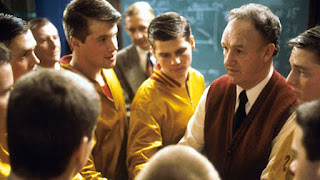
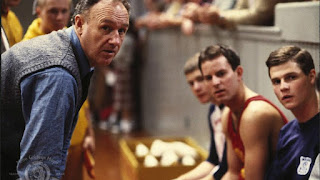
Movie Review: Hoosiers (1986)

A sports drama, Hoosiers (also known as Best Shot) is a traditional underdog story with plenty of heart and no shortage of platitudes.

It's 1951, and middle-aged Norman Dale (Gene Hackman) arrives in the backwater of Hickory, Indiana, to coach the local high school basketball team. Due to a chequered history, this is Dale's final chance at redemption. He immediately clashes with fellow teacher Myra (Barbara Hershey), and his more serious coaching methods disillusion a vocal and passionate group of parents.

The school's star basketball player Jimmy Chitwood has decided not to play this year for personal reasons, and without him the team struggles with a string of bad results. Shooter Flatch (Dennis Hopper) is the perpetually drunk father of one of the players but also an astute student of the game, and Dale recruits him as an assistant coach. Unsatisfied with progress, the parents try to force Dale out as pressure mounts for the new coach to deliver better results.

Loosely inspired by the 1954 exploits of Indiana's Milan High School, Hoosiers encourages old fashioned stand-up-and-cheer exuberance. The hokiness is earned, though, as the Angelo Pizzo script puts coach Dale through the wringer on multiple fronts before the bounces start to go his way. Director David Anspaugh deploys rural charm in good doses, finds poignant locker room moments, and excels at staging coherent on-court action for the many in-game snippets.

Just as the team's journey to overcome adversity and achieve success is positively celebratory, the film's many weaknesses are also plain to see. Apart from Dale, Myra, and Shooter, the other characters are poorly defined, perhaps due to budget constraints limiting the available supporting acting talent. Star player Jimmy gets four short lines of dialogue and is denied the opportunity to explain his rationale for first leaving then rejoining the team. The turnaround in the team's fortunes coincides with Jimmy's return, but Anspaugh skips over explaining whether the coach's methods or one overpowered player triggered the winning streak.  A few other side characters, including Myra's mother, are introduced with promise then simply discarded. 

The 18 years of age difference between Hackman and Hershey is obvious and grating, and what could have been a stellar friendship between coach Dale and teacher Myra is sacrificed for an awful romantic moment. 

But Hoosiers also offers plenty of honest passion, and it's impossible not to admire and cheer the trajectory of the plucky small town team forging a winning spirit, battling larger and better funded schools, and riding momentum all the way to the state tournament. Hackman does his part injecting sideline spikiness, navigating around his initial disdain of small town attitudes, seeking allies where he can find them, and arguing every call until he inevitably gets tossed. His reclamation project to uncover the man hiding beneath Shooter's drunkenness is a satisfying supplementary plot.

The corn is plentiful and sometimes uncultivated, but Hoosiers sinks the basket when it matters most.


All Ace Black Movie Blog reviews are here.

Monday, 2 April 2018

Movie Review: Falling Down (1993)


A psychological drama thriller, Falling Down portrays one man's journey past the edge.

In Los Angeles, middle-aged defence industry white collar worker William Foster (Michael Douglas) finally loses patience with a slow moving traffic jam caused by roadworks. He abandons his car and walks off with his briefcase, mumbling that he is heading home. The incident is witnessed by police Sergeant Martin Prendergast (Robert Duvall), who is retiring that day, having yielded to excessive nagging by his wife Amanda (Tuesday Weld).

Foster is in the throes of a full-fledged mental meltdown. Despite a restraining order he phones his ex-wife Elizabeth (Barbara Hershey) to tell her he is on his way because it's the birthday of their young daughter. On the long walk to Elizabeth's Venice Beach house he first tangles with a Korean shopkeeper then with members of a Hispanic gang, an altercation that provides him with a gym bag full of weapons. He then causes panic at a burger joint. Prendergast and Detective Sandra Torres (Rachel Ticotin) start to connect the dots about the strange man leaving a trail of carnage in his wake.

Directed by Joel Schumacher and written by Ebbe Roe Smith, Falling Down brings to life the secret rage of men who have had enough. With just a touch of humour and plenty of barely controlled fury, Foster plays out what many in his position may wish to do. Unable to dust himself off and try again,  this is a defeated man comprehensively slipping over the sanity threshold and now looking for all the wrong answers in all the wrong places.

It's a serious mental anguish topic, and despite some exaggerated episodes the film does not shy away from the destructive consequences, both in terms of self-harm and the pain and suffering inflicted on family and innocent bystanders.

With both his career and his family life seemingly at an end, Foster's inner demons are unleashed. He uncorks bottled-up racist thoughts, violently destroys a corner store over the cost of a pop can, and refuses to accept petty restaurant schedules for when breakfast can and cannot be served. He lives out the macho dream of having an arsenal at his disposal. And rocket launcher at the ready (with a kid proving how-to instructions), he challenges construction workers to explain, why exactly, the street is being torn up.

Schumacher alternates scenes of Foster's progress towards Elizabeth's house with Prendergast's long and messy last day on the job. The Sergeant first witnesses Foster's rough start to the day and then begins to hear about strange incidents involving a man in a white shirt and necktie instigating altercations in neighbourhoods where such men are not supposed to tread. The structure balances the film, breaks the monotony and allows Michael Douglas and Robert Duvall to share the screen time despite not meeting until late.

Falling Down walks a fine line between important and exploitive. William Foster is everyman on a really bad day, giving way to worst tendencies that are sometimes, sadly, just too powerful to contain.


All Ace Black Blog Movie Reviews are here.


Saturday, 31 March 2018

Movie Review: Hannah And Her Sisters (1986)


A social comedy, Hannah And Her Sisters delves into middle class and middle age emotional crises, and represents one of Woody Allen's finest cinematic moments.

In New York City, Elliott (Michael Caine) is an investment banker married to Hannah (Mia Farrow), a once aspiring actress who has settled into a life of domestic bliss. Although he loves his wife, Elliott is also secretly lusting after Hannah's more free-spirited sister Lee (Barbara Hershey), who is currently in a relationship as the muse of conceited and reclusive artist Frederick (Max von Sydow).

Hannah's other sister Holly (Dianne Wiest) is a former drug addict, always asking Hannah for money and still dreaming in vain about making it as an actress. Hannah's ex-husband Mickey (Allen) is a television producer going through his latest health scare related to hearing loss. Elliott contrives an "accidental" on-the-street meeting with Lee and finally gathers up the courage to express his love, but he is torn between the thrill of an affair and the stability offered by Hannah. Meanwhile the relationship between the three sisters ebbs and flows with the passing seasons.

Directed and written by Allen, Hannah And Her Sisters features a collection of New Yorkers struggling with typical Allen issues over two years book-ended by the anarchic warmth of Thanksgiving family gatherings. Elliott is imagining the greener grass on Lee's side of the sistery fence, Lee herself is feeling stifled by the egotistical and older Frederick, Holly is pursuing a career that does not exist and hypochondriac Mickey is dealing with his latest health scare and concluding that a change in religion is in order.

Meanwhile Hannah's parents do not offer much in the way of guidance -- or maybe they do. Norma and Evan (Maureen O'Sullivan and Lloyd Nolan) are living out their years with plenty of fire and ice, bickering as much as they are reminiscing, their lives having consisted of conflict, tumult, betrayal and an abundance of love.

Only Hannah herself appears to want to chart a steady course, and pays the emotional price for it. She happily gave up an acting career in exchange for relative domestic bliss. Stable, steady, the rock for her family and her sisters, Hannah is accused of being too perfect, her advice too pragmatic. Both admired and resented for the resilience, organization and warmth she provides, Hannah is an example that is too obvious to emulate.

These are all of course first world problems of privileged New Yorkers, but there is no denying the affinity Allen has for all his characters. The dialogue is sharp, funny and rings relatively true. Allen laughs at the situations surrounding the characters, not at the people themselves. And the multiple story arcs do spring some lifelike and unexpected surprises, some apparent dead ends proving to be pathways and other promising opportunities only leading to cul-de-sacs.

The film is perfectly paced, the multiple stories balanced, Allen mastering the juggling act and never staying in one place for too long.

The cast is deep with talent and absolutely stellar, Allen's prominence attracting a star in every role, and they equitably share the screen time. Farrow, Hershey and Wiest have rarely been better, benefiting from Allen's genius in creating well-rounded female roles. Caine acts with sorrow-filled eyes, nailing the middle-aged man willing to risk stability at home to chase one more fling.

The cast also includes Daniel Stern, Carrie Fisher (as Holly's frenemy), Julia Louis-Dreyfus, Julie Kavner, J.T. Walsh, John Turturro, and Richard Jenkins, as well as Tony Roberts and Sam Waterston in uncredited roles.

Hannah And Her Sisters is sly social commentary in a perfect package, clever enough to tease out human foibles and warm enough to understand their essential nature.


All Ace Black Blog Movie Reviews are here.


Monday, 28 August 2017

The Movies Of Barbara Hershey


All movies starring Barbara Hershey and reviewed on the Ace Black Movie Blog are linked below:

The Right Stuff (1983)


The Natural (1984)


Hannah And Her Sisters (1986)


Hoosiers (1986)


All Ace Black Movie Blog reviews are here.
The Movie Star Index is here.

Saturday, 19 August 2017

Movie Review: A Dangerous Woman (1993)


A peculiar romance drama, A Dangerous Woman attempts to explore some relatively original territory but fails to coalesce.

Martha (Debra Winger) is a socially and physically awkward and lonely woman, able to function by herself but suffering from some form of mental illness. She lives in a guesthouse next to her aunt Frances (Barbara Hershey), who is carrying on an affair with aspiring politician Steve (John Terry), who in turn is married to the alcoholic and potentially violent Anita (Laurie Metcalf).

Martha is fired from her job at a laundromat, wrongly accused of a petty theft actually committed by sleazy co-worker Getso (David Strathairn). Meanwhile handyman drifter Mackey (Gabriel Byrne) shows up to repair Frances' porch. Hunky but frequently drunk, Mackey forges an unusual bond with Martha, who is having trouble letting go of the injustice perpetuated by Getso.

Directed by Stephen Gyllenhaal (and featuring his kids Jake and Maggie in tiny roles), A Dangerous Woman features a terrific Debra Winger performance and little else. Martha's behaviour often falls just outside the normal range, causing her no end of grief, and Winger immerses herself into the quirky mannerisms of a woman-child who has difficulties engaging in the logic of the adult world. The performance tugs at the heartstrings of sympathy and is almost aching in its sustained intensity.

Everywhere around Winger, the film falls short. An adaptation of a novel by Mary McGarry Morris, the story meanders along irrelevant pathways and fails to set a direction. The entire subplot featuring Frances, the politician Bell and his highly-strung wife Anita drops in and out of the film and goes exactly nowhere. Character depth, motivation and evolution is fundamentally lacking, and time passes very slowly with plenty of repetitive drunken episodes featuring Byrne stumbling about. A late incident of violence is followed by an unsatisfactorily pat resolution.

The film does wade into the thorny territory where the nature of sexual consent can be debated. Multiple impairments come together to give Martha both unexpected pleasure and a downstream conundrum. It's an interesting question but arrives too late and is almost entirely bypassed by the Naomi Foner script.

Stephen Gyllenhaal has spent most of his subsequent directorial career in television territory, and A Dangerous Woman has the small-time look and truncated sophistication of an episode from the third season of tired network series. One woman gives her all, but all else is dangerously stale and familiar.


All Ace Black Blog Movie Reviews are here.


Monday, 19 January 2015

Movie Review: The Right Stuff (1983)


A grand celebration of the early days of the United States space exploration program, The Right Stuff is the finest level of ambitious drama. The story of men pushing against the farthest boundaries known to humanity is an exhilarating ride into new frontiers.

Soon after the end of World War Two, breaking the sound barrier is seen as the next major achievement in aviation. At Muroc Army Air Field in California, experimental aircraft are coming closer to the mythical threshold, and many pilots are dying as the equipment fails around them. Finally, war hero Captain Chuck Yeager (Sam Shepard) breaks the sound barrier in the rocket-powered Bell X-1, despite flying with broken ribs.

Chuck has the support of his wife Glennis (Barbara Hershey), who understands her man's desire to never settle for ordinary. Into the 1950s, Muroc is renamed Edwards Air Force Base, and the local watering hole becomes the preferred gathering place for some of the country best pilots who gather at Edwards set new speed records and test the newest, fastest and most dangerous planes. Yeager remains the spiritual guide for all the pilots, and he continues to re-set the speed record, including getting to Mach 2.0.

When the Soviet Union surprises the world by launching the Sputnik satellite, the US government scrambles to catch up, and the Mercury space program is born. After a series of rigorous fitness and stamina tests, seven military pilots are chosen to lead America into space, including John Glenn (Ed Harris), Alan Shepard (Scott Glenn), Gus Grissom (Fred Ward), Gordon Cooper (Dennis Quaid), and Walter Schirra (Lance Henriksen). The men form a tight bond and are anointed as the brave new explorers of the 20th Century, celebrated by the press as an excited nation gears up to confront new frontiers.

Shepard becomes the first American to launch into space, followed by Grissom, but the latter's flight is blemished by a mishap upon splashdown. Glenn is then selected to become the first American to orbit the earth, and his flight will feature an unexpected distraction. Back at Edwards, Yeager recognizes the changing times, but continues doing his thing: flying the most dangerous airplanes as fast and high as they can go.

Now recognized as a classic and one of the best films of the 1980s, The Right Stuff was remarkably a commercial failure upon its release. In 1982 space movies meant Return Of The Jedi and E.T.: The Extraterrestrial. Audiences enamoured with light sabres, laser guns, warp speed and cute aliens were not ready for a reality-based ensemble piece about the seemingly mundane business of figuring out how to take the first tentative steps into space.

Clocking in at a remarkable 192 minutes, The Right Stuff flies by at the speed of the sound. Director Philip Kaufman adapted Tom Wolfe's bestseller into an almost mythical story of modern knights daring to confront the monsters that live in the unexplored world of space travel, riding at the pointy ends of rockets launched with rudimentary, still-evolving technology. Except that this is all based on true events, and the bravery demonstrated by men like Yeager and the first astronauts laid the groundwork for humans to walk in the moon, a mere 10 years after the Mercury 7 were selected.

Kaufman's masterstroke is in weaving Yeager's story in with the space program. The Right Stuff blends the Greatest Generation that won the war with their younger and cockier brothers, men who reaped the rewards of victory and were then ready to take on the world - and space. Yeager represents the inspirational warriors of war, while men like Glenn and Shepard are the warriors of space exploration, who would not exist without the security and confidence that came with victory.

The Right Stuff includes plenty of colour, character, and surrounding personalities to humanize the story. The link between celebrity, money and success is made early, as the pilots and the politicians realize that secrecy does not pay-off; handsome men and their incredible flying machines will make headlines, and the money to sustain the program and allow it to flourish will follow.

The wives of the pilots suffer in silence, but suffer they do. Betty Grissom (Veronica Cartwright) is humiliated by the ignominious treatment handed to her husband after his spacecraft sinks. Trudy Cooper (Pamela Reed) suffers through her husband Gordon's absolute belief in his abilities. And Annie Glenn (Mary Jo Deschanel) suffers from a severe stutter, a condition that will result in a painfully funny non-encounter with Vice President Lyndon B. Johnson (Donald Moffat).

For the most part, government types (including Jeff Goldblum as a pilot recruiter), bureaucrats (particularly John P. Ryan as the Head of the NASA Manned Space Program) and rocket scientists (mostly Germans who switched sides after the war) are given short thrift and treated either as incompetent or clueless. The humour is appreciated, but it is left to other movies to recount the role played by the politicians and engineers to enable space flight.

A film without any dominant performances, each of the main actors gets a few scenes to shine. Shepard casts the longest shadow, while among the astronauts Ed Harris finds the charisma that propelled John Glenn first into orbit and then onto a successful political career. Fred Ward, Scott Glenn and Dennis Quaid sparkle when called upon. Barbara Hershey enjoys the unusual role of the cool pilot's wife who threatens her husband to never change his death defying ways.

Kaufman and his cinematographer Caleb Deschanel create a wide-open and blazing look for The Right Stuff, with stunning recreations of test flights, rocket launches and travel through space. Even the Earth-bound scenes at Edwards Air Base are characterized by flat terrain and open skies, an invitation for a brash nation to come forth and explore. The film is a wondrous visual experience, capturing a bright-eyed can-do spirit riding on not much more than bravado and a political imperative to keep up with and then overtake the Soviets, costs and risks be damned.


All Ace Black Blog Movie Reviews are here.


Saturday, 31 December 2011

Movie Review: The Natural (1984)


The Natural ends with contrived fireworks and a shower of sparks, a case of blatant celebratory self-congratulation that has the potential to cause nausea. But accepted on its terms as an unapologetic baseball fairytale, The Natural is a feel good movie that survives the gallons of sweet syrup dumped onto the screen. The screenplay unfolds like a child's bed-time story, but there is enough talent on display to touch the heart of more mature sensibilities.

It's the 1920s. Young baseball pitcher Roy Hobbs (Robert Redford) appears to have superlative talent, and is called for a try-out by the Chicago Cubs. Leaving behind his sweetheart Iris (Glenn Close), Hobbs is seduced on his journey by Harriet Byrd (Barbara Hershey), an unstable woman who shoots and severely wounds him in her hotel room, apparently ending his professional career.

Sixteen years later, now well into his thirties and having converted from pitching to hitting, Hobbs joins the struggling (and fictional) New York Knights after being spotted by a minor league scout. Hobbs struggles to convince coach Pop Fisher (Wilford Brimley) and his assistant Red (Richard Farnsworth) that he deserves his shot in the majors. When he is finally given the opportunity, his incredible hitting ability revitalizes the Knights, who go on a winning run. Journalist Max Mercy (Robert Duvall) starts snooping around to uncover Hobbs' past, while team owner The Judge (Robert Prosky) deploys the sultry Memo Paris (Kim Basinger) to distract Hobbs, as The Judge needs the Knights to lose in order for him to gain full control of the team.

The script conjured up by Roger Towne and Phil Dusenberry cleans up the harder edges of Bernard Malamud's novel, and strips down the story to the simplest good versus evil narrative, with the King Arthur legend providing the base inspiration. Director Barry Levinson plays along, bathing Glenn Close as the good Iris with white light straight from heaven, with only the singing angels and spiritual harps missing from her scenes. The evildoers, meanwhile, hatch their devious schemes from literally dark caves, Robert Prosky's The Judge refusing to even turn on the lights in his cavernous office, and Levinson just barely managing to resist adding prolonged maniacal laughter to his scenes.

Fortunately, Robert Redford and Robert Duvall are around to add some adult-worthy entertainment. Redford's natural wholesomeness shines through, and at least he is susceptible to the dangerous charms of first Harriet and then Memo, otherwise Roy Hobbs would have been fully expected to walk on water. It is left to Duvall to bring forth the crustiness of the baseball observer, his Max Mercy able to look past Hobbs' heroics and search for the hidden story behind the hits, baseball being nothing if not a sport that values legacy.

Also contributing to The Natural's charm are Wilford Brimley as coach Pop Fisher and Richard Farnsworth as his assistant Red, two baseball men well past their sell-by date and living out the closing days of an abandoned dream. Fisher is so busy lamenting lost opportunities that he needs Red's help to notice Roy Hobbs as the gift from the gods, dropping into his lap for a final drive at glory.

For once three women get crucial roles in a sports movie. Hershey sinks her stinger into a short but unforgettable turn as black widow Harriet Byrd. Kim Basinger is adequate as the resident distraction deployed by The Judge to gain control of the team, while Glenn Close makes the most of the glow that Levinson bequeaths onto her, Iris unwittingly controlling Hobbs' destiny across the years.

The Natural may have surrendered opportunities to deliver a darker, more thoughtful story. But it does achieve its admittedly less ambitious objective: pure mythological escapism centred on the baseball diamond.


All Ace Black Blog Movie Reviews are here.