Showing posts with label Dennis Hopper. Show all posts

Sunday, 1 March 2026

Movie Review: Lured Innocence (1998)


Genre: Suspense Drama  
Director: Kikuo Kawasaki  
Starring: Dennis Hopper, Marley Shelton, Talia Shire, Devon Gummersall  
Running Time: 99 minutes  

Synopsis: In Phoenix, newspaper reporter Elden (Devon Gummersall) is assigned to cover the trial of Elsie (Marley Shelton), who is accused of murder. Flashbacks to Elden's high school days reveal his crush on the alluring Elsie. But she is more interested in Rick Chambers (Dennis Hopper), an older businessman married to the wealthy Martha (Talia Shire), who suffers from a weak heart. Rick and Martha would both like to get rid of each other, inspiring Elsie to hatch a self-serving plan.

What Works Well: The first half generates some small-town intrigue as diner server Elsie (looking for a ticket out of town), businessman Rick (looking for wealth), and his wife Martha (looking for respect) reveal self-serving agendas and plot against each other.

What Does Not Work As Well: This is a low-budget attempted neo-noir with rudimentary production values, but spiced with a few steamy sex scenes. The narration is cringey, the acting wooden, plot ambitions are undermined by shortcuts, and key pivot points like Martha's heart condition and Elden' bizarre affliction (arousal + alcohol = fainting) are loudly pre-announced. All in a matter of a sentence, one key character gets married to a hitherto unintroduced partner, another character is imprisoned, and a murder accusation makes its way to trial except that it's debatable whether a murder ever actually took place.

Key Quote:
Rick (to Elsie): You just want to get away from it all.


All Ace Black Movie Blog reviews are here.

Wednesday, 2 March 2022

Movie Review: Hoosiers (1986)

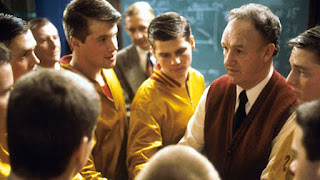
A sports drama, Hoosiers (also known as Best Shot) is a traditional underdog story with plenty of heart and no shortage of platitudes.

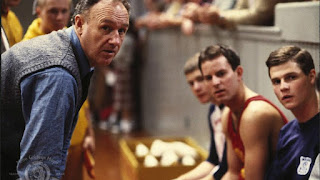
It's 1951, and middle-aged Norman Dale (Gene Hackman) arrives in the backwater of Hickory, Indiana, to coach the local high school basketball team. Due to a chequered history, this is Dale's final chance at redemption. He immediately clashes with fellow teacher Myra (Barbara Hershey), and his more serious coaching methods disillusion a vocal and passionate group of parents.

The school's star basketball player Jimmy Chitwood has decided not to play this year for personal reasons, and without him the team struggles with a string of bad results. Shooter Flatch (Dennis Hopper) is the perpetually drunk father of one of the players but also an astute student of the game, and Dale recruits him as an assistant coach. Unsatisfied with progress, the parents try to force Dale out as pressure mounts for the new coach to deliver better results.

Loosely inspired by the 1954 exploits of Indiana's Milan High School, Hoosiers encourages old fashioned stand-up-and-cheer exuberance. The hokiness is earned, though, as the Angelo Pizzo script puts coach Dale through the wringer on multiple fronts before the bounces start to go his way. Director David Anspaugh deploys rural charm in good doses, finds poignant locker room moments, and excels at staging coherent on-court action for the many in-game snippets.

Just as the team's journey to overcome adversity and achieve success is positively celebratory, the film's many weaknesses are also plain to see. Apart from Dale, Myra, and Shooter, the other characters are poorly defined, perhaps due to budget constraints limiting the available supporting acting talent. Star player Jimmy gets four short lines of dialogue and is denied the opportunity to explain his rationale for first leaving then rejoining the team. The turnaround in the team's fortunes coincides with Jimmy's return, but Anspaugh skips over explaining whether the coach's methods or one overpowered player triggered the winning streak.  A few other side characters, including Myra's mother, are introduced with promise then simply discarded. 

The 18 years of age difference between Hackman and Hershey is obvious and grating, and what could have been a stellar friendship between coach Dale and teacher Myra is sacrificed for an awful romantic moment. 

But Hoosiers also offers plenty of honest passion, and it's impossible not to admire and cheer the trajectory of the plucky small town team forging a winning spirit, battling larger and better funded schools, and riding momentum all the way to the state tournament. Hackman does his part injecting sideline spikiness, navigating around his initial disdain of small town attitudes, seeking allies where he can find them, and arguing every call until he inevitably gets tossed. His reclamation project to uncover the man hiding beneath Shooter's drunkenness is a satisfying supplementary plot.

The corn is plentiful and sometimes uncultivated, but Hoosiers sinks the basket when it matters most.


All Ace Black Movie Blog reviews are here.

Saturday, 31 July 2021

Movie Review: Waterworld (1995)

A post-apocalyptic epic survival adventure, Waterworld is ambitious but also derivative and bloated.

In the future, the ice caps have melted and all the continents are submerged. Survivors drift in ramshackle sailboats or congregate in rudimentary floating atolls, distrustfully trading for scarce resources and searching for the legendary Dryland. The Mariner (Kevin Costner) traverses the oceans in his customized sailboat, and with webbed feet and gills developing behind his ears, he is evolving into a human/fish hybrid. He sails into an atoll to trade, but is treated with hostility due to his mutations. 

When the atoll is attacked by Smokers led by the Deacon (Dennis Hopper), the Mariner escapes and rescues Helen (Jeanne Tripplehorn) and the child Enola, who has a tattoo on her back that may denote Dryland's coordinates. The Mariner is not used to having company and resents the presence of strangers on his boat. The Deacon and his band of goons are in hot pursuit, intent on seizing Enola. The Mariner eventually grows fond of his guests, then has to protect them against the Deacon's attacks as he becomes a reluctant participant in the quest for Dryland.

Essentially a wet version of Mad Max 2, Waterworld was a troubled and over-budget production, with director Kevin Reynolds navigating the adversity (including hurricanes) of filming on open water off the coast of Hawaii. Notwithstanding the familiarity of the material, the outcome is passable. Character definitions and evolutions vary between limited and non-existent and the dialogue is more often than not simply cringey. But the scope is impressive, the representation of civilization's remnants struggling to stay afloat is imaginative, and the action scenes are engaging enough.

The highlights include the Smokers' attack on the atoll, a float plane versus sailboat duel, and a deep underwater dive to demonstrate water's dominance. Despite regular injections of energy, at 135 minutes the pacing is uneven. Reynolds struggles to find the line where enough is enough, slapping on unnecessary prolongations for yet another stunt shot.

As lead protagonist, Kevin Costner's Mariner says few words and is mostly just angry whenever he needs to interact with humans. His brooding presence is suitably larger than life, but his lack of empathy persists deep into the story and creates an emotional void. Dennis Hopper as the Deacon overcompensates, his over-the-top villainous performance dangerously close to dredging up bad vibes from Dune. Jeanne Tripplehorn stays close to a single stance of frustrated determination.

The script (by Peter Rader and David Twohy) does not explain why the polar ice caps melted, but a raucous near-finale on board none other than the floating Exxon Valdez is a non-too-subtle hint. It may be soggy, but Waterworld does see the horizon.


All Ace Black Movie Blog reviews are here.

Saturday, 25 July 2020

Movie Review: Speed (1994)


A supercharged thrill ride, Speed rides a far-fetched plot at manic velocity. 

In Los Angeles, SWAT team members and best buddies Jack Traven and Harry Temple (Keanu Reeves and Jeff Daniels) foil the elevator hostages-and-bombing extortion plot of madman Howard Payne (Dennis Hopper). Believed to be dead, Howard remerges and quickly hatches his next atrocity, rigging a transit bus to explode if it slows below 50 mph and demanding a $3.6 million ransom.

Jack makes it onto the bus while it's in motion, and when the driver is accidentally shot passenger Annie Porter (Sandra Bullock) jumps behind the wheel. Harry tries to uncover the bomber's identity and location while Jack has to keep Annie driving above the threshold speed while figuring out a way to rescue the passengers and avoid an explosion.

A ridiculously simple "Die Hard on wheels" premise delivers exactly what it promises: a thrill every five minutes, acts of selfless heroism, a hissing villain, stunts galore, and a romance blossoming behind the steering wheel. Of course none of it makes the least bit of sense and the laws of physics are kicked off the bus early, but the sense of wild fun is infectious.

Jan de Bont steps up from cinematography duties and easily slips into the director's chair, infusing the film with vivid colours and bursting energy. Whenever faced with a choice between restraint and wild abandon, the quick answer in Graham Yost's script is more is better. This does lead to a protracted second climax on a subway rail car, unfortunately abandoning the bus focus in a case of not knowing when enough is enough.

A speeding bus crashing into everything from a stroller (no babies were hurt in the making of this movie) to an airplane and jumping over freeway gaps is no place for in-depth character exposition, and so Keanu Reeves, Dennis Hopper and Sandra Bullock default to shorthand definitions. Reeves gives Jack Traven an earnest boy scout gloss, Bullock's Annie starts and ends at gum-chewing feistiness, and Hopper's bomb expert is mad at a world he believes shortchanged his career. All three are good enough to complement the non-stop mayhem.

Speed is a jolt of undemanding visceral entertainment, as unpretentious in its intentions as the humble transit bus.


All Ace Black Blog Movie Reviews are here.

Sunday, 24 April 2016

Movie Review: The Osterman Weekend (1983)


A muddled thriller and the final film directed by Sam Peckinpah, The Osterman Weekend has a weak script and distracted execution.

CIA agent Laurence Fassett (John Hurt) loses his wife to an assassination. His subsequent investigation leads him to uncover a Soviet spy network known as Omega, consisting of three former college classmates: plastic surgeon Richard Tremayne (Dennis Hopper), stock trader Joseph Cardone (Chris Sarandon) and television producer with radical tendencies Bernie Osterman (Craig T. Nelson). Fassett convinces CIA director Maxwell Danforth (Burt Lancaster) that he can turn at least one of the spies into a double agent, with the help of controversial television journalist John Tanner (Rutger Hauer), also a former classmate of the men.

Fassett and Danforth lean on Tanner and cajole him into helping out with the plot. On a weekend when the Omega three are converging at Tanner's secluded house with their wives, Fassett wires the place up with numerous cameras and microphones. From a command post in the woods Fassett then orchestrates mind games against the spies to try to unhinge them and get at least one of them to consider becoming a double. But all is not what it seems, and before the weekend is over Tanner's family will be endangered.

Other than a top notch cast in decent form, not much about The Osterman Weekend works. Based on a Robert Ludlum novel, the film was a B-production that gained unexpected, and as it turned out, undeserved cachet when Peckinpah signed on as director, despite his failing health. By then considered a washed-up force, Peckinpah accepted the opportunity to restart his career, which led to many star names signing on to the project.

They need not have bothered. The script is mostly stuck in the early 1970s (the book was published in 1972), when the theme of surveillance was fresh and scary and captured in a spate of films like The Conversation and The Anderson Tapes. Here Peckinpah takes advantage of one more decade of sexual liberation on the screen by injecting plenty of scenes of bedroom frolicking as captured by hidden cameras, but it's all a sideshow that serves to needlessly distract from an already convoluted premise. Merete Van Kamp (Fassett's wife), Meg Foster (Tanner's wife), Helen Shaver (Tremayne's frequently drugged wife) and Cassie Yates (Cardone's wife) take turns appearing in various stages of undress, and it's almost all gratuitous.

But at least the sex and nudity are understandable as exploitation. The spy versus spy script is almost beyond comprehension, a victim of a lazy adaptation by Alan Sharp, perhaps grappling with weak source material. The reasons behind the central assassination of Fassett's wife are glossed over. The actual crimes committed by the Omega threesome are never explained. What proves to be incredibly sloppy approval from Danforth for Fassett to proceed with his high-risk, well-resourced mission turns out to be an inexcusable gaping hole.

When the bullets start flying and the violence escalates, the film offers middle-aged white collar men who are suddenly experts at combat and exceptional survival skills. And Tanner's profession as a hard-hitting, in-your-face journalist and interviewer exposing military cover-ups awkwardly mixes in an altogether dissonant tone that simply does not fit with the rest of the film's theme.

There is enough talent in the cast to ensure that The Osterman Weekend is not a total loss, with John Hurt committed in the most complex role as the emotionally wounded agent Fassett. Rutger Hauer, in the midst of his career purple patch, Craig T. Nelson, despite a bit of a ridiculous moustache, and a stodgy Lancaster are all serviceable.

True to form the project ended with Peckinpah embroiled in a battle with the producers, who wrestled control of the final cut and re-edited the film to try and improve legibility. By the end of 1984 Peckinpah was dead, aged 59. The Osterman Weekend is mess of a final note to end a career on, but perhaps also a most appropriate one.


All Ace Black Movie Blog reviews are here.

Wednesday, 8 October 2014

Movie Review: True Romance (1993)


A stylishly violent crime misadventure, True Romance is joyously out of control. The story of a newlywed couple who stumble onto a bag full of cocaine is crazy fun.

In Detroit, Clarence (Christian Slater), a big fan of Elvis, meets Alabama (Patricia Arquette) at a movie theatre. Although she is a call girl sent by Clarence's boss as a birthday gift, Alabama genuinely falls in love with Clarence, and he reciprocates. They get married almost immediately. Clarence is not afraid of violence, and decides to eliminate Alabama's psychotic pimp Drexl (Gary Oldman) to prevent him from re-emerging in Alabama's life. In the bloody confrontation that ensues, Clarence does kill Drexl, and inadvertently also steals a briefcase full of uncut cocaine worth millions.

After a quick visit to his dad Clifford (Dennis Hopper), Clarence and Alabama head to Los Angeles, where they connect with Clarence's buddy Dick (Michael Rapaport). Dick arranges a meeting with fellow actor Elliott Blitzer (Bronson Pinchot), who may be able to arrange for big-shot movie producer Lee Donowitz (Saul Rubinek) to buy the drugs. But mobster types including Don Vincenzo (Christopher Walken) and enforcer Virgil (James Gandolfini) want their drugs back, and they are hot on the tail of Clarence and Alabama, and don't care who they hurt to get their hands on the merchandise.

Directed by Tony Scott and written by Quentin Tarantino, True Romance was Tarantino's first involvement with a major studio, big budget production. Scott rearranged the story into a linear structure and altered the ending, but otherwise kept Tarantino's vision intact. The result in a madcap, ultra-violent adventure, insanely enjoyable but just lacking the laser sharp edge that would emerge one year later with Pulp Fiction.

After a somewhat stuttering start, once Clarence and Alabama get their hands on the illicit drugs the film takes off on a dizzying, fast-paced trip into a world of unimagined opportunity, bloodshed and larger than life characters. Everything about True Romance is hyper-intense, and the film creates a vortex of wild activity that demands attention. Scott amplifies all the film's elements, from Clarence's oversized Cadillac to the garish colours of the Los Angeles hotel where he holes up, to the stomach-churning rollercoaster ride that serves as a negotiations venue with Elliott. The shoot-outs, villains and attitudes are no less magnified.

Tarantino conjures up two exceptional face-off scenes. In the first Don Vincenzo has Clifford tied up and is demanding to know the whereabouts of Clarence. Instead Clifford launches into a history lesson about the ethnic origins of Sicilians that will do his chances of surviving the ordeal no good at all, but then that's Clifford's point. The second scene features Alabama having to survive the brutal henchman Virgil without giving up the location of the briefcase. Both scenes are playful, savage and ingenious in celebrating sacrifice for a cause.

With a cast that also includes Christopher Penn and Tom Sizemore as police detectives; Brad Pitt as Dick's zoned-out roommate; Samuel L. Jackson as Big Don (a random thug); and Val Kilmer as the spirit of Elvis, True Romance boasts an incredible cast, with committed performers in almost every role. Christian Slater and Patricia Arquette make for an engaging and ridiculously cute couple in the middle of the mayhem, while Rapaport, Pinchot and Rubinek form an often hilarious triangle of self-obsessed Hollywood types tilting into dangerous territory.

And of course the film ends with Tarantino's traditional over-the-top showdown, a multi-pronged hotel room battle with plenty of ferocious firepower and precious few survivors. The romance is true, but it's just a spark for what proves to be true pandemonium.


All Ace Black Blog Movie Reviews are here.


Tuesday, 18 October 2011

Movie Review: Easy Rider (1969)


And this is how the 1960s ended.

Easy Rider is the punctuation mark at the end of a decade's worth of social upheaval and rejection of traditional norms. Living the life of freedom translates to riding the open highway on mammoth motorcycles, smoking weed, dealing drugs, smoking weed, visiting communes, smoking weed, landing in jail, smoking weed, being met with suspicion by every establishment man, smoking weed, exploring a whorehouse, smoking weed, and attracting lustful women by the mere fact of existing.

Dennis Hopper directed, Peter Fonda produced, and together with Terry Southern, they co-wrote the Easy Rider script. And as the laid back Captain America (Fonda) and the more highly strung Billy (Hopper), they gave life to two iconic characters. Their most memorable travelling companion is George Hanson (Jack Nicholson), a hard-drinking, philosophical son of influential parents, quick to abandon his life and join a trek to New Orleans.

Easy Rider is a buddy road movie, exploring the alternative life of checking-out and specifically the end-result of all the rule-breaking. The very thin thread of plot has Captain America and Billy making their way to Mardi Gras in New Orleans, stopping at various off-the-beaten-track locations and picking up an assortment of characters along the way. But the film is really about physically and emotionally breaking away from any expectations and responsibilities, with no shortage of open-highway, landscape-rolling-by shots, interrupted by discussions about what it means live by no rules and the consequences of spinning away and creating unique orbits.

Nicholson had been making movies since 1958, but in a star-making role he brings a just slightly unhinged intensity to the quest for freedom, viewing life through the thick lens at the bottom of the bottle and quickly cutting through all the nonsense. Fonda and Hopper allow Nicholson to have the final say on a convulsing nation's split attitude:

Hanson: Oh, yeah, that's right. That's what's it's all about, all right. But talkin' about it and bein' it, that's two different things. I mean, it's real hard to be free when you are bought and sold in the marketplace. Of course, don't ever tell anybody that they're not free, 'cause then they're gonna get real busy killin' and maimin' to prove to you that they are. Oh, yeah, they're gonna talk to you, and talk to you, and talk to you about individual freedom. But they see a free individual, it's gonna scare 'em.

The other two stand-out stars are the two monstrous motorcycles, custom-built for the movie and either destroyed or stolen during filming. With roaring engines, Hopper and Fonda pessimistically present the quest for individuality as enjoying its moments but doomed to tragic failure, fabric woven over many years proving inhospitable to upstart freedom seekers. 

Easy Rider is a nontraditional adventure, and a prescient generational eulogy.


All Ace Black Movie Blog reviews are here.

Thursday, 21 July 2011

Movie Review: Blue Velvet (1986)


A delectable combination of the weird, the disturbing and the stylish, Blue Velvet is an unforgettable film experience. Director and screenwriter David Lynch dreams up a nightmare of utter human evil lurking just below the surface of normalcy, and ensures that every small quaint town will forever be viewed with suspicion:  heinous people may be hiding in every shadow.

College student Jeffrey Beaumont (Kyle MacLachlan) returns to his hometown of Lumberton to visit his ailing Dad, who has suffered a stroke. Out on a walk, Jeffrey makes a gruesome discovery: a discarded, severed human ear. Jeffrey alerts Detective Williams, who starts to investigate, while Jeffrey re-connects with Sandy (Laura Dern), the detective's daughter. Sandy informs Jeffrey that sultry local nightclub singer Dorothy Vallens (Isabella Rossellini), whose signature song is Blue Velvet, is in some kind of trouble and is being investigated by the police.

With Sandy's help, Jeffrey breaks into Dorothy's apartment, but has to hide in the closet and watch in horror as a brute of man called Frank (Dennis Hopper), who inhales an unknown substance through a gas mask, arrives and sexually humiliates and violently abuses Dorothy. Jeffrey surmises that Frank and his men are holding Dorothy's husband Don, the former owner of the severed ear, and her child Donny hostage while Frank regularly forces her to cater to his deviant sexual whims.

Despite all the warning signs, Jeffrey can't stop himself getting involved. He dives into an affair with Dorothy and starts tailing and photographing Frank and his men, uncovering their illegal activities. Frank is soon onto Jeffrey, who gets beaten up after being introduced to Frank's drug and prostitution den, where the beyond creepy Ben (Dean Stockwell) holds court. With the police moving in, Jeffrey finds himself in way over his head, as he tries to save Dorothy from Frank's insanity while the bodies pile up.

The plot of Blue Velvet matters little, and on close examination, makes even less sense. The film is an artistic canvass for Lynch to intricately paint several intertwining themes about the human and societal experience, the most prominent of which is the inevitable transition to adulthood. Jeffrey's insistence on continuously meddling with the criminal underworld appears infuriating: he ignores every opportunity to walk away from trouble. Through Jeffrey's actions, Lynch is emphasizing that there is no choice about growing up and dealing with the difficult and sometimes dangerous problems of adulthood.

A second theme is what lies beneath the surface. Life in Lumberton appears as idyllic as the American dream can get, white picket fences, smiling firemen, and lazy summer days lounging in the yard. It is so surreal that Lynch infuses Lumberton with many 1950s shadings, a decade perceived as more innocent, optimistic and hopeful. Co-existing just below this veneer of perfection are the sordid criminals, and throughout his movie Lynch scatters parallels between Frank and his gang and the ugly insects just below the surface of the manicured lawn introduced in the opening sequence.

A related and more complex theme that Lynch plays with is the contradiction between outward appearance and actual behaviour. Not only does society have inner secrets, every individual may harbour confounding hidden behaviours and motivations. Sandy is the daughter of a police officer, blonde, wholesome and seemingly all good. Yet she doesn't hesitate to tell Jeffrey classified police information that starts him on the road to trouble; she helps him to break into Dorothy's apartment; and she repeatedly ignores her boyfriend Michael as she enjoys the ride that Jeffrey's adventure furnishes for her.

Dorothy is the dark cabaret singer that seemingly represents nothing but trouble. Yet of all the characters in the film she is the one most victimized and in most need of rescuing. Detective Williams is supposed to help but is always giving Jeffrey a suspicious look; and his partner Detective Gordon certainly proves to be much more dangerous than he first appears. Lynch is providing a reminder that for grown-ups, the game of life becomes much more complex, and both people and places are often not what they seem.

Helping Lynch to deliver this kaleidoscope are four actors who have rarely been better. Kyle MacLachlan's movie career never flourished, but as Jeffrey he was perfect, combining innocence with an eagerness to pursue danger to its darkest corners. Laura Dern projects nothing but fresh-faced chastity while she effortlessly behaves in much naughtier ways. Her performance is a magician's sleight of hand, dazzling with a diversionary look while pulling off entirely unexpected actions: in many ways, Sandy is the most interesting and complex character in the movie.

Isabella Rossellini takes on the role of Dorothy with gusto, and her performance is certainly brave: abused, victimized, yet demanding more of the same because that is all she knows, she lives in a world so black that absolute mental darkness is her only comfort zone. And finally, Dennis Hopper brings Frank to life, one of the most vile characters ever placed on the screen. Vicious, abusive, manipulative, intimidating, foul-mouthed, addicted to something through that inhaler, and without a single redeeming feature, Frank is just plain scary. In a career with several highlights, Frank is one of Hopper's stand-out roles.

Blue Velvet is a one-of-a-kind searing bolt of originality that leaves a permanent and most memorable mark.


All Ace Black Blog Movie Reviews are here.


Saturday, 22 November 2008

Movie Review: Swing Vote (2008)


Interesting premise. Horrible execution.

Sometimes, Hollywood just seems to forget what the word "subtle" means, or how powerful it can be to deliver a message with cleverness and gentle prodding. Instead, the brash "in your face" delivery method is unleashed to carpet bomb any trace of soul that tries to poke itself out of the ground.

Swing Vote, directed by Joshua Michael Stern and written by Stern and Jason Richman, has Kevin Costner as the blue collar uneducated beer-loving single dad who is the beneficiary of a computer malfunction and gets to cast his vote again in the US Presidential election. And on his vote rides the outcome of the entire tight election between the Republican incumbent (Kelsey Grammer) and the Democratic challenger (Dennis Hopper). Interesting premise, and a clever idea that could have delivered compelling drama, comedy, or both. But in the hands of Stern and Richman, the film is a pure colour-by-crayons disaster that seems to run backwards into every imaginable cul-de-sac.

The international press descends onto Costner's tiny town and creates a media circus that the film overcooks to a charred crisp. Then both the Republicans and the Democrats wade into the mess in an attempt to win his vote, and proceed to immediately chuck overboard all that they stand for in response to every off-handed remark made by Costner's clueless character. So for example, overnight, the Republicans become pro-environment, the Democrats become pro-life, with the two candidates bowing to every whim of their driven campaign managers.

In the middle of the farce is Costner's idealistic, precocious daughter (Madeline Carroll, the only watchable thing in the movie), who despite having two substance-abusing losers as parents is somehow growing up to be the smartest kid in all of New Mexico. And let's not forget to throw in the ambitious local female TV reporter who wants this story to be her stepping stone to national prominence, and her boss the local station executive who works hard to define the word stereotype.

The film must win recognition for strictly limiting every character to one dimension; not avoiding any cliches; and not delivering a single intelligent, memorable or reflective moment.

And if the first 110 minutes were not bad enough, the film out-does itself in the last 10 minutes. All of sudden, Costner gets a brain, and starts to care; a character who could not stop thinking about beer suddenly contrives to deliver a painful monologue about the importance of being a good citizen, working hard, contributing to society, and voting. The two candidates just as suddenly seem to find a conscience, although even this transformation is hopelessly flubbed in the case of the Democrat, who needs a full-face whacking from his wife to rediscover his values (did we mention the lack of subtlety?).

Swing Vote is witless, boring and simply awful, for its entire overblown length.


All Ace Black Blog Movie Reviews are here.