Showing posts with label Jeff Goldblum. Show all posts

Monday, 7 April 2025

Movie Review: Wicked (2024)


Genre: Fantasy Musical  
Director: Jon M. Chu  
Starring: Cynthia Erivo, Ariana Grande, Jeff Goldblum, Michelle Yeoh  
Running Time: 160 minutes  

Synopsis: The land of Oz is celebrating the death of the Wicked Witch of the West (Cynthia Erivo). When the good sorceress Glinda (Arianna Grande) is asked what made the Witch wicked, she recalls their story in flashback. Elphaba (who became the Witch) is born green and with magical powers. Her stunned parents show her no love, although she is kind to her younger paralyzed sister. Elphaba and Galinda (later Glinda) meet at Shiz University, where they are roommates, enemies, then friends. Elphaba's powers are noticed by Dean of Sorcery Madame Morrible (Michelle Yeoh), and she is promised an audience with the Wizard (Jeff Goldblum).

What Works Well: The cinematic adaptation of the popular stage musical benefits from imaginative world-building, with bright colours and a child-appealing light-hearted sense of fun. The basic inclusion lessons are equally spoon-fed in small and deliberate morsels to register with young minds. Arianna Grande has a lot of fun as the entitled wannabe sorceress adorably convinced that the world revolves around her.

What Does Not Work As Well: The CGI overload is often the most impressive feature on the screen, and drives the experience towards animation wizardry where success is measured by pixel density. The songs are largely forgettable and support the most superficial of societal lessons (be yourself; be kind). From beneath the green make-up, Cynthia Erivo's one demonstrated emotion is seething anger for the entirety of the inexcusably obese running time - and this is only Part 1.

Key Quote:
Glinda: Something is very wrong, I didn't get my way... I need to lay down.


All Ace Black Movie Blog reviews are here.

Friday, 24 December 2021

Movie Review: The Switch (2010)

A creaky romantic comedy, The Switch stretches credibility in search of laughs and love. A strong cast is still crushed by overbearing predictability.

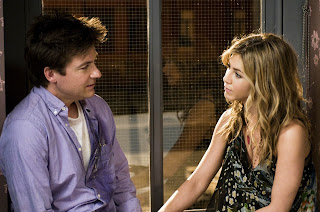
In New York City, Kassie (Jennifer Aniston) decides to have a child using a sperm donor. Her best friend Wally (Jason Bateman), a stock analyst who suffers from mild neurosis, tries to talk her out of it, but she persists and selects college professor Roland (Patrick Wilson) as the donor. At the "insemination party" organized by Kassie's best friend Debbie (Juliette Lewis), a drunk and disoriented Wally secretly switches Roland's sperm for his own and recalls nothing about the incident.

Kassie gets pregnant and relocates to Minnesota. Seven years later she returns to New York with her son Sebastian and reconnects with both Wally and Roland. Wally quickly bonds with young Sebastian, who exhibits familiar signs of neurotic behaviour. Wally seeks advice from his boss Leonard (Jeff Goldblum), while Kassie starts a relationship with Roland, still believing he is the father.

With Wally confined to the friend zone but clearly still smitten by Kassie, The Switch telegraphs all the essential plot points within the first ten minutes. Allan Loeb's screenplay then trudges through another 90 minutes to arrive at the pre-ordained ending, suffering through all the predictable beats with precious few sparkling moments. In the hands of co-directors Will Speck and Josh Gordon, the tortured premise hinges on the well-worn malaise of characters failing to have the necessary conversations in fear of resolving all misunderstandings within television sit-com episode length.

The introduction of Sebastian in the second half provides a bit of a boost, and Wally's observations of nascent mannerisms within his offspring provide some father-son warmth independent of genre confines. In contrast, none of the other characters are remotely believable outside the flighty rom-com bubble, and emotions barely rise above good-looking-actors-reading-lines. Jennifer Aniston's Kassie is coldly self-obsessed as a love interest and even less invested as a mother. Jeff Goldblum and Juliette Lewis are wasted side-kick afterthoughts, and Patrick Wilson never stands a chance as the forced third point of a contrived love triangle.

Despite creating the space to delve into the challenges of single motherhood and anxiety within both adults and kids, the narrative lacks the courage for meaningful commentary. The Switch mixes up the donations, but still arrives at a dull place.


All Ace Black Movie Blog reviews are here.

Thursday, 16 December 2021

Movie Review: Into The Night (1985)

A crime comedy, Into The Night is an uneven mix of cool vibe, slapstick humour, and violence.

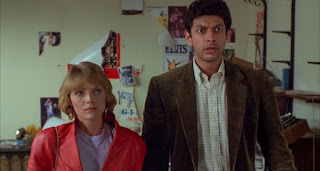
In Los Angeles, aerospace engineer Ed Okin (Jeff Goldblum) is suffering from severe insomnia. Already unhappy at work and unsatisfied in his marriage, he finds out his wife is cheating on him. Taking the advice of work colleague Herb (Dan Aykroyd), Ed heads to the airport in the middle of the night to catch a flight to Las Vegas for some unwinding.

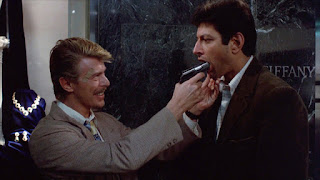
But at the airport parkade, the frantic Diana (Michelle Pfeiffer) bursts into his car as she flees a group of assassins. Ed helps her escape, and gets embroiled in her wild adventure of stolen emeralds involving rich Hollywood executive Jack Caper (Richard Farnsworth) and his wife Joan (Vera Miles), French crime boss Monsieur Melville (Roger Vadim) and his ruthless henchman Colin Morris (David Bowie), Iranian intelligence officer Shaheen (Irene Papas) and her four incompetent assassins, and an FBI agent (Clu Gulager).

Directed by John Landis and written by Ron Koslow, Into The Night offers plenty to enjoy. Sparkling nighttime cinematography by Robert Paynter captures glistening Los Angeles locations, while the smooth Ira Newborn music soundtrack featuring B.B. King is excellent. The overall mood is of why-not absurdity, the fakery of the city and the artifice of the movie industry a metaphorical justification for anything goes.

Jeff Goldblum and Michelle Pfeiffer also nail their roles, shallow as they are. Goldblum embraces the zonked-out-by-insomnia stance and rides it well from start to finish, while Pfeiffer keeps Diana's effervescence just far enough away from irritating to remain sympathetic. And one cool Cadillac elegantly graces the screen.

The plot is less impressive. The emerald theft triggering all the running around is a rudimentary device, and the strain of prolonging the adventure is obvious as ever more random villains and characters are thrown into the pile. Landis and Koslow struggle to find reasons for Ed and Diana to continue their madcap escapades together, Ed in particular oscillating with an exasperating lack of logic between bailing and getting deeper involved.  

If the narrative goes stale, a distracting spot-the-celebrity-cameo game is available. Almost every minor role is occupied by a well-known movie director, the likes Paul Mazursky, David Cronenberg, Jonathan Demme, Don Siegel, Amy Heckerling, Jim Henson, Colin Higgins and Daniel Petrie all making appearances. 

Co-existing sometimes uncomfortably, bursts of humour and violence provide jolts of energy. The comedy is low-brow and the murders bloody, as Into The Night meanders between bright lights and muddled shadows.


All Ace Black Movie Blog reviews are here.

Wednesday, 20 January 2021

Movie Review: Le Week-End (2013)

A drama about the twilight of marriage, Le Week-End is limited in scope and unsettled in tone.

Birmingham-based couple Meg and Nick (Lindsay Duncan and Jim Broadbent) arrive in Paris for a weekend trip to celebrate their 30th wedding anniversary. He is a college professor of philosophy and she is a teacher, both are approaching retirement and money is tight. The tension between them is significant, and Meg is infuriated by the cheap room Nick booked. She instead decides to splurge and checks them into a suite at an expensive hotel.

The passion has seeped out of the marriage, Meg and Nick no longer have sex, and she does not even want him touching her. They bicker and fight but also have some fun as they enjoy the sights and restaurants, sometimes skipping out on paying the check. With Meg's resentment rising, the dynamics of the weekend are altered by a chance meeting with Morgan (Jeff Goldblum), Nick's friend from their Cambridge days and now a celebrated author.

Featuring a tortured central relationship oscillating between cold and frigid with an abundance of awkwardness and just occasional hints of playfulness, Le Week-End offers little to attract. Director Roger Michell and writer Hanif Kureishi lean heavily on the performances of Lindsay Duncan and Jim Broadbent, but forget to create characters worth caring about. Meg displays a particularly acidic brand of meanness, still embracing her rage from a 15-year-old straying incident. Instead of emerging as a couple worth rooting for, this bickering pair is best served by having their gasping union shot behind the shed.

The introduction of Morgan is late in coming, and intended as a dual jolt: one class behind Nick at Cambridge, Morgan is now a successful author surrounded by beautiful people in a fancy Parisian apartment, while Nick is fading into a tainted retirement in Birmingham. And maybe to make matters worse, Morgan treats Nick as his inspiration, which reinforces Nick's insecurities and supports Meg's contention that Nick never fulfilled his potential.

The misery ends with a couple of speeches about failure and love, neither very convincing and both filed under too little and too late. Le Week-End was intended to celebrate an anniversary, but should instead denote the necessary demise of a tiresome marriage.


All Ace Black Blog Movie Reviews are here.

Friday, 29 December 2017

Movie Review: The Lost World: Jurassic Park (1997)


A dinosaurs-on-the-loose monster movie, The Lost World: Jurassic Park offers good special effects and very little else.

Chaos theorist Dr. Ian Malcolm (Jeff Goldblum) is hired by John Hammond (Richard Attenborough) to observe and document dinosaurs in their natural habitat on the fictional Isla Nublar. Hammond created the dinosaurs on that island before moving them to the park that was the subject of the first movie. Malcolm travels with photographer Nick (Vince Vaughn) and field equipment manager Eddie (Richard Schiff) and on the island they team up with Malcolm's girlfriend behavioral paleontologist Dr. Sarah Harding (Julianne Moore).

At the same time, Hammond's nephew Peter Ludlow (Arliss Howard) is taking over the business and sends his own large and heavily equipped group, including big game hunter Roland Tembo (Pete Postlethwaite) to capture some of the dinosaurs and restart the business of commercializing the animals. The two teams initially clash but eventually have to team up to survive as the dinosaurs resent the multiple intrusions on their territory.

The first sequel to 1993's Jurassic Park, The Lost World is again directed by Steven Spielberg and serves mainly to showcase the advances in technology over the four years. Good as the creatures were in the original, they are much better here, with more fluid movements and more detailed textures.

And that's as far as any enjoyment goes in The Lost World. Beyond ogling the dinosaurs, this is a fundamentally deficient film where the characters are of the immediately forgettable plastic variety, the plot, dialogue, events and set-pieces are contrived, familiar and far from scary, the action and violence is mainly bloodless, and everyone acts as stupidly as possible at every decision point in order to unleash and prolong the rampage.

The David Koepp screenplay, adapting Michael Crichton's follow-up book, does not even appear to try and create anything intelligent. The action rushes to humans idiotically unlocking the cages of pissed-off dinosaurs as quickly as possible, and then compounding the lunacy by smuggling a baby dino away from its parents and into a trailer. Then the supposedly intelligent protagonists stand around and wonder why the dinosaurs are sort of upset and wrecking the place.

And just to emphasize the prevailing asininity, how about the heavily armed guard whose job it is to protect others, except that he is always wearing headphones to enjoy his music and drown out, you know, all cries for help or the sounds of approaching prehistoric predators.

The Lost World: Jurassic Park looks gorgeous, but is otherwise a vacuous piece of cretin-dominated silliness.


All Ace Black Blog Movie Reviews are here.


Saturday, 25 February 2017

Movie Review: Nine Months (1995)


A romantic comedy about transitioning from couplehood to parenthood, Nine Months showcases Hugh Grant's emerging talents and achieves big laughs with some slick slap stick.

In San Francisco, child psychologist Sam (Grant) and ballet teacher Becky (Julianne Moore) are in a seemingly perfect long-term relationship. When she announces an unexpected pregnancy, Sam is frazzled and feels unready. His attitude is not helped by constant accidental interactions with the chaotic family of Marty and Gail (Tom Arnold and Joan Cusack), who have three kids and a fourth on the way. Sam's friend Sean (Jeff Goldblum), a struggling yet sophisticated artist, is also not a fan of babyhood, having just broken off a relationship to avoid becoming a father.

As the pregnancy progresses, Becky becomes more committed to the idea of having a child, while all Sam can focus on is the loss of his independence and the fundamental changes to their lifestyle. The couple reach a crisis point, not helped by the seemingly incompetent efforts of Dr. Kosevich (Robin Williams), a recent Russian immigrant with limited vocabulary.

Directed and co-written by Chris Columbus, Nine Months was Hugh Grant's first studio-backed Hollywood production. The film is perhaps overstuffed with Grant's signature mannerisms of rapid blinking, eye-shifting, stuttering and off-handed cynicisms, but overall this is a comedy that benefits from his talent and establishes the Grant screen persona as the likable but boyish urbane man who refuses to grow up.

This is rom-com where the romance eventually takes a back seat to the comedy. Columbus firmly sets his focus on achieving crowning laugh-out-loud moments, and largely delivers. Some of it is pure slapstick, including an encounter with a Barney-type dinosaur at a toy store, but it works. And thanks to Robin Williams committing to the insanity of a veterinarian insecure about his first foray into human medicine, the film's finale is a frantic classic.

In its more serious moments Nine Months preys on the theme of men unwilling to mature. Sam is at the peak of his youth's fantasy, enjoying being in love, an emerging career, a new sports car and a beautiful woman by his side. The concept of abandoning what appears to be perfection to dive into the world of fatherhood is terrifying, and not made any easier by his superficial observations of what appears to be the anarchy of families in the full swing of parenting. His transformation is of course linear and predictable, but Columbus makes the most of a natural and widespread anxiety.

The cast members provide strong support. Moore registers as a woman fully embracing impending motherhood and unafraid to make difficult decisions when needed. Robin Williams has just the two prominent scenes but is unforgettable as Dr. Kosevich, while Jeff Goldblum delivers another version of his superficially smooth expert roles, gradually revealing Sean as a king of nothing.

Nine Months captures the emotional disarray of pregnancy: the gestation period is long, if for no other reason than to allow men to catch up with the drastic changes to come.


All Ace Black Blog Movie Reviews are here.


Thursday, 25 August 2016

Movie Review: California Split (1974)


A slice-of-life film set in the world of pitiful men succumbing to a life of continuous gambling, California Split suffers from a vague structure, less than compelling plot and loud overlapping dialogue. But once the story finally finds an anchor, both the drama and the level of engagement improve.

In Los Angeles, Bill Denny (George Segal) and Charlie Waters (Elliott Gould) meet at a poker game and establish a loose friendship based on their mutual love of gambling. Charlie has no expectation of a life outside gambling and will gamble on anything at anytime, maintaining an easy going, roll-with-the-punches (sometimes literally) attitude. Bill is more serious and intense, struggling to balance a career with his increasingly dominant gambling habit. Charlie introduces Bill to his friends, the rather dimwitted prostitutes Barbara (Ann Prentiss) and Susan (Gwen Welles).

Just as Bill starts to enjoy Charlie's regular company, the latter suddenly disappears. Left on his own, Bill freefalls into a full-fledged gambling addiction and finds himself deep in debt with his bookie Sparkie (Joseph Walsh, who also wrote the script). Upon Charlie's return, Bill is determined to prove himself a winner, and plans an all-or-nothing gambling trip to Reno.

Directed by Robert Altman in his trademark off-handed style, California Split takes a long time to find traction. Patience is rewarded once the characters are belatedly defined, but while Bill's downward spiral does engage, an element of vague tedium permeates proceedings. The technique of having multiple loud conversations overlapping in the same scene quickly grows tiresome, and it takes Altman the best part of an hour to be done with introducing the characters in a freewheeling first half that often dips into structural sloppiness.

The second half is much better. Once Bill find his rock bottom and starts to understand that just like gambling, Charlie's friendship comes with no guarantees, the film latches on to a theme. The trip to Reno turns into an expedition to prove that at least one winning streak resides in every gambler. Altman and Walsh then nail the climax, gambling emerging as more about self-definition and less about winning and losing.

The film's aesthetic accurately captures the depressing surroundings in which gambling thrives. Far from the glittery razzle dazzle marketing image of gambling, Bill and Charlie spend large chunks of their days and nights in smoke-filled windowless and featureless rooms, filled with desperate, unsavory souls intent on drowning their reality in pursuit of cheap riches.

George Segal and Elliott Gould do what is expected, the film's easy-going tone suiting both actors but also not providing any highlight opportunities for them to shine. Ann Prentiss and Gwen Welles as the sweet but messy roommate hookers add to the general milieu of losers getting by as best as they know how. Jeff Goldblum makes a brief early career appearance.

California Split is half of a good film, the early clumsiness offset by a late winning hand.


All Ace Black Blog Movie Reviews are here.


Saturday, 20 August 2016

Movie Review: Invasion Of The Body Snatchers (1978)


A science fiction horror drama, Invasion Of The Body Snatchers builds to a fine level of tension in the story of aliens duplicating and replacing humans through organic, plant-generated pods.

Alien spores from a distant but dying planet travel to Earth, latch onto plants, mix with water, and morph into beautiful small flowers. In San Francisco, health department worker Elizabeth Driscoll (Brooke Adams) takes one of the flowers home. A few days later she notices a dramatic change in the behaviour of her boyfriend Geoffrey (Art Hindle), who has become a lot more aloof and robotic. Elizabeth confides in her co-worker and lover Matthew Bennell (Donald Sutherland), who suggests that she has a talk with celebrated psychiatrist Dr. David Kibner (Leonard Nimoy).

Similar reports of strange personality changes sweep through the city. Elizabeth, Matthew, and their friends Jack and Nancy (Jeff Goldblum and Veronica Cartwright) start to piece together what is going on: when humans sleep the flowers grow into large pods that create emotionless duplicates and destroy the original. With the snatchers taking over the city, Matthew and his friends have to fight off sleep and find a way to survive.

A remake of the 1956 original and directed by Philip Kaufman, Invasion Of The Body Snatchers expertly plays with a sense of creeping dread. The film contains its fair share of disgusting moments and effective shocks, but Kaufman's intention is to create cerebral rather than physical scares, and he succeeds admirably.

Relying on a sense of hopelessness in the face of an unseen threat rather than outright horror, the story unleashes an organic, messy and determined foe on an unsuspecting city. With no spaceships or weapons of any kind, the invaders simply destroy humanity from within, using the disguise of an innocent, exotic-looking flower. The film works as a metaphor for the proliferation of pollution and toxins destroying all that is good and transforming people into uncaring beings. It is equally effective as a cautionary tale about the speed with which pandemics can spread, and the potentially woefully inadequate levels of preparation to combat an unexpected threat.

The first two thirds of the film establish the characters and introduce the warning signs that all is not well. Kaufman is patient, hinting at what might be and allowing Elizabeth and Matthew plenty of time to round into real and flawed people. The final third does occasionally struggle to find new plot elements, and there are some prolonged chase segments that could have been trimmed. Excellent nighttime cinematography by Michael Chapman, combined with chilling a music score by Denny Zeitlin featuring some blood-curdling screams, help to maintain momentum.

Brooke Adams gives the brightest performance, and the unfolding horror is mostly seen through her character's eyes. Donald Sutherland is a bit more sleepy but swings into action in the second half of the film. Jeff Goldblum, in one of his earlier prominent roles, and Veronica Cartwright provide good support. Leonard Nimoy's casting is a clever touch, as his Dr. Kibner tries to exude calm and promote an intellectual rather than panicked reaction.

There are no heroes or epic showdowns in Invasion Of The Body Snatchers, and the film leaves plenty of open questions, contributing to a sense of pessimism. The intention of the aliens is to survive on a new planet; the fate of the suddenly hapless human species is a less important detail.


All Ace Black Blog Movie Reviews are here.


Saturday, 14 May 2016

Movie Review: Independence Day (1996)


An alien invasion science fiction extravaganza, Independence Day packs a globe-full of carnage into the story of yucky invaders intent on destroying Earth, and the human efforts to repel them.

With July 4th approaching, a menacing armada of mammoth alien spaceships arrives over Earth, disrupts all satellite communications and takes up station above major cities. US President Thomas Whitmore (Bill Pullman), a former air force pilot, is unsure of the aliens' motives and whether or not to order an evacuation. His advisors include the stoic General William Grey (Robert Loggia), excitable Secretary of Defense Albert Nimzicki (James Rebhorn) and Communications Director Constance Spano (Margaret Colin).

Constance's former husband is David Levinson (Jeff Goldblum), an intellectually gifted MIT graduate whose lack of ambition has landed him a job as a satellite technician at a television station. David decodes the aliens' inter-fleet communication signal, revealing their countdown towards a massive hostile attack. David and his father Julius (Judd Hirsch) rush to the White House to try and warn the President. In Los Angeles, Captain Steven Hiller (Will Smith) is a cocky air force pilot, debating whether to propose to long-term girlfriend Jasmine (Vivica A. Fox), an exotic dancer. He interrupts his vacation and reports back to base upon witnessing the alien spaceship above LA.

The aliens do indeed attack as predicted by David, causing massive loss of life and the destruction of entire cities. The President is hustled off on Air Force One, but the First Lady (Mary McDonnell) isn't so lucky. Hiller joins an air force counterattack, but the advanced technology of the invaders proves too strong. President Whitmore faces a monumental challenge to save the human species, and the path to unlocking an effective military counter strategy passes through the government's secretive Area 51 facility in the Nevada desert.

Directed by Roland Emmerich, Independence Day is a throwback to 1950s style humans vs. aliens sci-fi thrillers. With the advantage of glitzy special effects and charming actors radiating heroism, the film rides a cool groove of action and devastation, set against end-of-the-world excitement. The film takes its time in the first 30 minutes to establish an interesting set of characters, and once the aliens reveal their intent, Emmerich kicks off more than two hours of merriment and mayhem around a simple question: how will humans fight back when faced with nothing less than a surprise war of annihilation with superior extraterrestrials.

For all the sound, fury and glib one-liners, not all of Independence Day is as slick as it would like to be. The scenes of massive spaceships hovering over cities are impressive, but never quite satisfying with the enemy craft rarely fully defined. In general the computer-generated scenes of destruction are hit-and-miss, with the scale sometimes appearing suspect. To maintain family-friendliness there is a notable absence of corpses in scenes where survivors stumble through the wreckage of cities reduced to rubble. The technological key to defeating the aliens, once found, is barely explained, with star charisma expected to be more important than even an iota of scientific discourse.

The romance elements are standard fare for the genre without getting too much in the way, while the independence day hokum about the rebirth of humanity on America's birthday is adequate for easily excitable patriotic young minds, but is best not dwelled upon.

But star charisma is what Independence Day is all about, and the combination of Will Smith and Jeff Goldblum does not disappoint. Smith oozes star power, gets the best lines and the snappiest attitude, and emerges as a hero as both an ace pilot and a man sticking by his exotic dancer girlfriend. Goldblum plays perfectly off his persona as the geeky-but-potentially-cool science guy cultivated around The Fly and Jurassic Park. Bill Pullman is adequate but lands in more bland territory compared to his two co-stars.

The secondary cast adds plenty of texture and is better than the regulation stock characters. Robert Loggia adds stature as the General standing by the side of the President, James Rebhorn is his counterweight as a Secretary of Defence playing politics at the wrong time, and Judd Hirsch get an expanded presence as David's slightly overwhelmed but still thoughtful father. Randy Quaid achieves one his better supporting roles as an alcoholic crop duster with a colourful history related to the aliens, and eventually finds his inner Slim Pickens.

Flashy and furiously fun, Independence Day has much to celebrate.


All Ace Black Blog Movie Reviews are here.


Tuesday, 8 March 2016

Movie Review: Jurassic Park (1993)


A science-gone-wrong monster epic from director Steven Spielberg and writer Michael Crichton, Jurassic Park boasts ground-breaking special effects but is an otherwise strangely dull, plotless and bordering on boring monsters-on-the-loose thriller.

Eccentric tycoon John Hammond (Richard Attenborough) has created the Jurassic Park tourist destination filled with cloned dinosaurs on the tropical island paradise of Isla Nublar. Before the park opens to the public, a misbehaving dinosaur kills a worker, prompting investors represented by lawyer Donald Gennaro (Martin Ferrero) to insist on an expert independent safety audit. Paleontologist Dr. Alan Grant (Sam Neill), paleobotanist Dr. Ellie Sattler (Laura Dern) and chaos theorist Dr. Ian Malcolm (Jeff Goldblum) are recruited to inspect the site. Hammond's grandchildren Tim and Alexis drop by for a visit just as the experts start their work.

The scientists are awed by the sight of recreated dinosaurs roaming the island within areas segregated by electrified fences. Hammond explains the cloning science, with the dinosaur DNA obtained from mosquitoes trapped for millennia in fossilized tree sap. But the park's weakness resides with disgruntled computer systems programmer Dennis Nedry (Wayne Knight), a slob of a man seeking greater financial rewards. When Dennis deactivates parts of the security system to steal dinosaur embryos, he sets off a series of events that allows the dinosaurs to roam free, placing the lives of the scientists and Hammond's grandchildren at risk.

Jurassic Park is a visual treat, and by the standards of 1993, the special effects are magnificent. Spielberg brings assorted dinosaurs to realistic life, and watching the actors interact with the ancient beasts is a thrilling experience.

At least, until the novelty wears off and the mind begins to wander towards the empty space where the non-existent narrative is supposed to reside. Crichton co-wrote the screenplay, and he brings his typical sloppy habits to the fore. The film has no meaningful human dimension, and the actors are left to grapple with plastic characters spouting stock phrases, while tiny, underdeveloped plot fragments are strewn all over the island. At the heart of the film's problems is the premise that all the security and computer systems of a multi-billion dollar investment can be entrusted to a single underpaid sloven like Dennis Nedry. The conspiracy to steal embryos is never more than a barely-baked idea to unleash chaos.

Elsewhere, there is a tired sub-theme about Dr. Grant being intolerant of children, so of course he is saddled with saving the lives of young Tim and Alexis once the dinosaurs break out. Dr. Malcolm's chaos theories are presented as next to inexplicable, while Dr. Sattler starts down the road of exploring why a Triceratops is falling regularly ill, but that's another plot point that is summarily abandoned.

Jurassic Park defaults to a series of well-executed set-pieces that nevertheless become irritatingly predictable: monsters attack, humans run for their lives. An endless sequence features a mammoth Tyrannosaurus Rex toying with the car in which Tim and Alexis are hiding. Later on, the vicious Velociraptors take their turn to hunt the humans, eventually cornering the kids in the kitchen.

With Spielberg at the helm and the film heavily slanted towards the pre-teen demographic easily mesmerized by dinosaurs, there is never an actual risk that any character of consequence will actually get hurt, and all the violence is incongruously bloodless. It's innocent vanilla fun, a clash of creatures never intended to co-exist, and that's as deep as the themes of the film are allowed to go.

Jurassic Park deserves recognition for raising the special effects bar and demonstrating what magic is possible with a combination of CGI and animatronics. But as a film it is a surprisingly soulless exercise in juvenile storytelling: two hours of screams, roars and not much substance.


All Ace Black Blog Movie Reviews are here.


Monday, 19 January 2015

Movie Review: The Right Stuff (1983)


A grand celebration of the early days of the United States space exploration program, The Right Stuff is the finest level of ambitious drama. The story of men pushing against the farthest boundaries known to humanity is an exhilarating ride into new frontiers.

Soon after the end of World War Two, breaking the sound barrier is seen as the next major achievement in aviation. At Muroc Army Air Field in California, experimental aircraft are coming closer to the mythical threshold, and many pilots are dying as the equipment fails around them. Finally, war hero Captain Chuck Yeager (Sam Shepard) breaks the sound barrier in the rocket-powered Bell X-1, despite flying with broken ribs.

Chuck has the support of his wife Glennis (Barbara Hershey), who understands her man's desire to never settle for ordinary. Into the 1950s, Muroc is renamed Edwards Air Force Base, and the local watering hole becomes the preferred gathering place for some of the country best pilots who gather at Edwards set new speed records and test the newest, fastest and most dangerous planes. Yeager remains the spiritual guide for all the pilots, and he continues to re-set the speed record, including getting to Mach 2.0.

When the Soviet Union surprises the world by launching the Sputnik satellite, the US government scrambles to catch up, and the Mercury space program is born. After a series of rigorous fitness and stamina tests, seven military pilots are chosen to lead America into space, including John Glenn (Ed Harris), Alan Shepard (Scott Glenn), Gus Grissom (Fred Ward), Gordon Cooper (Dennis Quaid), and Walter Schirra (Lance Henriksen). The men form a tight bond and are anointed as the brave new explorers of the 20th Century, celebrated by the press as an excited nation gears up to confront new frontiers.

Shepard becomes the first American to launch into space, followed by Grissom, but the latter's flight is blemished by a mishap upon splashdown. Glenn is then selected to become the first American to orbit the earth, and his flight will feature an unexpected distraction. Back at Edwards, Yeager recognizes the changing times, but continues doing his thing: flying the most dangerous airplanes as fast and high as they can go.

Now recognized as a classic and one of the best films of the 1980s, The Right Stuff was remarkably a commercial failure upon its release. In 1982 space movies meant Return Of The Jedi and E.T.: The Extraterrestrial. Audiences enamoured with light sabres, laser guns, warp speed and cute aliens were not ready for a reality-based ensemble piece about the seemingly mundane business of figuring out how to take the first tentative steps into space.

Clocking in at a remarkable 192 minutes, The Right Stuff flies by at the speed of the sound. Director Philip Kaufman adapted Tom Wolfe's bestseller into an almost mythical story of modern knights daring to confront the monsters that live in the unexplored world of space travel, riding at the pointy ends of rockets launched with rudimentary, still-evolving technology. Except that this is all based on true events, and the bravery demonstrated by men like Yeager and the first astronauts laid the groundwork for humans to walk in the moon, a mere 10 years after the Mercury 7 were selected.

Kaufman's masterstroke is in weaving Yeager's story in with the space program. The Right Stuff blends the Greatest Generation that won the war with their younger and cockier brothers, men who reaped the rewards of victory and were then ready to take on the world - and space. Yeager represents the inspirational warriors of war, while men like Glenn and Shepard are the warriors of space exploration, who would not exist without the security and confidence that came with victory.

The Right Stuff includes plenty of colour, character, and surrounding personalities to humanize the story. The link between celebrity, money and success is made early, as the pilots and the politicians realize that secrecy does not pay-off; handsome men and their incredible flying machines will make headlines, and the money to sustain the program and allow it to flourish will follow.

The wives of the pilots suffer in silence, but suffer they do. Betty Grissom (Veronica Cartwright) is humiliated by the ignominious treatment handed to her husband after his spacecraft sinks. Trudy Cooper (Pamela Reed) suffers through her husband Gordon's absolute belief in his abilities. And Annie Glenn (Mary Jo Deschanel) suffers from a severe stutter, a condition that will result in a painfully funny non-encounter with Vice President Lyndon B. Johnson (Donald Moffat).

For the most part, government types (including Jeff Goldblum as a pilot recruiter), bureaucrats (particularly John P. Ryan as the Head of the NASA Manned Space Program) and rocket scientists (mostly Germans who switched sides after the war) are given short thrift and treated either as incompetent or clueless. The humour is appreciated, but it is left to other movies to recount the role played by the politicians and engineers to enable space flight.

A film without any dominant performances, each of the main actors gets a few scenes to shine. Shepard casts the longest shadow, while among the astronauts Ed Harris finds the charisma that propelled John Glenn first into orbit and then onto a successful political career. Fred Ward, Scott Glenn and Dennis Quaid sparkle when called upon. Barbara Hershey enjoys the unusual role of the cool pilot's wife who threatens her husband to never change his death defying ways.

Kaufman and his cinematographer Caleb Deschanel create a wide-open and blazing look for The Right Stuff, with stunning recreations of test flights, rocket launches and travel through space. Even the Earth-bound scenes at Edwards Air Base are characterized by flat terrain and open skies, an invitation for a brash nation to come forth and explore. The film is a wondrous visual experience, capturing a bright-eyed can-do spirit riding on not much more than bravado and a political imperative to keep up with and then overtake the Soviets, costs and risks be damned.


All Ace Black Blog Movie Reviews are here.


Monday, 18 August 2014

Movie Review: Silverado (1985)


A valiant attempt to revitalize the Western, Silverado packs in all the genre elements but lacks the required subtlety and sophistication to craft a memorable experience.

In the wild west, Emmett (Scott Glenn) shoots dead four assailant trying to kill him. He then saves the life of Paden (Kevin Kline), who had been left to die in the desert, and the two men join forces and make their way to the town of Turley. Emmett helps his brother Jake (Kevin Costner) escape from the clutches of sheriff Langston (John Cleese), while Paden renews acquaintances with Cobb (Brian Dennehy), his former riding partner. Emmett, Paden and Jake then team up with Mal (Danny Glover), a black cowboy and expert marksman who was driven out of Turley.

The four men head to the town of Silverado, and on the way rescue a wagon train of settlers from bandits. Hannah (Rosanna Arquette), a member of the wagon train, is soon widowed and catches the eye of both Paden and Emmet. In Silverado Emmet and his new friends walk into the middle of a land dispute where Emmett's past will catch up with him, a professional gambler (Jeff Goldblum) will complicate matters, Paden will have to confront Cobb again, Mal reconnects with his father and sister, old scores are settled, and new lives are started.

Despite featuring a dream cast and boasting Kevin Costner's breakthrough role, Silverado is merely competent. The film's fundamental weakness is a simplistic good versus evil narrative that, while enjoyable as a straightforward romp, recalls the genre's earliest era, where characters were all good or all bad with no place for shadows of complexity. Silverado pretends that the 1960s and 1970s never happened when it comes to the genre's evolution, maybe in an attempt to reach out to a younger 1980s audience just looking to cheer on the good guys without straining any mental muscles.

Also contributing to Silverado's problems is a sprawling script, written by director Lawrence Kasdan and his brother Mark, that attempts to cover too much territory. The film bounces from one set-piece to another searching for all the traditional genre elements and squeezing them in, whether they belong or not, and extending the running length to a wholly unnecessary 133 minutes.

Thrown into the mix are the strangers who become allies, the canyon ambush, the wagon train in danger, the land dispute with ruthless cattlemen, the revenge story across generations, the black cowboy fighting racism, the father/son bonding, the saloon confrontation, the good girl forced to become a whore, the corrupt law officers, the expert marksman and the quick draw, the mysterious gambler, and the final shootout on the dusty main street. Silverado lines them all up and ticks them off a master checklist in what becomes an eye rolling exercise in unfocussed and soulless filmmaking.

With so much going on the characters remain superficial, the heroes and bad guys defined as such and growing only in the most predictable directions, as the film rushes to the next derivative climax. Some of the characters, including Rosanna Arquette's Hannah and Jeff Goldblum's Calvin, are quite poorly underwritten.

On the positive side, Silverado projects and maintains a jovial attitude thanks mainly to Kevin Kline's performance. Without veering into comic territory, Kline injects just enough dry humour to ensure that the film avoids taking itself too seriously. Scott Glenn, in a rare but welcome starring role, provides the counterbalance as quieter, more intense presence. Costner is a bundle of barely controlled youthful energy in a vivacious performance that launched him on a charisma-fuelled career.

Kasdan and cinematographer John Bailey bathe the film in bright yellows to create an upbeat, sun-drenched visual aesthetic, and the sets recreating Western towns are intricate if a little too polished. And the air of good intentions and professional delivery permeates the movie, with the galaxy of stars clearly having fun but also doing a fine job of bringing the disparate characters to life, Brian Dennehy a standout as the gruff Sheriff Cobb profiting from the business of being the law.

In pursuing a long-shot resurrection of a much loved genre, Silverado is difficult to dislike but also infuriatingly naive.


All Ace Black Blog Movie Reviews are here.