Friday, 2 August 2024
Movie Review: Truth (2015)
Wednesday, 10 July 2024
Movie Review: All Is Lost (2013)
Sunday, 4 February 2024
Movie Review: Lions For Lambs (2007)
Genre: Drama

All Ace Black Movie Blog reviews are here.
Saturday, 27 August 2022
Movie Review: An Unfinished Life (2005)
Escaping an abusive relationship with boyfriend Gary (Damian Lewis), Jean (Jennifer Lopez) packs up her 11-year-old-daughter Griff (Becca Gardner) and heads to the Wyoming ranch of her gruff father-in-law Einar Gilkyson (Robert Redford). He is not thrilled to see her, still blaming Jean for her role in the death of his son Griffin. In addition to running the ranch, Einar also cares for his long-time friend Mitch (Morgan Freeman), who is slowly recovering from severe wounds suffered in a bear attack.
Jean finds a job at a diner in the nearby town and initiates a relationship with local sheriff Crane (Josh Lucas), while Einar starts to bond with his granddaughter. With the bear captured and held in a cage, Mitch reflects on his near-death encounter and prods Einar to forgive Jean and move on from the past. The tension level rises when an agitated Gary shows up, looking for his ex-girlfriend.
All the characters and issues residing within An Unfinished Business are introduced within 20 minutes of the start. From there a straight, clear line can be drawn to the ending, and no surprises get in the way of the safest predictions. Director Lasse Hallström brings his expertise in docile human-centred dramas to this adaptation of a Mark Spragg book, and delivers quality but staid entertainment.
Without narrative twists, time is invested painting a rustic picture of life on a Wyoming farm (pickup trucks to be fixed, cows to be milked) and the nearby one-street town (drunk young cowboys to be taught a few lessons). Jean finds a job at the local diner, and of course the owner Nina (Camryn Manheim) is the earth mother type with her own dramatic backstory, introduced and wrapped up in all of one scene.The performances are excellent, Jennifer Lopez rising to the challenge of matching two legends. As Einar, Redford is dusty and distressed but mostly stubbornly determined to hold a grudge. Morgan Freeman brings the familiar physically-damaged-but-emotionally-prescient seen-it-all-before sidekick persona to Mitch. Becca Gardner keeps young Griff refreshingly real, balancing curiosity with uncertainty in her new surroundings.
The bear sub-plot occupies too much screen time, from capture to feeding and then a breakout, all forming a clumsy metaphor for getting back up stronger when life knocks you down. This applies directly to the bear and Mitch, but figuratively to all the characters. An Unfinished Life is every life accumulating scars of pain and wisdom, a story both genuine and common.
All Ace Black Movie Blog reviews are here.
Movie Review: Three Days Of The Condor (1975)
In New York City, a quiet CIA station is attacked by a murderous team led by the shadowy Joubert (Max von Sydow). The only survivor is Joe Turner (Robert Redford), nicknamed Condor, who escapes the mayhem because he was out picking up lunch. Turner is a bookish researcher, with a job to read espionage books and feed knowledge to the CIA's computers. Now he is on the run and unsure who to trust.
The CIA's Higgins (Cliff Robertson) arranges for Turner to reach safety, but unknown to Higgins, this turns out to be a trap, and Turner barely survives another assassination attempt. Desperate for cover he randomly abducts Kathy Hale (Faye Dunaway) at a boutique, and forces her at gunpoint to provide him with refuge at her apartment. As Turner tries to piece together the motivations and perpetrators behind the station hit, his relationship with Kathy evolves towards a romance.
An adaptation of a James Grady novel written for the screen with dark cynicism by Lorenzo Semple Jr. and David Rayfiel, Three Days Of The Condor springs into action with an explosive first act. Director Sydney Pollack sets the stage at a sleepy CIA research station occupied by bookworms rather than spies, then unleashes the fury of assassins. Turner loses all his anchors, including girlfriend/co-worker Janice (Tina Chen), and suddenly has to dredge up and apply basic agent training just to stay alive.
As Turner uses Kathy's apartment as a base and works hard to outhink his foes, Pollack maintains quick pacing and a sense of coiled tension. Redford and Dunaway do their part as a dream photogenic couple. But all the good thriller intentions and attractive visuals cannot quite conceal a potholed plot unravelling into a mess of grey men engaging in internecine warfare and conspiracies to cover conspiracies. It all has something to do with Turner stumbling upon a mysteriously published book exposing a secret CIA plan to control Middle East oil fields, but the nefarious scheme is barely explained and ultimately irrelevant.The affair between Turner and Kathy smolders with pent-up sexuality but strains credibility and ultimately leaves a sour taste. She is forcibly abducted, held hostage, and roughed up by an agitated, almost incoherent man, but within a hours they are making passionate love (not to mention he is being pursued by assassins and just recently stumbled upon the bullet-riddled corpse of his girlfriend). Kathy is well-defined as a lonely amateur photographer with a different perspective on life, but her uniqueness does not nearly justify the narrative rush to wedged-in passion. Equally befuddling is Turner's seamless transition to a smooth field agent capable of outsmarting and overcoming seasoned veterans.
And yet Three Days Of The Condor is never less than gripping. The New York locations provide an organic backdrop to an unyielding battle of wits, the action never dawdles, and Turner's trenchcoat-and-raised-collar look exudes effortless dominance. This big bird has some clumsy proportions, but still soars.
All Ace Black Movie Blog reviews are here.
Sunday, 9 January 2022
Movie Review: Indecent Proposal (1993)
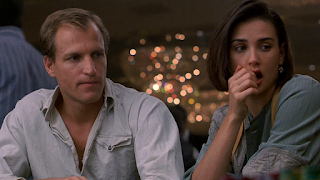
Los Angeles high school sweethearts Dave and Diana Murphy (Woody Harrelson and Demi Moore) married young and are still deeply in love. He is an architect and she is a real estate agent. But they overextend financially, and when a recession hits, they find themselves near bankruptcy and about to lose everything.
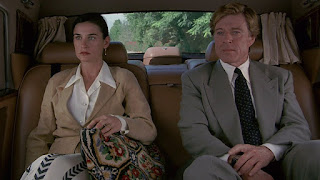
In a desperate attempt to raise cash they head to Las Vegas, where billionaire tycoon John Gage (Robert Redford) spots Diana and is immediately infatuated. After the couple's gambit to make money at the tables fails, John makes them an extraordinary offer: one night of intimacy with Diana in exchange for a million dollars. The couple have to decide if the money is worth the risk to their marriage, but John's agenda extends beyond just the one night.
Indecent Proposal is more of a cocktail party conversation starter than a movie. Directed with magazine glossiness by Adrian Lyne from a truistic script by Amy Holden Jones, the narrative peaks when the billionaire pops the question. What follows is a quick decent to the land of Dave's jealousy and John's stalking, Diana caught between two men demonstrating juvenile and entitled behaviour within a distastefully warped love triangle.
Which is all unfortunate. The three photogenic stars deserve better material to work with, the script leaving them stranded without basic definitions. As the one night stand develops into a longer pursuit and relationship, Diane never questions what John sees in her, nor when he will discard her in favour of the next ingenue he spots at a boutique. Nor does she express any concerns about jumping from a scrappy life to the elite circle of billionaires.Hubby Dave switches in an instant from go-along to manically possessive, while John Gage is the blandest of billionaires. Redford affixes a condescending smile and glides through the movie with a laughably unconvincing justification for Gage's exercise in home-wrecking - something about not finding the courage to speak to a stranger on a subway car when he was a teenager.
Boosted by a radiant Demi Moore, the earlier scenes of Dave and Diana as a young couple in love carry an attractive innocence, and Lyne knows his way around a good sex scene. The passionate details of Diana's night with John are omitted, a clever creative decision to capture Dave's state of mind. But despite the occasional spark, Indecent Proposal is a decent idea wasted.
All Ace Black Movie Blog reviews are here.
Saturday, 14 November 2020
Movie Review: Our Souls At Night (2017)
In a small Colorado town, Louis Waters (Robert Redford) and Addie Moore (Jane Fonda) are neighbours on a tranquil street, both living alone after their spouses died and the children moved out. Addie approaches Louis and proposes he come over to platonically sleep with her, for the comfort of companionship and conversation. Although a man of few words, Louis agrees.
The arrangement works, and they start revealing difficult chapters from their lives. Addie endured a family tragedy that shattered her emotionally, while Louis cheated on his wife. Now his sleepovers briefly become the talk of the town, but their new routine is disrupted when Addie's grown son Gene (Matthias Schoenaerts) deposits his seven year old son Jamie with Addie while he sorts out trouble in his own relationship.
Reuniting on the screen for the first time since 1979's The Electric Horseman, Robert Redford and Jane Fonda elevate Our Souls At Night with authoritative veteran performances. While the adaptation of the Kent Haruf book is a placid story with familiar middle class travails as seen from the far end of life, the presence of two Hollywood legends maintains firm engagement.
Ritesh Batra directs with due respect for the material. Without dawdling, the scenes are staid and drama-free, consistent with the tone of two protagonists with enough life experience to easily avoid outbursts. Even when the potentially combustible Gene appears with a more middle-aged propensity for anger and grudge-holding, the script by Scott Neustadter and Michael H. Weber seeks understated tension from admonishing looks and unspoken words.Loneliness in old age, awakening the flicker of physical intimacy, and reflecting on past mistakes are among the unsurprising narrative mileposts and disclosed inflection points. Louis and Addie work their way to understanding the valuable contributory roles still available to them, now with the power of wisdom as an impressive secret weapon. They may not be spry, but they can chart a course to make amends, help each other, and support their offspring with soft authority.
Old souls may find the nights difficult, but they can still glow during the day.
All Ace Black Blog Movie Reviews are here.
Thursday, 9 April 2020
Movie Review: Jeremiah Johnson (1972)
A picturesque western, Jeremiah Johnson is ponderous and long, but creates a unique aura through stubborn persistence.
In the mid-1800s, Mexican War veteran Jeremiah Johnson (Robert Redford) heads west and into the mountains, seeking a life of isolation, hunting and fishing. After a quiet run-in with Paints-His-Shirt-Red (JoaquÃn MartÃnez) of the Crow tribe, Johnson is befriended by grizzly hunter Bear Claw Chris Lapp (Will Geer) who teaches him hunting and trapping skills.
Johnson then meets a half-crazed widow (Allyn Ann McLerie) whose family was slaughtered by Blackfoot warriors. She thrusts her young son (Josh Albee) into Johnson's care. He next befriends Del Gue (Stefan Gierasch), a wild man of the west tortured and left for dead by the Blackfeet. Through that strained friendship Johnson ends up with a wife Swan (Delle Bolton), the daughter of a Flathead tribal chief. Now with a woman and child to care for, Jeremiah attempts a life of domesticity, but more difficult trials await.
An episodic and languid western, Jeremiah Johnson stretches close to two hours but feels much longer, complete with an Overture and an unnecessary Intermission. The story is loosely based on an actual John "Liver Eating" Johnson, but given the limited scope of character development offered by the script (co-written by John Milius), it almost does not matter. Director Sydney Pollack is most interested in capturing snow-covered and wide open landscapes, with unspoiled nature and a smattering of Native Americans reluctantly tolerating adventurers like Johnson.
The film unfolds in mostly listless episodes chronicling encounters along the route to loneliness, Johnson a man of few words and fewer emotions but capable of assessing his environment and protecting himself as needed. The portrayal of Native Americans is reasonably nuanced and varies by tribe from naturally aggressive to suspicious but docile. Johnson is portrayed as a pacifist but responsive according to specific survival requirements, from acquiescing to marry Swan to seeking revenge when it's time to spill blood.
Robert Redford peers out from a narrow vantage point located below a thick mop of hair and above a bushy beard, mostly satisfied with staring at the surrounding beauty. The rest of the cast is under-powered. Will Geer and Stefan Gierasch play different versions of essentially the same character, while both the woman and child collected by Johnson are distinctly uncommunicative.
And yet, Jeremiah Johnson almost wills its way to a plateau of significance. The film is slow to cast its spell, but gets there in the end. After the hunting, marrying and killing (plenty of killing), almost all in slow and silent motion, the character leaves a mark of tired triumph, a man determined to absorb all the hostility his chosen environment can throw at him and live to tell the tale.
All Ace Black Blog Movie Reviews are here.
Friday, 8 November 2019
Movie Review: The Candidate (1972)
An inside look at an election campaign from humble beginnings to election night, The Candidate is immersed in the cacophony of creating energy and momentum at the cost of abandoned values.
Veteran campaign manager Marvin Lucas (Peter Boyle) goes looking for a Democratic candidate to challenge popular Republican incumbent Crocker Jarmon (Don Porter) in the upcoming California election race for Senator. He settles on relative unknown Bill McKay (Robert Redford), an idealistic social activist and son of former governor John J. McKay (Melvyn Douglas).
Bill is initially reluctant, and agrees to run only if he remains unfiltered and honest in all his communications. From initial stumbling outings at scarcely attended events, he gradually builds momentum, closing the gap in opinion polls. With his entourage of handlers growing McKay's message and image become much more polished, and he emerges as a credible threat to Jarmon as voting day approaches.
A political drama with a few touches of humour, The Candidate traces the build-up of one man's public image, from relative unknown to charismatic challenger. Early in his initially fledgling campaign Bill McKay delivers a speech to a large room filled with hundreds of empty cheap folding chairs and a couple of old geezers. With election day beckoning his candidacy catches fire, and he is continuously surrounded by supporters and oversized posters of his face, barely able to move without being mobbed.
This transformation is the subject of Jeremy Larner's script, and director Michael Ritchie adopts a high energy documentary style, cameras constantly on the move chasing McKay from event to event as he hones his message and grows comfortable in the spotlight. McKay and Lucas scale an undeniable high as they start to believe Jarmon can genuinely be defeated, and the mutual exchange of nourishing energy between the candidate and his growing army of supporters is palpable.
Along the way, McKay loses all that he started with. His stump message becomes repetitive, simplistic and utterly banal. He learns to deliver it with conviction and the crowds love it, but his promises are devoid of content and details. Externally he beams, waves and pretends to love the adulation. In private moments he knows he is selling out like every other politician, delivering what the masses think they want, not what they need.
Ritchie wedges his cameras into the hustle and bustle of makeshift strategy rooms and campaign stops, The Candidate a non-stop on-the-run sequence of jostling and jerkiness. The background noise and overlapping conversations are also incessant. Larner's script thrives on phones ringing, hordes banging on doors, hangers-on either shouting over or interrupting each other and engaging in their own sidebar conversations. It may all be admirably realistic, but eventually exhausting and marginally irritating as a cinematic experience.
With all the focus on event mechanics, The Candidate neglects to round out its central characters. Both McKay and Lucas are defined only by the trajectory of the election, with precious few moments for the men behind mission. Whenever McKay tries to find a quiet moment to think or hold a serious conversation the phone rings or a mob invades the room, a familiar case of political noise trumping any genuine reflection on policy.
All Ace Black Blog Movie Reviews are here.
Saturday, 2 November 2019
Movie Review: A Walk In The Woods (2015)
A semi-biographical drama and buddy comedy, A Walk In The Woods uses a long hike late in life to explore past decisions with a soft touch.
Elderly travel author Bill Bryson (Robert Redford) has reached a creative dead end. With his career reduced to reissuing old books and attending the funerals of dead friends, he decides on a whim to hike the 3,500 kilometre Appalachian Trail from Georgia to Main, an arduous months-long commitment. Bill's wife Catherine (Emma Thompson) is horrified at the idea, but cannot talk him out of it. She does, however, convince him to find a hiking partner.
None of the friends and colleagues that Bill approaches are interested, but his buddy from the old days Stephen Katz (Nick Nolte) hears about the hiking plan and eagerly volunteers. Katz is a grizzled free-spirited hell-raising adventurer who has done little with his life, and is now overweight and in poor health but at least has quit drinking. The two men travel to Georgia and start the hike, which turns into an opportunity to get reacquainted and for Bill to reassess his life.
A Walk In The Woods is sharply written and funnier than it needs to be. Directed by Ken Kwapis, the adaptation of the novel by Bill Bryson adopts a low key attitude towards the sense of malaise permeating the author's life. Dramatic revelations, hug-outs and big reveals are mercifully left out of the backpacks. Instead, Bill reflects upon his life tangentially and almost apologetically, as the hike and conversations help lift the fog about his achievements as he regains the perspective easily lost within daily minutiae.
As they huff and puff across the terrain Bill and Katz trade barbs and chip away at the jumble of life's compromises. Their friendship may have melted away under the strain of decidedly different attitudes, but neither claims the higher ground. Katz remained loyal to the young and fearless version of himself, gathering memories, legendary exploits, poor health and arrest warrants along the way. Bill settled to a life of domesticity with one woman, writing popular travel books and maintaining a healthy curiosity for learning. Passing a rock formation along the trail, Bill explains the various types of rocks and how, when and why they were created. "They're just rocks", growls Katz.
Along the way Bill and Katz encounter other hikers, mostly younger, some helpful, a few irritatingly smug, others just tired. Mostly these meetings serve to remind Bill and Katz they are slow, old and unlikely to complete the trail. While Katz is happy to call it a day anytime, Bill insists he is no quitter and doggedly proclaims he will carry on, with or without companionship. And when they face potentially lethal hazards in the form of hungry wildlife, bad weather and slippery ledges, maturity jumps in front of panic to handle the risk.
The film's primary joy is derived from the buzz between Robert Redford and Nick Nolte, two veterans finding a crackling dynamic built on character contrasts. Redford allows the cragginess of his 79 years to rest easily on the surface, wisdom, patience, honesty and stubbornness now the only things that matter for Bill. Nolte at 74 gives Katz a memorably gravelly and lumbering presence, a man who can dominate any environment just as easily as he can outstay his welcome.
In addition to Emma Thompson as Bill's wife, the supporting cast also features Mary Steenburgen as lodge owner the men meet along the trail.
A Walk In The Woods brings fresh air, edgy discourse, brushes with danger, moments of spectacular scenery, and a much needed emotional reset, useful at any age.
All Ace Black Blog Movie Reviews are here.
Sunday, 11 June 2017
Movie Review: Out Of Africa (1985)
A grand autobiographical romantic drama, Out Of Africa enjoys lavish scenery but is an otherwise slow moving and dreary tale.
It's the eve of the Great War. Desperate to leave her native Denmark, the wealthy but unattached Karen Dinesen (Meryl Streep) proposes a marriage of convenience to her titled but penniless friend Baron Bror von Blixen (Klaus Maria Brandauer). She gains the title of Baroness, he gains her money, and off they go to the wilds of Kenya where they purchase a farm and start a new life. On the long journey to her new home Karen meets for the first time big game hunters Denys Finch Hatton (Robert Redford) and Berkeley Cole (Michael Kitchen).
Karen's marriage to Bror never gains traction, as he unilaterally makes the decision to switch from cattle farming to coffee crops, then he abandons her to pursue hunting expeditions before joining the war effort, leaving Karen to run the farm on her own for months on end. Karen is a feisty and independent woman and manages well, including establishing strong relations with the natives and starting better education programs for their children. On one of her few nights with Bror she contracts syphilis, final confirmation of his rampant womanizing.
In Bror's absence Karen's intermittent encounters with Denys and Berkeley grow warmer, and although at first Karen believes she is more interested in Berkeley, gradually Denys' independent charm starts to attract her attention. Bror finally gives up all pretense of a functioning marriage and moves out, providing an opening for Denys to initiate a serious courtship in pursuit of Karen's heart.
Directed by Sydney Pollack, Out Of Africa is based on Karen von Blixen's memoirs. The film is an example of a personal story given the full Hollywood-on-steroids treatment and amplified well beyond the strength of the original material. A simple story of a European woman carving out a new life in Africa is turned into a mythological opera of massive proportions, and prolonged to a mind-numbing 160 minutes.
The Academy decided that slow moving lyrical scenes equated to cinematic quality, and Out Of Africa scooped up seven Oscars, including Best Film and Best Director. The film wears the accolades uneasily. Apart from the many admittedly beautiful shots of African wildlife and landscapes, there is little to justify Out Of Africa as a landmark film experience. Streep's Danish-African accent hybrid is admirable, but ironically she was bypassed on Oscar night.
A large part of the film's problems reside in the thin material. Grand romantic dramas of this length require strong supporting characters and a turbulent, preferably historical backdrop to gain relevance. Out Of Africa offers nothing beyond Karen's lonely existence and the attempts to create substance out of her outreach to the local tribespeople are rudimentary at best. Denys is a marginal, almost tertiary character for the first half of the film (despite Redford receiving top billing), Bror abandons her early, and the First World War is a very distant event. The film becomes about Streep narrating her mundane adventures as she moves at a glacially slow pace towards allowing herself to open her heart to Denys. No amount of beautiful sunsets can hide the lack of content.
The pacing and emotions improve marginally once the romance finally catches fire, but Pollack then drags out the ending well past relevance, in an obsessive pursuit of creating a legend out of a love story. The film creaks and buckles under its own weight.
As enjoyable as a three hour slide show from top National Geographic photographers, Out Of Africa offers visually beauty in turgid packaging.
All Ace Black Blog Movie Reviews are here.
Tuesday, 24 November 2015
Movie Review: The Company You Keep (2012)
A drama about former revolutionaries approaching their twilight, The Company You Keep presents an interesting treatise but is ultimately undermined personalized simplifications.
Sharon Solarz (Susan Sarandon) is arrested in upstate New York. For over 30 years she was living a simple domestic life under a false identity, evading arrest for the murder of a Michigan bank security guard during a 1980 robbery-gone-wrong. Sharon was as a member of the revolutionary Weather Underground, a small group of idealistic students who turned to violence against symbols of the US government. After her arrest, young reporter Ben Shepard (Shia LaBeouf) is encouraged by his editor (Stanley Tucci) to explore Sharon's story. Ben's investigation leads him to Jim Grant (Robert Redford), a widower and well-respected Albany lawyer. Shepard exposes Jim's real identity as fugitive Nick Sloan, another former member of the Weather Underground.
FBI agent Cornelius (Terrence Howard) closes in, forcing Nick to flee. He deposits his young daughter with his brother Daniel (Chris Cooper) and embarks on a cross-country escape to re-connect with his old associates including lumberyard owner Donal Fitzgerald (Nick Nolte) and college professor Jed Lewis (Richard Jenkins). Nick's real objective is to flush out Mimi Lurie (Julie Christie), the only former member of the revolutionaries who can clear his name. Ben also continues his chase of the story, and starts to uncover some well-kept secrets related to the botched Michigan heist from many years ago.
The Company You Keep walks a tightrope between a serious examination of idealism in old age, and a rather opportunistic gathering of veteran actors enjoying a reunion. Director Robert Redford manages to land the film just on the right side of relevant, thanks to an earnest tone, committed performances, and a story that touches on broad societal dynamics but always retains a personal focus.
The script by Lem Dobbs presents the many different pathways to adulthood available to young revolutionaries. Sharon and Nick attempted to meld into obscurity. Mimi and her friend Mac Mcleod (Sam Elliott) kept up the subversive protests in any available form, with Mimi evolving into a marijuana trafficker. College teacher Jed never approved of violent methods, and so never forgave the likes of Nick for contaminating the movement of peaceful protesters. Lumberyard owner Donal and organic farmer Billy Cusimano (Stephen Root) moved into seemingly respectable businesses, with just a whiff of illicit dealings.
With the best years well behind them they all ask themselves questions about the value of their youthful struggle, whether the fight was won or lost, and what they could or should have done differently. In adulthood they find varying degrees of contentment, either hiding from their past or celebrating it. As parents Sharon and Nick view life through the lens of their families, a perspective that brings a desire to accept responsibility and right the wrongs of history. The Company You Keep retains its power as long as it rides the wave of social movement commentary through the retrospective and tired eyes of the individuals who influenced it.
The film falters when it starts to resemble a routine chase movie, with Nick always one step ahead of agent Cornelius. And while the focus on individuals is commendable, the ending is fumbled once it gets too personal. As the background to the ill-fated Michigan bank robbery is revealed, threads emerge to entangle Henry Osborne (Brendan Gleeson), the investigating officer of the time, into the web once inhabited by Nick and Mimi. The film gets distracted by the minutiae of shady family friendships, lost children and selfish behaviour, and the momentum built by the broader social context is all but lost.
A cast this deep in talent was only ever going to be excellent. Redford and LaBeouf get the biggest roles, with Redford showing every one of his 77 years, and LaBeouf perhaps pushing the aggressive young reporter role too hard. While it is a pleasure to see Julie Christie in a short but still meaningful role, frustratingly, stars like Sarandon, Nolte, Elliott and Anna Kendrick (as an FBI agent) get minimal screen time.
The Company You Keep does not fully engage, but does delve into essential issues in the company of outstanding talent.
All Ace Black Blog Movie Reviews are here.
Thursday, 15 October 2015
Movie Review: Butch Cassidy And The Sundance Kid (1969)
It's the late 1890s in Wyoming, and times are slowly changing: bicycles are threatening to replace horses. Butch Cassidy (Newman) leads his Hole in the Wall gang as they pull off a series of bank and train robberies, with his partner The Sundance Kid (Redford) providing most of the accurate shooting skills. Cassidy, who never actually seems to use his gun, summarily puts down an internal leadership challenge, while Sundance enjoys the company of girlfriend Etta Place (Katharine Ross).
The gang proceeds to pull off two more heists, hitting the same train on consecutive journeys. Their audacity catches up with them, and a relentless posse is assembled by the rail company, forcing Butch and Sundance to flee for days. Cornered on a rocky mountainside, they finally shake off their pursuers with a great dive. With too much heat on them, the outlaws along with Etta relocate to Bolivia. They start a new life, but despite language and cultural barriers, they are soon back to their old ways of robbing banks and payrolls for the fun of it.
The strong anti-establishment winds of the late 1960s allowed outsiders to be re-acclaimed as heroes, and Bonnie And Clyde proved that cinematic excellence can be achieved by allowing villains to become likeable cinematic protagonists. Butch Cassidy And The Sundance Kid ignores half a decade's worth of Spaghetti Westerns by revisiting the genre and creating a fun-filled place where the bad guys are good and the good guys are boring. Butch and Sundance get the witty dialogue, mostly outsmart rather than outgun their opponents, and carry on affairs with sexy school teachers and lovable whores, all with an irreverent, irresistible attitude.
The William Goldman screenplay represents actual events from the lives of Butch and Sundance, but ultimately, there is not much in terms of plot. Beyond a few routine train and bank hold-ups and one long chase, director George Roy Hill recognizes his stars are the main attraction. With Newman as Butch providing the smart alecky brains and Redford as Sundance supplying the brooding gunplay, the movie is all about two buddies having a grand old time out west. The film's appeal extends as far as the interplay between the two men can take it, and Newman and Redford deploy their magnetism to stretch the limited material much further than it would otherwise deserve.
Despite the star power and witty dialogue exchanges, the film's faults do occasionally come to the surface. The posse chase scene goes on forever and consumes a remarkably long portion of the running time, a case of a concept introduced, consumed and then squeezed out of all joy. Even the "who are those guys?" line gets tired well before the chase ends. The bicycle riding montage, set to the out-of-place Raindrops Keep Fallin' On My Head, kills more screen time and is only cute for those who worship Newman riffing on a silly persona.
But Hill maintains stylistic interest by playing with some sepia-toned scenes, and then rebalances the film with a strong final third. The outlaws work their way back to fine form in Bolivia, overcoming the language barrier to reenter the business of taking other people's money. The final, bullet-drenched climax with the Bolivian army effectively combines buddy sensibilities with a classic western showdown.
Butch Cassidy And The Sundance Kid may be scrubbed and lighthearted to excess, but it does commemorate the unlikely partnership of two men who left a bullet-marked legacy on two continents.
All Ace Black Movie Blog reviews are here.
Tuesday, 11 August 2015
Movie Review: Barefoot In The Park (1967)
The literal and figurative ups and downs in the lives of a newlywed couple, Barefoot In The Park is a tender comedy capturing the rollercoaster early days of marriage.
Paul (Robert Redford) and Corie (Jane Fonda) are New York newlyweds and very much in love. They spend their honeymoon ensconced at a Plaza Hotel room for six days. Corie is uninhibited, loves life and takes risks. Paul is a junior lawyer and much more reserved. When real life has to get started, they rent a small fifth floor apartment in a walk-up building with no elevator. The apartment is cramped, has no heat, and a hole in the skylight. Corie's adventurous spirit allows her to make do, and she turns the apartment into a home. But her desire to maintain a newlywed spirit is thwarted by Paul's stiff focus on his career.
They meet their exotic and elderly but young-at-heart neighbour Victor (Charles Boyer), who lives in an attic apartment above them, and Corie hits on the idea of introducing Victor to her lonely mother Ethel (Mildred Natwick). As Victor and Ethel embark on a wildly unpredictable relationship, Corie and Paul arrive at a crisis point, as his inability to loosen up clashes with her desire to enjoy life to the fullest.
A Neil Simon play adaptation directed by Gene Saks, Barefoot In The Park is a humorous look at the expectations and disappointments in the early days of couplehood. The film moves briskly through the stages of a young marriage, from sex obsession to optimistic homemaking, through to the early challenges of routine separation and then a first full-blown crisis. Paul and Corie do pack in a lot of married life into 106 minutes of screen time, but Saks keeps it generally breezy until a slightly draggy final 15 minutes.
Simon wrote the screenplay, and the film is undoubtedly stage bound, with most of the action unfolding within the cramped fifth floor apartment. But this is a film that benefits from the confined location, allowing a deep focus on two characters learning what it means to start a new life together. The apartment itself becomes an essential character, and a metaphor for life's challenges. The five flights of stairs, the lack of heat, the broken skylight and the tiny bedroom, not to mention the peculiar upstairs neighbour, are the initial set of tests that Paul and Corie have to navigate, as life starts them out with niggling obstacles that they can either learn to overcome together or argue about.
Barefoot In The Park tests the hypothesis that opposites can attract, and Simon creates in Corie and Paul two different characters who nevertheless may be a perfect match. Corie wants to run headlong into whatever life has to offer and wants to have fun while embracing every new experience. Paul is much more responsible, feeling the pressure of trying to establish himself in his career and therefore more easily distracted from the task of marriage-building. As a couple they are deeply in love and good together but also susceptible to disappointing each other. The film probes both the strengths and weaknesses of the relationship, asking what changes they each have to make to transform two individuals into one couple.
Jane Fonda brings Corie to life with a mix of sexy playfulness and well-reasoned stubbornness. Robert Redford is more reserved as he reprises his stage role, but he does have more of a brewing conflict to deal with: a realization that life now is quite different, with a new partner to be kept satisfied outside the law firm. Charles Boyer and Mildred Natwick provide memorably eccentric support in the roles of Victor and Ethel. They provide comic relief and serve as an example to the young couple of how affairs of the heart rarely follow a script.
Funny, witty and dramatic when it needs to be, Barefoot In The Park is a droll stroll.
All Ace Black Movie Blog reviews are here.
Thursday, 2 July 2015
Movie Review: Brubaker (1980)
A slow burning prison drama, Brubaker portrays a noble fight against a corrupt system but lacks the depth of character needed to sustain its weighty intentions.
In the late 1960s, a new group of prisoners arrives at the derelict Wakefield State Prison in Arkansas. Among them is a quiet man (Robert Redford) who says little and observes a lot. He witnesses crumbling infrastructure, inhumane conditions and a brutal system of prisoners designated as trustees regularly abusing inmates with whippings and torture. Meanwhile the warden and his administrators are either absent or uncaring. When he stumbles upon a detainee in solitary confinement (Morgan Freeman) threatening to start a riot, the quiet man reveals himself to be Henry Brubaker, the new reformist warden of the prison, appointed with the help of politician Lillian Gray (Jane Alexander).
The idealistic Brubaker takes over the running of the facility, sets about to improve living conditions and appoints a couple of the more dependable prisoners as trustees, including Dickie (Yaphet Kotto) and Bullen (David Keith). He uncovers a racketeering operation based out of the prison grounds, and corruption that extends well outside the prison walls: the surrounding community depends on the prison for slave labour and a steady stream of revenue from contracted projects that are shoddily delivered. By disrupting the long-established status quo Brubaker finds himself at odds with state prison board officials, including chairman John Deach (Murray Hamilton). Things get a lot worse when a long-term prisoner reveals an ever darker secret about what goes on at Wakefield.
Director Stuart Rosenberg returns to the prison milieu he helped to make famous with Cool Hand Luke, but this time it is the warden rather than a prisoner who shakes up the system. Written by W. D. Richter, Brubaker is loosely inspired by the real-life experiences of warden Thomas Murton and the 1967 Arkansas prison scandal. The film settles down to 132 minutes of oppressive drama where prison life is either bad or worse, the mood is grim and prospects bleak. Brubaker's progressive energy represents a thin ray of hope. But gradually he comes to realize that as difficult as it is to make changes within the prison walls, it's the fight against the broader community, benefitting from the prison as a source of slave labour and fraudulent contracts, that represents the greater challenge.
Within the prison the film is dominated by a large number of desperate men abandoned in dilapidating conditions, while the businessmen and politicians on the outside are determined to leave an existing economically advantageous arrangement alone. Rosenberg and Richter successfully build up a system seemingly too entrenched for one man to take on, and then let their hero loose to try and knock down a sturdy wall built on exploitation and abuse.
Cinematographer Bruno Nuytten colours the film in dark blues, greys and black, creating a bleak, grimy and frequently damp environment whether the action is inside the old buildings, on the expansive grounds, or within the depressed community. This is a film drenched in the pessimism of a broken system, and the tone rarely varies.
While mentally engaging, Brubaker rarely stirs the soul. The central character is too monotonal in his quest to do good, and little is offered in the way of character depth or evolution. Redford's performance starts and stops with a dogged determination, and does not change in the face of insurmountable odds.
The trustees and prisoners are plentiful, and that is a problem. Rosenberg is unable to carve out any individual identities beyond the most rudimentary sketches, and in the absence of characters with compelling depth, the film does drag. While David Keith as Larry Lee Bullen comes closest to finding a personality, Murray Hamilton and Jane Alexander have plenty of screen time but not many opportunities to step beyond their predictable character boxes. In addition to Morgan Freeman in his first credited role, stalwarts M. Emmet Walsh and Wilford Brimley have relatively minor appearances.
Brubaker has the right intentions and a worthwhile story, but lacks the spark needed to truly break out of the prison walls.
All Ace Black Blog Movie Reviews are here.
Thursday, 12 February 2015
Movie Review: The Chase (1966)
A southern drama about a small town simmering with social tensions, The Chase promises much and offers a cast filled with talent. But it stays in the oven for too long, emerging as an overcooked and tough to chew mess of a meal.
In deep rural Texas, convicted criminal Bubber Reeves (Robert Redford) has busted out of prison and is on the run. News of the escape reaches the nearby small town where Bubber was born and raised, and the townsfolk are immediately thrown into a frenzy of anxiety and anticipation. Businessman Val Rogers (E.G. Marshall) pretty much owns the town and likes to think that he controls everything and everyone in it, including Sheriff Calder (Marlon Brando). Val's son Jake (James Fox) is the heir apparent to his father's empire, and is trapped in a marriage of convenience to Elizabeth (Diana Hyland), while carrying on an open affair with Anna Reeves (Jane Fonda), Bubber's lonely wife.
Meek banker Edwin Stewart (Robert Duvall) desperately wants to be part of Val's inner circle, but his wife Emily (Janice Rule) is tired of waiting for Edwin to make something of himself. She is having an affair with the seemingly more presentable but equally married Damon Fuller (Richard Bradford). Fuller is part of a group of gun-toting men who believe themselves to be above the law and almost openly disrespect Sheriff Calder's authority. Over the course of one day and one night, Bubber edges ever closer to the town, emotions boil over, and Calder and his wife Ruby (Angie Dickinson) find themselves increasingly isolated as they try to keep a lid on a town about to explode.
Early on it becomes clear that there is not much chasing going on in The Chase. Directed by Arthur Penn (who later disowned it) and produced by Sam Spiegel, the film enjoys some moments and benefits from a remarkable cast in good form. But the ambition overreaches the narrative premise, and the film gets caught spinning in place. The Lillian Hellman script (heavily doctored by Spiegel) tries to create a tense boiling pot of a town galvanized by the wait for a dangerous criminal, but the attempt is only partially successful.
The story gets into trouble early. To start, there is little that is dangerous about Robert Redford as Bubber Reeves, who is portrayed as more of a victim than a criminal. With his perfectly coiffed hair catching the light just so in the Texas wilderness and his good boy looks betraying any attempt at evil, the threat that is supposed to exist at the centre of the film dissolves in Redford's substantial star charisma.
In the town itself, there are just too many unsavoury characters making life miserable for each other. Most of the residents appear to be carrying on extramarital affairs, while the prevailing agony, bitterness and resentment is in keeping with the mean spirited nature of a community rife with vigilantism, classism and racism. They all appear dissatisfied and wretchedly unhappy, and they all seem to deserve it.
The sheer number of minor characters causes the film to lose momentum. There are snippets of numerous sub-stories including Bubber's parents; a religious old woman who putters around town; another elderly couple; a gaggle of teenagers; and a land owner/loan shark who serves as the perpetual interested observer. None gain traction and all get in the way, to the point that at a climactic moment late in the film, it's not even clear which tertiary character pulled the critical trigger.
In the middle of the over-ripened fruit Sheriff Calder and his wife Ruby are an oasis of goodness, and The Chase gradually veers towards traditional one-good-man-against-a-bad-town territory. Bubber almost turns into a MacGuffin, a catalyst to trigger a story of the lawman confronting the corruption that lurks within. And whenever Brando or Dickinson are on the screen, The Chase picks itself up and does much better, Brando ironically bringing a laconic intensity to the only likeable character in the film, while Calder and Ruby appear to enjoy the only rational relationship in this forgotten corner of Texas.
In the film's most memorable scene, Penn practices playing with bucketfuls of blood by subjecting Brando to a vicious beating at the hands of the town's gun-happy vigilante men. It's an excessive sequence, in keeping with the overheated tone of why stop at a single punch when ten will do. The Chase is tolerable fare, with enough going on to maintain interest but too much going on to gain and maintain focus.
All Ace Black Movie Blog reviews are here.
Tuesday, 15 July 2014
Movie Review: This Property Is Condemned (1966)
A tale of southern desperation inspired by a Tennessee Williams one-act play, This Property Is Condemned simmers on steady heat but never quite sizzles.
Alva is attracted to Owen the moment she sees him, but he is initially not impressed with her fanciful imagination and the way she toys with men at the behest of her mother. But gradually their relationship develops into a romance, which gets complicated when Owen's motive for coming to Dodson is revealed. With Hazel growing increasingly desperate for Alva to show some love for Johnson, J.J. willing to risk everything for a chance to be with Alva, and Owen quickly becoming the most hated man in town, emotions reach a boiling point.
The second movie directed by Sydney Pollack, This Property Is Condemned is a talkative piece of Americana, steeped in the south at a time when desperation was every adult's middle name. There are no sympathetic characters in Dodson, and this both elevates and hampers the film. The men and women of the derelict railway town outdo each other in meanness and narcissism as they trample over each other to try and escape the economic quagmire, oblivious that their collective stampede is only succeeding in digging a deeper hole of desolation.
Hazel, J.J., Alva and Mr. Johnson really do deserve each other, and certainly don't deserve any better. It is questionable whether outsider Owen is an improvement over the townsfolk, and certainly his chosen profession denotes a cold heart, a comfort with others' agony and an inability to settle down. The cocktail of insensitive characters makes for trainwreck-style entertainment, ironic in the context of a railway town, and it's clear early on most of the residents of Dodson are unlikely to be clever enough to stumble onto happy endings.
The lack of any displayed empathy also means This Property Is Condemned remains a relatively detached exercise. It is difficult to care about Alva despite her miserable dilemmas: she is simply too self-obsessed and too far gone into her fantastical stories and flirtatious games to generate genuine warmth. And it's equally difficult to invest in the unlikely relationship between her and Owen, who never moves beyond the observant interloper. Hazel and J.J. are there to wallow in an ugly existence of their own making, their levels of desperation having long since pushed them to the darkest corners of selfishness.
A vivacious Natalie Wood brings Alva to full life as a woman who knows that she is too beautiful for her surroundings, and who is as trapped by her irresistible looks as she is by her depressed town. Mary Badham, of To Kill A Mockingbird fame, is excellent as the counterpoint younger sister, and the only character in the film young enough to not quite yet be consumed by the rampant despondency. Charles Bronson, Robert Redford and Kate Reid are good, but stick to variations on a single note. Robert Blake and Dabney Coleman have small roles.
The screenplay (co-written by Francis Ford Coppola) does pick up steam in the final third as the characters talk less and hurtle purposefully towards their fate, with Pollack making excellent use of a very wet New Orleans as the action moves to the big city. In the opening scene Hazel's boarding house is presented as abandoned, the building condemned. The movie works its way to an outcome of compounded misery, the result of an economic disaster and egotistical floundering.
All Ace Black Movie Blog reviews are here.