Showing posts with label David Strathairn. Show all posts

Saturday, 16 May 2026

Movie Review: Twisted (2004)


Genre: Psychological Crime Thriller  
Director: Philip Kaufman  
Starring: Ashley Judd, Samuel L. Jackson, Andy Garcia, David Strathairn  
Running Time: 97 minutes  

Synopsis: In San Francisco, police officer Jessica Shepard (Ashley Judd) is promoted to a homicide detective under the tutelage of Commissioner John Mills (Samuel L. Jackson), who has mentored her ever since she lost her parents in shocking circumstances. Now she partners with Detective Delmarco (Andy Garcia), and they start investigating a series of murders with one thing in common: the victims are men who have had one-night stands with Jessica. As she grows closer to Delmarco and attends sessions with a therapist (David Strathairn), Jessica experiences blackout episodes and starts to suspect she may be a murderer.

What Works Well: This is an engaging-enough psychological mystery, with a flawed but worthwhile protagonist grappling with more questions than answers. Ashley Judd is serviceable in the main role and receives strong support from Samuel L Jackson (confident), Andy Garcia (weary), and David Strathairn (thoughtful). Director Philip Kaufman demonstrates interest in both character-building and investigative machinations, throwing enough clues and red herrings into the grisly-past-casting-a-shadow-on-the-present premise to sustain momentum.

What Does Not Work As Well: Not much distinguishes the script from countless slick 1990s thrillers, and despite the twists and turns, the evil mind behind all the murders is not difficult to guess. The motive and timing of all the killings are at best questionable, and the final act stretches the limits of logic and is more frantic than considered.

Key Quote:
Jessica: Everyone who kisses me... turns up dead.


All Ace Black Movie Blog reviews are here.

Saturday, 28 March 2026

Movie Review: Bad Manners (1997)


Genre: Drama  
Director: Jonathan Kaufer  
Starring: David Strathairn, Bonnie Bedelia, Saul Rubinek, Caroleen Feeney, Julie Harris  
Running Time: 88 minutes  

Synopsis: Married couple Wes and Nancy (David Strathairn and Bonnie Bedelia) are both Boston-area professors, but the passion has long since seeped out of their relationship. Their staid home is upturned by the visit of Nancy's former lover Matt (Saul Rubinek), a musicology professor in town for a guest lecture, accompanied by his much younger lover and research assistant Kim (Caroleen Feeney). Wes is jealous of Matt, the free-spirited Kim stirs the pot, and accusations of theft and infidelity are soon rocking both couples.

What Works Well: The adaptation of the David Gilman stage play exposes turmoil between two mis-matched couples, and carries obvious echoes from Who's Afraid Of Virginia Woolf. Strong performances by the four main cast members animate a milieu of crackling discontent hiding beneath a veneer of upper middle class respectability. Selfish motivations, generational gaps, and suppressed frustrations bubble to the surface, driving a steady stream of narrative twists.

What Does Not Work As Well: The stage origins are only partially concealed, and the plot hinges on a couple of logic leaps unworthy of supposedly smart people. A missing $50 bill immediately becomes an accusation of theft, and music notes within a garbled composition are posited as no less than possible proof of God's existence. Elsewhere the incessant lying erodes any sense of belief in what anyone is saying, slowly undermining the investment in already unlikeable characters.

Key Quote:
Kim: You're being a bore.
Wes: I am a bore. I lead a placid life.


All Ace Black Movie Blog reviews are here.

Sunday, 18 January 2026

Movie Review: Walkaway Joe (2020)


Genre: Drama  
Director: Tom Wright  
Starring: David Strathairn, Jeffrey Dean Morgan, Julian Feder, Julie Ann Emery  
Running Time: 89 minutes  

Synopsis: In rural Louisiana, small-time pool hustler Cal McCarthy (Jeffrey Dean Morgan) walks out on his wife Gina (Julie Ann Emery) and 14-year-old son Dallas (Julian Feder). Dallas is devastated, and sets out on his bike to track down his dad, who is presumably on his way to a Baton Rouge pool tournament. The teenager is soon picked up by Joe (David Strathairn), a wanderer traveling in his RV to escape his own demons. Joe and Dallas establish a bond as they track down Cal, but trouble awaits.

What Works Well: Dallas as a son looking for his irresponsible father and Joe as a father tortured by his inability to reconcile with his family are a matched pair of lost souls. Director Tom Wright allows the drama to breathe and the surrogate father-son relationship to develop organically, with plenty of mishaps and curves along the road. Broken Americana in the form of featureless back roads, small motels, nondescript diners, and uninspired pool halls create an ambience of lost opportunity and abandonment of responsibility. Both David Strathairn and Jeffrey Dean Morgan deliver lived-in performances surrendering to defeatism, the dank smell of failed fatherhood hanging over both. 

What Does Not Work As Well: The premise and resolutions are tidy to the point of predictability, and some story elements (the background to the tension between Joe and his about-to-get-married son; Cal's serious money issues), are either underdeveloped or only allowed to surface too late. The mechanics behind Dallas' pool talent wizardry are left unexplained.

Key Quote:
Dallas: Think God ever makes mistakes when he assigns children to their parents?
Joe: I don't know.
Dallas: He should have put us together.
Joe Haley: He did, son. He did.


All Ace Black Movie Blog reviews are here.

Sunday, 3 March 2024

Movie Review: Where The Crawdads Sing (2022)


Genre: Mystery Drama Romance  
Director: Olivia Newman  
Starring: Daisy Edgar-Jones, David Strathairn, Taylor John Smith, Harris Dickinson  
Running Time: 125 minutes  

Synopsis: In North Carolina of 1969, Chase Andrews (Harris Dickinson) is found dead in an expansive marsh area. Kya Clark (Daisy Edgar-Jones), a social recluse who has lived alone in the marsh since childhood, is arrested and charged with murder. Lawyer Tom Milton (David Strathairn) comes out of retirement to defend her, and as the trial proceeds, Kya's backstory is revealed. Her family was torn apart by an abusive father, she raised herself and became an expert in marsh ecosystems, then as a teenager, she experienced romances with Tate Walker (Taylor John Smith) and then Chase, before his death.

What Works Well: The adaptation of Delia Owens' bestselling book uses a mysterious death as a framing device to explore themes of abandonment, resilience, abuse, romance, and justice. The duality of outcasts as objects of derision and fascination resides within Kya, both Tate and Chase attracted to her unique attributes but for different reasons. Director Olivia Newman includes just the right amount of captivating natural scenery, and is comfortable with a traditional storytelling structure where the courtroom scenes and flashbacks work together to reveal Kya's often heartbreaking experiences.

What Does Not Work As Well: Some of the story's foundational blocks are wobbly. For a young unschooled woman confined to the marsh her entire life, Kya is often a picture of radiant health, good grooming, and refined behaviour. The murder charge against her is built on the flimsiest of evidence, and given the relatively long duration, the final act speed races through numerous events but stubbornly refuses to show the pivotal moment in Kya's life.

Conclusion: Elegant and picturesque, but spongy when convenient.


All Ace Black Movie Blog reviews are here.

Tuesday, 18 January 2022

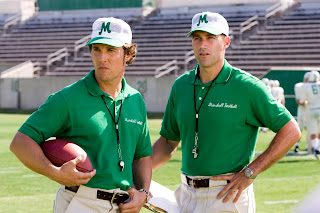
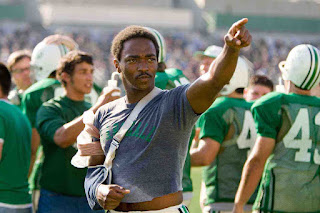
Movie Review: We Are Marshall (2006)

A sports drama, We Are Marshall is an inspirational but also frequently melodramatic rise-from-the-ashes story.

In 1970, a plane crash kills 75 people, including most of the Marshall University football team. The survivors include team captain Nate Ruffin (Anthonie Mackie), who missed the trip due to injury, and coach "Red" Dawson (Matthew Fox), who gave up his seat on the doomed flight at the last minute. The university's community of Huntington, West Virginia, descends into shock, including influential local business leader Paul Griffen (Ian McShane), who lost his son in the crash. 

President Donald Dedmon (David Strathairn) considers shutting down the football program, but Ruffin rallies support to rebuild the team. After being turned down by all leading candidates, Dedmon hires Jack Lengyel (Matthew McConaughey) as head coach. Lengyel has no prior association with Marshall but plenty of energy, and convinces Red to join him as assistant coach. A frantic recruitment program results in a group of young and untested freshmen and walk-ons being cobbled together into a team to tackle the new season.

An undoubtedly touching story of grief and recovery afforded the full Hollywood treatment, We Are Marshall draws strength from a real-life tragedy giving birth to resilience. Director McG translates Jamie Linden's script into a polished and well-staged narrative, combining the search for meaning with the difficulty of life marching on, regardless. For all the tender emphasis on loss, the film is also unabashedly manipulative, seeking opportunities to pause and deliver rousing moments, motivational speeches, and fists-in-the-air demonstrations of togetherness, always accompanied by requisite musical flourishes.

The focus is on a small group of community members navigating numbness and fury, survivor's guilt, a father's sorrow, and overwhelming helplessness, fuelling different opinions on whether reactivating the football program benefits healing. With Matthew McConaughey in full charm-on mode, coach Lengyel becomes the outside catalyst not personally affected by the tragedy and therefore able to prod the community on the path to recovery. 

But grief this deep lingers, and to the film's credit, not all the characters are eager to join the rebirth process. While the overblown climax casts a long shadow, thankfully the journeys of grieving dad Paul Griffen and diner server Annie (Kate Mara), who was engaged to Paul's son, end on a more wistful note away from sports heroics. David Strathairn adds eloquent touches of hesitant humanity as the university president with no playbook on how to navigate a mammoth tragedy.

A gesture of respect by a rival school's football team asserts the unifying power of sport, and the on-field scenes are well-staged, capturing the grit, agony, and ecstasy of college football. We Are Marshall knows where the goal is, and despite bombastic tendencies, registers an assured victory.


All Ace Black Movie Blog reviews are here.

Monday, 11 October 2021

Movie Review: Nomadland (2020)

A slice-of-life semi-documentary, Nomadland explores an off-the-grid society of individuals with a different sense of belonging.

The industrial town of Empire, Nevada, is abandoned after the last manufacturing plant shuts down. Fern (Frances McDormand) also loses her husband to disease. She packs up her belongings in a van and sets off to live a nomadic, house-less life, picking up odd jobs where she can find them and falling in with a community of like-minded individuals living on the margins. She meets fellow nomad Dave (David Strathairn), and they start a friendship of sorts, but Fern is most comfortable on her own, in her van.

Less driven by plot and more an exercise in patient observation, Nomadland settles for capturing rugged natural beauty and unfiltered stories. McDormand and Strathairn are joined by a cast of non-actors sharing their experiences, and director ChloĆ© Zhao adopts a slow pace and non-judgemental stance, finding the humanity and pride within a group functioning outside the norms. 

Despite embracing solitude and a sense of individualism, moments of happiness and sadness emerge to underline common benevolence. Each in their own way the nomads are victims of circumstances and unforgiving economic or health crises, but they are united in nevertheless defining an independent road towards self-improvement and progress.

Fern is crusty and has difficulty conveying friendliness, but stresses the difference between homeless and house-less. Through her sister and later with Dave, she has options to live much more comfortably, at least in a strictly physical sense. But after the trauma of losing her town and her husband, the van comes to represent a deeply ingrained attachment to a form of stubborn personal freedom and self-reliance, and Nomadland succeeds in defining the lifestyle as a form of choice.

The hardships inherent in living in a cramped space on wheels are not glossed over. In between vistas of open landscapes and close-ups of a welcoming nature, Zhao takes the time to convey the constant battle against the bitter cold, finding the next casual job, dealing with sickness, the strain of equipment failure, and mundane but essential biological functions.

Fern, David and the community of people they meet all possess private motives to embrace a different style of life. Unburdened by traditional cinematic structure, Nomadland is similarly comfortable with a lack of convention.


All Ace Black Movie Blog reviews are here.

Saturday, 3 July 2021

Movie Review: No God, No Master (2013)

A crime drama inspired by real events, No God, No Master tackles too many stories with a blunt mindset, and succeeds at none.

It's 1919 in New York City, and tension is mounting between union organizers and wealthy industrialists, made worse by friction between Italian and Irish immigrants. Parcel bombs start appearing on door steps, claiming the life of an innocent kid. Bureau of Investigation Agent William Flynn (David Strathairn) and his partner Eugenio Ravarini (Sam Witwer) start investigating, but when prominent citizens including John D. Rockfeller are targeted with more bombs, Attorney General Mitchell Palmer (Ray Wise) and a young J. Edgar Hoover get personally involved.

Meanwhile shoemaker Nicola Sacco and labourer/writer Bartolomeo Vanzetti share anarchist tendencies inspired by radical leader Luigi Galleani and the left-wing magazine edited by Emma Goldman. Flynn finds his investigative progress stymied by Palmer and Hoover, who appear fixated on a mass immigrant deportation agenda. Meanwhile Flynn's friend and neighbour Concetta is worried her son Tony is being sucked into the unfolding chaos.

An independent production written, directed and produced by Terry Green, No God, No Master does feature pleasing visuals of New York City in the early 20th century. Green creates a beguiling sense of time and place, and the set designs and costumes are elegant. As the world-weary Flynn, a typically dependable David Strathairn is another plus.

But the rest of the film is a clumsy disappointment. Early and often, Green firmly parks his sympathies with the little people to the detriment of any nuanced exploration of issues. Anarchists, immigrants and unionists are all romanticized poets, intellectuals and just cause advocates fighting the good fight against profit-thirsty capitalists and heartless government types. The blatant propaganda undermines any attempt at thought-provoking entertainment.

The ham-fisted approach may have been more tolerable with refined storytelling, but in an uncouth script several drafts away from the necessary polish, Green bites off more than he can chew. The parcel bomb investigation gets hopelessly lost, the Sacco-Vanzetti sub-plot is half-baked at best, and an action sequence featuring a kidnapping and bullet-riddled rescue unravels due to bewildering levels of incomprehension.

In an unfortunate epitaph, No God, No Master ends with several screens of small text attempting to provide context and resolution to the scattered ideas left hanging. The domestic terrorism events of the early twentieth century deserve better cinematic scrutiny than this.


All Ace Black Movie Blog reviews are here.

Wednesday, 13 March 2019

Movie Review: Fracture (2007)


A legal crime drama, Fracture boasts an intriguing mystery and two worthy opponents squaring off on opposite sides of the law, although the plot is not as smart as it wants to be.

In Los Angeles, aeronautical safety expert Ted Crawford (Anthony Hopkins) is aware that his wife Jennifer (Embeth Davidtz) is having an affair with police detective Rob Nunally (Billy Burke). He waits for her to return home, shoots her in the head, and calmly surrenders to Nunally, confessing to being the shooter.

Hotshot deputy district attorney Willy Beachum (Ryan Gosling) is assigned the case by his boss Joe Lobruto (David Strathairn). Beachum is about to make a big money career move into the private sector to practice corporate law, and is already flirting with his boss-to-be Nikki Gardner (Rosamund Pike). The Crawford shooting appears to be a straightforward conviction, but Ted has meticulously planned his crime, and Willy will get sucked into a much more complicated case than he bargained for.

A cerebral chess game between a humiliated husband out for blood and a cocky prosecutor with one eye firmly on careerism, Fracture is a sharp and polished duel, benefitting enormously from the two lead actors. The showdown between veteran Anthony Hopkins and upstart Ryan Gosling is epic, and they are both at the top of their game. Hopkins is all about almost imperceptible eyebrow movements, knowing glances and shadows of smiles. Gosling is the confident steel of youth, riding his record of courtroom victories towards the dangerous land of arrogance.

But unfortunately the Daniel Pyne script cannot rise to the quality of the actors. Once Crawford's crime is committed and his intention to engage in a battle of wits revealed, Fracture stalls. Willy is quickly placed into a corner by Crawford's pre-planning, and director Gregory Hoblit is left stranded outside the courtroom and having to consume about 45 minutes of screen time without many plot developments. The lazy interval is half-heatedly invested in a side quest relationship between Willy and Nikki that sucks energy out of the main story without adding much relevant content.

The mechanisms available for Willy to eventually try and turn the tables are not difficult to guess, and the film's late reveals are not as clever as Pyne wishes them to be. However, there is some character depth along the way, particularly for Willy. Through his humbling encounter with a twisted but ingenious man, the deputy district attorney is provided the opportunity to reassess the legend in his own mind and redefine what matters most.

Although the acting aces the writing, Fracture is nevertheless an enjoyably discerning joust.


All Ace Black Blog Movie Reviews are here.


Saturday, 19 August 2017

Movie Review: A Dangerous Woman (1993)


A peculiar romance drama, A Dangerous Woman attempts to explore some relatively original territory but fails to coalesce.

Martha (Debra Winger) is a socially and physically awkward and lonely woman, able to function by herself but suffering from some form of mental illness. She lives in a guesthouse next to her aunt Frances (Barbara Hershey), who is carrying on an affair with aspiring politician Steve (John Terry), who in turn is married to the alcoholic and potentially violent Anita (Laurie Metcalf).

Martha is fired from her job at a laundromat, wrongly accused of a petty theft actually committed by sleazy co-worker Getso (David Strathairn). Meanwhile handyman drifter Mackey (Gabriel Byrne) shows up to repair Frances' porch. Hunky but frequently drunk, Mackey forges an unusual bond with Martha, who is having trouble letting go of the injustice perpetuated by Getso.

Directed by Stephen Gyllenhaal (and featuring his kids Jake and Maggie in tiny roles), A Dangerous Woman features a terrific Debra Winger performance and little else. Martha's behaviour often falls just outside the normal range, causing her no end of grief, and Winger immerses herself into the quirky mannerisms of a woman-child who has difficulties engaging in the logic of the adult world. The performance tugs at the heartstrings of sympathy and is almost aching in its sustained intensity.

Everywhere around Winger, the film falls short. An adaptation of a novel by Mary McGarry Morris, the story meanders along irrelevant pathways and fails to set a direction. The entire subplot featuring Frances, the politician Bell and his highly-strung wife Anita drops in and out of the film and goes exactly nowhere. Character depth, motivation and evolution is fundamentally lacking, and time passes very slowly with plenty of repetitive drunken episodes featuring Byrne stumbling about. A late incident of violence is followed by an unsatisfactorily pat resolution.

The film does wade into the thorny territory where the nature of sexual consent can be debated. Multiple impairments come together to give Martha both unexpected pleasure and a downstream conundrum. It's an interesting question but arrives too late and is almost entirely bypassed by the Naomi Foner script.

Stephen Gyllenhaal has spent most of his subsequent directorial career in television territory, and A Dangerous Woman has the small-time look and truncated sophistication of an episode from the third season of tired network series. One woman gives her all, but all else is dangerously stale and familiar.


All Ace Black Blog Movie Reviews are here.


Saturday, 4 June 2016

Movie Review: L.A. Confidential (1997)


A film noir masterpiece set in Los Angeles of the early 1950s, L.A. Confidential features a convoluted, multi-layered and character-rich story of crime, corruption and conspiracy.

The arrest and imprisonment of crime boss Mickey Cohen creates a vacuum at the top of the Los Angeles underworld. The police department tries to project a clean cut image through the sanitized television show Badge of Honor, but the reality is that the force, under the command of Captain Dudley Smith (James Cromwell), is rife with corruption.

Three officers go about their careers with very different attitudes. Jack Vincennes (Kevin Spacey) loves the glamorous life and colludes with scum journalist Sid Hudgens (Danny DeVito), who publishes the Hush- Hush tabloid, to stage high profile narcotics arrests. Ambitious Ed Exley (Guy Pearce) has a strong moral compass inherited from his father, a deceased cop, and wants to be promoted to Detective Lieutenant as quickly as possible. Bud White (Russell Crowe) is a hot head, quick to settle disputes with physical violence, but he also may be smarter than he looks. When a jail cell brawl gives the police department a black eye, Exley earns the wrath of his colleagues, and a promotion, by naming names.

Despite Cohen's arrest the department struggles to put a lid on increasing levels of street violence. Cohen's former associates are methodically gunned down, then a bloody multiple murder is committed at the Nite Owl coffee shop, with ex-cop and White's former partner Dick Stensland among the victims, as well as porn starlet Susan Lefferts (Amber Smith). A trio of Negroes is suspected of committing the Nite Owl murders and Exley becomes a hero for bringing them conclusively to justice.

But White pursues the Lefferts angle and uncovers a high-class pornography, prostitution and blackmail ring operated by businessman Pierce Patchett (David Strathairn), who forces his girls to undergo plastic surgery to resemble famous movie stars. White starts a steamy relationship with Lynn Bracken (Kim Basinger), the Patchett girl made to look like Veronica Lake. Exley starts to have doubts about the perpetrators behind the Nite Owl case, White starts to feel used by Smith, and Vincennes finally gets disgusted with his own attitude when a gay sting operation goes wrong. The three men still don't like each other but have to start cooperating to uncover what is really going on in the L.A. crime world.

Directed by Curtis Hanson, who co-wrote the the Academy Award winning script with Brian Helgeland, L.A. Confidential oozes style, substance and attitude. The adaptation of the James Ellroy book remains coherent despite the various narrative threads, multiplicity of characters, and various personal and hidden agendas. Curtis and Helgeland expertly weave together a hard-hitting story of uncompromising violence and sex that celebrates unique characters, avoids buddy movie trappings, and maximizes the value out of strong and opposing personalities forced to co-exist.

In focusing almost equally on three protagonist, none of them too likable, L.A. Confidential sets itself apart from most other crime films. Vincennes, Exley and White have quite a few more flaws than redeeming features, and it is fascinating to watch these men evolve, grapple with their own personalities and then overcome their mutual resentment just enough to cooperate, without ever giving up on who they are. Russell Crowe and Guy Pearce were relative unknowns but quickly establish a strong screen presence. Spacey is the perfect fit for the role of Vincennes, the cop possessing a perfect understanding of what Los Angeles is all about: show business and personal promotion first, everything else for sale.

Further adding to the potent mix of masculinity are Dudley Smith as the uncompromising police captain and Pierce Patchett as the shadowy businessman with a side business. Smith and Patchett are power brokers in a city intoxicated by power and sex, and they have long since learned that bending the rules under the veneer of respectability is the way to get things done.

Even minor characters prove to be important. Sleazy narrator Sid Hudgens stages and reports on arrests in equal measure, less interested in the news and much more interested in serving up scandalous headlines and photos. Former police officer Buzz Meeks and the disgraced Dick Stensland leave the force but don't leave the criminal world too far. Tough, big but dim, they both find themselves over their heads as the crime wave intensifies.

Not exactly a femme fatale but more of a willing victim with the irresistible weapon of seductiveness, Lynn Bracken is the one woman in a plot dominated by aggressive men. Kim Basinger is surprisingly effective combining unconstrained sexuality with vulnerability and was rewarded with the Best Supporting Actress Academy Award.

While it is a challenge to keep track of the many characters and plot complexities, the payoff is immense. As the threads come together, the film soars to heights of proficiency, the bodies are uncovered, the conspiracies revealed, the criminals and crime fighters emerge from the shadows and collide in an exhilarating climax.

The cinematography by Dante Spinotti captures a Los Angeles still growing into itself, baking under the sun, selling an image manufactured by the Hollywood dream factory but also consumed by corruption at every level. An evocative, jazz-infused Jerry Goldsmith score perfectly complements the ambiance.

Under the harsh sunshine and in the West Coast heat, L.A. Confidential is dark, moody, and magically compelling.


All Ace Black Blog Movie Reviews are here.


Sunday, 14 December 2014

Movie Review: The Bourne Ultimatum (2007)


The conclusion to the Jason Bourne trilogy, The Bourne Ultimatum does not disappoint. An action-packed joy ride filled with breathless chases and ruthless violence in international settings, the film places an exclamation mark at the end of a high calibre modern spy story.

Jason Bourne (Matt Damon) is still on a mission to understand his own past, reclaim his identity, and confront the CIA superiors who turned him into a ruthless assassin engaged in black operations. Equally determined to stop him are CIA Deputy Director Noah Vosen (David Strathairn) and CIA Director Ezra Kramer (Scott Glenn), who just want Bourne to be terminated to tie up the one remaining loose end with the illicit Treadstone and Blackbriar operations. CIA Deputy Director Pam Landy (Joan Allen) is also brought in to try and snare Bourne, but she is more sympathetic to his cause.

Bourne keys in on British journalist Simon Ross (Paddy Considine) who is receiving information about Blackbriar from a source within the CIA. Bourne connects with Ross in London in a meeting that ends with a CIA sharpshooter taking out Ross in a crowded train station. The trail leads to Madrid, where Bourne reconnects with agent Nicky Parsons (Julia Stiles), who sides with him as they make their way onto Tangiers to track down the CIA source. There are more merciless assassins in wait, but Bourne doggedly makes his way to New York, to confront his past once and for all.

The Bourne Ultimatum sticks closely to the formula established for the franchise. Plenty of grim action, spies mercilessly chasing spies, hitmen galore, incredible stunts and feats of human durability, and the shortest possible narrative scenes to provide the action some structure to hang on. It's predictable, highly kinetic, and for this series, it works.

Almost everything in Ultimatum was seen before in Identity and Supremacy. The car chases, foot chases, motorbike chases, close-quarters combat, surveillance and panic in the streets are all here. Supremacy director Paul Greengrass returns for the third installment and polishes everything to a shine, the tension always high, the stakes for Bourne and his CIA controllers a matter of life and death, or for the higher ups at least a matter of saving a career and avoiding Congressional hearings.

With a story, style and characters that were never going to be blessed with the gift of originality, Greengrass pushes all the elements to the edge of credibility, and sometimes beyond. With each successive brush with death Jason Bourne appears to take on indestructible qualities, shrugging off his bone rattling injuries, instantaneously losing his scars and proceeding to travel effortlessly between countries and infiltrate the most secure of secretive buildings.

In one frantic foot sequence through Tangiers, Bourne jumps three or four times off of balconies and through apartment across the street, seemingly equipped with the ability to sense his enemy's movements through buildings several blocks away. The climactic carnage of the now mandatory car chase should be enough to a least send Bourne to the hospital for an extended stay. Instead he emerges from the wreck of what used to be his car unscathed, pointing his gun, ready for the next round.

Stylistically Greengrass finds the limit of his love for micro-edits, shoving the hand-held camera wherever it will shake the most and closest to the action, and then editing every chase and fight with the sharpest possible cutting. Greengrass doesn't so much capture the action as allow his cameras to be pummeled by the brute forces in every confrontation, challenging the eye and the brain to keep up. The effect walks the line between heart-pounding exhilaration and stomach-turning nausea.

The cast of veterans get on with the job with minimum deviation from the standard "this is serious" emoting. Matt Damon glides through the film fending off bad guys with the cold efficiency that comes with the certainty that the story only ends when the lion's den is infiltrated.  David Strathairn, Scott Glenn and, late in the game, Albert Finney form the triangle of men with secrets that need to be defended at all costs. Interestingly, Bourne is only ever helped by women during his Ultimatum adventure, with Julia Stiles and Joan Allen reprising roles from earlier installments and lending a more sympathetic ear to the man searching for the solution to his own mystery.

A suitable ending to a thrilling trilogy, The Bourne Ultimatum tidies up the story with another jolt of frenzied excitement.


All Ace Black Blog Movie Reviews are here.


Tuesday, 8 January 2013

Movie Review: Lincoln (2012)


Steven Spielberg gently wraps his arms around one of the most critical moments in the history of the United States: in the four month period between Abraham's Lincoln re-election and his assassination, slavery was abolished and the Civil War ended, clearing the decks for a unified country to find its footing, and a future superpower to emerge. Lincoln is the story of a dignified President leading his country out of the abyss and onto the road towards glory.

It's January 1865, Lincoln has been re-elected, and a meat-grinder of a Civil War is still rumbling, although it now appears that the Union has the upper hand and the rebels of the Confederate south are exhausted. To the surprise of his Secretary of State William Seward (David Strathairn), Lincoln (Daniel Day-Lewis) decides that now is the moment to push the 13th Amendment, abolishing slavery, through Congress.  Lincoln's reasoning is challenging yet simple: when the war ends, congressmen will lose the courage to support the Amendment.

Members of his own Republican party, including long-time slavery opponent Thaddeus Stevens (Tommy Lee Jones), line up behind Lincoln, but not before some congressmen, prodded by the influential Francis Preston Blair (Hal Holbrook) demand that the President make overtures to a Confederate delegation wishing to negotiate an end to the war.

The tantalizing prospect that there may be a deal in the making for the fighting to end places the passage of the Amendment in jeopardy, particularly as Lincoln needs 20 Democrats to defect from their party ranks and support the vote. Seward deploys operative William Bilbo (James Spader) and his crew to do what is necessary to secure the Democrat votes. As the clock ticks down towards a history-defining showdown in Congress, Lincoln has to also deal with his son Robert (Joseph Gordon-Levitt) wanting to joint the army, much to the horror of First Lady Mary Todd Lincoln (Sally Field), still traumatized by the earlier loss of another son.

Lincoln is a commanding talk fest, the movie a series of mostly tense encounters between men arguing over the future of a nation. Spielberg and screenwriter Tony Kushner (adapting portions of the book Team of Rivals: The Political Genius of Abraham Lincoln by Doris Kearns Goodwin) keep the drama moving by mixing national with domestic politics, Mrs. Lincoln humanizing Lincoln by forcing him to deal with family issues while the country teeters on the edge of destiny. Sally Field's performance is rather obvious, as the first lady often gets in the way of the business of nation building.

The political discourse is necessarily complicated: securing the passage of an Amendment through a Congress filled with men pursuing diverse agendas was never going to be easy, and Kushner's script does not shy away from the more convoluted machinations that churn away beneath the factory of politics. Spielberg keeps the narrative on the safe side of comprehensible, and there is always the sage presence of Lincoln to smooth over the rough patches and patiently remind his foes and friends alike that the country will only ever move forward when he scourge of slavery is forever consigned to history.

Daniel Day-Lewis embodies Lincoln in a performance for the ages. The bent posture, the patient demeanour, the paternalistic smile, the slow, deliberate movements, and the always thoughtful eyes mapping out an ingenious approach to every encounter: Day-Lewis becomes Lincoln, easily switching from father to commander, from listener to story-teller, and from educator to mentor. He polishes the role to a shine that sets the new standard against which all future portrayals of the man will be evaluated, and none are ever likely to measure up. David Strathairn, Tommy Lee Jones and Hal Holbrook provide strong support in a cast of characters dominated by men of power and purpose.

At 150 minutes, the film carries plenty of weight. And with every phrase from the man's mouth delivered with grace and distinction, he threatens to transform into a faultless divine entity rather than a man. But Spielberg finds the ways to demonstrate that even Lincoln was less than perfect, an unintended confrontation with his son Robert spiralling in an unfortunate direction.

Ultimately Lincoln is leadership at its purest: forming the vision of what is needed; finding the fortitude to proceed despite severe opposition and the methods to succeed when none were obvious; and most crucially, determining the right moment to act. Lincoln is about a man seizing the moment, forging history, and launching the future.


All Ace Black Blog Movie Reviews are here.


Monday, 3 September 2012

Movie Review: Good Night, And Good Luck (2005)


The story of television reporter Edward R. Murrow taking on Senator Joseph McCarthy in the 1950s, Good  Night, And Good Luck is a reminder that unchecked power will run amok. The film stays well within itself, a relatively small slice of journalistic history used as commentary on the dangers of a nation falling asleep.

With the Soviet Union firmly established as an existential enemy, Wisconsin Senator McCarthy is on a rampage to uncover communist sympathizers in the United States. Throwing wild accusations on the congressional floor and holding hearings in which defendants are accused with the flimsiest of evidence, McCarthy is either a hero or and out-of-control egomaniac tilting at windmills.

CBS television Reporter Edward R. Murrow (David Strathairn) and his co-producer Fred Friendly (George Clooney) decide to risk the wrath of the network executives and advertisers by challenging McCarthy's methods and agenda. With the tentative support of chief executive William Palley (Frank Langella), Morrow airs several episodes of his news show that are overtly critical of McCarthy. Undeterred, the Senator fires back with personal accusations of his own against Morrow and his team.

With the debates over the war in Iraq and the Patriot Act polarizing the "with us or against us" rhetoric in the Unites States of the 2000s, Clooney looks two generations back and finds parallels within the paranoia of the Cold War. In the name of fighting communism McCarthy created a witch-hunt that ultimately served no purpose except to turn Americans against each other. Left unchallenged, McCarthy was portraying himself as the nation's saviour, ferreting out a dangerous network of spies and Soviet agents.

The reality was that McCarthy's accusations were often unsubstantiated, his investigations uncovered no meaningful evidence, and the links to communist or socialist causes were predominantly dredged up from decades past, when the United States and the Soviet Union were allies in their fight against the Nazis.

Still, it required men like Morrow to make a courageous stand, and Good Night, And Good Luck (Morrow's standard sign-off line) leaves no doubt that this is a story of the good guys of the press against the crazed, wide-eyed politicians. With the heroic and evil sides clearly demarcated, the script by Clooney and Grant Heslov struggles to create any sort of drama. There is a bit of tension created within CBS by Morrow's stand on the high ground, but the network's chief executive William Paley has a bark stronger than his bite and is quickly supportive of Morrow's actions.

With the public applauding Morrow's expose of McCarthy's buffoonery, it is left to Don Hollonbeck (Ray Wise), another of CBS's reporters, to suffer the agony of character assassination by a McCarthy-friendly print journalist. Hollonbeck's tangential struggle is dealt with in a few broad strokes, an almost token admission that there are casualties in every fight worth fighting.

A distracting sub-plot involving Robert Downey Jr. and Patricia Clarkson as CBS staffers who keep their non-policy conforming marriage hidden from their colleagues is less than interesting and smacks of padding.

It is left to the stylistic elements of Good Night, And Good Luck to create a memorable experience around Strathairn's stoic performance, and Clooney as director does not disappoint. The film is a study in dark black and light black, rather than black and white, the studio, control room and offices of CBS, as well as the adjacent watering holes, contributing to a study in shades of gloom. And the ever present cigarette smoke, in the studio, on-air and in every scene, is seductively camera friendly but a reminder that while the reporters were taking on the politicians, they were all being collectively poisoned. And Clooney seamlessly integrates historical footage of McCarthy into the film to complete the transformation of Good Night, And Good Luck into a bygone era.

While not necessarily lifting any new weights, Good Night, And Good Luck is a timely reminder that protecting the good nights requires good vigilance.


All Ace Black Blog Movie Reviews are here.