All Ace Black Movie Blog reviews are here.
Reviews of Classic and Current Movies


Paleoclimatologist Jack Hall (Dennis Quaid) and his team uncover evidence in Antarctica supporting the theory that climate change could trigger an ice age by disrupting North Atlantic currents. At a subsequent conference, his warnings are unheeded by Vice President Becker (Kenneth Walsh), but Scottish oceanographer Terry Rapson (Ian Holm) is intrigued and starts to share data with Hall. Soon thereafter ocean temperatures start plummeting, and extreme weather events strike without warning, including a hailstorm in Tokyo and multiple tornadoes in Los Angeles.
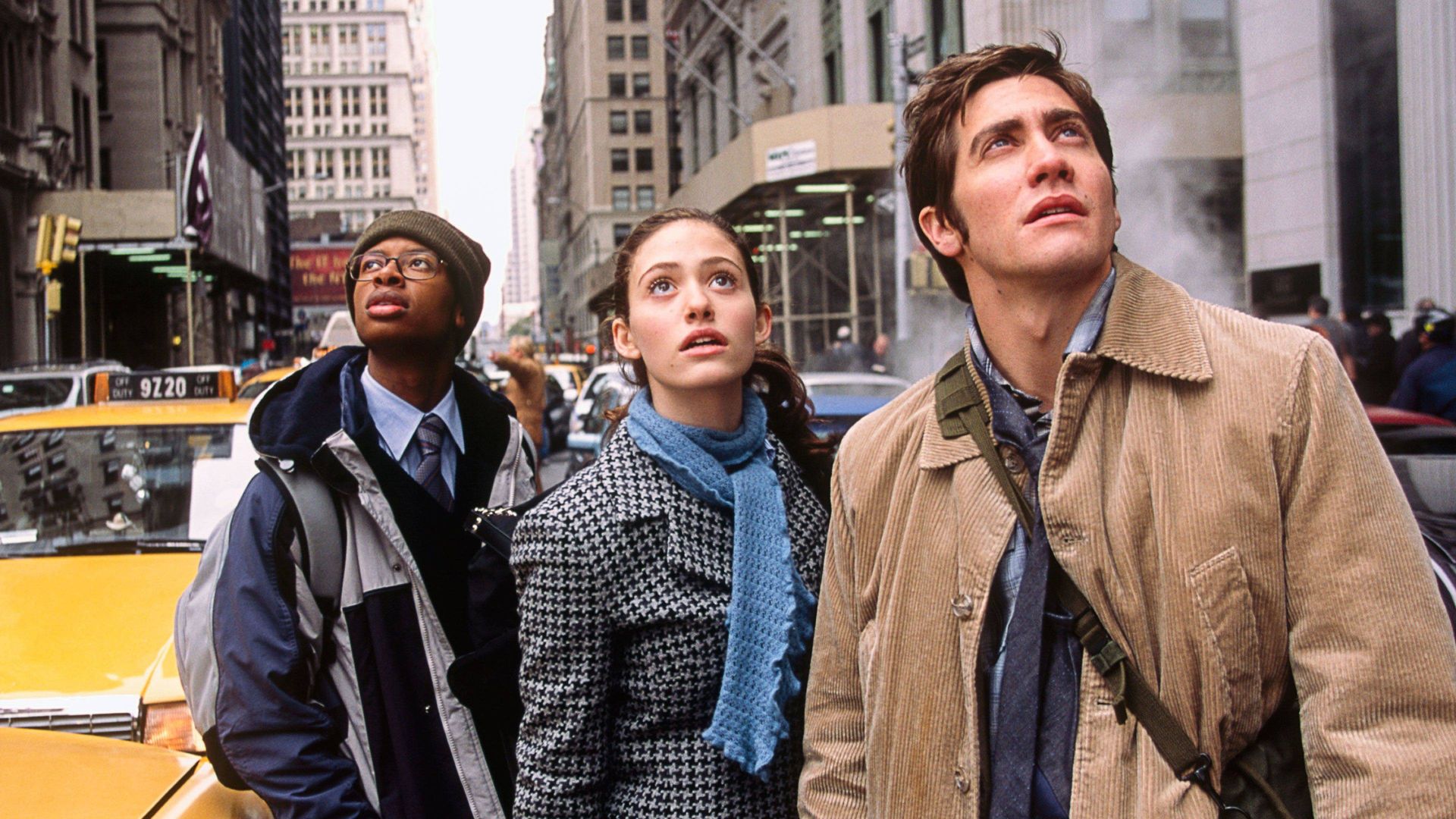
Three massive storms then form over the northern hemisphere. Hall's son Sam (Jake Gyllenhaal) and his college friends including classmate Laura (Emmy Rossum) are in New York when the city is submerged by a massive tsunami. They take refuge in the public library and have to keep warm as temperatures plummet to extreme freezing levels. Jack has to provide advice to the President by developing new climate models, while also planning a rescue for Sam.
A throwback to the large-scale disaster movies of the 1970s, The Day After Tomorrow deploys the latest CGI technology with impressive results. Director and co-writer Roland Emmerich crafts an often stunning vision of nature flipping upon itself and establishing a new normal in short order, the northern hemisphere plunging into a new ice age within days. The science is dubious and the speed of transition questionable, but the magnificence of the screen spectacle is not in doubt.Emmerich and the army of computer wizards enjoy destroying both Los Angeles and New York in separate catastrophes. Numerous mammoth tornadoes leave Los Angeles in ruins, before the film's coup de grâce: a humongous tsunami crashes into Manhattan, the visuals creating a terrifying wall of water forcefully invading the great metropolis. The hailstorm in Tokyo, a triple helicopter crash, and the quick-freeze visuals add a never-a-moment-to-rest gloss.
Amidst the high quality artistry, the humans are understandably short-changed, and the plot points are often groan-inducing. A sick kid in the care of Hall's wife (Sela Ward) is the most nauseating attempt at smarmy manipulation, but another unnecessary interlude involves an inconvenient infection necessitating a medication search interrupted by wolves-on-the-loose. The father-son tension between Jack and Sam is haphazard, and Jack's entire icewalking trek from Washington DC to New York City is just loony. Other than taking potshots at inept politicians, the government response subplot is elemental, leading to a tepid denouement.
The performances are generally as plastic as the characters, although Jake Gyllenhaal does make an impact as a young man starting to find his voice. Regardless, The Day After Tomorrow does not need good acting nor perceptive character motivations to impress: this is a joyride vision of global disaster, masterfully rendered.
All Ace Black Movie Blog reviews are here.
In the US, Judge Robert Wakefield (Michael Douglas) of Ohio is appointed as the President's new drug czar, leading the government's "war on drugs". Wakefield is unaware his high achieving 16-year-old daughter Caroline (Erika Christensen) and her friends are dabbling in hard drugs. When Caroline's addiction becomes obvious, Robert's work and private lives collide and his relationship with wife Barbara (Amy Irving) is strained.
In Mexico, Tijuana police officer Javier Rodriguez (Benicio del Toro) and his partner Manolo Sanchez (Jacob Vargas) are in the middle of a turf war between two drug cartels. Javier is recruited by the powerful General Salazar (Tomas Milian) to help federal anti-drug efforts. On Salazar's instructions, Rodriguez arrests cartel assassin Flores (Clifton Collins, Jr.) who is then tortured for information. Wakefield seeks allies in Mexico and identifies Salazar as a potential force for good.
In San Diego, police officers Montel (Don Cheadle) and Castro (Luis Guzmán) arrest businessman Eduardo Ruiz (Miguel Ferrer), who uses storefronts as cover for a drug distribution network. In return for leniency Ruiz identifies the wealthy Carlos Ayala (Stephen Bauer) as the powerful representative for one of the Tijuana cartels. Ayala is promptly arrested, stunning his pregnant wife Helena (Catherine Zeta-Jones) who is living the high-society life oblivious to her husband's real business. Montel and Castro have to keep Ruiz alive long enough to testify, while Helena gets only slimy support from Ayala's lawyer Arnie (Dennis Quaid) and turns to the assassin Flores for more potent help.Featuring an ensemble cast, brisk pacing and enough content to easily justify the 147 minutes of running time, Traffic delves into the high-profit, high-risk, high-damage drugs business from multiple perspectives. Written by Stephen Gaghan and directed by Steven Soderbergh, the core message promotes pragmatism about the depth of the problem and the inefficacy of simplistic solutions. The loosely connected stories shine the light on unlimited supply, insatiable demand and unimaginable profits fuelling a business larger than most governments. Not surprisingly, slogans, blunt initiatives and even good intentions fold under the pressure of corruption, addiction and violence.
Traffic is about an underworld filled with ruthless behaviour, but avoids any traditional action scenes. Gaghan and Soderbergh maintain focus on individuals, personalizing the dilemmas and boiling down a gargantuan industry to a human scale. From Ayala's smug confidence that he is untouchable, to young Caroline throwing away her future in search of the next hit, passing through Rodriguez realizing everything right is wrong, the futility of declaring war on a health crisis made worse by bad laws is laid bare.
As the drama jumps between various stories, Soderbergh (also the cinematographer) uses colour to signal locales. The scenes in Mexico start with an overexposed palette of reds and yellows, while Wakefield's journey of learning about his daughter is bathed in deep blues. Helena's scenes resemble a glossy magazine representing unearned wealth and privilege.
In Washington DC, respected senior judge Justice Lowell (Thomas Barbour) shockingly takes his own life. Soon after, Justice Department clerk Elizabeth Quinn (Katie O'Hare) is found murdered. The main suspect in the Quinn case is homeless hobo Carl Wayne Anderson (Liam Neeson), a Vietnam War veteran rendered deaf and dumb by post-war afflictions.
Overworked public defendant Kathleen Riley (Cher) is assigned to defend Carl, with Judge Helms (John Mahoney) presiding at the trial and Charlie Stella (Joe Mantegna) prosecuting. Enterprising milk industry lobbyist Eddie Sanger (Dennis Quaid) is on the jury and starts discretely helping Kathleen by uncovering evidence that could prove Carl's innocence. Kathleen and Eddie also start to get attracted to each other, threatening the integrity of the trial.
While the talent on both sides of the camera suggests a quality production, Suspect never convinces. Writer Eric Roth scrounges for obscure ideas and arrives at a slick lobbyist deciding, for never explained reasons but maybe having something to do with irritation at being unable to avoid jury duty, to play amateur detective, contaminating the trial not just by colluding with the public defendant but also pursuing her romantically.Elsewhere the accused Carl Anderson as a deaf and dumb victim of an uncaring society is an interesting angle, but director Peter Yates is never quite able to navigate to a place where the disabilities are just a plot enhancement and not a cinematic hindrance. Liam Neeson, by not saying a word, elevates himself above most of the rest of the material.
As for the larger conspiracy surrounding Elizabeth Quinn's death, Riley and Sanger eventually uncover corruption from years past involving powerful people, although not powerful enough to remove incriminating evidence from a filing cabinet drawer accessible to any lowly clerk.
The courtroom verbal sparring borders on bland, both Cher and a disinterested Joe Mantegna defaulting to conviction-free blank line readings and fake over-emoting. A couple of badly executed and tension-free action scenes are thrown in, including Cher running around in an empty building with an assailant in pursuit for what seems like an eternity. The very next day she is back in the courtroom, but really, with a rushed and raucous ending flattening all remaining plot credibility, she need not have bothered.
All Ace Black Blog Movie Reviews are here.
The setting is Hartford, Connecticut in the late 1950s. Cathy and Frank Whitaker (Julianne Moore and Dennis Quaid) are superficially the ideal and successful married couple with two young children. She is a full-time homemaker, while he is a hardworking executive with an electronics firm. Cathy has a circle of close friends, including Eleanor (Patricia Clarkson).
The veneer of perfection cracks when Cathy catches Frank with a male lover. He starts therapy sessions to try and treat his homosexuality, and their relationship suffers. She embarks on a friendship with her Black gardener Raymond Deagan (Dennis Haysbert), a well-educated small business owner and the widowed father of a young daughter. But suburban Hartford is not ready for interracial friendship, and Cathy is soon the subject of vicious community gossip.
Despite poking at important social topics and enjoying a shiny aesthetic, Far From Heaven is burdened with an off-putting self-aware artificiality. Director and writer Todd Haynes is less interested in recreating the actual 1950s but rather presents a nostalgia-tinted view filtered through the flicker of dramatic movies from the era. The result lands somewhere between mocking and mimicking the cinematic creations of the Eisenhower years, Far From Heaven carrying stiff and unrealistic dialogue, exaggerated acting, indulgently coordinated women's outfits, and over-zealously saturated colours.
Julianne Moore and Dennis Quaid struggle against the material but buckle under the strain of bewildering mannerisms and stiff conversations, their performances distinctly derivative. Far From Heaven overinvests in flair, and strays far from substance.
All Ace Black Blog Movie Reviews are here