Showing posts with label Marlon Brando. Show all posts

Monday, 15 February 2021

Movie Review: The Young Lions (1958)

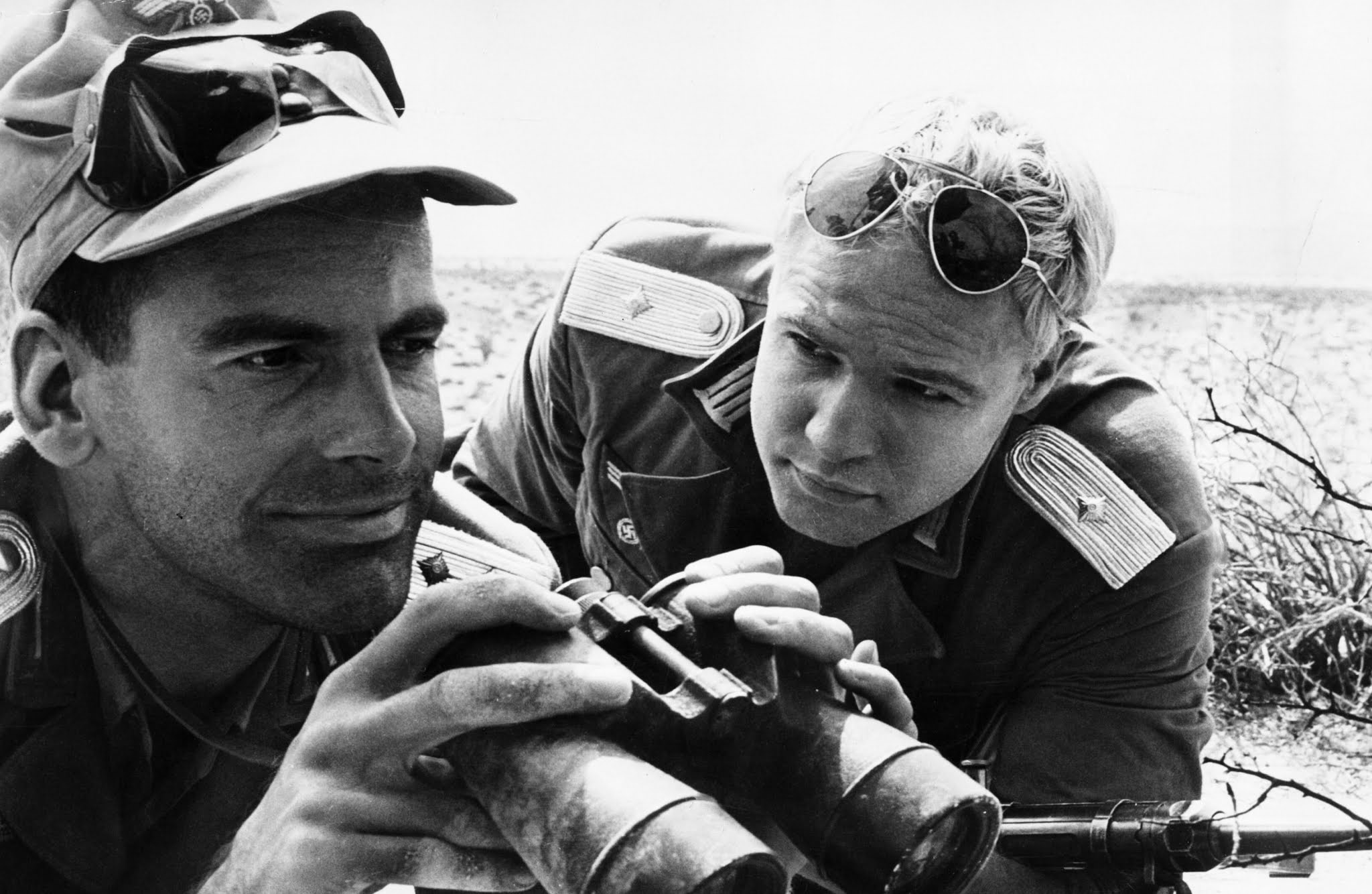
An epic World War Two drama spiked with notable action, The Young Lions explores the intense personal and military experiences of three memorable characters, one German and two Americans.

On New Year's Eve of 1938, German ski instructor and shoemaker Christian Diestl (Marlon Brando), an idealist seeking a better future, romances American vacationer Margaret Freemantle (Barbara Rush). She is repulsed by the growing wave of German expansionism and returns to the United States and her boyfriend Michael Whiteacre (Dean Martin), a Broadway entertainer. 

When America enters the war, Michael meets store clerk Noah Ackerman (Montgomery Clift) at the Army draft office. Michael labels himself a coward and tries to avoid service, but Noah, a Jew, calmly accepts conscription. Michael introduces Noah to Brooklyn girl Hope Plowman (Hope Lange). Their courtship starts with a commuting odyssey, then Noah has to win over her father (Vaughn Taylor), who had previously never met a Jew. 

Christian becomes a Lieutenant in the German army occupying Paris under the command of the merciless Captain Hardenberg (Maximilian Schell). He meets Parisienne Francoise (Liliane Montevecchi), then has a torrid encounter with Hardenberg's wife Gretchen (May Britt). Both Christian and Hardenberg are reassigned to the North African front lines. Meanwhile Michael and Noah go through basic training together, and Noah is exposed to bullying.

Once the liberation of Europe starts, Michael has to decide if being a coward is what he really wants, Noah will experience the chaos of combat, and Christian's idealism will be severely tested.

An adaptation of Irwin Shaw's novel, The Young Lions earns its 167 minute length with a focus on rich character development as well as a few scenes of short and sharp war action. The Edward Anhalt script is eloquent, ably maintaining control of multiple story lines from late 1938 to the end of the war in Europe. Edward Dmytryk keeps the scenes relatively short and the pacing brisk, pausing when necessary but never dragging. The result is a gourmet cinematic experience.

With abundant content comes a few weaknesses, and The Young Lions is not immune. A plausible argument can made that each of Brando, Clift and Martin (at 34, 38 and 41 years old respectively) are older than their "young" characters, with Clift perhaps visually least convincing as a budding man. Martin's character Michael Whiteacre is prominent early and late, but disappears for long stretches in the middle and is afforded relatively few scenes to navigate his arc. And a motorcycle escape sequence is kneecapped by rudimentary rear projection and flirts with unintended comedy.

But in the context of the film's scope, these are quibbles. The Young Lions soars to majestic heights of dramatic involvement by investing in people from different backgrounds, the war shaping who they are and what they stand for, the three central characters evolving into compelling men through complex growth journeys. 

Christian starts with a vision of a more equitable Europe where shoemakers can break free from the shackles of classism. His disillusionment rises as he awakens to the evils of the Nazi party and the brutal tactics employed by men like Hardenberg. Noah has the most to fight for, starting in Brooklyn where a Jew is treated with suspicion, then at training camp where survival means confronting bullying. And Michael is a man of music and cocktail parties, perhaps capable of pulling a few strings to secure a cozy desk assignment but aware of the implications to his sense of self.

Anhalt and Dmytryk are not satisfied with just the central stories and extend their focus to other fascinating characters surrounding the three men. Captain Haldenberg rides his rigid adherence to the principles of an implacable invading army from the highs of photo opportunities in Paris to unimaginable lows. And while Margaret and Hope are relatively static, Hardenberg's wife Gretchen, in just a couple of scenes, emerges as an unforgettable representative of the elite and decadent Berlin set, her behaviour and fate mirroring that of her Captain. In occupied Paris, the feisty Francoise is torn between fury at the German invaders, fear of fraternizing with the enemy, and the enticing prospects of a European project with men like the attractive Christian at the helm.

The cast sparkles with acting talent. A blond Marlon Brando brings a German accent to his sometimes mumbled internally anguished introspection. Montgomery Clift is committed as the outsider used to coping with a lowly status, instinctively aware a world war can change all societal dynamics. In one of his earliest dramatic roles Dean Martin is not in the same talent class, but is never less than serviceable. Maximilian Schell, in his first Hollywood feature, remarkably matches Brando with a dominant portrayal of regime loyalty.

The action scenes inject well-timed jolts of energy and allow the characters to further define their psyches and earn battlefield legacies. The best is a commando attack in North Africa demonstrating the double sword of ingenuity and cruelty.

Monumentally ambitious and grandly substantive, The Young Lions is an impressive roar.


All Ace Black Movie Blog reviews are here.

Wednesday, 27 January 2016

Movie Review: The Freshman (1990)


A crime comedy mixing mobster satire with broad laughs, The Freshman benefits from a fine Marlon Brando performance riffing on his godfather persona, and an engaged Matthew Broderick. The film is astute and entertainingly frivolous in equal patches.

Clark Kellog (Broderick), raised by his wildlife-loving but otherwise obtuse step-father Dwight (Kenneth Welsh), leaves his rural Vermont home behind and heads to New York University to study film making. Within minutes of arriving in the big city, Clark meets the fast-talking Victor (Bruno Kirby), who offers Clark a ride but promptly steals all his money and luggage. Eventually Victor makes amends by introducing Clark to his uncle Carmine Sabatini (Brando), a businessman with a lucrative job offer that can't be refused.

Sabatini professes great admiration for Clark, who is intimidated into accepting a well-paid job as a driver tasked with transferring unspecified cargo from the airport to New Jersey. He also meets Sabatini's daughter Tina (Penelope Ann Miller), and with bewildering speed she professes her love for Clark and starts to talk of marriage. The cargo turns out to be a rare Komodo dragon being illegally imported into the care of the mysterious Larry London (Maximilian Schell), a flamboyant chef. Clark realizes that he has been sucked into an illicit and bizarre scheme involving gourmet meals featuring near-extinct species. He quickly wants out, but escaping Sabatini's web will be a complicated process.

The running joke in The Freshman is that everyone recognizes Carmine Sabatini as a spitting image of Don Corleone, but no one quite gets to say it. Brando mumbles his way through the role and has great fun recreating one of his greatest screen characters, but in this case the crime boss appears to be involved in nothing more serious than arranging over-priced banquets for air-headed rich guests.

The Freshman is filled with this kind of attractive asymmetry, where characters appear to be stereotypes but then step sideways into unfamiliar and quirky territory. Sabatini's pregnant pronouncements can be construed as either profound or simplistic, and his affection towards Clark may or may not be a real surrogate father-son bond, Victor oscillates between scruffy thief and resourceful potential brother-in-law, while Tina innocently combines mobster's daughter with a potentially genuine attachment to Clark. Larry London hints at a Nazi-laced evil past, but he could also be just an inventive cook.

Director and writer Andrew Bergman succeeds for the most part in threading the needle where Clark's ludicrous adventure stays on the right side of plausibly ridiculous. Broderick's fresh-faced, wide-eyed persona is a good match for Brando's dark and domineering boss, and the two create the film's best moments in several long conversational scenes. The Komodo dragon is also excellent and dominates a quite perfect comedy sequence as Clark and his film school friend (Frank Whaley) grapple with the reptile on an eventful trip from the airport to a hidden New Jersey zoo-of-sorts.

Some of the story details are less well constructed, and late on Bergman quick-fries a plot about corrupt conservation officers, while step-father Dwight reappears but is shortchanged into sitting in the back of a car and saying little.

The Freshman is a refined comedy which delivers a range of laughs without taking itself too seriously.


All Ace Black Blog Movie Reviews are here.


Thursday, 12 February 2015

Movie Review: The Chase (1966)


A southern drama about a small town simmering with social tensions, The Chase promises much and offers a cast filled with talent. But it stays in the oven for too long, emerging as an overcooked and tough to chew mess of a meal.

In deep rural Texas, convicted criminal Bubber Reeves (Robert Redford) has busted out of prison and is on the run. News of the escape reaches the nearby small town where Bubber was born and raised, and the townsfolk are immediately thrown into a frenzy of anxiety and anticipation. Businessman Val Rogers (E.G. Marshall) pretty much owns the town and likes to think that he controls everything and everyone in it, including Sheriff Calder (Marlon Brando). Val's son Jake (James Fox) is the heir apparent to his father's empire, and is trapped in a marriage of convenience to Elizabeth (Diana Hyland), while carrying on an open affair with Anna Reeves (Jane Fonda), Bubber's lonely wife.

Meek banker Edwin Stewart (Robert Duvall) desperately wants to be part of Val's inner circle, but his wife Emily (Janice Rule) is tired of waiting for Edwin to make something of himself. She is having an affair with the seemingly more presentable but equally married Damon Fuller (Richard Bradford). Fuller is part of a group of gun-toting men who believe themselves to be above the law and almost openly disrespect Sheriff Calder's authority. Over the course of one day and one night, Bubber edges ever closer to the town, emotions boil over, and Calder and his wife Ruby (Angie Dickinson) find themselves increasingly isolated as they try to keep a lid on a town about to explode.

Early on it becomes clear that there is not much chasing going on in The Chase. Directed by Arthur Penn (who later disowned it) and produced by Sam Spiegel, the film enjoys some moments and benefits from a remarkable cast in good form. But the ambition overreaches the narrative premise, and the film gets caught spinning in place. The Lillian Hellman script (heavily doctored by Spiegel) tries to create a tense boiling pot of a town galvanized by the wait for a dangerous criminal, but the attempt is only partially successful.

The story gets into trouble early. To start, there is little that is dangerous about Robert Redford as Bubber Reeves, who is portrayed as more of a victim than a criminal. With his perfectly coiffed hair catching the light just so in the Texas wilderness and his good boy looks betraying any attempt at evil, the threat that is supposed to exist at the centre of the film dissolves in Redford's substantial star charisma.

In the town itself, there are just too many unsavoury characters making life miserable for each other. Most of the residents appear to be carrying on extramarital affairs, while the prevailing agony, bitterness and resentment is in keeping with the mean spirited nature of a community rife with vigilantism, classism and racism. They all appear dissatisfied and wretchedly unhappy, and they all seem to deserve it.

The sheer number of minor characters causes the film to lose momentum. There are snippets of numerous sub-stories including Bubber's parents; a religious old woman who putters around town; another elderly couple; a gaggle of teenagers; and a land owner/loan shark who serves as the perpetual interested observer. None gain traction and all get in the way, to the point that at a climactic moment late in the film, it's not even clear which tertiary character pulled the critical trigger.

In the middle of the over-ripened fruit Sheriff Calder and his wife Ruby are an oasis of goodness, and The Chase gradually veers towards traditional one-good-man-against-a-bad-town territory. Bubber almost turns into a MacGuffin, a catalyst to trigger a story of the lawman confronting the corruption that lurks within. And whenever Brando or Dickinson are on the screen, The Chase picks itself up and does much better, Brando ironically bringing a laconic intensity to the only likeable character in the film, while Calder and Ruby appear to enjoy the only rational relationship in this forgotten corner of Texas.

In the film's most memorable scene, Penn practices playing with bucketfuls of blood by subjecting Brando to a vicious beating at the hands of the town's gun-happy vigilante men. It's an excessive sequence, in keeping with the overheated tone of why stop at a single punch when ten will do. The Chase is tolerable fare, with enough going on to maintain interest but too much going on to gain and maintain focus.


All Ace Black Movie Blog reviews are here.

Saturday, 1 November 2014

Movie Review: Apocalypse Now (1979)


An epic mess of a war film, Apocalypse Now is a grandiose masterpiece in spite of itself. Francis Ford Coppola overcame legendary disasters to create a staggeringly hellish view of the Vietnam War, and the experience of watching the film is a multisensory marvel.

It's 1969, and US involvement in the Vietnam War is in full swing. Special operations officer Captain Willard (Martin Sheen) is recruited for a covert mission. He is to travel upriver to the remote jungles of Cambodia and eliminate decorated US Colonel Kurtz (Marlon Brando) "with extreme prejudice". Kurtz has gone rogue, establishing his own militia, fighting the war on his own terms, disobeying orders while unleashing extreme brutality. Willard joins the crew of a small navy patrol boat commanded by "Chief" (Albert Hall), and including as crew members California surfer Lance Johnson (Sam Bottoms); a New Orleans "Chef" (Frederic Forrest); and young gunner Miller (Laurence Fishburne).

The patrol boat is provided with a transportation lift by the Cavalry Regiment of Lieutenant Colonel Kilgore (Robert Duvall), an eccentric commander looking for surfing opportunities and happy to unleash the fury of his helicopters on a Vietnamese village to secure a beach with excellent waves. Willard and his patrol crew next stumble onto a garish special entertainment event for US troops featuring Playboy playmates. Further upriver is a hellish battle zone for a bridge, with uncoordinated US troops trading fire with the Vietcong at close quarters. With the crew of the small boat now battered and bewildered, Willard gets ever closer to Kurtz' hideout, and come to understand that his already murky mission will be a lot more complex than he ever realized.

Years behind schedule and millions over budget, Apocalypse Now, a loose adaptation of Joseph Conrad's Heart of Darkness, was a legendary production. An already arduous filming schedule in the Philippines was regularly disrupted. A typhoon destroyed the Playboy set, the payroll was stolen, the on-location sound recordings proved to be virtually useless, Martin Sheen suffered a heart attack during filming, and Marlon Brando was monstrously overweight.

During a prolonged post-production period, Coppola and his editing team weaved movie making magic and created a classic depiction of an out of control war. Apocalypse Now is a feast of colour cinematography by Vittorio Storaro, complemented by an overwhelming soundtrack featuring audacious musical selections. As Willard makes his way upriver, what unfolds before him is an amplified and grotesque celebration of a war machine churning with death. In the jungles of Vietnam entirely new realities become the new, obscene, normal.

Kilgore glorifies death to others, appears to personally have absolute immunity, and dismisses the mechanics of war as minor obstacles on the way to find good surfing beaches. A metaphor for the entire war from the American perspective, the entertainment spectacle with the Playboy bunnies is lit up against all theoretically good principles of warfare. Tantalizing soldiers with playmates must have seemed like a good idea to someone with no idea about the theatre of war. The event predictably disintegrates into a riot: fighting men become more so in the middle of a jungle, losing all discipline.

The deafening bridge battle strips away any veneer of orderly in-battle glory. Here at the unknown edges of comprehension, soldiers are operating on mechanical hyperdrive, fighting against an unseen but nearby enemy for essential turf, hundreds of miles away from anything recognizable.

Exposed to the ravages of a war seemingly feeding on its own momentum, Willard and the patrol boat crew slip into Cambodia's surreal tribal lands where sticks and spears are still the weapons of choice. Kurtz has his hideout here, and he represents the exclamation mark at the end of the prevailing madness. When civilization disintegrates and man adopts killing as sports and entertainment, what makes more sense than a reset back to the most ancient and barbarous tribal practices?

Robert Duvall gets the showiest role as Kilgore, and creates an iconic, career-defining character. Kilgore responds with annoyance at the fear of others as bombs explode all around him, Duvall standing tall and riding a peak with one of the best lines of dialogue about war's dehumanization.

Kilgore: You smell that? Do you smell that? Napalm, son. Nothing else in the world smells like that. I love the smell of napalm in the morning. You know, one time we had a hill bombed, for 12 hours. When it was all over, I walked up. We didn't find one of 'em, not one stinkin' dink body. The smell, you know that gasoline smell, the whole hill. Smelled like . . . victory. Someday this war's gonna end.

Martin Sheen is more of a spectator presence at the heart of the film, Willard an interested observer on a mission rather than an instigator. Brando adds unexpected and unwelcome heft for the final 45 minutes. Ironically, it is Dennis Hopper as a fast talking photojournalist at Kurtz's compound who becomes the more memorable personality as the end of Willard's journey. The supporting cast also includes small roles for Harrison Ford and Scott Glenn. Apocalypse Now started filming in 1976, with Ford a relative unknown. By the time it was released in August 1979, he was a global star thanks to 1977's Star Wars.

The final third of Apocalypse Now descends into unintentional and grim disarray. Coppola never found a coherent ending for his film. Brando showed up to the set comically bloated, so all the Colonel Kurtz scenes are filmed with partial lighting and black shadows to try and hide the fat. Having Brando move like a decorated soldier was out of the question, so he is reduced to mostly sitting and reading incomprehensible texts. Coppola debated among three endings, and the chosen climax is both befitting in its almost otherworldly drowning into the macabre, and unconditionally befuddling. The definitive film about war as an out of control hell finds its own place of anguish to end on, a case of Coppola stumbling into the darkest corner only to find a new description of the worst possible nightmare.


All Ace Black Blog Movie Reviews are here.


Friday, 4 July 2014

Movie Review: Morituri (1965)


A World War Two marine espionage thriller, Morituri (also known as The Saboteur and Code Name Morituri) offers an initially engaging plot, but the film eventually loses focus, and despite the presence of stars Marlon Brando and Yul Brynner, drifts into muddled waters.

Robert Crain (Brando) is an anti-war German hoping to quietly wait out the conflict in India. British intelligence agent Colonel Statter (Trevor Howard) presses him into service, to infiltrate a German freighter under the command of Captain Mueller (Brynner), sailing from Japan to Europe and carrying a load of precious rubber for the Nazi war machine. Crain's mission is to disable the ship's self-destruct explosive charges, to allow the Allies to intercept Mueller at sea and seize the cargo intact.

Crain is provided with a fake identity as an SS commander. He boards the ship as a guest passenger and sets about his mission to find and disable the charges. He clashes with the ill-tempered and patriotic Mueller, who has a chequered past and is having troubles of his own maintaining control of his men. Also on-board are political prisoners being transported back to Europe. When Mueller accidentally stumbles into the middle of an Allied convoy and changes course, Crain's plans are disrupted and he has to improvise a new mission. Events are further complicated when actual SS agents board the ship to deposit another batch of detainees, including Jewish female prisoner Esther (Janet Margolin).

Filmed in crisp black and white, Morituri is mostly confined to the narrow passageways of the freighter chugging its way across the ocean. Although the thriller elements are initially present as Crain stealthily explores the ship to try and find and disable the explosives, the film is more of an intellectual chess game between a spy risking everything and a suspicious and determined captain.

Apart from its unmarketable name (which is Latin for "about to die"), Morituri starts to stumble about one third of the way through, when the plot is knocked off-course and never recovers. A straightforward story of sabotage on the high seas morphs into an ill-defined plot about mutiny and abandoning ship. Yet another change in direction finds the back end of the film unexpectedly dominated by Esther's story of tragic sexual abuse. Although an anti-war theme is maintained, Morituri loses its identity and devolves into fragmented arcs.

Austrian director Bernhard Wicki does his best with the Daniel Taradash adaptation of the Werner Jörg Lüddecke novel, and clearly there are competing ideas and sub-plots here that may have worked better on the page than on the screen. Morituri would have benefited from streamlining and better sequencing. Esther's story, in particular, sails in late to seize centre stage, throwing the tone of the film into the turmoil of the Holocaust and the politics of gang rape.

Marlon Brando excels in a relatively unfamiliar action-oriented role, his take on a pacifist forced to participate in a war that he despises filled with barbed commentary about the futility of violence. Both Brando and Brynner navigate the film with reasonable German accents, and Brynner has the longer character journey, traveling from proud warrior and father to a more circumspect man who learns to doubt.

Well-intentioned but overloaded, Morituri is a capable but clunky vessel.


All Ace Black Movie Blog reviews are here.

Monday, 24 February 2014

Movie Review: Julius Caesar (1953)


A sincere adaptation of the Shakespeare play, Julius Caesar adheres to stage rules but still finds the passion at the heart of the story of intrigue and betrayal among Rome's elite.

After defeating Rome's enemies, Julius Caesar (Louis Calhern) is at the height of his power, and the expectation is that the Senate will offer him the position of Emperor for life. Afraid that Caesar is becoming too ambitious and placing his personal glory ahead that of Rome, a group of noblemen plot an assassination. Cassius (John Gielgud) is the ring leader, and he invites the well respected Brutus (James Mason) to join the conspiracy, appealing to Brutus' love of Rome's ideal model of governance.

After agonizing over the decision, Brutus joins the band of assassins, and Caesar is stabbed to death on the Ides of March. At the insistence of Brutus, and despite Cassius' unease, the killers spare the life of Caesar's loyal companion, the athletic Mark Antony (Marlon Brando). Antony pretends to be resigned to the will of the conspirators, but he uses his charisma and spectacular skills in oration to turn the public against the assassination, triggering a brutal battle for power.

If Shakespeare needs to be filmed, it's likely best to do it this way: a stellar cast, lavish sets, and top production values. This takes away, somewhat, from lingering questions as to why the ancient Romans may choose to speak in 16th Century English. The trouble with Julius Caesar, as with any faithful movie adaptation of classic theatre, is the confines of dialogue written to dominate, where characters don't so much converse as trade volleys of soliloquies. This is forgivable in the cozy setting of the stage, but comes across as exceedingly stiff on the modern and expansive format of film.

Julius Caesar overcomes these challenges as best at it could, thanks to Brando, Mason and Gielgud all delivering committed performances. Mason finds all of Brutus' intellectual self-doubt and higher purpose in defending Rome's reputation even at the cost of the ultimate betrayal. Gielgud is pure conspiratorial evil, his brooding Cassius the head of the plot but smart enough to acknowledge the importance of bringing Brutus into the fold. And Brando enjoys his one mammoth scene, roaring with rage to shake Romans out of their slumber and spark the civil war to oust the conspirators.

Joseph L. Mankiewicz directs with appropriate reverence to the source material, packing the play into a tidy 121 minutes, and finding impressive-looking sets to stage the action. However, some of the dialogue is delivered breathlessly quickly, which does not help to convince that the characters are actually thinking before reciting their prose.

Almost totally wasted are Deborah Kerr as Brutus' wife Portia, and Greer Garson as Caesar's wife Calpurnia. MGM likely wanted a star in every key role, but Kerr and Garson each get exactly one relevant scene, and then they both comprehensively disappear from the action, leaving the men behind to battle over the soul of Rome.

Which is maybe just as well, as women are less likely to ever justify or condone the sordid backstabbing at the heart of the story. Riding the quality of the epic source material all the way to a bloody conclusion filled with perforated peers, Julius Caesar is a potent parable of power and politics.


All Ace Black Blog Movie Reviews are here.


Monday, 20 January 2014

Movie Review: Guys And Dolls (1955)


A colourful musical hampered by odd casting choices, Guys And Dolls stretches a minimalist plot to a remarkable 150 minutes, but maintains interest with a steady drizzle of highlights.

In New York, a group of small-time con men addicted to gambling entrust organizer Nathan Detroit (Frank Sinatra) with finding a location for an illegal craps game, despite the close attentions of Lieutenant Brannigan (Robert Keith). Nathan is also under pressure from Miss Adelaide (Vivian Blaine), a stage performer and his fiancée of 14 years, to finally get married. Looking for a quick $1,000 to secure a gambling venue, Nathan makes a bet with the laid back Sky Masterson (Marlon Brando): Sky will win the bet and $1,000 if he manages to take Sister Sarah Brown (Jean Simmons), leader of the Save A Soul Mission, to Havana for dinner. Otherwise, he will have to pay $1,000 to Nathan.

Sky moves quickly to court Sarah, who is struggling to attract anyone to her Mission. Meanwhile, the pressure on Nathan grows with the arrival of Chicago mobster Big Jule (B.S. Pully) in town, looking for some gambling action, while Miss Adelaide runs out of patience with Nathan's gambling obsession. Sky does indeed get Sarah to Havana, but their budding relationship is damaged when her Mission is used as a venue for gambling. With Big Jule looking for big winnings, all the gamblers meet in the sewer for a high stakes game, while Sky has to find a way to win back Sarah without falling into Brannigan's clutches.

With a story built almost entirely around the flimsy premise of finding a location for craps and a fairly basic bet-motivated romance, Guys And Dolls scrambles around for sub-plots and themes to hang some content on. To a certain extent the film finds humour and irony in the clash between a group of rough gamblers and a Mission intent on saving the souls of any and all sinners. The script by director Joseph L. Mankiewicz and Ben Hecht, based on the 1950 Broadway show, makes the most of small situations, but there is no escaping the overall slow pace and long waits between meaningful story developments.

The casting choices of producer Samuel Goldwyn had more to do with cashing in on Brando's skyrocketing popularity after the success of On The Waterfront than suitability for the role. Despite the prevailing spirit of fun throughout Guys And Dolls, Brando, Simmons and Sinatra all seem marginally uncomfortable. Brando is no singer, and while he does his best, his warbling is laboured. Simmons isn't a singer either, but she is asked to do less of it, and when she does deliver her highlight If I Were a Bell, she belts it out with some conviction. Sinatra, meanwhile, is given relatively little singing to do, and he just comes across as too smooth and too inherently good for the hustling character of Nathan Detroit.

Mankiewicz' direction is often static and unimaginative. He does relatively little to add motion picture dynamism, and many scenes carry the unmistakable whiff of a stage show being unimaginatively filmed. The sets are always animated with stacks of extras, but also obviously studio bound and lacking the authentic air of a real city.

Guys And Dolls does find some excellent moments. The scenes between Brando and Simmons gradually gain heat, and reach a fine boil in the prolonged Havana sequence, by far the best stretch of the movie. Surrounded by a night full of Latin sensuality, Sky melts away Sarah's stiff inhibitions to reveal the steamy woman within. Also good is the climactic craps game in the sewer, Mankiewicz finally finding some energy with a lively dance number and then a couple of all-or-nothing duels involving Nathan, Big Jule and Sky.

And the film wins plenty of style points, the set designs exploding with a vivid intensity, matched by slick men's outfits featuring a wide variety of colours, with Sky's sense of cool standing out in his love of variations on black.

A celebration of the simple pleasures that occupy men who should know better, Guys And Dolls is an undemanding roll of the dice.


All Ace Black Blog Movie Reviews are here.


Monday, 28 October 2013

Movie Review: Reflections In A Golden Eye (1967)


A train wreck of weird characters behaving badly, Reflections In A Golden Eye goes off the rails early and never recovers. The story of suppressed homosexuality on an army base teaming with lust and madness spirals into self-imposed chaos.

Major Weldon Penderton (Marlon Brando) commands a US army base in the south. He is stiff, unhappy, suppressed and not interested in sleeping with his wife Leonora (Elizabeth Taylor). She enjoys riding her horse Firebird, and finds sexual satisfaction with willing neighbour Lieutenant Colonel Morris Langdon (Brian Keith). Langdon's wife Alison (Julie Harris) is deeply depressed following the death three years earlier of her newborn child. Alison is only happy in the company of the effeminate and extroverted Filipino houseboy Anacleto (Zorro David).

Also on the base, Private Williams (Robert Forster) looks after cleaning the horses and stables, and has the habit of riding horses in the nude. Penderton starts to get attracted to Williams, who in turn starts stalking the the Penderton household, and invading Leonora's room while she sleeps. With Alison's condition worsening, Penderton growing ever more enamoured with Williams, and Williams developing the unhealthy habit of sniffing Leonora's underwear, the boiling emotions finally erupt.

Based on a 1941 novel by Carson McCullers, Reflections In A Golden Eye is just too close to an unintended comedy. Five of the main characters belong in a mental asylum, rather than a military base, and without a sensible core to hold the film together, it resembles more of a farce than a drama.

Penderton is dour, preens at himself in the mirror, mumbles his incomprehensible military teachings to the bewilderment of his students, gets into a fight with a horse, and stalks his men around the base. Leonora is wild-eyed, over-sexed, and happy to humiliate her man, including whipping him across the face at a swanky party. Alison is deep into depression, operating at the edge of reason, while Williams is a voyeur, an intruder, a lingerie-sniffer, and rides horses while naked. And finally there is Anacleto, floating, dancing, singing and smiling for his own entertainment in an astonishing display of flightiness.

The performances match the characters in a theatrical display of exaggeration. Brando mutters, rambles and stares, while Taylor sticks either her rear end or her cleavage in Brando's face at every opportunity. Harris mostly just looks into the non-existent distance, and Forster, in his debut, wears a single fixed look of anguish and hardly says anything. Zorro David, in his first and mercifully last movie appearance, is in a world on his own, doing something that on a bad day may resemble acting, but even that is debatable. Brian Keith is left with the only semi-rational character, and he is naturally overwhelmed.

It is all supposed to represent suppression and lust, but director John Huston never finds the fine line where normal behaviour is strained by unresolved internal conflict, and settles instead for a large serving of outright battiness. Huston adds to the air of melodrama-run-amok by tinting the movie with a golden hue, creating a gold-and-black film with just the odd object per frame maintaining its colour. According to the peerless Anacleto, it's all supposed to represent the reflection of what a golden peacock's eye can see, but the effect is that of basic nausea. After the film bombed, normal colour was restored to later prints, but the film's awfulness is most appreciated with the original pee-coloured vision.

Forget the military base: Reflections In A Golden Eye is a certifiable cuckoo's nest.


All Ace Black Movie Blog reviews are here.

Thursday, 17 October 2013

Movie Review: On The Waterfront (1954)


A masterpiece delving into union corruption and the power of the individual, On The Waterfront is a potent drama with a peerless Marlon Brando performance and an outstanding supporting cast.

Union boss Johnny Friendly (Lee J. Cobb) rules his waterfront district by intimidation, lining his pockets by running rackets and relying on the working men adhering to the "D and D" (deaf and dumb) code of conduct. Terry Malloy (Brando) hovers on the outer edge of Friendly's circle of corruption, and unwittingly finds himself used to lure informant Joey Doyle to his death. Joey's sister Edie (Eva Marie Saint) demands that the perpetrators be identified and brought to justice, and she shames Father Barry (Karl Malden) into action: he tries to encourage the men into testifying, but Friendly's goons are quick to beat-up anyone who breaks the code of silence.

Terry makes advances towards Edie, and gradually they become close, although she does not know Terry had a role Joey's death. As more men are violently silenced, Terry is influenced by Edie and Father Barry, and starts to consider testifying against Friendly. But his brother Charley (Rod Steiger) is one of Friendly's closest associates, and turning against the union boss and his henchmen will carry a high personal cost.

On The Waterfront carries the ominous tones of director Elia Kazan's own struggles. In 1952 he testified before the House Committee on Un-American Activities, naming names and identifying communist sympathizers from years past. In the movie, Terry Malloy is caught between doing what he is being told is the right thing to do, and loyalty to his "group", the organization of Johnny Friendly. Testifying against Friendly means betraying his friends and family, but remaining silent means letting down Edie and Father Barry, and allowing a rotten situation to get worse.

Alternating between an emerging unlikely love and the power of the fist down at the docks, On The Waterfront is full of energy. Friendly and his goons run a tight ship, controlling who gets to work and who does not, who gets the cushy job and who gets to toil, all determined according to favours afforded and gained. The men chafe under a regime imposed by violence and facilitated by their own acquiescence.

The Budd Schulberg script allows plenty of time for the romance between Edie and Terry to develop, and the measured pace contributes to the air of authenticity. Edie initially appears too good and too smart for Terry, and time is needed for her to find the charm and humanity within the self-described "bum". Once they start to care for each other, Edie offers a moral compass and a road to salvation, and Terry starts to understand that he may have something to gain by standing up for what is right. The film's beating heart is found in Terry's transformational journey from dim witted hanger-on to an inspirational leader of men.

Brando is surrounded by the triangle of Cobb (loyalty), Steiger (family) and Malden (conscience), and the four actors create an electric dynamic. Brando is brutally brilliant as a man suddenly being pulled in three different directions at once, the bum-like tendencies of a boxer who long-since sold-out now overburdened by unfamiliar responsibilities and demands.

Terry Malloy, speaking with his brother Charley: You don't understand. I coulda had class. I coulda been a contender. I coulda been somebody, instead of a bum, which is what I am.

Cobb is all fiery rule-by-fear, while once awakened, Malden is a tentative force for pure good. It is left to Steiger to provide the most textured supporting performance, Charley smart enough to see the writing on the wall, but hoping his brother would fully enter Friendly's fold before he can be convinced to testify. As much as Terry has a dilemma, Charley has a real problem, since he is all-in with Friendly and subject to potentially humiliating punishment should his brother talk.

All four men were nominated for Academy Awards, with Brando receiving his first statue at the fourth attempt. Eva Marie Saint, in her film debut at age 30, also won the Academy Award as Best Supporting Actress. Her turn as Edie is tenacious in the pursuit of justice and enlightened enough to explore a relationship with Terry.

Filled with heart, sweat, agony, blood and triumph, On The Waterfront rocks the docks.


All Ace Black Blog Movie Reviews are here.


Monday, 1 April 2013

Movie Review: The Wild One (1953)


An iconic anti-authority film, The Wild One enhanced Marlon Brando's reputation on the road to superstardom and created the template for the hell-raising, angst-riddled teenager, rebelling against everything and nothing.

Johnny Strabler (Brando) leads a group of motorcycle riders known as the Black Rebels Motorcycle Club. Decked out in leather and driving loud bikes, they travel through small communities in California, drinking heavily, kicking up dust and generally causing havoc. At the town of Carbonville, a motorcycle race is in progress and the BRMC members make a nuisance of themselves before one of them steals the second-place trophy and gives it to Johnny.

At the next town of Wrightsville, law enforcement is minimal and Johnny and the gang take over the streets. Local girl Kathie (Mary Murphy) works at the one restaurant in town and is the daughter of the meek Chief of Police Harry Bleeker (Robert Keith). Kathie has never ventured out of the town, but Johnnie is attracted to her. Things get a lot wilder when a rival gang led by Chino (Lee Marvin) shows up. With the BRMC tearing up the town and antagonizing citizens towards vigilante justice, any potential relationship between Johnny and Kathie appears doomed.

Mildred: Hey, Johnny, what are you rebelling against?
Johnny: What've you got?


Written by John Paxton and Ben Maddow from Frank Rooney's short story, and inspired by actual 1947 events that took place in Hollister, California, The Wild One predicts a collision of generations. Members of the BRMC have no external war to channel their energy towards, and so they direct their anger inwards towards their own society. Their elders know too well the horrors of conflict and are intolerant and impatient with out-of-control youthful behaviour. With no middle ground and no effective arbitration, the threat of youthful shenanigans prompting violence is never far from the surface.

With mayhem on the streets, director László Benedek keeps the focus tight on Brando as Johnny, providing The Wild One with a singular focus, and an exploration of a burgeoning movement through an individual. With his leather jacket, long sideburns, cap at an angle, Triumph motorcycle, and unsmiling, rarely reactive expression, Brando defined what it meant to be an angry, misunderstood youth.


The source of his anger is never probed deeply, although when he is being beaten by the townsfolk Johnny makes reference to his father punching him. He also obliquely mentions not trusting cops and figures of authority, having been betrayed in the past. Johnny's condition is more important to him than its causes. It's enough for him that he is rebelling, but for people like Kathie reaching out to him, he will remain an enigma until he starts expressing what the fight is all about.


The second-place trophy is a persistent symbol of unearned endearment. Johnny never earns the trophy to begin with; he then offers it to Kathie before she is ready to understand and accept him. The equally undeserving Chino demands the trophy and fights Johnny over it in a representation of a meaningless trigger unleashing disproportionate coiled aggression. Later Kathie asks Johnny for the trophy when he is no longer sure about her.

The trophy also contributes to Johnny finally smiling broadly as he finds a glimmer of hope that some version of his rebellion will catch on with his peers, his motorcycle and leather perhaps serving as multi-generational symbols of freedom, independence and mass renewal once causes are finally defined.


All Ace Black Blog Movie Reviews are here.