Showing posts with label Gregory Peck. Show all posts

Monday, 13 November 2023

Movie Review: The Big Country (1958)


Genre: Western
Director: William Wyler
Starring: Gregory Peck, Carroll Baker, Jean Simmons, Charlton Heston, Burl Ives, Chuck Connors, Charles Bickford
Running Time: 166 minutes

Synopsis: Former mariner James McKay (Gregory Peck) relocates from Baltimore to the west as he prepares to marry his fiancée Pat (Carroll Baker). Her father Henry "the Major" Terrill (Charles Bickford) owns a massive ranch, and his loyal foreman Steve Leech (Charlton Heston) desires Pat and resents James' presence. The Major is locked in a feud with nearby landowner Rufus Hannassey (Burl Ives), as both are dependent on water from land owned by schoolteacher Julie Maragon (Jean Simmons), who is romantically pursued by Rufus' loathsome son Buck (Chuck Connors). James attempts to peacefully de-escalate every situation, but his quiet dignity unsettles the locals.

What Works Well: An epic western, William Wyler's adaptation of the Donald Hamilton book explores multiple grand themes, from personal (a man's measure of self-worth) to societal (the slow evolution towards non-violence). Strong romance elements provide James McKay with two possible matches in Pat and Julie, and as illustrations of his character, McKay's treatment of women contrasts sharply with the more brutish Leech and Buck. The film's strength resides in multiple sturdy character arcs, veterans Charles Bickford and Burl Ives adding depth to the antagonism between The Major and Rufus, while the father-son tension between Rufus and Buck provides a powerful undercurrent. Expansive cinematography by Franz F. Planer complements a running "big country" reference, and the music score by Jerome Moross is one of the iconic western soundtracks.

What Does Not Work As Well: Given the breadth of storytelling, the ending deserved more reflective exposition.

Conclusion: Big narrative ambitions fulfilled on a big canvas.


All Ace Black Movie Blog reviews are here.

Monday, 2 October 2023

Movie Review: On The Beach (1959)


Genre: Post-Apocalyptic Cold War Drama
Director: Stanley Kramer
Running Time: 134 minutes

Synopsis: In 1964, a nuclear war annihilates humanity in the Northern Hemisphere. As Australia awaits the arrival of deadly radiation, Commander Dwight Towers (Gregory Peck) docks the US Navy's nuclear submarine USS Sawfish in Melbourne. Still grieving the loss of his family, Towers is introduced to Moira Davidson (Ava Gardner), who is seeking a romance. Towers also meets Lieutenant Peter Holmes (Anthony Perkins) of the Australian Navy, who is struggling to comfort his wife Mary (Donna Anderson). Nuclear scientist Julian Osborn (Fred Astaire, in his first dramatic role) joins them on a reconnaissance mission to measure radiation levels over the Pacific, a journey that will reach San Francisco then San Diego, the source of a mysterious radio signal.

What Works Well: The adaptation of Nevil Shute's cautionary novel packs enormous quiet power, portraying humanity's demise through the eyes of the final set of survivors, resigned to their fate. John Paxton's script deftly avoids melodrama, instead allowing creeping dread to emerge in potent moments of realization, regret, and despair. The military, scientific, and civilian perspectives are provided equal weight through the stories of Towers, Osborn, Moira, and the Holmes family, and gradually themes of loss and lament grab hold at individual and collective levels. Director Stanley Kramer affords even minor characters (the San Francisco sailor, the Australian Navy commander and his assistant) respectful moments, and the closing embraces of finality have rarely been matched for sheer poignancy.

What Does Not Work As Well: The slow pacing allows the immensity of extinction to settle like a heavy fog, contrasting prolonged interactions with the miniscule time remaining for life on Earth, but the running length still borders on excessive.

Conclusion: Unthinkable tragedy distilled to the essence of human desire for meaningful connections.


All Ace Black Movie Blog reviews are here.

Sunday, 14 May 2023

Movie Review: The Sea Wolves (1980)


Genre: War Adventure
Director: Andrew V. McLaglen
Starring: Gregory Peck, Roger Moore, David Niven, Trevor Howard, Barbara Kellerman
Running Time: 120 minutes

Synopsis: In British India of 1943, Lieutenant-Colonel Lewis Pugh (Gregory Peck) and Captain Gavin Stewart (Roger Moore) uncover a German transmission station located on a ship anchored in the Portuguese-controlled port of Goa. Unable to mount a military operation in neutral territory, Pugh and Stewart turn to Colonel Grice (David Niven) and his aging Calcutta Light Horse volunteers to coordinate a raid. Meanwhile, Stewart initiates a romance with the alluring widow Mrs. Agnes Cromwell (Barbara Kellerman).

What Works Well: Inspired by the actual events of Operation Creek (chronicled in James Leasor's 1978 novel Boarding Party), this is an old-fashioned World War Two adventure featuring clever allies outfoxing evil Nazis, with a bit of suave sleuthing and dangerous dalliance on the side. The on-location filming ensures plenty of organic local texture, and the climactic raid is decently engaging.

What Does Not Work As Well: Director Andrew V. McLaglen is caught between delivering a spy caper (leveraging Roger Moore's Bond charisma) or a throwback to World War Two movies from the 1950s and 1960s (reuniting Gregory Peck and David Niven). Unsurprisingly the movie falls into the yawning gap. Shallow characterizations and careless inattention to the hairstyles and wardrobes of the 1940s do not help, and the over-long duration succumbs to tedium well before the action finally starts.

Conclusion: These wolves are more bark than bite.


All Ace Black Movie Blog reviews are here.

Saturday, 17 September 2022

Movie Review: Night People (1954)

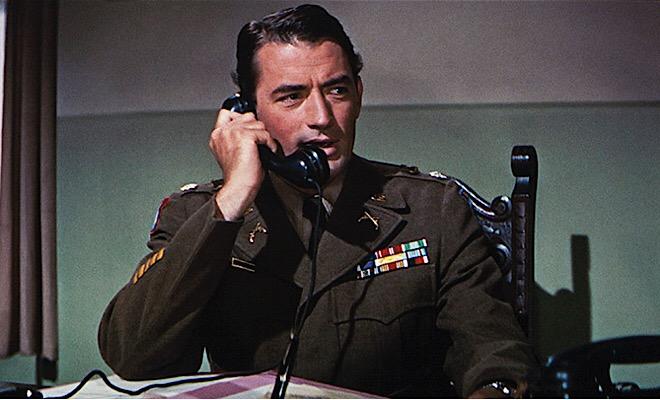
A Cold War front-line drama, Night People delves into spy and counterspy tensions. The dialogue-dominated plot veers from suitably complex to plain silly.

In the post-war divided city of Berlin, American soldier John Leatherby (Ted Avery) is kidnapped by Soviet agents. Lieutenant Colonel Steve Van Dyke (Gregory Peck) is in charge of negotiating his release, and learns through his well-connected East German source (and former lover) "Hoffy" Hoffmeir (Anita Björk) that the Soviets want a swap. Meanwhile, the kidnapped soldier's father Charles Leatherby (Broderick Crawford), a well-connected businessman, arrives in Berlin demanding action.

The Soviets want to trade Leartherby for the elderly Schindlers, a husband-and-wife couple. Frau Schindler (Jill Esmond) is now a nightclub piano player, and her blind husband was a German officer during the war. They are both sure to face torture or death if handed to the Soviets. Van Dyke grapples with the morality of handing two German citizens to the Soviets to free an American soldier, and his task gets more complex when more deceptions come to light.

Despite being mostly set in nondescript governmental offices and hospital rooms, Night People is wastefully filmed in CinemaScope. The technology is a mismatch with the subject matter: the needless widescreen expanse punctures what should have been the drama's intensity. 

Nevertheless, producer, director and writer Nunnally Johnson just about rescues decent entertainment from the imagery's far-flung corners. The intrigue surrounding the missing soldier and the echoes of the Second World War still resonating around Berlin provide a good foundation for a spy drama. Gregory Peck is reliably stoic and self-confident as the man entrusted with rescuing a messy situation, and Broderick Crawford adds the bluster of a father pushing for simplistic solutions. The cast is rounded out by Rita Gam as Van Dyke's capable assistant, along with support roles for Walter Abel, Buddy Ebsen and Peter van Eyck.

But Johnson is happy to talk rather than walk his way through the complexities of the Cold War, and too many critical events take place off screen. The film entirely ignores events happening in East Berlin, robbing the plot of counterpoints. Plenty of words are used to describe one of Van Dyke's key Soviet contacts being compromised, and many more words are used to try and describe the Schindlers' backstory. Actually showing these events would have resulted in a richer experience.

The details of the third act are best left unscrutinized. Van Dyke's resolution can only result in an escalation of subsequent enemy action, and why the Soviets didn't just kidnap the Schindlers instead of bargaining for them remains a mystery. Night People posits a good scope, but at the wrong scale.


All Ace Black Movie Blog reviews are here.

Thursday, 21 July 2022

Movie Review: Yellow Sky (1948)

A thoughtful western with eerie settings, Yellow Sky contemplates themes of honour, greed, and leadership.

In 1867, outlaw James "Stretch" Dawson (Gregory Peck) leads his gang into a town where they quietly rob the local bank without hurting anyone. The gang members include the cool and detached Dude (Richard Widmark), the ambitious but highly strung Lengthy (John Russell), the noisy Walrus (Charles Kemper), and the young Bull Run (Robert Arthur). Chased by a posse, they escape into a hostile desert.

Suffering dehydration and exhaustion, the gang arrives at the abandoned town of Yellow Sky. The only inhabitants are a young woman named Mike (Anne Baxter) and her Grandpa (James Barton), a prospector. Mike triggers sexual tension among the gang members, while Lengthy and Dude take turns challenging Stretch's leadership. When Dude learns that Grandpa has a stash of gold, Stretch negotiates a share agreement, but greed causes gang rivalries to explode into violence.

Directed by William A. Wellman, written by Lamar Trotti, and inspired by Shakespeare's The Tempest, Yellow Sky enjoys unconventional twists. The absence of a natural protagonist is pleasantly disorienting. Stretch Dawson is an outlaw, and has to work hard to reveal the gradations of good separating him from the other gang members. The settings and terrain are also more mythical than traditional westerns, the narrative seeking mental and physical isolation as triggers for organizational breakdown. The desert crossing sequence is a brutal odyssey across unforgiving land, and at the end of it the ghost town of Yellow Sky is the antithesis of salvation.

A watering hole at the town's edge emerges as the one initially unifying source of life, until a woman, gold, and greed combine to bust up the gang. Mike's male name metaphorically signals she is unaware of her impact on men. Quickly a target of their lust, she also wields power beyond the rifle to influence outcomes. 

Some of the film's other elements are less refined. The large group of Apaches who ride into town are an unwieldy plot contrivance in the evolution of trust between Stretch and Grandpa. Wellman excels when the pacing is deliberate, but struggles when emotions run high, the scuffling and shootout scenes lacking polish. And the search for gold takes a detour into an unlikely and clumsy mine excavation.

But the aesthetics are always engaging and convey a slightly surreal trapped-in-a-nightmare mood, the black and white cinematography (courtesy of Joseph MacDonald) making excellent use of sparsity to surround Stretch and his men with ramshackle nothingness. And the narrative strengthens with the sturdy character arc navigated by Stretch, Trotti providing him with a background, a reason to reform, and an opportunity to stand by his word and seek redemption. In Yellow Sky, the pathway from money to wealth passes through an arid test of self-reckoning.


All Ace Black Movie Blog reviews are here.

Thursday, 20 January 2022

Movie Review: MacKenna's Gold (1969)

A western treasure hunt adventure, MacKenna's Gold harbours ambitions of grandeur but is just plain awful.

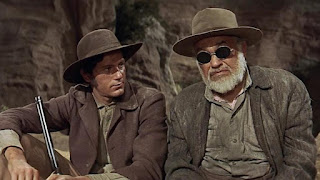
In Arizona of 1874, Marshal Sam MacKenna (Gregory Peck) stumbles upon a map locating a canyon full of gold. Local legends have long spoken about such a location, with Apache spirits protecting the treasure from any intruders. Sam burns the map, but is soon captured by his old foe the bandit Colorado (Omar Sharif) who believes Sam must remember the map's details.

Colorado's gang also holds Inga Bergemann (Camilla Sparv) as a hostage to dissuade a chasing cavalry group from attacking. Sergeant Tibbs (Telly Savalas) is a cavalry member with his own ambitions to find the gold. A group of men from the nearby town of Hadleyburg join Colorado's treasure hunt, including Old Adams (Edward G. Robinson), who claims to have once seen the treasure before being blinded by vengeful Apaches. MacKenna does not believe the gold even exists, but has to keep himself alive long enough to escape and rescue Inga. 

Clocking in at an interminable 128 minutes, with horrifying legends of an original three hour cut, MacKenna's Gold is plagued by plastic motivations, bad casting, superfluous folksy narration, and an almost laughably inept script courtesy of producer Carl Foreman. Director J. Lee Thompson does capture majestic scenery and dazzling rock formations in Arizona and Utah, but the visual beauty is quickly trampled by atrocious pacing and unimaginative dynamics.

Within a charisma-free set of characters, the usually reliable Gregory Peck is simply disinterested, while Omar Sharif tries and miserably fails to channel Tuco. Both are not helped by remarkably juvenile dialogue in which characters threaten to kill each other in every scene.

The lowlights arrive early and frequently. The so-bad-it's-really-bad opening song Old Turkey Buzzard, incredibly composed by Quincy Jones with lyrics by Foreman, sets the stage, and the turkey reference soon proves entirely appropriate. An entire sub-cast of veteran actors, including Robinson, Eli Wallach, Lee J. Cobb, Anthony Quayle, Raymond Massey, and Burgess Meredith, is introduced with the theatrical inelegance of a stiff board meeting, before being summarily massacred in the next scene.

Director Thompson and his team of editors clumsily paste the stars into the action scenes with fuzzy and mismatched rear-projection. As part of a limp lust triangle, an entirely silent Julie Newmar as Apache woman Hesh-Ke, a member of Colorado's gang, spends the entire movie trying to kill Camilla Sparv's Inga. One of these women ends up falling to their death off an enormous cliff, but no one seems to remotely care. 

The ending features a rock formation shadow that grows longer as the sun rises, then three characters inexplicably scale an impossible-to-climb vertical cliff; two of them fight on a ledge half-way up; then all three clamber back down. The grand finale of destruction mixes a few impressive shots of collapsing rocks with plenty of atrocious miniature effects unworthy of a film school project.

It's easy to imagine MacKenna's Gold impressing ten year old boys. Everyone else starts to wonder whether Old Adams' poke-your-eyes-out fate is really all that bad.


All Ace Black Movie Blog reviews are here.

Friday, 10 December 2021

Movie Review: The Gunfighter (1950)

A soulful Western, The Gunfighter explores the curse of notoriety as the clock ticks towards multiple showdowns.

Aging and lonely outlaw Jimmy Ringo (Gregory Peck) is saddled with a reputation as the fastest gunslinger in the west. Everywhere he goes, he is challenged by smug gunfighters. Arriving at a small town, he is forced to kill Eddie (Richard Jaeckel), the latest young thug to draw on him. Jimmy rides out towards Cayenne, pursued by Eddie's three brothers.

Jimmy's arrival at Cayenne's saloon causes a commotion. Bartender Mac (Karl Malden) alerts Marshal Mark Strett (Millard Mitchell), a reformed ex-outlaw. Jimmy seeks Mark's help to arrange a reunion with his wife Peggy (Helen Westcott) and young son, but Peggy is reluctant to get re-involved. Meanwhile, grieving father Jerry Marlowe believes Ringo killed his son; Hunt Bromley is the latest gunslinger eager for a showdown; and Eddie's three brothers close in on Cayenne, seeking revenge.

Jimmy Ringo is only 35 years old, but years of lawlessness weigh heavily on his shoulders. This Nunnally Johnson-produced ode to a gunfighter underlines the emotional toll of ghosting through life from town to town, carrying a quick-draw reputation to rival Wyatt Earp, and encountering a succession of snotty-nosed kids all willing to die in search of dubious glory.

Ringo settles down at the Cayenne saloon, and the presence of a celebrity triggers a wild and wacky carnival-like atmosphere in town. But director Henry King creates an intimate theatre-like experience, with writers William Bowers and William Sellers most interested in exploring the internal conflict between man and infamous legend. Although only 85 minutes long, The Gunfighter exudes comfortable and character-driven confidence in a search for what matters.

Ringo now only cares to re-earn Peggy's love and his son's affection, and until the reunions can be arranged, he will politely resist Marshal Strett's pleas to ride out. But Peggy is rightfully suspicious of any form of reattachment to a man unfamiliar with domesticity, while outside the saloon multiple threats converge: a father convinced Ringo killed his son; an arrogant and devious gunslinger craving the title of fastest gun in the west; and three brothers engaged in a dogged pursuit. Aided by Gregory Peck's sturdy presence in the central role, the resulting countdown is a conflict between Ringo embracing his humanity and defying his reputation.

Ringo and Strett reminisce about the old days and their diverging fortunes, Strett having chosen a path of respectability, Ringo too famous an outlaw to seek redemption. One man has a future, the other only a past. He squeezes minutes out of his remaining time in town, keenly aware of the dwindling opportunity to shape his legacy.


All Ace Black Movie Blog reviews are here.

Saturday, 25 July 2020

Movie Review: The Great Sinner (1949)


A grand drama and romance set in the world of compulsive gamblers, The Great Sinner is awash with human failings and sentimentality.

It's the late 1800s, and writer Fedya (Gregory Peck) is bedridden and hallucinating, seemingly near death. His lover Pauline (Ava Gardner) finds his recently completed manuscript and starts reading. The rest of the story unfolds in flashback. 

Fedya is heading to Paris when on a whim he disembarks at the resort town of Wiesbaden, Germany, just to stay close to the beautiful Pauline, who beguiled him on the train. He discovers she is a professional gambler, spending her evenings playing roulette at the lavish casino operated by Armand de Glasse (Melvyn Douglas), and her late nights playing high stakes card games in private hotel rooms. Her father General Ostrovsky (Walter Huston) is also a good-natured gambling addict.

Fedya falls deeply in love with Pauline, and although fascinated by the gambling culture, he resists partaking. He witnesses the desperate disintegration of Aristide Pitard (Frank Morgan), an elderly gambler who loses everything including the will to live. But when Fedya understands that Armand has a stranglehold on both Pauline and the General due to accumulated debts, he ventures to the roulette table to try and win a fortune to buy Pauline's freedom.

A prestige production from MGM, The Great Sinner is inspired by the Fyodor Dostoevsky novel The Gambler, with a script co-written by literary heavyweights Christopher Isherwood, Austrian René Fülöp-Miller and Hungarian Ladislas Fodor. Featuring luxurious sets and hundreds of extras populating a playground resort where the extremely wealthy prey on the luckless, the film shimmers with corrupted and damaged spirits.

Director Robert Siodmak stays close to the main theme of love as a powerful force capable of pushing Fedya into a gambling death spiral. Whether love can also pull him out is the subject of the final act, but at all times The Great Sinner features heightened emotions and near-instantaneous addiction triggers. The appeal of compulsive betting is presented as less of a process and more a jarring on-off switch, and Fedya is not the only character who drops into gambling's clutches with remarkable speed.

With all the film's components burdened by talkative weight, other more abstract but still heavy-handed currents swirl, including religious symbolism and the confluence of physical and mental health.

Gregory Peck is sturdy enough to carry the role of Fedya and convince as a strapping young lad transforming from upright to flat on his back, physically, emotionally and metaphorically. His euphoric scene commanding the roulette wheel into yielding a fortune is quite spectacular. Ava Gardner as Pauline arcs in the opposite direction, from frivolous irresponsibility to the purity of dedicated love, but always in fetching gowns, stunningly colourful even in black and white.

They are supported by a cast deep in veteran talent. In addition to Melvyn Douglas, Walter Huston and Frank Morgan, Ethel Barrymore (as Pauline's wealthy grandmother) and Agnes Moorehead (as a gnarly pawn shop owner) make telling contributions.

The Great Sinner has no concept of half measures in action or affection, but ironically lands as a middling effort, breaking even for the night.


All Ace Black Blog Movie Reviews are here.

Tuesday, 16 June 2020

Movie Review: The Bravados (1958)


A routine western exploring a quest for revenge blinded by rage, The Bravados mixes beautiful scenery and dogged convictions in a bowl of genre cliches.

Jim Douglas (Gregory Peck) rides into the small border town of Rio Arriba to witness the hanging of four men (played by Stephen Boyd, Lee Van Cleef, Henry Silva and Albert Salmi) who have been convicted of a violent bank robbery. Douglas has been tracking the criminals for six months, believing they raped and killed his wife. In town he rekindles a relationship with his ex-lover Josefa Velarde (Joan Collins), and meets banker Gus, his daughter Emma and local Sheriff Sanchez.

On the evening before the hanging most of the townfolk congregate at a church service, and the four criminals make their escape, taking Emma with them as a hostage. A posse is organized and Jim emerges as a leader in tracking the bandits. As he corners each of the criminals individually they all plead ignorance about his wife's murder, but he anyway doles out his version of frontier justice.

With most of the action consisting of Douglas and the posse hunting down the escapees, the filming locations in Mexico infuse The Bravados with a cinematic majesty. The CinemaScope production features stunning landscapes, director Henry King and cinematographer Leon Shamroy capturing imposing vistas of waterfalls, gorges, cliffs, trails and impressive plains.

The alluring imagery and visual splendour compensate for an ordinary story and stiff performances. The stock stranger-seeking-justice narrative remains exceptionally shallow, the Philip Yordan script deploying awkward silence instead of providing context. Gregory Peck aims for stoic but is surprisingly awkward in the central role, and the supporting characters on the good side of the law are featureless.

But with the help of good casting, the four criminals add zesty colour. Boyd, Van Cleef, Salmi and especially Henry Silva provide a welcome edge and emerge as the more interesting group compared to the bland justice-seekers.

The story serves as an obtuse beware-of-assumptions critique of McCarthyism, with religion playing an intentionally exaggerated role as an alternative moral compass. The dusty small town of Rio Arriba boasts an ostentatious church more appropriate for a city ten times the size, complete with a heavenly all-boys choir. The divine gloss reorients Jim's perspective, from an initial reluctance to enter the church doors to a final moment of reckoning when the church is the only place he can turn to.

With a decent twist in the tail, The Bravados follows a crooked but still largely familiar trail.


All Ace Black Blog Movie Reviews are here.

Sunday, 9 December 2018

Movie Review: MacArthur (1977)


A wartime biopic about the celebrated but controversial general, MacArthur is a plodding effort and never comes close to defining the man or the events he shaped.

It's 1942, and under increasing pressure from dominant Japanese forces, US General Douglas MacArthur (Gregory Peck) reluctantly obeys an order from President Franklin D. Roosevelt (Dan O'Herlihy) to leave the Philippines. His parting words are "I shall return". He relocates to Australia, where he starts to train a fighting force to recapture lost territory in the South Pacific.

US and Australian forces go on the offensive starting in New Guinea. MacArthur deploys a strategy of bypassing and cutting off Japanese strongholds, and starts to turn the tide of war. After debating strategy with Roosevelt and Admiral Chester Nimitz, MacArthur fulfills his promise and lands back in the Philippines in 1944, and oversees the Japanese surrender one year later. But his role in helping to reconstruct post-war Japan is interrupted by a new conflict erupting in Korea.

Directed by Joseph Sargent and co-written by Hal Barwood and Matthew Robbins, it's difficult to imagine MacArthur as anything other than a meek and unsuccessful attempt to replicate the impact of Patton (1970). Unfortunately the film takes an interesting subject and does next to nothing with the material. Undercast, underwritten and devoid of any narrative depth, MacArthur recreates key events from the general's World War Two and Korea eras in a perfunctory manner devoid of emotional resonance.

The few positives include one relatively brief scene of self-doubt at the dawn of a major battle, and a few impactful excursions to bloody battlefields.

But otherwise the film is over-dependent on star Gregory Peck making impassioned speeches about nebulous themes like honour, loyalty and country, in the hopelessly misplaced trust that insipid nationalistic statements define a man. The film underplays any other characters or relationships in MacArthur's world. His wife Jean (Marj Dusay) gets to say perhaps 20 words in the entire film. Politicians and other military leaders are reduced to stock representations spouting banal dialogue.

The complexities of a country desperate for heroes elevating MacArthur to mythical status, assisted by his clever self-promotional efforts, are treated with abject superficiality. Equally, MacArthur's political ambitions, and his gradual descent into potentially dangerous self-aggrandizing to the point of creating his own foreign policy and defying political orders, are all treated with oh-well dismissiveness, on the way to another speech opportunity.

MacArthur was a complex leader, but the film is a tactical blunder.


All Ace Black Blog Movie Reviews are here.


Sunday, 14 January 2018

Movie Review: Designing Woman (1957)


A classy romantic comedy bordering on farce, Designing Woman delivers both romantic imbroglios and big laughs.

During a trip to California, sports journalist Mike Hagen (Gregory Peck) meets, falls in love, and quickly gets married to fellow New Yorker Marilla Brown (Lauren Bacall). They arrive back in New York City and realize they really don't know each other. Mike attempts to hide a past relationship with actress Lori Shannon (Dolores Gray), and is also stunned to find out that Marilla is independent, wealthy and runs a fashion design business.

Things get worse when they meet each other's friends. Mike's poker buddies include dense former boxer Maxi Stultz (Mickey Shaughnessy), while Marilla's social circle consists of sophisticated members of the arts community, including former boyfriend Zachary Wilde (Tom Helmore). Life becomes even more complicated when Mike's editor Ned Hammerstein (Sam Levene) warns him that mobster Martin J. Daylor (Edward Platt) has unleashed his henchmen to silence Mike's expose of boxing corruption.

Written by George Wells and directed by Vincente Minnelli, Designing Woman manages the difficult feat of being smart and preposterous at the same time. This is a romance with an abundance of madcap comedy, Minnelli surrounding his lovers with enough insanity to keep the energy level at extreme while maintaining narrative control. The film's lush aesthetic adds to the intensity, with bright colours, attentive set design, and lavish costumes providing a vivid and always animated backdrop.

Peck and Bacall play to their straight strengths. He is the confident square-jawed investigative sportswriter who always expects to get the girl, and she is the urban independent sophisticate with plenty of fire under the cool exterior. When they are alone together, they click, but otherwise they have little in common other than a willingness to take risks. She joins him at a boxing bout dressed for a night out at the theatre. He accompanies her to a women's fashion show. None of it goes well.

With the central characters in good hands, Minnelli is free to surround them with plenty of absurdity. Lori and Zachary provide a double dose of suddenly jilted ex-lovers. Marilla's friends include a hyperactive acrobatic stage performer who cannot help but unleash his gymnast moves. Mike's ex-boxer buddy Maxi is a malfunctioning wrecking machine with hard fists and a harder head. And Lori's large pet poodle has a distinctive personality and an insatiable appetite for chewing on shoes. As the story progresses the supporting cast grows in stature and the film shines with kookiness.

The highlights are many. Mike, Lori and a plate of ravioli at an Italian restaurant is a cinematic masterpiece. The convergence of Marilla's artistic friends and Mike's poker buddies on the same night at the same apartment sets up an epic social catastrophe. And Mike's attempt to navigate around town with a fragile gift from his editor Ned is a fine example of on-the-margins comedy.

Designing Woman is funny and fearless, an elegant romance overflowing with wacky vitality.


All Ace Black Blog Movie Reviews are here.

Friday, 26 August 2016

Movie Review: Duel In The Sun (1946)


An overwrought Western romantic drama, Duel In The Sun is a barely tolerable exercise in overheated emotions. David O. Selznick's foolish attempt to create another Gone With The Wind unfortunately crosses the line into unmitigated camp.

In Texas, the wealthy Scott Chavez (Herbert Marshall) kills his flirtatious wife (Tilly Losch) and her lover. Before being hanged for murder, Scott arranges for his half-breed free-spirited daughter Pearl (Jennifer Jones) to live with the family of his former lover and second cousin Laura Belle McCanles (Lillian Gish). The McCanles own a massive ranch, and while Laura Belle welcomes Pearl, her wheelchair bound patriarch husband Senator Jackson McCanles (Lionel Barrymore) does not conceal his condescending and racist attitudes.

The two McCanles sons immediately start to vie for Pearl's attention. Jesse (Joseph Cotten) is a calm and educated man, but also lacking in charisma. Lewt (Gregory Peck) is rough and rude, but also passionate and possessing a violent streak. Pearl tries to grab Jesse's attention, but it is Lewt who makes the aggressive move to start a steamy, possession-obsessed relationship, and Pearl can't resist his advances. With the approaching railway supported by Federal troops encroaching onto the McCanles property, a deep rift emerges between Jesse and the Senator, amplifying the tension.

While King Vidor is credited as the director, Duel In The Sun was a troubled production that suffered from Selznick's continuous meddling. In total up to seven directors may have had a hand in creating the film, including William Dieterle, Otto Brower, Selznick himself and none other than Josef von Sternberg, who was hired as a lighting expert to ensure Jennifer Jones always looked good.

And making Jones look good was one of Selznick's main motivations. They were in a relationship that would end in marriage, and Selznick was intent on sparing no expense to make Jones a huge star. He also wanted to top Gone With The Wind with another big-scale romance. Unfortunately, Duel In The Sun fails on all counts.

Despite a hideous makeup job that miserably fails to conceal her whiteness, Jones does look ravishing, and her wardrobe helps her convey an unconstrained sexuality. But Jones' overacting has to be seen to be believed, and in many scenes she descends into theatricality only suitable for the silent era or the amateur stage.

But much worse is a jackhammer script that invests 145 minutes on a romantic triangle featuring love, hate, sex, rape, racism, devotion and repulsion, often crammed into the same scene. An adaptation of a Niven Busch novel, the film does deserve recognition for daring to tackle some thorny issues head-on, including sexual power struggles and discrimination due to race. But the film fundamentally fails to provide any enriching societal or historical context around the romantic complications. The subplot related to the railway expansion appears in brief throwaway scenes and is soon forgotten. Instead the entirety of the movie drowns in the melodramatic emotions of Pearl as she wildly fluctuates between the breathless pursuit and evasion of Jesse and Lewt with no rhyme or reason.

While Lionel Barrymore and Lillian Gish show the younger cast members how its done, the stars surrounding Jones flounder just as badly as she does. Gregory Peck struggles mightily as the bad guy, the script calling on him to transform into an overtly evil man but depriving him of any depth. Joseph Cotten is so bland as Jesse that when he leaves the ranch after his dispute with the Senator, no one seems to notice.

If nothing else Duel In The Sun looks gorgeous, with plenty of sunsets, silhouettes, deep reds, blazing yellows and grand vistas to convey the harsh but wide open Texas terrain. But after a train wreck that seems to belong in another movie but here serves as an apt metaphor for the entire project, the film ends with what is probably one of Hollywood's best bad climaxes: a crawl-in-the-dust fiasco intended as dramatic but that is nothing short of hilarious in the worst possible way. For all the wrong reasons, it really is difficult to look away from the debacle that is Duel In The Sun.


All Ace Black Blog Movie Reviews are here.


Saturday, 6 August 2016

Movie Review: Cape Fear (1962)


A psychological family-in-distress thriller, Cape Fear builds momentum through the sheer menace of what may happen. Robert Mitchum's domineering performance as criminal Max Cady towers over the film.

Sam Bowden (Gregory Peck) is a respected lawyer in a small town, where he lives with his wife Peggy (Polly Bergen) and young daughter Nancy (Lori Martin). Sam is suddenly confronted by Max Cady (Mitchum), a criminal released after serving eight years in prison for sexual assault. Sam's testimony was instrumental in convicting Max, and now the felon seems intent on extracting revenge.

Except that Max does nothing to break the law, satisfying himself with simply intimidating Sam, Peggy and Nancy with his sheer presence. Feeling threatened, Sam turns to his friend police chief Mark Dutton (Martin Balsam) and then private detective Charlie Sievers (Telly Savalas) to try and find a reason to either run Max out of town or arrest him. But Max is one step ahead, and he hires lawyer Dave Grafton (Jack Kruschen) to defend his rights. With Sam growing more concerned for the welfare of his family, he decides to stash Peggy and Nancy at a remote Cape Fear houseboat, but all will not go according to plan.

Directed by J. Lee Thompson, Cape Fear is a tight, exquisitely paced film, with a superb Bernard Herrmann score adding to the building sense of dread. The eternal conflict between good and bad is crystallized into the threat posed by one man against a wholesome family, and the James R. Webb script quickly etches out uncomfortable truths: the law can only go so far, and resisting evil intentions can easily drive good men like Sam Bowden into previously unthinkable actions.

The film draws its power from Max Cady's stubbornly patient ability to actually do nothing except hover around Sam and his family, breaking no laws. Max instead takes out his demented sexual aggression on call girl Diane Taylor (Barrie Chase), and does so with such ferocity that he chases her out of town rather than turn her into a witness. Instead it is Sam who starts harbouring thoughts of criminality to put an end to the perceived threat, and suddenly the potential victim turns into a budding aggressor, moving both men closer together into a grey zone of emotional turmoil.

To adhere to the sensibilities of the era Cape Fear avoid mentioning rape and paedophilia, but leaves no room for doubt. Cady is a danger to women, particularly young Nancy. Sam's rising levels of paranoia stem not out of a sense of personal danger, but his heightened awareness that he is helpless to protect his wife and daughter. Cady finds opportunities to ogle Nancy in a racy outfit at the bowling alley and then in a bathing suit; by merely walking on the sidewalk he induces a terrorizing ordeal for the young girl in the bowels of her school. Rarely has a film created such horror out of mere potentiality.

Robert Mitchum delivers one of his career best performances, fully occupying the twisted and intimidating personality of Max Cady. Thompson knows exactly what to do with Mitchum: he just let's him be, such that scenes of Cady sitting and walking near enough to the Bowdens create impeccable tension, the ever present Panama hat a symbol of a laidback approach to violence.

With a memorable psychopath leaving an indelible impression on an idyllic small town landscape, Cape Fear is a magnificently ominous thriller.


All Ace Black Blog Movie Reviews are here.

Wednesday, 6 April 2016

Movie Review: Arabesque (1966)


A hopelessly muddled romantic thriller, Arabesque tries to recapture the spirit of Charade but falls hopelessly short.

After the murder of another academic, Oxford University hieroglyphics expert Professor David Pollock (Gregory Peck) is hired by the extremely wealthy shipping magnate Nejim Beshraavi (Alan Badel) and his henchman Sloane (John Merivale) to decipher a coded message. Pollock accepts the assignment at the urging of Hassan Jena (Carl Duering), the well-regarded Prime Minister of an unnamed Middle Eastern country. Jena wants Pollock's help to know what Beshraavi is up to.

At Beshraavi's lavish London estate, Pollock soon meets the stunningly beautiful Yasmin Azir (Sophia Loren), who is either Beshraavi's accomplice or his prisoner. Pollock realizes that he has inadvertently gotten involved in a dangerous plot involving criminal acts related to a forthcoming international trade treaty. He does not know whether or not Yasmin can be trusted, and soon he finds himself on the run with dead bodies piling up all around.

Directed by Stanley Donen, Arabesque is borderline inept. While the star power on display and the London locations maintain a bare minimum of interest, the adaptation of the Gordon Cutler book The Cypher suffers from an incomprehensible plot, obvious set-pieces, and derivative execution. It does not take long for the film to get lost in an overload of ill-defined characters pursuing undefined objectives, and Donen walks well past the edge of constructing an engaging mystery and wades into a morass of double and triple crosses that serve no purpose other than to intentionally confuse.

Yasmin switches sides or invents a new side with every other scene, very quickly shattering plausibility into irrelevant fragments. Within 30 minutes it becomes painfully obvious that no one involved in the production believed in the story, and Arabesque defaults to a silly sequence of chase scenes involving as many distractions as possible. Loren's many outfits are stunning, there is a side-trip to the London zoo, and an unfunny interlude in truth serum territory, all intended to take the focus away from the wobbling narrative.

Peck and Loren exchange dialogue that aims for sharp but often hits inane instead, and no one pauses to ask why with so many killers chasing a single piece of paper, seemingly intelligent men like Sloan and Beshraavi never think of making a copy for safe keeping.

The hieroglyphic message itself is the worst kind of MacGuffin, and once the hidden message is revealed, the plot makes even less sense. It all ends with a few more late-to-the-party twists, Donen barely bothering to explain the most basic elements of the conspiracy as a boring helicopter-and-horses chase scene confirms the general lack of original ideas. Arabesque is neither an exciting thriller nor a persuasive romance, just an awkward collection of symbols trying hard to be important but actually signifying nothing.


All Ace Black Movie Blog reviews are here.

Wednesday, 2 March 2016

Movie Review: The Boys From Brazil (1978)


A Nazi-hunting thriller with science fiction overtones, The Boys From Brazil is an entertaining romp through the world of outlandish conspiracies. The film is far from perfect, but nevertheless wildly successful.

The events are set in the present. In Paraguay, young American Nazi hunter Barry Kohler (Steve Guttenberg) stumbles onto a nefarious plot. Nazis old and young are gathering under the direction of the one and only Angel of Death himself Dr. Josef Mengele (Gregory Peck) to launch a new evil scheme. Mengele orders the death of 94 men in nine different countries, all about 65 years old and with nondescript careers as civil servants. Before he is silenced, Kohler is able to send a garbled warning message to esteemed but aging Vienna-based Nazi hunter Ezra Lieberman (Laurence Olivier), but the reasons behind the planned assassinations remain a mystery.

With help from his sister Esther (Lilli Palmer) and a Reuters reporter, Lieberman tries to understand what Mengele is up to and why, as seemingly random men start to die across Europe. Meanwhile, Eduard Seibert (James Mason), the head of security for the Nazi plot, identifies Lieberman's meddling as a risk and demands that the killings stop to avoid attention, but Mengele refuses to comply and pushes ahead. Gradually, Lieberman uncovers elements of an extravagant plan decades in the making, involving a former Nazi prison guard (Uta Hagen), an ominous teen-aged boy, cloning on a large scale, social engineering, and another attempt by the Nazis to dominate the world.

An adaptation of the Ira Levin book directed by Franklin J. Schaffner, The Boys From Brazil has a terrifically imaginative plot, filled with large holes but breathless enough to overcome them with ease. The film enjoys a galloping pace and two larger than life characters in Mengele and Lieberman. Schaffner delivers an exhilarating mix of action on three continents, conspiratorial plotting, and pauses for commentary about a world beginning to forget the horrors of the past, thereby creating an opportunity for evil forces to regroup.

While the return-of-the-Nazis central plot packs a punch, the film turns out to be most prescient in its introduction of human cloning as a viable development. A good 20 years before science caught up, The Boys From Brazil factually presents the technology, its capabilities and potentially far-reaching implications. That ground-breaking scientific discoveries may first be used by dark forces for nefarious causes comes as no surprise.

For all the gloss, the film has clunky patches. The action and murder scenes are relatively poorly executed, almost suggesting that Schaffner sent out the second unit when his main stars were not involved. And there is a set-piece involving a fight between two old men, complete with howling dogs itching to get in on the action, that dances along the line between ridiculous and hilarious. Head of security Seibert's firm attempts to derail Mengele's plot places him on the same side as Lieberman, and tips the balance against the antagonist, who now has to cover his rear flank while pushing ahead with the plot.

Nevertheless, the presence of Olivier, Peck and Mason easily overcomes the ponderous moments. The stalwarts have fun with their entrenched characters, Olivier picking up an Academy Award nomination and Peck earning the Golden Globe equivalent. Both men ham it up, but the outrageous plot deserves men who can tackle the weight of history, and the stars deliver.

The Boys From Brazil carries a wild warning within a rollicking thriller, and delivers it with Samba panache.


All Ace Black Blog Movie Reviews are here.

Monday, 9 November 2015

Movie Review: The Omen (1976)


A sophisticated devil-as-child horror thriller, The Omen is a wildly enjoyable romp through evil supernatural territory. A terrific cast and a ridiculously hammy but chillingly effective choral music score help the film on its way to classic status.

On a stormy June 6 night in Rome, American diplomat Robert Thorn (Gregory Peck) faces a familial crisis when his wife gives birth to a son who immediately dies. A priest at the hospital offer a surreptitious solution: another baby boy was born at the same time and his mother died. Robert accepts the switch, and does not tell his wife Katherine (Lee Remick). They name the child Damien. A few years later Robert is appointed U.S. Ambassador to the United Kingdom and the family relocates to London.

With Damien around five years old, mysterious and violent events start to surround the child. His nanny commits suicide. Her replacement Mrs. Baylock (Billie Whitelaw) is darkly committed to Damien to the point of disobeying Robert and Katherine's wishes. An evil-looking dog appears at the Thorn estate and Mrs. Baylock insists on retaining the animal as guard dog. Damien suffers a hysterical breakdown near a church. Father Brennan (Patrick Troughton) stalks Robert, insisting that he has crucial information about Damien's birth. Diplomatic photographer Keith Jennings (David Warner) starts to notice strange shadows on his prints when he takes photos of people around the Thorn family. When more tragic violence strikes, Robert teams up with Keith to investigate Damien's backstory, a horror-filled journey that will take them back to Italy with a brief detour to the ancient Middle East.

Directed by Richard Donner, The Omen arrived after Rosemary's Baby (1968) and The Exorcist (1973) helped to establish the box office credentials of the devil when surrounded by A-list directors and acting talent. The Omen does not disappoint, and thanks to an existential end-of-the-world narrative, is the most horrifying of the three in terms of lingering impact. Damien's story is established early on as the fulfillment of Biblical prophecies for the final apocalyptic battle between good and evil, and while Robert Thorn's anguish is personal, the confrontation carries overtones of a much more destructive showdown. The film mixes drama with creeping anticipation, and unleashes short sharp shocks of pure terror at regular intervals.

After a patient build-up to establish the premise, The Omen offers an unrelenting sense of foreboding, made all the more unsettling because a seemingly innocent child is the centre of the storm. The violence is unflinching and often quite shocking, launched with the spectacular nanny hanging in the most unexpected of settings. Anyone who represents a threat against Damien is then fair game, and Donner effectively builds up to a series of calamities that will befall Katherine, Father Brennan, and others. With a sense of helplessness seeping into Robert Thorn's life as tragic but foretold events come to pass, The Omen manages to shock because the worst that can be predicted nevertheless happens despite ample warning, and in the most dreadful way possible.

The film's power is dramatically enhanced by an Academy Award winning Jerry Goldsmith music score that positively drips with demoniacal intent. The main theme song Ave Satani may mangle proper Latin, but the insanely dedicated chants of Ave Satani and Ave Versus Christus curdle the blood, while the lyrics that translate as we drink the blood, we eat the flesh, raise the body of Satan!, delivered with grandiose treatment worthy of the most ancient Gothic cathedrals, contribute immeasurably to the film's grim mood.

The lead performances from Gregory Peck, Lee Remick and David Warner are functional without necessarily breaking any new ground. It is left to Billie Whitelaw as the literal guardian of evil and Patrick Troughton as Father Brennan to add highly enjoyable and over the top shadings. Whitelaw never had a better screen role, and her tight smile and dark eyes hint at a ferocious will to serve her dark lord. Troughton is tortured as Father Brennan, a man desperately trying to make amends for his role in unleashing hell on earth.

The Omen deliver scares aplenty, and creates an impressively long lasting gloom-laden mood. Damien is here, evil is among us, and the future is uncertain.


All Ace Black Blog Movie Reviews are here.


Friday, 6 March 2015

Movie Review: Gentleman's Agreement (1947)


A post-war deep dive into home front antisemitism, Gentleman's Agreement tackles the thorny topic with courage, and thrives in uncovering the subtle forms of discrimination that silently eat away at human dignity.

Widowed writer Philip Green (Gregory Peck) moves to New York with his young son Tommy (Dean Stockwell) and accepts a writing assignment from magazine publisher John Minify (Albert Dekker) to prepare a series of articles about antisemitism. As Philip struggles to find a suitable approach to the topic, he starts a romance with Minify's niece Kathy Lacey (Dorothy McGuire). His mother Mrs. Green (Anne Revere) tries to help him find inspiration for the research. Finally Philip settles on an angle: he will pretend to be Jewish for six months, and write about his personal experiences.

As soon as Philip starts introducing himself as a Jew, he begins to encounter subtle forms of prejudice and stereotyping. He finds antisemitism even at the magazine offices, where his own secretary Elaine (June Havoc) and the human resources manager harbour unspoken discriminatory attitudes. More troubling is the mindset among the wealthy middle class as represented by the well-bred Kathy and her social circle, where silence and shunning are often more cutting than the spoken word. With Philip beginning to suffer under the strain of his assignment, he reconnects with his Jewish wartime buddy David Goldman (John Garfield), who has been suffering from antisemitism all his life. Philip also finds an unlikely ally in the form of the magazine's fashion editor, the sassy and outspoken Anne Dettrey (Celeste Holm).

Directed by Elia Kazan and produced by Darryl F. Zanuck, Gentleman's Agreement is a somber exposition of anti-Jewish discrimination as it lurks in respected circles. The film is both powerful and preachy. There is no denying the clever angle of focussing on subtle hate in middle and upper class America, and unmasking inaction and silent acquiescence as the foundations on which little men with moustaches can stand and unleash terror. But Kazan (who co-wrote the script) is too direct, eschewing subtlety as Green calls out every encounter that he experiences and rails with barely restrained anger at the insidious discrimination.

And Philip Green transforms from curious writer to indignant victim in a hurry. Gentleman's Agreement stops being about reporting on antisemitism, and becomes instead one man's fight to vigorously stand up to it. In doing so he also demands that all around him join the fight, and Green becomes the focal point for a reform movement rather than the interested observer. The script understandably goes in this direction to generate a sense of personal injustice and feed the craving to make a stand and improve society, but the "change the world, now!" rallying cry is only credible in an unsophisticated cinematic context.

Despite the head-on approach, Gentleman's Agreement takes some courageous chances. With Green standing solidly on the side of right, the Kathy Lacey character emerges as the conflicted emotional centre of the film. As a romantic and life partner Kathy seems perfect for Philip, but her dilemma starts when she is forced to deal with his temporary Jewish persona, and Kazan allows the relationship to repeatedly stumble on the invisible personal and familial demons that Kathy has to confront.

Gregory Peck offers a typical upright performance, emphasizing Green's uncompromising stance but, particularly in the film's second half, at the expense of character depth. Peck turns Green into a bull rampaging through the china shop of prevailing social conventions, willing to wreck the place and its people in order to save them all.

With Peck on the straight and narrow path, it is left up to Dorothy McGuire to navigate with exceptional nuance the complex churn where righteousness and getting along collide, as Kathy undergoes the most interesting evolution. Albert Dekker, John Garfield and Celeste Holm provide sparkling support, with Holm creating in Ann Dettrey a particularly modern and memorable career woman.

With the horrors of the Holocaust still fresh, Gentleman's Agreement is an important achievement, delivered with professional purposefulness. It won the Academy Awards for Best Film, Best Director and Best Supporting Actress (for Holm), and was nominated for five others. It may lack some circumspection, but serious topics sometimes deserve the harsh spotlight to chase away the shadows.


All Ace Black Blog Movie Reviews are here.