Showing posts with label Sean Young. Show all posts

Sunday, 25 February 2024

Movie Review: No Way Out (1987)


Genre: Thriller  
Director: Roger Donaldson  
Starring: Kevin Costner, Gene Hackman, Sean Young, Will Patton  
Running Time: 114 minutes  

Synopsis: In Washington DC, the US Navy's Lieutenant Commander Tom Farrell (Kevin Costner) is selected for an intelligence assignment by Secretary of Defense David Brice (Gene Hackman). Tom also starts an affair with socialite Susan Atwell (Sean Young), who happens to be Brice's mistress. In a fit of jealousy, Brice accidently kills Susan. His chief assistant Scott Pritchard (Will Patton) concocts a cover-up plan to blame Susan's death on non-existent Soviet spy Yuri. But Tom knows what really happened, and has to prove the truth before he himself gets implicated.

What Works Well: This is a slick thriller combining Cold War intrigue, inter-governmental political machinations, lust, romance, and scandal. Robert Garland's screenplay updates the 1946 novel The Big Clock (by Kenneth Fearing), and director Roger Donaldson keeps the pacing brisk and the tension at elevated levels, mixing cocktail parties for the Washington DC elites with backroom plotting and the occasional chase scene. In a star-making role, Kevin Costner oozes confident charisma as the Navy lieutenant sliding into unexpected convolutions at the Pentagon and in his personal life, while Sean Young adds allure. The final controversial twist demonstrates brain-scratching courage. 

What Does Not Work As Well: Starting with the hastily conceived distraction story to chase invisible spy Yuri, the second half plot holes start to consume all logic, culminating in ridiculous actions including defence officials planting evidence in computer systems and allowing a couple of unscreened civilians full access to every room in the Pentagon (the largest building in the world). The notable dip in quality coincides with Gene Hackman being sidelined into a bystander.

Conclusion: Sparkling with talent and enthusiasm, but perforated by sloppy conveniences.


All Ace Black Movie Blog reviews are here.

Thursday, 7 June 2018

The Movies Of Sean Young


All movies starring Sean Young and reviewed on the Ace Black Movie Blog are linked below:

Stripes (1981)


Blade Runner (1982)


Dune (1984)


No Way Out (1987)


Friday, 25 December 2015

Movie Review: Wall Street (1987)


A dynamic, glitzy drama set in the world of super-rich investors, Wall Street is both a celebration and condemnation of capitalism's worst excesses. Oliver Stone creates a dazzling story of wealth gone mad, a playground for egotistical men where profits rule, the stakes are routinely measured in millions, and the careers of ordinary mortals are cheaply bought and discarded.

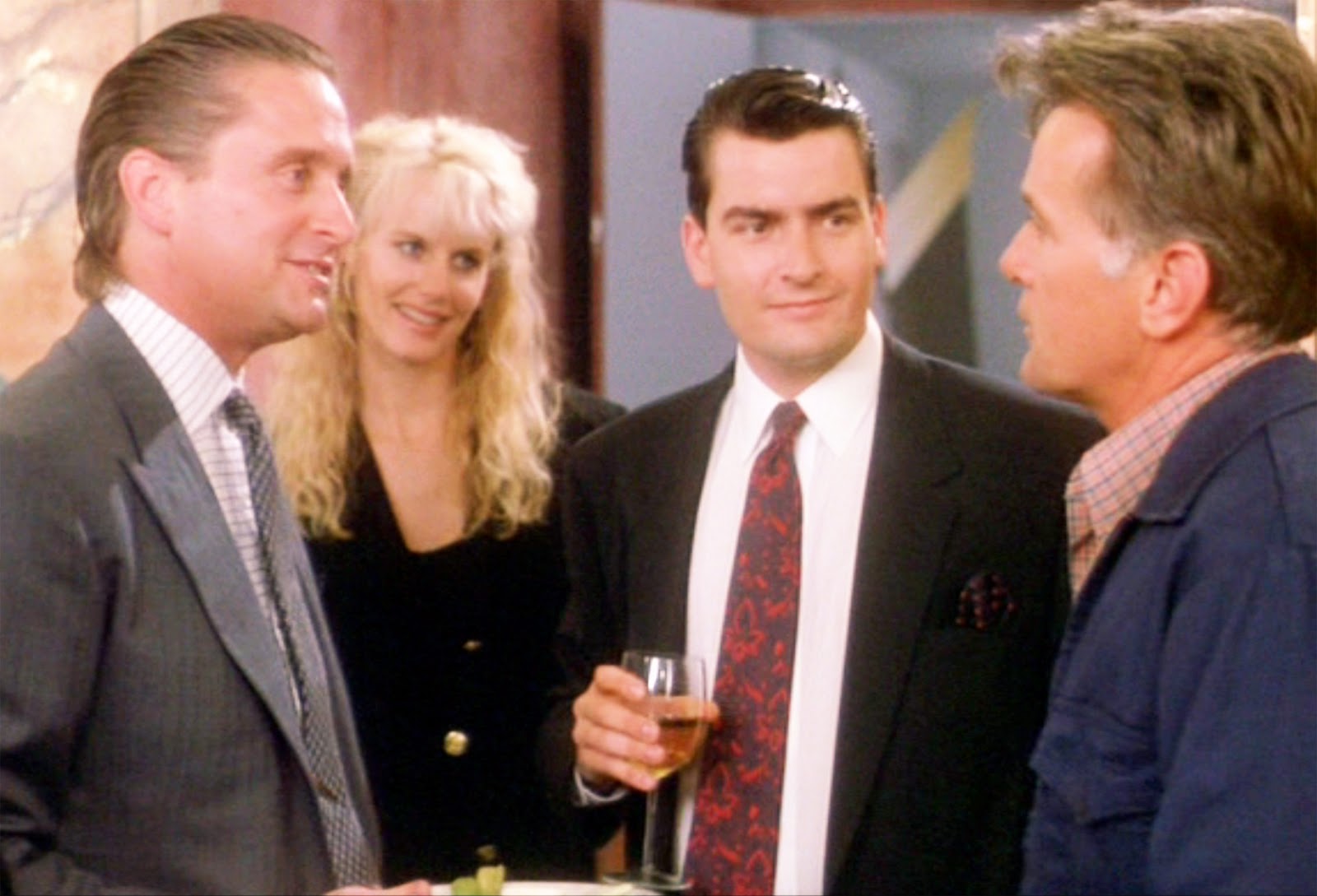
Bud Fox (Charlie Sheen) is a young but ambitious stockbroker at a middling Manhattan investment firm, still making cold calls to try and build up a client base. His father Carl (Martin Sheen) is a humble and honest aircraft maintenance crew chief at Bluestar, a fledgling airline. Bud's persistence finally pays off when he lands the extremely wealthy and ruthless corporate investor Gordon Gekko (Michael Douglas) as a client. Gekko likes what he sees in Bud, and takes him under his wing, exposing him to the power of inside information, the art of taking over corporations and breaking them up for great gains, and a world where obscene amounts of short-term profits can be derived from high-stakes stock price manipulation.

Gekko: The most valuable commodity I know of is information.

Bud's education includes meeting Sir Larry Wildman (Terence Stamp), an even wealthier investors and one of Gekko's chief rivals in the global corporate take-over game. Buoyed by success and fueled by Gekko's money, Bud starts tapping his college friends, including lawyer Roger Barnes (James Spader), to seek insider tips on upcoming mergers, and to set up bogus trading accounts to hide his activities from the Securities and Exchange Commission. Now very rich, Bud's life is fully transformed. He buys a swanky apartment and starts a serious relationship with glamorous interior designer Darien Taylor (Daryl Hannah). But when one of Gekko's upcoming deals threatens to hit close to home, Bud has to finally decide who he really is.

Gekko: What's worth doing is worth doing for money.

Fresh from the success of 1986's Platoon, director Oliver Stone moves from the jungles of Vietnam to the equally treacherous and shadowy terrain occupied by the manipulators of the global finance system. Wall Street is high-paced, magnetic and seductively glossy. Tracing the arc of  protagonist Bud Fox, Stone steps behind the curtain and into the offices of the power brokers who actually determine the winners and losers on Wall Street. It is a place both difficult to resist and absolutely corrupt, free of quaint principles related to morality and humanity, and driven solely by greed and profit.

Stone succeeds in making the world of Gordon Gekko fabulously attractive. For ambitious young men like Bud Fox, it's not difficult to be sucked into the promise of a life filled with limousines, lavish restaurants, expensive suits, glamorous women, high-end real estate and millions in the bank. It's a castle in the sky floating on high-stakes gambling with the odds tilted in favour of the Gekko's who profit from widespread malfeasance, and Stone builds up the allure with plenty of pizazz.  It's not easy to make financial transaction look exciting, and Stone pulls it off with energetic camera work and in-your-face scenes capturing the frenzy of the trading floors and the adrenaline rush of deal making in real time.

Gekko, talking to Bud: Wake up, will ya, pal? If you're not inside, you're outside, okay? And I'm not talking a $400,000 a year working Wall Street stiff flying first class and being comfortable, I'm talking about liquid. Rich enough to have your own jet. Rich enough not to waste time. Fifty, a hundred million dollars, buddy. A player, or nothing. Now, you had what it took to get into my office; the real question is whether you got what it takes to stay.

Not all of the film works perfectly. There are a couple of scenes, one between Bud and his father Carl and another between Bud and Gekko, where exaggerated emotions and shouting replace intelligent discourse. And Bud's awakening to the damage that Gekko and his ilk can cause is treated simplistically and rather abruptly. But overall, the script (co-written by Stone and Stanley Weiser) triumphs thanks to a treasure trove of sharp exchanges and observations, mostly courtesy of Gekko, that serve to define a caustic perspective on not just the world of capitalism, but the human condition itself.

The character of Gordon Gekko is an enduring symbol of the decade of greed, and Michael Douglas won the Best Actor Academy Award for creating a believable, even sympathetic, merchant of money. Gekko creates wealth, no matter the consequences, and Douglas' cold-eyed portrayal allows the character to make sense in a world where the limits of capitalism are unconstrained. Bud Fox may be the sympathetic core of the film, but Gordon Gekko emerges as its true voice, an unrepentant genius exploiting the system and selling his vision to anyone wishing to share the dividends.

Gekko, addressing an audience of corporate shareholders: The point is, ladies and gentlemen, that greed, for lack of a better word, is good. Greed is right, greed works. Greed clarifies, cuts through, and captures the essence of the evolutionary spirit. Greed, in all of its forms: greed for life, for money, for love, knowledge, has marked the upward surge of mankind.

Charlie Sheen does enough to carry Bud's journey without ever transcending the role. Daryl Hannah does well as the prestigious lover who comes with the money, unapologetic in her pursuit of the life that millions can buy. In addition to James Spader, the deep supporting cast includes roles for Hal Holbrook as a old-fashioned investor who still looks for long-term company value, Sean Young as Gekko's wife, and John C. McGinley as Bud's animated colleague, left behind when Bud moves into the stratosphere of investing.

Gekko: It's a zero sum game – somebody wins, somebody loses. Money itself isn't lost or made, it's simply transferred – from one perception to another. Like magic. This painting here? I bought it ten years ago for sixty thousand dollars. I could sell it today for six hundred. The illusion has become real, and the more real it becomes, the more desperately they want it. Capitalism at its finest.

Wall Street invests in quality film making and vigorous, character-driven storytelling, and achieves an exhilarating return on investment.


All Ace Black Blog Movie Reviews are here.


Saturday, 7 June 2014

Movie Review: Ace Ventura: Pet Detective (1994)


An exercise in abject silliness that actually works, Ace Ventura: Pet Detective unleashed Jim Carrey and his brand of over-the-top physical comedy on an unsuspecting world.

In Miami, Ace Ventura (Carrey) is a really weird and quite broke pet detective, hired to find and recover missing pets of all sorts. When Snowflake, the dolphin mascot of the Miami Dolphins NFL team, is abducted on the eve of the Super Bowl, the team's publicist Melissa Robinson (Courteney Cox) turns to Ace for help. But with the case attracting high public scrutiny, he quickly runs afoul of police lieutenant Lois Einhorn (Sean Young).

Ace's investigation leads him to believe that a member of Miami's 1984 AFC Championship winning team was responsible for Snowflakes' disappearance, and gradually a plot is uncovered involving a disgruntled former employee out to sabotage Miami's chances in the upcoming Super Bowl. A murder soon complicates the case, and star quarterback Dan Marino finds himself in a lot of trouble as the big game approaches.

1994 was Jim Carrey's spectacular break-out year, with The Mask and Dumb And Dumber joining Ace Ventura in catapulting the Canadian from obscurity to a comic superstar. Ace Ventura was the first to be released, a surprise hit that established Carrey's persona as a real life cartoon character, ridiculously expressive, living life according to a manic code of conduct that applies only to him, and extroverted to an extreme. Carrey has the uninhibited acting skills and dead-on timing essential to transform stupid behaviour to laugh-out-loud goofiness, and Ace Ventura showcases his skills to perfection.

There is really no other reason to watch this film. The plot is beyond inane, and the supporting cast is so thin as to be non-existent. Sean Young and Courteney Cox are meek foils to Carrey, and both are blown away into irrelevance. That rapper Tone Loc and quarterback Dan Marino are high up in the list of cast members says it all about the other talent on display. Director Tom Shadyac, making his debut, wisely ignores everything else and just trains his cameras on Carrey, who carries the film.

And riding on Carrey's energy, Ace Ventura is non-stop laugh fest. As a character Ace is indomitable, fuelled by misplaced self confidence and an inability to be rattled, whether facing a madman with baseball bat, wild gunmen, an incompetent police force, or a broken windshield. Whenever he appears to reach any limit his pushes for more comedy, catching bullets with his teeth, swimming with a shark, or exposing the evil mastermind against all logic. It's all ridiculous, and it mostly works as pure escapism.

Unapologetically ludicrous, Ace Ventura: Pet Detective crack the case of preposterous slapstick.


All Ace Black Blog Movie Reviews are here.


Thursday, 27 December 2012

Movie Review: Blade Runner (1982)


A triumph of visual style over narrative substance, Blade Runner is a magnificent sensory achievement. Director Ridley Scott creates a sombre future Los Angeles that is all too believable, and the stunning images enrich the otherwise standard story of a hunt for rogue replicants.

In 2019, the world's cities are polluted and overpopulated, and many humans live and work on other planets.  Human-like robots, known as replicants, are manufactured by the dominant Tyrell Corporation to help perform specific functions, but the powerful Nexus-6 models, built with a four-year limit on their life, are specifically prohibited from Earth due to violent tendencies. Retired Los Angeles police officer Rick Deckard (Harrison Ford) is a "Blade Runner", a specialist in tracking down and "retiring" rogue replicants. With the help of the mysteriously dark Gaff (Edward James Olmos), police chief Harry Bryant (M. Emmet Walsh) recalls Deckard to help in finding and eliminating four Nexus-6 models who have arrived illegally on Earth.

Led by Batty (Rutger Hauer), Leon (Brion James), Pris (Daryl Hannah) and Zhora (Joanna Cassidy) are searching for a way to overcome their four-year life limit. Deckard meets Dr. Eldon Tyrell (Joe Turkel) the main designer of the replicants, and Batty's primary target. Tyrell's latest experiment is Rachael (Sean Young), a replicant unaware of her status and injected with fake memories to help her believe that she is human. As a romance develops between Deckard and Rachael, Deckard tracks down first Zhora then Leon, but Batty and Pris find their way to J.F. Sebastian (William Sanderson), a genetic designer who can lead them to Tyrell.

Based on the Philip K. Dick short story Do Androids Dream Of Electric Sheep?, Blade Runner is working with limited source material, effectively a glorified but quite linear detective chase. Scott successfully fuses together a depressingly bleak future with basic film noir characteristics to create a memorably artistic tableau, rendering the actual plot quite secondary.

Blade Runner's dazzling achievement is a rich extrapolation of the present into a credible but horrendous future recreation of a large Earth city. The Los Angeles of 2019 is an overpopulated urban nightmare bathed in constant darkness, never-ending rain, persistently rising steam from unidentified cavities, and washed with the sickly glow of incessant, oversized neon corporate advertising. Mammoth, super-dense buildings dominate the cityscape, the population is mostly Asian, every inch of sidewalk is congested, and the police presence is pervasive in hovering "spinner" vehicles, their yellow beams of light adding to the suffocating environment. Every external scene in Blade Runner re-emphasizes this grim future, Scott making use of shadows and light to create a hallucinatory, recalibrated but frighteningly believable reality.

The film plays with several themes related to the essence of being human. The replicants are struggling against their unalterable built-in four-year life span, expressing the hopelessness of an existence that is certain of a termination date. Humans of course suffer the same certainty of death, but without knowledge of the expiration time, and the screenplay by Hampton Fancher and David Peoples questions the fairness of human-like creations, designed to express human emotions, but sabotaged in their ability to hope and dream, that most essential of human attributes. There are also puzzles related to Deckard (is he human or a replicant), and, ultimately, what does the future hold when the line between natural and man-made humans is blurred beyond obvious recognition.

With the film's appearance dominating the plot and characters, the performances are understandably subdued. Harrison Ford, looking to expand from the Star Wars universe, has little to work with, Deckard hard boiled enough but without the edge or wit afforded to classic film noir investigators. Rutger Hauer's Roy Batty emerges as the most dominant character, physically and emotionally imposing, a replicant who understands his role and fallibilities all too well. Sean Young wears the same sad and puzzled expression throughout, a not-so-fatale femme, Young as unassured about her performance as Rachael is about her humanity. Daryl Hannah, Joanna Cassidy, Brion James, William Sanderson and Edward James Olmos are colourfully good fits for their bizarre surroundings, but in limited roles none can benefit from any character evolution.

Blade Runner set a new standard for what a serious science fiction film could look like, in a universe where reality is not so much newly constructed as imaginatively stretched from the more austere elements of the present. It's an enduring cinematic achievement, the routine story compensated for by a dazzling package.


All Ace Black Blog Movie Reviews are here.


Sunday, 8 January 2012

Movie Review: Stripes (1981)


A showcase for the comedic talent of Bill Murray, Stripes is only as good as its star. Murray's laid-back sardonic style creates good friction with the motif of military discipline, but Stripes suffers from having little to offer other than Murray's attitude.

John Winger (Bill Murray) abandons his job as a taxi driver, is abandoned by his girlfriend, and has his car repossessed, all on the same day. He convinces his friend Russell Ziskey (Harold Ramis) that they should join the army, and off they go to training camp. The fellow recruits include the overweight Ox (John Candy) and an assortment of the psychotic and the dim. Drill Sergeant Hulka (Warren Oates) tries to make soldiers out of them, with limited success. Hulka's platoon muddles its way to graduation before becoming embroiled in an unexpected incursion behind the Iron Curtain.

Much of Stripes was improvised on the spot, director Ivan Reitman keeping the cameras rolling while Murray made things up and the other cast members reacted. It's a sometimes fascinating viewing experience, but the struggle to create a cohesive movie out of essentially uncoordinated comedy moments is also clear. Stripes sags and surges, meanders and regains focus, ultimately providing an interesting but bumpy ride.

When it works, Stripes delivers scenes of comic gold. Murray's speech to rally his platoon prior to the graduation ceremony is classic, as is the platoon's performance in the ceremony itself. But in the final 30 minutes featuring the unplanned invasion of Czechoslovakia, Stripes loses its way in a groan-inducing attempt to superimpose superfluous action onto a comedy, with mostly embarrassing results.

The thin ice of material that Stripes skates on is exemplified by a deleted sequence (restored in the Extended Cut) that has Winger and Ziskey hitch a ride on a military plane to an unnamed war zone, where they are captured by undefined heavily armed mercenaries and threatened with death, but save themselves when Winger starts singing Quando Quando Quando. It's a nonsensical interlude, scraping by on Murray's improvisational talent and spontaneity. A mud wrestling match between John Candy's Ox and a bevy of near-naked models is also a punch line stranded by an absence of meaningful context.

Elsewhere in the cast, Ramis proves to himself that he is no actor, his uncomfortable performance as Ziskey crossing the line from comic to incompetent. Warren Oates performs his function as the crusty drill sergeant with good intentions, while P.J. Soles and Sean Young as the Military Police officers who develop relationships with Winger and Ziskey realize early on that they need to be comely rather than convincing.

Stripes is a one-man comedy routine expanded into a military farce. It is remarkable that it works as well as it does, and this is testimony to Murray's unique talent to deliver cool humour with perfect timing.


All Ace Black Blog Movie Reviews are here.