Showing posts with label Mary Elizabeth Mastrantonio. Show all posts

Wednesday, 23 February 2022

Movie Review: Class Action (1991)

A legal drama, Class Action adds father-daughter tensions to a court room battle. The familial conflict and the pursuit of justice are both adequate, but vie for the same space.

In San Francisco, Jed Ward (Gene Hackman) is a celebrated lawyer at a small firm, known for representing victims of accidents caused by corporate negligence. His daughter Maggie (Mary Elizabeth Mastrantonio) is also a lawyer, but the opposite of her father. She is on a partner track at a soulless law firm defending large corporate interests. Maggie is also in a romantic relationship with her boss Michael Grazier (Colin Friels).

Maggie and Jed are barely on speaking terms. She blames him for emotionally abandoning the family and enjoying numerous affairs. Her mother Estelle (Joanna Merlin) suffered in silence, and the marriage survived. Now Jed and Maggie find themselves on opposite sides of the same case. He is representing burn victims claiming a defective design caused cars to explode on impact. She is defending the auto manufacturer. Estelle pleads with Maggie to turn down the case, but both father and daughter relish the opportunity to match wits in the court room.

Combining a David vs. Goliath court case with an inter-family feud guarantees drama at every turn, and director Michael Apted delivers as expected. Class Action is a proficient effort, corporate maleficence and cross-generational squabbling providing twin robust storylines to pursue. The production values are high, the visuals slick but controlled, and Mary Elizabeth Mastrantonio, without ever looking quite comfortable, does enough to avoid being mismatched by the dependable Gene Hackman.

But the script by Carolyn Shelby, Christopher Ames, and Samantha Shad is trying to tell two substantive stories in 105 minutes, and so predictably defaults to short cuts. On the home front, Jed's womanizing and his wife Etelle's decision to stand by her man are flash fried, leaving Maggie to simmer in rage as a perpetually angry daughter. In the courtroom, the testimony fast forwards only to the most essential witnesses, in a highlights package format devoid of build-up. And with all the event crowding in the middle, the car crash victims are marginalized and reduced to almost disrespectful sketch representations. 

The two narratives merge in Jed and Maggie's face off as representatives for the plaintiffs and defendants respectively. Class Action fleetingly pretends to walk the neutral line, before overlapping nefarious cover ups at the auto company and Maggie's law firm comprehensively tilt the balance towards Jed's cause. Here coincidences become far-fetched contrivances and a series of less than professional actions shine a bad light on several lawyers.

The talented supporting cast helps navigate the rough patches, and includes Laurence Fishburne as one of Jed's associates, Donald Moffat as the senior partner at Maggie's firm, and Matt Clark as the presiding judge.

In taking on perhaps too much drama, Class Action doesn't lose any arguments, but neither does it fully convince.


All Ace Black Movie Blog reviews are here.

Wednesday, 7 April 2021

Movie Review: The Abyss (1989)

An ambitious science fiction underwater survival adventure thriller with cold war undertones, The Abyss is visually stunning and technically astounding, but sidelines people in favour of machinery. 

The nuclear-powered USS Montana submarine sinks after an encounter with an unidentified object in deep waters near Cuba. With a hurricane moving in, the US Navy launches a rescue attempt. The crew of the nearby Deep Core underwater drilling platform led by Virgil "Bud" Brigman (Ed Harris) is hurriedly recruited to support a SEAL team under the command of Lieutenant Coffey (Michael Biehn). Deep Core's designer and Bud's wife Dr. Lindsey Brigman (Mary Elizabeth Mastrantonio) joins them, although the couple are on the verge of divorce.

Underwater, tensions rise when Coffey starts suffering from the effects of high-pressure nervous syndrome. Then mishaps leave Deep Core stranded at the bottom of the ocean without surface communications. Encounters with alien beings continue, with Coffey attributing the activity to enemy action and unilaterally deciding to nuke the area using one of the Montana warheads. Bud and Lindsey have to set aside their differences and work together to prevent a series of catastrophes and save each other.

Written and directed by James Cameron and clocking in at 140 minutes (an Extended Cut adds another 20 minutes), The Abyss borrows themes from science fiction landmarks including The Day The Earth Stood Still, 2001: A Space Odyssey and Close Encounters Of The Third Kind. The plot unambiguously stands against military action and nuclear escalation, and argues for protecting the environment and the majesty of the oceans. Meanwhile, technologically superior friendly beings keep watch on humanity's progress (or lack thereof).

To achieve his vision Cameron subjected himself, the actors and crew to a gruelling schedule of almost continuous filming in massive water tanks, with Ed Harris and Mary Elizabeth Mastrantonio taking the brunt of the physical strain. The effort registers on the screen, the action taking place almost entirely under water, the characters' exertion and exhaustion in battling frigid waters, deep underwater pressure, and the continuous risk of drowning adding to the drama's intensity.

But the film tries to do too much and never latches onto to a cohesive, human-centred direction. Bouncing from rescue mission to natural disaster then a survival ordeal before veering towards a crew-versus-SEALs hostage drama followed by a nuclear device countdown preceding a deus ex machina finale embellished with psychedelia, the narrative lurches from one crisis to the next, barely catching a breath or pausing for an explanation.

Along the way the machines take centre stage, especially in the clumsy and awkward opening 90 minutes, so eager to get wet that character definitions and human emotions are forgotten somewhere on the shoreline. It's late in the day by the time Bud and Lindsey finally break through the stock bickering and round into people worth caring about. Harris and Mastrantonio then deliver a couple of stellar and unforgettable sequences of love, heroism and sacrifice merging in exceptional tests of endurance. The Abyss is a technical marvel, but only soars when human warmth overcomes the frigid hardware.


All Ace Black Movie Blog reviews are here.

Thursday, 17 October 2019

Sunday, 26 April 2015

Movie Review: Consenting Adults (1992)


A klutzy thriller with an uneven tone, Consenting Adults tries to convey a slick erotic vibe but then morphs into ridiculous murder territory and sinks under the weight of its misguided pretensions.

Richard and Priscilla Parker (Kevin Kline and Mary Elizabeth Mastrantonio) are a typical suburban couple, working in the music industry, raising their daughter, grappling with some debt issues, and dealing with a passion-reduced marriage. Eddie and Kay Otis (Kevin Spacey and Rebecca Miller) move in as the new couple next door. Eddie is a fast-talking, risk-taking bundle of energy, with a solution to every problem, no qualms about bending the law, and a pushy personality.

The two couples become friends, and Richard can't help but be attracted to the winsome Kay, an amateur blues singer with a husky voice. Eddie pulls an insurance scam to generate some quick money for the Parkers, and then starts to hint at a wife-swap, initially horrifying Richard. But sensing that Priscilla may be open to the experience, Richard warms up to the idea. Then a bloody murder is committed, turning Richard's life completely upside down.

Directed by Alan J. Pakula, the first 45 minutes of Consenting Adults is a fairly interesting exploration of close to middle age angst, and the pressures of work, kids, and finances as they attack the stability of a marriage and leave it vulnerable to outside temptations. Eddie is a catalyst to stir the Parker relationship, and stir he does. Eddie offers a window into an attractive lifestyle where, with just a bit of innovative skirting of societal laws, everything can be refreshed.

The first half of the film peaks with the promise of the Parkers succumbing to sexual experimentation as the next step in spicing up their lives towards the dark side, and then the film falls apart. Whether or not intended as a clumsy thou-shall-pay-the-price-for-coveting-thy-neighbour's-wife morality tale, Consenting Adults jettisons all its thoughtful content and disintegrates into cheap, large plot-hole filled murder and mayhem territory, culminating in asinine Ramboesque infiltrations and no less a weapon than an Uzi submachine gun making a late appearance to settle scores.

Kevin Kline delivers what must be one the worst performances of his career. He spends the first half of the film in a dumbfounded, dormant trance, before suddenly turning into an action hero with Bruce Willis capabilities. Kevin Spacey dominates with his excitable portrayal of Eddie, an infectious personality that devours life. But even Eddie falls off the cliff of sanity, along with the back-half of the film. Mary Elizabeth Mastrantonio and Rebecca Miller are fine, but also underutilized. Forest Whitaker as an insurance company investigator and E.G. Marshall as a crusty lawyer make late appearances before disappearing into irrelevance, making way for the flying bullets and swinging baseball bats.

Consenting Adults is frozen between attempted cerebral thriller and botched cretinous action, and is finally just caught with its pants down.


All Ace Black Movie Blog reviews are here.

Sunday, 5 April 2015

Movie Review: Robin Hood: Prince Of Thieves (1991)


Another retelling of the legend, Robin Hood: Prince Of Thieves rides the charisma of star Kevin Costner but is an otherwise overlong and unnecessary rehash of a familiar story.

Robin Of Locksley (Costner) is part of King Richard The Lionheart's latest Crusade. Things are not going well and Robin is imprisoned in Jerusalem. He makes his escape along with a Moor named Azeem (Morgan Freeman). As Robin sails back to England, the evil Sheriff of Nottingham (Alan Rickman) assisted by his cousin Guy of Gisborne (Michael Wincott) and the evil witch Mortianna (Geraldine McEwan) takes advantage of the vacuum created by the King's absence to make a grab for power. Robin's father Lord Locksley (Brian Blessed) refuses to join the Sheriff and is killed.

Robin and Azeem arrive in England to find the Locksley estate destroyed. Robin connects with his childhood friend Marian Dubois (Mary Elizabeth Mastrantonio), a cousin of the King, but she is playing a cagey game of staying on good terms with the Sheriff to protect her estate. The Sheriff identifies Robin as a threat to his plans, prompting Robin and Azeem to escape into Sherwood Forest where they join forces with a band of farmers and misfits hiding from the Sheriff's brutality and high taxes. Robin organizes the group, which includes Little John (Nick Brimble), Will Scarlet (Christian Slater) and eventually Friar Tuck (Mike McShane), into a band of thieves, and they start to gather wealth by hijacking gold shipments while Robin plots a course to stop the Sheriff and avenge his father.

Directed by Kevin Reynolds, Robin Hood: Prince Of Thieves is an amiable enough romp through the legend. The film ticks all the boxes from action to romance, but cannot avoid a sense of paint by numbers, an assembly of elements lacking a soul. The settings are grand, the early scenes in Jerusalem are welcome, and when the swords clash and the arrows fly, the battles scenes achieve the requisite level of excitement and drama.

But the film carries an uneven tone, sometimes dipping into slapstick, occasionally trying for commentary about social justice, dabbling with tension among the ranks of the thieves, sprinkling some supernatural dust, deploying the requisite swashbuckling, playing with the theme of avenge thy father, and injecting romance here and there. It sometimes works in individual patches, but Reynolds is never able to create a unifying theme, and the severely bloated running time of 155 minutes does not help.

Star Kevin Costner coasts through the film with a "look how handsome I am!" posture, not really even trying to do much more than wow the camera with star power. Morgan Freeman is much better, and appears to be the only member of the cast with the necessary solemnity matched with wit to rise above the silliness. The bad guys lack venom and undermine the more dramatic aspects of the movie. Alan Rickman is mostly goofy as the Sheriff, and Michael Wincott is wasted as a less than fearsome Guy of Gisborne. Mary Elizabeth Mastrantonio tries hard but is never quite able to generate the required passion.

The film bursts into life in the final 30 minutes and offers a rollicking climax, the people rising up to bring down the Sheriff and his cronies as Robin claims his love and saves the day. The pivotal sword battle between Robin and the Sheriff raises an enjoyable bit of sweat. But when the dust settles and Sean Connery strides in for his cameo and Bryan Adams sings his smash hit "(Everything I Do) I Do It for You", it becomes apparent that Connery in two minutes is better than Costner in two hours, the song is better than the romance, and this version of Robin Hood recycles that which need not be recycled.


All Ace Black Blog Movie Reviews are here.

Wednesday, 5 March 2014

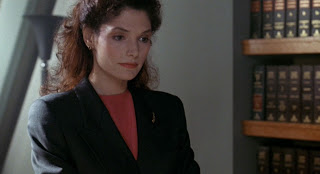
Movie Review: The Color Of Money (1986)


A worthy sequel to The Hustler (1961), The Color Of Money catches up with pool shark Eddie Felson in middle age, as he is about to be shaken away from the comforts of retirement. With effortless potency, Paul Newman reprises the role that he made famous, and finds a man ready to trade contentment for another shot at glory.

25 years after being forced to retire from shooting pool for money, Eddie Felson (Newman) is living a comfortable life, running a small bar, trading in alcohol, enjoying his girlfriend Janelle (Helen Shaver), and bankrolling mediocre hustler Julian (John Turturro). One evening Eddie spots young pool hot shot Vincent Lauria (Tom Cruise), and immediately recognizes a natural but guileless talent.

Eddie eventually convinces Vince and his girlfriend / manager Carmen (Mary Elizabeth Mastrantonio) to join him on a road trip to a tournament in Atlantic City. Along the way, they stop at derelict pool halls where Eddie tries to train Vince to become a hustler. But Vince hates to lose, even when losing means setting up a bigger payday. Meantime, Eddie starts to get the itch to pick up a cue and play again. Well before the trio reach Atlantic City, Eddie reaches a moment of truth, where he has to decide either to continue investing in Vince or to reactivate his own life.

To continue the story of one of the more compelling characters in movie history, director Martin Scorsese glamorizes shooting pool while celebrating the road trip grime that makes the world of hustling in small town halls irresistible to the Eddie Felsons of the world. The Color Of Money cruises as smoothly as Eddie's Cadillac, slicing through side streets filled with scrappy dives and the men who occupy them, waiting for the next mark to walk through the door.

The Color Of Money has a few too many stylish close-up shots of balls rolling on pool tables, Scorsese apparently hooked on the admittedly elegant sights and sounds of the game. From the satisfying thwack of the break to trick shots and near misses, the film immerses itself into the 9-ball culture, and unusually spends a lot of time on actual games scenes. This unnecessarily prolongs the film to two hours, and interrupts the more interesting character development aspects.

And it is the character of Eddie Felson, a full generation after the events of The Hustler, that is the centre of the film. The Color Of Money is the reawakening of Felson's soul from the purgatory of self-imposed pool exile, a journey sparked by his discovering of the next bright young thing in Vince, and more importantly, rediscovering the intoxicating allure of life on the road. Eddie belongs in the dank pool halls where he can smell the money and spot the players within seconds of entry, and his tutorship of Vince becomes a vehicle for reigniting his one passion in life.

Newman finally won his Best Actor Academy Award for a classy performance filled with middle age regret and renewed determination. Newman starts with a fulfilled Eddie not looking for any transformations, and ends with him finding renewed vigour, a lust for competition propelled by the need to make up for many years of lost time.

Tom Cruise holds his own opposite Newman, infusing Vincent with the slightly irritating exuberance of youth, naturally accompanied by smug cluelessness. Mary Elizabeth Mastrantonio exudes a cool detachment that may be attributed to an underwritten role, as the ambitious businesswoman who happens to be caught between her boyfriend and his mentor. In an early film appearance, Forest Whitaker has a small but critical role as a low key hustler.

For Eddie Felson, The Color of Money proves to be the green elixir that nourishes life.


All Ace Black Blog Movie Reviews are here.

Wednesday, 10 October 2012

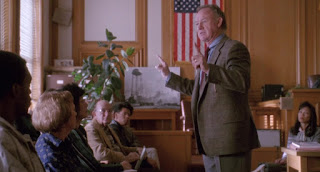
Movie Review: The Perfect Storm (2000)


Inspired by real events, The Perfect Storm is a melancholy ode to fishermen and a life spent battling the hidden dangers of the ocean in search of a livelihood. Director Wolfgang Petersen combines nature's fury with a human-centred drama that keeps memorable characters ahead of the raging special effects.

It's 1991, and the town of Gloucester, Massachusetts has for generations served as the home base to a fleet of swordfishing boats. Captain Billy Tyne (George Clooney) has been riding a recent streak of rotten luck, his boat the Andrea Gail bringing in a lot less fish than expected for owner Bob Brown (Michael Ironside). Although it's late in the season, Billy decides to set out for one more run, hoping to turn his luck around. His crew members are unenthusiastic about another exhausting fishing excursion, but they need the money. Among them is Bobby Shatford (Mark Wahlberg), who is planning to settle down with girlfriend Christina Cotter (Diane Lane), and although she begs him not to leave her again, he joins Billy for the extra cash.

With the Andrea Gail far out on the water as Billy searches for the perfect spot to snag the big fish, three different weather systems collide in the North Atlantic, creating a mammoth storm. Billy and his men make the decision to attempt a return home through the storm rather than wait it out at sea and watch their catch rot. Meanwhile, the leisure yacht Mistral is caught in the storm, and the three crew members need to be rescued in treacherous conditions by the Coast Guard. A Coast Guard helicopter subsequently runs out of fuel, ditches in the stormy seas, and the rescuers themselves are in need of a rescue.

By necessity, The Perfect Storm fills in a lot unknown gaps about the last journey of the Andrea Gail. Little is actually confirmed about what transpired on the boat's final journey, and given the relative freedom afforded by the absence of a historical record, the William D. Wittliff script, adapting the book of the same name by Sebastian Junger, imagines a moving scenario of tension, errors, conflicts, heroism and sacrifice.

The wisdom of including the story of the Mistral and the subsequent ditching of the Coast Guard rescue helicopter as part of The Perfect Storm's narrative is debatable. In real life the yacht that serves as inspiration for this incident was called the Satori, and of course a lot more is known about its rescue, and the subsequent drama of the Coast Guard needing to rescue their own after the chopper ditching. But in the context of The Perfect Storm, the Mistral story is introduced deep into the movie, almost as an afterthought, and generally takes away from the tragedy unfolding on the Andrea Gail. The crew of the Mistral (despite the presence of Karen Allen) and the Coast Guard rescuers remain largely faceless, stock characters, compared to the depth afforded to the crew on-board the Andrea Gail.

When the focus is on the fishermen and their lives, The Perfect Storm benefits from a stellar cast bringing to life the passion and yearning of the men and women who live and die by the sea. George Clooney finally found his breakthrough big-screen role as Captain Billy Tyne, a desperate man determined to risk everything to triumph over a devastating losing streak. Clooney's achievement is in making Billy likable despite him being down-on-his-luck and not very sociable. Both Clooney and Billy spring to life when the ocean demands the highest level of attention, and Clooney brings to the role the raw humanity of a most imperfect man facing his most cataclysmic challenge.

Mark Wahlberg as the young rookie Bobby Shatford provides able support as a willing and more than capable crew mate looking to make a few more dollars to kick-start  his domestic life. John C. Reilly as Murph is the veteran presence, perhaps what Bobby can look forward to several years on. Murph stokes a nasty feud with another crew member on board the Andrea Gail, in another example of The Perfect Storm not shying away from portraying the crusty edges of men who live in tight quarters for weeks on end in search of large smelly fish. Captaining a sister boat is Mary Elizabeth Mastrantonio as Linda Greenlaw, delivering a touching performance as Billy's soul sister and the last person to make radio contact with the Andrea Gail.

Back on shore, Diane Lane as Bobby's girlfriend and Janet Wright as his mother (and local inn keeper) represent the home front, and they add greatly to completing the fabric that defines a fishing community.

The cinematography by John Seale and the special effects crew masterfully recreate an angry ocean full of mountainous waves, furiously seeking to destroy any ship that dares to stray into the path of the hurricane. The Perfect Storm creates an intimidating canvass, with the fierce chill and threat of watery death flooding off the screen. The Andrea Gail battled against the odds and against gigantic waves, and she helped provide a lasting memorial for the power of nature and the men and woman who routinely venture into the teeth of danger.


All Ace Black Blog Movie Reviews are here.