Genre: Drama
Starring: Frances McDormand, Christian Bale, Kate Beckinsale, Alessandro Nivola, Natascha McElhone
Running Time: 101 minutes
Reviews of Classic and Current Movies

Rising star Steve Butler (Matt Damon) is dispatched by his employer Global Crosspower Solutions to secure gas exploration leases in a small Pennsylvania farming community. Steve has a stellar reputation for convincing landowners to sign quickly, and now he sets about ingratiating himself with the locals, assisted by his business partner Sue Thomason (Frances McDormand).
But their progress stalls when local high school teacher Frank Yates (Hal Holbrook) raises health and environmental concerns about the fracking process, and convinces the residents to hold a community-wide vote. Soon environmental activist Dustin Noble (John Krasinski) arrives in town to harden opposition to Global's plans. Steve and Sue have to improvise new methods to advance their cause, while Steve and Dustin compete for the attention of local farm owner Alice (Rosemarie DeWitt).
With a deft structure, Promised Land tackles the clash between economic development, resource extraction, and environmental impacts. While the plot leans - slowly but surely - towards arguing for protecting a traditional way of life, the screenplay by co-stars Krasinski and Damon at least gives all viewpoints a fair shake. Placing Damon's likable persona on the side of fracking is a wise move to stimulate debate, and Krasinski provides a solid counterweight, the two men sparring on opposite sides of a heated topic.
Both points of view carry weight. Damon's Steve Butler is provided a rural upbringing and a vantage point on the importance of industry. He speaks with personal conviction when putting forward his case for the farmers to accept and enjoy the riches coming to them from gas exploration, because otherwise their way of life is coming to an end. Krasinki's Dustin Noble is the scrappy but resourceful underdog, making life difficult for Steve and Sue by simply displaying blown-up images of dead cows on his family farm. Both performances are steady without requiring stand-out moments. Holbrook, McDormand, and DeWitt could all have been provided with more to do.Director Gus Van Sant adopts a patient approach, matching the restrained attitude with a small and scenic community where not much changes from one generation to the next. Moments of quirky humour lighten mood: Steve and Sue organize a community fair that does not go as planned, and the puzzle of small horses is a running source of amusement.
The battle for a community's soul ramps up to a couple of juicy-good late twists. However, the subsequent denouement is a clumsy let-down, a moment-of-triumph transformation landing with an unconvincing thud on the gym floor. Promised Land is attracted to the greener option, but is better when contemplating both sides of the fence.
All Ace Black Movie Blog reviews are here.
The setting is northern Minnesota in 1989. With her two children in tow, Josey Aimes (Charlize Theron) escapes an abusive relationship and takes shelter at the home of her parents Hank and Alice (Richard Jenkins and Sissy Spacek). To support herself she accepts the advice of her friend Glory (Frances McDormand) and takes a job at the local iron mine, where Hank works.
Josey finds the mine dominated by misogynistic and abusive men hostile to all the women workers. She is consistently subjected to demeaning insults, particularly from her manager Bobby Sharp (Jeremy Renner). Josey and Bobby knew each other from high school days, and now he persistently humiliates her with unwanted sexual advances. Both the union and management refuse to intervene. While the other women accept the abuse as part and parcel of the workplace, Josey reaches her limit and decides to take a stand, with help from lawyer Bill White (Woody Harrelson).
Inspired by the true story of Lois Jenson as chronicled in the book Class Action by Clara Bingham and Laura Leedy Gansler, North Country is a polished but also traditional workers' rights drama, highlighting a milestone case that set new standards for protecting women. Michael Seitzman's script combines courtroom face-offs, harrowing scenes of workplace cruelty, and Josey's hardscrabble life, and director Niki Caro weaves together a story about the quest for basic respect.
The depictions of workplace harassment inject a large dose of exasperated anger at a culture that can harbour unconscionable acts and tolerate - indeed protect - atrocious male behaviour. The women's reactions and survival tactics are presented on a spectrum, from Glory insulating herself with a union role, to Big Betty (Rusty Schwimmer) shrugging it off, while others like Sherry (Michelle Monaghan) suffer in silence for fear of losing their jobs. As Josey raises concerns and starts to push back, the men retaliate with worse treatment, and the women exorcise Josey as a troublemaker threatening their livelihood.But in some ways North Country tackles too much story. Josey's history, which of course becomes a topic of courtroom cross-examination, includes a high school encounter with a teacher, then an abusive relationship. Caro is sometimes at risk of trying to focus on too many directions at once, and in addition to the mine as employer, more than one man are presented as predators and placed in the position of pseudo-defendants. The melodramatics at the conclusion of the cinematic court case are also over-cooked to a crisp.
But an excellent cast helps overcome the weaker moments, with Charlize Theron and Frances McDormand the standouts. Theron is most effective during moments with her family, while McDormand deploys a hard shell at the workplace then navigates a life-altering disease.
Peripheral themes add essential texture, including an inter-generational conflict within the family: Josey's father Hank instinctively agrees the mine is no place for women. Meanwhile Josey's struggles to be a good mom provide a warm flow to her tumultuous life, the troubled relationship with son Sammy an always spiky source of tension. Glory's husband Kyle (Sean Bean) plays a small but pivotal role with Sammy, and Woody Harrelson delivers an effectively low-key performance as a former high school hockey star turned lawyer with emotional scars of his own.
Expertly calibrating infuriation with triumphalism, North Country stands up for dignity.
All Ace Black Movie Blog reviews are here.
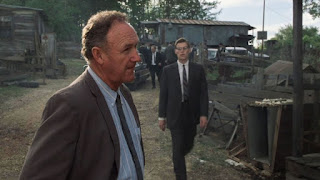
In 1964, three civil rights activists (two whites and one black) advocating for black voter registration are shot and killed in Jessup County, Mississippi. Initially only aware that the men are missing, the FBI send agent-in-charge Alan Ward (Willem Dafoe) and veteran agent Rupert Anderson (Gene Hackman) to investigate. Ward is urbane, young and idealistic; the grizzled Anderson is originally from the south, and the two men disagree about almost everything.
Ward and Anderson immediately clash with Sheriff Ray Stuckey (Gailard Sartain) and his Deputy Sheriff Clinton Pell (Brad Dourif), who are both racists and friendly with local Ku Klux Klan leader Clayton Townley (Stephen Tobolowsky) and his chief goon Frank Bailey (Michael Rooker). Ward calls for support from more FBI agents, creating a media storm, infuriating Mayor Tilman (R. Lee Ermey), and increasing arson and violence against blacks in the community. With the locals stonewalling the investigation, Anderson attempts to get close to Pell's wife (Frances McDormand), who may hold key information about the missing men.
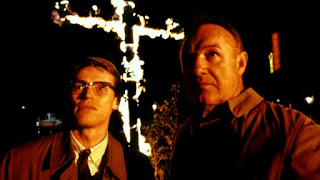
A deep dive into a boiling cauldron, Mississippi Burning explores the naked face of racism, not only alive and well but also in control of civic institutions. Loosely based on the murders of activists James Chaney, Andrew Goodman, and Michael Schwerner, director Alan Parker and writer Chris Gerolmo craft a gorgeous-looking and soulful drama, an ironically beautiful portrait of nefariousness.The elegant cinematography by Peter Biziou majestically captures a rustic setting of dusty roads, rural backwoods, dilapidating structures, and remote swamps stuck in time. Against this backdrop the excellent cast shines, Gene Hackman a particular joy as a seen-it-all agent deploying charismatic old-school methods to shake up the inhabitants of a gutter. Frances McDormand also stands out in a fragile role as the one local who may represent a path to enlightenment.
Beyond the rampant racism, the film finds enormous power from a tension-is-everywhere ethos. The locals resent the intrusion of the suited FBI agents. Ward and Anderson are at each other's throats, sometime literally. Secrets reside in the walls at Deputy Pell's household. Black community members are intimidated into silence. Churches and homes are firebombed, as the endless investigation causes tempers to boil over. And with Anderson's prodding, fissures eventually develop among the Klan members.
The film is not without faults. The narrative focusses only on white characters (as both heroes and bad guys), with the black community respectfully represented but confined to the background without a single prominent role. The three victims are also short-changed, and in fact barely named. And the final third, while still inspired by real events, leans towards gung-ho investigative tactics as a pressure relief valve to wrap up proceedings.
But Mississippi Burning glows brightly where it matters most, exposing the inhumane consequences of emboldened rot nurtured by poverty and ignorance.
All Ace Black Movie Blog reviews are here.
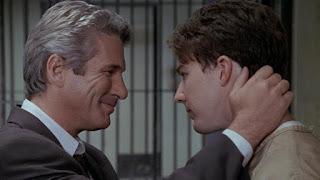
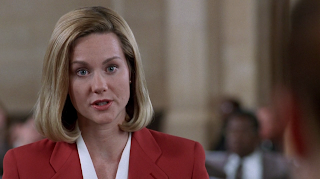
In Chicago, the respected Archbishop Rushman (Stanley Anderson) is brutally murdered. The police quickly arrest altar boy Aaron Stampler (Edward Norton) as he is escaping from the scene covered in blood. Celebrity defence lawyer Martin Vail (Richard Gere) offers his services to Aaron pro bono. Prosecutor Janet Venable (Laura Linney), one of Martin's ex-lovers, is assigned to the case, with a mandate from her boss District Attorney John Shaughnessy (John Mahoney) to secure a conviction and the death penalty.
The prosecution's case against Aaron is strong but lacks a motive. Martin interviews the stuttering, soft-spoken Aaron, and determines the simple young man from Kentucky is incapable of murder. Martin recruits psychologist Dr. Molly Arrington (Frances McDormand) to evaluate Aaron, while his team uncover several plots swirling around the Archbishop, including a politically-driven land development deal and evidence of sexual impropriety. In the courtroom of Judge Shoat (Alfre Woodard), Martin and Janet square off, but in an already complicated and high-profile case, surprises await them both.
An adaptation of the William Diehl novel directed by Gregory Hoblit, Primal Fear is a richly textured drama. Packed with revelations, the plot finds new twists at regular intervals, and despite plenty of artistic freedoms stays just on the right side of cinematically credible. The Archbishop's murder is only the starting point, and before long sub-plots related to corrupt business deals, pedophilia, and personality disorders merge into a grand, multi-faceted mystery.Of course some of the detours are elaborate distractions to cast doubt and open new avenues of potential guilt and innocence, prolonging the fundamental guessing game around Aaron's role. The altar boy as an innocent victim caught in the wrong place at the wrong time is Martin's thesis for the defence, but Aaron could also have been a pawn in much larger game, or holding his own difficult-to-uncover motive.
In his big screen debut, Edward Norton's performance as the hesitant, deferential, and scared Aaron is a stunning bolt of lightning. But then Martin and Dr. Arrington delve further into the defendant's psyche and reveal much more to his character, and Norton moves to a higher level of dominance, evolving into a formidable and unpredictable presence.
The rest of the cast is packed with talent, Richard Gere infusing Martin Vail with plenty of depth and arrogant confidence in the central role. In contrast Laura Linney struggles with a choppy definition of prosecutor Janet Venable, often caught in unconvincing demonstrations of tough mannerisms.
At 130 minutes, Primal Fear goes on, and along with writers Steve Shagan and Ann Biderman, Hoblit could have tightened the pacing. A foot race involving another alter boy with something to hide is wholly unnecessary, some of the courtroom shenanigans could have been truncated, and the sexual tension between Martin and Janet is overplayed and loops in repetitive circles.
But Primal Fear is an overall gripping legal thriller. The courtroom manoeuvres maintain a pointed level of drama as intersecting battles of wits and wills play out, some plain to see, others just plain devious.
All Ace Black Movie Blog reviews are here.
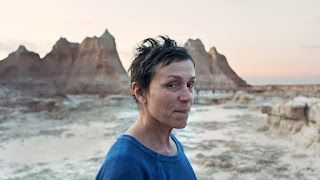
The industrial town of Empire, Nevada, is abandoned after the last manufacturing plant shuts down. Fern (Frances McDormand) also loses her husband to disease. She packs up her belongings in a van and sets off to live a nomadic, house-less life, picking up odd jobs where she can find them and falling in with a community of like-minded individuals living on the margins. She meets fellow nomad Dave (David Strathairn), and they start a friendship of sorts, but Fern is most comfortable on her own, in her van.
Less driven by plot and more an exercise in patient observation, Nomadland settles for capturing rugged natural beauty and unfiltered stories. McDormand and Strathairn are joined by a cast of non-actors sharing their experiences, and director Chloé Zhao adopts a slow pace and non-judgemental stance, finding the humanity and pride within a group functioning outside the norms.
Despite embracing solitude and a sense of individualism, moments of happiness and sadness emerge to underline common benevolence. Each in their own way the nomads are victims of circumstances and unforgiving economic or health crises, but they are united in nevertheless defining an independent road towards self-improvement and progress.Fern is crusty and has difficulty conveying friendliness, but stresses the difference between homeless and house-less. Through her sister and later with Dave, she has options to live much more comfortably, at least in a strictly physical sense. But after the trauma of losing her town and her husband, the van comes to represent a deeply ingrained attachment to a form of stubborn personal freedom and self-reliance, and Nomadland succeeds in defining the lifestyle as a form of choice.
The hardships inherent in living in a cramped space on wheels are not glossed over. In between vistas of open landscapes and close-ups of a welcoming nature, Zhao takes the time to convey the constant battle against the bitter cold, finding the next casual job, dealing with sickness, the strain of equipment failure, and mundane but essential biological functions.
Fern, David and the community of people they meet all possess private motives to embrace a different style of life. Unburdened by traditional cinematic structure, Nomadland is similarly comfortable with a lack of convention.
All Ace Black Movie Blog reviews are here.