Showing posts with label Orlando Bloom. Show all posts

Monday, 2 June 2025

Movie Review: The Outpost (2019)


Genre: War Action  
Director: Rod Lurie  
Starring: Scott Eastwood, Caleb Landry Jones, Orlando Bloom  
Running Time: 123 minutes  

Synopsis: During the Afghanistan War, the US Army establishes the remote Kamdesh combat outpost, ostensibly to reach out to local leaders and help with reconstruction efforts. Situated in a northern valley surrounded by mountains, the outpost is an easy target for Taliban militants. The soldiers at the base learn to deal with daily enemy small-arms fire, but are wary of an impending large-scale attack. That day arrives in October 2009, and 53 US soldiers have to defend the base against 300 Taliban attackers. 

What Works Well: Based on an actual Alamo-like battle known as the Battle of Kamdesh, this is a gritty ground-level war movie. The first half establishes the outpost routine, a combination of brotherhood bravado, isolation, clumsy attempts at connecting with locals, daily skirmishes, sudden losses, and the realization that something really bad is inevitable. The second half is fully occupied with the few-against-many battle, and director Rod Laurie covers the chaos and bravery up-close with mobile cameras that join the scattered American soldiers as they desperately attempt to fend off the enemy and save the fallen.

What Does Not Work As Well: Although focus eventually settles on the heroics of Staff Sergeant Clint Romesha (Scott Eastwood) and Specialist Ty Michael Carter (Caleb Landry Jones), this is an ensemble piece placing the collective ahead of the individual, at the cost of any meaningful character depth. Too many soldiers and micro-actions compete for limited time and space, while the opposing side is reduced to a context-free rampaging horde.

Key Quote:
Sergeant Romesha: Every time they take a pot shot at us, they're figuring us out. When the big one comes, they'll have us dialed in.


All Ace Black Movie Blog reviews are here.

Saturday, 1 June 2024

Movie Review: Unlocked (2017)


Genre: Espionage Thriller  
Director: Michael Apted  
Starring: Noomi Rapace, Michael Douglas, Orlando Bloom, Toni Collette, John Malkovich  
Running Time: 98 minutes  

Synopsis: In London, CIA Agent Alice Racine (Noomi Rapace) is an interrogation specialist traumatized by her inability to prevent a bombing in Paris two years ago. She is called back to active service to interrogate an apprehended courier who holds key information about an impending terrorist attack involving biological weapons. Her assignment quickly spirals into a race against time involving Alice's ex-boss Eric Lasch (Michael Douglas), former soldier Jack Alcott (Orlando Bloom), MI5 Intelligence Chief Emily Knowles (Toni Collette), and CIA Europe Division Chief Bob Hunter (John Malkovich).

What Works Well: This a smart, well-constructed, fast-paced, and twist-filled thriller. Writer Peter O'Brien minimizes over-the-top action scenes in favour of strategic and tactical surprises, rewarding concentration, thoughtfulness, and anticipation. With an emphasis on efficiency, veteran director Michael Apted maintains control over content-rich plot machinations fueled by a trust deficit. Noomi Rapace leads a stellar cast with a combination of grim determination and resourcefulness, while Orlando Bloom, John Malkovich, Toni Collette, and Michael Douglas add quality in smallish roles.

What Does Not Work As Well: With so much going on, it's no surprise that some of the details get frazzled, and important characters are short-changed in a crowded cast list. 

Conclusion: Unlocks refreshingly serious spy schemes.


All Ace Black Movie Blog reviews are here.

Sunday, 17 October 2021

Movie Review: Elizabethtown (2005)

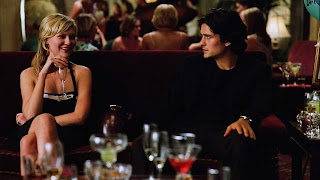
A romantic drama-comedy exploring themes of loss, Elizabethtown is a sweet but uneven journey through the complexities of family ties and coping with failure.

In Oregon, Drew Baylor (Orlando Bloom) is a superstar shoe designer at the Mercury sportswear company. When his latest design flops, eccentric owner Phil DeVoss (Alec Baldwin) faces a billion dollar loss, and Drew's girlfriend Ellen (Jessica Biel) distances herself from their relationship. Drew considers suicide, but his sister Heather (Judy Greer) calls with news their father Mitch has died suddenly while on a trip to his hometown of Elizabethtown, Kentucky.

On the near-empty overnight flight, Drew befriends perky flight attendant Claire Colburn (Kirsten Dunst). In Elizabethtown he meets his father's friends and relatives, and understands the depth of affection towards Mitch, although the Baylors never welcomed Drew's mother Hollie (Susan Sarandon). Over the coming few days Drew and Claire continue to see each, while Hollie causes waves by showing up for the memorial service.

Written, directed, and co-produced by Cameron Crowe, Elizabethtown is an uncoordinated but still engaging mishmash. Humour, drama, romance, culture shock, grief, a travelogue, and familial conflicts take turns setting the tone. The result is awkward, sometimes jarring, but always reasonably watchable despite an overstuffed, often whiny, soundtrack, although the inclusion of Lynyrd Skynyrd's Freebird makes up for a lot of the dross.

The film suffers most trying to define a narrative flow and logical transitions, and never really finds the magic formula. Segments exist in isolation almost as stand-alone ideas. A chunk of time is occupied in developing the romance between Drew and Claire, although their conversations border on obtuse. Frustratingly, Claire is confined to the prototypical perfect potential girlfriend who just happens to land in the protagonist's lap as an emotional saviour in his most desperate hour.

Then another long sequence gives the stage (literally) to Susan Sarandon as Hollie, trying in one night to make up for a lifetime of estrangement from Mitch's family. A final chapter steers (again, literally) into a road trip of southern landmarks. Drew grieving his career fiasco and the loss of his father are supposed to provide an arc, but the dramatic themes are only modestly refined.

The humour is derived from some typical familial quirks, including the uncles, aunts, cousins, and nephews Drew has to get to know in a hurry. Cousin Jesse (Paul Schneider), once in a Lynyrd Skynyrd tribute band, is now raising a very loud kid and is a particular source of laughs. At the hotel, Drew's room is on the same floor as a raucous wedding event, another venue for passable chuckles. 

A running joke is that Elizabethtown is difficult to find on the map. This hometown contains some charm, but is also easy to bypass.


All Ace Black Movie Blog reviews are here.

Wednesday, 17 January 2018

Movie Review: Pirates Of The Caribbean: The Curse Of The Black Pearl (2003)


A pirate adventure yarn, Pirates Of The Caribbean: The Curse Of The Black Pearl is overstuffed and overlong.

In a prologue, young Elizabeth Swann is on a cross-ocean journey to Port Royal when the ship she is on helps rescue young William Turner from a skirmish involving the legendary pirate ship Black Pearl. With William unconscious, Elizabeth takes a rare medallion from around his neck. Years later, Elizabeth (Keira Knightley) is being wooed by Commodore James Norrington (Jack Davenport), but her true love may be the grown-up Turner (Orlando Bloom). Meanwhile, Pirate Captain Jack Sparrow (Johnny Depp), a free-spirited maverick, washes up without a crew or a ship, looking to seize a new vessel.

Suddenly Port Royal comes under attack from the Black Pearl, commanded by Captain Hector Barbossa (Geoffrey Rush) and intent on recovering the lost medallion in order to break a curse of undeath. In the ensuing battle, Sparrow duels with Turner, who is now an expert blacksmith and sword maker. Elizabeth is captured by Barbossa, and when Sparrow learns of Turner's identity and lineage, the two men team up to try and mount a dangerous rescue operation.

Noisy, silly and interminable at 142 minutes, The Black Pearl showcases a laid back Johnny Depp modernizing the pirate persona with a large dose of chill irony. Jack Sparrow's detached mannerisms offer a bare minimum of interest as the rest of the movie slowly sinks under the weight of excess. Directed by Gore Verbinski, Black Pearl was inspired by Disney's theme park ride, and the lack of any cohesive plot elements beyond the most mundane ideas is achingly evident. This is a film all about visuals and attitude, the plot a muddled and distant afterthought.

Black Pearl descends into endless CGI-generated sword fights and other mindless escapades involving hordes of animated skeletons and faceless extras, with the characters bouncing between ship and shore action in pursuit of the next boring set-piece. Elizabeth, Jack and Turner take turns being held captive and then rescued all to serve the next tiresome confrontation between computer-generated figurines. An ancient curse, a medallion treasure and the undead in the moonlight may captivate the eight to twelve year old set, but even they will tire of sitting through two hours and twenty minutes of repetitive flimsiness.

Sparrow is an intriguing character and Depp deserves credit for inventing a new pirate prototype, but too often Sparrow is a sidelined observer in his own movie. He intervenes with a smart move every half hour or so, but overall plenty of blurry mayhem passes him by. Verbinski at least ensures that Black Pearl is often atmospheric and good to look at. But this is clever packaging without content, a cynical asset monetization exercise devoid of soul.


All Ace Black Blog Movie Reviews are here.


Wednesday, 24 August 2016

Movie Review: Kingdom Of Heaven (2005)


A historical epic based on real events, Kingdom Of Heaven is ambitious in scope and thoughtfully examines turmoil in the Holy Land during the Crusades. While the politics and battles are engaging, the film lacks emotional depth.

It's 1184, about a hundred years after the first wave of crusaders established a Kingdom in Jerusalem. Balian (Orlando Bloom), a blacksmith in the French countryside, has just suffered the loss of his wife through suicide. He reconnects with his father, the respected Baron Godfrey of Ibelin (Liam Neeson), a crusader making his way back to the Holy Land. Godfrey is wounded in a skirmish along the way, but Balian makes it to Jerusalem, where he finds the Leper King Baldwin (Edward Norton) ruling Jerusalem by allowing peaceful coexistence among all faiths and maintaining hold of a tenuous peace with Saracen leader Saladin (Ghassan Massoud).

The Marshal of Jerusalem Tiberias (Jeremy Irons) is an ally of the King, but the Knights Templar, under the leadership of Guy de Lusignan (Marton Csokas) and Raynald of Châtillon (Brendan Gleeson) are blood thirsty and power hungry, eager to set off a war with Saladin to impose Christian rule. To complicate matters, Guy is married to Baldwin's sister Sibylla (Eva Green). Balian settles down to working his father's lands, but with the Knights agitating for a war and Baldwin in ailing health, peace in the Holy Land is about to crumble.

Directed by Ridley Scott, Kingdom Of Heaven combines grand scenes of battle with an individual quest for life's true purpose. The film is passable both as a spectacle and a human drama, but never soars in either direction. Balian's story is interesting but never breaks through to a genuine level of engagement, while the army clashes are intense but often disintegrate into extras being thrown into a meat grinder.

At 144 minutes in length (with a much longer Director's Cut also available), the film is ambitious but doesn't create enough of a central drama to sustain its weight. Balian's story is a search for an objective after he loses his wife and commits murder in a rage, and his ponderous self-reflection does not always sit well in the context of massive historical events. It does not help that most of the dialogue is delivered with self-conscious importance, as if the characters knew they were partaking in events that would one day be chronicled in an important movie.

The rather unimaginative cast is adequate without threatening to compete with the grand sets and historical occasions. Orlando Bloom and Eva Green are promoted beyond their abilities to the front of a large production, and are not helped by an ill-defined and truncated romantic sub-plot. Liam Neeson, Jeremy Irons and Edward Norton carry better gravitas but are unfortunately confined to smallish roles.

The film reaches a highlight with Saladin's siege of Jerusalem, the outnumbered Balian organizing a clever defence, his objective not so much victory but the carving out of a bargaining opportunity. Scott excels at quite stunning scenes of massive armies on the move, long range and close combat action, and city walls being grimly contested to the death.

Screenwriter William Monahan does not try to disguise the film's noble intentions: the Holy Land has been a place of strife and religiously-motivated slaughter for millennia, and the path of peace can only be plotted by characters like the righteous knight Godfrey, the brave blacksmith Balian, and the benevolent King Baldwin. They have their flaws, but they all look past the individual towards the collective and seek accommodation in search of the greater good. Alas, evil co-exists in plain sight, possessing small minds but great power. The bad guys are embodied by Guy and Raynald, and the religious zealots do enough to topple the fragile peace from its perch and reignite war.

Kingdom Of Heaven is a glossy treatment of a sensitive subject, and ultimately goes out of its way to confirm the obvious: in this part of the world the names, affiliations and weapons will change, but violence in the name of God prevails across generations.


All Ace Black Blog Movie Reviews are here.


Sunday, 8 May 2016

Movie Review: Black Hawk Down (2001)


Based on real events, Black Hawk Down is a stellar war movie. The depiction of the Battle of Mogadishu is a stirring story of a mission gone wrong, and the men who had to subsequently rescue each other and limit the damage.

It's October 1993, and US forces including Army Rangers and elite Delta Force troops are stationed in Mogadishu, Somalia. Initially deployed on a famine relief mission, the US military is getting embroiled in a local civil war among squabbling warlords who do not hesitate to use starvation as a weapon. Powerful militia leader Mohamed Farrah Aidid is designated as the worst of the bad guys. Delta Force operators do capture arms dealer Osman Ali Atto (George Harris), but are no closer to shutting down Aidid's operation.

Based on sketchy intelligence, Major William Garrison (Sam Shepard) hurriedly cobbles together a mission to try and capture Aidid and his top aides while they meet at a safe house. American troops backed by helicopters leave the safety of their airport headquarters and delve into the dense Aidid stronghold of Bakaara Market within the labyrinthine confines of Mogadishu. Intended to last less than an hour, everything that can go wrong on the mission does go wrong, with thousands of militiamen taking up arms against the small American extraction team and shooting down two Black Hawk helicopters. The American forces get caught in a nightlong quagmire, incurring heavy losses while they try to rescue fallen soldiers and escape from a city filled with countless enemies.

Directed by Ridley Scott and based on the best-selling book by Mark Bowden, Black Hawk Down is an exhilarating war movie. After a slowish start to establish the premise, the film explodes into an unrelenting two hours of non-stop intensity as the battle is covered from several angles. As far as representing the grim agony of street warfare in third world cities against overwhelming opposing forces, the film stands a class apart. Scott and cinematographer Sławomir Idziak capture the chaos, confusion and danger-around-every-corner that characterizes modern urban warfare.

Soldiers are separated from each other, seemingly straightforward tasks like getting to the crash sites and rescuing the pilots turn into cascading disasters, with the rescuers needing rescue. Every block is a battleground, every window, doorway and rooftop a source of danger. Soldiers perform impromptu surgery, while others push ahead despite wounds and exposure to comrades killed under horrific circumstances. The film rams home both the insanity of war and the courage of the men who make it their profession.

Black Hawk Down does get a few things wrong. The Somalis are all faceless hordes, the definition of a blood thirsty enemy presented with no context. Back in the early 1950s Hollywood started to humanize natives in Westerns and then Germans in World War II movies. To produce a 2001 film without a modicum of perspective on what the other side is willing to die for is quite myopic.

Also relatively poor is the lack of distinction among the American fighting men. Josh Harnett, Tom Sizemore and Eric Bana emerge as individuals due to defined character traits, but the rest of the men are effectively interchangeable, and once bulked up in equipment and helmets, they all look the same. The large cast includes Orlando Bloom, Ewan McGregor, Tom Hardy, Jeremy Piven and William Fichtner.

But the objective of the film is to celebrate the armed forces, and to snatch a moral victory out of an astounding defeat which carried huge local tactical and overall strategic resonance. After the Mogadishu humiliation the US was seen as weak, defeatable, and quick to cut and run. But at the level of the fighting men, Black Hawk Down does reinforce the one-for-all and all-for-one ethos of the military, the heroic sacrifices, and no-man-left-behind principles. Against overwhelming odds the street battles feature countless examples of men risking their lives to help others, a band of brothers mentality that turns individuals into an army.

Loud, severe and imperfect, Black Hawk Down passionately captures the ugly realities of war as waged in hostile cities.


All Ace Black Blog Movie Reviews are here.


Monday, 27 August 2012

Movie Review: Troy (2004)


An epic adaptation of Homer's Iliad, Troy is a wildly enjoyable romp through ancient Greek mythology.  The mammoth scope of the Trojan War and the intriguing mix of characters involved in the siege, including kings, combatants, and their women, are brought to life with a lavish treatment enhanced by stunning cinematography and sweeping special effects.

It's the 8th century BC, and after years of warfare, king Agamemnon (Brian Cox) has almost succeeded in unifying all the Greek kings and armies under his command. The demi-god Achilles (Brad Pitt), the most fearsome warrior in the land, holds no respect for Agamemnon but does help in battles, as his destiny is to engage in constant war. King Odysseus (Sean Bean) is loyal to Agamemnon and one of the few men that Achilles respects, and acts as intermediary between the two.

Odysseus: Men are haunted by the vastness of eternity. And so we ask ourselves: will our actions echo across the centuries? Will strangers hear our names long after we are gone and wonder who we were, how bravely we fought, how fiercely we loved?

While the coastal city of Troy remains independent behind its imposing defensive walls, Agamemnon's brother king Menelaus (Brendan Gleeson) negotiates a peace treaty with Troy's two princes, Hector (Eric Bana) and Paris (Orlando Bloom). Hector is older and more mature, but the younger Paris is less experienced, more impetuous, and foolishly falls in love with Helen (Diane Kruger), Menelaus' wife. When Helen decides to join Paris on his return journey to Troy, Menelaus is personally outraged, but Agamemnon recognizes the opportunity to use the illicit love affair as an excuse to launch an all-out assault to subjugate Troy.

Agamemnon: Peace is for the women, and the weak. Empires are forged by war.

Assembling a massive army of 1,000 ships and 50,000 soldiers, including Achilles and his young cousin Patroclus (Garrett Hedlund), Agamemnon wages a vicious war against a stubborn Troy and its king Priam (Peter O'Toole). The campaign is full of bloody battles, unexpected triumphs, and setbacks for both sides, in the midst of which Achilles nurtures a romantic relationship with Hector's cousin the priestess Brisies (Rose Byrne), before the most famous ruse in warfare history is conceived by Odysseus to turn the tide of battle.

Thetis, Achilles' mother, to her son: If you stay in Larissa, you will find peace. You will find a wonderful woman, and you will have sons and daughters, who will have children. And they'll all love you and remember your name. But when your children are dead, and their children after them, your name will be lost. If you go to Troy, glory will be yours. They will write stories about your victories for thousands of years and the world will honor your name. But if you go to Troy, you will never come back, for your glory walks hand-in-hand with your doom. And I shall never see you again.

The Troy script by David Benioff is a modern-day masterpiece of cinematic literature. Deriving an elegant and relatively compact narrative out of Homer's sprawling story, and adopting a historical rather than mythological approach, Benioff successfully achieves the difficult task of introducing a large number of essential characters and events, and ensuring that they remain distinct and memorable. He also conjures up an impressive number of epic dialogue lines, which, while undoubtedly self-consciously pompous, help to capture the cross-millennial significance of ancient history's most intriguing war.

Odysseus: This war will never be forgotten, nor will the heroes who fight in it. 

With a solid screenplay to work from, director Wolfgang Petersen can focus on breaking out of his typical love of confined spaces, and he simply soars into the wide expanse of mythology. Working with cinematographer Roger Pratt, Petersen fills Troy with a succession of stunning images, including the thousand Greek ships approaching Troy's shoreline, and directs the combat scenes with brilliantly choreographed zest.

Petersen's fluid aerial cameras capture armies marching and then crashing into each other with dreadful force, the horrors of war elevated to meet the merciless standards of mythological legend. The computer-generated enhancements are seamlessly integrated, and Petersen keeps the humans at the centre of Troy, using the microchips to full advantage but never allowing them to seize control.

Odysseus, to Achilles: War is young men dying and old men talking. You know this. Ignore the politics.

It would have been easy for the actors to be swallowed up by the spectacle, but Brad Pitt delivers a surprisingly nuanced performance as Achilles, a man born for war but finding nothing worth fighting for.

Achilles: Imagine a king who fights his own battles. Wouldn't that be a sight?

A killing machine, a keen observer of the world, and a magnetic lover, Pitt creates an Achilles worthy of his exalted place in legendary history. Eric Bana almost matches Pitt, sword swing for sword swing, Hector emerging as by far the most noble character in Troy, protective of his younger brother, defender of Troy, caring for his family, respectful of his father, and an expert combat warrior.

Hector: All my life I've lived by a code and the code is simple: honour the gods, love your woman and defend your country. Troy is mother to us all. Fight for her!

The good performances continue, with Peter O'Toole a distinguished Priam, Rose Byrne feisty as Brisies in the face of prolonged physical threat, Sean Bean thoughtfully effective as Odysseus in his relatively few minutes of screen time, and Vincent Regan memorable as Achilles' faithful lieutenant Eudoros. Julie Christie gets one scene, but delivers one of the best lines in the movie (quoted above), as Thetis, Achilles' mother. Slightly less convincing are a couple of the younger actors, both Orlando Bloom and Garrett Hedlund lacking the necessary presence to hold their own amidst the overwhelming grandeur.

The James Horner music score is appropriately exalted, and employing a less-is-more philosophy, at times makes use of minimal sounds to brilliant effect, as in the drums that provide the backdrop for the battle between Achilles and Hector. Vocalist Tanja Carovska adds a few anguished passages to lament the mass slaughter of men in meat grinder battles, and to the credit of Horner and Petersen, the soundtrack is never repetitive despite the film's 162 minute running length.

Troy is an ambitious and immersive experience, a magnificent cinematic achievement worthy of representing the monumental legends that inspired it.

Odysseus: If they ever tell my story, let them say... I walked with giants. Men rise and fall like the winter wheat... but these names will never die. Let them say I lived in the time of Hector, tamer of horses. Let them say... I lived in the time of Achilles.


All Ace Black Blog Movie Reviews are here.