Genre: Crime Mystery
Running Time: 124 minutes

All Ace Black Movie Blog reviews are here.
Reviews of Classic and Current Movies


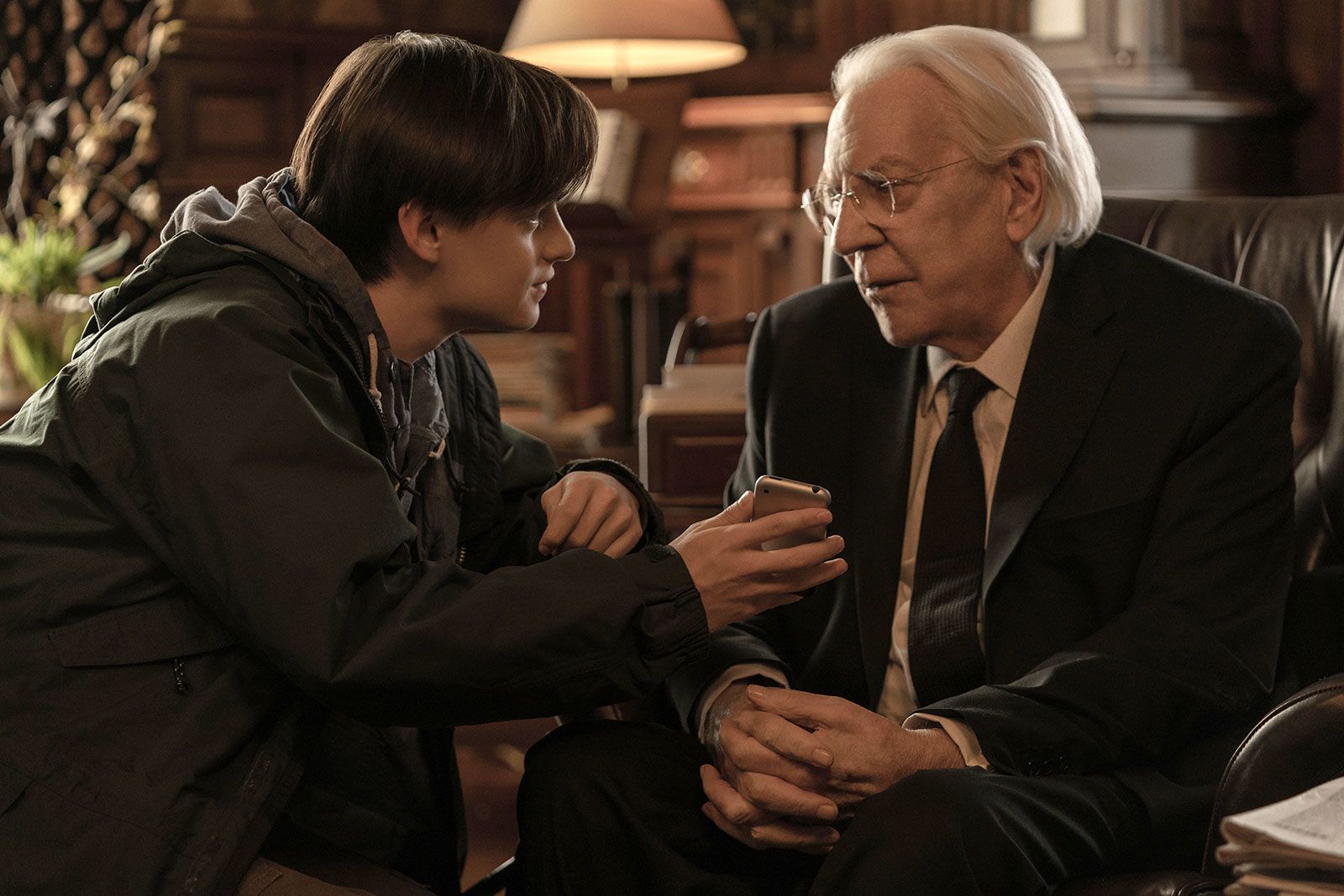
In a small New England town, Craig is a young boy being brought up by his single dad (Joe Tippett) after the untimely death of his mother. The wealthy but reclusive Mr. Harrigan (Donald Sutherland), a ruthless elderly businessman living in the community, requests Craig's services as a reader. Three times a week, Craig visits Mr. Harrigan's mansion and reads to him from classic books. This relationship goes on for many years, and evolves to include in-depth discussions about life, finance, and business.
Craig (Jaeden Martell) enters high school with Mr. Harrigan a big influence in his life. To show his appreciation, he gifts the old man his first cellular phone, and teaches him how to use it. At high school Craig is bullied by local goon Kenny (Cyrus Arnold), and develops an admiration for science teacher Ms. Hart (Kirby Howell-Baptiste). After Mr. Harrigan passes away, Craig is astounded to still receive messages from the dead man's phone, offering him a gateway to dark powers.
An adaptation of a Stephen King short story (with King co-producing the movie), Mr. Harrigan's Phone focuses on a young man's choices. Offering only touches of horror and suspense, writer and director John Lee Hancock opts for cautionary tale shadings. The mood is modestly foreboding, thanks to Donald Sutherland's intimidating presence and Harrigan's cavernous mansion, and for long stretches the drama tracks the straightforward awakening of a young mind to the world's complexities. When the time arrives for untimely deaths, the violence carries an edge but avoids gore.
Sutherland dominates the first half, and tension starts to drift sideways once Harrigan dies and is buried with his cell phone. Craig's journey arrives at the standard dichotomy residing within every person to pursue either easy and destructive or difficult and constructive solutions. Harrigan's influence and favored methods are a pathway to violence - gratifying but also shocking. The lessons are portrayed literally but learned metaphorically, the impact registering as a scary ability to impart negativity and cause mayhem. An escape route is available through memories of a kind mother and Craig accepting her death.
With the cell phone's ease of access encouraging the rush to gratification, Mr. Harrigan's Phone packages ethical dilemmas into a tidy parable juiced by technology. 
All Ace Black Movie Blog reviews are here.
In the near future, Earth is subjected to massive unexplained electrical storms. Perpetually calm and collected astronaut Roy McBride (Brad Pitt) barely survives a fall back to earth from the international antenna station. He is then recruited for a secret mission to travel to Mars and send a message to his father Clifford (Tommy Lee Jones), a legendary but missing astronaut.
A generation earlier Clifford commanded the Lima Project on a mission to the outer reaches of the solar system to seek evidence of intelligent life. But he was believed dead 16 years ago when contact was lost with Lima near Neptune. Now he is presumed alive and responsible for the electrical storms. Roy arrives to Mars and sends the message to his father, but when he is prevented from reading the response, he embarks on an unsanctioned mission on the spaceship Cepheus to Neptune.
Directed and co-written by James Gray, Ad Astra looks beautiful but is heavily laden with soulful narration, psychology and philosophy, and all of it ultimately drifts towards frustrating purposelessness. Despite a suitably subdued Brad Pitt performance, the narrative disintegrates early, with fragments of plot points and characters introduced and abandoned to no effect.
The movie is caught in dissonance of its own making, mixing a human-scaled sense of downbeat realism with ridiculous cliffhanger moments. A rover chase on the surface of the moon may be relatively unique, but represents a lot of what is wrong with the script. Apparently pirates are roaming the moon, but their intentions are never discussed. Later Roy tangles with angry monkeys on an abandoned spacecraft, makes use of a water-filled underground pipe system on Mars, secretly clambers into a rocket at take-off through the engine compartment, uses a hatch as a makeshift shield against space debris to float through space, and perfectly times a nuclear explosion to propel his spacecraft to safety. None of these supposed highlights pass the logic test or meaningfully enhance the story.The characters do not fare any better. Donald Sutherland is prominent early on as a sort of mission minder, but is unceremoniously dropped. Ruth Negga and Liv Tyler briefly float in and out of Roy's adventure. And Tommy Lee Jones bites into the Marlon Brando role from Apocalypse Now, but never gets to explain quite why - or how - he was trying to destroy Earth all the way from Neptune.
At the heart of Roy's trip is a search to better understand his father. Ignoring the space setting and all the hardware, Ad Astra becomes a simple story of one man coming to terms with his father's depression and sense of personal failure. Even this narrative bumps against a truncated and unsatisfactory resolution. There may be many reasons to hijack a future space program, but resolving daddy issues should not be one of them.
Agent Neil Shaw (Wesley Snipes) is a covert operative for the United Nations, using vaguely unethical tactics to push forward globalization and trade objectives. Along with fellow agents Bly (Michael Biehn) and Novak (Liliana Komorowska) he reports to Eleanor Hooks (Anne Archer), the chief aide to the UN's Secretary General Douglas Thomas (Donald Sutherland).
In New York City, China's ambassador Wu (James Hong) and business tycoon David Chan (Cary-Hiroyuki Tagawa) are targeted by an assassin in a conspiracy to derail a major trade agreement. Shaw finds himself falsely implicated as the trigger man, with the FBI's Frank Capella (Maury Chaykin) hot on his trail. Shaw teams up with interpreter Julia Fang (Marie Matiko) to uncover the real conspirators and clear his name.
Despite ambitions to weave the philosophy of Sun Tzu's titular text into the narrative, The Art Of War is an unimaginative thriller crammed with numbingly repetitive stunts unimaginatively mounted by director Christian Duguay, and hobbled by an almost impossible-to-follow plot courtesy of co-writers Wayne Beach and Simon Barry. Characters are barely introduced before being summarily slayed by faceless villains, and the action gallops from one unexplained set piece to another without pause. And of course the conspirators reveal their plans at inopportune moments and are suddenly incompetent at killing just when it matters most.
Wesley Snipes has enough charisma to cut through the action and almost saves a few moments, but he too is comprehensively defeated by the weak material. All of which is unfortunate, because notwithstanding the bewildering decision to fictitiously expand the UN's mandate to include trade negotiations, conflicts sparked by the power shifts of international commerce should contain the seeds of a worthwhile cerebral thriller.
The Art Of War pretends to venture into new and profound terrain, but remains trapped in a tired and familiar patch.
All Ace Black Movie Blog reviews are here.
It's the 1930s, and Tod Hackett (William Atherton) arrives in Hollywood with dreams of making it as a set design artist. He finds an apartment at the rundown San Bernardino Arms and meets his neighbours, a collection of wannabes at the margins of the movie industry. He quickly falls in love with Faye Greener (Karen Black), a vivacious extra striving for greater roles, but she rejects him.
Faye's father Harry (Burgess Meredith) is a former small-time vaudevillian and now a door-to-door salesman in poor health, peddling a miracle cure. He collapses in the apartment of inhibited accountant Homer Simpson (Donald Sutherland), which leads to Faye and Homer starting a muted relationship.
Tod secures a job in the studio art department run by Claude Estee (Richard Dysart) and Ned Grote (John Hillerman), and never loses hope of winning Faye's heart. He meets her friends Miguel (Pepe Serna), who is involved in cockfighting, and cowboy Earle Shoop (Bo Hopkins). Tod and Faye attend a fake healing church sermon run by Big Sister (Geraldine Page), and survive a spectacular on-set calamity while filming a recreation of the Battle of Waterloo.
An adaptation of the 1939 book by Nathanael West, The Day Of The Locust attempts to shine a light on the victims of Hollywood's unforgiving culture. But the film is an overlong and momentum-free effort, a suffocatingly boring journey through the gutter of the boulevard of broken dreams.The riffraff characters are a collection of down-and-outs lacking self awareness and pathetically still pursuing the bright lights. They are uniformly unappealing and one-dimensional in their capacity to hit the same notes and achieve the same outcome, director John Schlesinger unable to generate sympathy or trace engaging arcs.
And so Tod expresses his love for Faye early, she makes it clear he's not good enough for her, and this dynamic remains unchanged, much like their careers are stalled in the same place. She gravitates towards accountant Homer, who may have some wealth but compensates with a vacuous personality. Donald Sutherland sleepwalks through the role with a startled, deer-in-the-headlights look, except that a deer may have more to say than Homer does.
Elsewhere the cockfighting subplot and stag film interlude offer crass symbolism about Hollywood's sex-obsessed and bloodthirsty ruthlessness, while too much time is invested in Harry Greener before he mercifully expires. Other characters including studio executive Claude Estee, excitable cowboy Earle Shop, madame Mary Dove, foul-mouthed dwarf Abe and child actor Adore (Jackie Earle Haley) may have been more prominent in early drafts, but in the final product they barely register and simply add clutter and bemusement.
The set designs are attractive, and if nothing else The Day Of The Locust is always gorgeous to look at. The drama ends with a gargoylian opera of stampedic violence, fantastical puss popping into the oblivious eye of a movie premiere. As metaphors go its an appropriately overripe ending to a bloated yet dreary spectacle.
All Ace Black Movie Blog Reviews are here.