Showing posts with label Lee Grant. Show all posts

Monday, 9 November 2020

Movie Review: Defending Your Life (1991)

A fantasy romance, comedy and drama, Defending Your Life offers a few original after-life ideas but fails to properly exploit the premise.

Los Angeles-based marketing executive Daniel Miller (Albert Brooks) dies in a car crash on his 39th birthday. He is transported to the idyllic campus setting of Judgment City where his life's actions will be evaluated to determine if he deserves to progress or be sent back for another round on Earth. He meets his lawyer Bob Diamond (Rip Torn) and prosecutor Lena Foster (Lee Grant), and learns that nine days of his life will be used as evidence to judge his maturity as measured by acting without fear.

As his case is progressing Daniel meets Julia (Meryl Streep), recently deceased by accidental drowning. They enjoy the perks of Judgment City together, including unlimited food with no weight gain, and quickly fall in love. But it is soon clear Julia has lived impeccably and will be progressing, while Daniel still has a lot to learn about living life to the fullest and will likely be consigned back to the drudgery of another terrestrial life.

Finding an interesting seam between religious dogma and existentialism, Defending Your Life creates a secular afterlife governed by the universe, offering progress towards the joys of larger brain utilization for promising candidates. The only punishment for underachievement is a do-over, and Daniel Miller learns he is, in fact, on his 20th go-round, and still has work to do.

But having gone to the trouble of creating an intriguing premise, writer and director Brooks undersells the concept and tacks on a very earth-like rom-com with all the associated cringiness. Life's accomplishments are reduced to the simplistic objective of acting without fear, and neither prosecutor Foster nor defendor Diamond appear convinced. The film's key hinge scenes, replaying and evaluating Daniel's critical days, are reduced to routine bland vignettes ultimately suggesting little of consequence.

The romance between Daniel and Julia is hustled along at celestial speed from initial meeting to expressions of deep love, the attraction between them based on little more than Meryl Streep's whimsical etheralism. To endear himself Daniel unleashes a stream of corny dialogue that by itself should rush-deliver him back to Earth for swift punishment. Julia is never provided a reason to fall in love, while Brooks skips over any explanations about the rules of post-death romance.

A steady current of mild humour is maintained, mostly drawn from secondary characters and the absurdities of the surroundings. But Brooks as an actor sleepwalks through the film with apathetic bemusement, and Streep delivers one of her least impactful roles, Julia drawn as an elusive ideal rather than a person.

Defending Your Life is tantalizingly close to being good, but surrenders to meek resolutions.


All Ace Black Blog Movie Reviews are here.

Friday, 15 May 2020

Movie Review: The Internecine Project (1974)


A conspiracy thriller, The Internecine Project features an innovative multiple murder plot hampered by thin characterizations and a flimsy context.

Celebrated American economics professor Robert Elliot (James Coburn) is visiting London, where he reconnects with reporter Jean Robertson (Lee Grant), his ex-lover. Shady businessman E.J. Farnsworth (Keenan Wynn) then offers Elliot a high-ranking position in the US government, but only if Elliot cleans up his side-business in industrial espionage. This requires Elliot to make sure four people die in short order.

The intended victims are misogynist masseur Albert (Harry Andrews), high-priced prostitute Christina (Christiane Krüger), tweedy government official Alex (Ian Hendry) and sonic wave scientist David (Michael Jayston). Elliot ingeniously arranges for the four targets to kill each other in one night, but not everything will go according to plan.

The Internecine Project does not lack for talent on either side of the camera. The film is co-written by Jonathan Lynn and Barry Levinson, who also co-produced, with Geoffrey Unsworth in charge of cinematography. Director Ken Hughes is always on the lookout for the interesting angle, and with Coburn and Grant providing star power, the basic ingredients are impressive.

But this British production is limited by a singular focus on executing a clever series of sequential murders, at the expense of everything else. The initial setup is sketched in at best, and Hughes dismissively waves at the espionage and corporate corruption plot. The four victims-to-be are barely introduced before Elliot winds them up and sends them on their way. As a result the cold mechanics of murder are much more interesting than the people doing the killing and getting killed, and this is not a good thing.

Worse still is a remarkable underutilization of star power. Grant as reporter Jean Robertson is reduced to the role of irritant in the film's second half, her half-baked journalistic assignment subsumed by whiny interruptiveness. Coburn is confined to a dark office, counting telephone rings and ticking off a checklist with a painted expression of concern.

With a late twist-in-the-tail similarly botched and creating no emotional impact, The Internecine Project leaves a trail of forgettable dead bodies and little else.


All Ace Black Movie Blog reviews are here.

Friday, 10 August 2018

Movie Review: Valley Of The Dolls (1967)


A show business drama, Valley Of The Dolls is a soap opera with overclocked emotions bursting forth at every turn.

The elegantly sophisticated Anne Welles (Barbara Parkins) leaver her small New England town to seek her fortune in New York City. She finds a job at an agency specializing in show business contracts, and meets Neely O'Hara (Patty Duke), the understudy for stage megastar Helen Lawson (Susan Hayward). Helen spots Neely's talent and fearful of being upstaged, fires her. Jennifer North (Sharon Tate) is an admittedly talentless chorus girl surviving on her seductive physical attributes.

Neely works hard, achieves stardom as a singer and an actress, and marries Mel (Martin Milner). Jennifer marries singer Tony Polar (Tony Scotti), whose career is managed by his sister Miriam (Lee Grant). Anne embarks on a relationship with her boss Lyon (Paul Burke), although he never wants to settle. She then achieves some fame as a model for a cosmetics firm. Although Anne, Neely and Jennifer all appear to be on the fast-track to happiness, plenty of unexpected surprises await, including increasing dependencies on "dolls", the pills that boost energy or induce sleep.

Jacqueline Susann's salaciously trashy book, one of the biggest bestsellers of all time, is turned into a salaciously trashy movie. Directed by Mark Robson, Valley Of The Dolls is undercast with mediocre talent, and overburdened with melodrama. The claws are out, the daggers are drawn, the pills are gulped, and three women (four, counting Helen Lawson) have their careers clouded by negativity, addiction, and backstabbing.

Stuck somewhere in the twilight zone between a really warped take on All About Eve and an early model for the primetime television soap operas of the 1980s, the film is filled with naked ambition, hysterical ups and downs, some brief but at the time scandalous nudity, and an entrenched attitude that for one woman to succeed, another has to fail. Of course all the men are also either manipulative or susceptible to manipulation, or both.

As social commentary, the film has some value in marking the sexual revolution of the 1960s and feminism merging into the mainstream. Anne, Neely and Jennifer are sexually independent, free to pursue both careers and husbands, easily drop the men who disappoint them, and never question their strength as women. Unfortunately, in Valley Of The Dolls independence and meanness are often conjoined in both genders.

Barbara Parkins, Patty Duke and Sharon Tate were never more than middling talents, yet here they land as the three stars of a much-anticipated film adaptation. Parkins does little other than look chic, Duke devours most of the scenery with a wildly over-the-top performance, and Tate appears unfortunately perfectly cast as the expressionless and talentless actress surviving on her physical attributes.

Susan Hayward and Lee Grant add some class and bite, but are consigned to supporting roles. The men fare worse: television non-entities Martin Milner, Tony Scotti, Paul Burke and Alexander Davion as Ted Casablanca are all plastic, interchangeable and disposable.

Valley Of The Dolls scores some points as bad enough to be good and a guilty pleasure to suit the right mood, but otherwise just registers as annoyingly overwrought.


All Ace Black Movie Blog reviews are here.

Thursday, 24 May 2018

Tuesday, 9 May 2017

Movie Review: Airport '77 (1977)


A disaster movie with a galaxy of stars trapped on a submerged airliner, Airport '77 is as corny as can be expected but also surprisingly well produced.

Aging tycoon Philip Stevens (James Stewart) invites high profile guests to travel on his lavishly outfitted private Boeing 747 en route to the grand opening of his home-based museum. Captain Don Gallagher (Jack Lemmon) is in command of the flight, while Eve Clayton (Brenda Vaccaro) is Don's long-time lover and in charge of passenger comfort. The guests include Nicholas St. Downs III (Joseph Cotten) and Emily Livingston (Olivia de Havilland), who first met in the 1930s and are reunited on the flight. Businessman Martin Wallace (Christopher Lee) and his neglected and perpetually drunk wife Karen (Lee Grant) are also on the flight, as are Stevens' daughter Lisa (Pamela Bellwood) and her young son.

In the cargo hold is a large collection of expensive art, and this attracts a band of thieves under the leadership of co-pilot Chambers (Robert Foxworth). Over the Bermuda Triangle the criminals release a sleeping gas to knock out Gallagher and all the passengers, and Chambers changes course, flying below the radar towards an uninhabited island. But in dense fog the 747 clips an off-shore oil rig, the plane crashes into the sea and sinks to the sea bed, intact but leaking. Gallagher has to keep the passengers calm and find a way to notify rescuers of the plane's location while the Navy and Coast Guard mount a search operation.

Directed by Jerry Jameson, Airport '77 arrived relatively late in the cycle of 1970s disaster films. By now the formula is overly familiar: collect a bunch of mostly elderly Hollywood stars, place them in peril, and play a parlour game of who lives and who dies before the credits roll. While everything about the film is conventional, the production values are well above average, yielding a mixed experience where the content is tired but the packaging is slick.

Disaster movies tend to work better in confined spaces, and the coffin-under-the-sea premise is appropriately claustrophobic and generates a real sense of danger, with water slowly seeping into the plane, and the passengers threatened with both drowning and asphyxiation.

The film's ambitions are reflected in a superior cast deep in veteran talent. Lemmon and Cotten are most prominent and get to run around the bowels of the cavernous plane and play the role of heroes. The likes of Stewart, de Havilland, Grant and Lee ensure that as irritating as the passengers are, they are good at being irritating. George Kennedy makes his obligatory disaster movie appearance, but this time is limited to a more minor role as a rescue coordinator. The special effects are decent for the era and have survived the test of time.

The final act transforms into a propaganda piece for the rescue capabilities of the Navy and Coast Guard, and although again the cheese factor is odorous, the execution is polished. Jameson keeps the pacing tight, delivering the drama in under two hours, and the final acts of tactical implementation, heroism, and late-in-the-day death are completed with requisite precision.

Airport '77 is definitely all wet, but enjoys its time in the cinematic tub.


All Ace Black Blog Movie Reviews are here.


Saturday, 1 October 2016

Movie Review: Damien: Omen II (1978)


The first sequel in the devil-as-a-child franchise is better than it needed to be. Although Damien: Omen II does descend into a long series of gory deaths, there is enough acting talent and story progression to retain series momentum.

One week after the events of The Omen, the old man Carl Bugenhagen (an uncredited Leo McKern) is killed in Israel, buried in an archaeological dig collapse before he can warn others that the image of the devil's son has been uncovered on an ancient wall. Seven years later, Damien (Jonathan Scott-Taylor) is about to turn 13 years old and living with his adopted parents, rich industrialist Richard Thorn (William Holden) and his second wife Ann (Lee Grant), along with their son Mark (Lucas Donat). Richard is the brother of diplomat Robert Thorn from the original story.

With Damien and Mark about to go to cadet school, the elderly aunt Marion (Sylvia Sidney) tries to warn Richard and Ann that Damien is evil; they dismiss her ramblings. The next morning the sudden appearance of a raven at the base of Marion's bed triggers a fatal heart attack. At the military school, Damien is protected by drill Sergeant Daniel Neff (Lance Henriksen) who encourages Damien to read the Bible's Book of Revelations. At Thorn Industries Damien also has an ally in high ranking executive Paul Buher (Robert Foxworth), who has a plan to control vast amounts of the world's food supply. The young boy starts to understand who he is, while gruesome death awaits anyone who tries to stand in his way.

Mechanically directed by Don Taylor, Damien: Omen II is a middling horror film. Without coming close to capturing the Gothic intensity of the original, the sequel finds enough of a plot to move Damien's story along despite an out-of-control death count. Taylor does not demonstrate much patience for establishing mood or creating build-up, so he compensates with some effective short sharp shocks and an increasing volume of gore.

The early deaths carry the bigger impact, as heralded by a spooky raven, and reach an early climax with a reporter meeting a quite messy end on a desolate rural road. Later there is a nightmare-inducing and well-executed trapped-under-ice death, only compromised because it is somewhat unnecessary. As the film progresses the untimely demises multiply, the film unfortunately defaulting to the low road where a kill-everyone mentality prevails. The gore quotient hits the redline with an elevator mishap that befalls a doctor misguidedly trying to understand Damien's strange blood cellular structure.

In amongst the horror, young actor Jonathan Scott-Taylor does a fine job guiding Damien on a journey of discovery. The film is an inflection from abstract horror to Damien understanding and accepting his destiny, and Scott-Taylor masters the cold stare of evil while also exposing the angst of a young man discovering the enormity of his fate. A befuddled William Holden, three years before his death, generally goes through the motions, while Lee Grant is more engaged and enjoys one late scene filled with steely determination.

With another Jerry Goldsmith score dripping with faux satanic chants, Damien: Omen II registers effective moments amidst the mayhem, a cheesy coming of age tale soaked in grisly malevolence.


All Ace Black Blog Movie Reviews are here.


Sunday, 19 October 2014

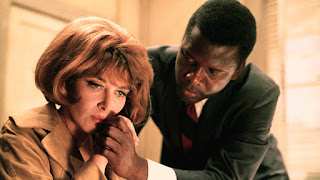
Movie Review: In The Heat Of The Night (1967)


A simmering murder mystery overheated to the boiling point by racial tensions, In The Heat Of The Night is a seminal cinematic achievement, a turning point in the portrayal of blacks on the screen and a riveting small town thriller.

In the small southern backwater of Sparta, Mississippi, night patrolman Sam Wood (Warren Oates) finds wealthy businessman Mr. Colbert dead in the street, killed with a blow to the head. The local redneck police chief Bill Gillespie (Rod Steiger) orders a sweep of the town, and Wood picks up Virgil Tibbs (Sidney Poitier) at the train station. Black, well-dressed and very much a stranger, Tibbs is immediately a suspect, and Gillespie treats him with racist contempt. But Gillespie is stunned to learn that Tibbs is a Philadelphia police detective, passing through Sparta while visiting his mother.

Through a combination of pressure from his superior and his personal pride, Tibbs stays in Sparta to help solve the murder, while Gillespie is grudgingly convinced by Sparta's mayor (William Schallert) to accept Tibbs' help. Tibbs and Gillespie never really get along, but start to tolerate each other as they track down persons of interest including Mrs. Colbert (Lee Grant), small-time drifter Harvey (Scott Wilson), Colbert's business rival Endicott (Larry Gates), and late night diner counterman Ralph (Anthony James). Sam Wood also emerges as a suspect, as well as being implicated in a sordid unwanted pregnancy involving a 16 year old local girl. With Mrs. Colbert threatening to pull her late husband's investment out of town and Tibbs attracting an increasing number of enemies, the pressure mounts to catch the murderer.

Directed by Norman Jewison and written by Stirling Silliphant based on the John Ball book, In The Heat Of The Night draws one of the most distinct before-and-after lines in Hollywood movie history. Poitier's Guess Whose Coming To Dinner, also from 1967, portrayed a black man being accepted into a white liberal educated family. In The Heat Of The Night has no such acceptance: Virgil Tibbs is a qualitatively better law officer than Gillespie; and through his sheer force of conviction, Tibbs will prove to Sparta and all its bigoted residents that a black man will overcome deep-rooted racism and serve the cause of justice.

For all its redefining of racial relations, In The Heat Of The Night is also a fine, complex murder mystery. In sweltering heat made worse by prevailing hot winds of xenophobia, plenty of suspects emerge as the potential killer, and Tibbs gathers personal enemies by focusing the investigation in unexpected directions. He is convinced the drifter Harvey is innocent when plenty of evidence points to his guilt, and Tibbs rocks the town to its core by suspecting Endicott and then getting involved in the unwanted pregnancy case. The film's climax does feel rushed, and Jewison would have done better to provide some of the secondary characters a bit more room to breathe.

In The Heat Of The Night maintains its tension by not caving in to any easy moments of reconciliation. To the bitter end, Gillespie just barely finds a way to work with Tibbs, and never misses an opportunity to make Tibbs' life harder than it needs to be. The film avoids becoming a buddy movie, as Gillespie's respect grows by barely perceptible increments. It's only in the final scene that Tibbs gets the benefit of the slightest kind gesture and phrase, and even then, Gillespie wraps his gratitude with a tinge of relief that the two are finally parting ways.

Two moments from the film stand out and earn their place in movie history. In the first, when Gillespie, who has been callously referring to Tibbs as "boy", asks Tibbs what they call him in Philadelphia, he roars back "They call me MISTER Tibbs!."  And in the second, Endicott is insulted that he is considered a suspect in the Colbert murder and slaps Tibbs hard. Tibbs returns the slap, just as hard. It's a shocking, time-stands-still moment, a black man striking a respected white cotton magnate deep in the south.

The two central performances are perfect, primarily because they don't stray from the essence of the two characters. Poitier emphasizes Tibbs' pride, confidence and hints of justified arrogance. Steiger keeps Gillespie true to a small-town cop, refusing to admit he is in over his head, furiously chewing his gum to compensate for the absence of any useful detective skills, while eyeing Tibbs with a combination of suspicion and contempt.

In The Heat Of The Night the movies encountered an inflection point. A murder was committed, and race relations on the big screen changed forever.


All Ace Black Movie Blog reviews are here.

Saturday, 27 July 2013

Movie Review: Shampoo (1975)


A sex and politics farce of sorts, Shampoo is weighed down by petulant characters engaged in uniformly selfish behaviour. The lack of anyone remotely sympathetic, or halfway intelligent, sucks most of the enjoyment out of the movie.

It's the eve of the 1968 presidential election. In Los Angeles, George (Warren Beatty) works as a hairdresser. He dreams of opening his own salon, but does not have the credit or business savvy to secure a loan. Extremely popular with his lady clients who find him sexually irresistible, George is sleeping with Jill (Goldie Hawn), who is naive enough to think that she is the only woman in his life. In fact, George jumps into bed with any willing woman, including Jackie (Julie Christie), the mistress of the pompous, rich and politically-connected Lester (Jack Warden).

Jackie suggests that George approach Lester to secure a private loan. While Jackie is torn between the promise of what Lester can offer her (should he ever leave his wife) and George's raw passion, Lester is intrigued by George, but also suspicious of him. As well he should be: George is also sleeping with Lester's wife Felicia (Lee Grant). Meanwhile, Lester's daughter, Lorna (Carrie Fisher) wants in on the action with George. As Nixon is confirmed as the winner of the election, a night of stuffy political banquets and wild sex parties provides a backdrop for George, Lester and Jackie to sort out their futures.

Shampoo bids a fond adieu to the free-wheeling, sex-drenched days of the 1960s social revolution, and ushers in the era of cynicism and corruption, as marked by Nixon's election. It's an interesting seam in cultural history, but Shampoo is unable to do much with it. Bogged down by uninteresting and unlikable characters, the film is a tiresome merry-go-round of sexual obsession among a group of desperate dullards. It's rarely funny, nor does it carry any meaningful weight of drama.

Director Hal Ashby struggles to create something watchable out of the Robert Towne script, finding only so much story in the ongoing sexapades and half-hearted attempts at irony. Precious few laughs and fewer sober thoughts are generated, and none are sustained. Shampoo settles down to a series of set-piece parties and hair appointments interrupted by brief couplings that admittedly were risqué in 1975.

Warren Beatty rides around on his motorcycle from house to house and bed to bed (or just the floor will do, on some occasions) having sex with every desirous female, and he sports a serious contender for the most ridiculous hairdo in the history of motion pictures. As is typical for the Beatty persona, he mostly just is, a catalyst around which women flutter and dissolve, for no apparent reason related to ability, smarts or prospects. George is a great summary of things that women regret wasting their time on in their later years.

Jack Warden, usually confined to limited screen time, gets one of his more expansive roles. Representing a 1950s man beginning to get really lost at the end of the 1960s, Warden makes Lester the most interesting character in the movie as the man with everything but inching towards a variety of self-destruct buttons to counter the growing boredom and detachment.

The ladies of Shampoo are hampered by having no brains to overcome the sexual gravity generated in proximity to George. The characters played by Julie Christie, Lee Grant and Goldie Hawn never answer any questions related to what is attracting them to a big-haired loser stuck in a dead-end job. Hawn's Jill seems able to grab any man she wants (and indeed she tries to arouse George's jealousy); Christie as Jackie is already wrecking one home by carrying on with Lester; with George, she risks destroying her destruction, which may be quite appropriate. And Grant's Felicia is pretending to be jealous of Jackie while cheating on Lester with George. Sympathetic, these women are not.

Only Carrie Fisher as Lorna seems to get it right: she uses George to scratch an itch, and has no other agenda or expectations. Welcome to the 1970s.


All Ace Black Blog Movie Reviews are here.