Genre: Dramedy

All Ace Black Movie Blog reviews are here.
Reviews of Classic and Current Movies


Ex-Secret Service agent and now private bodyguard Frank Farmer (Kevin Costner) is considered the best in the business. He reluctantly agrees to provide protection to superstar chanteuse and movie actress Rachel Marron (Whitney Houston), who is receiving death threats. Frank finds Rachel's life chaotic and security lax, and proceeds to add cameras and fencing at her estate. He also meets Rachel's young son Fletcher and sister Nicki, publicist Sy (Gary Kemp), long-term manager Devaney (Bill Cobbs), burly bodyguard Tony (Mike Starr), and chauffeur Henry.
Rachel and Frank are initially hostile to each other, but she initiates a seduction and they sleep together, disrupting his job focus. As the death threats continue and turn to acts of violence, Rachel is nominated for an Oscar, and Frank has to sort out friend from foe with the lavish Academy Awards ceremony approaching.
The teaming of hot Hollywood star Kevin Costner with music charts diva Whitney Houston ensures bedazzlement. Costner effectively delivers his stoic quiet-man-with-a-past persona (Frank blames himself a bit for failing to prevent the Reagan shooting). In her film debut Houston is a hesitant actress, but deploys her extraordinary voice to belt out hits like I Have Nothing (used as a slogan by Rachel's predator), thumping dance tune Queen of the Night, I'm Every Woman, Run to You, and the eternal I Will Always Love You. To director Mick Jackson's credit, the songs are used judiciously and don't interfere with the flow.
Lawrence Kasdan's script has just enough fragments of interest to build momentum, but Jackson does struggle to justify the 129 minutes of running time. The chemistry between Costner and Houston is tepid at best, not helped by an emotionally psychotic romance scripted to switch between mushiness and hostility every 15 minutes. An interlude in the country at the cottage of Frank's father manages to be obtrusive, incongruous, and incoherent, backfiring in all sorts of nonsensical directions.Kasdan does capture the chaos of a music star's life and surrounds Rachel with a long list of jealous or conceited suspects, encouraging a guess-the-villain game. The reveals take too long to arrive within a bad combination of blurted confession and faceless depravity, although a suitably chaotic final act at the Academy Awards ceremony injects frazzled energy. The Bodyguard brings out the big guns, but demonstrates wayward aim.
All Ace Black Movie Blog reviews are here.
In October 1962, US aerial spy photographs reveal new Soviet nuclear missile bases under construction in Cuba. Special Assistant to the President Kenneth O'Donnell (Kevin Costner) is a witness as President John F. Kennedy (Bruce Greenwood) and his brother Attorney General Robert Kennedy (Steven Culp) assess the situation with military and political advisors. They determine the missiles are an existential threat and have to be removed within days, before they become operational.
With the Soviets denying the existence of the bases, American military commanders argue for aerial bombing followed by an invasion of Cuba. The Kennedys recognize forceful action could lead to a global nuclear war. Other administration officials, including Defense Secretary Robert McNamara (Dylan Baker) and Ambassador to the United Nations Adlai Stevenson (Michael Fairman) propose more considered options, including a blockade of Cuba and trading the removal of US missiles in Turkey. With the world marching towards devastation, President Kennedy has to make the toughest decisions of his life.
The Americans and the Soviets pulled back from the brink of a nuclear war in October of 1962, and so the ending of Thirteen Days is a matter of well-known historical fact. Which makes the film quite remarkable: director Roger Donaldson and writer David Self create a tense, almost terrifying drama, capturing the shadow of war creeping over the world, uncertainty, misinformation, clashing agendas, and miscommunication adding to the immense weight of minute-by-minute decision-making at the highest levels of government.
The movie is based on the 1997 book The Kennedy Tapes by Ernest R. May, and Philip D. Zelikow. Donaldson avoids stage confines by jumping frequently to the seas and skies around Cuba, inserting plenty of b-roll showing military hardware flexing, and taking side-trips to the United Nations. But Thirteen Days finds a home at the White House, and by focussing on the inner sanctum of American power, the film deepens the focus on the Kennedys: what they knew, when they knew it, and their ever shifting calculus.The scenes of O'Donnell's home life and his interactions with military men conducting surveillance of Cuba are clumsy and an overall bad fit. But the White House events are presented through his eyes, and while his role may have been exaggerated, he does provide an accessible entry point. Through the long 145 minutes of running time, the President and his brother encounter doubt and second-guessing, moments of uncertainty haunting them as they grapple with the enormity of the crisis. But they are also portrayed as beacons of good, Donaldson and Self parking their loyalties firmly with the President and portraying him as walking the finest of thin lines through the maze of bad options.
The revelations of internal differences of opinion elevate the drama. The military leaders are hawkish and itching to start a war; they are also borderline dismissive of the President and seek to circumnavigate his orders. Diplomats like Stevenson are dovish and looking for points of negotiation, but also potentially dangerously meek. A range of well-expressed viewpoints is exactly what a President needs, and Thirteen Days elegantly places the Kennedys in the eye of the storm, as the unpredictable winds of war swirl.
All Ace Black Movie Blog reviews are here.
It's the early 1960s in rural Montana. Margaret and George Blackledge (Diane Lane and Kevin Costner) have been married for a long time, and run a ranch together. She is an expert at breaking horses, and George is a retired lawman. Their son James and his wife Lorna (Kayli Carter) have a young son Jimmy. The strong-willed Margaret is overbearing towards Lorna but dotes over her grandson.
An accident claims the life of James, and Lorna quickly remarries Donnie Weboy (Will Brittain). Margaret witnesses Donnie mistreating his new wife and step-son, and is then heartbroken when Donnie, Lorna and Jimmy suddenly leave town without a goodbye. She senses Jimmy is in danger and convinces a reluctant George to join her on a road trip to North Dakota, where Donnie's family comes from, to rescue the child. As they get closer to Gladstone, Margaret and George learn the Weboy family has a fearsome reputation, and reclaiming Jimmy will not be easy.
Written and directed by Thomas Bezucha, Let Him Go has plenty to enjoy, starting with the cast. Kevin Costner and Diane Lane settle into a spiritual level of marital comfort with professional ease, the two veterans forging the genuine dynamic of a couple together for a long time and keenly aware of the union's strengths and weaknesses. They are complemented by gorgeous cinematography courtesy of Guy Godfree, measured and character-defined pacing, and a sense of impending doom as Margaret and George get closer to the isolated Weboy homestead.
The narrative is propelled by the spectre of death and loss as a normalized part of Margaret's uncompromising determination to do what she believes is right, and in the way she believes is right. And so the same grandma-bear attitude that alienated Lorna comes to the fore in an increasingly dangerous mission into the soul of darkness to rescue her grandson. Margaret's true inner strength is mostly revealed through George's mirror as a husband filled with admiration for his wife's feistiness but also keenly aware of the trouble she can bring upon them.Let Him Go starts to run into trouble once the extended Weboy family is introduced. Here Bezucha veers towards gargoylian representations of an evil redneck clan more befitting a slasher horror flick. With Lesley Manville holding court as the queen hornet, brutality is unleashed, rubbing awkwardly against the pre-established mood of dramatic lyricism.
Better intentions reside within the character of Peter Dragswolf (Booboo Stewart), an Indigenous man the Blackledges meet and befriend on the road to North Dakota. Peter has a personal story of loss, solitude, and a self-defined fresh start, reflecting some of what Margaret is experiencing. He deserved a larger share of the 114 minutes of running time.
Despite some unbalanced ambitions, Let Him Go reveals the deep roots of courage, conviction, and compromise nurturing a sturdy human bond.
All Ace Black Movie Blog reviews are here.
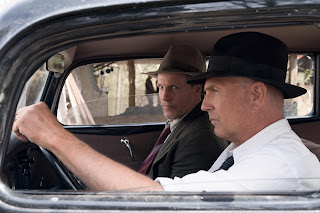
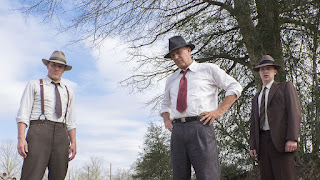
It's 1934 in Texas, and violent criminals Clyde Barrow and Bonnie Parker are folk heroes. After the pair embarrass Governor Miriam "Ma" Ferguson (Kathy Bates) by orchestrating a prison break, she reluctantly agrees to call upon retired Texas Ranger Frank Hamer (Kevin Costner) to hunt down the couple. He teams up with his ex-partner Maney Gault (Woody Harrelson) and despite advancing years and limited physical abilities they hit the road to try and intercept the elusive outlaw couple.
Working on the theory that criminals always go home, Hamer and Maney focus on the Dallas area, but the locals are protective of the famous couple and close ranks. Bonnie and Clyde's killing spree continues, with several police officers murdered and the FBI helpless. Hamer and Maney maintain a dogged pursuit and cross into neighbouring Oklahoma then Louisiana, and gradually gather enough clues to close-in on their targets.
An essential antidote to the romanticism of Bonnie And Clyde (1967), The Highwaymen is the other side of the story. Here the criminals are infrequently spotted bloodthirsty killers, ambushing and murdering police officers for fun, including Bonnie applying the final shotgun blast to the head of already fallen men. The John Fusco script demonstrates no sympathy towards any societal or economic justifications. Clyde's father (William Sadler) gets one long scene to try and explain his son's actions, and is summarily deflated by Hamer.
As for the folk hero status of the two murderers, The Highwaymen adopts an exasperated shake-of-the-head stance. For deep-seated reasons, this is a society that venerates anti-authoritarianism. Men like Frank Hamer and Maney Gault can do little other than bypass the nausea and get on with the job.And so director John Lee Hancock settles down to tell the story of two former Texas Rangers, themselves no strangers to bloodletting. They carry deep emotional scars, and at the start of the movie are hiding behind domesticity (Hamer is more successful) to bury the pain. Through Department of Corrections Chief Lee Simmons (John Carroll Lynch), the state calls upon them to unretire and sanctions two more killings.
Hamer and Maney are old, unable to run after suspects, and well past their sharp shooting days. What they do have is guile and experience, and gradually they recreate their partnership dynamic and make progress. Their quest is long, mistakes are made, and more people die. Through a draggy middle act, Hancock struggles to justify 132 minutes of running time, although the stark vistas of Texas and a landscape dotted with ramshackle depression-era migrant camps offer good visuals.
The two veteran actors help ride out the slow patches, the pauses for reflection well-paced to add texture without interrupting flow. Harrelson and Costner both co-produced and equally invest in their roles, Harrelson as Maney in particular showcasing a maturity to now discern the thin margins between right and wrong.
The Highwaymen are destined to arrive at a well-known and culturally iconic climax. The joy is in the journey, and two seasoned experts ensure a worthwhile drive.
All Ace Black Movie Blog reviews are here.
In West Texas, Roy "Tin Cup" McAvoy (Kevin Costner) runs a ramshackle golf driving range with his friend Romeo (Cheech Marin). In his college years, Roy and his friend and rival David Simms (Don Johnson) both showed great promise on the golf course. Simms is now a star on the PGA tour, while Roy never tamed his aggressive play with the necessary discipline to compete.
Simms and his girlfriend Dr. Molly Griswold (Rene Russo), a psychologist, show up at the driving range and old rivalries are rekindled. Simms convinces Roy to be his caddie for a charity tournament, an experience that ends badly, while a mutual attraction develops between Roy and Molly. To prove himself worthy of her love, he decides to enter the U.S. Open.
A bloated exercise in celebrating a maverick character, Tin Cup attempts to recreate the vibe of Bull Durham. Director and co-writer Ron Shelton re-teams with star Kevin Costner, and the setting switches from baseball backwaters to golf hinterlands. This is a retread with less interesting characters who really don't deserve the attention, the seams showing in a patched-up attempt to remix an old formula at an inexcusable length of 134 minutes.
For a movie about golf, there is too much golf. The final chapter is an endless recreation of Roy's US Open run, passing through all the regional qualification tournaments, and the pacing starts to resemble a long night of tedium watching the Golf Channel with no off button on the remote. An unknown's Quixotic quest to win a major tournament carries traditional underdog appeal, but it's still a relief when the William Ross music soars to predictable levels of nauseous melodrama to celebrate a heroic inability to compromise principles.Nuggets of enjoyment do rescue a basic level of watchability. Kevin Costner admirably invests in a man content with his chosen lot in life, a living example that raw talent alone is far from a sufficient condition for success. The west Texas desert milieu provides a beautifully desolate backdrop to a proud life happily wasted, and Don Johnson is quite good as the suitably smarmy but still quite clever counterpoint.
Rene Russo struggles with the underwritten and frequently unconvincing role of Molly - for a doctor she is none too clever and quickly falls for the charms of a flawed man - but nevertheless provides some comic relief and the occasional spark. Cheech Marin is a classic sidekick, equally entranced and frustrated by his hero.
Despite a wild swing aiming for old glories, Tin Cup settles for a middling round.
All Ace Black Movie Blog reviews are here.
In the future, the ice caps have melted and all the continents are submerged. Survivors drift in ramshackle sailboats or congregate in rudimentary floating atolls, distrustfully trading for scarce resources and searching for the legendary Dryland. The Mariner (Kevin Costner) traverses the oceans in his customized sailboat, and with webbed feet and gills developing behind his ears, he is evolving into a human/fish hybrid. He sails into an atoll to trade, but is treated with hostility due to his mutations.
When the atoll is attacked by Smokers led by the Deacon (Dennis Hopper), the Mariner escapes and rescues Helen (Jeanne Tripplehorn) and the child Enola, who has a tattoo on her back that may denote Dryland's coordinates. The Mariner is not used to having company and resents the presence of strangers on his boat. The Deacon and his band of goons are in hot pursuit, intent on seizing Enola. The Mariner eventually grows fond of his guests, then has to protect them against the Deacon's attacks as he becomes a reluctant participant in the quest for Dryland.
Essentially a wet version of Mad Max 2, Waterworld was a troubled and over-budget production, with director Kevin Reynolds navigating the adversity (including hurricanes) of filming on open water off the coast of Hawaii. Notwithstanding the familiarity of the material, the outcome is passable. Character definitions and evolutions vary between limited and non-existent and the dialogue is more often than not simply cringey. But the scope is impressive, the representation of civilization's remnants struggling to stay afloat is imaginative, and the action scenes are engaging enough.The highlights include the Smokers' attack on the atoll, a float plane versus sailboat duel, and a deep underwater dive to demonstrate water's dominance. Despite regular injections of energy, at 135 minutes the pacing is uneven. Reynolds struggles to find the line where enough is enough, slapping on unnecessary prolongations for yet another stunt shot.
As lead protagonist, Kevin Costner's Mariner says few words and is mostly just angry whenever he needs to interact with humans. His brooding presence is suitably larger than life, but his lack of empathy persists deep into the story and creates an emotional void. Dennis Hopper as the Deacon overcompensates, his over-the-top villainous performance dangerously close to dredging up bad vibes from Dune. Jeanne Tripplehorn stays close to a single stance of frustrated determination.
The script (by Peter Rader and David Twohy) does not explain why the polar ice caps melted, but a raucous near-finale on board none other than the floating Exxon Valdez is a non-too-subtle hint. It may be soggy, but Waterworld does see the horizon.
All Ace Black Movie Blog reviews are here.
College student Jack Ryan (Chris Pine) is working towards an economics degree when terrorists attack the US on September 11, 2001. He enlists and serves in Afghanistan, where he is severely wounded in a helicopter crash. Back in the US, medical student Cathy Muller (Keira Knightley) helps in his rehabilitation, and they fall in love. The CIA's Thomas Harper (Kevin Costner) recruits Jack as an undercover financial analyst to trace terrorist funding sources.
Ten years later, Jack is living with Cathy but his secretive activities strain their relationship. After Russia loses a key United Nations vote, Jack uncovers shady financial transactions linked to the conglomerate headed by oligarch Viktor Cherevin (Kenneth Branagh). He travels to Moscow and concludes Cherevin is plotting a terrorist attack followed by a massive dollar sell-off to cripple the US economy. With Cathy unexpectedly showing up in Moscow and assassins already on his trail, Jack has his hands full.
An attempted re-boot of the Tom Clancy-created Jack Ryan franchise with Pine stepping into the role previously occupied by Alec Baldwin, Harrison Ford, and Ben Affleck, Shadow Recruit is merely serviceable. Kenneth Branagh directs (in addition to playing Cherevin) and provides a polished, often glistening aesthetic, but with the Bond, Bourne, and Hunt franchises redefining genre depth and artistry, Shadow Recruit suffers from a nothing-new-here feel and struggles for relevance.Pine is fine in the role, mixing charisma with determination and flashes of anxiety to capture the psyche of a cerebral analyst thrown into the operational spy theatre's deep end. But he is not helped by a barely-there plot, in which nothing is known about the planned terrorist attack until the final act. The threat to sell dollars on the financial markets is always going to fail the challenge of creating tension from techno-talk and computer screens filled with so much gibberish. Girlfriend Cathy being drafted into a CIA operation at short notice provides further evidence of flaky scripting.
The film's centrepiece is better. Jack, Cathy and Cherevin attend a fancy dinner and engage in a battle of wits, subterfuge and seduction, with Harper orchestrating support from the wings. Here writers Adam Cozad and David Koepp assemble a worthwhile evening, leveraging the tension between Jack and Cathy, east/west cultural rub points, and Cherevin's deep-rooted character traits.
The rest of the action speeds downhill, the usual hostage-taking and frantic car chases leaving no impression. On a plane ride back to the US, Jack, Cathy and Harper plus a small team of analysts fill in the conspiracy gaps on-the-fly (literally), in a scene intended to demonstrate connect-the-dots analytical work but in fact demeaning the process with cinematic shortcuts.
In a movie world where other spies get more elaborate resources, Jack Ryan: Shadow Recruit has a lot to learn, and not a lot of time to do it.
All Ace Black Movie Blog reviews are here.
U.S. Navy pilot Jay Cochran (Kevin Costner) retires after 12 years of service and heads down to Mexico to visit his old friend Tibey Mendez (Anthony Quinn), who lives on a sprawling estate defended by armed guards. Tibey's much younger wife Miryea (Madeleine Stowe) is unhappy in their marriage and immediate sets her eyes on Jay. But Tibey is a ruthless political power-broker and will not tolerate anyone stealing his wife's heart. Nevertheless Jay and Miryea embark on a passionate affair, leading to violence.
Author Jim Harrison adapted his own novella into a screenplay, and Tony Scott directs with his usual eye for visual flair, but the ponderously-paced Revenge never clicks. The film gets bogged down in endless plastic dialogue between Jay and Miryea, Costner and Stowe trading passive line delivery and blank looks set to sappy music.
Once Jay and Miryea cross the line from talking to lovemaking, Tibey makes his move to forcibly separate the lovers, triggering a gore-fest. The revenge-most-violent aspects apply equally to Jay and Tibey, as both men are intent on redressing wrongs from their perspective, but all the blood-spilling unfolds with mechanical soullessness.
The second half grows increasingly disjointed and throws a bewildering array of new characters onto the screen. A caring Mexican and his mother, a traveling Texan, a couple of guys with their own revenge agenda, and Sally Kirkland as the lead singer of a touring heavy metal band (?!) all get a few disconnected scenes, quantity trumping quality as none of them are defined well enough to progress beyond the prop stage.In contrast to the emotion-challenged Costner and Stowe, Anthony Quinn plays Anthony Quinn, domineering, larger than life, gregarious, sneaking in a dance, and with an eye for the kill when necessary. It's an overly familiar performance but at least full of conviction, and when Quinn disappears for a long stretch, the movie loses charm.
The Mexican setting provides Scott with opportunities to capture vivid colours, gorgeous beaches, romantic sunsets, dusty small towns, dank cantinas and local flavour, and Revenge is never less than pretty to look at. The movie also opens with an irrelevant high-speed interlude as Cochran takes his final flight in a Navy jet fighter against a flaming red-orange sky. The director has an inert revenge drama on his hands, and not surprisingly would rather be somewhere else.
All Ace Black Movie Blog reviews are here.