Showing posts with label James Stewart. Show all posts

Sunday, 19 March 2023

Movie Review: Broken Arrow (1950)


Genre: Western
Director: Delmer Daves
Starring: James Stewart, Jeff Chandler, Debra Paget
Running Time: 93 minutes

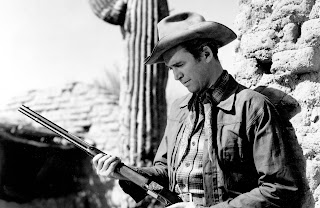
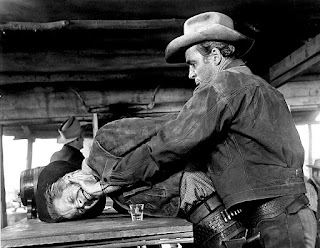
Synopsis: In Arizona of the 1870s, ex-Union Army scout Tom Jeffords (James Stewart) heals an Apache youth, earning a reputation for compassion. Despite the vicious war raging between the Apache tribe and settlers, Tom reaches out to Apache leader Cochise (Jeff Chandler) to negotiate safe passage for mail carriers. Tom also falls in love with young Apache woman Sonseeahray (Debra Paget). But with deep suspicions on both sides, building a lasting peace will remain a challenge.

What Works Well: Inspired by Jeffords' actual life adventures as chronicled in Elliot Arnold's book Blood Brother, Broken Arrow treats the Apache with notable sympathy. The Albert Maltz screenplay never hedges: the natives are defending their land and families from aggressive invaders, and most of the irredeemable white characters treat the Apache with subhuman disdain; the quest for peace is consequently challenged by both sides. Director Delmer Daves invests plenty of time appreciating tribal culture (doubtless Hollywoodized), including touching wedding vows. Ernest Palmer's cinematography makes excellent use of Arizona locations, and the tendency for thoughtfulness does not preclude traditional Western action set-pieces.

What Does Not Work As Well: The final chapter crams personal and epochal resolutions into a rushed few minutes. Consistent with the cinematic era, the main Native American characters are played by white actors with tan makeup, although Cochise's rival Geronimo is portrayed by Indigenous Canadian Jay Silverheels. The romantic subplot is tender, but partners 16-year-old Debra Paget with the 41-year-old Stewart.

Conclusion: An impressive leap forward in the depiction of a defining culture clash.


All Ace Black Movie Blog reviews are here.

Sunday, 13 November 2022

Movie Review: No Highway In The Sky (1951)

A commercial aviation drama, No Highway In The Sky demonstrates respect for science but loses altitude in a languid third act.

At the Farnborough air base in England, newly arrived executive Dennis Scott (Jack Hawkins) meets one of the employees, American aeronautical scientist Theodore Honey (James Stewart). Honey is an absent-minded eccentric obsessed with testing metal fatigue caused by vibration on the tail section of the Reindeer, a modern aircraft recently entered into service. He is also raising his daughter Elspeth (Janette Scott) on his own, after losing his wife during the war. 

Honey 's calculations suggest the Reindeer's tail will fail without warning after about 1440 flight hours, although his lab tests are yet to prove the theory. He boards a flight to Canada to investigate a recent crash and is shocked to find himself on a Reindeer plane approaching the 1440 hour limit. He raises the alarm with the Captain as well as fellow passenger Monica Teasdale (Marlene Dietrich), a glamorous movie star, and flight attendant Marjorie (Glynis Johns). But his warnings to turn the plane back will not be immediately heeded.

After 1950's Harvey, director Henry Koster and star James Stewart re-team for another drama hinging on idiosyncrasies. No Highway In The Sky is an adaptation of a Nevil Shute novel and one of the earliest cinematic attempts to tackle the potential dangers of commercial flight. Despite plenty of (intentional) bafflegab extending to nuclear fission, the narrative focus is on science, engineering, mathematics, and rigorous testing.

What could have been dry subject matter is animated by the eccentricities of Theodore Honey. He is the prototypical absent-minded scientist who cannot remember his own home address, but can master complex mathematics and pass on his knowledge to his daughter through engaging games. Stewart overplays the role with exaggerated mannerisms, but his antics also inject a potent dose of likeability and humour.

Koster plays with various model and back-screen projection effects (some ok, others dreadful) to capture the flight scenes, while the roomy interior of the fictional Reindeer best resembles a hotel lobby. The film peaks in the middle third, the flight from England to Gander, Newfoundland introducing two women for Honey to fret about in Marlene Dietrich's movie star and Glynis Johns' stewardess. But first and foremost on the scientist's mind is the likelihood they will all die because the tail might fall off over the Atlantic. Koster keeps the drama finely poised between looming tragedy and warm character interactions shrouded in kindness.

Unfortunately all the events after that flight are grounded, and not in a good way. Energy seeps out quicker than jet fuel can be burned, as Honey struggles to prove his theory while the two women wonder if the scientist is worth the trouble of a love triangle. The ending is particularly flat, blurted news from elsewhere and an obvious scientific oversight colliding in a rushed wrap-up. No Highway In The Sky enjoys a brisk take-off and a good flight, but bungles the landing.


All Ace Black Movie Blog reviews are here.

Monday, 5 September 2022

Movie Review: The Spirit Of St. Louis (1957)

An elegant biography, The Spirit Of St. Louis is the story of the first transatlantic flight, a milestone event in the history of aviation.

On May 19 1927, 24-year-old pilot Charles "Slim" Lindbergh (James Stewart) endures a sleepless night at a Long Island hotel overrun by reporters. He is waiting for the weather to clear to attempt his life's ambition: a non-stop solo flight from New York to Paris. As sleep eludes him, Lindbergh recalls his early days as a passionate airmail pilot in the midwest. Upon hearing of a competition offering prize money for the first flight crossing the Atlantic, he convinces a group of St. Louis-based investors to back him. 

Lindbergh tries to buy a Bellanca plane from New York's Columbia Aircraft Corporation, but they want to select their own pilot. So he turns to the relatively unknown Ryan Aeronautical Company out of San Diego, and works with Ryan's chief engineer Donald Hall to design and build the Spirit Of St. Louis single-engine monoplane in just over 60 days. Once he takes off for the expected 40 hour flight, the sleep-deprived Lindbergh battles extreme fatigue in the cramped cockpit, and has to overcome fog and ice build-up while managing his fuel supply and navigating by dead reckoning.

The Spirit Of St. Louis is a finely crafted salute to a historic event and a legendary pioneer. Based on Lindbergh's book, director Billy Wilder allows the momentus story and the one central character to dominate. The sprawling 135 minutes establish the era's context and reveal Lindbergh's audacious personality, brimming with optimism, a can-do attitude, and unshakable belief in aviation's potential.

At 49-years-old James Stewart should have been much too old to play Lindbergh, but he just about gets away with it, helped by a slim physique and dyed hair. Stewart's voice acting shines during the seminal flight, with most of the action and tension confined to Lindbergh's thoughts and conveyed through narration. He effectively projects the uncertainty and self-doubt - sometimes bordering on pure panic - hiding beneath the sheer bravado of undertaking the flight alone, in unproven equipment, and with barely any navigation aids.

The special effects team also deserves credit: the film captures the allure of the early days of flight, Lindbergh learning his craft on ramshackle mail trips taking off from fog-shrouded muddy fields. The New York to Paris flight occupies the film's final third, cinematographers Robert Burks and J. Peverell Marley seamlessly stitching interior and exterior shots. Small moments, like Linbergh buzzing a fishing boat and screaming for directions to Ireland, then upon spotting land wondering exactly which part of Europe he is approaching, demonstrate the madness required to achieve greatness.

The film does suffer from some bloat: several flashback scenes add little to the story (the flying priest, the barnstorming/flying circus interlude) or go on for too long. The absence of any meaningful secondary characters forces Stewart to carry the full acting load, and the script (by Charles Lederer, Wendell Mayes, and Wilder) is happy to focus on an individual heroic achievement rather than seeking to acknowledge key supports. 

A worthy commemoration of a stunning accomplishment, The Spirit Of St. Louis is not perfect, but still completes a smooth flight.


All Ace Black Movie Blog reviews are here.

Saturday, 16 October 2021

Movie Review: Winchester '73 (1950)

A revenge western adventure, Winchester '73 enjoys a rich set of characters and multiple story lines connected by a prized rifle.

Lin McAdam (James Stewart) and his friend High-Spade Frankie Wilson (Millard Mitchell) track down Dutch Henry Brown (Stephen McNally) in Dodge City. Lin has a personal revenge motive and wants Dutch dead, but marshal Wyatt Earp (Will Geer) seizes all weapons in the name of law and order. Instead, Lin and Dutch compete in a target shooting competition, with a coveted Winchester '73 rifle as the prize.

Lin: Awful lot of law for a little cowtown.
Wyatt: This is the kind of cowtown that needs a lot of law.

Lin wins the competition but Dutch seizes the rifle and scampers out of town. Dutch is headed to Tascosa, but along the way he loses the rifle in a poker game to weapons trader Joe Lamont (John McIntire). Lin persists in hunting down Dutch, and still ahead are encounters with Indian leader Young Bull (Rock Hudson), saloon girl Lola Manners (Shelley Winters) and her fiance Steve (Charles Drake), an inexperienced cavalry squad led by Sergeant Wilkes (Jay C. Flippen), and reckless criminal Waco Johnnie Dean (Dan Duryea), the fastest gun in Texas.

The first collaboration between star James Stewart and director Anthony Mann, Winchester '73 provides Stewart an opportunity to harden his image. Intent on revenge, capable of violence, and undeterred by any obstacle, Lin McAdam is a template for a redefined, morally more vague and much more interesting western protagonist. He has purposefully entered a moral grey zone by seeking vengeance the old fashioned way, but he comes from an honourable background and may still find a pathway to future domesticity.

The eloquent and witty script by Borden Chase and Robert L. Richards provides rich surroundings for a complex adventure. The rifle, marketed as "The Gun That Won The West", is a clever plot device, regularly changing hands and at some point owned by all the character types associated with the frontier: lawmen, criminals, Indians, cowards, traveling salesmen and soldiers. 

Dutch: Haven't I seen you somewhere?
Lola: I've been somewhere.

The episodic structure works in the movie's favour. The revenge story provides an arc, but otherwise Fleischer never reveals where the action will move to next, and even Lin's quest contains twisty revelations. Notable characters are introduced late, act unpredictably, and some meet an abrupt demise. Other than the drawn-out target shooting competition, the pacing is brisk, and the drama alternates between showdowns, edgy dialogue interactions, and soulful reflections. William H. Daniels contributes crisp black and white cinematography, while editor Edward Curtiss strives for coherence during the many action scenes.
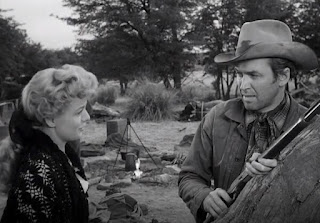
And as much as Lin is a memorable protagonist and Dutch a worthy villain, Winchester '73 is stocked full of other colourful characters brought to life by a stellar cast making the most of limited screen time. Millard Mitchell as High-Spade is not only a loyal friend but also a sage conscience, keeping an eye on Lin's pursuit of vengeance and always reminding him of his essence. 

High-Spade, referring to Lin's father: Did you ever wonder what he'd think about you hunting down Dutch Henry?
Lin: He'd understand. He taught me to hunt.
High-Spade: Not men. Hunting for food, that's alright. Hunting a man to kill him? You're beginning to like it.
Lin: That's where you're wrong. I don't like it. Some things a man has to do, so he does 'em.

Will Geer offers a unique and impressively laid-back take on Wyatt Earp, while John McIntire as weapons trader Joe Lamont exerts dominant authority even when outnumbered by Dutch and his ragtag men. Sergeant Wilkes is new to the west, and Jay C. Flippen affords him the curiosity to learn from Lin and High-Spade, even as the trio discover they met before on a different battlefield. And then Dan Duryea arrives to steal the back-end of the movie as the over-energized Waco Johnnie Dean.

Waco: What was I saying?
Lola: You were talking about yourself.
Waco: Where did I stop?
Lola: You didn't. But you can now. I already know all about Waco Johnny Dean, the fastest gun in Texas.
Waco: Texas? Lady, why limit me?


Shelley Winters enjoys some good lines but otherwise suffers as the only woman in world defined by men. Rock Hudson is an unconvincing Indian leader and Tony Curtis has a small role as a member of the cavalry who briefly gets to hold the rifle.

A formidable weapon, Winchester '73 is owned by many, but only rests in rightful hands.



All Ace Black Movie Blog reviews are here.

Friday, 9 October 2020

Movie Review: The Naked Spur (1953)

A taut western, The Naked Spur gets under the skin of five distinct characters engaged in a lethal battle of wits.

Rancher turned bounty hunter Howard Kemp (James Stewart) teams up with veteran gold prospector Jesse Tate (Millard Mitchell) to track down fugitive Ben Vandergroat (Robert Ryan), wanted dead or alive for murder. Disgraced ex-soldier Roy Anderson (Ralph Meeker) joins Howard and Jesse, and the trio capture Ben and his girlfriend Lina (Janet Leigh).

Howard had intended to use the $5,000 bounty on Ben's heads to repurchase the ranch he lost when his ex-lover betrayed him. Jesse and Roy now want their share of the reward money, and as the tense group make their way to Abilene, the resourceful Ben sets about exploiting the tensions between his three captors. An encounter with Blackfoot tribals adds further complications.

A journey driven by greed, complicated by uneasy alliances, and stirred by a charismatic fugitive desperate to save his neck from the hangman's noose, The Naked Spur is a dark, complex western. Carrying worthy echoes of The Treasure Of The Sierra Madre, the script by Sam Rolfe and Harold Jack Bloom presents five flawed character with disparate personal aspirations, and director Anthony Mann conjures up delectable moral dilemmas and psychological gamesmanship.

The third western collaboration between director Mann and star Stewart, The Naked Spur provides Stewart with one of his most intriguing characters, immediately placing the drama on dangerous ground. Howard Kemp is no stand-up hero looking to do the right thing. Instead he is deeply damaged by a love gone wrong, and has now defaulted to a stance of personal greed seeking to redress a sense of deep injustice. Indeed, the script hints Kemp chose Ben as his prey because he is the easiest target compared to genuine hardened outlaws.

While Kemp does his best to dissuade Jesse and Roy from claiming a share of the reward, they have their own issues to deal with. The aging Jesse has dedicated a lifetime to the futile pursuit of gold, a fading dream Ben can easily exploit. And the roguish Roy is on the run and desperate for the additional firepower a group can provide. 

Further intrigue is introduced by Lina and her spiky relationship with all the men. She immediately senses both Howard and Roy making moves towards her; and is shocked when the ever enterprising Ben encourages her to lead them both on, introducing a romantic duel as another potential crack to weaken the already rickety alliance against him.

With just the five speaking parts, Mann is able to delve deep into his characters, the fascinating multi-dimensional conflicts playing out against a lush landscape of forests, cliffs, caves and roaring rivers along the slow but dangerous trail to Abilene. As tensions run high, acts of betrayal and unexpected heroism converge towards moments of truth. With trust in short supply and no unity of purpose, few objectives are fulfilled, The Naked Spur a harsh exposition of the difference between superficial desires and soulful needs.


All Ace Black Blog Movie Reviews are here.

Saturday, 19 October 2019

Movie Review: The Big Sleep (1978)


A private investigation thriller, The Big Sleep moves Raymond Chandler's novel to modern day England but fails to recreate the requisite mood of pervasive dank criminality.

In suburban London, private investigator Philip Marlowe (Robert Mitchum) is hired by the elderly and paralyzed General Sternwood (James Stewart) to investigate and stop a blackmail campaign involving his wild younger daughter Camilla (Candy Clark). Marlowe also meets older daughter Charlotte (Sarah Miles), whose husband Rusty Regan has been missing for a month. The blackmail investigation leads Marlowe to book merchant Geiger, his assistant Agnes (Joan Collins), and her partner Brody (Edward Fox).

The trio are running a small scale pornography and blackmail racket, but soon Geiger is murdered, the Sternwood chauffaur turns up dead, and Brody is also summarily killed. One common thread linking the deaths appears to be slick gangster and casino operator Eddie Mars (Oliver Reed), whose wife Mona (Diana Quick) is also missing. With chief henchman Lash Canino (Richard Boone) emerging as a ruthless intimidator, Marlowe is intrigued that everyone he meets mentions the missing Regan, but no one is especially keen to find him.

A certain amount of courage is required to remake a classic, and to relocate a quintessential late 1930s Los Angeles crime story to 1970s England. This Lew Grade production insists on wedging a sordid American tale into a manicured British context, with English director Michael Winner also writing the screenplay. The result is predictable: despite the engagingly convoluted criminality, everything seems just off.

The story is faithful to the labyinthine book, but Winner never finds the style and mordant temperament required to stitch together the blur of killings and multiple conniving characters. The events are ticked-off with mechanical proficiency but zero chemistry, the staid English settings never clicking with the material and also left unexploited. Winner almost apologetically steers clear of contaminating Chandler's caustic attitude with any prim Englishness, leaving the film stranded in a vague blend of time and space.

Given the strength of the cast, the lack of any cohesiveness between people, events and places is almost tragic. Every key role is occupied by solid talent, but the stars appear to operate in detached parallel dimensions. The temperature between Robert Mitchum's Marlowe and Sarah Miles' Charlotte remains colder than the inside of a basement freezer unit. Oliver Reed is effective as the fashionable nexus of evil Eddie Mars, but never connects at a human level with any of his victims or enemies. And Candy Clark as Camilla lands on the side of childishly insane, missing all the essential nymphomaniac and rebellious undercurrents.

Although some of the dialgue wit survives and James Stewart rolls back the years to convey a stricken tycoon's heartache, this version of The Big Sleep is an exercise in transplanting the body but ignoring the soul.


All Ace Black Bog Movie Reviews are here.


Tuesday, 16 July 2019

Movie Review: The Flight Of The Phoenix (1965)


A survival adventure, The Flight Of The Phoenix explores tense dynamics among a group of men stranded in the unforgiving desert.

In North Africa, jaded veteran pilot Frank Towns (James Stewart) and his hard drinking navigator Lew Moran (Richard Attenborough) are in command of a cargo flight to Benghazi, flying an aging twin-engine Fairchild C-82 Packet airplane. A disparate group of men from various backgrounds are hitching a ride, including British military men Captain Harris (Peter Finch) and Sergeant Watson (Ronald Fraser); French Doctor Renaud (Christian Marquand); German scientist Heinrich Dorfmann (Hardy Krüger); and several oil field workers including the dimwitted Cobb (Ernest Borgnine).

During the flight Towns encounters a severe sandstorm, first knocking the plane off course then stalling both engines and forcing a hard landing in the desert. The men have plenty of dried dates for food but only enough water for about 10 to 15 days. With no signs of a forthcoming rescue Harris and one other survivor embark on a perilous march through the desert, while Heinrich reveals he is an airplane designer and develops an audacious plan to build a flying plane out of the wreckage.

An adaptation of the 1964 Elleston Trevor novel written for the screen by Lukas Heller and directed by Robert Aldrich, The Flight Of The Phoenix is an epic story of stress, hope and interpersonal dependencies under desperate circumstances. In the classic tradition of survival stories, the film is most interested in exploring emergent conduct and mental pressure when strangers with contrasting perspectives are trapped together for a prolonged period.

Themes of discipline, leadership and the transference of behavioral expectations from routine to emergency contexts permeate through the film. Heller's script delves into the complexities of authority under stress through the hierarchical relationship between Captain Harris and Sergeant Watson. Here codes of discipline and obedience built for war buckle under the strain of bleak prospects unrelated to hostile action. Suddenly deception and cowardice are in play, all in the name of eking out a survival advantage.

More fundamental to the group's prospects is the tension between Captain Towns and Heinrich Dorfmann. The normative leadership of the only man who can fly a plane is challenged once his aircraft is a crumpled wreck in the desert. Heinrich's well-calculated idea to build a new plane may sound insane, but it's the only available plan, and only he can lead it. Towns has already managed to steer his career in a downward spiral towards flying for a fifth-rate cargo operation in the desert with a drunk as his navigator, and yielding authority to a German nerd is not something he can readily accept. The essential role of the moderator, fulfilled by the now forcibly sober Moran, is accentuated.

The performances from James Stewart, Richard Attenborough and particularly Hardy Krüger are sturdy and appropriately layered, helping the film overcome its mammoth 142 minutes of running time. Some episodes serve to unnecessarily prolong the action while thinning the herd, but Aldrich overall keeps his focus on the characters. The resultant drama is engrossing despite most events being confined to a single location in and right around the plane's wreckage.

All men eventually wilt but a few also rise to the challenge. The Flight Of The Phoenix salutes the human ability to adapt and survive against overwhelming adversity.


All Ace Black Movie Blog reviews are here.

Sunday, 23 June 2019

Movie Review: The Man Who Shot Liberty Valance (1962)


A western about the frontier's evolution towards civility, The Man Who Shot Liberty Valance  thoughtfully reflects on the people and events that shaped an emerging nation.

Respected Senator Ransom Stoddard (James Stewart) and his wife Hallie (Vera Miles) make an unexpected visit to the town of Shinbone. The Senator reveals to the gathering journalists he is in town to attend the funeral of a man called Tom Doniphon and proceeds to recount their history together.

Decades earlier Ransom arrives in Shinbone as an idealistic young lawyer, and is quickly introduced to the ways of the wild west by vicious outlaw Liberty Valance (Lee Marvin), who robs Ransom and violently beats him up. The lawyer is rescued by rancher Tom Doniphon (John Wayne), the only man with the courage and gun skills to stand up to Liberty.

Tom's presumed bride-to-be Hallie runs the local eatery and helps Ransom recuperate while he teaches her to read and write, and an attraction develops between them. The rugged Tom pragmatically believes in the the ways of the gun, but Ransom wants to use education and the law to help bring outlaws to justice. With tensions in the territories rising, Ransom, Tom and Liberty are drawn into a raucous political conflict over statehood.

A western rich in narrative threads, The Man Who Shot Liberty Valance offers a quest for a new form of justice, a tense friendship, a romantic triangle, and the messy birth of political process as an alternative to individual score settling. John Ford directs with a intimate focus on characters and personal events rather than large-scale action, and the film uses individual stories to evoke a mood of inevitable change.

The overarching theme is creeping progress, for better or for worse. Happy to help out in the kitchen and serve at tables, Ransom Stoddard idealistically stands for education (for all), due process, and judgment in a courtroom rather than through the barrel of a gun. And yet he is forced to pick up a weapon and (haplessly) practice his shooting skills in a town still deciding whether to join the future.

Although John Wayne is first billed on the screen and his Tom Doniphon is the hinge around which the film rotates, James Stewart's Ransom Stoddard is the main character and the change agent pushing back against the west's more primitive tendencies to help create a more rational society. Together with Lee Marvin as an excellent title villain, the three men create a strong central triangle representing the past, present and future.

The capable supporting cast also includes Andy Devine as the cowardly and less than useless Marshal Appleyard, Edmond O'Brien as the newspaper editor Peabody, Woody Strode as Tom's loyal ranch hand Pompey, and Lee Van Cleef as one of Liberty's thugs.

Ford's tendencies towards rowdy excess emerge on a few occasions. The film meanders to over two hours, and some of the democracy-in-the-making crowd scenes, first in Shinbone and later at the Capitol City, go on for longer than needed with plenty of Capraesque speechifying.

And yet The Man Who Shot Liberty Valance finds its way to a most ironic and yet fully suitable denouement. The honest man of peace and order is a worthy political representative for the town that adopted him, even if his achievements are obscured by history's mythology.

Newspaper editor to Senator Stoddard: This is the West, sir. When the legend becomes fact, print the legend.


All Ace Black Movie Blog reviews are here.

Tuesday, 5 March 2019

Movie Review: Ziegfeld Girl (1941)


A musical drama, Ziegfeld Girl examines the consequences of sudden fame on the lives of three women thrust into the spotlight.

It's the 1920s, and legendary Broadway impresario Florenz Ziegfeld (who is never seen) is recruiting girls for his next big "Ziegfeld Follies" show. Sheila Regan (Lana Turner) is spotted working as a department store elevator girl. She is in love with her truck driver boyfriend Gil (James Stewart), but anyway joins the show. Young vaudeville performer Susan Gallagher (Judy Garland) is also recruited, although she is reluctant to leave her father Pop (Charles Winninger), a long-time vaudevillian, behind.

Sandra Kolter (Hedy Lamarr) is supporting her husband and classical violinist Franz (Philip Dorn) as he desperately seeks employment when she is offered a role in the Follies. Franz cannot accept his wife wearing skimpy outfits and parading in front of strangers, and leaves her.

The three girls make their debut, and their lives change forever. Sheila attracts the attention of the wealthy Geoffrey Collis (Ian Hunter), and embraces an alcohol-fuelled and lavish but shallow lifestyle, leaving Gil behind. Her brother Jerry (Jackie Cooper) befriends Susan, who has to adapt her singing style to appeal to more sophisticated audiences. And Sandra starts a relationship with the show's lead singer Frank Merton (Tony Martin), although they are both married.

Ziegfeld does not appear in a movie carrying his name, the black and white cinematography takes away from the spectacle, the running time of 132 minutes is too long, the sappy melodrama sometimes drips off the screen and some of the song-and-dance numbers include recycled footage from The Great Ziegfeld (1936).

And yet, Ziegfeld Girl still works remarkably well as an elaborate and multi-faceted drama about the price of fame. MGM unfurls the full glamour treatment in showcasing burgeoning stars Stewart, Garland, Lamarr and Turner in the lead roles, and the film is a whirlwind look at the shockwave of stardom as experienced by women offered an opportunity of a lifetime but no guarantees about the consequences. The performance number do cause bloat, so director Robert Z. Leonard compensates by maintaining fairly zippy pacing in the narrative scenes, and teases out the dilemmas facing the women. For all three, the abandonment of their pre-fame man is a turning point.

It's almost possible to sympathize with Sheila as she luxuriate in her Park Avenue apartment, admiring her numerous evening gowns and expensive jewelry, and drowning her guilt at abandoning Gil in copious amounts of alcohol. Although her story is the most prominent, Susan and Sandra also get plenty of screen time. Sandra is more pragmatic, choosing a job and salary with the Follies over poverty and starvation with Franz. And 17 year old Susan has perhaps the most difficult separation to endure: her father will carry on his touring vaudeville show without her, and she will have to unlearn most of what he taught her.

Ziegfeld's shows are lovingly recreated in the musical numbers directed by Busby Berkeley, including the traditional descending-the-stairs moments and the ridiculous over-the-top costumes and head wear. But the movie's highlights are the unexpected nuggets on the sidelines of the main show: Susan salvaging her audition by quickly understanding the need for subtlety in delivering I'm Always Chasing Rainbows; and later her dad getting his unexpected chance to shine in Mr. Gallagher and Mr. Shean.

Ziegfeld plucked girls from obscurity, taught them how to prance on-stage, and gave them a shot at accelerated stardom. The bright lights were enlightening for some, but blinding for others.


All Ace Black Blog Movie Reviews are here.


Sunday, 9 December 2018

Movie Review: The Shop Around The Corner (1940)


A romantic comedy and drama, The Shop Around The Corner is a delightfully sweet story of mixed-up love.

In Budapest, Alfred (James Stewart) is the floor manager of the fashion and accessories store owned by Mr. Matuschek (Frank Morgan). With Christmas approaching, the pressure is on to have a good sales season. Alfred's co-workers include the kindly but meek Pirovitch (Felix Bressart), the smarmy Vadas (Joseph Schildkraut), and young but ambitious delivery boy Pepi (William Tracy). Klara (Margaret Sullavan) joins the sales team through her sheer force of will, and clashes with Alfred, his calm and calculated personality not clicking with her vivacious attitude.

Unknown to both of them, Alfred and Klara are anonymously corresponding with each other through a match-by-letter service, with a big date approaching where they are supposed to meet. However, Mr. Matuschek is under increasing pressure on the home front, doubting Mrs. Matuschek's fidelity. His personal stress spills onto his employees, disrupting Alfred's career and love life.

An adaptation of a Miklós László play directed and produced by Ernst Lubitsch, The Shop Around The Corner is a lighthearted romance filled with quirky characters, the soulfulness of an approaching Christmas season, and a classic opposites attract dynamic.

Working in confined surroundings, Lubitsch creates clever and multi-layered interactions between his lovers-to-be. In person the sparks fly in all the wrong directions as they irritate each other with incompatible mannerisms. But they also dreamily speak of the perfect potential residing in their anonymous letters, a case of yearning for the concept of an ideal match residing in the written word while the warts-and-all reality of their potential union is already exposed.

The film is unsurprisingly stage bound, with most of the scenes taking place on the shop floor. A few aspects of the Samson Raphaelson script don't quite work, including Mr. Matuschek disrupting his critical relationship with Alfred just before he receives all the information he needs about his wife's dalliances. Alfred and Klara spend most of the movie sparring instead of developing their romance, and the second half of the film does contain plenty of asymmetrical if benign deception.

James Stewart is his typical upstanding self, while Margaret Sullavan sparkles as the driven woman seeking both and a career and a romance, and who will not settle until her ambitions are achieved. The film is greatly aided by the supporting cast, with Frank Morgan a strong presence hiding Matuschek's kind heart behind a stern exterior. Felix Bressart is also memorable as Pirovitch, a man who has seen everything come and go and will help but only quietly and otherwise skulk away from any noisy conflict.

Mr. Matuschek's shop is full of surprises good and bad, including an unexpected love hiding just around the corner.


All Ace Black Blog Movie Reviews are here.


Tuesday, 9 May 2017

Movie Review: Airport '77 (1977)


A disaster movie with a galaxy of stars trapped on a submerged airliner, Airport '77 is as corny as can be expected but also surprisingly well produced.

Aging tycoon Philip Stevens (James Stewart) invites high profile guests to travel on his lavishly outfitted private Boeing 747 en route to the grand opening of his home-based museum. Captain Don Gallagher (Jack Lemmon) is in command of the flight, while Eve Clayton (Brenda Vaccaro) is Don's long-time lover and in charge of passenger comfort. The guests include Nicholas St. Downs III (Joseph Cotten) and Emily Livingston (Olivia de Havilland), who first met in the 1930s and are reunited on the flight. Businessman Martin Wallace (Christopher Lee) and his neglected and perpetually drunk wife Karen (Lee Grant) are also on the flight, as are Stevens' daughter Lisa (Pamela Bellwood) and her young son.

In the cargo hold is a large collection of expensive art, and this attracts a band of thieves under the leadership of co-pilot Chambers (Robert Foxworth). Over the Bermuda Triangle the criminals release a sleeping gas to knock out Gallagher and all the passengers, and Chambers changes course, flying below the radar towards an uninhabited island. But in dense fog the 747 clips an off-shore oil rig, the plane crashes into the sea and sinks to the sea bed, intact but leaking. Gallagher has to keep the passengers calm and find a way to notify rescuers of the plane's location while the Navy and Coast Guard mount a search operation.

Directed by Jerry Jameson, Airport '77 arrived relatively late in the cycle of 1970s disaster films. By now the formula is overly familiar: collect a bunch of mostly elderly Hollywood stars, place them in peril, and play a parlour game of who lives and who dies before the credits roll. While everything about the film is conventional, the production values are well above average, yielding a mixed experience where the content is tired but the packaging is slick.

Disaster movies tend to work better in confined spaces, and the coffin-under-the-sea premise is appropriately claustrophobic and generates a real sense of danger, with water slowly seeping into the plane, and the passengers threatened with both drowning and asphyxiation.

The film's ambitions are reflected in a superior cast deep in veteran talent. Lemmon and Cotten are most prominent and get to run around the bowels of the cavernous plane and play the role of heroes. The likes of Stewart, de Havilland, Grant and Lee ensure that as irritating as the passengers are, they are good at being irritating. George Kennedy makes his obligatory disaster movie appearance, but this time is limited to a more minor role as a rescue coordinator. The special effects are decent for the era and have survived the test of time.

The final act transforms into a propaganda piece for the rescue capabilities of the Navy and Coast Guard, and although again the cheese factor is odorous, the execution is polished. Jameson keeps the pacing tight, delivering the drama in under two hours, and the final acts of tactical implementation, heroism, and late-in-the-day death are completed with requisite precision.

Airport '77 is definitely all wet, but enjoys its time in the cinematic tub.


All Ace Black Blog Movie Reviews are here.


Tuesday, 25 August 2015

Movie Review: Bend Of The River (1952)


A sturdy western, Bend Of The River is the story of homesteaders making their way west, and the resourceful men who can either help or victimize the new wave of settlers.

Glyn McLyntock (James Stewart) is leading a large convoy of wagons carrying optimistic farmers towards new pastures in Oregon. Jeremy Baile (Jay C. Flippen) is the grizzled leader of the settlers, and the group includes his headstrong daughters Laurie (Julie Adams) and Marjie (Lori Nelson). Laurie and Glyn are attracted to each other, but stop short of expressing any true affection. After making camp one evening, Glyn scouts ahead and stumbles onto a lynching-in-progress: he saves Emerson Cole (Arthur Kennedy) from the noose. The two men recognize each other: they were both frontier raiders on the Missouri - Kansas border, and both are trying to find new starts away from chequered pasts.

Emerson joins the convoy and proves to be handy in overcoming the challenges of the trail, including fending off a raid by Shoshone Indians, during which Laurie suffers an arrow wound and Emerson saves Glyn's life. The convoy gets to Portland, where they meet professional gambler Trey Wilson (Rock Hudson) and local businessman Tom Hendricks (Howard Petrie). Glyn and Jeremy lead the settlers to remote hillside territory to establish the farming community, but their resupply plans are disrupted by an unexpected gold rush that consumes Portland. With Hendricks reneging on his deals and the settler community facing starvation over the winter, Glyn has to take matters into his own hands and joins forces with Jeremy, Emerson and Trey on a dangerous cross-mountain trek, although the lure of gold means that trust is in short supply.

The second collaboration between director Anthony Mann and star James Stewart, Bend Of The River is filled with characters, incidents, and fundamental questions about redemption and second chances. The film is as much an exploration of events as it is a thoughtful probing of the nature of the men who shaped the west, and the screenplay by Borden Chase finds a pleasing balance between action and character development.

Mutual suspicion colliding with the absolute need to trust forms the core of the film. Glyn and Emerson circle each other, each identifying both the danger and potential that resides in the other man. They are quickly indebted to each other and forced to collaborate, although neither is ever quite sure where loyalties will ultimately land. Jeremy has no choice: his group of settlers needs men like Glyn and Emerson to make it to safety and then to survive at the remote settlement. Jeremy will either trust men like Glyn and Emerson, or die. And there are always wildcards in the form of the gambler Trey and businessman Hendricks. They are out to make a buck one way or another, but whether it's principled or opportunistic profit could mean the difference between death and survival for Jeremy and his family.

And the fundamental question is whether men like Glyn and Emerson can change, from social outcasts to community builders. In the one area where the film falls short, the script tackles this issue loudly and repeatedly, the social message delivered with a jackhammer rather than any subtlety.

Mann and cinematographer Irving Glassberg colour the screen with the gorgeous scenery of the Pacific Northwest, with snow-capped mountains and the rich green forests creating a majestic backdrop. Equally impressive is the recreation of Portland as a frontier town, at first a staid and welcoming place and then a riotous town overrun by prospectors and profiteers. There is always something stunning to look at in Bend Of The River, and it's almost always beautiful.

James Stewart and Arthur Kennedy are excellent in the two central roles as frontiersmen who are the same yet potentially different. Stewart reveals Glyn's conflict as a man not comfortable admitting that his past is suspect, and fighting for his second chance in as dignified a manner as the west will allow. Kennedy allows Emerson to be, if anything, more honest. More comfortable with his past, Emerson will reform only on his own terms, and if the price is not too high.

Bend Of The River is a symbolic juncture where decisions will need to be made, trading off personal gain for societal benefit: not all men will turn in the same direction.


All Ace Black Blog Movie Reviews are here.


Friday, 16 May 2014

Movie Review: The Shootist (1976)


John Wayne's last film, The Shootist is a glittering final curtain on a gigantic career. The story of a terminally ill but still grizzly gunslinger planning for his own death provides impeccable closure to the man and his epoch.

It's 1901, and Queen Victoria has just died. Aging gunslinger J.B. Brooks (Wayne) has killed 30 men in his lifetime, and claims that they all deserved it. Suffering from severe and continuous back pain, he arrives in Carson City, Nevada to be examined by his old friend "Doc" Hostetler (Jimmy Stewart). The doctor diagnoses terminal cancer. Brooks has at most two months to live, and his very final days will be exceedingly painful.

To prepare for his demise Brooks rents a room at the boarding house managed by the widow Bond Rogers (Lauren Bacall) and her teenage son Gillom (Ron Howard). Once Rogers realizes who her new guest is, she wants him gone, but he refuses. Marshal Walter J. Thibido (Harry Morgan) also tries and fails to convince Brooks to depart. Vultures like the local newspaper man (Rick Lenz), an old lover (Sheree North), and the local undertaker (John Carradine) try to figure out ways to profit from Brooks' impending death. But Brooks is making plans of his own. He can't cheat death, but he will face it according to his own code.

The Shootist unfolds over just a few days, as Brooks comes to terms with the certainty of his end, ties up loose ends and turns out the lights with dignity. He finds in Bond and Gillom suitable companions to accompany and tolerate him on his final days, and director Don Siegel allows the movie to flourish as Brooks opens his soul for the first and last time to a widow and her fatherless teenager. Siegel centres the film on Brooks and deploys the pace of a smooth character study, a few scenes of jolting action and witty humour punctuating the journey to the final climax.

Contrary to some popular myths, when filming The Shootist Wayne was not yet diagnosed with the cancer that eventually killed him in 1979. He also did not intend The Shootist to be his final screen performance. That this proved to be his final film and foreshadowed his ultimate struggle with terminal cancer was a turn of fate, an exclamation mark on a career that started in 1926 and ended exactly 50 years later.

And what a performance to end on. Wayne portrays J. B. Brooks as singularly uncompromising, his intentions and methods stringent, his values untouched. Brooks may be dying, but he will define the day, time, place and method, and Wayne closes his filmography with a towering show of inner strength, Brooks' resolve undermined only by his failing health.

And it's not just J.B. Books who is dying. As represented by the death of Queen Victoria and the turn of the century, his whole era is coming to an end, the world is moving on, and gunslingers who live by a rigid and ruthless code are turning into fossils from the past.

By now the glorious era of Westerns was also a distant memory, Spaghetti Westerns had come and gone and spoofed the genre into the ground. Violence-drenched odes to the old men of the west like The Wild Bunch (1969) had pushed the genre to its limit, and there was little new territory to explore. The Shootist writes the final chapter with more reflection than violence, allowing the hero who symbolized an era and the genre to exit on his own terms.

James Stewart (in a relatively small role) and Lauren Bacall join Wayne as stalwarts from a bygone era. Ron Howard's Gillom represents the next generation, and he is the only character thrilled to have Books around. Gillom overlooks all of Books' lethal tendencies and simply considers him a legend, a man to admire and emulate, in an apt metaphor of how the present views the Western past. In addition to John Carradine, there are key appearances by the likes of Richard Boone, Hugh O'Brian and Scatman Crothers.

Not many acting careers end at the top. In The Shootist John Wayne was able to ride off into the sunset with his head held high, unbowed by the changing times and still in charge of his destiny.


All Ace Black Blog Movie Reviews are here.


Sunday, 4 May 2014

Movie Review: The Philadelphia Story (1940)


An overrated high society romantic comedy, The Philadelphia Story is contrived and stagey, but maintains a certain allure thanks to a committed cast.

At her lavish family estate, Philadelphia socialite Tracy Lord (Katharine Hepburn) is about to get married to the stuffy George Kittredge (John Howard). Tracy's former husband  C. K. Dexter Haven (Cary Grant) shows up uninvited hoping to win his former wife back, as do two gossip reporters Macaulay "Mike" Connor (James Stewart), a frustrated author, and Elizabeth Imbrie (Ruth Hussey) a photographer with a crush on Mike. Tracy's young sister Dinah (Virginia Weidler) would like Tracy to reconcile with Dexter, although that marriage ended quite badly. Tracy's estranged father Seth (John Halliday) also suddenly shows up, adding to the pre-wedding stress.

As the big day approaches, Tracy finds herself becoming attracted to the down-to-earth Mike, and she starts to question her commitment to George. Dexter takes every opportunity to remind Tracy that she is a cold, perfect goddess who demands to be worshipped, and that she cannot tolerate any imperfections in her men. George and Mike pile on the pressure by also pointing out to Tracy all her haughty faults. To deal with her mounting confusion Tracy drinks to excess at the pre-wedding party, which only causes more romantic chaos among the three men now after her heart.

The Broadway play is translated to the screen with stellar casting. Hepburn financially backed the stage production and starred in it, and the movie helped restore her to the front ranks of Hollywood stars. With the suave Grant and ordinary-man Stewart playing to their strengths, The Philadelphia Story never lacks in charisma and star power. The dialogue is passably witty, while Virginia Weidler as Dinah and Ruth Hussey as Elizabeth offer grounded support.

But director George Cukor is never able to break free of the stage, and the film often bogs down in long-winded, talky scenes which play well on the stage but suffer from lack of energy and animation on the screen. The three leads all deliver their lines with a knowing twinkle in their eye, undermining any cinematic coherence, and the camera placement and actor movements all contribute to the sense of filmed theatre.

The material is too thin and laboured to fully make up for the lack of energy. The story may have played well to the upper classes of the day, but it has aged quite poorly, both as a romance and a comedy. The character's motivations and conversations never come close to being realistic. The fundamental premise of a series of guests showing up uninvited, hanging around the bride for hours on end, and unabashedly criticizing her values and behaviour to force an entire personality reassessment hours before the big wedding, just rings hollow. Matters are entirely not helped by an over-dependence on the consumption of gallons of alcohol as a transformational plot device.

The 1956 musical remake as High Society dramatically increased the colourful glamour quotient, dispensed with most of the introspection, and allowed the music to unlock the more timeless whimsical ingredients. Although it does glow with star wattage, The Philadelphia Story is unfortunately stuck in time, and on the stage.


All Ace Black Blog Movie Reviews are here.


Saturday, 15 February 2014

Movie Review: The Far Country (1954)


A gold rush adventure, The Far Country is a satisfying western, with impressive scenery making up for a lackadaisical narrative.

During the Klondike gold rush, Jeff Webster (James Stewart) and his sidekick Ben Tatum (Walter Brennan) lead a cattle drive toward Dawson City in the Canadian territories. At the Alaskan border town of Skagway, Jeff runs afoul of racketeering Judge Gannon (John McIntire), who seizes the cattle and attempts to intimidate Jeff. Local businesswoman Ronda Castle (Ruth Roman) comes to the rescue and invites Jeff to join her supplies caravan to Dawson, but not before innocent Renee Vallon (Corinne Calvet), the daughter of Skagway's doctor, develops a crush on Jeff.

Jeff eventually steals back his cattle, further infuriating Gannon, and demonstrates a stubborn streak of self-preservation by making his way to Dawson, securing a prospecting claim and looking after only himself. When Ronda and Gannon make their move to seize control of Dawson, Jeff has to decide where his real interests lie.

One of five western collaborations between Stewart and director Anthony Mann, The Far Country rarely strays from fairly standard, and sometimes cursory, treatment of common western themes. The action scenes start and end with a suddenness that hints at lazy scripting courtesy of Borden Chase, while Jeff's transformation journey from loner looking after himself to a man who must learn to care about his community can be spotted early.

The film is more memorable for breathtaking scenery and mud-drenched depictions of fledgling towns supporting the gold rush. Filming in Jasper National Park, Mann and cinematographer William H. Daniels make excellent use of the rugged, chilly and imposing terrain. Skagway and particularly Dawson are portrayed as rough frontier towns, where the rich and powerful rule by intimidation, either with subtlety in the case of Ronda, or with more open aggression, the method preferred by Gannon.

The potentially romantic triangle between Jeff, Ronda and Renee adds an element of human interest, but with Jeff mostly in love with himself and Ronda clearly more manipulative than caring, there is little room for any serious affection to flourish.

James Stewart cruises through the movie with a smooth, laid-back presence, his impressive confidence bordering on disinterest. More engaged are the two antagonists. John McIntire adds plenty of colourful bite to the role of Judge Gannon, a seemingly self-appointed law officer, prosecutor, juror and judge. Ruth Roman as Ronda Castle exudes the determination of a woman always ready to buy her way to ever increasing power, and looking for the most convenient partner for every given opportunity. Walter Brennan, as always, plays Walter Brennan.

The Far Country is a visual feast at the front lines of the quest for gold; the plot and characters stay much closer to home.


All Ace Black Blog Movie Reviews are here.


Tuesday, 11 December 2012

Movie Review: Anatomy Of A Murder (1959)


An absorbing courtroom drama, Anatomy Of A Murder bids a firm farewell to the 1950s and welcomes a new, much more liberal decade. With sometimes startlingly frank discussions about rape, semen, abuse, panties, and women's sexuality, and a probing of the link between psychiatric condition and criminal acts, Anatomy Of A Murder happily jumps from one taboo subject to another, ushering in a new era.

In small-town Upper Michigan, Paul Biegler (James Stewart) is a former District Attorney, now struggling to run his own home-based law practice. Paul's best friend is old-timer Parnell McCarthy (Arthur O'Connell), a former lawyer but now a confirmed drunk. Desperate for work, Paul accepts a seemingly hopeless case: to defend Lieutenant Frederick Manion (Ben Gazzara), who admits to shooting dead a pub-owner called Barney Quill, after Quill raped Manion's wife Laura (Lee Remick).

Laura is stunningly beautiful, dresses provocatively, and can't help flirting with every guy she meets, including Paul. But she insists that Quill did rape her, triggering an uncontrollable rage in Manion. Paul convinces Manion to plead not guilty due to temporary insanity, and sets off to find a medical expert to prove the point. Paul also uncovers the role played by Quill's bartender Alphonse Paquette (Murray Hamilton) on the night of the rape and murder, while McCarthy tracks down the background of the mysterious Mary Pilant (Kathryn Grant). When the trial starts, Paul is up against a shark of a prosecutor in the form of Claude Dancer (George C. Scott), who will do his best to prevent Paul from turning what should be a straightforward murder trial into a rape and revenge case.

The poster art and the angular, playful credit sequence announce the forthcoming change of decades. Anatomy Of A Murder also immediately deploys an enjoyable and innovative all-jazz soundtrack by Duke Ellington (who also makes a cameo), capturing the spirit of a movie tackling serious issues with a light touch. And the Wendell Mayes script wastes no time in going where few movies had gone before, delving into the vocabulary associated with rape cases and courageously portraying the victim as a liberated woman pro-actively seeking the attention of men.

Otto Preminger keeps Anatomy Of A Murder moving along a taut wire for its entire 160 minutes of running time. Cleverly injecting humour to break the tension, and giving equal time to the exploration of murder, rape, and a marriage punctured by jealousy, the film is rich with characters worth knowing and truths worth unveiling. The entire final third is dedicated to the court proceedings, and Preminger creates a dynamic and cavernous courtroom environment with a multitude of perspectives presided over by a caustic but reasonable judge. There are enough colourful events and personalities on show that Sam Leavitt's black and white cinematography is a simplifying relief.

Paul Biegler is one of James Stewart's final great roles. Stewart received his fifth and final Best Actor Academy Award nomination for bringing to life a lawyer who is smarter than he looks, more melancholy than he shows, charming and disarming when needed, and much more dogged than his foes give him credit for. Stewart sparring with the uncompromising George C. Scott in the epic courtroom battle is a duel for the ages.

Lee Remick is the other star of Anatomy Of A Murder. In just her fourth screen role, Remick sizzles as an over-sexed wife attracting the eye of every man she meets, and revelling in the attention. Dressed in pants, high heels and tight tops as she proves too hot to handle for rural upstate Michigan, Laura is a challenge for Paul both in fending off her lustful looks and insofar as her story of rape may have sounded suspicious even to her own husband. In a performance full of refinement, Remick ensures that Laura is convincing both as a seductress and a victim.

Anatomy Of A Murder expertly dissects a case of death by jealousy, and finds within it societal norms already changing and about to be severely disrupted by a decade of tumultuous upheaval.


All Ace Black Blog Movie Reviews are here.