Showing posts with label Ray Milland. Show all posts

Saturday, 28 March 2026

Movie Review: The Swiss Conspiracy (1976)


Genre: Thriller  
Director: Jack Arnold  
Starring: David Janssen, Senta Berger, John Saxon, Ray Milland, John Ireland, Elke Sommer, Anton Diffring  
Running Time: 83 minutes  

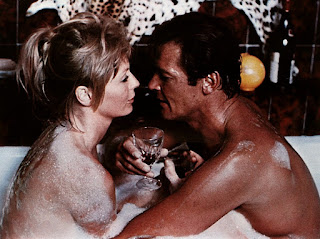
Synopsis: In Geneva, former US Justice Department official David Christopher (David Janssen) is hired by bank president Hurtil (Ray Milland) to investigate a blackmail plot targeting five bank clients. The victims include the alluring Denise Abbott (Senta Berger), tough Chicago crime boss Hayes (John Saxon), and shady Texas businessman McGowan (John Ireland). Meanwhile, bank Vice President Benninger (Anton Diffring) and his lover Rita (Elke Sommers) may be suspects with means and a motive. As Christopher investigates, the dead bodies start to accumulate, drawing the attention of Police Captain Frey (Inigo Gallo).

What Works Well: The Swiss locations and slick production values provide scenic backdrops, and the complex story rewards attention by delving into sordid secrets hiding behind anonymous bank accounts and stone facades of respectability. Director Jack Arnold mixes action scenes with plot advancements and a mutual seduction, and throws in a couple of red herrings to extend the guessing game all the way to a decent mountaintop climax. The supporting cast contributes an interesting character actor in every role. 

What Does Not Work As Well: David Janssen lumbers through the action with little finesse but many shirt buttons undone. A few of the chase scenes go on for longer than needed, and the final plot explanations are unleashed in a frantic flurry. A couple of Ferraris engage in a high speed duel that unfortunately has nothing to do with the plot. Seemingly extensively damaged, one of the Ferraris emerges unscathed in the very next scene.

Key Quote:
Denise (to David Christopher): I'll change into something less comfortable.


All Ace Black Movie Blog reviews are here.

Saturday, 15 January 2022

Movie Review: Gold (1974)

A thriller set in the high-stakes mining industry, Gold is ambitious but uneven. 

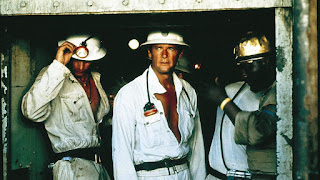
The setting is South Africa, where an explosion at the Sonderditch gold mine results in multiple fatalities despite the best rescue efforts of underground manager Rod Slater (Roger Moore). The explosion was caused during an unsanctioned dig towards an underground dike ordered by the mine's director Manfred Steyner (Bradford Dillman), who is married to Terry (Susannah York), the granddaughter of the mine's owner Hurry Hirschfeld (Ray Milland).

Manfred is part of an evil international syndicate led by London-based gold investor Farrell (John Gielgud). By breaching the dike and flooding Sonderditch and adjacent mines, the syndicate aims to profit on the markets. The unsuspecting Slater is promoted to general manager, and also starts an affair with Terry. Manfred orders Slater and his crews to dig towards the dike, and potential disaster. 

With Roger Moore enjoying international fame after his first 007 outing, producer Michael Klinger assembles a Bond-like crew featuring director Peter Hunt, editor John Glen, production designer Syd Cain, and titles designer Maurice Binder. Gold is a not-bad adaptation of a Wilbur Smith book, the Stanley Price script not lacking in scope, characters, locations, and effort.

The film starts and ends strongly. The opening is literally a bang, the dangerous world of mining introduced through an explosion and breathless rescue operation. The climax is a similarly thrilling race to avert a complete catastrophe. In between, the narrative chugs along but the pace slows as the conspiracy unfolds and plenty of screen time is occupied by a rather tepid romance between Slater and Terry.

Mostly filmed in apartheid-era South Africa, Gold features plenty of travelogue material and sometimes cringey attempts to avoid the obvious. Only one character is overtly racist, and Black culture is represented through tribal dances and soccer matches. Black miner King (Simon Sabela) has a prominent and heroic role, but it's a whites-only affair at the cocktail parties and serious meetings.

John Gielgud's ruthless market manipulator and Bradford Dillman's slimy germophobe combine for a potent duo of antagonists lined up against Moore's unbuttoned-shirt heroics. The production values are adequate, and the film enjoys a reasonable layer of gloss. Gold may not bedazzle, but neither is it dull.


All Ace Black Movie Blog reviews are here.

Thursday, 9 July 2020

Movie Review: Easy Living (1937)


A screwball comedy and romance built on a series of misunderstandings, Easy Living enjoys high energy levels but too often strays into excessive overacting.

Wealthy bank tycoon J.B. Ball (Edward Arnold) first insults his son John Ball Jr. (Ray Milland), then has an argument with his wife Jenny (Mary Nash) and throws her new expensive fur coat off the balcony. It lands on the head of the penniless Mary Smith (Jean Arthur), ruining her hat. She tries to return the coat, but J.B. insists she keep it and helps her buy a new hat. 

Rumours immediately swirl that Mary is J.B.'s new mistress. Hotelier Louis Louis (Luis Alberni) spots an opportunity to revive the fortunes of his flagging luxury hotel, and invites Mary to stay at the Imperial Suite for the pure publicity value. She is bewildered but accepts, and soon meets John, not knowing he is J.B.'s son. Additional false assumptions are piled on, eventually leading to romance and frantic stock market trading.

Filled with over-the-top physical comedy bordering on juvenile farce, Easy Living walks a fine line between smart and silly. The script by Preston Sturges is punctuated by people falling down the stairs, tripping over each other, smashing into furniture, getting into fights, and in one instance, a massive fracas at an automat fast food restaurant. Director Mitchell Leisen fully invests in the slapstick, with the resulting vitality and absurdity competing for prominence.

The script enjoys a modest level of sharp wit, and is mostly concerned with poking fun at pompous rich people grappling with the consequences of wagging tongues and profit seekers. Mary's spectacular ascent from a nobody to the buzz of town, through no intention or action of her own, is wry commentary on fate's little games. 

The actors are encouraged to match the madcap shenanigans and deliver loud and broad performances. Edward Arnold shouts his way through the entire movie and gets progressively more tiresome. Leisen also offers too much of Luis Alberni's smarminess and mangled English as he tries to cheese his way towards salvaging his hotel business.

The exception is Jean Arthur, perfectly cast as the eye of the storm. She maintains an even keel as Mary Smith, unaware of the gossip and innuendo storm unleashed by a fur coat landing on her head. Easy Living remains watchable thanks to her grounded performance.

The romance elements are relatively tepid, John Ball Jr. and Mary brought together at that automat fiasco then finding a nominal spark. Ray Milland enjoys a few decent moments but is largely overshadowed by the louder characters and disappears for long stretches. Instead of building towards a romantic climax, the script is distracted by a much less interesting frenetic stock trading sub-quest.

Easy Living is easy to like, and also relatively easy to leave.


All Ace Black Movie Blog reviews are here. 

Tuesday, 21 November 2017

Movie Review: Reap The Wild Wind (1942)


A colourful maritime epic, Reap The Wild Wind has a bit of everything but not much of anything.

It's the 1840s, and Key West, Florida is a key marine gateway to the United States. Vessels frequently wreck in the rough seas, and salvage operators rush to rescue sailors and retrieve cargo. Rough and ready Loxie Claiborne (Paulette Goddard) runs a legitimate salvage company, while her rivals King Cutler (Raymond Massey) and his brother Dan (Robert Preston) are more interested in causing wrecks for profits. As a further complication, Dan is secretly in love with Loxie's cousin Drusilla (Susan Hayward).

The Cutlers' chicanery causes the ship captained by Jack Stuart (John Wayne) to wreck. Loxie rescues Jack and they fall in love. He dreams of captaining the Southern Cross, a modern steam boat owned by shipping tycoon Commodore Devereaux. Loxie travels to Charleston and flirts with Steven Tolliver (Ray Milland), Stuart's rival and Deveroux's influential second-in-command, to try and secure the Southern Cross command for Stuart. Instead, Tolliver falls in love with Loxie. Tolliver travels to Key West to investigate the Cutlers, heating up the love triangle but also forcing Tolliver and Stuart to cooperate to try and stop the escalating series of shipwrecks.

Produced and directed by Cecil B. DeMille, Reap The Wild Wind is a bright, boisterous, and busy adventure. The story hops between the bustling port of Key West and the much more refined and civilized Charleston, with frequent sailings out to sea to experience the world of cargo ships in rough waters and the salvage crews who either provide assistance or prey on misfortune. The production values are high, the screen pops with colour, the costumes are lavish, hordes of extras populate every corner of the screen, and the sets and special effects are state of the art for the era.

With no shortage of characters and events, the film breezes through the two hours of running time, and DeMille somehow contrives to end his epic with a dangerous underwater dive featuring a massive angry squid, but only after the film takes a substantive detour into courtroom drama territory.

The romantic triangle and underhanded business alliances crackle away as DeMille alternates between affairs of the heart and cut-throat underhanded double-crosses. It's all happening all the time, not a surprise given that Reap The Wild Wind is based on a newspaper serialization. The film benefits from the brisk fun factor, and also suffers from the consequent lack of depth and any sense of lasting substance.

Loxie is in the middle of everything, an irrepressible independent woman well ahead of her time in a man's world, and Goddard injects the necessary energy to allow Loxie to drive the film ever forward. The men are more troublesome and less worthy, rendering the romance moments more irritating than engaging. Ray Milland as Tolliver is foppish, bland and abusive, and worst of all attached to silly dog ventriloquist tricks. John Wayne as Stuart is sturdy but maybe none too bright, and the fistfights between the two men erupt all too predictably.

Reap The Wild Wind is undoubtedly entertaining, and just as definitely sailing in shallow waters.


All Ace Black Movie Blog reviews are here.

Wednesday, 15 November 2017

Movie Review: Beau Geste (1939)


An epic military adventure about brotherhood and sacrifice, Beau Geste is an absorbing and richly rewarding drama.

It's the middle of the Sahara desert, and a French Foreign Legion relief column, responding to reports of Arabian tribal attacks, arrives at Fort Zinderneuf and finds no signs of life. All the men inside the fort are dead but positioned at their parapet firing stations with rifles pointed at a departed enemy. Only two men lie dead in more natural positions, one of them killed by a sword and holding  a note confessing to the theft of "Blue Water", a precious gem.

Fifteen years earlier, the Geste brothers Beau (Gary Cooper), Digby (Robert Preston) and John (Ray Milland) are adopted orphans being raised by the kindly Lady Patricia Brandon (Heather Thatcher). The brothers are close friends and dream of joining the French Foreign Legion. Patricia is running into money problems, and her one remaining precious asset is Blue Water, a massive sapphire worth a fortune but also legendary for bringing bad luck to its owner.

The boys grow up into upstanding young men, and John falls in love with his childhood sweetheart Isobel (Susan Hayward). One evening Lady Patricia and her adopted sons are admiring Blue Water when the lights go out and the jewel disappears. No one confesses to the theft. Soon after, the three men do join the Foreign Legion and undergo training at the hands of the brutal Sergeant Markoff (Brian Donlevy). Digby is separated from his brothers before circumstances lead to a reunion at Fort Zinderneuf.

A remake of the 1926 silent film and making use of the same sets, the 1939 version of Beau Geste is a lavish adaptation of the classic P.C. Wren novel. Director William A. Wellman and his excellent cast weave the intricate story with confidence, delivering in under two hours a deeply satisfying adventure touching on themes of military honour, family bonds, companionship, and sacrifice.

The narrative arc is supremely elegant. The opening scene at an isolated fort filled with dead soldiers is unforgettable, setting a sweeping mood of anticipatory dread. It is followed by a flashback to events 15 years prior with the Geste brothers as young boys, Wellman and screenwriter Robert Carson cleverly unveiling the brothers' personalities and future legacies. Both scenes boast details that will echo back in amplified tones close to 100 minutes later, when the events at the fort are finally revealed.

A large part of the film's appeal lies in the complexity of the characters. None of the Gestes are presented as impeccable heroes, lending weight to the mystery of the missing Blue Water gem. And the ambitious and brutal General Markoff, the closest thing to the villain of the piece, gets plenty of time to demonstrate his qualities when the going gets tough. Brian Donlevy's chilling turn as Markoff, bordering on psychotic but finding an arena where psychosis may be a good thing, was deservedly nominated for an Academy Award.

The rest of the cast members share the screen time, with Gary Cooper, Ray Milland and Robert Preston getting their individual moments without dominating. In one of her earliest roles, Susan Hayward gets a relatively few scenes. The rest of the supporting cast is filled with sturdy character actors, including J. Carrol Naish, Albert Dekker, and Broderick Crawford.

Beau Geste is packed with plot, and all the pieces come together in the rousing final act. Once the action moves into the fort for the final third of the film the mystery of the missing jewel intermingles with a brewing mutiny and an external threat to the troops. At the middle of it all are brothers looking out for each other. Wellman never loses sight of the heart of his story, and proceeds to deliver one of the screen's most poignant farewells. Whether in the comfortable surroundings of home or in an unforgiving desert surrounded by death, gallant gestures matter.


All Ace Black Blog Movie Reviews are here.


Sunday, 28 May 2017

Movie Review: The Lost Weekend (1945)


A stunning alcoholism drama, The Lost Weekend packs a knockout punch as a dark exploration of a grim human addiction.

In New York City, Don Birnam (Ray Milland) is a struggling writer and a hopeless alcoholic. In front of his girlfriend Helen (Jane Wyman) and his brother Wick (Phillip Terry) Don pretends to be on the road to recovery, but in reality all he can think of is getting the next drink. He stashes bottles in hiding places throughout his apartment to hide them from Wick, but sometimes also outsmarts himself.

Don, speaking to bar owner Nat: It shrinks my liver, doesn't it, Nat? It pickles my kidneys, yes. But what does it do to my mind? It tosses the sandbags overboard so the balloon can soar. Suddenly, I'm above the ordinary. I'm competent, supremely competent. I'm walking a tightrope over Niagara Falls. I'm one of the great ones. I'm Michelangelo, molding the beard of Moses. I'm Van Gogh, painting pure sunlight. I'm Horowitz, playing the Emperor Concerto. I'm John Barrymore before the movies got him by the throat. I'm Jesse James and his two brothers — all three of 'em. I'm W. Shakespeare. And out there it's not Third Avenue any longer: it's the Nile, Nat, the Nile — and down it moves the barge of Cleopatra.

Don finagles his way out of Wick's weekend trip to the country, staying behind in a city full of temptations and embarking on a quest for money to buy booze. Despite Helen's increasingly frantic efforts to save her man, Don's real companions are bartenders and floozies as his weekend becomes a downward spiral of desperation towards the bottom of the bottle. As the weekend wears on, he also recounts the history of his relationship with Helen to a bartender.

Nat: Why don't you cut it short?
Don: I can't cut it short. I'm on that merry-go-round. You gotta ride it all the way. Round and round until that blasted music wears itself out and the thing dies down and comes to a stop... At night, the stuff's a drink. In the morning, it's medicine... It's a terrifying problem, Nat, because if it's dawn, you're dead. The bars are closed and the liquor stores don't open until nine o'clock and you can't last until nine o'clock. Or maybe Sunday, that's the worst. No liquor stores at all, and you guys wouldn't open a bar, not until one o'clock. Why? WHY, Nat?

Directed and co-written by Billy Wilder, The Lost Weekend is the first serious on-screen treatment of alcoholism's vice-like grip. The disease is presented for what it is, a destructive controlling force with potential to crush careers and relationships. Far from the hitherto traditional portrayal of jovial drunks cracking jokes and providing comic relief, The Lost Weekend is an unyielding and fearless journey into the abyss.

The tone is set early. From the opening scene a bottle is hanging outside the apartment window, hiding in plain sight, Don waiting for any opportunity to be alone and take a swig. And as soon as he rids himself of Wick's attention he turns to lies, theft, and pawn shops to scrape together the dollars needed to supply himself with alcohol for his weekend binge. The film captures ingenuity sparked by despair, and the depths to which Don will sink to secure the next drink.

Helped by a dedicated Ray Milland performance revelling in the freedom of abdicating to an insidious disorder, Wilder conjures up two unforgettable highlights. The first finds Don at a swanky late night lounge, racking up a large drinks bill he cannot afford to pay. He attempts to improvise a solution, risking the depths of humiliation to service his addiction. The second climax features Don reduced to pawning his typewriter to again raise some much needed drinking funds, the final surrender of a career capitulating to substance dependency. All the pawnshops are closed, and Don's trek takes him across New York, but he will not give up the search for a few dollars to satisfy his cravings.

Nat, to Don, referring to the number of drinks: One's too many an' a hundred's not enough.

Still turning the screws Wilder pushes deeper. Don's thoughts turn to more permanent solutions, and even Helen's love and commitment become opportunities for more self-annihilation. Drowning in the sorrow of an all too common condition, The Lost Weekend is horrific, essential and unblinking.


All Ace Black Blog Movie Reviews are here.


Monday, 3 April 2017

Wednesday, 25 January 2017

Movie Review: The Major And The Minor (1942)


A bland one-trick comedy, The Major And The Minor suffers from a ridiculous premise, a lack of wit and phony execution.

Frustrated with a series of dead-end jobs in New York City, Susan Applegate (Ginger Rogers) gives up on life in the big city and decides to return to her simpler roots in Iowa. Short of money for the adult train fare, Susan pretends to be 12 years old and buys a discounted child's ticket. On board the train she plays a cat and mouse game with the conductors to avoid detection. She finally hides in the compartment of Major Philip Kirby (Ray Milland), who is returning to his military academy where his smothering fiancée Pamela Hill (Rita Johnson) awaits.

Philip falls for the child trick and takes Susan under his wing, housing her at the academy for a few days after train trouble delays her trip. She finds herself having to carry on pretending to be 12 years old, surrounded by lustful adolescent cadets. Pamela's younger sister Lucy (Diana Lynn) immediately sees through Susan's disguise, but more trouble awaits when Philip and Susan start to develop genuine feelings for each other.

The first Hollywood film directed by Billy Wilder, The Major And The Minor has seedlings of ideas that would grow into better films in the future, notably the adults-in-disguise theme of Some Like It Hot. But in and of itself, The Major And The Minor is a flimsy and forgettable effort that has aged exceptionally poorly. There is very little that is funny about 31 year old Ginger Rogers unconvincingly pretending to be 12 for almost the entire duration of the film, and it's made worse with all the other adults in the story somehow falling for the lame deception.

The film would be more tolerable if it stumbled onto some moments of cleverness or romance, but it does not. The script (co-written by Wilder) is hampered by poor pacing, repetitiveness and scenes prolonged well past their useful length, and the narrative is filled with generally unappealing characters behaving poorly. It's difficult to remember a knock-out scene or even one sharp exchange of dialogue. OK, there is one:

Train conductor, suspicious that Susan is not who she says she is: If you're Swedish, suppose you say something in Swedish.
Susan: I vant to be alone.

The romance never has an opportunity to gain traction, because Philip believes that Susan is 12. The adult affection he starts to develop for her is fundamental for the film and yet can only be icky. Susan is left to engage in a battle of surreptitious wills with the possessive Pamela, and starts to demonstrate the emotional maturity of a 12 year old by using juvenile antics to get between Philip and his chosen fiancée.

The Major And The Minor is an inauspicious US debut for Wilder, neither major nor minor, just annoyingly discordant.


All Ace Black Blog Movie Reviews are here.


Saturday, 18 June 2011

Movie Review: Love Story (1970)


Boy meets girl, boy loves girl, boy marries girl, girl supports boy, girl dies. As straightforward as romantic tragedies get, Love Story is exactly what is says on the tin: a doomed love story, manufactured with the sole purpose of crashing a happy union onto the rocks of the ultimate calamity. Based on the best-selling book by Erich Segal, who also wrote the script, the story struck a chord and the movie became a cultural phenomenon.

Oliver Barrett (Ryan O'Neal), a rich Harvard graduate and feisty hockey player on his way to law school, meets Jennifer Cavalleri (Ali MacGraw), a spirited Radcliffe College music student. She is vivacious, artsy, and has a sharp wit that turns every conversation into a jousting match. Jenny's social background is several steps lower than the snooty Harvard class that Oliver belongs to, but this does not stop them from falling madly in love.

Oliver has a dysfunctional relationship with his stern father (Ray Milland), and Oliver's romance with Jenny does not help matters: Oliver's parents perceive her to be beneath them. Oliver becomes completely estranged from his father, and goes ahead and marries Jenny. As Oliver goes through law school, Jenny works as a teacher to support them. He graduates and takes a position with a prestigious New York law firm. All seems to be going well and they plan on starting a family, until Jenny is diagnosed with a fatal disease (likely cancer, although this is never mentioned in the film): she has very little time left to live.

Love Story has some points of irritation: for all her fresh-faced appeal Ali MacGraw's performance is almost theatrical in its grandiose delivery of every line; the famous musical love theme is over-used to distraction in the second half of the film; and Ryan O'Neal's default mode is that of the angry young man, no matter what is going on in his life.

And the infamously bad tag line "Love means never having to say you're sorry" has just gotten worse with time.

But director Arthur Hiller makes great use of Boston locations, and captures the spark of emerging love in the early scenes between Jenny and Oliver. More admirably, Love Story also takes the time to show the comforts of love and the tenderness between an established couple. A brief sofa scene with Jenny resting on Oliver while they each read a book grasps the essence of couplehood. And the scenes with Oliver's parents are deliciously uncomfortable, resonating with a mountain of never to be resolved issues between Oliver and his dad.

A cultural landmark for better or for worse, Love Story neither over-promises nor under-delivers. It is faithful to all elements necessary to create a heartbreaking romance.


All Ace Black Movie Blog reviews are here.

Saturday, 17 July 2010

Movie Review: Dial M For Murder (1954)


In London, struggling professional tennis player Tony Wendice (Ray Milland) plots the perfect murder and an airtight alibi to get rid of his rich but cheating wife Margot (Grace Kelly). 

But while his plan seems ingenious, in practice everything unravels with unintended consequences. Chief Inspector Hubbard (John Williams) and Margot's lover Mark Halliday (Robert Cummings), a crime fiction writer, are soon trying to untangle a mess of a plot gone wrong.

Alfred Hitchcock's adaptation of Frederick Knott's nimble play is both sure-footed and clever. Hitchcock keeps the tone, pacing and settings close to their stage roots, allowing the strength of the story, sharp dialogue and a confident cast to deliver a simple yet gripping film.

Ray Milland as the has-been tennis star husband is effectively slimy and sinister as he conjures up two plots against his wife: the first he planned for years; the second he has to develop in minutes. Grace Kelly does well as the seemingly innocent wife-with-a-lover who is suddenly confronted with death twice over. And John Williams is most watchable as Chief Inspector Hubbard, who uses his wits and old-fashioned detective work to piece together a plot involving a planned yet bungled murder, an unintended victim, apparent blackmail, and infidelity.

Hitchcock delivers thrills, tension and a battle of wits in an economical 105 minutes, and deploys ever-interesting camera angles to wring suspense out of simple settings.

Evil intentions make the call, but Dial M For Murder still gets the right number.


All Ace Black Blog Movie Reviews are here.