Showing posts with label Burt Lancaster. Show all posts

Sunday, 26 April 2026

Movie Review: Separate Tables (1958)


Genre: Drama  
Director: Delbert Mann  
Starring: Burt Lancaster, Deborah Kerr, Rita Hayworth, David Niven, Wendy Hiller, Rod Taylor, Gladys Cooper, Cathleen Nesbitt  
Running Time: 100 minutes  


Synopsis: The setting is the The Beauregard Hotel in Bournemouth, England. The residents include the gossipy Mrs. Railton-Bell (Gladys Cooper) and her obedient and dowdy daughter Sibyl (Deborah Kerr), who has a crush on the talkative Major Pollock (David Niven). The divorced John Malcolm (Burt Lancaster) drowns his sorrows at the local pub but promises to marry the hotel manager Pat Cooper (Wendy Hiller). Medical student Charles (Rod Taylor) is prevented from concentrating by feisty girlfriend Jean (Audrey Dalton). The guests' established rhythms are first disrupted by the arrival of John's ex-wife Anne (Rita Hayworth), a glamorous model, and then by a shocking scandal.

What Works Well: The adaptation of two stage plays by Terence Rattigan (who co-wrote the screenplay) deploys sharp writing to create a rich texture of turmoil churning beneath staid surroundings. Director Delbert Mann teases out a Britain in post-war transition, the older generation holding on to conservative ideals while the younger members frolic and test new boundaries. David Niven (as Pollock encounters the limits of deceit) and Deborah Kerr (as Sybil finally cracks her shell) shine brightest in a stellar cast that allows mannerisms, etiquette, and social norms to collide with secrets, scandals, emotional releases, and new beginnings.

What Does Not Work As Well: The production is strictly stage-bound, and unsurprisingly a few scenes slip into theatrical melodrama. While the emotional untidyness is welcome, a few character decisions in the final act demonstrate genuinely suspect judgement.

Key Quote:
John Malcolm: You know something, Ann? No one I know of lies with such sincerity.


All Ace Black Movie Blog reviews are here.

Saturday, 25 April 2026

Movie Review: Lawman (1971)


Genre: Western  
Director: Michael Winner  
Running Time: 99 minutes  

Synopsis: Land baron Vincent Bronson (Lee J. Cobb) and five of his cattlemen go on a drunken spree in the town of Bannock, inadvertently killing an old man. Months later, Bannock marshal Jered Maddox (Burt Lancaster) arrives in the town of Sabbath, which is essentially owned by Bronson, intent on arresting the six men. Bronson offers to negotiate with help from Sabbath marshal Cotton Ryan (Robert Ryan), but Maddox is adamant that the law must be served, leading to escalating cycles of violence.

What Works Well: This revisionist western upturns traditional taming-the-frontier themes with brazenly unsettling audacity. Here the protagonist Maddox is singularly determined to apply the letter of the law, the supposed villain is open to compromise, and the resultant spiral of violence is a condemnation of rules applied in the absence of contextual judgment. The Gerald Wilson script is eminently quotable, and excels in revealing complex trade-offs by providing well-rounded views of multiple characters. Robert Ryan shines in the caught-in-between role, while Lee J. Cobb and Burt Lancaster represent opposing perspectives with rich textures, leading to a jarringly unconventional climax.

What Does Not Work As Well: Director Michael Winner's sense of visual style incorporates awkward over-deployment of zooms and bullet hole blood spurts.

Key Quote:
Vincent Bronson: It took guns to get the land, guns to keep it, guns to make things grow. The guns that pride called out... and each time we buried the cost.


All Ace Black Movie Blog reviews are here.

Sunday, 1 March 2026

Movie Review: Come Back, Little Sheba (1952)


Genre: Drama  
Director: Daniel Mann  
Starring: Burt Lancaster, Shirley Booth, Terry Moore, Richard Jaeckel  
Running Time: 99 minutes  

Synopsis: Middle-aged childless couple Doc and Lola Delaney (Burt Lancaster and Shirley Booth) are stuck in a loveless marriage. He is a chiropractor and recovering alcoholic, while she is frumpy, lonely, and still grieving the disappearance of her dog Sheba. They rent a room in their house to vivacious college art student Marie (Terry Moore), who has a serious boyfriend back home but nevertheless starts flirting with classmate Turk (Richard Jaeckel). Marie's presence stirs up Doc's passion and upsets the household dynamics.

What Works Well: This adaptation of the William Inge stage play is an in-depth, soaked-to-the-soul exploration of loss. Doc and Lola have endured the loss of innocence, a lost child, the loss of her parents' support, the truncation of his career, and his descent into alcoholism. Now her dog's disappearance is a sad postscript residing on top of a cold marriage with a wrecked past and no present. Marie waltzes into this context full of vibrancy and hope, rocking Doc and Lola out of complacency and into emotional and unstable reactions. Director Daniel Mann creates dynamism through searing but understated character interactions, and Shirley Booth excels in translating her stage role to the screen, portraying Lola as a pathetically grating wife clinging to selected memories as a survival mechanism.

What Does Not Work As Well: Burt Lancaster's performance cannot be faulted, but his robust and confident screen persona is misaligned with Doc's fragile psychology.

Key Quote:
Doc: Alcoholics are mostly disappointed men.
Lola: Sure, I know...you was never disappointed, were you, Doc?


All Ace Black Movie Blog reviews are here.

Saturday, 10 June 2023

Movie Review: Scorpio (1973)


Genre: Crime Drama
Director: Michael Winner
Starring: Burt Lancaster, Alain Delon, Paul Scofield, John Colicos
Running Time: 114 minutes

Synopsis: Veteran CIA agent Cross (Burt Lancaster) is working with his younger protégé "Scorpio" (Alain Delon), a cat-loving French assassin. They complete a job in Paris and return to Washington DC, where the CIA's McLeod (John Colicos) suspects Cross is a double agent and hires Scorpio to kill him. Cross flees to Vienna, where the KGB's Zharkov (Paul Scofield) offers temporary protection. As Cross tries to arrange his wife's extraction to Europe, Scorpio closes in. 

What Works Well: Director Michael Winner revisits the theme of an expert hitman guarding against the wannabe upstart, this time with a darker Cold War backdrop. The satisfyingly twisty plot enjoys the density of enemies as friends and affords 60-year-old Burt Lancaster the opportunity to unleash a knowing sparkle. Alain Delon supports with stony good looks and angled model postures against the photogenic European backdrops. The action scenes navigate the lines between clunky, prolonged, and serviceable.

What Does Not Work As Well: A lot of screen time is consumed by repetitive scenes of men in trenchcoats tailing each other with grim intent. The plot points are served-up with a hearty dose of cinematic license for Scorpio and Cross to make extraordinary physical and logic leaps. Ultimately, whether or not one assassin succeeds in assassinating another assassin is of little consequence.

Conclusion: Despite some wayward moments, hits the target enough times to leave a mark.


All Ace Black Movie Blog reviews are here.

Friday, 7 October 2022

Movie Review: Twilight's Last Gleaming (1977)

A military drama, Twilight's Last Gleaming wields the threat of launching nukes, but sinks into the silos.

In Montana, disgraced former Air Force General Lawrence Dell (Burt Lancaster) breaks out of prison along with convicts Powell, Garvas, and Hoxey (Paul Winfield, Burt Young, and William Smith). They infiltrate and take control of an Intercontinental Ballistic Missile launch site. With his finger on the button that could launch nine nuclear warheads towards the Soviet Union, Dell connects with his former commander General Martin MacKenzie (Richard Widmark) and demands to talk to US President David Stevens (Charles Durning).

Dell wants Stevens to publicly release top secret documents revealing the futility of the Vietnam War. MacKenzie crafts a plan for a military assault on the silo base to end the takeover, while Stevens weighs his options with a group of advisors.

Twilight's Last Gleaming enjoys an impressive-looking set at the silo base, and the opening facility penetration is decent when swallowed with a liberal dose of just-go-with-it. But while a rogue General could have plenty of reasons to initiate global destruction, releasing the minutes of a White House meeting about a past conflict must be close to the bottom of the list. Walter Wager's novel may have worked on paper, but the script by Ronald M. Cohen and Edward Huebsch rarely extracts tension out of the doofus premise, and director Robert Aldrich makes matters worse by extending the exercise to a wholly unnecessary 146 minutes.

Minutiae replaces substance and the pace slows to a crawl. Several sequences consist of Dell and his crew in the launch room waiting for President Stevens and his advisors to make a decision, with MacKenzie playing the role of joker in the pack. Aldrich attempts an artificial injection of energy with overuse of split screens, and twice resorts to prolonged handle-this-gizmo-with-care-or-it-will-explode scenes. 

Burt Lancaster and Richard Widmark are always watchable and come close to rescuing a few moments. An unlikely choice for President, Charles Durning appears suspicious of his own abilities to convince. He is surrounded by veterans like Melvyn Douglas and Joseph Cotten spouting their lines with earnest plasticity. 

The final act throws logic to the wind, the previously cold and calculating Dell succumbing to a bout of idiocy but only after Stevens opts for a ludicrous plan to end the showdown. The plot suddenly veers towards unearned notions of grand self-sacrifice, further hastening Twilight's Last Gleaming's descent into darkness.


All Ace Black Movie Blog reviews are here.

Saturday, 9 July 2022

Movie Review: The Swimmer (1968)

A metaphorical journey of self-discovery, The Swimmer explores the chasm between outward appearances and inward reality.

In suburban Connecticut, fit, tanned, and middle-aged Ned Merrill (Burt Lancaster) shows up in his bathing trunks at the backyard swimming pool of his wealthy friends. He is welcomed warmly with social chit-chat, along with some puzzlement. Ned then conceives a plan to swim through the pools of all his neighbours on his way back home.

At various stops he encounters Julie (Janet Landgard) the former babysitter of his children; young pre-teen boy Kevin; actress Shirley (Janice Rule), with whom he had an affair; and several other friends and neighbours. Ned's behaviour and memories are often erratic, and the reactions he receives at various stops become increasingly hostile as he nears home.

An adaptation of a John Cheever story, The Swimmer sidles up then delivers a devastating emotional blow. Directed by Frank Perry and written by his wife Eleanor, this is a surreptitious exposition of the lies lurking behind manicured lawns. The beautiful cinematography bursts with the vivid colours of affluent suburban dreams, the landscape dotted with luxurious homes spaced enough apart for beautiful people to expose plenty of skin but still hide behind stories of their choosing. 

The social commentary is unrelenting and unsparing. Starting with facades of health and beauty, Ned's confidence, optimism, and denial atrophies with each passing swimming pool towards the depth of desperation. Each interaction peels back a layer of dignity, the trip home revealing a core of immorality and selfishness residing at his soul. 

The narrative trajectory never points to itself, but is cleverly revealed in the gaps between just some of Ned's pronouncement - mostly about his wife and two daughters - and the reactions from his friends and neighbours. The something-is-not-quite-right disconnect between image and authenticity grows ever wider, ultimately consuming Ned.

Burt Lancaster delivers an authoritative performance, walking the fine line between clueless pride and fragility. Never wearing anything other than his swim trunks (and even ditching those for one scene), Lancaster allows his emperor-has-no-clothes gait and expression to mirror the process of Ned's emotional destruction. Each member of the large supporting cast gets just the one swimming pool, Janet Landgard as the ex-babysitter and Janice Rule as the ex-mistress wielding the most influence on Ned's journey. 

The Swimmer can try to glide past the truth of his own making, but this race home has only one loser.


All Ace Black Movie Blog reviews are here.

Friday, 4 February 2022

Movie Review: Atlantic City (1980)

An engrossing character study and crime drama, Atlantic City focuses on people, time, and a sense of place, with just the right dose of tense criminal activity.

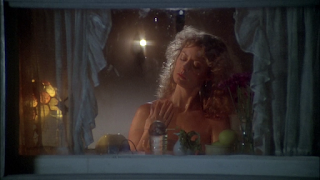
Atlantic City is undergoing a transformation, with old heritage buildings and hotels being knocked down to make way for new casinos. Old-timer Lou (Burt Lancaster) is a low-key runner in a small numbers racket, and scratches a few more bucks by caring for his neighbour Grace (Kate Reid), a bed-ridden but demanding widow. Also living in the same building is Sally (Susan Sarandon), a server at a hotel fish bar training to become a croupier and dreaming of a career in Monte Carlo. Through his window, Lou admires Sally's nightly cleansing-with-lemons routine.

Sally's no-good husband Dave (Robert Joy) has run off with her sister Chrissie (Hollis McLaren), but now both show up in Atlantic City and want to stay with Sally. The free-spirited and pregnant Chrissie bonds with Grace over foot massages, while Dave recruits Lou's help to sell drugs he stole from thugs in Philadelphia. When Dave's drug-dealing career comes to a sudden end, Lou is left holding plenty of drugs and cash, and finally has an opportunity to impress Sally and experience his version of the big time.

Set in a milieu of questionable renewal, Atlantic City breathes deeply from the dust of demolition and reconstruction. Director Louis Malle ensure the city is an important lead character and a noisy participant in the process of erasing the past and striding into a future defined as better by virtue of investment. 

With the city in a half-state of renewal, no one is satisfied with the present, and Atlantic City is populated with a memorable set characters interacting during personal transitions. In an achingly honest script, writer John Guare laments the past with the romanticized lyricism necessary for the soul's survival. Lou's inclinations to harken back to yesteryear reveal a sometimes pathetic recasting of non-existent past glories, Lou living in a grandeur he built for himself to cover for so much nothingness. 

Meanwhile, Sally hates her past and lives for a future in Europe, her awful present consisting of peddling fish, battling the stink, and surviving the advances of a casino manager who may hold the key to her future. Her no-good but still soft-touch husband Dave is hustling for better days through drug dealing, Chrissie lives simultaneously in the past and future thanks to her reincarnation beliefs, and Grace feeds off exaggerated references to her dead husband's status in the old underworld.

When even the grandest old hotels are being demolished for something new, hope for a change in fortunes is eternal, and Lou is about to experience the best of times. He inherits more money than he ever handled, and awkwardly, but predictably, buys the most expensive outdated suit he can find. He then sets out to transform his voyeurism into courtship by throwing money at Sally's problems. And for a brief interlude, it appears possible that a sad old man without much of a past and a sad young woman with a vague future can find happiness together. 

The entire cast shines, led by Burt Lancaster in a soulful mood, allowing Lou to relax into his advancing years but deftly revealing his small-time foundations. Susan Sarandon conveys Sally's state of constant aggravation in search of a ticket to elsewhere, her eyes quick to realize she needs help from men she will never tolerate. 

Atlantic City will change but persevere, in some form. Lou and Sally will also dream of better days past and future, but have less time and ability to redefine who they truly are.


All Ace Black Movie Blog reviews are here.

Tuesday, 10 August 2021

Movie Review: Criss Cross (1949)

A film noir featuring ill-fated lovers, snarling rivals, and a daring theft, Criss Cross is always breathless, often exhilarating, but also flawed.

In a Los Angeles parking lot, lovers Steve Thompson (Burt Lancaster) and his ex-wife Anna (Yvonne De Carlo) plot to meet after he participates in a heist the next day. In flashback, Steve recalls his past eight months.

After divorcing Anna he drifted across the country, but returned to Los Angeles purportedly to care for his mother (Edna Holland), but really because he could not stay away from Anna. He reconnects with his friend Detective Pete Ramirez (Stephen McNally), secures a job as an armoured car driver, and reunites with Anna at their favourite hangout, the Round-Up club.

Although they bicker constantly, Steve and Anna start dating again and discuss getting remarried, despite his mother's vehement disapproval. Suddenly, Anna abandons Steve and marries mobster Slim Dundee (Dan Duryea). She soon regrets her impulsiveness and they resume what is now an affair, but Slim starts to get suspicious. Steve conceives of a daring armoured car heist as a distraction.

Criss Cross features several quite brilliantly memorable scenes. In a dream-like state, Steve observes Anna dancing (with an uncredited Tony Curtis) at the Round-Up, as flutist Esy Morales and his band perform Jungle Fantasy. The surprisingly violent heist sequence is a chaotic collision of explosions and improvisation as plans are abandoned and reformulated on the fly in the thick fog of smoke bombs. The bar at the Round-Up is a living room away from home, bartender Frank (Percy Helton) and a perpetual barfly (Joan Miller) providing a comfortably familiar environment for life's turning points.

The good moments continue, as director Robert Siodmak takes a deep breath and slows everything down for a stupendous hospital scene delving into mortal fear triggered by helplessness and guilt. And the ending, once witnessed, is unforgettably bleak.

While the movie frequently sparkles, it is also beset by gaping weaknesses. The Daniel Fuchs screenplay is unevenly paced, with Steve and Anna never provided the opportunity to demonstrate their strengths as a couple before the mean bickering takes over. Criss Cross is fundamentally about Steve risking everything for his love of Anna, but what is on the screen is less love and more infatuation and a need to possess, allowing Anna's character the freedom to wriggle towards an understandable pursuit of independence.

The heist appears wedged into the doomed romance, both the introduction and resolution of the hold-up leaving behind some gaping holes. Steve suggesting the crime on a whim is extraordinary and out of character, and the aftermath is a layer cake of dim decisions and unexplained actions, including how the stolen money ended up where it did after the shooting stopped.

Siodmak fills Criss Cross with all the noir adornments. Crisp nighttime cinematography, stark light sources, smoke, narration, flashbacks, and close-ups surround flawed characters stepping on each other to eke out an advantage, intrinsically aware nothing worthwhile can be gained without an equivalent spectacular loss.


All Ace Black Movie Blog reviews are here.

Tuesday, 30 June 2020

Movie Review: Castle Keep (1969)


A surreal World War Two movie, Castle Keep embarks on a philosophical quest to find the intersection of war, art, and sex.

It's the winter of 1944. In Belgium, a ramshackle unit of eight US soldiers under the nominal command of Major Abraham Falconer (Burt Lancaster) occupies the Maldorais, an imposing ancient castle filled with artwork. The Count (Jean-Pierre Aumont) is the castle's owner, married to the much younger Therese (Astrid Heeren). Soon Falconer and Therese are having an open affair, with the approval of the Count, who is impotent but would welcome a son.

Private Benjamin (Al Freeman Jr.), an aspiring writer and the unit's only Black member, chronicles the men's experiences. Captain Beckman (Patrick O'Neal) is an art historian and attempts to educate the other soldiers about the castle's art collection, but they are more interested in the whorehouse at the nearby town. Sergeant Rossi (Peter Falk) finds the local bakery and reverts back to his role as baker and family man. Corporal Clearboy (Scott Wilson) is infatuated with a Volkswagen found on the castle grounds.

Falconer anticipates a German counteroffensive in the area as part of the Battle Of The Bulge. He decides to fortify the castle and make a defensive stand, placing the precious art in harm's way. Both the Count and Beckman are horrified, but Falconer is determined to forge his destiny.

The anti-war sentiment of 1969 is retrospectively applied to World War Two, and Castle Keep plants a distinctive flag as a different kind of war film. Writers Daniel Taradash and David Rayfiel adapted the 1965 William Eastlake novel with a European sensibility laced with dark humour, and director Sydney Pollack creates a stylish, often visually stunning story of war's collision with culture. While occasionally crossing over from philosophical to onerous, the film carves a uniquely cerebral identity. 

War's abhorrent incompatibility with love, art, and all things of beauty is teased out through a deceptively simple narrative structure. The castle occupies lush landscaped grounds filled with romantic statues, while the inside walls and ceilings are decorated with masterpieces. Falconer's unit arrives at this abode in a disjointed state, the men disrespecting the Major, their dialogue and behaviour atypical for soldiers. The script hints early they may all be dead anyway, representing dreams shattered by the incursion of a destructive global conflict.

Whether alive or expired, the men are beyond jaded about the war and more interested in other pursuits, including women, cars (bordering on a fetish), baking, and writing. For educated men like the Count and Beckman, destroying classic artworks is a crime. But for warriors like Falconer, complete with his eye patch and buffalo mentality, the castle is a perfect defensive fortification. He alone commands a warlike attitude, his one eye firmly focused on military objectives and intentionally blind to collateral damage.

In addition to the Volkswagen echo, the free love of the 1960s shows up in Falconer's quick sexual conquest of the willing Therese with the quiet acquiescence of the Count. Therese is the Count's wife and also his niece; it does not matter: he just wants a son, and will accept Falconer bedding Therese perhaps in return for the castle's treasure being saved.

Adding to the surreal surroundings is another group of hollow-eyed anti-war soldiers wandering through the nearby town led by Lieutenant Bix (Bruce Dern). Instead of calling for an end to the fighting they noisily protest fornication at the popular Reine Rouge whorehouse. The protestors eventually encounter mortar strikes, in what proves to be a short confrontation.

With a primary interest in war as a most barbaric anti-cultural weapon, Pollack does not pull back on the combat scenes. The second half boasts two epic battles. First Falconer's men slow down the advancing Germans with an ambush featuring whores with Molotov cocktails and a tank incursion into a church. The climactic defensive stand at the castle occupies the final 30 minutes, Pollack able to maintain the men's incongruous attitudes even as they put up a spirited defense of their new realm.

Wearing eccentricity as a medal of honour, Castle Keep towers over a landscape of emotions ravaged by endless war.


All Ace Black Movie Blog reviews are here.

Sunday, 5 April 2020

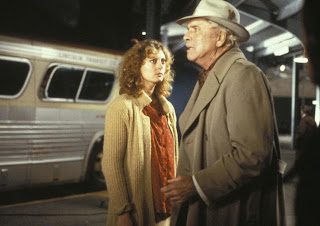
Movie Review: Airport (1970)


A grand multi-story disaster epic, Airport helped formulate the genre template. A star-studded cast and multiple overlapping emergencies sustain the thrills over one long night.

The setting is Chicago's Lincoln International Airport during a snowstorm. Airport Manager Mel Bakersfeld (Burt Lancaster) is struggling to keep the airport functional, an objective made difficult when a taxiing airplane gets stuck in the snow and blocks the airport's main Runway 29. The alternative Runway 22 is shorter and impacts a surrounding community. Mel calls upon chief maintenance mechanic Patroni (George Kennedy) to help unwedge the Boeing 707.

Mel's brother-in-law is womanizing pilot Vernon Demerest (Dean Martin), who is about to take charge of an overnight flight to Rome. Vernon is having an affair with stewardess Gwen (Jacqueline Bisset), and she reveals her pregnancy just before departure. Mel's marriage to his wife Cindy (Dana Wynter) is falling apart, allowing him to evolve his relationship with airline customer service representative Tanya Livingston (Jean Seberg).

Meanwhile Tanya has to deal with the elderly Ada Quonsett (Helen Hayes), who is apprehended as a serial stowaway but anyway boards Vernon's flight. But most worrisome is depressed businessman D. O. Guerrero (Van Heflin), who plans to kill himself with a briefcase bomb in order for his wife Inez (Maureen Stapleton) to benefit from insurance money. As Vernon deals with in-flight emergencies, Mel and Patroni frantically work to reopen Runway 29, now an urgent matter of life and death.

The adaptation of Arthur Hailey's 1968 book is brought to the screen by director George Seaton, who also wrote the surprisingly taut screenplay. The film created the blueprint for a decade-long cycle of disaster movies, spawned three direct but lesser sequels, and inspired several parodies. Airport also heralded the blockbuster era to come, well-produced but easy-to-digest escapism loved by audiences and generating mass profits on a previously unimaginable scale.

And despite the stiff dialogue, lack of any narrative depth beyond the here and now, and some cringe-worthy corporate boosterism, there is no denying the film's appeal. The cast members are stereotyped but in good form, Lancaster, Martin, Kennedy and Heflin playing to their pre-established strengths, while Seaton fills the screen with activity, inside the terminal, on the tarmac, and on-board the flights, all in gorgeous technicolor. Frequent use of split screens, relatively accurate technical jargon, and a packed agenda of colliding personal and work emergencies easily occupy the 136 minutes of running time.

With action and events moving briskly, the memorable moments are plentiful. Helen Hayes earns many of them, and claimed a Best Supporting Actress Academy Award for a delicately funny turn as the unlikely stowaway Ada. Her repertoire of tricks to get past every checkpoint plus a disarming charm and conversational gifts are put to good use on the ground and in the air.

Dean Martin makes the most of the cocky Vernon coming to terms with Gwen's pregnancy, and gets another well-crafted highlight in his attempt to talk down Guerrero.

As the man in the middle of it all, Mel's agitation with bureaucrats and politicians comes to a satisfying boil when a clueless Commissioner chooses the worst possible time to suggest the airport's closure. And after a few rounds of bickering, Mel and Cindy as a husband and wife presiding over a wrecked marriage carve out a surprisingly adult resolution.

And finally George Kennedy creates the Patroni legend with his full-throttled attempt to prod the stranded Boeing 707 into motion, the irresistible force of one man determined to triumph over a mammoth immovable object. The night will not be over until the cigar is well and truly chomped.


All Ace Black Movie Blog Reviews are here.

Sunday, 8 December 2019

Movie Review: Seven Days In May (1964)


A Cold War political thriller, Seven Days In May uses a tense military takeover scenario in the United States as an avenue to explore themes of democracy, loyalty and nationalism in the shadow of a global conflict.

It's the early 1970s, and U.S. President Jordan Lyman (Fredric March) is facing severe criticism and protests for pushing ahead with a nuclear disarmament deal with the Soviet Union. He believes the agreement to be the only pathway to peace, but the Chairman of the Joint Chiefs of Staff Air Force General James Mattoon Scott (Burt Lancaster) believes the President is severely undermining national security.

Scott's right-hand man Colonel "Jiggs" Casey (Kirk Douglas) picks up cryptic clues suggesting Scott is planning a coup d'etat within a few days, using a covert military unit funded without appropriate authority and assembled and trained at a secret base near El Paso, Texas.

Jiggs takes his evidence to Lyman, who believes enough to investigate. He dispatches his chief aid Paul Girard (Martin Balsam) to interrogate a Navy commander stationed in the Mediterranean, trusted Senator Ray Clark (Edmond O'Brien) heads to El Paso, and Jiggs approaches Scott's former mistress Eleanor Holbrook (Ava Gardner) to dig up potentially useful dirt. But with the clock ticking, finding hard evidence against the plotters will prove a challenge.

With the Cold War at its peak after the 1962 Cuban missile crisis, Seven Days In May joined Dr. Strangelove and Fail Safe in a trio of 1964 films exploring various what-ifs of the conflict. Based on a novel by Charles W. Bailey II and Fletcher Knebel with a script by none other than Rod Serling, Seven Days In May delves into the perils of harbouring trust in a peace process, and at least as a starting point comes closest to predicting the actual course of negotiations eventually pursued by the United States and the Soviet Union.

The film uses the Cold War as background stage set. The focus is on the erosion of trust in a President's actions at the highest levels, and the potential for a cabal of generals and politicians to hide in plain sight while plotting a governmental takeover. Serling places intrigue and evidence gathering at the forefront of the story, Seven Days In May not featuring a single act of serious violence despite the threat of massive military and political upheaval. Director John Frankenheimer luxuriates in choreographing deep focus black and white scenes, turning the nation's most secretive boardrooms and offices into cerebral battlegrounds.

Along with star Kirk Douglas, Frankenheimer was instrumental in pulling the project together, and he assembled a dream cast, adding Lancaster, March, Gardner, O'Brien and Balsam, all in good form and tackling grim roles with requisite seriousness. And the film passes the baton around the lead roles at regular intervals, Douglas, Gardner and then March taking turns in the spotlight, with Lancaster a menacing presence throughout.

By the end March rolls back the years and emerges as a dominant presence, his scenes opposite Douglas (revealing the conspiracy threads) and Lancaster (a tense confrontational showdown) both mesmeric. Serling's script may be faulted for underplaying the President's hand and authority as the climax approaches, but also allows for the epic interpersonal clashes to play out.

As the race against time to unmask the conspiracy hurtles towards the designated hour of action, the film grabs opportunities to debate the merits of pursuing peace. General Scott cannot fathom how a powerful ideological foe can ever be trusted to disarm and has the public on his side, while Lyman, with sinking approval ratings, is convinced negotiating a treaty from a position of strength is the only path to a non-ruinous future. It's an eternal warmongers versus peacemakers polemic, and sometimes nothing less than the future of a powerful nation hangs in the balance.


All Ace Black Movie Blog reviews are here.

Monday, 18 November 2019

Movie Review: The Train (1964)


A gripping World War Two action film, The Train is an intense story of heroism presented with considerable panache. An uncompromising battle over the fate of a train unfolds as a metaphor for unyielding resistance in the chaotic dying days of the German occupation of France.

It's August 1944, and the Allies are close to liberating Paris. German Colonel von Waldheim (Paul Scofield) is intent on transporting to Germany hundreds of celebrated paintings by famous artists looted by the Nazis from throughout France. He overcomes bureaucratic delays and secures a train, loading it with his cargo of stolen art.

Arts curator Mademoiselle Villard (Suzanne Flon) understands the value of keeping the masterworks in France, and appeals to the underground cell led by rail yard manager Labiche (Burt Lancaster) to stall the train's progress until the Allies arrive. But Labiche's group strength has been decimated, and he expresses no interest in culture. His cell is anyway busy delaying a German armaments train to expose it to a British bombing raid.

When gruff engineer Papa Boule (Michel Simon) risks his life to save the arts train, Labiche and his collaborators Didont (Albert Rémy) and Pesquet (Charles Millot) decide to risk everything for one last mission. They improvise an elaborate and risky ruse to try and keep the train in France, a plan that will involve station manager Jacques (Jacques Marin) and innkeeper Christine (Jeanne Moreau).

Combining ferocious action with quiet moments of tension, The Train is a superlative World War Two adventure. Loosely inspired by factual events recounted in the 1961 book Le Front De L'art by Rose Valland, the film extracts surprising drama and poignancy from a simple story about a small group of resistance fighters doing all they can to derail a grand theft. The focus is a train, but the message is about national pride and standing up with limited and ever dwindling resources to a barbaric regime.

In a classic distillation of the war to two individuals on opposite sides of the conflict, the script by Franklin Coen, Frank Davis, and Walter Bernstein pits Colonel von Waldheim against Labiche. The irony is that it is von Waldheim who is an admirer of the arts while Labiche could care less. The struggle between them transcends the train cargo and evolves into a battle of wills to record one last blow before the Germans depart France.

The film is a visual study in dynamic fluidity. Director John Frankenheimer was a late replacement for Arthur Penn, and elevates The Train to a stylish art piece. Making excellent use of black and white cinematography, Frankenheimer goes looking for eye catching framing, and packs the film with several memorable long uninterrupted tracking shots featuring exquisitely choreographed activity. The settings vary from offices filled with German army clerks frantically burning documents as defeat looms to bustling rail yards where French workers, German soldiers and their nervous officers intermingle with cacophonous train traffic supporting the war effort.

The heart of the film is action, and The Train is filled with breathless set-pieces, from a bombing raid on a train yard to several clandestine stealth missions, and a quite spectacular derailment / crash combo designed to wedge and delay a treasure. All the action scenes are real, and star Burt Lancaster does many of his own stunts in a performance full of understated bravado.

The human cost of exceptional courage is high, and The Train is unblinking in confronting the sacrifice required to stop evil. After years of brutal conflict, a resigned determination on both sides to wage battle to the bitter end assures horrific casualties. And for the French resistance fighters, the prize is much more than a train full of paintings.


All Ace Black Blog Movie Reviews are here.

Saturday, 9 November 2019

Movie Review: The Midnight Man (1974)


A convoluted low-key murder mystery, The Midnight Man is overstuffed with plot but lacks any sense of mood or relatable characters.

Released on parole after serving a prison sentence, ex-Chicago police officer Jim Slade (Burt Lancaster) accepts a position as a night watchman at Jordon College, the job arranged for him by his pal and the college's head of security Quartz Willinger (Cameron Mitchell). Jim reports to parole officer Linda Thorpe (Susan Clark), who is constantly bickering with local sheriff Jack Casey (Harris Yulin) about his deputy Virgil's goonish methods.

Slade stumbles upon a psychiatry department break-in and the theft of sensitive cassette tapes. One of the students involved is the troubled Natalie Clayborne (Catherine Bach), and soon she turns up dead. Casey arrests creepy janitor Ewing (Charles Tyner), but Slade starts his own unauthorized investigation. Natalie's boyfriend, a professor and a local artist are among the suspects, while a trio of local redneck goons start to threaten Slade. When Natalie's father Senator Phillip Clayborne (Morgan Woodward) arrives in town, the death count escalates rapidly.

An adaptation of a book by David Anthony filmed on location at Clemson University in South Carolina, The Midnight Man is co-directed, co-produced and co-written (all with Roland Kibbee) by star Burt Lancaster. Unfortunately he glides through the film in an essentially comatose state, as an almost impossible to follow plot clatters all around him.

The deep flaws are obvious throughout. Key events take place off-screen and are then verbosely explained. For the purpose of expanding the pool of suspects a multitude of individuals are introduced in snippets, creating an avalanche of indistinct characters. The result is a go-through-the-motions whodunnit crammed with creeps, with no individual rounded into anything more than a plastic representation.

Actions and motivations are eye-poppingly dreadful, from blatant police brutality to a parole officer jumping into bed with her parolee passing through professors lusting after their young students. And somehow the film takes a detour to Deliverance inspired bayou territory, a trio of inbred idiots (including Ed Lauter) complete with their own Ma Baker styled leader unleashing their version of primitive chaos on the pristine college campus town for reasons that never quite make sense.

At least the rednecks do provide a platform for the one energetic sequence in the film, as Slade bulldozes his way out of farm captivity. As for resolving the actual murder-blackmail-abuse crime fiasco, pick any suspect, they all deserve to be locked up.


All Ace Black Blog Movie Reviews are here.


Saturday, 26 October 2019

Movie Review: Executive Action (1973)


A conspiracy drama, Executive Action offers an alternative plot for the 1963 assassination of President John F. Kennedy.

It's early in 1963, and a group of powerful men including Robert Foster (Robert Ryan) and black ops organizer James Farrington (Burt Lancaster) are convinced the Kennedys are planning a ruinous multi-term dynasty. They ask influential industrialist Harold Ferguson (Will Geer) to support an assassination plot already under preparation. Foster predicts the President will soon seek a nuclear disarmament treaty with the USSR; support the black civil rights movements; and pull troops out of Vietnam, all actions considered damaging to the plotters' interests.

Ferguson is sceptical, but Farrington and Foster continue with the arrangements. Three-man sniper hit squads are trained to shoot at a slow moving target, and Lee Harvey Oswald, a troubled ex-Marine with a shadowy history including a stint in Moscow, is unknowingly selected and groomed as a convenient fall guy. When JFK's trip to Dallas is announced, the plotters influence the parade route to include the perfect kill zone. In the meantime Kennedy does announce the policy initiatives predicted by Foster, convincing Ferguson to throw his weight behind the plot.

Eighteen years before the much more famous JFK, the modestly budgeted and independently produced Executive Action pitched a fuzzy conspiracy theory as an explanation for the presidential assassination. Written by Dalton Trumbo and featuring one of Robert Ryan's final career performance, the film does not pretend to bring any new facts to the debate; this is just a hypothesis, cobbling together a vague cause and possible methodology.

Director David Miller mixes documentary footage from Kennedy's final few months with the fictional narrative of Foster and Farrington spearheading operational readiness and Ferguson gradually gaining conviction that Kennedy needs to be eliminated. The shooting in Dealey Plaza is recreated as a triangulated kill zone with multiple trained snipers firing at the President in his motorcade.

Other than as a curiosity, not much of Executive Action gains traction. Despite the presence of stars Burt Lancaster, Ryan and Will Geer, the conspirators are barely introduced and remain plastic puppet masters devoid of background and context. Too much time is invested in the efforts to entrap Oswald as a fall guy, and no theory is suggested to explain how a well funded plot involving seemingly limitless resources and dozens of operatives (including Ed Lauter as a grim-faced kill squad team leader) could be kept secret. The evildoers openly and confidently discuss their plans, leaving the impression JFK himself was the only man not to know he was about to be a target.

And the final third of the film loses all narrative momentum. After the shooting the lead conspirators are relegated to standing around and watching television like the rest of the country, as Oswald is arrested then killed by Jack Ruby, here introduced in a botched hurry. Executive Action becomes a rerun of well-known events stitched together with little added value, a cinematic hypothesis rejected due to truncated imagination.


All Ace Black Blog Movie Reviews are here.


Monday, 24 June 2019

Movie Review: Sweet Smell Of Success (1957)


A drama about the power of the press deployed for all the wrong reasons, Sweet Smell Of Success is a messy but still potent treatise on misplaced priorities.

In New York City, Sidney Falco (Tony Curtis) is a sleazy publicist who has been frozen out by influential show business newspaper columnist J. J. Hunsecker (Burt Lancaster). The cold-hearted Hunsecker is unhappy that Sidney has been unable to break up the budding romance between J.J.'s sister Susan (Susan Harrison) and jazz musician Steve Dallas (Martin Milner).

Berated by his clients, almost broke and desperate to get back into Hunsecker's good books, Sidney pulls out all the stops and plants a false rumour about Steve with a rival newspaper columnist. This triggers a confrontation between Steve and J.J., with unexpected consequences.

Sweet Smell Of Success features a free-wheeling, always-on-the-move style riding the energy of New York City after dark, a city that never sleeps because vile men spend the night plotting. An adaptation of an Ernest Lehman novella with the character of J.J. Hunsecker inspired by the real-life columnist Walter Winchell, the film boasts dialogue rich with insults, put-downs, threats and sarcasm as dark-hearted rivals outmaneuver each other in a sordid world of their own making.

While the story's essence of a wicked man attempting to derail his sister's romance is relatively lightweight, crazed dynamism is derived from a chaotic production which had filming start before the script was ready. Pages of the Clifford Odets screenplay went instantaneously from typewriter to set, and the result is a torrent of characters and factoids, some relevant and others not so much, drifting in and out of scenes, adding plenty of ambience and realism but also disorienting narrative dizziness.

Director Alexander Mackendrick makes the most of the anarchy and maintains focus on two men utterly lacking in scruples. Falco and Hunsecker are obsessed with their own self-interest, the publicist a say-anything hustler and the columnist a power broker in a business built on his whispers and innuendo. Neither men should matter at all in a rational society, but this is show business in New York City, where careers are made or destroyed with a few words published in the right column.

The unattached Hunsecker's incestuous obsession with his sister is strongly hinted at, and Lancaster brings to the role a chilling empathetic blankness highlighted by the most perfectly fitting browline glasses. Tony Curtis enjoys a dramatic role, losing his morality in the sudoriferous sewers as Falco prostitutes a cigarette girl, arranges a blackmail sting, then peddles career-destroying drugs-and-communism lies, all within a couple of nights.

The lovers Susan and Steve are the pure couple, and unsurprisingly, the most boring characters in this story. Nor should they expect any noble help from the authorities: Lt. Harry Kello (Emile Meyer) of the New York police is not much more than a freelancing goon-for-hire.

Sweet Smell Of Success condemns malevolent journalism and the men who enable it, but does so with undisguised relish.


All Ace Black Blog Movie Reviews are here.

Tuesday, 3 April 2018

Movie Review: Zulu Dawn (1979)


A historical war movie, Zulu Dawn recounts the story of the Battle of Isandlwana at the start of the Anglo-Zulu War. The film suffers from a slow start but picks up some steam in its final third.

It's January 1879 in Natal, British South Africa. High Commissioner Sir Henry Bartle Frere (John Mills) contradicts Royal guidance and issues an ultimatum to the powerful Zulu King Cetshwayo (Simon Sabela), insisting that the King should adhere to British laws. Cetshwayo predictably refuses, triggering a declaration of war.

The British forces are under the command of the arrogant Lieutenant General Lord Chelmsford (Peter O'Toole). The other leaders include Colonel Durnford (Burt Lancaster), commander of a large force of the mounted Natal Native Contingent, and young adventurer Lieutenant William Vereker (Simon Ward), recently attached to Durnford's forces.

Chelmsford crosses the Buffalo River into Zulu territory with a large force and plenty of supplies. Initially encountering little resistance, Chelmsford leaves the main camp at Isandlwana lightly defended, splits his army and goes looking for enemy forces. The Zulu secretly amass 20,000 warriors and launch a surprise attack on the Isandlwana camp, where about 1,800 defenders have to fight for their lives.

Directed by Douglas Hickox and written by Cy Endfield (adapting his book), Zulu Dawn is a prequel to 1964's Zulu, which picked up the next day's events with the famous British defence of Rorke's Drift. In contrast the Battle of Isandlwana was an ignominious defeat for the British, the result of a modern army's arrogance and an overwhelming enemy numerical advantage.

Once the shooting starts Hickox does a good job of recreating the battle, which occupies the final 30 minutes of the film. The field tactics are coherent, the British errors are brought to the fore, and the gruesome action registers, as the fighting eventually defaults to close quarters combat. A few acts of heroism (mostly from the British side) punctuate the fighting, and the growing realization for key characters that this may very well be the end highlights the battle's outcome.

Unfortunately, Hickox has to find approximately 85 minutes of build-up before the film gets to the battle, and here he is much less successful. Zulu Dawn leaves behind the sense of misplaced ambition to create a relatively long military epic, and Hickox struggles for material to fill the front-end running time, resulting in a flabby and boring experience.

When afforded the opportunity, Endfield's script makes all the wrong choices. Instead of focusing on a few characters and zooming in on context, too much time is spent on pomp and ceremony, both in Zulu rituals and British garden parties. Too many characters clutter the British command structure, and none of the them emerge as compelling leaders worth knowing. Then the crossing of the Buffalo River takes forever, with endless shots of men, horses, wagons and supplies sloshing through the mud from shore to shore.

Some indelible scenes do survive, including Lord Chelmsford out in the field, supposedly looking for the enemy, insisting on taking time out for a formal meal complete with servers, a white tablecloth and silver cutlery, and refusing to accept that his base camp is the target of a devastating imminent attack. Durnford's last stand is another well-executed memorable moment.

In addition to Peter O'Toole, Simon Ward and John Mills, the cast features a who's who of British acting royalty, including the likes of Bob Hoskins, Denholm Elliott, Christopher Cazenove, Peter Vaughan, Ronald Lacey, and Ronald Pickup. Burt Lancaster, doubtless in the film to attract larger American and international audiences, struggles with an on-again off-again Irish accent. The film was shot in South Africa, with a troubled production history featuring various accusations of unpaid bills.

An adequate recreation of an important battle, Zulu Dawn is otherwise a cinematic opportunity missed.


All Ace Black Movie Blog reviews are here.

Saturday, 10 December 2016

Movie Review: The Killers (1946)


A film noir with plenty of panache, The Killers is a gritty crime story told with often mesmerizing style.

In a small town, two killers track down and shoot dead the surprisingly docile ex-convict Swede Anderson (Burt Lancaster), living incognito as gas station attendant Peter Lund. Swede left behind a small amount of life insurance money to an obscure beneficiary, prompting insurance company investigator Jim Reardon (Edmond O'Brien) to delve into Swede's backstory by interviewing his associates. Reardon eventually connects with police Lieutenant Sam Lubinsky (Sam Levene), who explains that Anderson had to abandon a career as a promising boxer due to a hand injury.

Smitten by beautiful gangster's moll Kitty Collins (Ava Gardner), Anderson drops his girlfriend Lilly (Virginia Christine) and turns to a life of crime. He eventually falls in with the gang of crime lord "Big Jim" Colfax (Albert Dekker), including Kitty (now Big Jim's girl) and two-bit criminals "Dum Dum" Clarke and "Blinky" Franklin, and they plot an audacious big-money company payroll heist. But not everyone is playing it straight, and with bullets flying Reardon will need to piece together a complicated story of double cross to uncover the truth.

Directed by Robert Siodmak as an adaptation of an Ernest Hemingway short story, The Killers is a taut and highly enjoyable crime thriller but not quite as perfect as its reputation would suggest. Although the plot is gripping and the stylistic elements are textbook noir, the film suffers from a few but significant shortcomings.

The first is the gaping emotional hole in the middle of the story. Siodmak and a team of three scriptwriters (including John Huston) settle on good-guy insurance investigator Jim Reardon as the most central character, and he is simply not interesting enough to hold the film together. This is a problem brilliantly solved in the 1964 remake by moving the killers themselves much closer to the core of the story. Here in the 1946 version the killers are faceless and peripheral characters, while their victim Anderson is a patchy presence, reasonably effective when on screen but all too frequently reduced to a fleeting secondary character.

The second weakness is the relationship between Anderson and Kitty Collins. His infatuation with her charms is essential to his demise, but here she is marginalized to a sultry presence on the edge of relevance, almost devoid of dialogue. Anderson stands at a distance agog at her mere existence. There is simply not enough dangerous attraction or connivance between the two, and the lack of genuine sensuality undermines the drama.

But otherwise The Killers is a feast for the eyes and the mind. Siodmak constructs almost every frame to celebrate harsh light and dark shadows, often using background light to bathe the film in silhouettes and obscure characters and faces engaged in the shadowy world of crime. The story is rich, convoluted and satisfying, a classic tale of multiple betrayals and ingenious dishonour among thieves.

Lancaster makes the most of his screen time to jump from retired circus acrobat to movie stardom. His take on Swede Anderson brings out the pathos of a strong man who could have been a contender but is now reduced to pursuing a life of crime, ensnared by men and women way more sophisticated at the game of treachery. Ava Gardner is underused but still intermittently captivating, while the rest of the cast members are generally entrenched in relatively stock portrayals.

Despite some stumbles, The Killers is a fascinating story of many flawed men and one scheming woman, enhanced by a visually stunning package.


All Ace Black Blog Movie Reviews are here.