Showing posts with label Dan Duryea. Show all posts

Saturday, 20 April 2024

Movie Review: Too Late For Tears (1949)


Also Known As: Killer Bait  
Genre: Crime Noir  
Director: Byron Haskin  
Starring: Lizabeth Scott, Dan Duryea, Arthur Kennedy, Don DeFore, Kristine Miller  
Running Time: 100 minutes  

Synopsis: Married couple Alan and Jane Palmer (Arthur Kennedy and Lizabeth Scott) stumble onto a bag full of ill-gotten but untraceable cash. He wants to immediately contact the police, but she believes this is their big opportunity to be rich, and convinces him to wait one week. They store the bag at a train station, but Jane anyway embarks on a spending spree. With Alan still insisting they need to do the right thing, Jane spots an opportunity to achieve her dreams when criminal Danny Fuller (Dan Duryea) shows up to demand his money.

What Works Well: This is an unpredictable noir exploring emotions tested by unexpected wealth. Jane Palmer is an unforgettable greed-driven force of evil, and Lizabeth Scott's searing performance brings an epic femme fatale to life. Jane has never met a man she cannot manipulate, and dark references to her first marriage suggest she has been playing this game for a long time. In Roy Huggins' screenplay (based on his own book), every role surrounding her matters, and the small but effective cast shines with intensity. Alan's sister Kathy (Kristine Miller) and his wartime buddy Don (Don DeFore) gain prominence as the twisty machinations unfold.

What Does Not Work As Well: Some of the plot details are clunkily convenient.

Conclusion: But not too late for murder, seduction, and multiple layers of subterfuge.


All Ace Black Movie Blog reviews are here.

Saturday, 16 December 2023

Movie Review: The Woman In The Window (1944)


Genre: Noir Crime Drama
Director: Fritz Lang
Starring: Edward G. Robinson, Joan Bennett, Dan Duryea, Raymond Massey
Running Time: 99 minutes

Synopsis: With his family on vacation, stodgy Professor Richard Wanley (Edward G. Robinson) meets alluring model Alice Reed (Joan Bennett), who invites him for drinks at her place. Before long another man bursts in, a struggle ensues, and Richard kills the stranger in self defence. Fearing his life will be ruined if he calls the police, Richard plots with Alice to dump the body and tell no one. But District Attorney Frank Lalor (Raymond Massey), who is also Richard's friend from their social club, starts to assemble the clues, and the threat level rises when crooked ex-cop Heidt (Dan Duryea) shows up with blackmail on his mind.

What Works Well: Playing on classic noir themes of an innocent man who succumbs - just once - to a temptress and tumbles into a pile of trouble, director Fritz Lang and writer Nunnally Johnson accentuate the details. Richard is a studious professor of crime, and therefore attempts to carefully think his way out of his predicament. But in a study of unintended consequences, his every step and every statement expose him to self-incriminating risks. Edward G. Robinson is a perfect bourgeois in over his head, Joan Bennett sells dangerous allure, and Dan Duryea arrives in the second half with bags of oleaginous ill intent.

What Does Not Work As Well: The District Attorney is very quick to connect the dots, and while cleverly delivered, the ending chooses a safe pathway over edgier alternatives.

Conclusion: One mistake is all it takes.


All Ace Black Movie Blog reviews are here.

Saturday, 16 October 2021

Movie Review: Winchester '73 (1950)

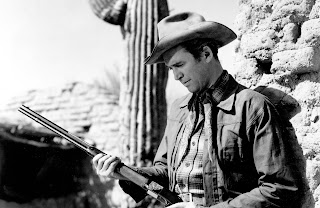
A revenge western adventure, Winchester '73 enjoys a rich set of characters and multiple story lines connected by a prized rifle.

Lin McAdam (James Stewart) and his friend High-Spade Frankie Wilson (Millard Mitchell) track down Dutch Henry Brown (Stephen McNally) in Dodge City. Lin has a personal revenge motive and wants Dutch dead, but marshal Wyatt Earp (Will Geer) seizes all weapons in the name of law and order. Instead, Lin and Dutch compete in a target shooting competition, with a coveted Winchester '73 rifle as the prize.

Lin: Awful lot of law for a little cowtown.
Wyatt: This is the kind of cowtown that needs a lot of law.

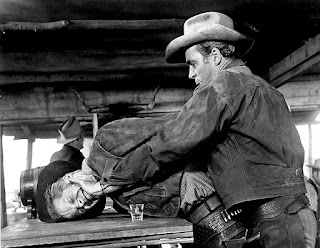
Lin wins the competition but Dutch seizes the rifle and scampers out of town. Dutch is headed to Tascosa, but along the way he loses the rifle in a poker game to weapons trader Joe Lamont (John McIntire). Lin persists in hunting down Dutch, and still ahead are encounters with Indian leader Young Bull (Rock Hudson), saloon girl Lola Manners (Shelley Winters) and her fiance Steve (Charles Drake), an inexperienced cavalry squad led by Sergeant Wilkes (Jay C. Flippen), and reckless criminal Waco Johnnie Dean (Dan Duryea), the fastest gun in Texas.

The first collaboration between star James Stewart and director Anthony Mann, Winchester '73 provides Stewart an opportunity to harden his image. Intent on revenge, capable of violence, and undeterred by any obstacle, Lin McAdam is a template for a redefined, morally more vague and much more interesting western protagonist. He has purposefully entered a moral grey zone by seeking vengeance the old fashioned way, but he comes from an honourable background and may still find a pathway to future domesticity.

The eloquent and witty script by Borden Chase and Robert L. Richards provides rich surroundings for a complex adventure. The rifle, marketed as "The Gun That Won The West", is a clever plot device, regularly changing hands and at some point owned by all the character types associated with the frontier: lawmen, criminals, Indians, cowards, traveling salesmen and soldiers. 

Dutch: Haven't I seen you somewhere?
Lola: I've been somewhere.

The episodic structure works in the movie's favour. The revenge story provides an arc, but otherwise Fleischer never reveals where the action will move to next, and even Lin's quest contains twisty revelations. Notable characters are introduced late, act unpredictably, and some meet an abrupt demise. Other than the drawn-out target shooting competition, the pacing is brisk, and the drama alternates between showdowns, edgy dialogue interactions, and soulful reflections. William H. Daniels contributes crisp black and white cinematography, while editor Edward Curtiss strives for coherence during the many action scenes.
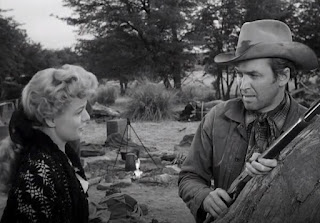
And as much as Lin is a memorable protagonist and Dutch a worthy villain, Winchester '73 is stocked full of other colourful characters brought to life by a stellar cast making the most of limited screen time. Millard Mitchell as High-Spade is not only a loyal friend but also a sage conscience, keeping an eye on Lin's pursuit of vengeance and always reminding him of his essence. 

High-Spade, referring to Lin's father: Did you ever wonder what he'd think about you hunting down Dutch Henry?
Lin: He'd understand. He taught me to hunt.
High-Spade: Not men. Hunting for food, that's alright. Hunting a man to kill him? You're beginning to like it.
Lin: That's where you're wrong. I don't like it. Some things a man has to do, so he does 'em.

Will Geer offers a unique and impressively laid-back take on Wyatt Earp, while John McIntire as weapons trader Joe Lamont exerts dominant authority even when outnumbered by Dutch and his ragtag men. Sergeant Wilkes is new to the west, and Jay C. Flippen affords him the curiosity to learn from Lin and High-Spade, even as the trio discover they met before on a different battlefield. And then Dan Duryea arrives to steal the back-end of the movie as the over-energized Waco Johnnie Dean.

Waco: What was I saying?
Lola: You were talking about yourself.
Waco: Where did I stop?
Lola: You didn't. But you can now. I already know all about Waco Johnny Dean, the fastest gun in Texas.
Waco: Texas? Lady, why limit me?


Shelley Winters enjoys some good lines but otherwise suffers as the only woman in world defined by men. Rock Hudson is an unconvincing Indian leader and Tony Curtis has a small role as a member of the cavalry who briefly gets to hold the rifle.

A formidable weapon, Winchester '73 is owned by many, but only rests in rightful hands.



All Ace Black Movie Blog reviews are here.

Tuesday, 10 August 2021

Movie Review: Criss Cross (1949)

A film noir featuring ill-fated lovers, snarling rivals, and a daring theft, Criss Cross is always breathless, often exhilarating, but also flawed.

In a Los Angeles parking lot, lovers Steve Thompson (Burt Lancaster) and his ex-wife Anna (Yvonne De Carlo) plot to meet after he participates in a heist the next day. In flashback, Steve recalls his past eight months.

After divorcing Anna he drifted across the country, but returned to Los Angeles purportedly to care for his mother (Edna Holland), but really because he could not stay away from Anna. He reconnects with his friend Detective Pete Ramirez (Stephen McNally), secures a job as an armoured car driver, and reunites with Anna at their favourite hangout, the Round-Up club.

Although they bicker constantly, Steve and Anna start dating again and discuss getting remarried, despite his mother's vehement disapproval. Suddenly, Anna abandons Steve and marries mobster Slim Dundee (Dan Duryea). She soon regrets her impulsiveness and they resume what is now an affair, but Slim starts to get suspicious. Steve conceives of a daring armoured car heist as a distraction.

Criss Cross features several quite brilliantly memorable scenes. In a dream-like state, Steve observes Anna dancing (with an uncredited Tony Curtis) at the Round-Up, as flutist Esy Morales and his band perform Jungle Fantasy. The surprisingly violent heist sequence is a chaotic collision of explosions and improvisation as plans are abandoned and reformulated on the fly in the thick fog of smoke bombs. The bar at the Round-Up is a living room away from home, bartender Frank (Percy Helton) and a perpetual barfly (Joan Miller) providing a comfortably familiar environment for life's turning points.

The good moments continue, as director Robert Siodmak takes a deep breath and slows everything down for a stupendous hospital scene delving into mortal fear triggered by helplessness and guilt. And the ending, once witnessed, is unforgettably bleak.

While the movie frequently sparkles, it is also beset by gaping weaknesses. The Daniel Fuchs screenplay is unevenly paced, with Steve and Anna never provided the opportunity to demonstrate their strengths as a couple before the mean bickering takes over. Criss Cross is fundamentally about Steve risking everything for his love of Anna, but what is on the screen is less love and more infatuation and a need to possess, allowing Anna's character the freedom to wriggle towards an understandable pursuit of independence.

The heist appears wedged into the doomed romance, both the introduction and resolution of the hold-up leaving behind some gaping holes. Steve suggesting the crime on a whim is extraordinary and out of character, and the aftermath is a layer cake of dim decisions and unexplained actions, including how the stolen money ended up where it did after the shooting stopped.

Siodmak fills Criss Cross with all the noir adornments. Crisp nighttime cinematography, stark light sources, smoke, narration, flashbacks, and close-ups surround flawed characters stepping on each other to eke out an advantage, intrinsically aware nothing worthwhile can be gained without an equivalent spectacular loss.


All Ace Black Movie Blog reviews are here.