Running Time: 105 minutes

All Ace Black Movie Blog reviews are here.
Reviews of Classic and Current Movies

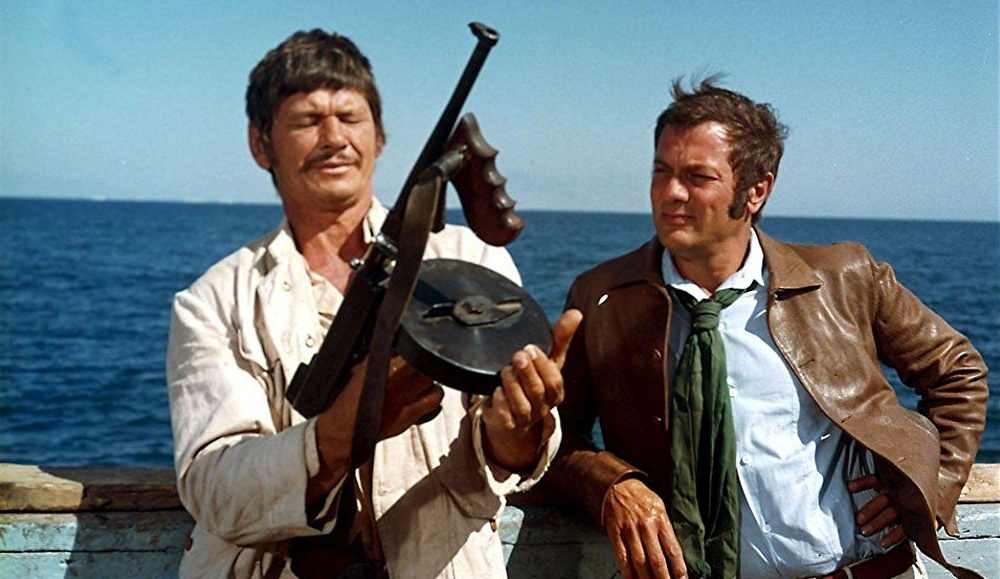
In 1922, American adventurers Adam Dyer (Tony Curtis) and Josh Corey (Charles Bronson) meet in the Aegean Sea. Josh is looking to profit from the ongoing Greco-Turkish War and internal Turkish strife by selling the services of his well-armed mercenary unit. Adam wants to reclaim a ship seized from his family during the Great War.
Colonel Elci (Fikret Hakan), acting on behalf of local governor Osman Bey (Gregoire Aslan), hires the two men to escort a train carrying undisclosed precious cargo, with Adam hoping to secure the release of his ship as part of the deal. Adam and Josh soon learn they are helping to transport the governor's daughters along with their guardian Aila (Michele Mercier), plus gold bars and precious jewels. Numerous skirmishes with various enemies await.
You Can't Win 'Em All is a series of highlights in search of a cause. The set-pieces are well-staged and reasonably rousing, including an old fashioned bar brawl, a noisy battle around a train enhanced by machine-guns, another shooting free-for-all on a boat, plus the bonus of an air raid on an army camp.
The problem for director Peter Collinson is all the bits in-between. Intended as an old-fashioned buddy adventure in foreign lands, the Leo V. Gordon script proceeds in fits and starts, contains long stretches of nothingness, and quickly unravels into incomprehensible territory. The myriad factions competing for cheap labour in the form of uniformed extras include the Turkish army, Turkish rebels, Greek invaders, and American meddlers. Combined with multiple shifting personal agendas and everyone lying all the time, it's never clear who is trying to do what to whom or why.Collinson does not help matters by wasting endless shots on travelogue-style Turkish scenery. A train moving through the countryside, mounted armies galloping through the terrain, and colourful grand halls full of festive food and belly dancers are all very pretty, but ultimately betray the lack of content. Bronson (proficient profiteer) and Curtis (weasley womanizer) appear interested, share decent rapport, trade one-liners, and exude well-earned charisma, but they are defeated by the wayward plotting. You Can't Win' Em All can't fill the empty spaces between punctuations.
All Ace Black Movie Blog reviews are here.
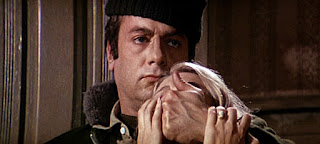
Opening text introduces the film as the story of Albert DeSalvo, the self-confessed Boston Strangler. Starting in 1962, an unknown assailant later revealed to be DeSalvo (Tony Curtis) embarks on a murder spree in Boston and the surrounding towns, sexually assaulting and strangling to death single women in their homes. Initially the victims are elderly, but eventually women of all ages are murdered. The killer talks his way into his victims' apartments, avoiding forced entry and leaving no clues.
With the murders gaining national attention, Detective Phil DiNatale (George Kennedy) and Sergeant Frank McAfee (Murray Hamilton) are among the investigators assigned to the case. They interrogate all known violent offenders and sexual perverts, but the murders continue. Assistant Attorney General John Bottomly (Henry Fonda) is appointed to coordinate across jurisdictions, but the killer remains frustratingly elusive.
With DeSalvo's identity revealed from the start and his fate commonly known, The Boston Strangler lacks narrative tension. Edward Anhalt wrote the script as an adaptation of the Gerold Frank book, and director Richard Fleischer uses split screens and a documentary-style grittiness to recreate a few of the murders, the police response, and the public reaction. The film achieves decent engagement more through style than content.The murderer is not fully shown on the screen until about halfway through the film, leaving the generic representations of detectives DiNatale and McAfee as the rather dull main characters for long stretches. With the strangler not making mistakes, Anhalt and Fleischer invest in the arduous work of identifying, tracking down, and interrogating numerous persons of interest. The public is keen to help, and soon phone calls are flooding in about every creepy guy in town.
Perhaps sensing the investigation is floundering, the bookish Bottomly is reluctant to get involved. Henry Fonda is equally rather listless in a hesitant role, meandering from lawyer to detective then psychologist without much explanation. Tony Curtis stretches in a serious role as DeSalvo, an intriguing and not unsuccessful experiment.
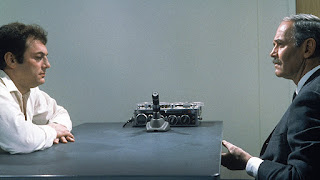
Most of the acting showcase moments arrive in a final chapter staged almost entirely in a sparse white hospital room, DeSalvo now a captive and Bottomly eager to get into the mind of a murderer. The drama is stripped down to cerebral levels, lacking excitement but striving for insight.
All Ace Black Movie Blog reviews are here.
The setting is New York, and although the four main characters are never named, the representations are obvious. On the night Marilyn Monroe (Theresa Russell) shoots the blowing-skirt-above-the-grate scene for The Seven Year Itch witnessed by a mass of onlookers, Albert Einstein (Michael Emil) is holed up in a hotel room preparing for a conference. Senator Joseph McCarthy (Tony Curtis) is in town trying to pressure Einstein into admitting he is a communist sympathizer. And Marilyn's husband Joe DiMaggio (Gary Busey) is despondent, watching the world ogle his wife.
Over one long night the four characters meet in pairs in Einstein's room, engaging in conversations on a variety of topics. An elevator attendant (Will Sampson) interacts with a few of them.
Writer Terry Johnson adapts his stage play to the screen, and admittedly, Albert Einstein, Marilyn Monroe, Joe McCarthy and Joe DiMaggio walk into a hotel...is a potentially compelling introduction to a joke or a skit. But despite oodles of style, director Nicolas Roeg cannot hide the subsequent lack of substance. Beyond the initial what if curiosity, Insignificance fizzles.
So Marilyn is not a dumb blonde and can take a (clumsy) crack at explaining the theory of relativity. Reciprocating the role reversal, Einstein responds by revealing his legs, and is not beyond considering a sexual escapade, although he is resolute in refusing to humour McCarthy's accusations. Meanwhile the Senator's frolic with a prostitute is compromised by his erectile dysfunction. And Joe DiMaggio is exactly who he is, a gum-chewing ballplayer deeply in love with his wife, but tired of her prolonged absences and forced to share her with millions of fans.Roeg scatters flashback snippets to the childhoods of the four characters in a superficial attempt to explain what shaped their psyche, and makes an effort to infuse some visual splendour as an antidote to the nondescript hotel room hosting most of the dialogue. The ending attempts to layer Einstein's worst nightmare on top of the already imagined drama, and by this stage the film is gasping for any oxygen to relieve the tedium.
With four character sharing the screen time, the actors are unable to meaningfully delve beneath the make-up. Insignificance is a compelling set-up with a limp punchline.
All Ace Black Movie Blog reviews are here.
Carlo Cofield (Tony Curtis) is driving across the United States to a new start in California. On the outskirts of Los Angeles he accidentally tangles with aspiring artist Laura (Claudia Cardinale) and loses all his possessions. Out of pity she invites him to sleep at her beach house, where Carlo finds out Laura is the mistress of swimming pool company executive Rod Prescott (Robert Webber).
An enterprising type, Carlo quickly finagles a job with Prescott and meets his wife Diane (Joanna Barnes). He mingles with the beach community of muscle heads and beach bunnies, and is immediately smitten by Malibu (Sharon Tate), a sky diver and the girlfriend of bodybuilder Harry (David Draper). Carlo also secures a suspiciously cheap dream beach house of his own and a Rolls Royce as he sets out to win Malibu's heart, but much trouble lies ahead.
A flimsy celebration and satire of the Los Angeles beach community, Don't Make Waves features plenty of talent engaged in embarrassing antics. Tony Curtis, Claudia Cardinale and director Alexander Mackendrick are all much better than this dross, and they don't come close to saving an inert script (somehow three writers are involved) adapting the Ira Wallach book Muscle Beach.
The attempts at humour include the excitable Laura frequently breaking into frantic Italian, and Carlo demonstrating a remarkable ability to sell swimming pools to whoever does not need one. But he is still dumb enough to swim among a gaggle of surf boards, earning a deserved bonk on the head, and he does not think to ask any questions when an idyllic house falls into his lap at seemingly no cost (the house later reveals its faults in a non sequitur climax).Meanwhile Sharon Tate, in the first of her films to be released, is reduced to a bikini-clad sex pot with hardly any lines of dialogue. Mackendrick repeatedly lingers on her body in a distasteful display of juvenile salaciousness, although almost everyone here is shirtless for long stretches.
Rod is possessive of Laura, who imagines a romance with Carlo, who lusts after Malibu and uses an astrologer to convince her dim boyfriend Harry sex is bad for his bodybuilding. And with this level of ineptitude, Don't Make Waves sinks without a trace.
All Ace Black Movie Blog reviews are here.
Bob Weston (Tony Curtis) is the star writer for trashy tabloid magazine STOP. For his next assignment he sets out to sully the reputation of celebrity author and psychologist Dr. Helen Gurley Brown (Natalie Wood). Just 23 years old, she gained fame for writing the bestseller Sex And The Single Girl, a must-read book empowering women to gain control of their careers and sexuality. Bob thinks she may be a virgin and actually knows nothing about relationships.
Bob has a girlfriend Gretchen (Fran Jeffries) and frolics with his secretary Susan (Leslie Parrish), but he steals the persona of his next door neighbour Frank Broderick (Henry Fonda), a women's stockings salesperson always one argument away from divorcing his wife Sylvia (Lauren Bacall), and approaches Helen pretending to be in need of marital counselling. Soon Bob and Helen are really falling in love, jeopardizing his standing as the king of sleaze.
Helen Gurley Brown's 1962 book Sex And The Single Girl was one of the sparks that helped ignite the 1960s as the decade of women's liberation and new attitudes towards sex, and both her name and the book are borrowed to create a fictional romantic comedy. Joseph Hoffman wrote the bouncy script, and it's certainly a meandering effort featuring multiple mix-ups, trash journalism, pop psychology, and a battle of the sexes redrawn along new front lines. The numerous plot points are eventually all but abandoned in favour of good-natured farce.
None of it should really work, but in the hands of director Richard Quine and thanks to a wicked sense of humour willing to poke fun at all targets, Sex And The Single Girl somehow only gains momentum. The script never misses an opportunity to fire a sharp arrow, the popped balloons including the fields of psychology, gutter dwelling reporters, and penny-pinching corporate committees. On the margins Hoffman looks for laughs with an irreverent intervention by a waterfront hobo, a wacky trip to the zoo featuring role-reversal monkees, and an over-the-top representation of Broderick's stocking business. Plenty of references to Some Like It Hot confirm the film's heightened self-awareness.A strong cast helps. Tony Curtis and Natalie Wood both exude confident sex appeal, and their duel sparkles. In supporting roles Henry Fonda and Lauren Bacall as Bob's bickering neighbours are both miscast, but anyway bring depth to the battling Brodericks. Fran Jeffries gets to sing a couple of sultry numbers, Leslie Parrish is the secretary on the prowl, and Mel Ferrer appears as Rudy, Helen's dance-loving psychiatrist colleague.
The final 30 minutes of Sex And The Single Girl are dedicated to an epic multiple car chase, Hoffman and Quine steering the plot towards a massively irrelevant but ridiculously enjoyable high speed drive to the airport, a couple of taxi drivers and one motorcycle cop getting in on the bonkers action. All the characters are involved and somehow contrive to swap cars and partners, with some pretzels thrown in for good measure. The sequence is a marvellous cinematic achievement, and while Sex And The Single Girl may not really care to know where the sex revolution is going, it swerves all over the highway trying to avoid finding out. 
All Ace Black Movie Blog reviews are here.
Produced and directed by Stanley Kramer, The Defiant Ones is a seminal achievement. The story of Cullen and Joker represents the reality of race relations between whites and blacks in the United States, stuck together and struggling to get along despite the obvious benefits of working together. Without ever descending into preachiness, the film confronts and acknowledges the tension born of ignorance, and then celebrates the strength and respect that come from combining forces towards a common goal. The initial antagonism directed at an unplanned union never quite goes away; but crucially, it fades into insignificance in the face of burgeoning humanity.