Showing posts with label Barbara Stanwyck. Show all posts

Sunday, 20 March 2022

Movie Review: Clash By Night (1952)

A romantic drama with an edge, Clash By Night uses a love triangle to contrast domesticity with animal magnetism.

Ten years after departing, Mae Doyle (Barbara Stanwyck) returns to her humble California hometown fishing community, having failed to find neither a husband nor a fortune on her travels. Her brother Joe (Keith Andes) treats her return with suspicion, but his girlfriend Peggy (Marilyn Monroe), who works at the cannery, makes quick friends with Mae.

Steady and respectful Jerry (Paul Douglas) runs a successful fishing boat and starts dating Mae. She finds him reliable but unexciting. Jerry introduces Mae to his friend, cinema projector operator Earl (Robert Ryan). Mae and Earl are of the same caustic and cynical breed, and are naturally attracted to each other. But Mae chooses security over danger, marries Jerry, and they have a child. When Earl re-enters Mae's life, trouble follows.

An adaptation of the 1941 play by Clifford Odets, Clash By Night hugs its stage origins. Director Fritz Lang inserts contextual fishing town shots of waves crashing against the shoreline, clouds traveling across the sky, and scenes of fishing activity as Jerry's boat brings in the daily catch. But that's the extent of the film's outdoor ambition. The bulk of the scenes are staged indoor dialogue exchanges, with theatrical performances to match.

The adult - sometimes torrid - subject matter is moderately engaging. The script by Alfred Hayes boldly tackles lust and adultery, and allows space for Mae to explore her options without immediate condemnation. More generally, Clash By Night underlines a theme of women wriggling free of men's expectations and speaking out about their individual wants and needs. Jerry, Joe and Earl are different men but their offerings are predictable. In their search for happiness, Mae and Peggy articulate - or demand - evolved treatments.

As the returnee who stirs the sleepy town's pot, Mae recognizes the comfortably boring benefits of Jerry, but has an inner dark side yearning for a shiftless man like Earl. Barbara Stanwyck thrives in the role's duality, but could have benefited from elaboration on Mae's wilder instincts. The rest of the performances are robust, rising up to the challenge of frequent shouting.

A sub-plot, probably intended as comic relief but hardly delivering any, involves Jerry looking after his rickety and frequently inebriated father with the dubious help of scrappy uncle Vince (J. Carrol Naish). These secondary characters meander in and out of scenes to cool down the overheated romantic agitations.

Demonstrating progressive sparks, Clash By Night doesn't break down the walls but is a worthwhile catch.


All Ace Black Movie Blog reviews are here.

Thursday, 30 July 2020

Movie Review: The Lady Eve (1941)


A screwball comedy and romance, The Lady Eve rides the energy of a dynamic Barbara Stanwyck performance but is an otherwise sputtering effort.

On a cross-ocean voyage returning to the United States, snake scientist Charles Pike (Henry Fonda), who just completed a year of research deep in the Amazon jungle, is a magnet for the ladies. He stands to inherit his family's brewing fortune, but Charles is a clumsy and socially timid introvert. Professional card sharps Colonel Harrington and his daughter Jean (Charles Coburn and Stanwyck) target Charles for a big score, and they lure him towards a substantial loss at their gambling table.

But Jean and Charles start to genuinely fall in love, and she tries to convince her more ruthless father to back off. Before she can be honest with Charles he uncovers the Harringtons as scammers and the burgeoning romance ends badly. Back on land, Jean does not forgive nor forget and plots an elaborate ruse involving impersonating a British aristocrat to achieve revenge, love or both.

Carrying strong echoes of 1938's Bringing Up Baby complete with the socially inept scientist and his wild animal fixation, The Lady Eve checks off screwball fundamentals. Writer and director Preston Sturges builds his narrative around the talented, seductive, determined, smart and edgy character of Jean Harrington, and Barbara Stanwyck responds with a glowing performance, radiating heat and connivance and easily dominating the film's core. Henry Fonda's bumbling victim is likeable enough, but borders on a spineless non-entity, an almost too-easy target for swindlers and cheap laughs.  

The first half on the luxurious ship is an enjoyable and breezy mix of comedy, romance and collusion. Sturges nurtures a light seafaring mood and allows Charles' well-dressed ineptitude to bounce off the Harrington's buzzsaw machinations. Jean's shoe-change seduction, followed by her breathy and handsy recovery from a snake encounter, are both timeless highlights.

But the second half stumbles both in intention and execution. Jean's follow-up pursuit of Charles' heart and money is a muddled combination of humiliation and outlandish hide-in-plain-sight subterfuge. Her haughty yet jovial British "Lady Eve" persona tries too hard and talks too much, and the bumpy tone is made worse by an overabundance of physical slapstick moments featuring Charles making a fool of himself every five minutes.

The climactic confrontation on a train is initially funny but Sturges stretches the one joke too far and the scene buckles under both unwieldy length and heavy-handed symbolism.

The supporting cast is strong, with Charles Coburn delightful as a veteran con artist. The film is notably poorer when he disappears and Eugene Pallette steps forth in the less interesting role of the Pike patriarch. William Demarest has a more constant presence as Charles' frequently flustered guardian.

Mixing winning and losing hands, The Lady Eve rides choppy seas.  


All Ace Black Blog Movie Reviews are here.
 

Tuesday, 11 December 2018

Movie Review: East Side, West Side (1949)


A marriage, infidelity and murder story, East Side, West Side is a star-laden drama with a decidedly weak script.

In New York City, couple Jessie and Brandon Bourne (Barbara Stanwyck and James Mason) have patched up their marriage a year after he had an affair. She is a calm and patient housewife, while he is a playboy businessman unable to control his lust. Now his mistress Isabel Lorrison (Ava Gardner) has returned to town, and Brandon is quickly back under her trance and succumbing to his philandering instincts.

As Jessie struggles to decide whether she can ever trust Brandon again, she befriends department store model Rosa Senta (Cyd Charisse), and through her meets former police officer and now international investigator Mark Dwyer (Van Heflin). He immediately senses Jessie's inherent loneliness. Their lives are thrown into turmoil when a murder is committed, with no shortage of suspects with motives.

A glossy MGM production designed to showcase the sordid secrets of the rich elites, East Side, West Side features current and future stars in every meaningful role. The talented cast cannot save a feeble by-the-numbers script by Isobel Lennart, based on the Marcia Davenport novel. The dialogue is stiff, most of the actors go about their business in a mechanical trance, and director Mervyn LeRoy adds little to the drama.

With Stanwyck in particularly subdued form and Mason struggling to convince as a playboy not in control of his libido, the will-she-or-won't-she-leave-him dilemma never gains traction. Only Gardner adds some heat as the other woman, but her smoldering mannerisms land flat opposite Mason's lethargy. Heflin and Stanwyck are supposed to create an undercurrent of potential romance in the final act, but the absence of chemistry means they come across as friends at best.

The murder sub-plot arrives really late, suddenly lurching the film into a police procedural. A couple of hitherto barely seen marginal characters in the form of hoodlum Dawning (Douglas Kennedy) and icy blonde Felice (Beverly Michaels) become involved. And just as quickly, the case is tidied up, having contributed little to the central drama.

The film's title refers to the two halves of New York, upper class and working class. A brief sojourn by Mark and Jessie to his neighbourhood roots is thrown in to justify the reference, but like the rest of the movie, it's a perfunctory gesture.


All Ace Black Blog Movie Reviews are here.


Tuesday, 21 June 2016

Movie Review: Executive Suite (1954)


A drama about a duel for dominance in the corporate boardroom, Executive Suite takes an admirably direct route towards its objectives, but in the process sacrifices character depth and elaboration on plot subtext.

In New York City, Avery Bullard, the President of large Pennsylvania-based furniture manufacturing firm Tredway Corporation, drops dead on the sidewalk. Avery never appointed a successor, and at the company headquarters office building a power struggle erupts as the Vice Presidents immediately start to manoeuvre themselves to succeed him.

The men in contention are the ambitious Finance chief Loren Shaw (Fredric March); the womanizing Sales VP Walter Dudley (Paul Douglas); the elderly Treasurer Frederick Alderson (Walter Pidgeon) who was closest to Bullard; the young and idealistic VP for Design and Development Don Walling (William Holden); and Jesse Grimm (Dean Jagger), VP for Manufacturing. Matters are complicated by majority shareholder Julia Tredway (Barbara Stanwyck), the daughter of the company's founder, and Board of Directors member George Caswell (Louis Calhern), who is looking to financially profit from Avery's unexpected death.

The women in the lives of the men are Don's wife Mary (June Allyson), who is urging her husband to quit Tredway and pursue his dreams away from corporate politics; Eva Bardeman (Shelley Winters), both secretary and mistress to Walter Dudley; and Erica Martin (Nina Foch), Avery's loyal secretary. As the Board of Directors gets ready to meet and appoint a new President, Shaw pulls all the strings to try and control the outcome in his favour. But his uncompromising bottom-line focus does not sit well with Alderson and Walling, who start looking for an alternative with unexpected results.

Directed by Robert Wise, Executive Suite is an almost mechanically-tuned examination of boardroom politics. The film is brisk and pointed, with the all-star cast in fine form. But the Ernest Lehman script is a bit too crowded with many similar middle-aged men, and a bare minimum of texture is offered to differentiate them. Tredway is plunged into a crisis, the power plays kick-off, and not enough breathing room is afforded for the men to establish who they are and why they may or may not deserve a promotion to the top chair.

Eventually Shaw emerges as the beady-eyed schemer and Don as the optimistic designer harbouring dreams of technical breakthroughs. Don gets the luxury of a family background to juggle with the unfolding workplace crisis, but the other men remain mostly office-dwelling creatures. The power struggle and tension builds to a nice sizzle, but the sub-plot involving Julia Tedway and her strained relationship with the deceased Avery never quite gains traction.

Executive Suite frequently circles the theme of driven men sacrificing everything, and mostly their families, for the sake of corporate ladder-climbing. The women are victims of neglect, pining either secretly or openly for attention they will not receive. Later the film explores the still relevant conflict at the heart of company priorities in the age of shareholders demanding instant gratification. Short-termism competes with loftier ideals of longevity and quality that demand investment in research and development.

The stellar cast members share the screen time, with Fredric March leaving the biggest mark as Shaw schools his competitors in the art of backroom company politics. William Holden is less convincing as the waffling Walling, while the other actors are somewhat trapped in straightforward characters. Barbara Stanwyck adds some drama as the economically powerful but emotionally weak link to the company's past, but her character is susceptible to slipping into melodramatics all too quickly.

Dispassionate and cold, Executive Suite is as ruthlessly efficient as the business world it represents.


All Ace Black Blog Movie Reviews are here.

Friday, 19 December 2014

Movie Review: Stella Dallas (1937)


A touching mother-daughter drama, Stella Dallas is an affecting and brilliantly conceived film, featuring a career-highlight performance from star Barbara Stanwyck.

In a Massachusetts factory town after the Great War, Stella Martin (Stanwyck) is eager to win the heart of the handsome and capable Stephen Dallas (John Boles). Now working in mid-management at the factory, Stephen comes from a once rich family, and lost his father to suicide and his bride-to-be Helen to another man. Stella eventually wins Stephen's heart; they get married and a year later daughter Laurel is born.

Stella is eager to be seen as a sophisticated society woman, but her behaviour is over-eager and more awkward than elegant. Stephen pleads with her to calm down and be herself, but she makes friends with the boorish Ed Munn (Alan Hale), further alienating Stephen who moves to New York to further his career. Left alone Stella dedicates her life to Laurel, who grows into a well-behaved young lady (Anne Shirley), devoted to her mother but still on good terms with her distant father. Stephen has meanwhile reconnected with Helen (Barbara O'Neil), now a widow with three boys of her own. With Stella struggling to remain relevant in Laurel's life, the fractured family reaches a crossroads.

Directed by King Vidor and based on the book by Olive Higgins Prouty, Stella Dallas is an always engaging drama about a woman who reached for the stars of the good life but found her grasp exceeding her abilities to cope. Stella's basic social talent gives her a taste of a life that she could have enjoyed, but her fundamental lack of sophistication forces her to stumble, fall and ultimately reevaluate what is most important to her. This is not a film about happiness or sadness, just life, unintended consequences and the challenging decisions that must be confronted under less than ideal conditions.

The mother-daughter relationship is at the core of the film, and Laurel becomes the one anchor in Stella's life. Stella strives to give her daughter the best possible opportunities in life, and in return, Laurel gives her mother a reason to persevere. Rarely has a film so beautifully captured the complex and difficult bond of inter-dependence between mother and daughter.

Vidor keeps the film moving at a brisk pace, the progression of the familial relationships summarized through key scenes that demonstrate, rather than talk about, the evolution of connections between Stella, Stephen, Ed, Laurel and Helen. The film's editing and pacing are years ahead of their time, Vidor producing a masterclass of vignettes that say a thousand words without dialogue.

Ed clumsily snuffing out a cigar in young Laurel's bowl is shown but never mentioned; it represents a breaking point for Stephen. Stella's fashion disaster at the tennis club is never discussed by anyone except as gossip between unnamed strangers. Yet it is the moment of truth for both Stella and Laurel, the physical manifestation of Stella reaching the limits of her usefulness as a mother to the blossoming Laurel.

Barbara Stanwyck delivers the performance of her life as Stella Dallas, starting as a young flirty thing eager to land a prize husband, and ending as a mother willing to sacrifice the world for her daughter's happiness. It is to Stanwyck's enormous credit that she nails complex emotions without once resorting to over-the-top emotional outbursts or excessive melodrama. Indeed, Stanwyck scales the peaks of intensity by pulling back, delivering with silence and deft expressions mountains of feeling.

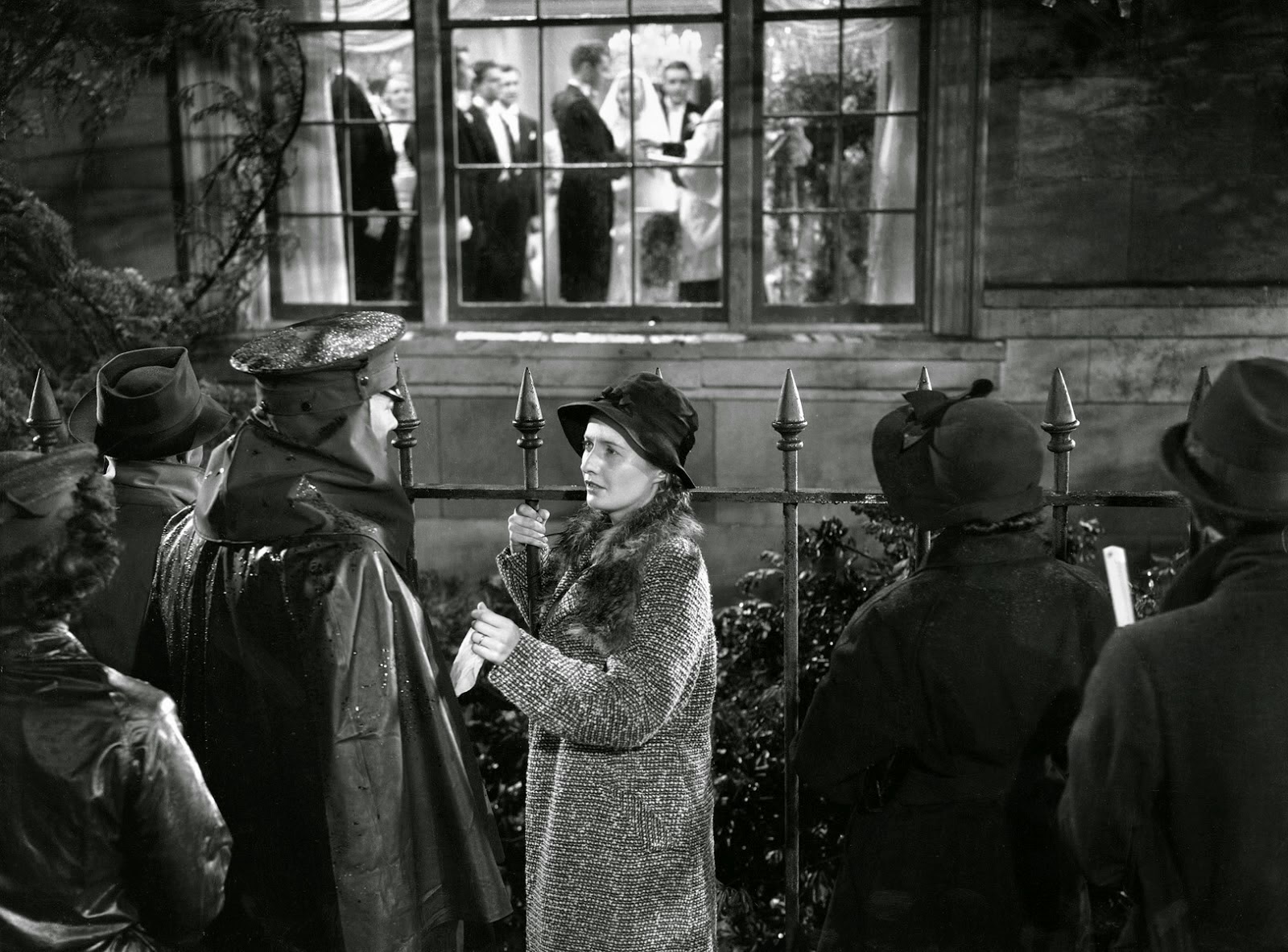
The many remarkable highlights include Stella lying awake in her train bunk bed, overhearing gossip, unable to do anything except quietly grieve for the embarrassment caused to her daughter. And the final scene, with Stella alone and silent, this time behind the fence, outside the window and in the rain witnessing her life carrying on without her, is devastating in its combination of outright relief and unimaginable pain on Stella's face.

This was the first of four Best Actress Academy Award nominations in eleven years for Stanwyck. She never won, but it is doubtful that she ever came closer to receiving the Oscar.

The supporting cast is solid, with Anne Shirley catching the eye as the grown up Laurel, a young woman caught between a deep love for her imperfect mother and the twinkling promises that only start to become available once Stella is sidelined.

Stella Dallas is an exceptional achievement, a film about people with emotions real and pure, ensuring enduring relevance.


All Ace Black Blog Movie Reviews are here.


Monday, 15 December 2014

Movie Review: Meet John Doe (1941)


Directed by Frank Capra, Meet John Doe is a feel-good story about populism, politics and pretense. The film is easy to enjoy, but lacks depth and sophistication.

Sassy newspaper columnist Ann Mitchell (Barbara Stanwyck) loses her job when the struggling daily paper is sold to tycoon publisher D. B. Norton (Edward Arnold). In her final column she writes about a letter she received from "John Doe" stating his intention to commit suicide on Christmas Eve, because he can't find a job and the world has become a grim place where people don't care about each other. John Doe and his letter are entirely manufactured by Ann. The published column is taken seriously and causes a political firestorm. Ann is re-hired to write a series of John Doe columns, outlining the source of his anger and creating a manifesto for a better society.

Vagabond "Long" John Willoughby (Gary Cooper) is hired to pretend to be John Doe, with his every word scripted by Ann, who uses her deceased father's diary for inspiration. Willoughby's caustic travelling companion "The Colonel" (Walter Brennan) hangs around to witness the deception.

Willoughby plays along with Ann's every request, hoping to make enough money to fix a bum elbow and take another shot at a baseball career. The John Doe political phenomenon takes off across the country in the form of organized clubs promoting good neighbourliness and citizens looking out for each other. But Norton and his backroom backers harbour secret intentions of hijacking the John Doe movement as a springboard for a presidential election campaign, leaving Willoughby and Ann to struggle with the consequences of their actions.

Meet John Doe easily achieves the objective of satirizing simplistic political messages, celebrating each individual and the power of neighbourliness while exposing the corrupt puppet masters behind every curtain. It's a simple slice of Americana effectively presented with Capra's typical charm. The plight of the average guy is once again placed front and centre as a gateway to a broader societal lesson, with simple solutions to complex problems easily devoured by the masses, a phenomenon that reverberates around the globe and across the years.

But the film itself stays on the same elementary plane occupied by its own message, and veers towards the simplistic. Capra and screenwriter Robert Riskin cannot quite find the dose of magic needed to elevate the themes and emotions towards something greater than the sum of the most basic ideas, and the film plateaus early and plays itself out with a combination of predictability and mild amusement.

Several scenes run much longer than they need to, from The Colonel's rant about "heelots" (hordes of heels in search of money) to the endless Bert Hanson story about forming the first John Doe club. The film seems unable to make a point without resorting to an overabundance of tiresome talk. It's never quite bland, but the absence of any true spark, wit, threat or sharp edge gives John Doe and his adventure a free pass towards a contrived ending that fails to resonate.

Gary Cooper is fine in a role that would have better belonged to James Stewart, but Cooper does all that he can with it. Long John Willoughby is the ultimate reluctant hero, and Cooper sheds any semblance of confidence and dives into the character's sideswiped puzzlement over sudden wealth, fame and influence. Any energy enjoyed by the film is provided by Barbara Stanwyck as Ann Mitchell. She enlivens the first half, but her character is subsequently tamed and takes a back seat as the Jon Doe phenomenon sweeps the nation and Long John' mounting dilemma becomes the centre of attention.

Not unexpectedly Ann falls in love with Long John, but only because the script demands it, and the film waves from afar at the notion of a romance without genuinely engaging in the concept. John Doe's story ends at the top of a building on Christmas Eve, the movie turns suddenly towards religion to find a quick exit, and an imperfect man again understands his value. It's all delivered with the best of intentions, and it's all just a bit twee.


All Ace Black Blog Movie Reviews are here.


Wednesday, 3 December 2014

Tuesday, 30 September 2014

Movie Review: Ball Of Fire (1941)


A screwball comedy, Ball Of Fire sparkles with wit and innovation thanks to Barbara Stanwyck's unbridled sensuality, and a witty clash-of-the-classes script.

Professor Bertram Potts (Gary Cooper) is leading a group of seven other stuffy academics sequestered in a dusty mansion to write a new encyclopedia. When Potts realizes that the team is hopelessly not equipped to properly write an entry about "slang" language, he recruits a group of common people to help out. Sassy cabaret singer Katherine "Sugarpuss" O'Shea (Stanwyck) at first wants nothing to do with Potts, but quickly crashes the mansion when her mob boss boyfriend Joe Lilac (Dana Andrews) orders that she be stashed away from the police, since her testimony can incriminate him.

Sugarpuss electrifies the mansion and the team of professors, and Potts finds himself irresistibly drawn to her. With the police investigation into Lilac dragging on, the mobster's lawyer decides that he should marry Sugarpuss since a wife can't testify against her husband. But Sugarpuss herself is starting to grow fond of Potts, and she won't find it easy to give up life at the mansion to rejoin Lilac's exploits.

Ball Of Fire is fast, furious, funny, packed with farce, and yet surprisingly tender. Directed by Howard Hawks in the same vein as his previous screwball classic Bringing Up Baby, Ball Of Fire adds new depth to the familiar formula. Much of the credit goes to the clever script by Charles Brackett and Billy Wilder, who surround the central opposites attract love story with layers of multiple characters, a zany energy, and refreshingly original embellishments.

The enjoyment level is amplified by successfully mushing three plots into one: an unlikely love story, a ridiculous encyclopedia research project, and a criminal dodging an investigation. Somehow, gangsters, academics and a cabaret singer end up seamlessly contributing to the same story.

At the middle of it all is Barbara Stanwyck in an Academy Award nominated performance. She creates an alluring bundle of energy as Sugarpuss O'Shea, a street smart performer who can talk herself out of any situation and manipulate any man into cross-eyed, weak-kneed submission. Sugarpuss is introduced with back-to-back interpretations of the musical number Drum Boogie, once in spectacular full orchestral mode and then on a single intimate instrument: a small match box. The brazen innovation of that scene sets the stage for the film, Hawks allowing Stanwyck to lead from the front whether she is plotting her wacky hideout survival or her unlikely love life.

With Cooper the stiff but slowly overheating love interest, the main supporting sub-plot of Ball Of Fire is at least partially a wacky reimagining of Snow White And The Seven Dwarfs, as Sugarpuss invades the workplace of an elderly crew beavering away on their project, and turns it upside down. The supporting professors, diametrically opposite to their unexpected guest in every way, are played for perfect laughs by the likes of Oskar Homolka, Henry Travers and Richard Haydn. They create a madcap environment of earnest academia disintegrating into a pool of juvenile lust as Sugarpuss knocks the stuffing out of their staid workplace.

Even more animated in support are Lilac's two hoodlums Duke Pastrami (Dan Duryea) and Asthma Anderson (Ralph Peters). They are the rather dense go-betweens connecting Sugarpuss in hiding with Lilac, and Hawks gives them plenty of time to add colour and criminal charisma as the comedy hurtles towards a chaotic conclusion.

Lighting up the sky with a streak of playful fun, Ball Of Fire is a bright blast.


All Ace Black Blog Movie Reviews are here.

Thursday, 21 August 2014

Movie Review: The Two Mrs. Carrolls (1947)


A clunky damsel-in-distress drama, The Two Mrs. Carrolls is hampered by wild over-acting and ham-fisted directing.

While on a trip to Scotland, painter Geoffrey Carroll (Humphrey Bogart) meets and falls in love with Sally Morton (Barbara Stanwyck). But she is then shocked to find out that he is married and has a young daughter Beatrice (Ann Carter). Geoffrey claims that his wife is an invalid, and she soon dies. About two years later, Geoffrey is seemingly happily married to Sally and living in a quaint village in England.

With Geoffrey suffering through a drought of inspiration, Sally's former boyfriend Charles "Penny" Pennington (Patrick O'Moore) reappears in her life, along with his friends the haughty Mrs. Latham (Isobel Elsom) and her seductive daughter Cecily (Alexis Smith). Geoffrey and Cecily are quickly embroiled in an affair, and Sally starts to feel threatened.

Completed in 1945 but only released in 1947, The Two Mrs. Carrolls attempts to follow in the footsteps of Rebecca (1940), Suspicion (1941), and Gaslight (1944). With Bogart and Stanwyck in the lead roles the elements are in place to create a compelling mystery, and there are brief snippets of a potentially interesting movie hiding somewhere inside the head of a philandering artist who can only paint when he is plotting murder.

But this may be one of Bogart's worst performances and most disappointing films. His portrayal of Geoffrey Carroll often crosses the line into unrestrained wide-eyed madness more suitable for the local theatre. In a story that demands subtlety in pursuit of tension, Bogart delivers sledgehammer psychosis. Stanwyck is better, but only marginally. Her Sally hides behind naiveté, but when the time comes to display worry and fear, she also climbs over the top.

The directing by Peter Godfrey is generally inept. He is unable to find any threads of empathy or nuanced character evolution to tie the drama together, and from the bombastic music to the plodding plot points, The Two Mrs. Carrolls reeks of clumsy execution.

Child actress Ann Carter is victimized by some of the most ridiculously adult-sounding lines of dialogue ever spouted on the screen by a young performer, and her theatrical delivery, obviously not helped by the tone-deaf Godfrey, is off-putting. Alexis Smith is underused, but provides the one performance that matches the intended tone of the material, her Cecily an insidious presence worming her way into the Carrolls' marriage.

The film stumbles its way through the familiar territory of Sally's infatuation turning to concern and then panic as she discovers that her husband is troubled and hiding many dangerous secrets. Even in 1947 it's all been done before, and much more stylishly.


All Ace Black Blog Movie Reviews are here.


Friday, 15 March 2013

Movie Review: Golden Boy (1939)


A passionate drama about conflicting life choices, Golden Boy pits a talent for boxing against a spiritual attachment to music in a battle for one man's soul.

In New York City, crusty boxing manager Tom Moody (Adolphe Menjou) takes a chance on unknown Joe Bonaparte (William Holden). Young, brash, and talented with a violin, Bonaparte proves himself in a series of bouts, and catches the attention of sports writers. Moody is waiting to finalize a divorce before marrying his much younger assistant Lorna Moon (Barbara Stanwyck), but the dashing Bonaparte catches Lorna's eye.

Joe's success in the ring clashes with his love of the violin: boxing damages the hands needed to create magical music, and Joe's dad (Lee J. Cobb) believes that boxing is very much the wrong choice for his son. Lorna is torn between falling in love with Joe, loyalty to Moody, and the once in a lifetime opportunity to make it rich by riding the coattails of a potential champion boxer. Joe's choices are further complicated when big-time mobster Eddie Fuseli (Joseph Calleia) muscles in on Moody, demanding to become Joe's co-owner in return for arranging a quick path to a shot at a glamorous boxing title.

Based on a Clifford Odets play, Golden Boy offers simple but heartfelt lessons in life. The Bonaparte family, complete with Joe's sister Anna and her husband Siggie, argue, love and make-up with genuine fervour. The worlds of boxing and music are presented as mutually exclusive, and Joe's decision is not made any easier by others harbouring self-interest. While the likes of Tom Moody and Eddie Fuseli make no secret that they are out to profit from Joe's boxing exploits, Joe's dad can offer nothing to support his advice except the divine pursuit of a natural talent for music.

Lorna emerges as the most interesting character, a woman fending for herself but suddenly uncertain about what she is looking for from life, from Joe, and from her supposed partner Moody. Lorna finds that she has Joe's ear, as he is as obviously falling in love with her as she is with him, but her ability to control his decisions begins to clash with how much she cares for him, leaving them both emotionally adrift. Lorna's meandering journey to a new self-consciousness is the elegant centrepiece of the film.

Stanwyck portrays Lorna with worldly eyes, a determined mouth, and a smile that hints that she is just smart enough to manipulate, as and when needed, the men in her world. William Holden is a bundle of unconstrained energy as Joe Bonaparte, his first credited role. Not quite convincing neither as a boxer nor as a violinist, Holden's physical presence carries him through, and he is most comfortable simply acting rather than pretending to be a sportsman or musician.

Adolphe Menjou is dependably shifty, finding the creases between shady boxing manager and well-meaning mentor, never losing sight of his own bottom line. Lee J. Cobb is memorable but predictable in a performance made of pure fatherly pathos.

Director Rouben Mamoulian opens up the play, making good use of the cavernous house where Joe, his dad, Anna and Siggie live, and dad's adjacent general store. Mamoulian finds or manufactures interesting backdrops for many scenes, and when the action moves to the ring, the fights are frantic and punishing.

Golden Boy presents a clear choice between short-term acclaim and long-term pleasure. Joe will only be able to move ahead once he shuts out the distractions and internalizes the distinction between having a lot of money and being truly rich.


All Ace Black Blog Movie Reviews are here.


Wednesday, 28 March 2012

Movie Review: Double Indemnity (1944)


A taut film noir, Double Indemnity is a classic tale of lust-fuelled murder. Director Billy Wilder assembles the pieces with slick expertise, and with the help of a terrific cast delivers the story of a deliciously doomed evil plot.

From the moment top insurance agent Walter Neff (Fred MacMurray) lays eyes on Mrs. Phyllis Dietrichson (Barbara Stanwyck), he is overcome by a desire to be with her. The trouble is, Phyllis is married to Mr. Dietrichson, an inattentive husband frequently away on business. Phyllis has rich tastes and craves constant emotional attention, and she seduces Walter into cooking up a plot to murder her husband and make a lot of money. They forge a life insurance policy that pays $100,000 if Mr. Dietrichson dies accidentally, and then proceed to kill him and elaborately make it appear as though he did indeed die by tragically falling from a moving train.

Just when it seems that all has gone according to plan, Walter is confronted by the sharp investigative instincts of his boss Barton Keyes (Edward G. Robinson), who leaves no stone unturned to ensure that the insurance payment is legitimate. Also causing unexpected complications are Lola (Jean Heather), Phyllis' daughter in law, and her shady boyfriend Nino (Byron Barr). Walter begins to realize that smart as he is, he may have been as much of a victim as Mr. Dietrichson.

With two of the sharpest noir minds in the business behind the story, Double Indemnity was bound to bask in the glory of a nefarious sex-and-money plot gone bad. James M. Cain wrote the book, and Raymond Chandler co-wrote the script with Wilder. The movie crackles with edgy dialogue, sophisticated glances, and high intellects being upstaged by their own uncontrolled libidos.

Wilder directs with an energetic economy that keeps the tension building as the story of greed unfolds. The events are recounted in flashback as a confession by Walter, and Double Indemnity starts with him already shot and bleeding badly. Walter's astounding lack of judgement becomes the central theme of the film, and MacMurray is perfect as the man who had a stellar reputation and the full trust of his employer, and threw it all away. Wilder uses shadows, contrasts and particularly blinds to enhance the downward spiral of Walter's drama, with every frame masterfully assembled.

Crucially, despite his career success Walter does not have a woman in his life, and Phyllis is so sexually overpowering that Walter succumbs with barely a second thought. Wilder extracts from Stanwyck a performance charged with doe-eyed seductiveness, a woman with a dark past who always gets her way, and plans about five moves ahead of her men in the chess game of financial short cuts.

Edward G. Robinson enjoys portraying Barton Keys as the only character with the depth of thinking to match wits with Phyllis. Always craving a cigar but never finding a lighter, Barton relies on instinct and his acute physical reaction to deception to reassemble the truth from the mess of lies that surround him, and gets close enough to the real story to rattle the cage of the co-conspirators and disrupt their road to riches.

Double Indemnity pays out handsomely on a policy of hard-boiled noir entertainment.


All Ace Black Blog Movie Reviews are here.